| - | - | - | - | - |
"Lykan."
There are times when a single word can
be more startling than a heavy-handed
clap on the shoulder. Lykan is my birth
name. The problem? It wasn't the name I
was using at the time.
I turned around toward the speaker
with an inane grin and a denial on my lips.
"I'm sorry, kind sir, buy you must have
mistaken me for . . . oh, hell." (That last bit
came as I saw who was accosting me.)
I'm a big man--unfortunate, since it's
hard to disguise size--but this guy was
even bigger. The impression of size wasn't
hurtt by the fact that he was carrying a
mace the size of a small watchtower, and
by the fact that he stood a full head taller
than the *2* fighters in plate mail who
flanked him.
I knew his face, of course. Who doesn't
know the face of the vice prelate, 2nd-ranking
cleric in the Order of the Prelacy?
I knew his name too--Reifus endearingly
nicknamed "the Pagan Hammer"-- and he
obviously knew mine, which he proceeded
to demonstrate a 2nd Time.
?You are Lykan,? he said in a growl that
would make a war dog proud, ?the thief.?
I glanced over my shoulder at my audience,
which was listening with growing
interest, and I gestured for him to lower
his voice. ?Peace, good sir,? I said, playing
to the gallery. ?Perhaps we can clear up
this . . . misunderstanding.? I stepped
closer to him?his bodyguards stiffened?
keeping my hands in plain sight and a
fawning smile on my face.
?You are Lykan,? he growled again. But
this time his voice was pitched lower. ?I
have need of your services.?
With an effort, I kept astonishment off
my face. ?Well, then,? I said, ?perhaps we
can deal.?
He scowled. ?I talk. You obey. You live.?
Whatever happened to the fine art of
negotiation? I sighed. ?All right.?
They escorted me to the Prelacy?s headquarters,
the Basilica?you know the building,
the only church built according to the
Ancient Barbarian Fortress school of
architecture?and into a reception room
large enough for the prelate to receive a
full battalion, should it strike his fancy. I
stood while the Pagan Hammer sat on an
ornate wooden throne (the throne normally
reserved for the prelate). I raised an
eyebrow.
Reifus nodded and answered the unspoken
question. ?Yes. The prelate has
gone to his eternal reward, as the Father
wills.? He made a complex gesture, but his
heart wasn?t in it and his presentation was
desultory. Then he got down to business.
?The Order of the Prelacy keeps its coffers
and its treasures within this Basilica,? he
said?and I could hear the capital letters?
?within the Vault of the Holies. You probably
know that, considering your
occupation.?
Though he said it with a sneer, I took it
as a compliment to my thorough research.
?Of course,? I told him. ?And I also know
that the vault is guarded by a trap that
your prelate designed himself. What of it??
Reifus raised his eyes to whatever
heaven the prelate was now occupying,
and he controlled himself with an effort.
?Yes, the trap. That?s where your skills will
prove of use.?
I caught on then and tried not to giggle.
?He didn?t tell you how to disarm it, did
he? How inconsiderate of him.?
Reifus scowled again; he was very good
at scowling. ?I need?the Order needs to
gain access to the treasures. You will disarm
the trap and open the vault.?
?And if I won?t??
His face was like a rock. ?Then I shall kill
you.?
I sighed, having already known the
answer to that question. ?I need some
information first. What?s in the vault??
?You have no need to know,? he said
gruffly.
?Well, did the prelate leave any notes
behind?personal writings, anything like
that??
?You have no need to know.?
Again, I sighed. ?When did he set up the
trap? Where had he been just beforehand?
What had he been reading? Tell me anything
that?ll give me a clue??
He cut me off. ?You have no??
??need to know. Right.? I ground my
teeth in frustration. ?Look, did the prelate
know he was dying, and did he tell
anyone?anyone?the secret??
The Pagan Hammer?s lips made a single
thin line. He stared at me in a new and
uncomfortable way. ?Yes, he knew he was
dying, but no, he didn?t tell anyone.? There
was a strange tone to the cleric?s voice. I
made a mental note not to ask in any
depth how the prelate had met his maker.
I gave up. ?Okay, you win. Take me to
the vault.?
He did. Down into the bowels of the
Basilica we went, eventually stopping in
front of a heavy ironbound door. Reifus
dismissed the two guards who?d been
dogging my steps. I watched them leave,
then turned to the cleric with a nasty grin.
?So you think, wearing your armor and
packing your mace, you're more than a
match for a sniveling, unarmed thief. Is
that what you think??
?Yes,? he said.
I glanced him up and down a moment,
then put my mind on business and looked
at the door. ?Is this the vault??
?The first door.?
?And beyond the first door??
?The second door.?
His dialogue was beginning to irritate
me. ?What if I refuse to go farther??
?I?ll kill you.?
?And if I try but fail??
?If the trap doesn?t kill you, I will.?
I was as good as dead, so I quit stalling. I
pulled out my thieves? kit and turned to
the lock?a big, clunky, old fashioned one.
I laugh at locks like that. I laughed at this
lock, picked it, and swung open the door.
Just before I stepped through, I said to
Reifus, ?Shut the door behind me, but
don?t lock it. And don?t come in, or I just
might disarm the trap by letting you walk
into it.? His expression told me I had no
worry on that score; the thought of the
trap scared the religion out of him. I
grabbed a lit torch from a sconce on the
wall and stepped through the first door.
Reifus shut the door behind me.
There was a short passageway between
the first and second doors. I scanned the
floor for trip wires, trapped stones?the
usual things. There was nothing. But when
I rested my hand on the stonework beside
the second door, the surface felt slightly
warm. Oh-ho, I thought.
I knew something about the prelate?my
research was even better than Reifus
thought. While he was working his way
up the hierarchical ladder, the prelate had
been a busy boy with his traps, setting up
tricky protections for various church
valuables. Like any ambitious thief checking
out the prize purses in his territory, I?d
read everything I could about the prelate?s
masterworks, and I was impressed (as
much as I can be by an amateur). The
prelate, it seems, favored biological traps.
In fact, he might have been the one who
conceived that oft-imitated beauty where
the trap dumps the victim into a gelatinous
cube. With that in mind, I knew exactly
what was on the other side of the door.
I pulled a glob of soft wax out of my kit
and quickly fashioned a pair of earplugs.
Next, out came some gauze from my firstaid
supplies (it pays to be prepared); I
bound a strip across my eyes. I could still
see, but dimly?which is how I wanted to
see. I picked the lock?it was as easy as
picking my teeth?and swung open the
second door. Prepared as I was, I almost
choked on the reek of ammonia and other
noxious substances that wafted out.*1*
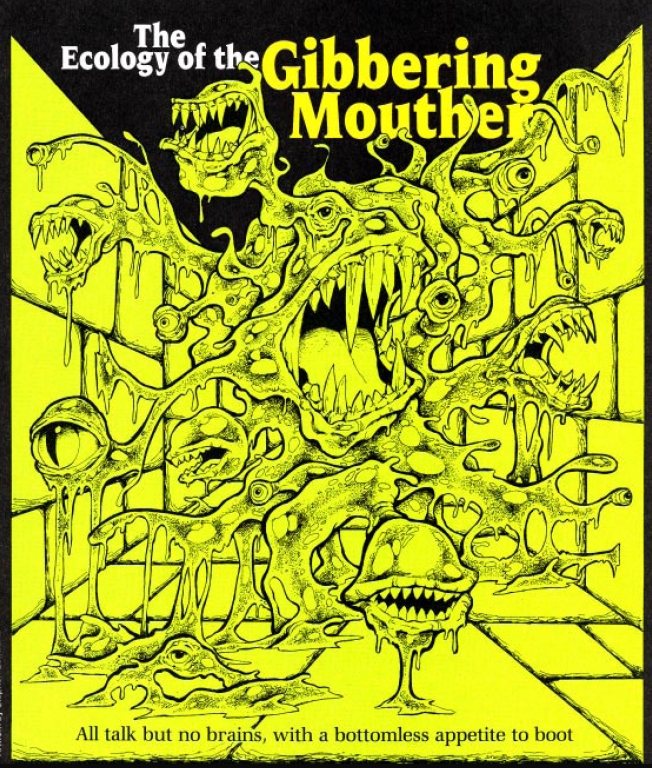
There it was, just as expected: a gibbering
mouther, the prelate?s biological trap,
sitting in the middle of a bare room with
glass-lined WALLS.
Gods, but it was ugly in the torchlight?
all eyes and mouths, like a bevy of stool
pigeons. The mouther lurched its green,
slimy body toward me, all its mouths
working. Some were biting at the floor,
pulling its nasty bulk along; others were
babbling nonstop.
Imagine all the inmates of an asylum
talking, screaming, and mumbling at once.
The noise the mouther was making was
even worse than that?or it would have
been if I could have heard it through my
earplugs. At least madmen speak in voices
that are human. The mouther doesn?t; its
din is a combination of sounds resembling
human voices, animal noises, and things
you would rather not think about. It?s
enough to unseat your reason. It?s the
sound of chaos incarnate?not just the
voices of the insane, but the voice of insanity
itself. It?s the voice of every creature
that makes up the mouther, each crying
out its torment.
I used to wonder where the mouther got
all of its eyes and mouths. One day someone
told me. There?s a theory?and I?ve no
reason to dispute it?that creatures absorbed
by a mouther become part of the
mouther.2 Their minds merge with its
mind, and they exist forever, irreversibly
mad, in a horrible form of living death.
When I saw this mouther, I believed it all.
I know a little about mouthers (it?s good
business to learn at least something about
all the things in the world that want to eat
you), but I don?t know where they come
from. Apparently, no one does. Some cite
these hideous creatures as examples of
why mages shouldn?t be allowed to experiment
with magic.
Gibbering mouthers are very hard to
kill. People will tell you the mouther?s
brain is buried somewhere in its middle,
and that?s why it?s so hard to land a telling
blow. Actually, the creature?s nervous
system is distributed throughout its bulk;
it has no distinct organ that you can point
at and call a brain. Hit a small pseudopod
and you?re just as likely?or unlikely?to
hit brain tissue as you are when you run
the beast through with a battle lance. You
can?t even suffocate it properly.*3*
One thing I do know about mouthers
reinforces one of my pet peeves. I?ve got
some advice for people (like the ex-prelate)
who do their own traps: Don?t. Use a thief
to stop a thief. I could have told the prelate
the problem with the gibbering
mouther. Yes, it?ll confuse, it?ll kill, it?ll eat
anyone who comes in to steal your treasure.
But if left alone long enough, it?ll eat
your treasure?that is, if the treasure?s not
on fire. That?s why I wasn?t too surprised
to find a bare room?once a treasure
room?at the end of the passage.*4*
I didn?t stop to ponder all of this then
and there. I acted. Otherwise, I would
have known the mouther?s secrets more
intimately than I really cared to. I backpedaled
fast, just as the monster advanced
and one of its mouths cut loose with a
nasty gob of saliva. The liquid struck the
wall behind me (I duck fast) and exploded
impressively. I almost dropped the torch
when I felt the heat and pressure from the
burst on my back. Even through the
gauze, the flash was impressive enough to
almost blind me. Mouther spittle contains
what alchemists call ammonium iodide, an
unstable compound and an effective contact
explosive: lots of flash, some punch,
and an impressive bang. It?s easy to concoct
in a lab; I?ve used it myself on occasion.
But the mouther does it naturally.*5*
I kept moving back. The mouther kept
advancing. The stone floor around the
monster smelled like it was baking; it was
probably beginning to soften now that the
creature was out of its glass-lined cell. This
was just another of the mouther?s tricks.
Lots of people think a mouther?s control
over ground consistency is magical. Not
really; it secretes a hellish mixture of
acids, solvents, and other foul fluids that
break down the integrity of stone. The
heat I felt was simply the heat liberated by
this chemical reaction?an exothermic
reaction, an alchemist friend called it. If
there?s any magic, it?s in the fact that the
mouther can wallow in this corrosive stuff
and not dissolve itself. (Incidentally, that?s
why the room was lined with glass. The
prelate must have known something about
mouthers. Glass is one of the few substances
they can?t digest.)
The mouther let fly with another
spitball?flash, bang!?but I was out of
there, already at the other end of the
corridor by the first door. Mouthers are
nasty beggars, but they?re slow. I had
enough time to take off the gauze blindfold,
remove the earplugs, and pocket the
lot. Then I threw the torch at the mouther
as it closed in. A mouth opened to catch it,
and the flame went out immediately. The
mouther shut up, probably startled by the
pain. I opened the door just enough to slip
through, then shut it calmly behind me.
Reifus was anything but calm, almost
hopping from foot to foot. His face was
streaked with sweat. I smiled up at his
face and said casually, ?Piece of cake.?
His jaw dropped. ?You did it??
I didn?t dignify his question with an
answer. ?Everything that?s in there is
yours.?
Reifus stared hard into my eyes. But if
the eyes are windows to the soul, I?d long
ago learned how to close the shutters.
I knew Reifus intended to kill me, but
not until he?d made sure of his new-found
wealth. He opened the door and stepped
inside, striding down the dark hall. I remembered
only at the last second to slap
my hands over my ears.
His scream was very, very loud?louder
than the babble. I wished I?d kept the
earplugs in. I won?t trouble you with details
on my subsequent escape.
I suppose I could have told him the
mouther was probably just on the other
side of the door?that, I could have done.
But then again, I figured he had no need to
know.
Footnotes
1. Under ideal conditions, a mouther?s
pungent reek can give warning of its presence
up to 20? away.
2. A mouther drains blood and nutrients
from its victim?hence the additional 1 hp
damage per round per mouth attached.
When the victim reaches zero hit points
and falls into a terminal coma, the
mouther flows over the body and begins
to absorb it. The mouther secretes digestive
juices that dissolve the victim?s outer
tissue. Complete dissolution takes 1d6 + 2
rounds for a human-size body; the body is
irrecoverable after 1d3 + 1 rounds. The
secretions have an additional effect, however:
they supply the nutrients needed by
the victim?s brain and nervous system to
keep the creature alive. The tissues making
up the victim?s central nervous system
and its eyes are absorbed into the
mouther, intact and functional. Though
the nervous tissues are spread throughout
the bulk of the mouther, they remain in
contact through thin fibrils of mouther
nervous tissue. The victim's brain, therefore,
never actually dies, and its anima (its
soul or spirit, as described on page
10 of
the AD&D 1st Edition DEITIES & DEMIGODS) is
never freed. Thus, a creature absorbed by
a mouther cannot be reincarnated or
resurrected, and cannot be contacted
through a speak with dead spell, since the
victim is not strictly dead. It is only when
the mouther is slain that the victim?s anima
is free to travel to the Outer or Inner
plane awaiting it.
Once the absorption is complete, the
mouther grows new eyes to surround and
utilize the victim?s corneas. The victim?s
teeth are not affected by the enzymes
since the enzymes cannot dissolve dental
enamel, and these are also ?pirated? for
use by the mouther.
Absorption by a mouther invariably
causes the victim to go incurably insane.
The mind of a victim known to have been
absorbed by a mouther can be contacted
through ESP, telepathy, and similar spells,
but with great difficulty ( + 6 bonus to
saving throws, for spells that allow them).
The mind is totally insane, however, and
nothing of use can be communicated to or
learned from the absorbed intelligence. In
fact, there is a cumulative 25% chance per
round of contact that the spell-caster
performing such mind reading will become
insane for 1d4 +8 rounds following
such contact.
3. Metabolically, the mouther is as confused
as its appearance implies. Though it
doesn?t breathe in the traditional sense,
some parts of its body require oxygen and
some do not (the latter using other chemicals
to respire). As a consequence, it is
impossible to asphyxiate a mouther: it
simply shifts to anaerobic respiration so
that it no longer requires oxygen. Similarly,
poisonous gases (e.g., cloudkill) are
ineffective; the mouther shifts its metabolism
to a different system that is unaffected
by the poisonous gas. Injected and
ingestive poisons are somewhat effective
against a mouther (though the creature
saves at +6), because these typically cause
tissue damage in addition to their metabolic
effects.)
4. A gibbering mouther eats virtually
anything, whether the food is animal,
vegetable, or mineral. While it prefers
animal tissue (preferably still alive and
kicking) and vegetable matter, the mouther
can also absorb and make use of most
metals and minerals. This is a consequence
of its strange metabolism: Virtually anything
can be incorporated into its makeup
or used as a life-giving nutrient. If there is
no animal or plant tissue available, a
mouther can change its metabolism so as
to sustain itself by absorbing other material.
If they actually swallow or absorb it,
mouthers can dissolve and utilize any
material except dental enamel (i.e., teeth),
glass, diamond, adamantite, and mithral.
These materials are resistant to all of a
mouther?s corrosive secretions and are
eventually expelled.
When it is well fed, a mouther can reproduce
through binary fission, much like
an amoeba; one mouther becomes two
smaller mouthers. The offspring are initially
2 HD but grow to full size (assuming
an adequate food supply is available) in 3-6
months. Offspring have the full powers of
an adult from the outset. When a mouther
divides, its mouths and eyes are shared
evenly between its offspring. When a
mouther has insufficient food or must live
on minerals, it does not reproduce.
5. These secretions are also highly corrosive
to flesh. Touching a mouther causes
1d4 hp corrosive damage to bare flesh.
Metals are unaffected unless they remain
in contact with the mouther for an extended
time or are absorbed. Nonmetallic
weapons, armor, and other items (e.g.,
wooden clubs, staves, leather armor, etc.)
that come in contact with a mouther for
even an instant must save vs. acid or dissolve
immediately.
AUGUST 1990