
| - | - |  |
- | - |
| Treasure | - | AD&&D | - | DMG |
Random Treasure Determination
| I. Map or Magic Determination | - | II. Map Table | - | III. Magic Items |
| Treasure | - | - | - | DMG |
<d%>
| 01-10 = Map Table (II..) |
| 11-00 = Magic Items Table (III.) |
If the treasure
in a monster's lair indicates that maps or magic are there,
you will often have to determine
which are present by random number
generation with %percentile%
dice. This is simple and the table shows which
tables to use to determine
the result. This system can be used for monsters
you place on the outdoor
map as well as for monsters randomly encountered
by a party exploring in the
wilderness. In any event, you will
have to make a number of
additional dice rolls to find exactly what is
within the treasure trove.
<i haven't done the hyperlinking>
<y? game school>
<maybe C# will b easier, a prioriti>
| I. Map or Magic Determination | - | II. Map Table | - | III. Magic Items |
| II.A. Monetary Treasure | - | II.B. Magic Treasure | - | II.C. Combined Hoard |
| Treasure | - | - | - | DMG |
II. MAP TABLE
| Dice | Result |
| 01-05 | False Map |
| 06-70 | Map to monetary treasure |
| 71-90 | Map to magic treasure |
| 91-00 | Map to a combined hoard |
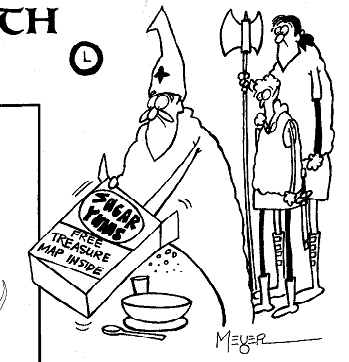
If a map is indicated, you
must generate a number between 01and 00 to
discover what the map leads
to. However, the contents of the map itself
are a problem, for how can
it be possible to direct each DM properly considering
the infinite number of possibilities
under which the map will be
located? The answer is that
this writer can only suggest. A map should
never list its treasure,
only show its location.
When a map is purposely placed
by the DM i t is obviously incumbent upon
him or her to satisfy both
its requirements - to what i t leads and where it
leads. Randomly discovered
maps are not an overwhelming problem. In
the dungeon they can show
a route down, up or (if the lair is at an edge of
the level map) off into an
area you have not yet drawn.
Use the RANDOM
DUNGEON GENERATION tables to set out a course which their map will
"show". There is no reason
why the treasure cannot be guarded, or why
monsters cannot be encountered
along the way, as long as the whole fits
reasonably together, i.e.
the map owner placed the guards or was unable
to get the treasure because
of these monsters. Generally, the whole route
can be quite long or only
a few hundred feet. If the treasure is particularly
rich you might wish to have
it hidden leagues away in another lost
dungeon, along the course
of a long underground river, or something
similar. The direction of
your campaign is strictly your own province.
Maps found outdoors in a monster's
lair can lead into an underground
labyrinth, a few miles in
the wilderness to some hidey-hole, lair, ruins, or
even in a town. Direction
is easily determined by a quick roll of d8, basing
the compass on 1 being north
(or whatever) and simply counting round (2
is northeast, 3 is east,
etc.). The table below may be used as a guide if you
wish:
| 01-20 | labyrinth of caves found in the lair |
| 21-60* | outdoors, 5-8 miles distant |
| 61-90* | outdoors, 10-40 miles distant |
| 91-00* | outdoors, 50-600 miles distant |
* Treasure shown on the map is:
| 01-10 | buried and unguarded |
| 11-20 | hidden in water |
| 21-70 | guarded in a lair |
| 71-80 | somewhere in a ruins |
| 81-90 | in a burial crypt |
| 91-00 | secreted in a town |
Elaborate as you see fit.
For containment, concealment and trapping, refer
to the tables given with
the RANDOM DUNGEON GENERATION.
Note that relatively low-value
treasures will not be as well guarded as those of great value.
| Dice | Result |
| 1-2 | 20,000-80,000 copper pieces (2d4), 20,000-50,000 silver pieces |
| 3-5 | 5,000-30,000 electrum pieces (5d6) |
| 6-10 | 3,000-18,000 gold pieces (3d6) |
| 11-12 | 500-2,000 platinum pieces (5d4) |
| 13-15 | 10-100gems (d10 X 10) |
| 16-17 | 5-50 pieces of jewelry (5d1O)* |
| 18 | Roll twice, discounting rolls above 17 |
| 19 | Roll thrice, discounting rolls above 17 |
| 20 | Each monetary item above |
<as always, do .html colors, for every word (ea.) that is the name of a color>
* Specific types of jewelry can be determined on the Jewelry and Items Typically Bejewelled Table (part of Appendix 1, DUNGEON DRESSING) if desired.
<trim?>
This table shows the parameters
for each sort of goods to be found in a
treasure of this sort. Random
number generation with d20 discovers which
sorts of goods are in the
trove. You will observe that the table is weighted
towards large quantities
of coins which will require a train to remove - or
must be left entirely if
foreplanning is not observed.
(As with
any treasure not taken immediately, you must set a percentage
chance
for it to be stolen away if it is abandoned by the discoverers. Their
actions
and precautions will serve as guidelines. If a monster guarded the
treasure,
the likelihood of it being taken elsewhere could increase
greatly.)
Base value of gems and jewelry
can be determined when the treasure is
actually divided and disposed
of.
| Dice | Result |
| 1-5 | Any item rolled on Magic ltem Table, plus 4 Potions |
| 6-8 | Any 2 items rolled on Magic ltem Table |
| 9-12 | 1 Sword, 1 Armor or Shield, 1 Miscellaneous Weapon |
| 13-14 | Any 3 items, no Sword or Potions |
| 15-18 | Any 6 Potions and any 6 Scrolls |
| 19 | Any 4 items, 1 is a Ring, 1 is a Rod |
| 20 | Any 5 items, 1 is a Rod, 1 is Miscellaneous Magic |
<make links to tables>
This random determination
table needs no explanation. Because of its
weighting, and the weighting
of the MAGIC ITEMS table, most treasures
will have magic potions,
scrolls, armor and weapons. This is carefully
planned so as to prevent
imbalance in the game. Keep potent magic items
rare. (Increase scarcity
by destroying or stealing what is found!)
| Dice | Result* |
| 01-20 | 1-2 Monetary Treasure and 1-5 Magic Treasure |
| 21-40 | 6-10 Monetary Treasure and 1-5 Magic Treasure |
| 41-55 | 3-5 8 6-10MonetaryTreasure and 1-5 & 15-18 Magic Treasure |
| 56-65 | 1-2, 3-5 & 6-1 0 Monetary Treasure and 9-1 2 & 13-1 4 Magic Treasure |
| 66-75 | 6-10 & 11-12MonetaryTreasure and 6-8 & 15-18 Magic Treasure |
| 76-80 | 3-5, 6-10, 11-12 8 16-17 Monetary Treasure and 1-5 & 9-12 Magic Treasure |
| 81-85 | 20 Monetary Treasure and map to 1-5 Magic Treasure |
| 86-90 | 20 Monetary Treasure and map to 19 Magic Treasure |
| 91-96 | Map to 1-2 & 3-5 Monetary Treasure, 20 Magic Treasure on hand |
| 97-00 | Map to 11-12 8 13-15 Monetary
Treasure plus 15-18 Magic Treasure,
20 Magic Treasure on hand |
<make links to tables>
* Key the results to the proper listingsfrom the prior two tables.
These are the real finds,
which can satisfy even the most avaricious dwarf's greed.
<EG>Note
that when it says "1-2 Monetary Treasure", for instance, it means the treasure
indicated by a die result of 1 or 2 on the MONETARY TREASURE
sub-table.
Combined hoards should be
hidden, trapped and guarded!
They should be located in
distant places too!
-