
-
-
| 1st Edition AD&D | The voidjammers | - | - | - |
| - | - | Dragon magazine | - | Dragon #159 |
Voidjammers!
An Astral taxi service for AD&D 1st Edition games
by Randal S. Doering
The Astral plane is a big place, empty
and lonely to those persons who dare to
travel it. It is also dangerous, home to the
marauding githyanki, and used by all sorts
of unpleasant travelers from the outer
planes as a halfway point in their journeys.
Anyone who explores the Astral
plane is pretty much on his own and must
be ready at any time to be attacked, lost to
the psychic wind, or flung into another
plane by accidentally passing through the
invisible backside of a color pool, as detailed
in the AD&D® Manual of the Planes.
There is, however, a safer way to travel
that forlorn plane of silver mists.
About a thousand years ago, an archmage
by the name of Peregrin became
bored with adventuring on the Prime
Material plane. He had overcome the most
deadly foes of his world and had no interest
in politics or a life of quiet research.
Forsaking his home plane forever, he
packed up his belongings and set off to
seek a life in other realities and planes. He
wandered dozens of planes, frequently
crossing the Astral as he did so, and eventually
it dawned on him that he could do
something greater than simply wander in
boredom. He decided to help travelers get
around in the Astral plane, making their
lives more interesting and exciting.
Drawing upon his extensive knowledge
of the planes, Peregrin traveled to a dozen
worlds to secure the materials and craftsmen
for the vessels that would accomplish
his dream. He envisioned a fleet of mighty
ships that would sail the Astral plane,
picking up voyagers from thousands of
worlds and realities and taking them
wherever they wished to go. No being
would be discriminated against on the
basis of race or alignment, so long as each
obeyed ships? officers when on Peregrin?s
vessels.
The obstacles were frightful. The githyanki
deeply resented the organized intru-
sion into their realm and attacked Peregrin
many times, driving his vessels into
psychic windstorms to ruin them and kill
their crews. Outer-planar beings, thinking
the vessels would be easy pickings, ravaged
Peregrin?s ships time and time again,
often before the ships could complete
their maiden voyages. Peregrin did not
give in. He sought alliances with mighty
beings of Neutrality and Good, and bound
evil creatures to his will. He singlehandedly
blasted his way to a face-to-face
confrontation with the queen of the githyanki
(this was long ago, when she was
much less powerful than she is today) and
forced her to call her people off from
raiding his vessels. He negotiated docking
ports in a hundred realities and forced the
natives to accept his will when negotiation
failed. Over the past 500 years, he has
forged a mighty empire in the Astral
plane, dedicated to helping the travelers of
that plane get to their destinations quickly
and safely.
The voidjammers
The instruments of Peregrin?s will are
the voidjammers: 10 heavily armed,
lightning-fast ships that cruise the Astral
plane by means of a bizarre form of mental
control. Each vessel is responsible for a
thousand stops along its line, making
about 10 stops a day and completing a
cycle every 100 true days. The vessels
never physically leave the Astral plane, for
they are not seaworthy; instead, they
cruise past various color pools and pick up
whoever is waiting for transport there.
Similarly, these vessels drop passengers off
when the appropriate pool comes up. The
voidjammers avoid wormholes at all costs,
for such disturbances can damage or even
destroy the ships.
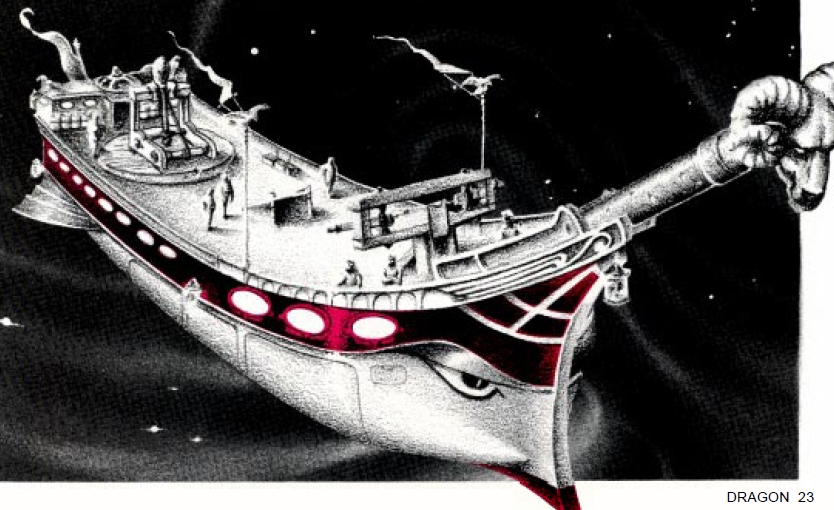
Voidjammers are each roughly the size
of a large merchant ship. Each is crewed
by 30 sailors of many races and worlds, all
professionals at sailing the Astral void.
While their work in sailing the ship is
minimal (the navigator and engineer do
most of the actual work), these persons
are responsible for such tasks as ship
repairs, picking up and greeting passengers,
making sure passengers are discharged
at their proper destinations,
loading and unloading cargo, and manning
the ship?s intrinsic weapons systems. Also
included in this category are such persons
as the chief cook and several assistants,
valets, maids, and other servants. Sailors
are all warriors of 2nd-5th level, though a
variety of other classes is represented
(DM?s choice). all are able to defend their
ship in close combat if necessary.
Most of the fighting, however, is accomplished
by the ship?s professional marines.
Every vessel has three warriors of 9th-
12th level. (There is a 15% chance for one
of these to be a ranger. No paladins will
sign on with Peregrin?s rather neutral
outfit.) In addition are a priest of 8th-10th
level, a wizard of 12th-15th level (there is
a 10% chance that this individual is an
specialist, instead), and a thief of 10th-12th
level. Peregrin does not sign on druids, for
they have little use in this plane. The marines
have a full complement of magical
items, as appropriate for characters of
their levels, all created especially for use
in this plane. Details are given later in this
article.
Most of the time, these heroes do nothing
except stand around and look impressive.
But when the vessel is threatened,
whether by outside forces or unruly passengers,
the heroes take care of the problem.
They are ordered to use the
minimum amount of force necessary to
correct military problems, but outright
termination of hostile beings is not uncommon
(especially when dealing with passengers
from the lower planes). In a dire
emergency, where the encountered difficulty
is almost certainly going to overwhelm
the vessel, a cry for help will be
sent to Peregrin himself, This worthy will
arrive in 5-10 minutes, bringing with him
enough firepower to level several small
cities. For these reasons, most regular
passengers aboard the voidjammers are
careful not to antagonize the crew.
In addition to the sailors and the marines,
there are a host of officers whose
job it is to actually run the vessel. These
people are: the chief engineer and his
assistant, a navigator and his assistant, a
communications mage, a passenger director,
a mate, and the captain. It is vital to
note that all of the crew members aboard
a voidjammer are at home on the Astral
plane, being physically there (not merely
astrally projected) and well used to its
conditions. Spell-casters aboard these
vessels are totally familiar with all Astral
spell changes. The DM should play these
NPCs as the dedicated people they are.
The most important person aboard a
voidjammer is the chief engineer. The vital
qualifier for this job is a powerful psionic
mind, followed by great willpower (wisdom)
and intelligence. In addition, the
chief engineer must have another vocation
as well, usually that of a spell-caster. He is
cross-trained to take the place of the communications
mage if necessary. The chief
engineer?s job is to operate, maintain, and
repair the ship?s engines, as well as perform
maneuvers and avoiding obstacles.
These tasks require an understanding of
the standard engines for a voidjammer.
Due to the nature of the Astral plane,
conventional means of propulsion as sails
or oars are useless. Using crude kinetic
energy?that is, pushing off rocks?is
sometimes useful, but it is slow and impractical
for any serious movement about
the plane. Mental power, on the other
hand, is fast and simple. It also does not
apply to objects. Peregrin understood
these facts when he set out to design the
voidjammers, and he devised a propulsion
system that could overcome the inherent
hardships. He searched the planes until he
found a brilliant silver metal that conducts
mental energy like copper conducts electricity.
He named the metal mindex, and it
forms many of the struts and supports
within the voidjammer?s frame. The metal
runs throughout the vessels length, stem
to stern, and can be likened to a great
web. The center of that web is the engine
room. Here several thick mindex cables
connect the strut-web to the engines,
which are two boxes each 2? in diameter
and attended by all sorts of magical devices.
Within the boxes are brains taken
from freshly slain mind flayers. The brains
are kept in nutritive baths and transported
to their boxes, where magic sustains their
lives. The brains are operated upon to
remove the personality and will of the
individual mind flayer while preserving
the great psionic power and complex
psychic structures of the creature's mind.
In this state the brains are useless, lacking
the will to make them do anything.
Here the chief engineer comes into the
picture. The chief engineer must psionically
connect with the mind flayer brains,
through such disciplines as telepathic
projection, telepathy or telepathic projection,
giving them direction and purpose.
The mind flayer brains are used as amplifiers
for the chief engineer?s will, sending
power to the mindex struts and causing
the voidjammer to move as if it had a mind
of its own. Since there are two mind flayer
brains acting as one, a voidjammer has an
effective movement rate of 480? per minute,
or 48?. This makes the ship very fast
in relation to just about anything else in
Astral space (with the exception of the
githyanki), and it has given the voidjammers
a reputation for fast service that
simply cannot be matched by any other
means of transport in that plane.
The brains used in each voidjammer can
vary as to exact psionic strength, but the
pair aboard each individual vessel must
match exactly; that is, if one mind flayer
brain-engine has an 18 Intelligence and
320 psionic ability points, its twin must
also have an 18 Intelligence and 320 psionic
ability points. Otherwise the brains
will not operate in tandem and will end up
tearing the vessel apart.
Originally, Peregrin tried using five or
six mind flayer brains for engines, but he
found that creatures of lesser mental
ability than that of a mind flayer could
handle only two such brains at once. He
experimented with the brains of lesser
psionic creatures but found that they
were not able to survive outside their
bodies without more support than they
were worth. When he used brains from
nonpsionic creatures, he found that the
disciplines of telepathy and the like could
not properly motivate the ?disabled?
brains into functioning. As a matter of
fact, the only brains that work better than
mind flayer brains are those of githyanki,
but Peregrin is already on touchy ground
with that race, and he did not think that
taking various powerful brains from that
race would help his relations with them.
Rumor, however, says that the flagship of
his fleet, the Voyager, runs with two githyanki
brains as engines. These brains are
able to move the huge vessel at a rate of
96?, making it able to pace the fastest
known creatures on the Astral plane.
Since the Voyager never runs from a fight,
there is no confirmation on whether the
ship can actually move this quickly or not.
There are disadvantages to this unusual
movement system. The mind flayer brains
are not actually sentient, but they are alive
and psionically active. Unfortunately, the
personality-removal process injures the
brains? psionic attacks and defenses. If the
voidjammer is psionically attacked, the
chief engineer must psionically link with
the brain-engines and attack and defend
for them, as they will be destroyed by any
attack that tears through their defenses.
The brains initially have no attack
strengths and only half their normal defense
strengths. For example, a mind
flayer brain with 300 psionic ability points
has only a defense strength of 75 points. A
chief engineer with a psionic ability of 200
would have 100 points of attack strength
and 100 points of defense strength, added
to the 75 defense points of each mind
flayer brain. If psionically attacking creatures
can tear through the 250 defense
points of the mind flayer brains and the
chief engineer, they can destroy the engines
and bring the voidjammer to a halt.
The mind flayer brains can take only one
point of psionic damage before burning
out, for they have no will of their own to
stave off psychic harm.
As noted earlier, the chief engineer is
responsible for maintaining the health of
the mind flayer engines, since they deteriorate
over a period of several centuries.
He is fully conversant with the methods
used to gather the brains (whether or not
he agrees with these methods), the functioning
of the magical devices used to keep
the brains alive, and any symptoms of
mental deterioration in the brains. He is
familiar with the mindex web and must
constantly check it for damage and wear.
All of these activities take tremendous
energy and dedication. For this reason,
these men and women are paid 5,000 gp
per true month, a wage that most of them
proudly tell inquiring passengers.
The chief engineer?s assistant must possess
the same qualities as the chief engineer
but does not have nearly as much
experience with the engines as his supervisor.
The assistant can operate the ship in
an emergency but otherwise does little.
Second in importance only to the chief
engineer is the navigator, the person responsible
for seeing that the ship keeps its
course and makes the proper stops along
its route. This task is extremely difficult,
for the Astral plane has no stars to steer
by and no magnetic poles to attract a
compass. Navigation is much like
engineering?accomplished by mental
ability. The navigator is expected to memorize
the location of hundreds of color
pools and wormholes and be able to see
wandering color pools ahead of time in
order to warn the chief engineer of the
danger. Navigators need a minimum of 17
intelligence to handle their jobs, as well as
some training with scrying devices. Scrying
is the most important part of the navigator
?s job. The navigator must constantly
scry ahead of the vessel, searching for
wandering color pools and newly formed
wormholes that could send the ship into
another plane or rip it apart. Special crystal
balls in the navigation room allow the
navigator to scan for indefinite periods of
time, placing the strain of viewing on the
device rather than the viewer. These devices
are created for Peregrin by residents
of the quasi-elemental plane of Minerals
and are unique to voidjammers. These
crystal balls are enchanted to shatter if
taken from their vessel, thus keeping their
secrets. It is not known if any spell-caster
can operate one of these devices or if
special training is required.
All navigators are illusionists. Their
levels vary greatly, but none are lower
than 5th level because the spectral force
spell is required of every navigator. Navigators
restrict their spells to informative
and miscellaneous magics, leaving combat
spells to the marines. Navigators must be
illusionists in order to operate and update
the great three-dimensional maps that let
them travel through Astral space. Each
navigation room has permanent illusionbased
spells showing thousands of blinking
lights of many colors (for color pools)
and twisting gray ropes of varying lengths
(for wormholes). There are also dozens of
tiny pictographic images, representing
hazards along the route of the voidjammer.
During normal operation this map is
hidden, kept invisible by the navigation
room?s magics. If the vessel comes upon a
new color pool, wormhole, or other feature,
the navigator causes the appropriate
section of the map to appear and adds the
new feature. Additions are created by
using a spectral force spell, using the
audio capability to make verbal notes that
automatically play when the navigator
wishes to hear them (the map is enchanted
so that these spells are made permanent in
the navigation room). Thus, if the voidjammer
encountered a githyanki castle, the
navigator could open the section of the
map pertaining to the ship?s current position
and check it for information on the
castle. If the castle wanders and is not on
the map, the navigator waits and see what
happens, then enters its image onto the
map with a verbal tag, such as ?Hostile
castle bearing red banners with six green
stars across the top, avoid at all costs.? If
that ship comes upon such a castle again,
it will know to avoid the castle. Deletions
on the map are caused with a simple dispel
magic spell. Navigation room maps are
considered 20th-level magic for purposes
of dispelling. Maps are also useful for
times when the ship is off course, perhaps
as a consequence of being attacked or
after a psychic wind. In this case, the
navigator has to fix on some familiar object
on the map, then seek to guide the
vessel back to that point. During these
times the navigator becomes the most
important person aboard the vessel, for it
is up to him to avoid the many hazards of
the Astral plane and save the ship.
The navigator?s assistant is responsible
for running messages between the navigator
and the captain (such as, ?There?s a
castle about an hour ahead?) and similar
legwork. He also receives tutoring in the
illusory arts and the use of the navigation
room maps. Learning the maps takes years
of careful study, and an attentive navigator
?s assistant commands great respect in
his own right.
Next on the hierarchy of the voidjammer
is the communications mage, a mage of
11th-15th level who specializes in informative
divination spells (a diviner, in AD&D
2nd Edition terminology). This person?s
task is to keep communications running
between parts of the ship (maintaining
mini - crystal balls set in each important
room) and between the individual voidjammers.
He is required to have the following
spells memorized at all times: comprehend
languages, magic mirror, message, read
magic, teleport, and tongues. In addition,
the communications mage has in his office
a crystal ball with clairaudience, set for
communication with other such crystal
balls in the fleet. He is expected to make
daily checks with the Voyager to report
his vessel?s condition and any special difficulties.
If the communications mage fails
to check in, Peregrin shows up in within
1-3 turns, as noted earlier in this article.
The communications mage is also expected
to be the ship?s chief diplomat, using his
language ability to talk with any beings
encountered in the course of the journey.
He is thus required to have a high charisma
as well as an astute mind and a
penchant for communication spells. The
communication mage does not meet regular
passengers but instead deals with
unusually powerful creatures (such as
various outer planar beings) that might be
encountered.
The passenger director, like the communications
mage, is required to have a
high charisma and must either be a mage
with comprehend languages and tongues
or possess items that confer those abilities
upon him. It is his job to greet passengers
and familiarize them with the vessel?s
public and off-limits areas and with Peregrin
?s policy of noninterference, as well as
to show passengers to their quarters and
see to their comforts. The passenger director
is the crewmember with whom travelers
interact the most, as it is his job is to
answer passengers? questions and keep
them entertained on their journey. Perhaps
the most important qualification for
this job is being neutral in alignment, for
the passenger director must deal with
passengers of all alignments and beliefs
and must offend as few of them as possible.
The passenger director talks freely
with passengers but carefully avoids topics
that give away information about Peregrin,
the voidjammers, or the business of
those vessels. Thus the passenger director
could explain color pools and wormholes
to interested passengers, but he will never
tell which planes are represented by what
color pools or what wormholes lead to
what planes. Doing this could lead travelers
to try their own travel on the Astral
plane, depriving the voidjammers of customers
and income. For the same reason,
these people will not describe spell distortions
on the Astral plane; by keeping passengers
in ignorance, the passenger
directors increase the chance of having
the voidjammers used repeatedly. Similarly,
passenger directors do not discuss
the layout of voidjammers, the make-up of
their crews, crew capabilities, etc. All such
a person will say about Peregrin is that he
is the wizard who owns the vessels. Topics
that are free for discussion include the
psychic wind, the two means of Astral
travel (physical and by astral projection),
descriptions of some of the common inhabitants
of the plane, various tales and
legends (made up by the DM as needed),
and the personal travels of the passenger
director prior to taking his current post.
(This is a golden opportunity for DMs to
develop interesting and powerful NPCs
with whom the characters may interact
time and time again. After all, the voidjammer
that serves the PC?s world will always
return, and passenger directors do not
change very often.)
The mate is a fighter of 9th-12th level
and is in charge of all the ship?s minor
functions, including scheduling, inspection
of the marines, and communications
reck-ups. The mate is not required to be
a particularly dangerous foe in combat,
since this is not part of his job; the requirement
of being a high-level fighter
insures that the person has had combat
experience and can command the respect
of his subordinates. A high charisma is
useful for this position, and most mates
have 15 + charisma scores. Passengers
have many opportunities to talk to the
mate, since he has duties all over the vessel.
The mate is restricted from speaking
on the same topics as the passenger director
but can otherwise chat with passengers
as much as the DM likes.
The final officer detailed here is the
captain, who can be an adventurer of any
class and is 12th-15th level, thus being the
most experienced crewmember aboard.
The captain?s prime requisites are three:
the ability to make clear, fast decisions; a
high (15 or higher) wisdom; and an ability
to work closely with people (charisma of
15 + and a strong lawful streak). His job is
to oversee the other crew members and
bear responsibility for everything that
happens aboard his voidjammer. The
captain keeps a strict log of everything
that happens, insures the smooth operation
of the vessel, and settles disputes
between passengers and crew. The captain
also makes decisions involving overall
ship?s operations, such as whether the
vessel enters battle or flees and if the
vessel will divert from its course for any
reason. Although the captain?s job is the
least physically demanding of any aboard
(even the communications mage has to
spend hours bent over crystal balls, mentally
straining to communicate with other
voidjammers), the captain is ultimately
responsible for the fate of the vessel and
must answer to Peregrin if things go
badly. Few crewmembers feel envious of
the captain?s position.
Passengers have almost no opportunity
to talk with the captain, since his duties
keep him constantly busy. There is one
exception to this, however. If the travelers
appear to be particularly powerful (and
they would have to be very powerful to
draw attention on a voidjammer!), the
captain invites them to talk with him. He
displays discreet interest in the mission of
the travelers, particularly if they anticipate
serious trouble while on his ship. He
also explains that such powerful people
probably have powerful enemies and that
he would appreciate not having his ship
become a battleground for passengers and
their foes. The captain in return reveals
any interesting stories he has heard to the
travelers, possibly leading to rich adventures
on the Astral plane. Captains are not
much for small talk as a rule, and when
they do decide to talk for a long time, they
are careful to avoid taboo subjects (those
noted with the passenger director). The
main purpose of a captain?s talking with
such travelers is to gauge their intentions
and possibly take extraordinary precautions
to safeguard the ship and its personnel
while those travelers are aboard. If
high-level characters use the voidjammer
system frequently, they may become good
friends with the captain of their vessel,
and this could lead to some very interesting
and exciting adventures. After all,
captains got all that experience somewhere
before they became captains of
voidjammers, and they now know many
people on many planes. Chances are that
they know quite a few sites suited for
high-level adventure, too.
FORUM
After reading the "Voidjammers!"
article
(DRAGON issue #159),
I was amused by the idea
of an astral taxi service.
The best use for this
organization would be to
speed up play, allowing
a kind and benevolent DM
to move the party
members through ?Astralia?
without forcing
them to hack their way through
githyanki
hordes. I was disturbed,
however, by the selfdescribed
omnipotence of the voidjammers
and
their super-mage, Peregrin.
Not only am I upset
by these upstart humans messing
up astral
space, but Peregrin just
doesn?t have the assets
to protect his silly little
ships. In the real world
of the SPELLJAMMER? boxed
set, Peregrin?s
fleet would be wiped out
in minutes by pirate
raids, beholder civil wars,
and radiant dragon
lunch breaks.
There are many reasons for
this vulnerability.
First off, the voidjammer
ships are relatively
slow. Manual of the Planes
(page 64) states that
the speed attained by mental
movement is 30'
(3") per point of intelligence.
This would allow a
person with an intelligence
of 18 to move at
54?. As a voidjammer hull
moves only at 48
(equal to an intelligence
of 16), it is not the
fastest thing in astral space.
Almost all of the
beings likely to be encountered
in the Astral
plane will have an intelligence
of at least 16. In
fact, the githyanki long
ago developed the ?void
cruiser? battle sleds (from
the "Fedifensor"
module in DRAGON issue
#67) that can carry a
dozen people at the movement
rate of the
smartest person aboard. These
are not only
faster than the voidjammers,
but they were
developed long before Peregrin
was even born.
The choice of heavy catapults
and heavy
scorpions for use on an astral
battlefield is
unwise. The rate of fire
of these heavy weapons
is too low to deal with the
short reaction times
found in astral combat. The
article states that
creatures can be seen from
1,000 to 2,000 yards
away. A githyanki attack
seen at the maximum
2,000 yards range will reach
the ship in less
than seven rounds. If the
attack is not discovered
until the githyanki are much
closer, or if
the attack is launched using
a head-on collision
course, the approach time
will be much less
(perhaps as little as two
rounds). During this
time, the ship?s heavy weapons
will be lucky to
get off a single shot. If
the attackers come
straight down at the ship
from 12 o?clock high
(made possible by the lack
of gravity), the weapons
will not even be able to
react to the attack.
The weapons are also the wrong
tools for the
job. A passenger liner with
a schedule to meet
will not wander off its course
in a search for
enemy fortifications. If
a fort drifts into its path,
the ship can simply go around
it. Responsible
captains will not put their
passengers in danger
by using a single catapult
against a heavily
defended adamantite fort
(this is a good way to
lose the ship). Astral combat
is more likely to be
between the ship and free-floating
humanoids,
whether a single powerful
raider (such as a
devil) or a mob of powerful
raiders (such as a
githyanki regiment). There
are simply not
enough large creatures or
objects in the Astral
plane to warrant the use
of siege weapons. A
more effective choice of
weapons would include
rows of rapid-fire, anti-githyanki
weapons along
the sides of the ship. During
combat, the ship
can also be spun along its
long axis in order to
bring new unfired weapons
to bear on approaching
enemies. If the ship spins,
it will also
disrupt the attackers? plans,
as they now cannot
simply launch a mass attack
against the top of
the ship. The only reason
to mount a heavy
ballista would be to use
magical javelins of
lightning, piercing, etc.
against single powerful
beings.
The open deck used by the
voidjammers is
just asking for trouble,
as boarding actions
against open-top ships are
incredibly easy to
pull off in a zero-gravity
battlefield. Githyanki
that are 90? away at the
start of the round (well
outside most missile ranges)
will be in your face
at the end of the round.
They will also have a
hefty charge bonus, as they
move four times as
fast as a light calvary unit.
A better design
would be a ship that is completely
sealed, like a
turtle. If the ship is also
spinning, it will be
much more difficult to board
it. A roof over the
battle deck also prevents
the exposed marines
from being picked off by
long-range missile fire.
By the way, with most of the
ship?s mass
removed by the anti-gravity
spell, the ram is
useless. The ship would simply
bounce off
anything big enough to be
worth ramming in
the first place. Ramming
requires speed and
mass (and lots of it) to
be effective.
I also have doubts on the
validity of Peregrin?s
omnipotence on the Astral
plane. From what I
have seen of his state and
magical items, a welltrained
githyanki regiment could
wipe him out
in only a few minutes, especially
if it is backed
up by the immortal githyanki
lich-queen. Indeed,
an abortive attack may be
launched
against one of his ships
just to get Peregrin to
rescue it and fall right
into a githyanki ambush.
Peregrin has only has 45
hp, by the way.
I must also object to Peregrin?s
use of illithid
brains as engines. While
I congratulate him on
finding a use for mind-flayer
brains, one of
Nature?s most renewable resources,
there are
certain ethical questions
that must be raised
regarding the salvage and
storage of those
brains. (A mind is a terrible
thing to waste.)
While mind flayers may be
looked down upon
by most civilized beings,
I?m sure there are few
who would condone the harvesting
and slavery
of their brains (reanimating
the dead or their
body parts is an evil act,
by the way). The
githyanki
brains that Peregrin uses in his ship
are also human brains, as
the FIEND FOLIO®
tome clearly states. Almost
everyone would
appreciate the defeat of
the githyanki, but few
would appreciate the harvesting
of human
brains (this is one reason
why everyone is after
the mind flayers in the first
place). If Peregrin
does not clean up his act
soon, he may earn a
visit from the Morality Police
(and not even
Peregrin can stand up to
a few solars and their
buddies).
I think that the voidjammers
presented in the
article should represent
Peregrin?s first attempt
at establishing a regular
passenger service.
After losing all of these
ships to enemy action,
and after receiving a few
notices from the
forces of Good or Neutrality
frowning on his
brain trade, Peregrin may
have decided to go
with regular spelljamming
technology like
everybody else (spelljamming
helms are thought
activated and should work
on the Astral plane).
A spelljammer, even at tactical
speeds, would
run rings around the fastest
brain-powered
voidjammer.
A series of adventures revolving
around the
slow collapse of Peregrin?s
taxi service and the
introduction of spelljamming
technology can
keep players entertained
for some time. Players
may also be curious as to
where these fancy
engines are coming from,
which will lead them
to venture into the arcane
space of the
SPELLJAMMER modules. The
outer and lower
planes have gotten somewhat
boring since the
disappearance of the demons
and devils, and
there is nothing like being
on the receiving end
of a few neogi suicide attacks
to put the excitement
back into the characters?
lives.
Steven Zamboni
Everett WA
(Dragon
#166)
I am writing in response to
Steven Zamboni’s
letter in issue #166
[regarding the article “Voidjammers!”
in issue #159]. Let me start
out by
saying that outer space and
the Astral plane are
not the same place. It is
also true that thought
“activated” is not thought
propelled.
Zamboni states that any creature
of 18 intelligence
can close with a voidjammer
from 2,000
yards in seven rounds. This
is only true if the
voidjammer stays still. Anything
in the Astral
plane that can think is able
to turn vertically
and horizontally at will.
Therefore, any combat
will be either a tail chase
or a head-on collision.
A tail chase between a voidjammer
(48) and an
attacker (54) with 18 intelligence
would result in
the attacker gaining at the
rate of 6 (54 - 48 = 6),
or 60’ (20 yards). At 1,000
yards, the aggressor
would take 50 rounds to close,
allowing the
ship’s weapons to fire a
total of 37 shots, 25 for
the catapult and 12 for the
scorpion.
The choice of heavy artillery
weapons is also a
good one for several reasons.
The first is that a
heavy catapult can launch
several hundred
pounds of heated nails at
a cluster of infantry.
The second reason involves
the void cruisers
developed by the githyanki.
The third reason is
that since all matter in
the astral plane is ?imported,
? it?s reasonable to assume
some very
large fortresses can
give chase.
Mr. Zamboni overrates the
value of an open
deck to attackers. Since
anything that can think
can change its yaw, pitch,
and spin at will, an
open deck is not open to
attack from above.
Steven states that the ship?s
mass is removed
by an anti-gravity spell,
making the ram useless.
To quote thousands of science
teachers, ?Gravity
affects weight, not mass!?
The article claims that Peregrin
lacks the
magical items, levels, and
hit points to defeat a
regiment of githyanki. This
article overlooks the
fact that Peregrin comes
from a plane where
thought equals magic. This,
according to the
Manual of the Planes,
allows him 11th-level
spells, possibly 12th-level.
He has also been an
apprentice to Thoth
(an Egyptian god), making
him a demipower by now. Peregrin
has also
fought the lich queen of
the githyanki on her
terms and won. This is (in
theory) how he beat
other powerful opponents
into submission.
The final issue raised against
Peregrin's taxi
service is his use of brains
to power the ships.
Necromancy is unpleasant,
but it?s not inherently
evil. It all depends on the
source of the
brains. The choice of illithid
brains stems from
their personality as a race.
All current information
points to the illithids as
agnostic egomaniacs
who either can?t or won?t
recognize even a
greater power as more than
an animal to be
hunted and used.
As for the rumors of Peregrin
using githyanki
brains on his flagship, it?s
possible the lich queen
is selling him the brains
of her rivals as part of
the peace treaty. It could
also be an unfounded
rumor started by Peregrin's
enemies.
D. M. Burck
Boyd KY
(Dragon
#175)