| Setting up shop | Ground Floor | 2nd Floor | 3rd Floor | Suggested NPCs |
| 2nd Edition AD&D | - | Dragon magazine | - | Dragon #160 |
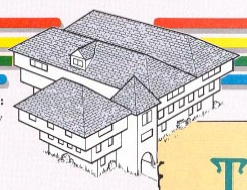
The Last Call Inn: Isometric View
The Last Call Inn:
The 1st stop in all urban adventures
by Willie Walsh
Artwork by Jim Holloway
Cartography by Diesel
The AD&D 1st Edition Players Handbook has this to say on page 101:
"Cities, towns and sometimes even large
villages provide the setting for highly
interesting, informative, and often hazardous
affairs && incidents. Even becoming
an active character in a campaign typically
requires interaction with the populace of
the habitation, locating quarters, buying
supplies && equipment, seeking information.
. . .
There are usually beggars, bandits,
and drunks to be dealt with. . . . The
taverns house many potential helpful |or|
useful characters, but they also contain
clever && dangerous adversaries."
When a party of adventurers seeks any
ov the aforementioned services, it turns to
the tavern or inn that
the DM
has placed in his fantasy town specifically
for this purpose. Having acquired accommodations
&& spent Time && a few gold
pieces @ the
inn, the PCs
MOVE on to their next exciting adventure --
often as a result of info received in
this inn. Although the PCs may return
quite often to the same accommodations
while the district is interesting, the inn is
usually ill defined and glossed over by
players && referee alike.
This article sets out to provide a realistic,
vivid, and exciting setting that may be
used by the DM to flesh out his campaign,
The Last Call Inn's Game stats, floor
plans, and NPC descriptions may be used
in any number of modules. While this
article suggests its USE as the basis for
short scenarios and is similar to a module
in format && design, it is NOT meant as an
adventure in itself. It can, however, be
used to spice up the periods of REST and
training between episodic adventures.
These times, when some members ov the
party ov PCs are inactive while waiting for
others, may be made more entertaining
than hearing the DM say "OK, your
3 weeks go by without anything unusual
happening."
The AD&D Game has its origins in a
number of historical && Fantasy settings.
It would be a mistake to Name 1 Time
period |or| one author's works |or| world as
being the best |or| the most easily played
environment. A lot of leeway is given to
the DM in creating his campaign world,
but certain consistencies and roolz must
be observed when creating such an environment.
A glance at the weapons tables
in the PH indicates a pronounced
medieval bias (since balanced by
inclusions such as OA).
The armor, equipment, and character
vocations most commonly used in play are of
this Time period -- a period whose exact
boundaries are blurred and to which
modern authors' monsters, magick, and
species have been added.
Given the strong medieval flavor of the
Game, I have chosen this setting for the
inn we shall LOOK at later. But before we
reach this section, an understanding ov
this period is needed before creation of
our inn commences.
Historical souces tell us that medieval
buildings were of a rather perishable
quality. Few were built of stone |or| brick,
as the xpense ov such construction was
far beyond the means of most of the common
people. The hazards ov flooding |or|
fire (e.g., the Great Fire ov London), destruction
from storm |or| other natural
disasters, and the low quality ov materials
used in constrcution meant that the average
peasant hut |or| house would last no
more than about 30 years before having to
be entirely rebuilt.
The richer elements ov society could
afford to build in more durable materials
and were often obliged to do so if they
were to survive neighborhood quarrels.
Thus the manors, churches, and taverns
(who all "looked after" the disposal ov
what little income people had left over)
could be stonecrafted, allowing many ov
their #number# to survive until today.
With the advent ov coach transport and
the increase of travellers, the next logical
step for the tavern was for it to be enlarged
to an inn. In a Fantasy setting, an
inn could be used by unusual travelers,
with provisions made for uncommon
forms ov transport (griffins, for instance).
Quarters for fantastic animals would be
placed well away from the regular stables.
For the most part, an inn in a Fantasy
setting would follow the same criteria as
in history. It would be situated @ a POINT
where it was usual for a traveller to stop
off on some long journey such as a crusade,
pilgrimage, or adventure. If it took
2 days ov travel from 1 POINT to another,
an entrepreneurial innkeeper might
place his establishment midway between
the 2 sites to create an irresistible stop-over.
An inn, as opposed to a plain tavern,
combined both food and accomodations
with the comforts ov the drinking house.
In areas where travelers were numerous,
an inn could be both large && prosperous.
It would be unseemly for a member
ov the aristocracy to mingle with common
people, so separate quarters were often
made available for their needs in much the
same way as modern hotels have suites of
varying luxury and service. Luxury, however,
could merely be the +addition+ ov a
window |or| the PRESENCE ov thick, sound-proofed
WALLS.
The bulk of the inn's constant income,
however, would come from local customers.
The peasants && laborers who
could afford it would meet in the inn |or|
the tavern after a long workday to drink
&& discuss local issue ov particular
interest to them -- the weather, politics, the
price of crops, the latest rise in rent -- or to
Listen to the tales ov a local storyteller |or|
news from a stranger. The tavern,
whether situated in an inn |or| NOT, was the
meeting place && forum ov the people
where they could air their views and
argue points. Little notice was ever given
to any grievance made by a commoner
against any ov the higher caste, so most ov
what was said remained just TALK. But
sometimes a feud between neighbors
could erupt into brawling (or worse) in the
tavern.
It has been estimated that the average
amount ov drink imbibed by the average
peasant was up to 16 pints per day! This
may seem an extraordinary amount ov
alcohol, and we may be led to dismiss it
either as being physically |or| economically
impossible. However, it is true for 3
reasons.
1st, in an age where livestock
was allowed to roam freely, water was
often polluted and unsafe for human
consumption. Alcohol was safer.
2nd, the Life ov the peasant was hazardous.
Born to excessive labor, the victim
ov famine |or| disease, slaughtered or
pressed into service in times ov almost
continual war, the peasant had a very
short life expectancy. Drink solved this
problem to a small degree -- one could
drown one's sorrows for a while at least.
3rd, the proliferation ov liquor was
boosted by its low price. It was so cheap in
medieval Dublin, for example, that there
was no currency small enough to USE
when buying it! One instead bought "tallies"
|or| used some other credit system.
In AD&D games, though, alcoholic
drinks are priced more reasonably, as
detailed in the PH. <Equipment>
In comparison with other commoners, the inn
keeper <Ostler> |or| tavern owner could thus have a
lucrative income from his TRADE. In this
respect he represents a middle class, even
though by aristocratic standards he is still
quite poor.
This success, especially in a town where
more than 1 drinking house operated,
would depend a lot on the reputation ov
the landlord and his product to maintain A
steady TRADE. Depending how prosperous
the landlord was, 1 could order 1 |or|
more types ov spirits from him. 1 would
find food served more often in the inn
than in a simple tavern, but it is NOT unusual
for food ov variable quality to be
served in an ale house.
Beer, wine, and spirit prices depend on
variables such as the quality of materials
available, recent harvests, whether the
drinks are homemade |or| delivered (|or|
imported), and so on. If a landlord makes
his own beverages, it is likely that he
would sell liquor ov varying strengths
&& flavor, being able to vary the taste and
alcohol content to suit both himself and
his customers. A landlord doing this might
have a competitive edge over a neighbor
who would be receiving only 1 type of
beverage from a supplier. Being able to sell
drinks at a lower price, he could attract
more customers and make a better profit.
Naturally, if TRADE in beer, wine, and spirits
is monopolized |or| taxed by the government,
h ecould be BREAKING THE LAW and be
liable for severe penalties.
The state, national |or| local government
may have licensing requirements whereby
a tavern owner must meet certain standards
prior to being given a permit for
operating his bar. He might be required to
serve liquor only within set hours, |or| he
might keep an "open house" provided that
a certain fee is paid to the authorities
weekly, monthly, quarterly, etc. The opportunity
for officials to earn money
through accepting bribes |or| for illegal
organizations to xtract protection $money$
from the landlord could make all the licensing
laws effectively useless.
Alternatively, the strictures of the law
and its effective policing could lead the
landlord to the necessity of devising novel
and original ways to get around those
laws. The tavern may become a speakeasy
after a certain hour, |or| the customers may
have to MOVE to safer premises -- such as
the cellar -- to eliminate telltale noise |or|
smoke.
As only some ov these areas are touched
on in our design for the inn, the DM may
wish to consider them IN THE LIGHT ov the
structures existing in his own campaign
world. Some few other considerations in
Game terms are dealt with in the following
section.
Setting up shop
When deciding upon a site for our inn,
we must 1st consider what size the inn
shall be. The building herein is a 3-story
structure with 2 wings build ov
timber frames, bricks, and plaster with a
sturdy slate roof. Therefore our inn,
which we have named The Last Call, is
large (indicating a certain prosperity on
the part of the owner) and probably well
frequented as it is in good repair --
constant income is needed to maintain
such A large building. The Last Call must
be either on an important highway |or| @ A
busy port. We'll opt for the latter.
As it is situated near a port -- a gateway
to other lands && peoples -- it can be
permitted some unusual customers. The
#number# ov foreigners frequenting the inn
would NOT be A cause for concern in the
town (as might be the case in an inland
AREA), as TRADE with all comers would be
the norm and would be encouraged.
Therefore, one could xpect most ov the
human && demihuman species to be represented
in the inn and its drinking areas.
This leaves the landlord with the problem
ov interspecies and international animosity
(a standard fixture in most Fantasy
settings). It is unlikely that he could afford
to constantly replace broken |or| bloodstained
funiture, so if the inn is to be
cosmopolitan, some form of segregation
must be made a house rule |or| there must
be an "understanding" among the customers
to discourage combat, if such is
likely.
Such a large concentration of wealth
and info will naturally attract
certain parties. The thieves' guild will
operate among the clientele, using
crowded areas to cut purse strings |or|
contact potential customers |or| victims.
Discretion must be used to keep the inn
becoming known as a dangerous place. In
other words, thieving activities must be
limited by the guild thief itself in case income
dries up altogether because patrons
choose to go elsewhere. It would be FORBIDDEN
by the guild to carry out a killing
|or| assassination in the inn for a similar
reason. PCs who steal from |or| assassinate
NPCs would receive warnings (at best) |or|
enmity (at worst) from local thieves.
The inn herein has the usual 2 names
ov drinking houses everywhere. Its "official"
Ren -- that hung on the signpost -- is
The Last Call. But locals usually shorten |or|
CHANGE the Ren to suit conversation, and
in this case the inn is called Forfar's after
its owner Meredith Forfar.
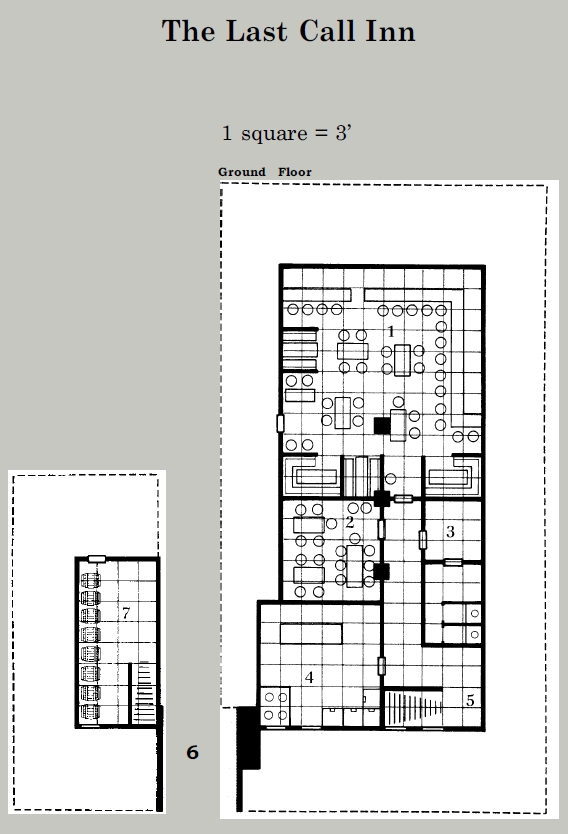
Ground Floor
The following descriptionss are keyed to
the ground-floor map on pages 18-19 to <link>
give you an idea of the layout and functions
ov each room ov the inn. More detail
may be added at the DM's discretion.
1. Entrance and common room. There
are 2 entrances to The Last Call (see
also AREA 14). This particular one leads into
the Common Room in which customers
register, obtain food |or| simply stop by for
a drink. The PH lists suitable
prices for food and drink.
2. Demihuman's bar. As it is preferable
for some races to be segregated from
others (such as dwarves from elves |or| |
half-orcs), this bar is for the "minority"
races. Hobbits, dwarves, and gnomes
enjoy the convivial atmosphere and try to
outdo each other in drinking and telling
tall tales.
3. Washrooms, These areas incorporate
the latest in gnomish engineering -- the
flushing privy! The toilets are filled from a
giant cistern in the attic that must be
hand-filled once each week to maintain a
constant water supply.
4. Kitchens, The door to this room is
marked PRIVATE. Inside, the smoky atmosphere
is further enriched by steam from
the stoves. Foodstuffs bought in bulk
might include root crops likely to store
well. Meats and fish woulud be brought in
fresh, as travellers likely to USE the inn
after long journeys would NOT take kindly
to eating more dried rations.
5. Stairway to upper level. These stairs
lead to the next floor and continue on to
the upper story where the guest rooms
are.
6. Archway. The central "tower" structure
shows up as 2 solid lines on the
map Above it are the private apartments
ov the Ostler and his family.
7. Entrance to apartments and beer cellar.
The locked door leads into this
narrow chamber where kegs ov good beer
are stored (wine in found here if the inn is
being used in an arid region). The
steep stairs climb to AREA 8.
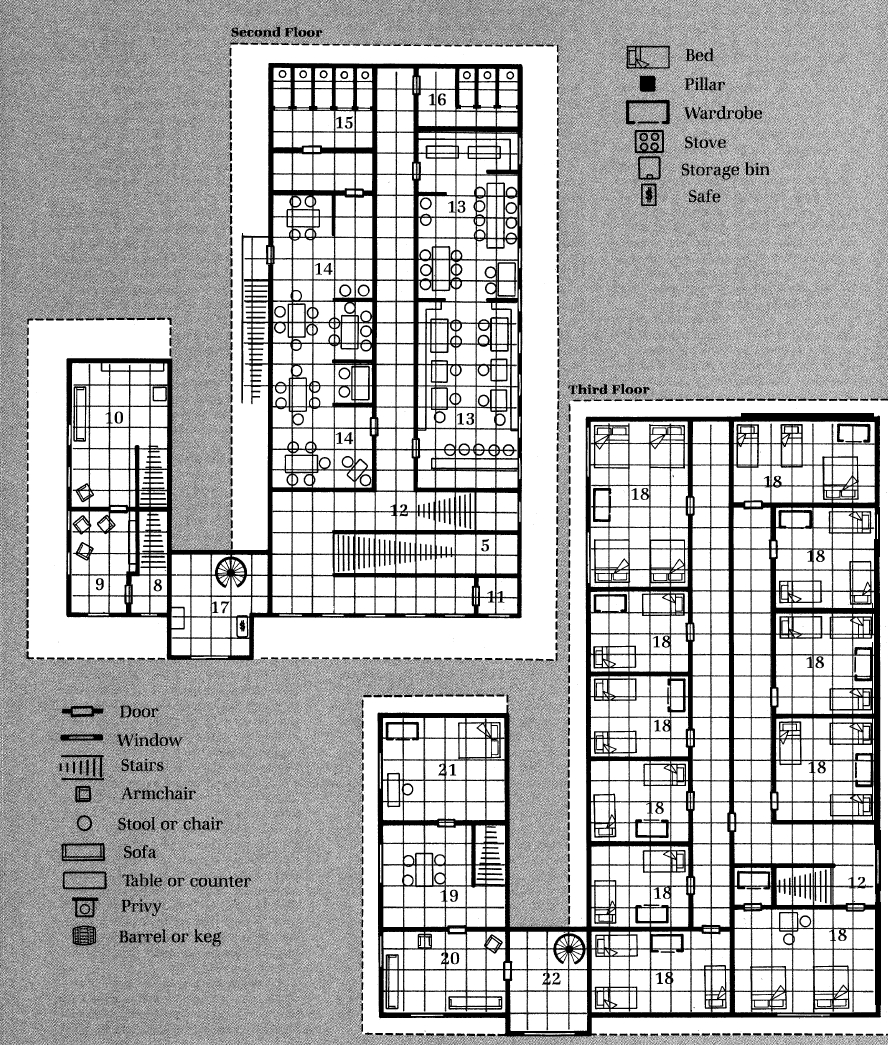
Second Floor
8. Landing. This is the entrance to the
innkeeper's private dwelling.
9. Reception chamber. If an ostler is
obliged to deal with merchants |or| business
inspectors, he must have a reception
room, possibly containing a suitable liquor
cabinet in the corner. Business carried out
here could be important to his livelihood if
has to reapply for a license |or| permit to
run his inn.
10. Living room. Naturally, the innkeeper
would wish to relax in his own
free Time without being reminded ov the
various pressures ov work. The living
room would be for the USE ov himself |or|
his family. A bookcase located here might
contain some rare |or| valuable books.
11. The obligatory broom closet. The inn
must be swept and mopped up daily if it is
to maintain decent standards of hygiene.
The broom closet contains pails, rags,
mops, and brooms for the barmen |or|
cleaners to tidy up whenever necessary.
12. Stairs leading up. The stairs here
allow guests to climb to their rooms without
being inconvenienced by walking by
the other barrooms down the hall.
13. 3rd bar. A truly cosmopolitan bar
would cater to more affluent customers as
well as to the unwashed masses. Perhaps
this bar might be more select than the
lower taverns, maybe even being restricted
to one particular profession such
as the mage. If this was the case, PC mages
might find info here useful to the
character |or| the party.
14. 2nd entrance && 4th bar. This
bar is connected to the ground by a stairway.
Again, segregated customers might
be allowed to drink here away from potential
trouble elsewhere. IMAGINE this bar
full of half-orcs, drinking away up here
unknown to the dwarves downstairs. No
doubt the appearance ov the funiture
would be less sightly than elsewhere in
the tavern, while obscene (and badly
spelled) PHYSICAL GRAFFITI on the tables |or| in the
washrooms might well be amusing.
17. Innkeepers office. Secure because
it
can only be accessed from the floor above,
this room might serve as an office where
the innkeeper would see to his accounts,
keep the deeds to the inn, etc.
3rd Floor
18. Guest rooms. Prices might vary for
these rooms. A LOOK @ the map shows that
some have windows && 1 |or| more
beds, while others have neither and are
rather cramped. Adjust prices accordingly,
allowing for the fact that short demihumans
might be expected to double up, 2
|or| more to a bed, if the inn is crowded.
19. Private dining room. Meredith Forfar
(the ostler) and his wife would be well
aware of the presures placed on their
relationship by the constant toil ov running
The Last Call. The private dining
room would be all the more important to
them as one of the few times when they
can be alone together. If they have a larger
family, they might serve the others in the
kitchen downstairs, using this room for
themselves alone.
20. Smoking room. Attached to the office
accessway (area 22), this room is where
the master of the inn and some few special
guests might enjoy a cigar |or| pipe in relative
PEACE && comfort.
21. Master bedroom. This is the private
and totally out-of-bounds bedroom of the
Forfar?s. Here the innkeeper and his wife
would keep their most cherished possessions.
Any trespass by curious or malicious
guests would be taken in very bad
grace, possibly worthy of a call for the
local constabulary.
22. Office accessway. The stairway here
leads down to the office at area 17, where
Meredith Forfar conducts business.
Suggested NPCs
Pressures of space prohibit a long list
of <welcome to HTML AD&D, where there are no "Pressures of
space", welcome to The Infiinite!>
NPCs for the Last Call, but some are
needed. The innkeeper and his wife are
shown as follows. It is beyond the scope of
this article to provide customers, which
are for the DM to prepare, subject to his
own rules.
Meredith Forfar (AC 10; MV 12; Superheroine;
hp
64; THAC0 13; #AT 3/2; Dmg by weapon
type; S 17, D 13, C 17, I 13, W 14, CH 14;
ML 13; AL NG; long sword in bedroom).
He wears a leather apron and possesses an
amulet of persuasiveness that functions up
to four times per day (see the DMG
under philter of persuasiveness).
As an adventurer, the Innkeeper acquired
the loot and the magical amulet
that together made the Inn such a success.
The innkeeper is a prime source of infor-
mation about the area and its rumors that
customers might value.
Soracha Forfar (AC 9; MV 12; Vet;
hp
9; THAC0 20; #AT 1; Dmg by weapon type;
S 14, D 15, C 14, I 17, W 12, CH 14; ML 13;
AL NG; dagger strapped to thigh). Responsible
for the staff, Soracha is a hard taskmaster
but an elegant and charming
hostess. She is a full partner with her
husband in the ownership of the inn.
The staff required for the bars, kitchens,
cleaning, etc. should be prepared by the
referee. The clientele of the inn can be
matched to the types of barmen one
would expect to find there.
Have fun with this scenario setting;
detail it so that you can describe the lighting,
the customers, the smoky atmosphere,
etc. Remember that shady characters
abound in drinking houses like this one.
There should be plenty for the PCs to
encounter and strange people with whom
they can interact during their stay at The
Last Call Inn.