(C) 1987 by Charles R. Saunders
by Roger Moore
Out of Africa
(C) 1987 by Charles R. Saunders
Note: This page combines 2 articles into 1.
Long before science-fiction writers
began populating outer space with bugeyed
aliens, the bards, skalds, and other
storytellers of pre-industrial Earth peopled
our own planet with imaginary beings of
incredible number and variety. Regardless
of culture or clime, human beings have
dreamed of imaginary counterparts, in
unknown lands beyond the mountains and
over the seas. These counterparts have
become so embedded in human culture
that today, even though the mountains and
seas have been explored extensively without
evidence of any such mythical beings,
those beings continue to exist in symbolic
fashion. From the heraldic dragon to the
boogeyman that hides behind the closet
door at night, the beings imagined by our
ancestors remain a part of our culture.
Over the past two decades, there has
been a resurgence of interest in the fabulous
beings of the ancient past. In part,
this resurgence is connected with a general
revival of interest in fantasy as a
literary genre. It can be attributed as well
to the advent of the fantasy role-playing
game. Mythical beings are an integral part
of these games, and volumes of compilations
of monsters of the world are perused
by game referees who seek new perils for
their underground realms.
It sometimes seems, however, that the
current interest in mythical beings is
confined to those associated
cultures of Western Europe, with a smattering
of Oriental creatures added for
good measure. The output of monsters
from the cultures of North and South
America, the Pacific, and Africa is omitted
from most compilations of mythical
beings. Such omission is especially apparent
in the case of Africa.
There are various reasons for these
omissions. In some cases, the compiler
deliberately leaves out products of the socalled
"primitive mind." One such compiler
is Heinz Mode, who wrote in Fabulous
Beasts and Demons:
"It may have been noticed that no mention
has yet been made of ancient America
or ancient Africa, the South Seas, and
Australia. That these areas may in fact be
largely left out is due to a fact already
stated: namely that the idea of monsters
arises at a relatively late stage of cultural
development. The ancient American civilizations
do show some rudimentary, perhaps
independent composite forms, but
these are for the most part ill-defined, and
it is often difficult to distinguish between
monsters and human figures masked or
disguised in animal skins. Ideas of magic,
totemistic customs, and animistic equations
of different natural spheres may
have led to some of the ideas underlying
the shapes that interest us here. But it
seems that these never brought about a
true creation of new beings in a distinct
visual form. For this reason, we shall
largely have to leave out these areas of
civilization if we want to keep to our subject,
though in individual cases references
will be made to possible connections. The
observation that monsters were not created
originally by the so-called primitive
peoples, as one might have expected; but
are in fact to a large extent the product of
highly developed civilizations is surprising
enough."
Mode's surprise might have been even
greater had he met the chemosit of East
Africa. The chemosit
is described as part human and part bird.
It has one leg and nine buttocks. Its red
mouth shines like a lamp at night. Whatever
else it may be, the chemosit is
unquestionably a new being in distinct
visual form. Not only that, but the name
chemosit is also given to an animal that
seems to be an amalgam of ape and hyena.
(We will meet this second manifestation of
the chemosit later in this article.) <link>
The chemosit is not unique. As you will
see, there are many other mythical beings
in Africa that fit Mode's (and anyone else?s)
definition of a ?monster.?
Descriptions of some of these beings
may be found in such compilations as
Perle Epstein?s Monsters, Peter Costello?s
The Magic Zoo, and Jose Luis Borges?
celebrated The Book of Imaginary Beings.
None of the above volumes, however,
mentions more than a scant few of the
imaginary inhabitants of Africa. Also, in
the Costello and Borges compilations, the
African beings they cite lack true African
provenance. Creatures such as the catoblepas, <cf. Narmer palette>
a bovine with a head too heavy to
carry upright, and the Amphisbaena, a
snake with heads at both ends of its body,
are products of the European imagination
rather than the African.
The search for true African mythical
beings must, therefore, begin with African
sources. The beings have always been
there; as the continent continues to
emerge from its centuries-long nightmare
of slavery and colonialism, the true extent
of the output of the African imagination
will become apparent to the fantasists,
scholars, and gamers of this part of the
world. This article represents only one
small scratch across a vast surface.
Unknown beasts
At first glance, a distinction between
?unknown beasts? and ?mythical beings?
may seem superfluous.
Aren?t both kinds of creature equally
products of the imagination? The answer
to that question is ?yes and no.? In the lore
of most African cultures, there are two
categories into which beings we consider
imaginary may be sorted: natural and
supernatural. The natural category would
include animal species that have not been
described and classified by zoologists, but
are nonetheless considered by Africans to
be as much a part of the local fauna as
lions and leopards. These elusive beasts of
river, forest, and plain could be considered
in the same light as the Loch Ness monster
of Scotland or the sasquatch of North
America -- animals whose existence has
not been verified scientifically, but are still
more likely to fall into the purview of
biologists rather than anthropologists.
Supernatural beings belong more to the
realm of folklore and mythology.
Often, natural and supernatural beings
are lumped together as products of ignorance
and superstition. Still, as Belgian
zoologist Bernard Heuvelmans points out
in On the Track of Unknown Animals,
zoos all over the world now contain specimens
of the gorilla, the okapi, and the
pygmy hippopotamus -- all of which were
once dismissed as products of native
superstition. There may be others.
Africa is a continent of rivers, with the
Nile, the Zaire (formerly Congo), and Niger
systems ranking among the longest in the
world. There are also several great lakes
surpassed in size only by those of North
America. These bodies of water teem with
a countless variety of fish, as well as hippopotami,
crocodiles, and water birds.
Formidable as the hippo and crocodile
are, even they are sometimes forced to
retreat when confronted by the unknown
beasts that share their environment. One
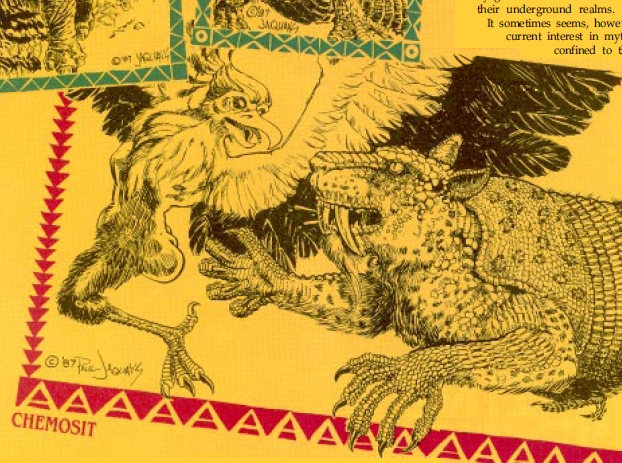
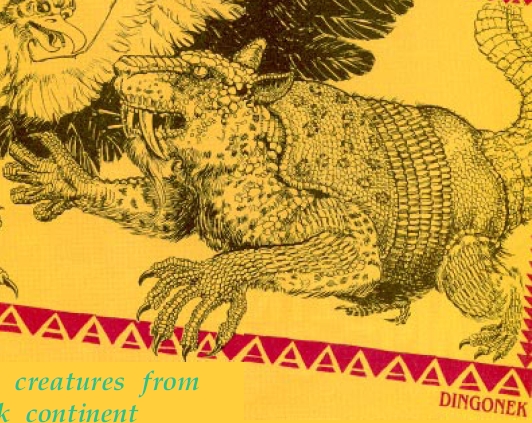
dangerous rival is the dingonek, a 15'-long
creature with a head like that of a lioness
or otter, long saberlike fangs, thick scales
like those of an armadillo, and a long, broad
tail. The dingoneks body is covered with
leopard-like spots, and its bulk rivals that of
a hippo. Its feet bear reptilian claws.
Even more impressive than the dingonek
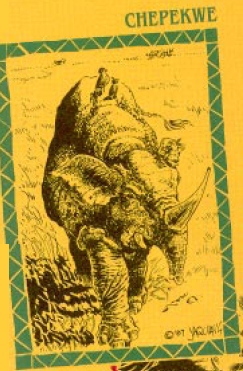
is the chepekwe, which appears to be part
rhinoceros and part elephant, with little or
no trace of the reptile in its makeup. The
chepekwe is the size of a small elephant.
Like the Indian rhinoceros (but unlike the
African), the chepekwe bears a single horn
on its nose. Its habitat is the swampy
regions of the Katange district of Zaire.
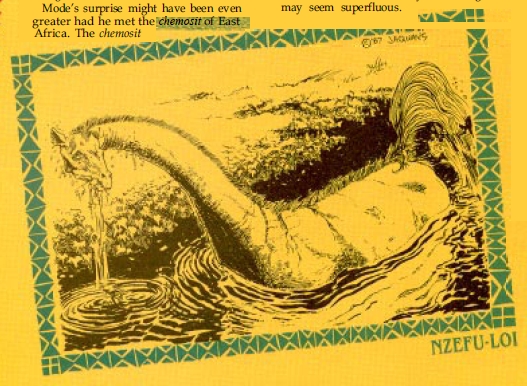
A similar water-dweller is the nzefu-loi
which dwells in the Lualaba River.
Although its name means ?water elephant,?
the nzefu-loi does not look like an elephant.
The shape of its body is comparable
to a hippo?s, but it has a long neck surmounted
by a relatively small head. The
head is armed with short, heavy,
downward-pointing tusks. Despite its
saurian configurations, the nzefu-loi sports
a long, hairy tail like that of a horse.
The nsanga looks very much like the
komodo monitor lizard, which is officially
the world?s largest lizard, growing to a
length of 10-12’. The nsanga beats that
record, as some of them have been reported
to stretch as long as 15?. Its lifestyle is
similar to that of the crocodile, which the
nsanga sometimes chases from choice
feeding-grounds. Although the nsanga
does not possess the fearsome jaws of a
crocodile, it compensates with agility and
razor-sharp claws.
The badigui lives in the Ubangi-Shari
River system in what is now the Central
African Republic. The grandfather of all
snakes, the badigui has sufficient size and
strength to crush a crocodile in its coils.
When it ventures out of the water, this
gigantic serpent leaves a track as wide as
the body of a Land Rover. As for length,
one witness saw only the upper portion of
a badigui, and that was 25? long!
Not all of Africa's unknown waterdwellers
are reptilian or pachydermal.
The morou-ngou is decidedly feline in
form. At 10-12? in length, the morou-ngou
appears to be an oversized panther adapted
to an aquatic environment. Its smooth,
otterlike coat can be either striped or solid
brown in hue. Although the previously
mentioned animals are not directly dangerous
to humans, the morou-ngou is very
inimical indeed. Often, it goes out of its
way to drown hapless humans in the
deepest part of the Ubangi-Shari.
Like the other beasts discussed thus far,
the morou-ngou is amphibious, and is thus
capable of surviving out of water. But the
lukwata of Lake Victoria is strictly aquatic.
Indeed, the lukwata may best be described
as a gigantic catfish, 12-15' in length. With
its wide gaping mouth surrounded by
twisting barbels, the lukwata would be a
terrifying apparition to unwary fishermen.
The last water beast to be described
here does not live in any of Africa?s rivers
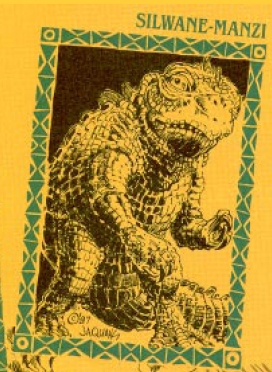
or lakes. The silwane-manzi is a seadweller
that sometimes leaves its threetoed
prints along the beaches of Natal,
South Africa. Zulus who have seen this
creature say that it is larger than a crocodile,
walks on its hind legs, is covered with
scales, and has a head that resembles that
of a turtle. Although the film was made
years after the Zulus? first descriptions of
the silwane-manzi, the sea-beast bears an
uncanny resemblance to the Creature
from the Black Lagoon!
Water is not the only habitat of
unknown beasts in Africa. Remote forests,
mountains, and savannahs harbor creatures
which have yet to appear on the
Wild Kingdom television program.
Conventional zoological wisdom tells us
that there are no bears in Africa. What,
then, is the nandi -- a marauder that has
harassed East African shepherds for centuries?
Lacking other terms of reference,
Africans who have encountered the nandi
say it looks like an overgrown hyena. But
when photographs of bears are shown to
these witnesses, they invariably change
their mind. Indeed, one variant of the
chemosit is the duba, whose name is Ara
bic for ?bear.? Although it is a huge, fearsome
creature, the nandi/duba appears to
confine its depredations to domestic
animals.
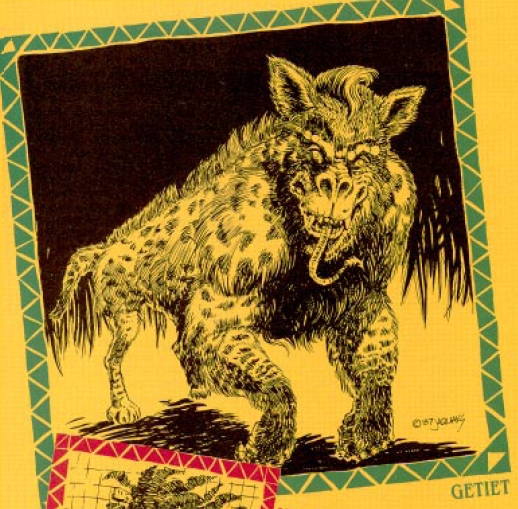
The chemosit, also called the getiet, is an
altogether different case. As mentioned
earlier, there are two versions of the chemosit.
The half-man, half-bird monster
mentioned in the introduction is more of a
demon than a natural creature. The other
version is a rapacious predator that seems
part-hyena, part ape, and 100% deadly.
Entire villages have reportedly fled the
fury of the chemosit, which has the unsavory
habit of tearing off the tops of its
victims' skulls and dining on the exposed
brain. In its own way, this second version
of the chemosit may be even more
demonic than the first.
Related to the chemosit is the engargiya
of Uganda. A large, shaggy, slope-backed
creature, the engargiya has been identified
by Heuvelmans as a descendant of the
chalicothere, a prehistoric animal that had
the anatomy of a herbivore combined with
disproportionately large claws on its forefeet.
Although the chalicothere became
extinct during the Pleistocene, Heuvelmans
speculates that a relict population
may survive in the East African bush.
The njenge is an omnivorous animal
about the size of a sheep. In pre-colonial
days, njenge made nuisances of themselves
by raiding farms and gardens. Although
said to be carnivorous as well as herbivorous,
there is no mention of the njenge
being dangerous to humans. It is covered
with hair like an English sheepdog.
Great cats like the lion, leopard, and
cheetah are virtually symbolic of African
wildlife. But there are two large feline
species that are just as spectacular and
dangerous as the cats trophy-hunters seek.
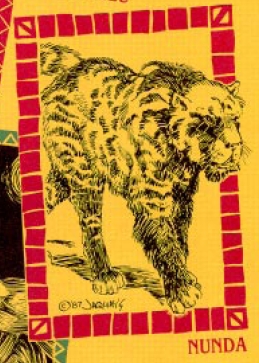
One is the nunda, a feline larger than a
lion and far more difficult to kill. In Swahili
legend, the nunda has a thick tail, small
ears, a bulky build, and a coat marked like
that of a civet. It is interesting to note here
that Louis Leakey once excavated the
fossil of a cat that seemed more tiger than
lion. The nunda could represent a survival
of this prehistoric species.
The other unknown feline seems almost
at the threshold of scientific recognition.
Known locally as the marozi, the cat is the
size of a small lioness. Traveling in pairs,
marozi are most frequently seen in the
Aberdare Mountains of Kenya. Though the
males do not boast the full mane of the
lion, they do have a whiskery ruff like that
of a bobcat or a lynx. Also, like a bobcat,
the marozi’s hide is spotted. Its tail is as
long as a leopard?s, however. For a time, a
pair of marozi skins were on display in
Nairobi.
Thus, we complete our survey of
unknown beasts. The listing is by no
means exhaustive. Like the okapi and the
pygmy hippopotamus, some of the above
creatures may one day be displayed in
zoos. But what zoo could hold a determined
badagui or chemosit?
Mythical beings
The existence of Africa?s supernatural
beings is rooted in the world of folklore,
myth, and superstition. Dissociated from
physical reality, supernatural beings are
nevertheless a part of the spiritual reality
of the cultures of which they are part.
Although they are not by definition evil,
these beings do tend to be associated with
the conjurations of sorcerers and witches.
Virtually all cultures have created supernatural
beings; there seems to be a universal
core of awe of the unknown that
impels us to mold that awe into something
with substance and shape. If the unknown
can be visualized, labeled, and classified, it
becomes (at least in reasoning) that much
easier to cope with.
Based on their different origins, there is
an important contrast between the behavior
of natural and supernatural beings.
With a few exceptions, the natural beings
are not a direct menace to humans. Like
other animals, they will leave you alone if
you leave them them alone. More often
than not, however, the supernatural
beings are dangerous to the people who
create them.
It is almost culturally universal that
people who share their environment with
large predators develop a tradition of
lycanthropy. African culture is no exception
to this rule. The most common kind of
African lycanthrope is the irimu, or wereleopard.
An irimu can also be a werelion,
depending on the locale of the mythmaker.
Like the European werewolf, the
irimu assumes beast-form when the moon
is full, but its bite does not infect its victims
with a similar curse. The condition is
induced by the spells of unscrupulous
sorcerers, though sometimes the sorcerers
are unable to control their creations. The
irimu is not to be confused with the Leopard
Men of West Africa, who disguise
themselves as leopards in rituals.
There are also werelions and werehyenas,
known respectively as chiwanda
and makishi. These beings differ from the
irimu in that the chiwanda and makishi
are beasts that can become human, while
the irimu is a human who can become a
beast. Entire cycles of folktales in Central
and Southern Africa revolve around the
theme of the ?Demon Bridegroom,? In
these stories, a makishi or chiwanda
comes to a village in human form and
seduces any local beauty who haughtily
rejects all other suitors. The demon
marries the maiden ? then, on the wedding
night, the demon reverts to its normal
form, with predictably terrifying
results.
The vampire is another supernatural
entity that appears in cultures all over the
world. The Central European version of
this blood-drinking monster is the most
prevalent, but there are other cultural
variations on the vampire theme.
At least two types of vampire have been
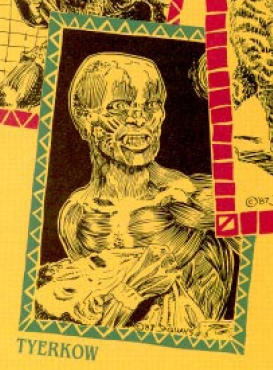
reported in Africa. One is the tyerkow,
which haunted the ancient city of Timbuktu
The tyerkow was a normal human
being by day, but at night it would shed its
skin and become a vampire with most of
the same attributes as the European variety.
In its skinless state, the tyerkow drank
the blood of sleeping citizens of Timbuktu.
To destroy a tyerkow, one must hide its
skin so that it has no safe haven which it
can return to by daylight. Of course, the
vampire is careful about hiding its skin.
The other type of African vampire is the
mwanga. The best description of the
mwanga is a person who turns into a
beast that lives on blood. In some ways,
the mwanga is a combination of vampire
and were-beast, with the mindless ferocity
of the were-beast linked to the blooddrinking
habits of the vampire. Unlike the
tyerkow, the mwanga is vulnerable to
ordinary weapons, though it takes a lot of
effort to dispatch it.
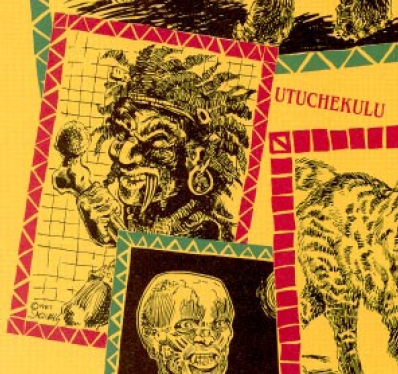
?Little people? are yet another worldwide
phenomenon in folklore. Gnomes
and leprechauns have African counterparts
in the forms of the utuchekulu and
the kitunusi, among others. The above-named
dwarves tend to be dangerous and
are better left alone. The utuchekulu are
about 3? high, have ebony skin and tangled
hair, and possess a long, sharp, blood-red
tooth which they use to kill their victims.
Their favorite prey? Humans, of course.
The kitunusi, on the other hand, is
somewhat ambivalent. Even its status as a
dwarf is not clear, as some stories say the
kitunusi is of normal size, but hitches itself
about in a sitting position. Whatever its
stature, the kitunusi wears a magic cloth
called kaniki. If a traveler is bold enough
to tear away a piece of kaniki, great riches
will be his. But failure to face down this
gnome results in illness, paralysis, and an
eventual, slow death.
Where there are little people, there are
also giants. All over the world, legends
persist of races of giants that preceded
humans on Earth. One African variation
on this theme is the story of the Rom, who
once inhabited northern Ethiopia. They
were so large that the normal-sized cattle
they herded were as sheep are to normal
humans. Their water-vessels were made
from entire hides of bulls, and they ripped
up entire groves of trees for firewood. For
a time, the Rom coexisted peacefully with
humans. They ultimately died out due to a
combination of infertility and competition
with the smaller but brighter ancestors of
the Ethiopians. Even today, lost cattle are
sometimes thought to have been stolen by
the vengeful ghosts of the Rom.
Another race of giants is the Sao, who
settled in the region of Lake Chad. They
are described as having bright, sunlike
eyes, and prodigious size and strength.
Indeed, accounts of the prowess of the Sao
bring to mind tales of Paul Bunyan and
Finn MacCool. Their bows were made
from the trunks of palm trees, and their
stature was such that they could carry an
elephant on their shoulders. Unlike the
Rom, the Sao were highly cultured, and
were willing to pass their knowledge on to
the ?little people? they encountered. Also
unlike the Rom, the Sao did not die out in
competition with normal humans, One
day, the Sao simply moved on and were
never seen again.
Elves are yet another worldwide mystical
phenomenon. Elves are sometimes
confused with dwarves and gnomes; strictly
speaking, though, an elf is a being that
operates on a higher spiritual plane than
do humans. The sidhe of Ireland are one
European example of this perception of
elves. For the Bantu-speaking people of
Zaire and other Central African countries,
the equivalent of the sidhe is a race called
the wakyambi, or the Heaven People. The
Bantu concept of heaven is not to be confused
with the Christian concept of heaven;
the name was translated as such
because the Congolese said the wakyambi
live ?in the clouds? or ?beyond the sun.?
Like most elves, the wakyambi are ambivalent
in their dealings with humans. They
have been known to conjure ?heavencattle
? for people they looked kindly upon.
On the other hand, the wakyambi are also
known to be harbingers of disaster. In
appearance, these elven beings are very
much like other Africans, the primary
difference being that the wakyambi have
tails. Contrary to some expectations, the
tail of the wakyambi is not considered a
sign of evolutionary degeneration.
Thus far, we have described creatures
that are part of a universal series of mythic
archetypes. Vampires, werewolves,
elves, and so forth are represented in
folklore from all corners of the world.
There are, however, mythic beings in
Africa that have few (if any) counterparts
in other continents? cultures.
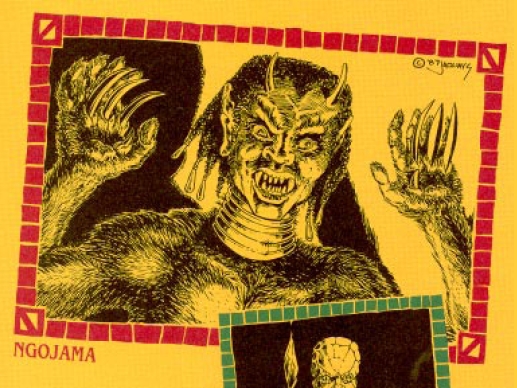
For example, there's the ngojama: a
demon that haunts the forests of the Tana
country. Ngojama is manlike in appearance
and has human intelligence, but he also
possesses long, iron-hard claws that grow
from the palms of its hands. Ngojama lies
in wait for unwary hunters, who quickly
discover that they are the demon's prey.
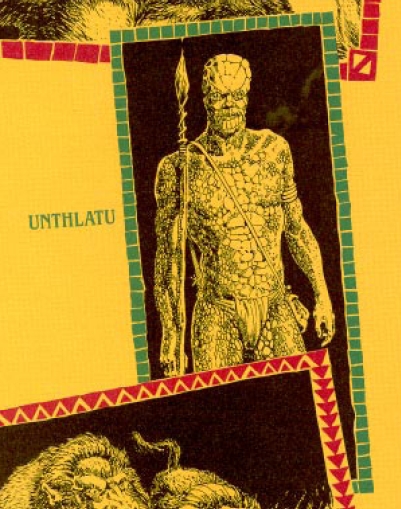
The Zulu speak of two manlike races
that may be found in their hills. One is the
unthlatu, or serpent-men. An unthlatu is
human in form but is covered with
smooth, slippery scales like those of a
python or boa. Unthlatu do not often
interfere in human affairs, but when they
do, one can never predict whether their
intervention will result in good or ill. In
one instance, an unthlatu saved the life of
a Zulu maiden who was abducted by a
river-demon. On the other hand, the
serpent-people are not above stealing
cattle from time to time -- a cardinal sin in
Zulu protocol.
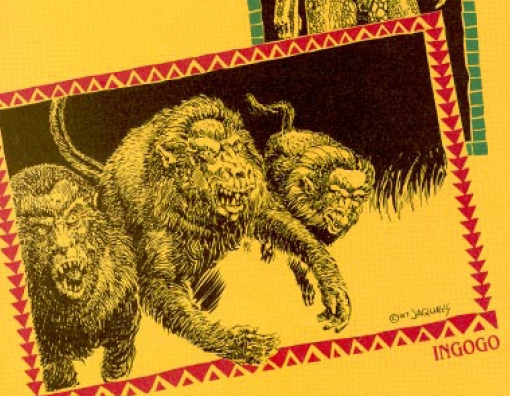
Less benign than the unthlatu are the
ingogo, which are a cross between
humans and baboons. The Zulu believe
ingogo to be the degenerate descendants
of an exiled clan. The ingogo walk on all
fours and have tails, although their faces
are still human enough. Although the
ingogo have retained the ability to speak,
their dietary habits have declined considerably,
as their favorite food is fresh Zulu.
The mangabangabana has an impressively
long name, but is in fact only half a
man, with one arm, one leg, and one eye.
Despite their truncated form, the mangabangabana
is more dangerous than the
ingogo. Not only is this grotesque halfthing
a man-eater; it also possesses the
power of flight! From its remote forest
villages, the mangabangabana swoops
down on women and children, and carries
them off to a horrible fate.
Great Zimbabwe, a collection of stone
ruins in the country that now bears the
same name, had its share of supernatural
beings, one of which was the mhondoro.
The mhondoro is the spirit of a semidivine
ancestor -- a king, priest, or warrior
-- which has the power to possess a
descendant and infuse him with all the
attributes that led to that ancestor?s fame.
The possession is temporary; when it is
over, the medium is left considerably
depleted, if not dead. Mhondoro are thus
called upon only in dire circumstances.
The zombie, or resuscitated corpse, is
perhaps the best-known of all African
supernatural beings, having made its way
across the Atlantic to Haiti and other parts
of the New World. A less noted fact is that
there are other types of revived corpses in
other parts of Africa.
The tuyewera, a specialty of the Kaonde
people of Zambia, is a Frankenstein-like
combination of an exhumed corpse and an
enslaved soul. To create a tuyewera,
Kaonde sorcerers first procure the body
of a person who has been slain by witchcraft.
The legs of the corpse are then
severed at the knees, and its tongue is cut
out. The sorcerer then animates the tuyewera
with the soul of an ancestor who
was known to have practiced witchcraft.
The result of this procedure is an unkillable
fiend that can steal, cause illness, and
kill at the sorcerer's command. At night,
the tuyewera is invisible. It moves by
hitching itself on its hands and the stumps
of its legs. It kills by sucking the breath
out of sleeping victims. The only way to
stop a tuyewera is to invoke an incantation
that induces the spirit of the witchancestor
to leave the revived corpse. At
that point, the maker of the tuyewera
loses control over his creation, and the
corpse swiftly decomposes. Kaonde sorcerers
frequently sold tuyeweras to people
who sought the services of a quiet
assassin.
We close our supernatural safari with a
look at Isikukumadevu, a Zulu variation of
the ?swallowing monster? theme. Isikukumadevu
is a huge, bloated, mossy creature
that once lived in a river that no longer
exists. As the proper form of address for
Isikukumadevu is ?Madame Monster,? it is
safe to assume that she is female. Politeness
is indeed a virtue when dealing with
a swallowing-monster; once Isikukumadevu
ingested an entire village because
one of its inhabitants offended her!
Thus ends our sampling of the unknown
beasts and mythic beings of Africa. As
mentioned before, we have only scratched
the surface of a vast array of entities. In
some cases, there are several variations on
a theme, such as reptilian water-beasts
and shape-changing lycanthropes, as well
as other types of resuscitated corpses.
Brief as this survey may be, it may still
provide an indication of the depth and
fertility of the African imagination.
Sources
Carey, Margret. Myths and Legends of
Africa. London: Hamlyn, 1970.
Courlander, Harold. A Treasury of African
Folklore. New York: Crown, 1975.
Davidson, Basil, The Lost Cities of Africa.
Boston: Little, Brown, and Company, 1959.
Garlake, Peter. The Kingdoms of Africa.
Oxford: Elsevier-Phaidon, 1978.
Heuvelmans, Bernard. On the Track of
Unknown Animals. London: Granada,
1972.
Radin, Paul (ed.). African Folktales and
Sculpture. Kingsport: Kingsport Press,
Inc., 1966.
Sanderson, Ivan T. More “Things”. New
York: Pyramid, 1969.
Werner, Alice. Myths and Legends of the
Bantu. London: Cass, 1968.
Gaming the Dark Continent
by Roger E. Moore
Any game master intrigued by Charles
Saunders?s article, "Out of Africa," will
likely be tempted to adopt some of the
creatures into whatever role-playing game
he or she most enjoys. This article offers
the AD&D® game statistics
on the 12 illustrated
monsters from Saunders?s article.
Game statistics on the other monsters
described in ?Out of Africa? may easily be
created; D&D® game statistics will closely
parallel the AD&D game statistics, and so
are not given.
A brief set of gaming notes is given
below each statistical description of a
monster. Aggressive creatures attack with
little provocation and rarely respond to
peaceful overtures. Aquatic creatures are
adapted for swimming, though they do not
breathe water (they can hold their breath
underwater for up to 10 rounds, however).
Carnivores eat meat but are not
necessarily aggressive or man-eaters.
Climbing creatures can use their claws or
limbs to scale walls and trees like a thief,
with a 95% chance of success. Fearless
creatures are immune even to magical
forms of fear. Herbivores eat only plant
matter, but are not necessarily passive.
Man-eaters are carnivores that deliberately
seek human prey; they are invariably
evil in nature. Minor demons may be
struck with nonmagical weapons; they
conform in all respects to the normal sort
of AD&D game demon, as
described in the
Monster Manual (page 16), with 60? infravision,
30?-radius darkness, and no teleportation
or gate/summoning abilities.
Speech-using beings may communicate
normally and usually have their own language
(and can learn other tongues as
well, though they might prefer to fight
rather than talk). Tool-using beings have
hands capable of wielding tools, weapons,
shields, and the like; they can throw
things if they desire, usually at normal
human ranges. Undead beings may be
turned or commanded by clerics, and are
immune to charm, hold, sleep, paralysis,
and all poisons; a typical vial of ho1y water
does 2-8 hp damage to them.
FREQUENCY: Very rare
NO. APPEARING: 1-4
ARMOR CLASS: 4
MOVE: 9?/24?
HIT DICE: 4 + 1
% IN LAIR: 20%
TREASURE TYPE: Special
NO. OF ATTACKS: 1 bite or 1 claw
DAMAGE/ATTACK: 1-6 or 2-7
SPECIAL ATTACKS: Nil
SPECIAL DEFENSES: Never surprised; also
as per normal demons
MAGIC RESISTANCE: 10%
INTELLIGENCE: Low
ALIGNMENT: Chaotic evil
SIZE: M
PSIONIC ABILITY: Nil
LEVEL/XP VALUE: V/245 + 5/hp
Moore: An aggressive, fearless, speech-using,
carnivorous minor demon. The chemosit
can see all hidden or invisible beings within
60?, and its mouth emits light equal to a
continual light spell. It is likely that a powerful
sorcerer could make use of a chemosit
for attacking his enemies, carrying
messages, and so forth.
Saunders: Mode's surprise might have been even
greater had he met the chemosit of East
Africa. The chemosit
is described as part human and part bird.
It has one leg and nine buttocks. Its red
mouth shines like a lamp at night. Whatever
else it may be, the chemosit is
unquestionably a new being in distinct
visual form. Not only that, but the name
chemosit is also given to an animal that
seems to be an amalgam of ape and hyena.
(We will meet this second manifestation of
the chemosit later in this article.) <link>
The chemosit is not unique. As you will
see, there are many other mythical beings
in Africa that fit Mode's (and anyone else?s)
definition of a ?monster.?
-
The chemosit, also called the getiet, is an
altogether different case. As mentioned
earlier, there are two versions of the chemosit.
The half-man, half-bird monster
mentioned in the introduction is more of a
demon than a natural creature. The other
version is a rapacious predator that seems
part-hyena, part ape, and 100% deadly.
Entire villages have reportedly fled the
fury of the chemosit, which has the unsavory
habit of tearing off the tops of its
victims' skulls and dining on the exposed
brain. In its own way, this second version
of the chemosit may be even more
demonic than the first.
FREQUENCY: Uncommon
NO. APPEARING: 1-6
ARMOR CLASS: 6
MOVE: 12"
HIT DICE: 10
% IN LAIR: Nil
TREASURE TYPE: Nil
NO. OF ATTACKS: 1 horn and 1 trample
DAMAGE/ATTACK: 2-16/2-16
SPECIAL ATTACKS: Charge
SPECIAL DEFENSES: Nil
MAGIC RESISTANCE: Standard
INTELLIGENCE: Animal
ALIGNMENT: Neutral
SIZE: L
PSIONIC ABILITY: Nil
LEVEL/XP VALUE: VII/1950 + 14/hp
Moore: An aggressive, swamp-dwelling herbivore,
If the chepekwe charges, it moves
at 18" for one round and does double
damage with its horn (but normal damage
with its trampling attack). Only man-size
beings or smaller ones may be trampled.
The chepekwe can only charge once per
turn. This creature cannot be trained or
domesticated except by magic.
Saunders: Even more impressive than the dingonek
is the chepekwe, which appears to be part
rhinoceros and part elephant, with little or
no trace of the reptile in its makeup. The
chepekwe is the size of a small elephant.
Like the Indian rhinoceros (but unlike the
African), the chepekwe bears a single horn
on its nose. Its habitat is the swampy
regions of the Katange district of Zaire.
FREQUENCY: Rare
NO. APPEARING: 1-2
ARMOR CLASS: 3
MOVE: 9?//9?(6?)
HIT DICE: 8 +4
% IN LAIR: Nil
TREASURE TYPE: Nil
NO. OF ATTACKS: 1 bite and 2 claws
DAMAGE/ATTACK: 2-16/2-12/2-12
SPECIAL ATTACKS: Charge
SPECIAL DEFENSES: Nil
MAGIC RESISTANCE: Standard
INTELLIGENCE: Semi-
ALIGNMENT: Neutral
SIZE: L
PSIONIC ABILITY: Nil
LEVEL/XP VALUE: VII/1300 + 12/hp
A fearless, aggressive carnivore that
rivals the bulette in temper. Accustomed
to attacking other large monsters, the
dingonek has developed a charging attack
using its head and body as a massive ram.
Given 60? in which to reach charging
speed, the dingonek will deliberately hurl
itself at large or dangerous prey, inflicting
double damage with claw attacks, an additional
2-20 hp damage from its head butt
(though without a bite), and stunning all
man-size or smaller beings as per a symbol
of stunning. The dingonek can also dig
into the earth with its claws and burst out
of the ground to attack encampments and
villages. Anyone standing behind a
dingonek can be smacked with its tail for
3-12 hp damage, though this attack is at
-4 to hit. Unfortunately, dingoneks can
swim, too.
Moore:
Saunders: Formidable as the hippo and crocodile
are, even they are sometimes forced to
retreat when confronted by the unknown
beasts that share their environment. One
dangerous rival is the dingonek, a 15'-long
creature with a head like that of a lioness
or otter, long saberlike fangs, thick scales
like those of an armadillo, and a long, broad
tail. The dingoneks body is covered with
leopard-like spots, and its bulk rivals that of
a hippo. Its feet bear reptilian claws.
FREQUENCY: Very rare
NO. APPEARING: 1 (10% of 1-4)
ARMOR CLASS: 6
MOVE: 12?
HIT DICE: 5 +2
% IN LAIR: 25%
TREASURE TYPE: D (only in lairs with
more than one getiet)
NO. OF ATTACKS: 1 bite and 2 claws
DAMAGE/ATTACK: 3-9/1-6/1-6
SPECIAL ATTACKS: Crushing
SPECIAL DEFENSES: Surprised on a 1
(1d6)
MAGIC RESISTANCE: Standard
INTELLIGENCE: Average
ALIGNMENT: Chaotic evil
SIZE: M
PSIONIC ABILITY: Nil
LEVEL/XP VALUE: V/300 + 6/hp
Moore: A fearless, aggressive, speech-using maneater.
This ugly and obnoxious beast kills
for pleasure, and a single individual may
attack an entire village and its people. If
both claw attacks hit a single victim, the
getiet may crush the victim, doing an
additional 2-8 hp damage. The getiet is
disliked even by other monsters, as it will
attack anything ? though it is not as stupid
as a dingonek. A getiet may ambush its
victims (though it generally dislikes being
subtle), and it often harasses larger monsters
simply for the pleasure of seeing
their frustration.
Saunders: The chemosit, also called the getiet,
is an
altogether different case. As mentioned
earlier, there are two versions of the chemosit.
The half-man, half-bird monster
mentioned in the introduction is more of a
demon than a natural creature. The other
version is a rapacious predator that seems
part-hyena, part ape, and 100% deadly.
Entire villages have reportedly fled the
fury of the chemosit, which has the unsavory
habit of tearing off the tops of its
victims' skulls and dining on the exposed
brain. In its own way, this second version
of the chemosit may be even more
demonic than the first.
FREQUENCY: Rare
NO. APPEARING: 1-20 (10% chance of
1-100)
ARMOR CLASS: 6
MOVE: 12”
HIT DICE: 1 + 3
% IN LAIR: 20%
TREASURE TYPE: Nil
NO. OF ATTACKS: 1 bite
DAMAGE/ATTACK: 1-6
SPECIAL ATTACKS: Grasp-and-bite routine
SPECIAL DEFENSES: Immune to all
enchantment/charm spells
MAGIC RESISTANCE: Standard
INTELLIGENCE: Low
ALIGNMENT: Neutral evil
SIZE: M
PSIONIC ABILITY: Nil
LEVEL/XP VALUE: II/36 + 2/hp
Moore: A speech-using, climbing, man-eating
primate that refuses to use tools and
destroys or throws away all treasure that
falls into its hairy paws. Completely vile in
every social respect, the ingogo is said to
run second in obnoxiousness to only the
getiet. Ingogo drive off wildlife, stampede
cattle, steal valuables, waylay travelers,
scream at night, and know more rude
curses than most humans will ever hear in
a lifetime ? some people say these are
their good points. Ingogo are also cowardly
except in large groups, but bully all
weaker than themselves.
If an ingogo makes a successful “to hit”
roll with one of its hands (doing no damage);
it can bite at a victim with a + 4
bonus to hit, doing an additional + 1 hp
damage on the attack. The ingogo may
thereafter continue to attack at a bonus
until slain or physically separated from
what it has grasped. An ingogo has an
equivalent strength of 17.
Saunders: Less benign than the unthlatu are the
ingogo, which are a cross between
humans and baboons. The Zulu believe
ingogo to be the degenerate descendants
of an exiled clan. The ingogo walk on all
fours and have tails, although their faces
are still human enough. Although the
ingogo have retained the ability to speak,
their dietary habits have declined considerably,
as their favorite food is fresh Zulu.
FREQUENCY: Very rare
No. APPEARING: 1
ARMOR CLASS: 6
MOVE: 12"
HIT DICE: 4+4
% IN LAIR: 10%
TREASURE TYPE: B
NO. OF ATTACKS: 2 claws
DAMAGE/ATTACK: 2-7/2-7
SPECIAL ATTACKS: Double damage if "to
hit" roll is 4 or more over base needed
to hit
SPECIAL DEFENSES: As per normal
demons
MAGIC RESISTANCE: 20%
INTELLIGENCE: Average-very
ALIGNMENT: Chaotic evil
SIZE: M
PSIONIC ABILITY: Nil
LEVEL/XP VALUE: V / 245 + 5/hp
Moore: An aggressive, speech-using, climbing,
fearless, man-eating minor demon. Ngojama
are difficult to control and are useful
to evil spell-casters only as assassins. Their
hand claws prohibit the ngojama from
using tools of any sort.
Saunders: For example, there's the ngojama: a
demon that haunts the forests of the Tana
country. Ngojama is manlike in appearance
and has human intelligence, but he also
possesses long, iron-hard claws that grow
from the palms of its hands. Ngojama lies
in wait for unwary hunters, who quickly
discover that they are the demon's prey.
FREQUENCY: Uncommon
NO. APPEARING: 1-8
ARMOR CLASS: 6
MOVE: 9?
HIT DICE: 11
% IN LAIR: Nil
TREASURE TYPE: Nil
NO. OF ATTACKS: 1 bite or 1 trample
DAMAGE/ATTACK: 1-4/1-4 or 4-24
SPECIAL ATTACKS: Nil
SPECIAL DEFENSES: Nil
MAGIC RESISTANCE: Standard
INTELLIGENCE: Animal
ALIGNMENT: Neutral
SIZE: L
PSIONIC ABILITY: Nil
LEVEL/XP VALUE: VII/1300 + 16/hp
Moore: A river-dwelling herbivore, often picked
on by dingoneks. This monster cannot be
domesticated.
Saunders: A similar water-dweller is the nzefu-loi
which dwells in the Lualaba River.
Although its name means ?water elephant,?
the nzefu-loi does not look like an elephant.
The shape of its body is comparable
to a hippo?s, but it has a long neck surmounted
by a relatively small head. The
head is armed with short, heavy,
downward-pointing tusks. Despite its
saurian configurations, the nzefu-loi sports
a long, hairy tail like that of a horse.
FREQUENCY: Uncommon
NO. APPEARING: 1-4
ARMOR CLASS: 6
MOVE: 12”
% IN LAIR: 25%
TREASURE TYPE: Nil
NO. OF ATTACKS: 1 bite and 2 claws
DAMAGE/ATTACK: 2-12/2-7/2-7
SPECIAL ATTACKS: Rake with rear claws
SPECIAL DEFENSES: Surprised only on a 1
(1d6)
MAGIC RESISTANCE: Standard
INTELLIGENCE: Semi-
ALIGNMENT: Neutral
SIZE: L
PSIONIC ABILITY: Nil
LEVEL/XP VALUE: VI/725 + 10/hp
Moore: A carnivorous, large, climbing cat,
remarkable only for its size. Like other
large cats, the nunda can leap up to 30’. If
both forepaws hit a single victim, the rear
claws may rake for 2-8/2-8 (two normal “to
hit” rolls required). If encountered in its
lair, there is a 30% chance that 1-3 cubs
will be present, each about 50% mature
and having no effective attacks. Nunda
climb and swim with ease.
Saunders: Great cats like the lion, leopard, and
cheetah are virtually symbolic of African
wildlife. But there are two large feline
species that are just as spectacular and
dangerous as the cats trophy-hunters seek.
One is the nunda, a feline larger than a
lion and far more difficult to kill. In Swahili
legend, the nunda has a thick tail, small
ears, a bulky build, and a coat marked like
that of a civet. It is interesting to note here
that Louis Leakey once excavated the
fossil of a cat that seemed more tiger than
lion. The nunda could represent a survival
of this prehistoric species.
FREQUENCY: Rare
NO. APPEARING: 1-4
ARMOR CLASS: 4
MOVE: 9?//12?
HIT DICE: 3
% IN LAIR: 20%
TREASURE TYPE: Nil
NO. OF ATTACKS: 1 bite and 2 claws
DAMAGE/ATTACK: 2-8/2-5/2-5
SPECIAL ATTACKS: Nil
SPECIAL DEFENSES: Nil
MAGIC RESISTANCE: Standard
INTELLIGENCE: Semi-
ALIGNMENT: Neutral
SIZE: L
PSIONIC ABILITY: Nil
LEVEL/XP VALUE: III/60 + 4/hp
Moore: An aquatic carnivore. Though it vaguely
resembles a lizard man, this creature
collects no treasure and is not civilized or
intelligent enough to use tools. It feeds on
sea and shore animals ? and sometimes
humans, though not out of preference.
Saunders: The last water beast to be described
here does not live in any of Africa?s rivers
or lakes. The silwane-manzi is a seadweller
that sometimes leaves its threetoed
prints along the beaches of Natal,
South Africa. Zulus who have seen this
creature say that it is larger than a crocodile,
walks on its hind legs, is covered with
scales, and has a head that resembles that
of a turtle. Although the film was made
years after the Zulus? first descriptions of
the silwane-manzi, the sea-beast bears an
uncanny resemblance to the Creature
from the Black Lagoon!
FREQUENCY: Very rare
NO. APPEARING: 1
ARMOR CLASS: 7
MOVE: 12”
HIT DICE: 6
% IN LAIR: 15%
TREASURE TYPE: E
NO. OF ATTACKS: 1 bite or 1 weapon
DAMAGE/ATTACK: 1-3 or by weapon type
( + 2 for strength)
SPECIAL ATTACKS: Blood drain, charm
person, summon rats (only)
SPECIAL DEFENSES: Regeneration, special
spell and poison immunities
MAGIC RESISTANCE: Standard
INTELLIGENCE: Very
ALIGNMENT: Chaotic evil
SIZE: M
PSIONIC ABILITY: Nil
LEVEL/XP VALUE: VI/600 + 6/hp
Moore: A speech- and tool-using, man-eating,
undead monster. The tyerkow does not
drain life levels, but its bite drains 1-4 hp
per round from its charmed victims. It has
the same powers of regeneration, summoning,
and charming that normal AD&D
game vampires have, but it cannot assume
gaseous form or shape change. Garlic, holy
symbols, holy water, running water, mirrors,
and sunlight affect tyerkows just as
they do normal vampires. Additionally,
taking the skin of a tyerkow and burning
it dooms the monster, for it will disintegrate
forever at dawn.
A tyerkow is a city-dwelling vampire. It
can move about normally by day while
wearing its skin, even in direct sunlight
(though it dislikes doing so). A tyerkow
always operates alone, and it has a
strength of 18 (nonpercentile).
Saunders: At least two types of vampire have been
reported in Africa. One is the tyerkow,
which haunted the ancient city of Timbuktu
The tyerkow was a normal human
being by day, but at night it would shed its
skin and become a vampire with most of
the same attributes as the European variety.
In its skinless state, the tyerkow drank
the blood of sleeping citizens of Timbuktu.
To destroy a tyerkow, one must hide its
skin so that it has no safe haven which it
can return to by daylight. Of course, the
vampire is careful about hiding its skin.
FREQUENCY: Rare
NO. APPEARING: 1-4 (4-40 in lair)
ARMOR CLASS: 5
MOVE: 12”
HIT DICE: 2
% IN LAIR: 20%
TREASURE TYPE: B in lair
NO. OF ATTACKS: 1 weapon
DAMAGE/ATTACK: By weapon type (+ 1
for strength
SPECIAL ATTACKS: Nil
SPECIAL DEFENSES: Cannot be grappled,
entangled, or grasped and held
MAGIC RESISTANCE: Standard
INTELLIGENCE: Average
ALIGNMENT: Chaotic neutral
SIZE: M
PSIONIC ABILITY: Nil
LEVEL/XP VALUE: II/28 + 2/hp
Moore: A carnivorous, tool- and speech-using
reptile in manlike form. Though social and
generally peaceful, unthlatu cause trouble
by stealing cattle. Each has a strength of
16 and generally wears little clothing.
Humans have great difficulty learning the
speech of the unthlatu, though the latter
do appreciate the effort. Because their
skins are so smooth and slick, normal
grasping attacks (even magical ones, such
as web and entangle) are not effective
against them — they simply contort them
selves and slide out of the way. Their
possessions could be caught, however.
Saunders: The Zulu speak of two manlike races
that may be found in their hills. One is the
unthlatu, or serpent-men. An unthlatu is
human in form but is covered with
smooth, slippery scales like those of a
python or boa. Unthlatu do not often
interfere in human affairs, but when they
do, one can never predict whether their
intervention will result in good or ill. In
one instance, an unthlatu saved the life of
a Zulu maiden who was abducted by a
river-demon. On the other hand, the
serpent-people are not above stealing
cattle from time to time -- a cardinal sin in
Zulu protocol.
FREQUENCY: Rare
NO. APPEARING: 1-6 (2-20 in lair)
ARMOR CLASS: 8 (wearing armor)
MOVE: 6?
HIT DICE: 1+2
% IN LAIR: 40%
TREASURE TYPE: D in lair
NO. OF ATTACKS: 1
DAMAGE/ATTACK: By weapon type
SPECIAL ATTACKS: Assassination (tooth)
SPECIAL DEFENSES: Nil
MAGIC RESISTANCE: Standard
INTELLIGENCE: Low-very
ALIGNMENT: Lawful evil
SIZE: S
PSIONIC ABILITY: Nil
LEVEL/XP VALUE: III/73 + 2/hp
Moore: A speech- and tool-using, man-eating
humanoid. The utuchekulu has an average
strength of 11, but its size severely
restricts the types of weapons it can use
(clubs, daggers, darts, etc.). An utuchekulu
can leap 5? in a single bound, and it uses
its leap to attack humans with its tooth. If
attacking from surprise, such a being can
assassinate a human, humanoid, or demihuman
victim with a 50% chance of success;
otherwise, the bite does 1-4 hp
damage. Unsurprised or alert victims
cannot be assassinated. Rangers gain their
damage bonuses when attacking these
monsters.
Saunders: ?Little people? are yet another worldwide
phenomenon in folklore. Gnomes
and leprechauns have African counterparts
in the forms of the utuchekulu and
the kitunusi, among others. The above-named
dwarves tend to be dangerous and
are better left alone. The utuchekulu are
about 3? high, have ebony skin and tangled
hair, and possess a long, sharp, blood-red
tooth which they use to kill their victims.
Their favorite prey? Humans, of course.
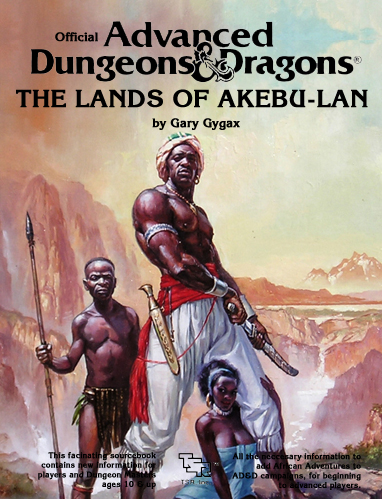
It would have been cool if he had actually written it!
LETTERS
No Africa?
Dear Dragon,
Does TSR have plans to develop an African
game world for the ADVANCED DUNGEONS &
DRAGONS® or DUNGEONS & DRAGONS® game?
The reason I ask this is because African-like
scenarios seem to be the least discussed. Almost
all references to an African-like area on any
game map in any game world are to a small,
poorly described jungle area. Every three or
four years, an article in DRAGON Magazine or
module in DUNGEON® Adventures is written,
but nothing collective appears.
I had hoped that the 2nd Edition Legends &
Lore would include an African pantheon. Not
only were there no new mythologies introduced
from the 1st Edition, but Egypt was the only
African culture included, and even that choice
had artwork that would suggest that Egypt was
northern European instead of northern African.
I see Africa as a rich heritage of vast deserts,
broad savannahs grasslands, and rain forests
(the jungle is a part of the whole, not the whole,
continent). It would make the perfect tropical/
subtropical adventure world. You could combine
the ancient empires like Kush, Nok, Nubia,
Ghana, and Ethiopia. You would have an ancient
world that could complement an ancient Egypt.
Later kingdoms present during the Middle
Ages—Mossi, Kanem Borneo, Mali, Songhai,
Fulani, and the Tuaregs in the savannahs; Yoruban,
Ashanti, Fon, Benin, and the Luba in the
rain forest; and the Zulu and Xhosa in the
south—would add all the political intrigue of a
medieval England or Japan.
I’m not saying that all of these ideas should be
used, but after volumes of folklore and mythologies
on written on each of these cultures, surely
something can be found. After all, 11 million
square miles of continent and 6,000 years of
recorded history should be hard to ignore.
I love your magazine. I have been an RPGA™
Network member and a steady subscriber to
both DRAGON Magazine and DUNGEON Adventures
since 1985. This letter is in no way a
criticism. I am an American of African descent
who has many friends who are attracted to the
game’s principle, yet put off by its apparent
Eurocentric point of view.
In the past year, there have been books on
Vikings, Aztecs, and Orientals in the AD&D
game, and on Native Americans and the Middle
East for the D&D game. It became necessary to
bring the topic up and be heard.
Brady English
Beckley WV
(Dragon #176)
Yours is not the first letter on this problem
that I’ve seen cross my desk. John K. Green
(Newark, N.J.) wrote to us with a similar complaint
about the Legends & Lore illustration (on
page 86) that you mentioned; I checked on the
matter and found that the art happened to be
available for second-rights use when something
“Egyptian” was wanted, so it was used. (TSR,
Inc. cannot commission new art all the time, as
it is too expensive.) I believe no harm was intended,
though one of the authors of the volume
agreed that the picture did not reflect the
physical characteristics of most, if any, of the
pharaohs. Egypt was a “melting pot” for every
culture in the area, from black African (Nubia)
to white European (Greece) to Arabic. Sculptures
from the dynastic periods show a wide
variety of racial features.
DRAGON Magazine has had very few articles
on African-derived fantasy gaming elements.
The demand is there, but we simply haven’t
gotten them. Issue #27 had an article on the
African mythos for an early version
of the D&D
game. Issue #122 had an excellent article by
Charles R. Saunders, the author of the Imaro
series, that described many new monsters
derived from African folklore (“Out of Africa”),
with a companion piece giving those creatures
AD&D game statistics (“Gaming the Dark Continent”).
Issue #159 had “Rhythm Warriors,”
which derailed an AD&D 1st Edition martial-arts
character class based on the ways of capoeira;
this was a fighting style created by escaped
black slaves in Brazil. In issue #170, “The Voyage
of the Princess Ark” took a look at the
Divinarchy of Yavdlom, a black kingdom in the
D&D® game’s Known World with a unique
social system. As a side note, issue #86 features
“Mzee,” a short story by Charles Saunders about
the early years of Imaro, a champion from a
fantasy African culture.
HWR2 Kingdom of Nithia details a HOLLOW
WORLD” culture based on ancient Egypt, with
some mention of a neighboring area called the
Tanagoro Kingdoms, modeled on ancient black
kingdoms in the real world. At the moment, no
AD&D or D&D sets are in progress detailing
African-like cultures, but this possibility is being
discussed now in the Games Division for both
the FORGOTTEN REALMS and HOLLOW
WORLD settings.
It’s our opinion that problems are there to be
fixed, and you, the readers, can do something to
help fix them. Let’s hear from you on this topic.
Do you want to see an African-based campaign
set and adventures? If you do, then write
immediately to the following people and tell
them your views: Karen Boomgarden (AD&D
game) or Bruce Heard (D&D game), c/o TSR,
Inc., P.O. Box 756, Lake Geneva WI 53147,
U.S.A. Your views are important, and this is the
time to let your opinions be heard. We need
proof of the gamers’ desire for such products,
and any letters we receive will be forwarded to
the appropriate manager
And, if you happen to have some ideas for
articles or modules about African-based topics,
send for the writers’ guidelines from the proper
magazine. Just enclose a stamped, self-addressed
envelope and send it (with a note
asking for the guidelines) to: DRAGON Magazine
or DUNGEON Adventures, P.O. Box 111, Lake
Geneva WI 53147, U.S.A.