| - | - | - | - | - |
| 1st Edition AD&D | - | Dragon magazine | Dragon #150 |
The Sunset World
In the realm of the mind flayers
by Stephen Inniss
From the opening address of the CXIXth annual meeting of the Imperial
Association for the Advancement
of Arts Magical, convened at the Koaadian Academy on Maskday in
the moon of Galewake, in the
seventh year of the reign of Irion. The speaker: Academican Fourth
M. Sungale, leader of the Ninth
Interplanar Expedition.
I am greatly honored to speak before so
august an assembly. Looking out among
you, I can see many who are my undoubted
seniors in scholarship, learning,
and originality of thought, and many nobles
distinguished in deeds and lineage. I
am humbly aware that my own achievements
and station are less spectacular. Yet
because of the nature of our expedition, it
pleased the Council to choose one whose
knowledge is broad rather than deep, a
simple soul attracted as much to action as
to learning, and whose station is not so
high as to bind with duties. So it is that I
was selected as coordinator of our enterprise,
and so it is that I now present you
with our findings.
Those of you who attended the Extraordinary
Session of two years ago will recall
our mandate: to study all aspects of the
Illithids?vulgarly known as mind flayers?
especially their nature, origin, and purpose.
The reasons for this were twofold.
First, the findings of the late Academican
Kratanitkul, whose investigations of Underearth
societies had uncovered an extensive
and elaborate network of Illithid
activity. Second, the urgent command of
our Emperor Himself. This latter came
hard on the heels of rumors concerning
the lands beneath the Gray Hills and the
tragic but lucrative foray therein by the
Sixth Legion Elite, and it was accompanied
by a generous influx of funds.
It has long been known that Illithids are
foreign to our world. We therefore made
it one of our primary objectives to study
these creatures at their point of origin. We
will explain to you the processes we used
to gain them, and what we learned in the
enterprise, but suffice it to say that we
managed to contact certain elements
among the githzerai. The two individuals
who agreed to serve as our guides were
members of the Monzari, one of the rebel
Sporting Clans. After long negotiations,
they admitted that they knew the location
of the Illithid homeworld and agreed to
guide us there.
Our complement consisted of representatives
from each of the major Disciplines;
two individuals most suited by training or
temperament to the rigors of research in
the field. We particularly sought Masters
and Academicans learned in herb and
beast lore, and in the ways of the Underearth.
To these scholars and their assistants
were added two mages skilled in
spells of combat and protection; 12 representatives
of the Order of Celestial Wanderers;
and a company of assorted hunters
and warriors under the leadership of Lord
Aragson. Our Monzari guides brought two
lean, doglike creatures they called szarkel.
The szarkel are imposing and graceful
beasts, but difficult to control; we found
them to be a great hindrance and nuisance.
We will present you with a short
monograph on the breed and its affinities;
I recommend that you attend that meeting,
for reasons that will become clear.
We discovered our destination to be an
alternate plane, surprisingly near our
own, yet in an unexplored direction. The
journey was uneventful save for some
interesting observations of the Astral
luminaries in that region.
The first sight of our destination was
less than encouraging. We arrived on a
rocky mound littered with ruins, and surrounded
on all sides by a swamp of shattered
and decaying trees and sooty black
grasses. We hurriedly pitched our tents
against a chill, damp breeze that brought a
rotting smell from the stagnant waters and
raised unpleasant sounds among the
standing stones and sparse, black vegetation
of our hillock. The only warmth issued
from the sullen fires of a swollen orb
half the size of our own Sun, perched a
finger?s width above the horizon. We stumbled
in the blurred shadows and diffuse
light, glancing upward now and then at
the half-familiar stars that twinkled in a
dark blue sky. A huge waxing moon, coppery
in that half-light, stood somewhat
past its zenith. Fleshy-leaved bushes
writhed to avoid our touch, or grasped at
passing arms and legs. There was a shrill
keening, barely audible over the wind,
from somewhere high above. From the
darkness of the swamp came a bellowing
and thrashing sound.
As we were to learn, this inauspicious
site was, in fact, one of the safer and more
habitable regions, and in one of its less
objectionable seasons. The sun seldom
shifted far from its position, for which
reason we called our new home the Sunset
World, though we were to learn that
its inhabitants know it as Ssirik Akuar.
Traveling sunward, the lands grow hotter
and more arid until at last the explorer,
comes to eternal noon, where water boils
when it touches the parched earth. In the
opposite direction are the Nightlands,
capped and covered with ice as the coldest
regions of our own world. Between the
Sunlands and the Nightlands is twilit
habitable region: a ring, thickest at the
poles and thinnest at the equator, between
the glaciers and the salt flats that cover
opposite halves of the glove. A chill wind
blows from the Nightlands toward the
warmth and water flows likewise first in
frozen glaciers, then in chill fresh meltwater,
and at last in tepid, briny rivers.
This flow of air and water never ceases or
changes in direction; the trees, bushes,
and the land itself are shaped by it.
The Sunset World is not without its
seasons, as we surmised from the broken
and uprooted trees in the swamps around
us. As seen from our encampment, the
sun dips a little below the horizon after
the hottest season and rises a little above
its usual position before the warm
weather, but the change of seasons is
caused by its variation in size. Over the
course of our stay, the sun shrank and the
wind chilled and weakened, only for the
sun to grow rapidly again to three times
the girth of our own Sun and the wind to
grow to a torrential gale for a brief hot
season. This entire cycle takes no more
than 20 of our weeks. Fogs and mists are
common near bodies of water, as the
changes in temperature are so sudden and
great. Seen from our campsite, the moon
rises as a thin crescent near the sun, waxing
until it sets toward the Nightlands; this
occurs over a period of perhaps 10 of our
days, after which it appears again to repeat
the performance some 10 days later.
The poorly drained land we first encountered
is typical of the habitable belt.
Much of the region between the ice and
the salty deserts consists of swamps or
shallow lakes. Deep bodies of water and
mountains are rare. Water is most often
found in pools and seeps, and seldom in
waterfalls or rapids.
This description will illustrate why the
Illithids are found only in the underground
regions of our world, where the
light is dim at best and the air is often
damp. Ssirik Akuar?s dim, red sun causes
them no more discomfort than torchlight
would, unlike the vigorous light of our
own daystar which would blind them and
burn their skins. The only element missing
from their subterranean haunts is the
everpresent wind of the Sunset World.
When we had camped and surveyed the
area, we began simple investigations of the
Sunset World?s animal and plant life. What
we had expected to be a relatively simple
exercise proved to be most taxing and
hazardous, though rewarding enough in
an academic sense.
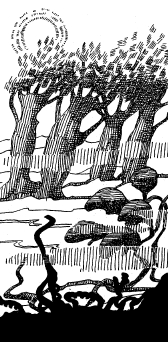
The plant life of Ssirik Akuar is black
rather than green; green plants do not
thrive in the available light. In the sunward
regions, some of these plants are
gray or silver due to the hairy or waxy
surfaces that shed excess light and retain
moisture. In most regions, however, the
vegetation has the color of pitch. Some of
the larger trees and bushes are streamlined
in the direction of the wind, having
oval-shaped trunks and sunward-pointing
branches. Others grow rapidly in periods
of greater heat and light, and occasionally
collapse under the impact of the strong
winds that follow. Still others avoid the
worst of the high wind by folding their
leaves or by moving about in search of
shelter. In general, the plant life of Ssirik
Akuar is more active than our own. To our
discomfort, we later discovered that these
plants may actively defend themselves
against animal life, or even attempt to trap
animals for food, either with viscous
leaves and simple water traps for small
creatures or with moving tendrils and
spiked branches or pits for larger creatures.
Many of these plants protect themselves
with secretions that make them
painful and often dangerous to touch.
Fungoid life is abundant on the Sunset
World and includes many motile forms.
Here we encountered a surprise. Many of
these lifeforms are sorts familiar to those
who travel the Underearth of our own
world. The significance of this at first
escaped us. Unfortunately, not all of our
researchers escaped the more aggressive
fungi.
No less surprising was Master Temrik?s
identification of an entire suite of animal
life already known to inhabit the Underearth:
the amorphs, as she is pleased to
call them. These include the crop of boneless
and shapeless creatures commonly
known as oozes, trappers, deadly puddings,
ropers, jellies, mimics, lurkers, and
the like. These, like the fungi, proved to be
a hazard. Envision a surface world in
which trappers may masquerade as gravel
banks or sandy clearings, and where ropers
may conceal themselves among the
stumps of the forests! Fortunately, these
creatures were not a significant menace to
our campsite itself once we posted guards.
The second and dominant form of animal
life was more actively dangerous.
While these were less familiar to students
of the Underearth, they do indeed have
representatives in our own world. They
include the Illithids, of course, but more
surprisingly, they include the creature
known as the carrion crawler and possibly
some other less-known denizens of the
deep passages. Just as the dominant life
forms of our own world are of a common
plan, so too with the build of these creatures.
There is an internal skeleton of
chitin rather than bone. The skin is thick
and generally covered with a protective
layer of mucus (though in the sunward
regions it may be rough and sharklike
instead). There are two eyes, and in addition
to lungs, even the air-breathing forms
have gills (those that cannot breathe water
employ these during periods of extreme
exertion). Adults have four limbs with four
digits apiece.
Creatures of the Sunset World generally
go through a grublike larval stage in
which they have a variable number of
limbs; these larvae almost invariably grow
from eggs laid in corpses or masses of
rotten vegetation, though there are also
some more sophisticated adaptions as in
the case of the Illithid. The carrion
crawler is an example of a form which
never reaches the adult stage but reproduces
in the larval stage. A distinctive
feature both in larval and adult forms is
the presence of tentacles around the
mouth in some multiple of four. These
serve as organs of touch, taste, and smell,
but their primary purpose is to capture
and manipulate food. To this end, the
tentacles may be provided with suckers,
blades, or hooks, or covered with poisons
that kill or subdue. The most advanced
forms carry special subunits that break off
and act independently by injecting poison
or burrowing into the victim. The mouth
consists of a complex collection of hard
parts protected by an external beak.
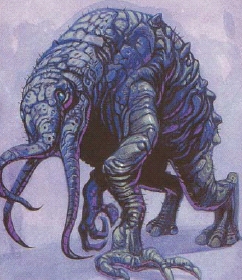
The dominant life forms are found in
great abundance on the land, and include
a number of batlike forms as well as amphibians.
We had little occasion to venture
into the larger bodies of water, but the
purely aquatic forms we encountered (as
much like cuttlefish or squid as like fishes)
were of the same general plan as the terrestrial
forms. Perhaps Ssirik Akuar also
holds the race known as the aboleth,
which shows a number of similarities to
Ssirik Akuar animal life despite notable
divergence. The pressure of time did not
allow us to explore the possibility.
The animals of Ssirik Akuar, particularly
those of the illithidlike body form, are
often sentient or semisentient. Many are
even resistant to magical or psionic attack
(the latter seems to be a side effect of the
former). Some of these creatures are even
psionically endowed.
These animals are capable of long periods
of inactivity followed by periods of
furious motion as they encounter prey or
predators. Their reflexes are exceptionally
quick, and they are strong and difficult to
kill, as we discovered to our chagrin on
more than one occasion. All are voracious,
as life in the habitable zones can be rather
sparse. As a result, creatures of this world
eat large amounts in short periods of time,
as the flesh and vegetation of Ssirik Akuar
are prone to rapid decay even at low
temperatures. In spite of the scarcity of
food, some creatures of Ssirik Akuar grow
to exceptional size. As formidable as they
are in our own world, Illithids are unexceptional
in their own.
Though there is some specialization,
most of the beasts of the Sunset World are
omnivores; palatable plants and subduable
animals are rare and not to be missed.
There are numerous large and small flying
forms which migrate back and forth over
the habitable crescent according to the
season and the creature?s preferred clime.
Likewise; some of the landbound creatures
are migratory. Other forms are
sessile and lie in wait for the migrants,
retreating to burrows if conditions be-
come too severe.
When our explorations of the Sunset
World?s natural history were well underway,
and we had achieved safety (though
not comfort) in our base camp on the
mound in the swamps, we began to fulfill
our primary purpose: an investigation of
the Illithids themselves. At first, we observed
from a distance and investigated
the numerous ruins we found. Later, we
made cautious observations of isolated
individuals at closer range. By this means,
we gained a basic knowledge of the Illithid
and its habits. Eventually, we were able to
supplement this with information gained
from the corpses of two confirmed solitary
individuals which were provided for
us through the efforts of Lord Aragson
and his men. All of this was time consuming;
for security, we had located our camp
far from Illithid activity.
Prior to our expedition, knowledge of
Illithid anatomy was scanty. The typical
Illithid garment (both in our own world
and on Ssirik Akuar) is a robe that conceals
all but hands, feet, and head. Illithid
bodies are rarely recovered for study, as
encounters with Illithids typically end in
the death of their opponents or the rapid
retreat of the Illithids. In those rare instances
in which Illithids are defeated and
killed before they can retreat, the tendency
of the flesh to putrefy quickly is an
additional barrier. Only a dedicated
scholar would be inclined to bring something
so noisomely unpleasant home for
study, and often the body is in poor condition
upon arrival,
The Illithid is much like other members
of the dominant form of animal life. The
skin is mauve over most of the body and
appears black in the light of Ssirik Akuar.
The iris and white of the eye are of the
same dead-white hue; in strong light, the
eye appears featureless, lacking any pupil.
However, in near-lightless conditions, a
vertical slit is visible. Close examination of
the light-adapted eye shows a series of
small pinholes where the pupil closes. This
accounts for stories that Illithids have no
pupil, since adventurers generally bear a
light source with them. It also vindicates
the illustrator of Gryriak?s Bestiary, who
shows Illithids with narrow-slitted pupils.
Presumably, a part of the Illithid dislike for
light is the near blindness caused by the
pupil?s extreme adjustment.
As frequently reported, the touch of an
Illithid feeding tentacle is deadly. Contrary
to the usual accounts (doubtless based on
observations made in the heat of battle),
the Illithid does not attach its tentacle to
the victim and simply ?draw out the
brain.? The process, as we have reconstructed
it, is more complicated and a
great deal more plausible. On firm contact
between the Illithid?s tentacle and the
victim?s head, a specialized subunit of the
tentacle detaches and burrows inward.
Once firmly lodged in the flesh, it bores
through the skull with a drill-like structure
and forms an extension that reaches
through the hole to touch the brain. Upon
contact with the victim?s brain, it disrupts
all functions, thus causing instant death.
The Illithid must direct this activity at
extremely close range (thus the common
perception that the Illithid tentacle remains
attached). Apparently, the Illithid
sends telepathic instructions to the killing
unit. We discovered by inadvertent experiment
that the burrowing halts if the Illithid
is slain or driven away, and that the
burrowing unit then becomes inactive and
may be removed with a knife (although
there is a danger of infection).
The ?drawing forth? of the brain of the
victim has (like most rumors) a basis in
fact. However, this follows the death of the
prey rather than preceding it; in addition,
it is a protracted procedure. When the
prey cannot resist and the process is not
likely to be interrupted, an Illithid places
its mouth in contact with the skull of the
victim at the point of the subunit?s entry
and removes a flap of skin. At this point,
some of the Illithid?s mouthparts function
as bone saws. They produce a hole about
half a handspan in width. The Illithid then
uses its complicated feeding apparatus to
remove and consume select portions of
the disabled brain.
It may seem that this is a rather involved
mode of nutrition, yielding a small return
for the effort and wasting a great deal of
potential food. Indeed, this is so. The
Illithid?s feeding apparatus is well-suited to
a wide range of other foods, including
ordinary flesh as well as certain seeds and
fungi. Illithids regularly eat a variety of
plants and animals, as was confirmed both
by observation of gathering expeditions
and from a catalog of the stomach contents
of our two specimens. Though Illithids
do seem to have a culinary
preference for the brain, and will select
that organ over any other, the primary
function of this most infamous habit is not
nutrition but reproduction!
Illithids are hermaphroditic and bear a
poorly developed larva from an opening at
a spot equivalent to the human solar
plexus. An Illithid carrying such a larva
will carefully remove the thinking parts of
the brain from some prey animal and
restore those parts which maintain the
body, carefully sealing off the blood supply
to the regions it has destroyed. The tiny
larva is then inserted into the skull cavity,
where it establishes a connection with the
nerves and blood vessels of the body. The
larva?s control is sufficient to allow for
swallowing and digestion of food provided
by the adult. However, this is insufficient
to support the growing Illithid. The host
body gradually shrivels and atrophies as
the larva draws on its reserves. As the
larva grows, it fills its host?s skull cavity
and then loosens the connection between
the skull bones so that the larva may expand
upward and outward. When the host
body is no longer useful, the larva metamorphoses
and emerges as an Illithid of
adult form, perhaps one-half to onequarter
of the normal size d&pending on
the size and type of host. Highly intelligent
hosts are preferred, presumably because
the skull can be expanded further and
possibly for subtler reasons associated
with the development of psionic powers.
In several cases, Illithids were observed
to carry out the initial series of operations
without placing a larva. The reasons for
this are unknown. Perhaps these were
failed attempts to complete the procedure,
or perhaps frequent practice is necessary
so that all will proceed smoothly when the
larva is ready.
We understand that the process of larva
placement is a reconstruction; in no case
did we observe the entire process. Our
find of a partially developed larva in the
dwelling of our second lone Illithid was
invaluable, as were the results of closer
investigations made at a later stage. While
it is not certain from our results on Ssirik
Akuar that Illithids can carry out the
entire cycle using human or humanlike
hosts, we strongly suspect so on the basis
of popular accounts and of hints dropped
by our githzerai guides. This has strong
implications for attempts at negotiation
with Illithids; overtures from creatures
that are regularly used in such a fashion
are not likely to be well received.
We observed a number of isolated and
peripheral individuals or groups living in
what one may suppose is the primitive
Illithid lifestyle. Like many of the Sunset
Worlds predatory creatures, Illithids must
locate scarce prey with a minimum of
effort. Their semimagical abilities serve
them well in this regard. The Illithid
chooses some safe burrow or cave and
projects itself astrally in search of food
while the body remains in a state requiring
little nourishment. These explorations
require little energy and entail little risk.
When a source of food is located, the
Illithid returns to its body and goes forth
either alone or in company, depending on
the effort required to harvest or subdue
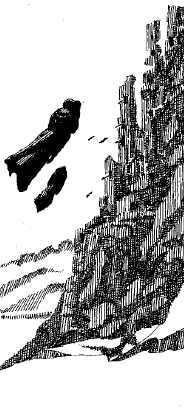
the food. An ability to pass over water and
mud unhindered and to levitate over difficult
terrain allows the Illithid to take a
direct route that involves little wasted
energy and reduces exposure to possible
hazards. Often the prevailing winds are
employed in conjunction with levitation;
the Illithid will rise up and let itself be
carried downwind toward its destination.
This is typically done only at low altitudes
or in foggy weather because of the danger
of airborne predators.
When prey is encountered at close quarters,
an Illithid?s ability to read and control
minds allows detection and capture of this
prey with a minimum of effort. If the
Illithids are in a group, they may coordinate
their activities mentally, or use verbal
and visual clues with a prearranged plan if
the quarry is psionically aware. If mental
control fails, an Illithid may use a blast of
mental energy to kill or incapacitate its
prey. Determined opposition usually
causes the Illithid to retreat for the simple
and logical reason that a weakened Illithid
might not survive the journey home. An
Illithid in the savage state is no safer than
a human in our own swamps and jungles
would be (perhaps less so). This habit
(which appears to have been learned in
Illithid prehistory) might well be the explanation
for the reported cowardice of
Illithids encountered in our own world,
where they are well known for fleeing any
encounter that begins to go against them.
However, such a hypothesis may be at
odds with what we later learned of the
hunting habits of civilized Illithids.
While solitary Illithids are widespread,
the majority of Illithids on the Sunset
World live in settlements of between 50
and 1,000 individuals. These settlements
generally consist of burrows and a cluster
of stone towers on the leeward side of a
hill. Entrances to the complexes are never
at ground level; they are only accessible
by air. This is presumably a precaution
against vermin and large predators, as
well as possible seasonal flooding. The
towers are of varying thickness and
height, and often have a cross section
determined by the prevailing winds.
Ranged about the central towers are the
orderly fields and pastures that provide
most of the settlement?s needs. Illithid
adults do not tend these; even junior members
of the community merely supervise
the work of various enslaved creatures.
Illithids abhor manual labor in any but
the most refined form, and have reduced
even the amount of labor that their slave
species must perform through extensive
alterations of the plants, animals, and
fungi around them. Meat and draft animals
and other servant forms are entirely
obedient and dependent, in some cases
requiring special dietary supplements that
only the Illithids have the skill to produce.
The various crops require little attention,
being largely self-regulating in form and
naturally resistant to invasion by weeds.
Even the towers themselves are grown
rather than constructed, being treelike
growths with stony skeletons. Many of the
Illithids? creations serve multiple functions,
as in the case of the fungi that provide
light, absorb waste, and serve as carpet
and tapestry in Illithid dwellings. The most
notable of the Illithid slave species is a
creature that has a form similar to that of
a baboon?the most Illithidlike of Ssirik
Akuar?s inhabitants. Nowhere did we
observe human or humanlike slaves. Our
githzerai guides volunteered that the
Illithids of Ssirik Akuar have abandoned
such practices.
Illithids of full-adult status spend much
of their time in the hunt, in various political
activities, in artistic and magical en
deavors (including the shaping of new
types of creatures), and in long periods of
meditation. The late Master Ponder Greymantle
made a particular study of the
hunting practices of the civilized Illithids
and followed several parties at a distance.
He found that the Illithids prefer intelligent
life for such sport (if sport it is), and
may pass up larger and less-intelligent
creatures for those that present a greater
challenge. These are by no means idle
amusements; the Illithids who participate
risk serious injury or death. Despite this,
while the hunters may feed on choice
portions of the kill, they are seldom concerned
to bring the remainder to their
settlements (even when the distance is
short). Their primary source of food is the
livestock and fields tended by their slaves
(and occasionally the slaves themselves).
Expeditions may reach far sunward or far
into the icy lands, though Illithids show
signs of discomfort in dry air or when the
temperature drops below freezing. The
Illithids? usual mode of attack is a wellplanned
ambush at highly favorable odds
for the Illithids. Pursuits of any length are
rare.
Illithid political activity is poorly understood
even after our closest studies. Apparently,
Illithid society is divided into
numerous tightly knit groups, all small and
all mutually opposed, although they may
be allied with other cliques for varying
lengths of time. It appears that members
of the same clique are often related to one
another. The typical Illithid embrace, an
interclasping of feeding tentacles, is seldom
seen except with members of a
clique. The reasons for this embrace are
unknown, but it is probably that signals
are exchanged; the tentacles are highly
sensitive to taste and touch. Significantly,
each partner in such an embrace is at the
mercy of the other. This is the only known
gesture of faith among Illithids. Open
violence between cliques is rare and most
often occurs in the form of ambushes and
assassinations rather than full-scale batties.
What body of law or custom regulates
these procedures and prevents a condition
of anarchy is unknown.
The third major Illithid activity is the
production of various artworks, books,
magical devices, and living creatures. This
is the only sort of labor that confers status.
Most frequent is the production of
new animals, plants, or fungi through
selective breeding or wholesale modification
The fields, stockpens, and slave quarters
contain many more odd individuals
than might be expected naturally, and the
various domesticated forms vary greatly
from settlement to settlement, apparently
in response to local fashions or conditions.
Peculiarly, Illithids were seen in one instance
to be breeding a new version of one
of the more formidable predators. This
would seem to indicate that there is some
yet undiscovered relationship between
Illithids and the creatures they hunt in the
wilderness.
Illithid art is seldom representational.
They seem to prefer abstract patterns of a
complex and angular sort, in colors that
are rather muddy to the human eye. Their
few depictions are generally of violent
scenes: hunts and conflicts between
Illithids. One particularly vivid mural
confirmed part of our story of Illithid
reproduction and provided an additional
bit of information: it would appear that
the ultimate triumph is to use other Illithids
as food for one?s larva.
Illithids produce numerous books and
scrolls, but we found those we examined
to be either entirely factual or completely
incomprehensible. If Illithids produce
fiction, this is not immediately evident.
Neither did we observe Illithids to erect
shrines or temples or spend any time in
worship; reports that they have no deities
are evidently correct. It is also notable that
Illithids seldom assemble in large groups
except under the most unusual circumstances.
Only once during our stay did we
observe such an action.
Iliithid meditation remains a mystery to
us. We thought at first that astral projection
took place during these sessions, but
careful measurements showed this not to
be the case. An Illithid engaged in astral
projection generally does so from a sealed
room, whereas meditation seemed to
occur in any sheltered spot. Perhaps the
missing worship of deities occurs during
these states, or perhaps these sessions are
merely a form of rest. Whatever the case,
this practice consumes a great deal of an
Illithid?s time.

We gathered much information from
peripheral observations, from the two
captures of which I have spoken, and from
a few daring forays into vacant Illithid
dwellings. Having mastered Ssirik Akuar?s
considerable natural hazards, and having
operated undetected at the fringe of Illithid
civilization for some time, we began
the final phase of our work. Here Academican
Kratanitkul?s particular gifts came
to the forefront: his ability to mimic the
appearance of Illithids and their slave
species and even to counterfeit certain
Illithid abilities proved invaluable. These
abilities served him well in his investigations
of Underearth societies. Academician
Kratanitkul and his assistants began a
period of extremely close observation.
In retrospect, we had grown somewhat
overconfident, perhaps pardonably so in
light of our prior successes. When our
guides became aware of our new plans,
they grew greatly agitated. The Monzari
had become increasingly distant and unhelpful
over the course of our stay, but
when we refused to reconsider our
course, they withdrew entirely to their
tents and would say nothing further.
In the beginning, our operations were
highly successful. Assistant Master Toliklos
will be able to present you with four
books of Illithid manufacture that cast a
great deal of light on Illithid life, though
they raise more questions than they answer.
Much of what I have told you concerning
the Illithids was supplemented or
confirmed during this period. It was a
time of great hope and great interest; it
was, however, unfortunately brief as well.
What final error Academican Kratanitkul
made we will never know. I fear his end
was not a pleasant one.
Fortunately, we had some warning:
Academican Kratanitkul and his associates
were tardy, but this was small reason for
concern as the difficulties of travel on
Ssirik Akuar sometimes make for long
delays. More worrisome was the failure to
locate them through scrying spells, but
these often go awry when the subject is
within or beyond a large concentration of
creatures resistant to magic. Our guides?
dogs, the szarkel, gave us our first clear
intimation of trouble.
It was the habit of the szarkel to run
about the camp unhindered. (This had
been cause for considerable friction between
the githzerai and our own people
because of the intractability of the dogs.)
The creatures did so pow, but mostly at
the perimeter, running back and forth,
sniffing at the wind, and staring intently
into the distance. Their masters stood
rigidly at the entrance to their tents, as if
listening. Abruptly, both dogs and githzerai
entered their dwellings. During this
time, the githzerai spoke not a word to
one another, and refused to acknowledge
our questions. When Lord Aragson would
wait no longer and followed the githzerai
in his desperation, he found their tents
empty. We never saw them again.
The assault was sudden. Lord Aragson
will give you the full account of it. It seems
that the Illithids were also overconfident.
While tragic, our losses were small in
proportion to the losses suffered by the
force that came against us. It is well that
we were prepared for a sudden departure,
however. When the Illithids retreated
from our unexpectedly strong
counterattack, we had time to make good
our escape before they could gather reinforcements.
So far as we can determine,
we were neither pursued nor traced. Our
journey homeward was as uneventful as
our outward faring,
There is one matter I have left for the
last, and for a purpose. You will recall that
we were encamped on a ruin. There are
many such on Ssirik Akuar, most of them
clearly of Illithid construction and presumably
abandoned as a result of climate
changes. We found a number of these
ruins in the salt desert. I urge you to examine
Master Kuro?s report most carefully,
but the gist of it is this: While most of the
sites had been stripped of all artifacts but
for the constructs themselves, a few
mounds were different.
We found traces of an outer wall of
stone blocks and buildings with entrances
at ground level. Below the water table
were organic remains preserved in the
acidic soil: traces of grain and straw, a few
charred timbers of pine and oak, fragmentary
skeletons of horses, cattle, and geese.
A few simple tools survived, and there
were many spent arrows. There were
other remains, too?human for the most
part, though one of the partial skeletons
may have been that of a gnome or small
dwarf. The skulls we found bore marks of
Illithid predation. All these traces and
remains were ancient in the extreme.
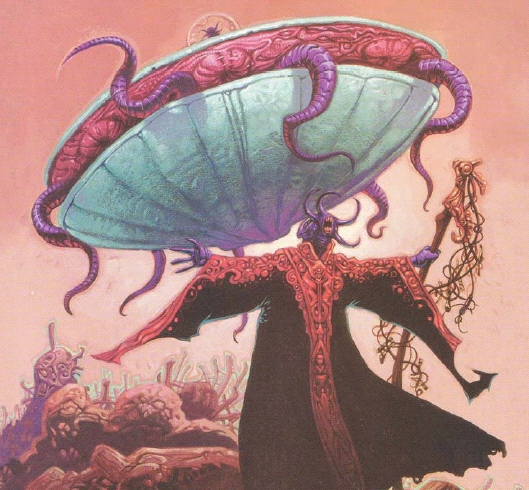
The meaning of these findings has been
much debated on our return journey and
during the time since our return. The
evidence is hardly conclusive, but I will
put forward the conjecture which best
suits the facts as I know them. Ssirik
Akuar is not the Illithid homeworld, as our
taciturn githzerai guides had implied. It
was once much like our own.
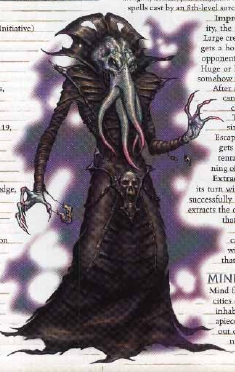
There is a persistent rumor among the
folk of the Underearth that the Illithids
seek to extinguish our Sun. This has very
properly been dismissed as foolish, wishful
thinking on their part. The Illithids
could no more thrive on a sunless surface
than could we. Within years or even
months of such a ludicrous outcome, the
planet would become an icy wasteland
unfit for any sort of life. The ruins we
found at Ssirik Akuar suggest to me a
more plausible and sinister story.
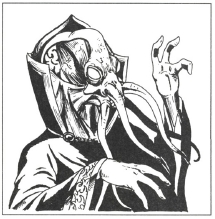
Much still remains to be explained, and
many more questions have been raised by
this final discovery. Where did the Illithids
originate if not on Ssirik Akuar? Why did
the githzerai assure us they had brought
us to the Illithid home world? Why should
the Illithids, if they produced the Sunset
World?s present conditions, have stocked it
with so many living things inimical to
themselves? How could such changes of a
world and its sun be accomplished? These
are difficult questions. Rather than answer
them, many of my colleagues would rather
suppose some other explanation for what
we found at Ssirik Akuar.
I confess that I find such questions less
than compelling. I am torn between a
certain lassitude?we are all of us tired
still from our sojourn?and a furious urge
to action, to any action. I feel a certain
chill at day?s end: perhaps only a relic of
Ssirik Akuar?s damp airs, but perhaps
something more?perhaps a chill of premonition,
a growing certainty that my
colleagues and fellow adventurers died not
merely in the service of learning, or even
for our Empire, but for something greater
still. They died so that we survivors might
bring this warning. I look at the Sun now
and wonder if it has grown somewhat
redder. Are the days and nights longer
than they were? As I contemplate these
thoughts, a further chill runs the length of
my body. Perhaps one day we, too, will
dwell in a Sunset World.
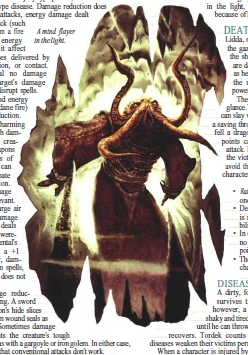
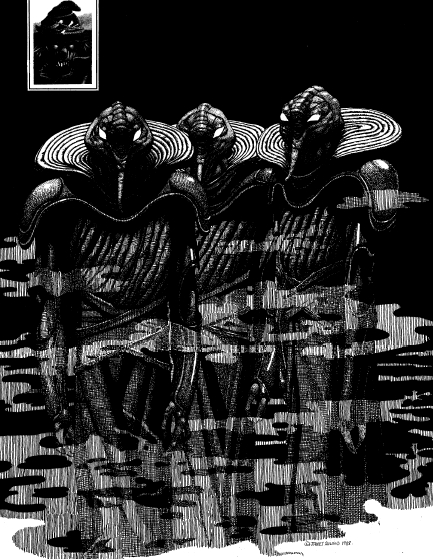
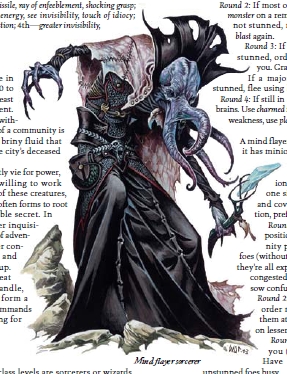
A mind flayer in the light.
More information on mind flayers may
be found in "The Ecology
of the Mind
Flayer," in DRAGON®
issue #78. The material
in this article and in "The Dragon's
Bestiary" may be used with the material
on mind flayers in the AD&D® 2nd Edition
Monstrous Compendium, Volume 1, with
some changes, particularly concerning the
use of psionics and methods of Illithid
reproduction.