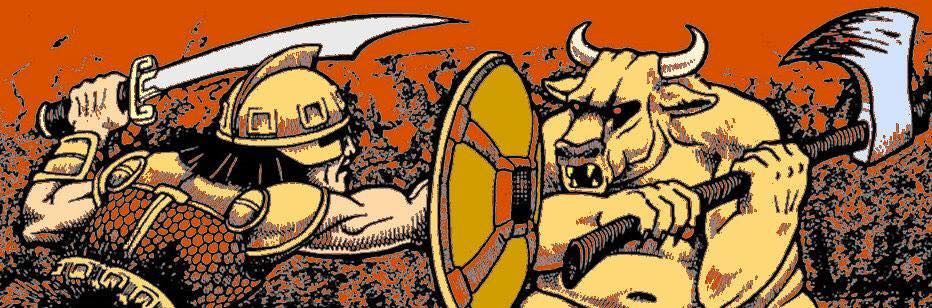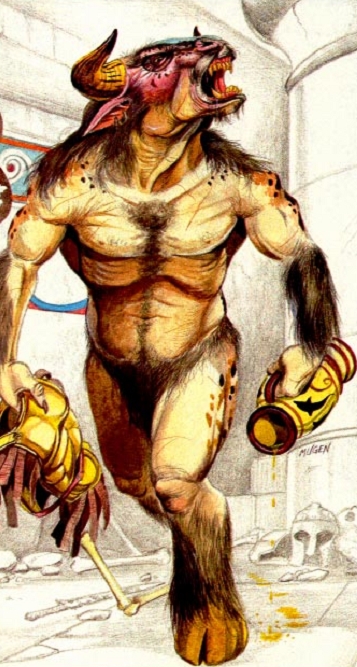
| Dragon magazine | - | Monster Manual III | - | Dragon #116 |
It was on the 5th of Fishspawn, in the
year 425 of the Dancing Unicorn,
when
my caravan was attacked and taken by a
large band of orcs. Amongst this horde
were several ogres and minotaurs serving
as mercenaries in the pay of the orcish
chieftain, Garkun Three-Fingers, who was
slain in the following month in the elven
lands. After the caravan?s defeat, several
other unfortunates and I were given over
to a large bull minotaur as part of the
plunder, and thus began my captivity
among the horned ones.
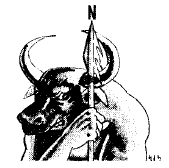
As I, more than any other human I
know, have spent more time in the pres-
ence of minotaurs, I have taken it upon
myself to write this brief narrative of
their
lives and habits. During my captivity,
I
observed in detail the society (such as
it is)
of these bestial folk, and was able to
pro-
long my life by using this information
to
its best advantage in dealing with my
lord
and his monstrous people.
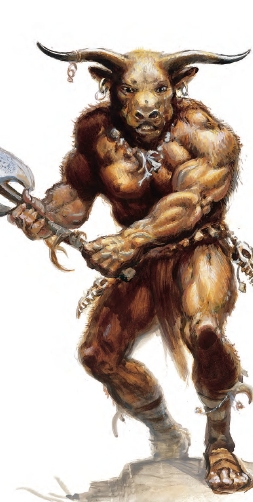
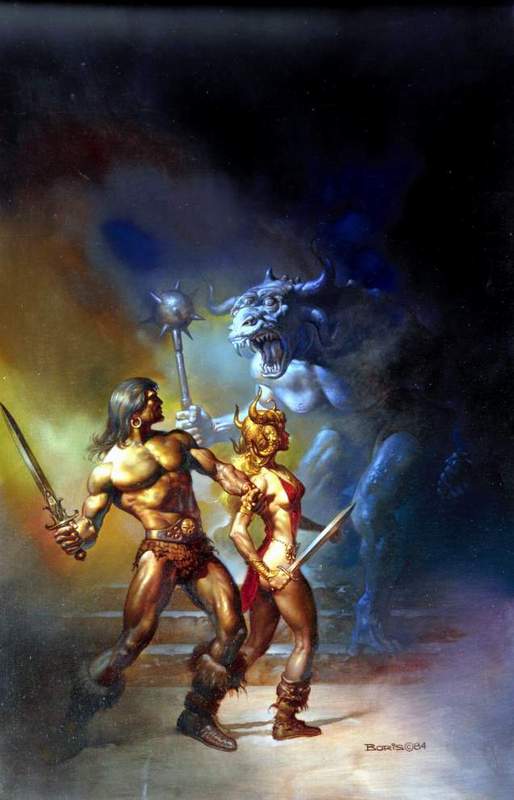
Of their appearance
For the benefit of the masses, I shall
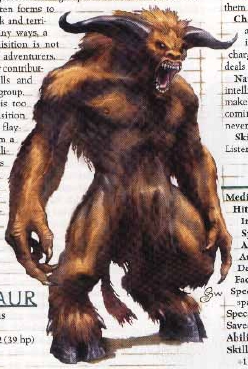
here note the obvious. The minotaur is
a
large, bipedal creature; a manlike beast
with a bull?s head, hooved feet, human
hands, and thick, wiry hair on the head,
forearms, lower abdomen, chest, and
lower legs. Bull minotaurs often attain
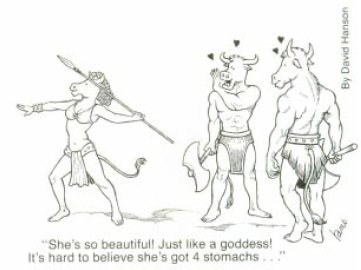
nine feet in height; females are generally
somewhat shorter, perhaps seven feet on
the average, but of no less savage a
temperament.
The lower body and torso are similar in
general appearance and build to those
of
ogres, although hairier. Females have
breasts and broad hips similar to those
of
most humanoid types. The minotaur?s
hands are massive and have thick yellow
nails, which occasionally serve as claws,
though they often break.
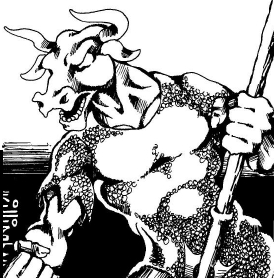
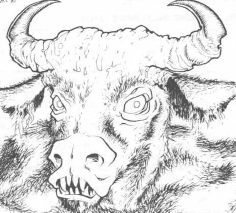
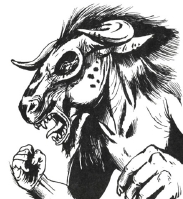
As is common knowledge, the head is
bovine in appearance, but there are many
differences to the careful observer. The
snout is thicker and more drawn out than
that of an actual ox. The teeth, particu-
larly the canines, are large and pointed,
for minotaurs are carnivores of the most
fell sort and regularly bite at their
enemies
and prey. Occasionally, the canine teeth
protrude even when the mouth is closed.
The eyes are set more forward and closer
together than those of actual cattle,
grant-
ing minotaurs depth perception.
The head is heavily furred, with the hair
color ranging from black to a light red-
brown tone. Bodily hair is the same color
as the head hair, although somewhat
shorter and stiffer. The large, deep eyes
are generally a dark brown. The horns
of
the minotaur are structurally similar
to an
ox, consisting of a horn sheath over a
central bone core. Both sexes possess
horns, although those of the male are
larger and heavier. The horns normally
curve slightly forward, although they
may
be broken or bent at an odd angle from
old injuries. I have heard that some mino-
taurs possess the tails of cattle, but
those I
knew had no tail at all.
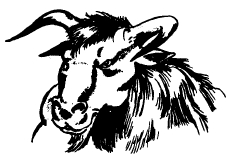
The horns of a bull minotaur are his
pride. Certain free moments of his leisure
time are spent polishing their length
with
old furs or rags, or sharpening their
tips
with stones. The color of the horn varies
with the color of the hair, although bi-
color and tri-color horns are not uncom-
mon. Dark-haired minotaurs generally
have dark yellow or yellow-brown horns.
The minotaurs I was among seemed to
favor darker horns for cultural reasons
?
and to this end, they oiled and stained
their horns to achieve a dark tone. The
horns were often decorated in one man-
ner or another, being often studded with
decorative brass or silver tacks and spikes.
I saw one minotaur whose left horn had
apparently been severed by an axe blow;
the horn had been rejoined and secured
by an etched band of brass, through the
artifices of a gray dwarf who served as
the
band?s blacksmith.
Other than horn ornamentation, mino-
taurs wear little in the way of decorative
jewelry. A few of my acquaintance wore
studded gauntlets or waistbands, which
obviously showed ogrish influence. Mino-
taurs are hardly above copying a style
or
mannerism used by other races, since they
have so little to contribute on their
own
save their native barbarism. If a said
deco-
ration is seen to enhance one?s fearsome-
ness, every minotaur who sees it will
adopt it at the drop of a hoof.
Of their growth
Minotaurs breed and give birth through-
out the year, and their society favors
re-
plenishment and increase of their
numbers. A single minotaur is usually
born to a cow; twins are rare and re-
garded as holy. By its second year, a
young
minotaur has fully developed horns and
can fight an orc on equal footing. By
its
fifth year, a minotaur is larger than
a man,
and by its tenth year, it has attained
adult
size and mannerisms. Sexual maturity
comes early, even by the third year in
some, and breeding likewise begins
quickly for them. To bear a warrior son
is
the highest act to which a cow may aspire;
to father a great many warriors is merely
another social ornament for the male.
Young bulls are tutored in the use of
weaponry by their sires and other males.
The youths spend much of their time
wrestling and fighting among themselves,
as rivalry between bulls is fostered virtu-
ally from birth. Few cruelties are spared
in their battles, and the scars from horn
and tooth of one?s early battles with
other
minotaurs serve to strengthen the warlike
charisma that the bulls prize so highly.
There is little maternal affection among
minotaurs. A young bull shows respect
to
a female, even its mother, only as long
as
she is physically superior to him. The
world of the minotaur is rooted in brutal-
ity and force of might, and females are
barely more than slaves among them.
When he reaches maturity, a young bull
may wander widely to avoid contact with
older, stronger bulls. Solitary minotaur
encounters are usually of this type. My
master was fond of boasting about his
exploits during this time of his life;
he
cared little for civilized marvels, being
intent upon showing his mastery over the
world at large through acts of wanton
violence and destruction of the basest
kind. No barbarian warlord has known the
utterly bestial worship of a minotaur
for
that which we call wickedness.
The minotaur?s lifespan may be as long
as eighty years, but because of the vio-
lence inherent in their life-styles, few
live
to even a ghost of this age. My master
was
a veteran of perhaps thirty winters, past
his prime but still one to be feared and
reckoned with by anyone of reason.
Of their society
To speak of minotaur society is perhaps
as senseless a remark as to speak of the
art of the orcs, yet certain traits become
obvious to anyone even crudely familiar
with this species. Particular practices
vary
to extremes between tribes of minotaurs,
being snatches of other cultures and be-
ings, adopted by minotaurs for a short
time ? only to be discarded as soon as
a
new practice is seen. I witnessed the
sud-
den appearance, spread, and disposal of
a
hundred practices during my captivity,
borrowed from every source within
imagination ? even from mortal enemies.
Polygamy suits minotaur bulls well; a
strong bull may maintain a harem of up
to
six or seven females. Infanticide is rarely
practiced by minotaurs, save for deformed
births, despite their desire for more
bulls.
I have mentioned their concern with con-
stant breeding and increase of their num-
bers. Even the birth of twin cows
(considered an evil portent by some tribes)
is better than no births at all. A cow,
at
least, can take her frustrations out upon
the slaves kept either in common or by
a
particular bull. I have been too well
ac-
quainted with this practice myself, though
I found ways of avoiding such unwanted
attentions from the harem kept by my
own master. I dwell more upon the lot
of
slaves elsewhere.
Bull minotaurs engage each other in
combat over plunder, females, positions
of
authority, and any other possible point
of
friction that may be imagined. The leader
of a raiding party or the dominant bull
in
an area is always the largest and strongest,
but not necessarily the most intelligent.
In
such combat, the antagonists grapple
weaponless, seeking to kick, bite, or
gore
each other into submission or an early
grave. One or both of the opponents in
such a duel may end up fatally wounded
?which is often what was intended by
the victor. A minotaur killing another
in
combat typically takes the left horn of
his
victim as a trophy. The tip of the horn
is
then removed so that it can be winded
in
battle or celebration. Such horns are
highly prized; my captor owned four.
Slaves are usually supervised by females
or young bulls and are employed in en-
larging and adding to the labyrinthine
minotaur lair. Minotaurs are not especially
vigilant in overseeing their slaves. Escapes,
at least temporary ones, are commonplace.
The chief recreation of bull minotaurs
(when not out raiding or drinking) is
track-
ing escapees through the lair or overland.
Perhaps one slave in two makes the escape
a permanent one; of the one who fails,
little can be said, save that perhaps
it is
better that minotaurs do not share the
love of torture that other monstrosities
(human and otherwise) relish. I digress,
but here I shall note that a minotaur
re-
gards death as a holy thing that should
come quickly, cleanly, and in combat.
If
the opponent has no weapons, at least
the
fight is ended much the sooner, and the
victor can enjoy the status of another
kill
(though it will be of little worth, as
they
give more honor to kills against powerful
and dangerous foes). A minotaur who has
slain thirty men or orcs in a battle would
not be held in half the respect accorded
one who killed an ogre or another
minotaur fighting for the opposition.
Minotaur favor twisted mazes in places
underground or in dense forests for their
lairs. My captor was lord of an area com-
monly referred to as the ?Forest of
Thorns,? which was reputedly once an
elven woodland burned by orcs. In this
place, great thorn trees, thick as a man?s
thigh, grow and intertwine to the the
point that they block the very sun.
Through this dismal wood, the minotaurs
had chopped a great maze of tunnels and
chambers, forming a nightmarish dwelling
that seemed to have no end.
Yet, this series of passages, hopelessly
confusing to a civilized mind, is navigated
by the minotaur with surreal ease. I be-
lieve this ability is due largely to the
mino-
taur?s acute senses (especially the olfactory
one), though perhaps an inborn trait is
present which allows the minotaur to
puzzle out geometry with the skill of
the
eldest mathematical savant of any univer-
sity. A minotaur can retrace its own trail
through an unknown area with uncanny
accuracy, its nostrils flared and snorting
at
the scent that it leaves ? yet I heard
of a
minotaur called Faceless, which had suf-
fered a severe facial wound that destroyed
any sense of smell which it must have
had,
but was capable of the same feat.
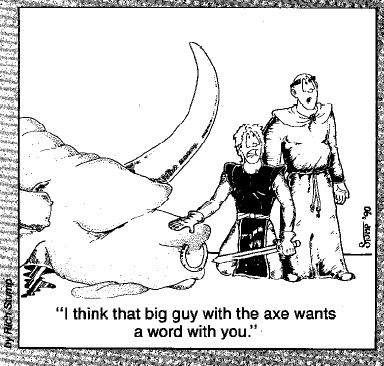
In armed combat, minotaurs favor weap-
ons that kill by concussion ? a crude
strategy, but one appropriate to their
nature. Their favored weapon of choice
is
by far the two-handed poleaxe. Stoutly
functional, these axes are rather crudely
made. During my captivity, I never saw
any means by which the minotaurs might
have produced these themselves; I believe
they obtained their weapons in trade from
orcs or hobgoblins. Minotaurs also employ
massive two-handed hammers, clubs, or
flails. Occasionally, they use stout,
thick
spears, although only as thrusting weap-
ons; I have never seen a minotaur throw
a
spear or other weapon, save in
frustration.
Minotaurs prefer the company of ogres
or other minotaurs. They have a grudging
respect for trolls and, one would assume,
also for giants. They look down on the
human, humanoid, and demi-human races,
making little distinction between them,
save as individual combatants whom the
minotaurs must fight and conquer. True
monsters, like dragons, are merely
opponents.
Minotaurs are exceptionally fond of
alcoholic drink, especially strong ?hard?
liquors and wines. Three times in the
company of visiting ogres, I observed
my
captor drink himself into a stupor that
lasted for several days (as, indeed, his
brutish guests did as well).
The language of the minotaur is very
similar to that of the ogre. As I was
some-
what familiar with ogrish, I was soon
able
to overcome the differences between the
two tongues. Aside from their actual spo-
ken language, there are a few vocaliza-
tions common to minotaurs alone. When
enraged or excited, a minotaur bellows
in
a manner reminiscent of an actual bull.
When pursuing prey or searching for a
hidden enemy, a minotaur gives out a
snort every few seconds, in an attempt
to
acquire possible scents.
The majority of minotaurs worship the
demon lord of their kind, Baphomet, to
a
greater or lesser degree. A Jovite high
priest has since told me that he believed
them to be a special creation of Geryon
from original ogrish stock, but I harbor
my doubts. Other creatures mix the nat-
ures of two or more basic beasts, such
as
the centaur and the pegasus, yet we have
no sure knowledge of how they came to
be so, either. The gods will have their
way.
I never heard the name Geryon mentioned
by any minotaur, though they freely called
out the name of their own lord in curses,
oaths, and taunts.
Minotaur bull-priests are easily recog-
nized from other minotaurs. Their horns
have series of crude pictograms carved
into them; these ?runes? are then dark-
ened with blood, and the horn is coated
with a dull yellow stain so that the carv-
ings stand out in vivid contrast. In addi-
tion, the bull-priests have themselves
painted with natural stains from earth
and
plant matter, and splash the blood of
slain
enemies upon themselves after battle.
Gnoll blood is favored for some reason
that I cannot explain, though some sage
who has other knowledge of these beings
may know the answer. Sacrifices are gen-
erally conducted in a central chamber
of a
bull-priest?s labyrinth, usually before
bat-
tle. Humans are the most common sacri-
fice, as they are the most easily available.
It is reputed that if such a sacrifice
is
especially pleasing to the lord of mino-
taurs, it is consumed by a ?cold flame.?
The passageways leading to such sacrifi-
cial chambers are decorated with the
bones of previous victims in curious,
intricate patterns.
Minotaur bull-priests are given some
measure of grudging respect by other
minotaurs, but this is always dependent
on the physical strength of the priest
himself. A battle horn made from a carved
bull-priest?s horn is highly regarded
by
minotaurs, so I assume the bull-priests
may be slain by their fellows with the
same facility as any other minotaur.
Overall, minotaurs are ignorant in the
ways of magic. They are not curious,
awed, or even amused by the ways of spell
casters; magic is either a threat or arro-
gantly ignored. For this reason, minotaurs
may be easily duped by even the simplest
of magic, although illusions must be of
the
most superior sort to trick the minotaurs?
keen senses. Minotaurs place no special
value on magical items in a treasure
hoard, although they may be aware of the
items? value to other creatures. Magical
items are soon traded for liquor or other
prizes (unless the item is a weapon),
so a
minotaur?s hoard rarely contains many
such dweomered things.
Of my escape
For two years and two-hundred seventy-
one days, I dwelt amongst these bestial
creatures, and I came to know them as
well as perhaps any could. I knew their
smell, their curses, their triumphs, and
their rage. I can close my eyes now and
see my old master, doubtless now a mere
skeleton on a forgotten battlefield, his
offspring raiding and looting with their
own savage tribes.
Many slaves were taken by my master?s
folk, but only I was favored enough to
be
kept alive, even when food was in short
supply and my master?s massive frame
shrank from starvation. I could not have
run from him, having a disabled knee
from the day of my capture, and I had
no
muscles with which to fight him directly
? but I was a student of spatial geometry
before I took up my father?s business
and
became a merchantman, and my teachers
said that my ability at drafting was
uncommonly sharp.
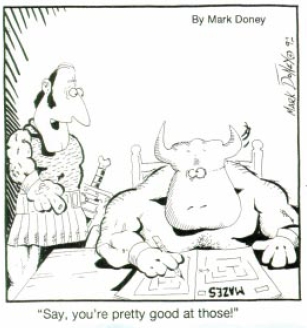
Thus, I survived by teaching my master
puzzles. From the first, trembling moment
when I handed that evil beast-lord a scrap
of parchment with a maze drawn thereon,
to the next thousand nights that followed,
my life was wholly dependent upon my
ability to create a fresh, new maze for
my
master to solve. He could not use his
nose
to solve it, you see, so only his eyes
and
brain were of use ? truly a challenge
for
any of his kind. No man can imagine how
slender a thread held me from destruc-
tion, save for my own terrorized ingenuity
at creating brain-teasers, one per night,
to
keep that bull amused. Though he told
me
that he would slay me outright if any
of
my designs failed to challenge him, I
be-
lieve that toward the end he came to be
rather fond of me, and even kept other
minotaurs who would have slain me for
my poor meat away from my person at
risk of his own life.
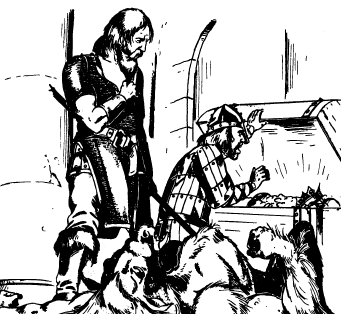
Such are the ways of the gods. When the
scout force for Lord Darduin's dwarven
legions rescued me in the heat of a pitched
engagement, I had bettered my own un-
derstanding of mathematics to the highest
degree, and now spend my days at this
university, a teacher and scholar -- and
a
free man.
Perhaps I should be grateful, but surely
you understand if I wish it had been oth-
erwise. When the weather changes and
my knee aches, I sit and remember those
days at my master?s hooved feet, and wish
I could forget.
Additional notes
1. Minotaurs are very adept at tracking
and trailing. They have a base 50% chance
to trail a man-sized creature. This base
is
modified upward 5% for each additional
man-sized creature in a tracked group.
The base is modified downward for envi-
ronmental and terrain factors, or a pur-
sued party's effort to conceal its scent
trail
(see Unearthed Arcana, page
21-22, for
possible additional factors). A minotaur
has
a 20% chance to trail prey without the
use of smell, using its other senses alone
?
especially its 90? infravision. This base
chance is decreased 2% for each melee
round elapsed since the creature passed.
The base is also modified (at the DM?s
option) for environmental and terrain
factors.
2. Due to its keen senses of smell and
hearing, a minotaur has a 20% chance to
detect invisible creatures. The base chance
is increased upward by 3% for each addi-
tional man-sized creature present.
3. A base 75% chance is
given for a
minotaur to retrace his trail through
an
unfamiliar area using all senses; without
the use of smell, the base drops to 45%.
-
4. A base 25% chance is
given for an
individual fluent in ogrish to correctly
interpret anything said by a minotaur.
5. Minotaur clerics reach
a maximum of
3rd-level clerical ability. Such clerics
can-
not cast healing spells. At 3rd level,
they
gain a spell identical to the second-level
magic-user spell strength.
6. A minotaur's contempt
of magick can
work to its disadvantage. For example,
a
minotaur would be loath to retreat from
a
magic-user
-- even in the face of major
offensive spells such as fireball. Its
conceit
for its ability would force it to withstand
the blast.
7. A minotaur, in addition
to biting and
goring, may kick with one hoof for 2-7
hp
damage or may strike out with one nailed
fist for 2-5 hp damage per round.