| The age of the samurai | Insight on war and combat | Samurai codes of conduct | Publication information | - |
| - | - | Part II | - | - |
| 1st Edition AD&D | - | Dragon #122 | - | Dragon magazine |
I cheered when the AD&D®
game’s
Oriental Adventures
rule book appeared
on the market. The monk class in the
original Players Handbook gave a
small
hint of what Oriental role-playing might
be
like, but the flavor of an overall campaign
just wasn’t there. Now, with the new
rules, considerable campaign material is
available — but there is a void where
reference works are concerned. Roleplayers
have access to numerous books
and resources concerning gaming with a
medieval flavor, but similar material on
Oriental worlds is harder to find. Players
or DMs just beginning to game in an Eastern
setting can be as confused as students
of Zen trying to understand the Wall
Street Journal.
The back of Oriental Adventures does
contain a bibliography
of books that were
used in one way or another to research
the tome. Most of the works listed are
historical, sociological, or philosophical;
though they are good resources, DMs
whose knowledge of the Orient is limited
to Lee Wing’s Take-Out down the street
may find the list a bit intimidating. Many
of the titles are self-explanatory, like
The
Art of War, the historical texts,
and those
referring to weapons and armor. But an
average DM, who thinks “sushi” is apeman
talk for “Susan” may have trouble
with A Book of Five Rings and will
be
totally confused by titles such as Budoshoshinshu.
A short survey of a few
especially significant books in the field
may help these bewildered DMs get back
on the path toward successful Oriental
gaming.
I will not “review” all of the books in
the
strictest sense of the word because of
their philosophical nature — I will briefly
summarize their contents, and if an opin-
ion or two slips in, please forgive me.
One
other prejudice of mine is that my knowledge
extends mostly to Japan, while Oriental
Adventures states that it combines
all
the Far Eastern cultures, which include
China, Japan, Korea, Thailand, and others.
Though the titles of these books may
sound obscure, many of them can be
found in or ordered from general bookstores.
Some can also be ordered by mail
from Kodansha International (10 East 53rd
St., New York NY 10022). The editions
listed at the end of this article might
not
be the only ones available, as these books
are translated from the original languages
and (in many cases) from manuscripts
hundreds or thousands of years old. A
word of warning: When shopping in a
general bookstore, avoid books with the
word “ninja” in the title. Most of these
describe the American movie villains, not
the true Japanese characters, and cannot
be considered authentic.
The age of the samurai
The Tokugawa era, dating from 1600 to
1868, is one of my favorites, as well as
the
source of most of the material on the
samurai
in Oriental Adventures. A
befuddled DM may now say that he’s read
Shogun and seen the TV mini-series,
so he
need go no further. True — if he doesn’t
want to understand the true nature of
historical Japan. Shogun is the
story of
Tokugawa Ieyasu, a real historical figure
whose name was changed to Toranaga by
author James Clavell. Shogun is no better
than a Western played by actors in Oriental
garb. It has been said that our effort
to
make a “samurai movie” is as bad as most
Japanese attempts to make horse operas.
A book closer to the Japanese spirit is
Eiji Yoshikawa’s Musashi. While
Musashi is
not mentioned in the Oriental Adventures
bibliography,
A Book of Five Rings is —
and its author, Miyamoto Musashi, is the
subject of Yoshikawa’s story.
Musashi is about the life of Miyamoto
Musashi, a historical figure who lived
at
the beginning of the Tokugawa era and is
said to have been Japan’s greatest swordsman.
We begin at the battle of Sekighara
with the young Musashi (known then as
Takezo) finding himself and his friend
Matahachi alive after the terrible conflict.
They take refuge with corpse robbers, a
mother and daughter, who hide them until
a search for losing troopers has passed.
Takezo recovers quickly and returns alone
to his home province. Still a fugitive,
he
finds that his home village will not harbor
him because the garrison troops will not
allow it. He must live off the surrounding
land like a SAVAGE.
The local lord learns of the trouble and
bolsters the garrison with troops who
have no luck capturing Takezo. Then
Takuan, a monk, says he will capture the
fugitive with the help of Takezo’s childhood
friend Otsu. The two go into the
forest, where Takuan cooks over the fire
and Otsu plays her flute. These sounds
and smells lure Takezo to the fire, where
Takuan convinces Takezo to turn himself
over to the monks care so the garrison
will not harm the villagers. Takuan hangs
Takezo from a tree to humble his wild
spirit and also to show him why he should
value his own life. Here begins the pilgrimage
of the now-renamed Takezo, Miyamoto
Musashi. The rest of the book follows
Musashi along his Way toward his most
famous duel, at the age of thirty, with
Sasaki Koriro.
Musashi gives the feeling of what
it was
like to be a traveler upon the roads of
Japan at the beginning of the Tokugawa
era, along with great insight into the
nature
of one of Japan’s great heroes.
Although Yoshikawa added his own imaginative
details to the story, the characters
all have a basis in historical fact. No
one
will ever know now whether this
account of Musashi’s life is an accurate
one, because of the folk history that has
grown up around him and most of the
other prominent people of that era.
A Book of Five Rings was actually
written
by Miyamoto Musashi and is not an
easy book to understand. It is a book of
strategy. The translator’s introduction
is
probably the most useful part of the book
for DMs. It gives a short history lesson
about Japan during the time of Musashi
and about Musashi himself. The book is
Musashi’s guide to strategy, in which he
uses sword-fencing as the basis for a
greater philosophical doctrine. Elements
of
the book may be of use to DMs in gaming
as well as in everyday life, but individual
DMs must make their own judgments as to
which parts are most valuable. A Book
of
Five Rings is the type of book that
gives
new insights with every reading. Though
some sections are hard to understand,
others are quite straightforward in dealing
with the bearing and carriage of a warrior
in life.
Musashi’s sword-fencing method was the
Way of two swords, although he never
used two swords against a good swordsman.
This, and the idea that if one man
can beat ten then ten can beat a hundred
and a thousand can beat ten thousand,
form a large part of Musashi’s strategy.
Musashi is also the basis of the kensai
character in Oriental Adventures.
He
devoted himself to the Way of the sword
and, while on that path, discovered that
enlightenment in the arts could be seen
through sword strategy. After his duel
with Sasaki Kojiro, he looked back on his
life and on all the duels he never lost,
and
decided that they were not the result of
superior strategy, but of luck or fate.
Having decided this, he worked even
harder to understand the Way of the
sword, finally succeeding at the age of
fifty. Musashi never let up. During the
last
two years of his life, he forsook the comforts
of easy living and retired to a cave,
there writing A Book of Five Rings.
Musashi left us not only the folk legends,
but also several works of art. Paintings,
carvings, and examples of calligraphy
were left behind by Musashi, showing by
their existence that Musashi was a truly
great man. He was also said to have composed
songs and played musical instruments,
but no examples of these
achievements survive today.
Insight on war
and combat
Another book of strategy is The Art
of
War by Sun Tzu, which dates from
500 to
300 B.C. China. Any campaigner wishing
to
engage in a war with his character’s neighbors
should first pick up this book and
read it from cover to cover. Sun Tsu’s
insights into warfare apply to all situations
where two forces meet. They are so comprehensive
that it would take an entire
BATTLESYSTEM™
supplement for Oriental
Adventures
to catalog them all and list
bonuses for each advantage (a development
gamers should hope comes to pass).
Unlike A Book of Five Rings, The
Art of
War is fairly easy to understand
and
implement in a campaign. Where
Musashi’s book deals mostly with single
combat and its applications to large-scale
strategy, Sun Tsu’s is chiefly concerned
with large-scale battles.
Samurai codes
of conduct
Two other books authored by samurai
are about personal conduct and the behavior
of samurai in everyday life. The first
is
Hagakure (Hidden Leaves). This book
was
written by Yamamoto Tsunetomo, a
Tokugawa-period samurai who, after his
lord died, wished to commit suicide with
his family in the traditional manner ?
only this type of action had become illegal
under the Tokugawa rule.
This points out that it is necessary to
go
beyond Shogun in order to learn
about the
historical samurai. The scene in the miniseries
(if anyone can remember that far
back) where Toranaga falls into the chasm
during the earthquake and Anjin-san is
the
only one trying to save him is totally
inaccurate
? all of Toranaga’s retainers would
have had to commit seppuku had Toranaga
fallen in and died, so all the retainers,
not
just Anjin, would have tried to save him.
An
interesting story comes from the shooting
of that scene in Japan. One extra, not
understanding the way the director wanted
the scene to be shot, kept jumping into
the
chasm to save Toranaga because he saw
that as the most likely action for his
character
as one of Toranaga’s retainers.
When prevented from committing suicide,
Yamamoto retired to a monastery
and became a priest. Hagakure comes
from Yamamoto’s dialogues with a visitor
over a period of ten years. During this
time, Yamamoto relates to his visitor what
the true meaning of Bushido is and the
way in which a true samurai conducts
himself. The book is good, although sometimes
difficult reading for the player who
wishes to know how to accurately play a
samurai character.
Budoshoshinshu, like Hagakure, is
a
guide to the Way of the samurai. Written
in the early 1700s by Daidoji Yuzan,
Budoshoshinshu was intended to benefit
Daidoji’s offspring. The book served to
remind his sons what a true samurai
would do in various situations, many
pertaining to the readiness to do battle.
Daidoji wrote the volume because he saw
much laziness brought about by a hundred
years of peace, and he wanted to tell
his sons about the bearing of a samurai.
All the books I have mentioned are
excellent resources for the gamer who
wishes to add that extra flavor to his
campaign.
I enjoy role-playing, and I started
(as most of us did) by playing the medieval
ancestors I imagine that I once had. Now,
after a great deal of reading, I am ready
to
try to role-play in a totally different
feudal
culture. I don’t know if I’ll ever truly
understand the Japanese culture, but I
will
certainly enjoy myself while learning.
Publication
information
Mushashi. Eiji Yoshikawa. Harper
& Row/
Kodansha International: 1981; $18.75.
A Book Of Five Rings. Miyamoto
Musashi. Victor Harris, translator. Overlook
Press: 1974; $7.95.
The Art Of War. Sun Tzu. James Clavell,
editor; Lionel Giles, translator. Delacorte
Press: 1983; $8.95.
Hagakure. Yamamoto Tsunetomo. William
Scott Wilson, translator. Avon: 1981;
$2.95.
Budoshoshinshu. Daidoji Yuzan. William
Scott Wilson, translator. Ohara Publications:
1984; $6.95.
JUNE 1987
Part II:
. . . And a Step Beyond That
The designer's new list of Oriental references
by David "Zeb" Cook
| The age of the samurai | Insight on war and combat | Samurai codes of conduct | Publication information | - |
| - | - | Part II | - | - |
| 1st Edition AD&D | - | Dragon #122 | - | Dragon magazine |
In the two years since I finished Oriental
Adventures,
my enthusiasm for Oriental
topics has not waned. Having read Mr.
Bunnell’s additional readings, I would
like
to add a few more I have found since the
completion of the Oriental tome.
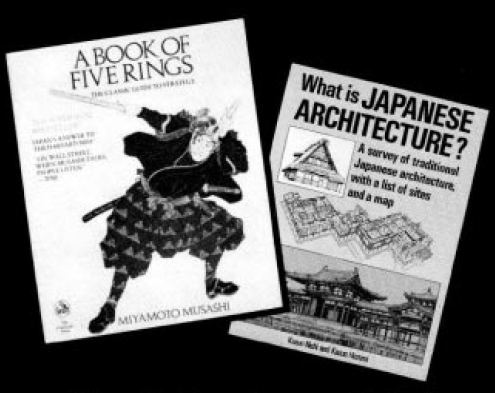
What is Japanese Architecture? Kazuo
Nishi and Kazuo Hozumi. (H. Mack Horton,
trans.) Kodansha International Ltd.: New
York, 1983. If you are a DM interested
in
running an Oriental campaign, do yourself
a big favor and buy or borrow this book.
Written in a clear style for non-architects,
the book covers all types of buildings
in
traditional Japan. More important to roleplayers,
almost every page has sketches,
floorplans, and maps of the buildings
described in text. Sections cover temples,
shrines, mansions, castles, towns, teahouses,
construction techniques, and
more. Armed with this book, you can
produce a map or a description for nearly
any Japanese-style building.
The Taiheiki: A Chronicle of Medieval
Japan. (No author given.) Charles
E. Tuttle
Co. (no date). Although it reads like a
novel, this book is actually a history
of the
events of 14th-century Japan, when the
Emperor Godaigo inspired the overthrow
of the Ashikaga shoguns. Written at the
time the events occurred, the Taiheiki
is a
history of intrigue and warfare. With the
massive numbers of names and relationships,
the book is not light reading. The
events, however, are presented in a
straightforward and clear fashion. For
the
role-player, the Taiheiki describes life
and
combat in a classic period of Japan’s history.
Much can be learned about dress,
etiquette, titles, and more from the book.
Ugetsu Monogatari (Tales of Moonlight
and Rain). Ueda Akinari. Charles
E. Tuttle
Co. (no date). Written in the 17th century,
this is a small collection of stories dealing
with ghostly themes. Here, samurai
encounter ghosts, faithful lovers return
after death, and dangerous creatures are
met. Simply written, the book is useful
to
any DM who can adapt many of the tales
to adventure plots.
Japanese Ghosts and Demons. Stephen
Addiss, ed. George Braziller, Inc.: New
York, 1985. This book is a museum catalog
for an exhibit with the same name as the
title. It has pictures of all the artworks
in
the exhibit, many reproduced in brilliant
color. In addition, there are several essays
describing ghostly and supernatural subjects
and how they are treated in Japanese
art. The illustrations alone can be of
great
use to an imaginative DM, providing both
adventuring ideas and colorful, descriptive
details. The essays tend to concentrate
on
art appreciation and history, though some
provide interesting details about ghosts
and spirits that are hard to find elsewhere.
Japanese Castles. Michio Fujioka.
Hoikusha Publishing Co. (no date). A slim
traveler’s book, this explains the basics
of
the Japanese castle with short (and somewhat
oddly translated) text and numerous
photographs in color and black-and-white.
While the information is not very detailed,
it does provide many fine views of castles
useful for descriptions and map designs.
The Samurai Film. Alain Silver. The
Overlook Press: Woodstock, N.Y., 1983.
A
film genre book, this looks at the history
and characteristics of samurai films in
Japan’s movie-making industry. It provides
a brief history of the samurai and a great
deal of critical analysis of samurai films..
This analysis is not tremendously useful;
however, the detailed descriptions of the
films can give you many ideas for plots.
The photographs and particular descriptions
of scenes and shots can also be used
to good effect by providing you with detail
for colorful encounters and descriptions
in
your game.
The Medieval Japanese Daimyo. Peter
Judd Arnesen. Yale University Press: New
Haven, 1979. If the publisher didn’t tip
you
off, be warned: This is not a simple or
even moderately difficult book! This is
a
doctoral dissertation written into book
form and should only be read by those
who really want detailed and in-depth
information. There is no fantasy or direct
role-playing material here. However, if
you
can manage it, the book does set out a
picture of the politics and government
of
medieval Japan. Serious Oriental Adventures
DMs may be able to use this information
to create an accurate and richly
detailed campaign — and, of course, you
can always use it to steal names.
JUNE 1987