| Boxing | Pankration (Classical) | Pankration (Freestyle) | Wrestling | - |
| 1st Edition AD&D | - | Dragon magazine | - | Dragon #156 |
--WRESTLING WITH STYLE--
Martial-arts from the ancient Greeks
by Janne Jarvinen (umlaut)
Up they stood, huge Aias Telamonius,
then Odysseus the calculating and resourceful
man. Wearing their belts, the
two men leaned toward each other in the
arena, and with oaken hands gripped one
another?s elbows. . . . The bones in each
man?s back creaked at the strain put on
him by their corded thews, and sweat ran
down in rills. Without pause they
strove to win the tripod: neither could
Odysseus throw his man and pin him, nor
could Aias countered by Odysseus? brawn.
The Iliad,
by Homer
translated by Robert Fitzgerald
In DRAGON® issue #122, Wayne Goldsmith
and Dan Salas revealed that martial
arts are not the sole property of the Orient.
But many readers know that some
sports practiced today are merely safer
and relatively less violent forms of ancient
styles of unarmed combat-or should I say,
martial arts?
The martial-arts system used in this
article was originally presented in the
AD&D® Oriental Adventures tome. However,
the Dungeoneer's Survival Guide and
Wilderness Survival Guide, with their new
NWP system that was
later incorporated into the 2nd Edition
Player's Handbook, make it possible for
non-Oriental characters to learn martial
arts, too. If you want to introduce unarmed
combat to your campaign, player
characters should be able to use both
weapon and nonweapon proficiencies to
learn martial arts. Alternately, the initial
proficiency would have to be a weapon
proficiency, while both weapon and nonweapon
proficiencies could be used to
gain special maneuvers. Likewise, the
special maneuvers of various styles included
herein (especially in the case of
pankration) are only suggestions, and the
DM should feel free to change them or
even invent his own special maneuvers.
Boxing
Boxing is one of the most ancient forms
of unarmed combat. It was first institutionalized
as a sport in ancient Greece, and <Achaea>
it was later adopted by the Romans. The
Iliad describes boxing both lyrically and in
great detail, making it evident that boxers
wore so-called fighting straps usually
made of ox hide. At first, the function of
the rawhide straps was to protect the
boxer?s fists and, to some extent, to protect
the opponent?s face. But in the passing of
time, the fighters wore straps made of
harder leather to ensure that the opponent
?s skin would break more easily. Later
on, steel studs and rivets were added to
the straps until, during the reign of the
Roman emperor Nero, fighters wore brass
knuckles and spiked ?boxing gloves.? These
bloody fights often took place at the Colosseum
of Rome. One poet sarcastically
mentions a boxer who was so badly
beaten during a fight that his own dog
didn?t recognize him when he came home.
At its best, however, ancient boxing was
a style of unarmed combat in which the
boxer?s mental qualities were as critical as
his physical condition. Stories tell of boxers
who won fights without giving or
receiving a punch, yet left their opponents
exhausted. Boxers are trained to have
lightning-quick reflexes and are allowed
three attacks per melee round.
Otherwise, ancient boxers were trained
pretty much the same way as they are
today. The Greeks had already noticed the
importance of a sandbag in practice.
Pankration (classical)
Pankration (Greek for ?all powers?) was
a combination of boxing and wrestling. In
648 B.C., it was included in the list of
sports in the ancient Olympic games. The
winner of each two-man fight was the one
who first brought his opponent to the
ground. This could be accomplished by
various punches or above-waist throws.
The matches were fought under the close
supervision of a referee (called a paidotrib).
Strongly grounded stances were
learned. When the Hellenic culture fell
into decay, classical pankration soon gave
way to a wilder version of the sport.
Pankration (freestyle)
Classical pankration is about as old a
sport as boxing and wrestling are, but the
same cannot be said about its wilder counterpart,
freestyle pankration (also known
as freefight). While the rules of wrestling
and boxing were much more looser than
they are nowadays, pankration allowed
nearly any imaginable punch, kick, throw,
or hold that could harm the opponent
(biting and eye gouging were usually forbidden,
though). Strikes below the belt
and low-aimed kicks were common.
It was little wonder that a fight like this
often resulted in the death of one of the
combatants. More often, however, the
paidotrib (assuming there was one) called
an end to the fight after one of the fighters
was completely exhausted, seriously
injured, unconscious, or suffering unbearable
pain. The fights were so violent that
when pankration for boys was introduced
to the 145th ancient Olympics in 200 B.C.,
the paidotribs didn?t let the weakerlooking
boys compete at all. Basically a
hard style, freefight can include almost
any maneuver. More often, however, a
freefighter sought to learn maneuvers
from a wide variety of combative styles
rather than concentrate on one particular
style, such as kicks. Of course, masters of
any style can compete in a freefight, too!
In its freestyle form, pankration was not a
sport but a deadly martial art.
Wrestling
Wrestling is probably the most ancient
of all sports. Although it requires a great
deal of strength, wrestling is basically a
soft style as it aims in neutralizing, rather
than destroying, the opponent. There are
scores of wrestling styles, and this article
gives an overall view of only one of them.
Wrestling was very popular in ancient
Greece. It was included in the ancient
Olympics both as a sport by itself and as
the culmination of the pentathlon event.
Special halls, called palaistrons, were built
for wrestling practice. The philosopher
Platon was a famous wrestler in his own
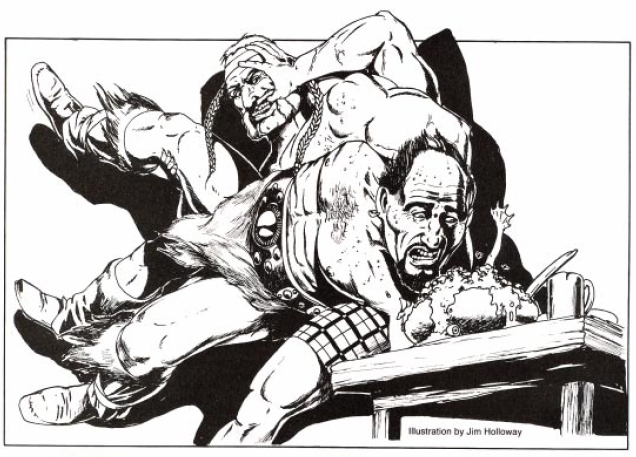
time. In the beginning, wrestling involved
above-waist holds, as described by the
poet Homer. Wrestling?s rules weren?t very
strict. In The Iliad, Odysseus is said to
have kicked one opponent behind the
knee, knocking the man (Aias) backward;
Odysseus then dropped on his chest.
Bibliography
Homer. The Iliad. Translated by Robert
Fitzgerald. New York: Doubleday & Co.,
1974.
Table of Greek Martial-Arts Styles
| Name | Number of attacks | Damage | AC | Principle attack | Special maneuvers | Weapons |
| Boxing | 3/1 | 1-8 | 7 | Hand | Strike 1
Iron Fist Move 1, 6 Mental 2, 5 |
see below |
| Pankration, classical | 2/1 | 1-6 | 7 | Body or hand | Strike 1
Throw 3, 4 Move 1, 3 |
None |
| Pankration, freestyle | 2/1 | 1-8 | 8 | None | Strike 1
Kick 1, 2 Throw 3 Lock 1,3 Move 2 Vital area 1, 2 |
None |
| Wrestling | 1/1 | 1-4 | 6 | Body | Lock 1, 3, 4
Throw 3, 4 Move 2, 3 Vital area 1 |
None |
Too much punch
Dear Dragon:
I have a question about Janne Jarvinen?s
"Wrestling With Style,?" in issue #156.
The author
discusses the different types of unarmed
combat that were used by the Greeks. The thing
that bothers me is the damage inflicted by the
various styles. A boxer gets three attacks per
round and does 1-8 hp damage per attack (as
much as a long sword). This means that a boxer
can inflict up to 24 hp of punching damage in
one round! This doesn?t even count the various
weapons that can be used. I find this a little
too
much to believe. The AD&D® 2nd Edition
rules
state that punching damage is 1-3 hp damage
per hit. What causes the vast difference in
damage results, or is this a printing mistake?
Also, what is the meaning of the Special
Maneuvers column on the chart? What do the
numbers mean after each attack?
Scott Clark
Teaneck NJ
(Dragon #160)
Hmm. Your editors seem to have missed that
inconsistency. I see no problem in reducing
the
damage to 1-3 hp per punch, or to whatever
level you feel is appropriate. We’ll keep
an eye
on that in the future.
Special maneuvers
are extraordinary actions
explained in the AD&D 1st Edition
volume
Oriental Adventures, on page 102.