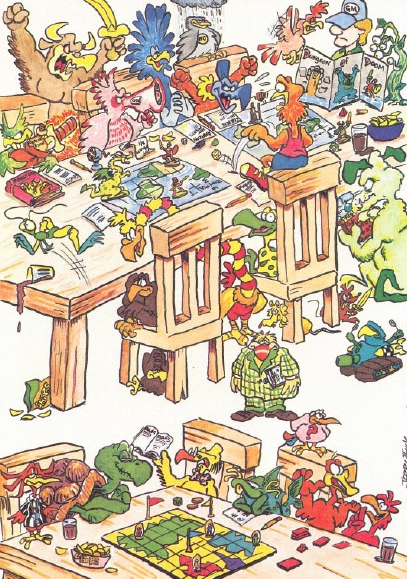
Most campers and hikers find bird
and animal
watching to be pleasant additions
to their outdoor
activities. Gamers can engage in
the same enjoyable
distractions -- and not just at
game conventions, either.
Many of the unusual species described
in this article
can be spotted in your own living
room or den whenever
there is a role-playing or war
game in progress.
Good close-up views of a few of
these species can also
be had in store windows and bathroom
mirrors.
Birds are far and away the most
common and visible
forms of game-convention wildlife.
They can be found
in all convention habitats and
display a wide range of
calls and behaviors, many of them
annoying.
Normal ornithologists have a distinct
advantage
when identifying different avian
species, as normal
birds come in a variety of sizes,
shapes, and colors. Not
so with game-convention species:
They all look alike.
The usual plumage of game-convention
birds consists
of a tight T-shirt (which displays
a ubiquitous abdominal
bulge), ratty shorts, tattered
sneakers or loafers,
and the obligatory satchel or stack
of rule books. A
grimy baseball cap is common but
optional. This sameness
makes visual identification impossible,
so it is best
to rely on habitat, activity, and
sometimes voice. Some
of the most common species. to
look for follow, in no
particular order.
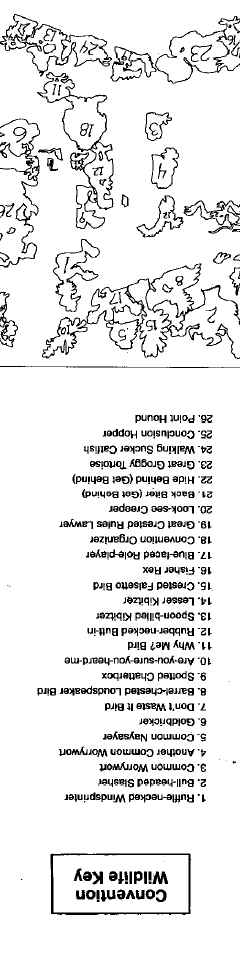
Can you identify
these species of game-convention
wildlife?
Read this article and
test your skills
of identification.
<Answers at the end of this page>
Ruffle-necked Windsprinter
(Quixotious impetuous)
This bird is found only in role-playing
areas. It can be distinguished by its excessive
energy (rare among sedentary
gamers), and it cannot sit still for more
than 2 minutes. It can always be found
either trying to get the GM’s attention or
engaging in some inane game activity, such
as interrogating the town drunk, helping
little old ladies across the street, or tilting
at windmills. This bird doesn’t care what it
does as long as it’s the center of attention.
Windsprinters like to be game referees so
that they can be in the LIMELIGHT all the
time. This bird can often be recognized by
its oft-repeated and plaintive call, “Isn’t
there anything to do?” Some of the more
vocal specimens of this species might be
confused with the Spotted Chatterbox.
Close observation, however, will reveal
that the Windsprinter actually pays attention
to the GM and has its character do
things.
Bull-headed Slasher
(Anarchistus desperadus)
A close relative of the Ruffle-necked
Windsprinter, this bird should migrate to
the traditional war-game habitats where
killing things is all there is to do. Unfortunately,
this species lacks the historical
background and the understanding of
strategy and tactics required for success in
the war-gaming habitats, so it remains
among the role-players. Like the Windsprinter,
the Slasher is seldom satisfied
with what is actually happening in the
game, so it seeks to create its own action.
Such action almost always involves combat,
but the Slasher can make do with
anything that requires a die roll instead of
thought. Not satisfied with helping little
old ladies across streets, the Slasher tries
to throw them under speeding wagons,
chop them into little pieces, or at least pick
their pockets. A Slasher never tilts at
windmills (windmills don’t bleed), but it
will cast bolts of lightning into crowded
bars. Occasionally, a Slasher will bite off
more than it can chew, whereupon it
mutates into a Why Me? Bird.
Common Worrywort
(Paranoidus certainus)
The gaming birds known as the Worryworts
(genus Paranoidus) are most commonly
found in role-playing habitats,
although the board-game and miniatures
areas have their shares of them. All
Worryworts appear to have a symbiotic
attachment to their characters or gaming
pieces (even to those assigned to them 10
minutes ago). The Worrywort lives in
constant fear that some harm will befall its
character. While all good role-players
suffer for their characters, the Worryw
o r t s s u f f e r w i t h t h e m .
For example, the Common Worrywort is
certain that the referee is out to get his
character or the character’s entire party.
Common Worryworts find it impossible to
negotiate with NPCs, and they conduct
dungeon adventures like bomb-squad
missions. The pining calls of these birds
attract Windsprinters, Slashers, and
Spoon-billed Kibitzers like bees to honey.
Occasionally, though, particularly intelligent
specimens of Worryworts are
encountered which are actually capable of
formulating workable plans.
Common Naysayer
(Paranoidus pessimist)
This Worrywort bird can find at least
one reason why any given plan will not
work, and it can manufacture at least a
dozen horrible consequences for any
given failure. This bird's gloomy outlook
can drive even a Rubber-necked Butt-in
into a fit of depression, although a Lesser
Kibitzer can often persuade a party to
temporarily ignore the Naysayer.
Goldbricker
(Paranoidus milksop)
This Worrywart bird cannot tolerate any
damage to its character. Goldbrickers
prefer to play warriors or priests (fighters
with over 100 hp and more armor than
the U.S.S. New Jersey are perennial favorites
with the species). When a fight breaks
out, the Goldbricker's character heads
straight for the rear (if it isn't there
already), even if the opponent is an
arthritic goblin.
This habit often causes
the bird to be confused with the Get
Behind, an altogether different creature. If
the character’s hasty retreat fails to take it
to safety, the Goldbricker will do all it can
to obliterate the opponent before the
opponent gets an attack, stopping only
long enough to berate the GM for not
allowing its character to win initiative. If
its character is damaged, the Goldbricker
will immediately use its most potent healing
magic (if it has any) or whine pitifully
until someone cures all its character’s
damage, even if all opponents are dead
and the character still has 99 hp left.
Don’t Waste It Bird
(Paranoidus frugalis)
A close relative of the Goldbricker, this
Worrywort bird hordes everything: spells,
gold, and especially charged magical items.
It can be immediately distinguished from
its cousin by its distinctive call (e.g., “No, I
won’t use my wand; it has only 57 charges
left on it.”).
Barrel-chested Loudspeaker Bird
(Vociferous stridentus)
Usually heard but not seen, this bird’s
piercing call is audible almost everywhere
within a crowded game room. The call is
usually sufficient to disrupt games in the
bird’s immediate vicinity. This strange
behavior is triggered when the bird thinks
it sees someone it knows on the other side
of the room. Unfortunately, the bird never
gets a response because the target person
has been misidentified or cannot hear the
call because he is out of range. When the
Loudspeaker Bird gets no response, it will
repeat its strident call with foghorn regularity
until it grows hoarse or gets clipped
in the beak. Angry remonstrations of a
nonphysical nature from nearby GMs and
players are always ignored, although a
Lesser Kibitzer can usually induce this
bird to lapse into five minutes of bemused
silence by suggesting that the Loudspeaker
Bird actually walk the short distance to the
target person and converse normally.
Spotted Chatterbox
(Vociferous verbosus)
A close relative of the Loudspeaker Bird,
the Spotted Chatterbox lacks its cousin?s
volume and power, but it makes up for
this by chattering nonstop, pausing only
occasionally for breath. It has learned to
space these pauses, however, so that the
GM and players think they?re getting a
word in edgewise. Its constant habit of
interrupting everybody often causes it to
be misidentified as a Ruffle-necked Windsprinter,
but the Spotted Chatterbox never
says anything worth hearing. Occasionally,
a GM or party manages to get on with the
game in spite of the Chatterbox; this
doesn?t bother the bird at all, as it simply
selects a new victim and chatters away.
This habit makes the Chatterbox a terrible
hazard to any Spoon-billed Kibitzers hovering
about the game.
Are-you-sure-you-heard-me
(Prolix adnauseus)
This bird can be found nearly everywhere,
though it prefers games where a
Spotted Chatterbox is already causing
confusion and providing a smoke screen
for the Are-you-sure-you-heard-me?s activities.
This bird has an uncanny ability to
pick the worst possible time to tell a referee
what it intends to do, then judge the
possible results and rebroadcast a slightly
altered version a moment later. An Areyou-
sure-you-heard-me will never accept
the fact that it has made an error; instead,
it insists that it wasn't properly understood.
If allowed to repeat itself often
enough, it can transform even the silliest
action into a brilliant operation. Skilled
Are-you-sure-you-heard-mes are able to
make this transformation virtually
undetectable.
Why Me? Bird
(Obstreperous excusus)
This gaming bird can be identified by its
unparalleled bad judgment and its adamant
refusal to accept any blame for the
often fatal consequences of its ill-considered
actions, The Why Me? Bird has one
of the most complex songs of all convention
birds, sometimes so prolonged that
the bird is mistaken for a Spotted Chatterbox
A typical excerpt runs like this: ?I had
to open that chest or the thief would?ve
gotten all the treasure, and if the fighter
hadn?t led us into that nest of scorpions,
the cleric wouldn?t have had to use his
antipoison spell on him, and besides, he
should have had two anti-poison spells. . . .?
Rubber-necked Butt-in
(Omnisciencea cad)
This particularly obnoxious bird often
inhabits role-playing games, hoping that
the GM will ask the party to designate a
caller. Other specimens prefer miniatures
games where they can steal the other
players? thunder under the guise of acting
as overall commander. The Butt-in has the
amazing ability to control several characters
or units simultaneously, stepping on
other players? toes with impunity and
citing superior experience (or bigger fists)
as justification. If left uncontrolled, this
pest will usurp the prerogatives of every
other player at the table; experienced
referees use gags, muzzles, or straitjackets
to exert proper control. Rubber-necked
Butt-ins sometimes join flocks of Spoonbilled
Kibitzers, but they only do this in
order to attack GMs.
Spoon-billed Kibitzer
(Omnisciencea maximus)
This bird generally shuns role-playing
areas, being cowed by the GM?s presence.
Its favorite habitat is the board-game area,
where it can quietly watch a game in
progress and quickly offer unsolicited
advice before anyone can stop it. Occasionally,
large flocks of Spoon-billed Kibitzers
will descend on a role-playing game,
however, where they exchange comments
with each other as the game progresses.
These flocks are skilled at staying out of
the GM?s hearing range while making sure
they can be overheard by at least two
players.
Lesser Kibitzer
(Belatus sagacious)
This close relative of the Spoon-billed
Kibitzer is never found in flocks; in fact, it
occasionally actually joins games. Like the
Rubber-necked Butt-in, this bird has ideas
for every character, but it always offers
suggestions instead of issuing commands.
The Lesser Kibitzer often withholds its
advice until after a player has made an
error, then explains its own ideas. Unfortunately,
by that time it?s too late for the
advice to do any good. This tactic frustrates
players but usually placates referees
when the Kibitzer is not a player. When
functioning as a player, this bird often
remains detached from the game for long
periods of time, and in this passive mode it
can actually be mistaken for a Great Groggy
Tortoise. Once the Kibitzer settles down
in this way, only a prolonged session of
dithering will rouse it. Once so roused,
however, there is no way to stop the
stream of advice coming from the bird.
When the Lesser Kibitzer is operating in
this fashion, it often appears to be a
Rubber-necked Butt-in, but it may be
distinguished from the latter by its politeness.
Like the Ruffle-necked Windsprinter,
the Lesser Kibitzer often prefers to be a
referee, where its smarts can be more
fully appreciated.
Crested Falsetto Bird
(Androchauvinus superficialis)
Curiously, no females of this species
have ever been observed. This bird is
undetectable until it is given a female
character to play. When this happens, the
bird immediately begins primping and
preening and adopts an ear-wrenching
falsetto voice. When it does drop its adopted
voice, it is usually only to give the GM
witty instructions, such as: ?My character
goes off and does girl stuff.?
Fisher Rex
(Deceptus ex cathedra)
There is a theory that the Fisher Rex is
not a true species at all, but merely a
mutated Rubber-necked Butt-in or Lesser
Kibitzer. This bird is found only as a referee,
and it delights in giving players
equivocal or incomplete information in
order to force them to make serious blunders.
Dealing with this bird can be particularly
frustrating, as it often drops subtle
hints and clues that will reveal the truth if
they are noticed in time, This insidious
bird can even fool a Common Worrywort,
though its favorite prey is the Walking
Sucker Catfish. The Fisher Rex also takes a
heavy toll of Conclusion Hoppers.
Blue-faced Role-player
(Rantus vaudevillis)
The bird is named for its habit of roleplaying
until it is blue in the face. It is
found only in role-playing habitats. Large
flocks of them regularly gather at the most
exclusive and prestigious role-playing
events. Their favorite call is: ?I don?t care
which character you give me.? It is often
voiced just as the bird comes to roost.
Great Groggy Tortoises prefer to act as
GMs for players of this species, since these
birds are capable of running an entire
game all by themselves. (This ability infuriates
Ruffle-necked Windsprinters, but
Lesser Kibitzers don?t seem to notice.)
Individuals of this species will invariably
fall into confusion when confronted with a
situation that requires the application of
common sense or game logic, and thus
they often fall prey to the Fisher Rex.
Convention Organizer
(Travailus exhaustus)
A few respected ornithologists maintain
that this bird does not exist at all, and
indeed this species is seldom seen. The
fact that these birds are similar to the
legendary phoenix helps to maintain their
mystique: Each individual disappears
yearly, only to rise again from the ashes of
old conventions. Some subspecies have
been known to disappear and reappear on
a quarterly basis. Typical specimens
exhibit an overall rumpled appearance and
a jaundiced expression. This is usually not
helpful in identifying them, as all convention
gamers tend to look like this, especially
on days three and four of a four-day
convention. On closer inspection, however,
an observer will note that this bird has an
inexplicably belligerent attitude (actually
caused by ignorant conventioneers who
insist on feeding these birds too many
stupid questions and inane complaints).
While this bird is not always dangerous,
observers should take special care, as the
smallest misstep can cause an outbreak of
frenzied violence. Usually, however, the
Convention Organizer will issue a warning
call first, such as: ?Clear out of here! I?ve
got an event scheduled in this room in two
minutes!? Such warnings can be ignored
only at extreme peril.
Great Crested Rules Lawyer
(Proctus obstructus)
This bird is arguably the worst pest of
all convention birds. While it is usually less
obnoxious than the Rubber-necked Butt-in,
it has a wider living range, encompassing
all convention habitats (it is rumored,
however, to be quite respected in boardgame
areas). Generally innocuous, the
Great Crested Rules Lawyer becomes
immediately noticeable when it begins its
distinctive behavior and song. The bird
squares its shoulders; throws out its chest,
and clears its throat with an audible
?ahem.? Thereafter, it pontificates about
the rules currently in play. When in full
song, it resembles a Spotted Chatterbox,
but it can be distinguished by the monotony
of its recitations. Several things can
trigger this behavior, the two most common
being the appearance of a monster
the party has never encountered before,
and the sight of anyone reaching for a rule
book.
All Great Crested Rules Lawyers actually
know their rule books by heart with only
a few (usually quite convenient)holes in
memory, and they can quote the rules verbatim.
Some specimens can actually recite
the rules backwards ? this is not as
impressive as it seems because these individuals
tend to try to apply the rules backwards
as well. Unfortunately, even when
this bird remembers the words frontward,
it often does not know what they mean.
The same methods used to control
Rubber-necked Butt-ins will usually quell
the Great Crested Rules Lawyer?s outbursts,
but some referees like to add a
smack from a cattle prod, too.
While you enjoy watching the many
varieties of convention birds, be sure to
keep an eye out for these game-convention
plants and animals.
Look-see Creeper
(Encroachus agogus)
This vine can be found growing right at
the referee?s elbow. When the plant is full
grown, it is impossible for the referee to
move without brushing against it. The
vine?s everquesting tendrils constantly try
to sneak a peek behind the referee?s screen
and often succeed at knocking the screen
over. A shrublike subspecies grows at the
foot of a gaming table, where it can get a
look at the adjacent referee?s materials.
There are two distinct subspecies of this
annoying rodent, both of which inhabit
role-playing areas. The first, the Back
Biter, prefers to play thieves and assassins,
but it plays characters from other classes
in the, same manner. This rodent is constantly
circling, climbing walls, flying, and
otherwise trying to get behind any opponent
encountered. It has been known to
become very angry at GMs who allow it to
be spotted either before or after it makes
its back attacks. The second subspecies,
the Hide Behind, often resembles a Goldbricker.
It spends all its time cowering
under cover, emerging only to launch
missile attacks. Both subspecies will panic
if confronted by a foe who can see or
melee with them.
Great Groggy Tortoise
(Stuperous oblivious)
This reptile is often overlooked amid the
hurly-burly of a convention. It likes to
drowse in the body heat of other gamers,
and can be found quietly snoozing at
gaming tables, its appendages and head
wrapped in a semifetal position. It is
known for being able to sleep even
through the blustering of a Loudspeaker
Bird, and one specimen has even been
seen with a Spotted Chatterbox perched
on its carapace. The tortoise can sometimes
be roused in order to roll a die, but
thereafter it dozes off again. Great Groggy
Tortoises can sometimes be found running
morning games, much to the chagrin of
Ruffle-necked Windsprinters and the
delight of Are-you-sure-you-heard-mes.
Walking Sucker Catfish
(Clodus faux pas)
This amphibious fish resembles the
walking catfish of the southeastern United
States. When confronting other players, it
can be a hardy and tenacious foe. It has
one great weakness, however ? it always
takes a referee at his word, making it an
easy target for the Fisher Rex. Many specimens
have reportedly taken bait, hook,
line, sinker, and pole.
Conclusion Hopper
(Spurious prejudgus)
This insect can be found almost everywhere,
except in face-to-face boardgaming
habitats (although it can be found
in double-blind and PBM board games).
The Conclusion Hopper is always willing
to make a decision based on an assumption
or incomplete information. Once this
insect reaches a conclusion, it is almost
impossible to convince it that it is wrong.
In fact, it is usually able to convince other
players that it is right. A Conclusion Hopper
that has just made a disastrous conclusion
often resembles a Why Me? Bird.
POINT Hound
(Cupidius enfant terrible)
Though this bothersome canine occupies
the same habitats as the Blue-faced Roleplayer,
it does not care about role-playing
for its own sake. It only cares about being
recognized for role-playing.
All Point Hounds belong to a huge conclave
whose territory covers most of the
continental U.S. and southern Canada,
with smaller packs in places as widely
scattered as Alaska, Germany, and Norway.
Communication within the conclave
is remarkably efficient; even the most
distant and isolated members always know
what the other members have been up to.
They probably cover such vast distances
by howling in relays (see below), but no
one knows for sure. Point Hounds typically
travel in packs of three to seven
individuals, but even these tend to split up
when unleashed upon a convention. When
two Point Hounds from different packs
meet, they usually engage in a dominance
tussle, and the Hound with the highest
status within the conclave invariably wins.
Lone Point Hounds are more pests than
threats, although when role-playing they
have been known to turn on fellow players
and shred them at the drop of a hat.
Point Hound GMs will ignore all other
species and give their attention only to
other Point Hounds.
Point Hounds appear to be exceptionally
intelligent, but they are merely sly and
devious. They often instigate elaborate
subterfuges in order to get what they
want, even when what they desire is easily
obtainable (like event tickets) or totally
imaginary (like the advancement advantages
gained from sitting in a certain position
at the gaming table). When not
role-playing, they loll about tournament
headquarters with their long, wet tongues
hanging out, waiting for the results from
their last event to be calculated and posted.
If kept out of headquarters, they make
nuisances of themselves by scratching and
sniffing at the door. In any case, their
incessant yipping and whining about point
totals, advancements, and who probably
took first place can try the patience of
even the most saintly referee or convention
worker.
When results are finally posted, all Point
Hounds in the area will sit next to the
sheet and howl at it. When other Point
Hounds hear this, they immediately rush
to the sheet and join in. Eventually, every
unoccupied Point Hound at the convention
will join the chorus, producing pandemonium
that is audible for miles.
When encountered in a pack, Point
Hounds are more confident, more noisy,
and more rude, though usually not dangerous.
If a potential victim is cornered,
however, trouble is sure to ensue, as even
a lone Point Hound becomes bold and
downright vicious. Experienced tournament
organizers often carry chairs and
whips to guard against such possibilities.
Muzzles and bludgeons are useless; an
enraged Point Hounds slavering jaws and
pin head will always slip a muzzle, and an
attacking Point Hound is so single-minded
that it simply doesn?t notice blows to any
part of its anatomy.
Many Point Hounds have a chameleon
power that makes them look just like a
normal gamer or one of the species mentioned
previously. This has led at least one
tournament organizer to collar and tag
them for easy identification.
APRIL 1989