| - | - | - | - | - |
| Dragon Magazine | - | The Dragon #10 | - | AD&&D |
Nothing too ambitious. In one article, I
hope to
provide a new way of handling encumberance,
a way
of describing the physical appearance of
your characters,
and — hopefully! — provide an equitable
and reasonable method of handling sexual
differentiation.
Should space allow it, I will also give
you
working blueprints for a warp drive and
a one-page
synopsis of the Mind of God. Oh, well.
I’ll start off by saying that I borrowed
some of
this from the Warlock rules printed in
the Spartan,
#9 — the idea of a Size characteristic,
at least. But
the concept is here heavily modified and
made more
rational. (I hope.)
Size is an additional characteristic rolled
on 3 sixsided
dice. In addition, all characters should
also
roll Build on one six-sided, with a 1 indicating
a
Light Build, a 2-5 meaning a normal build,
and a 6
indicating a heavy build. Build is functional
only for
human beings, but roll it up for non-humans
anyway.
(I’ll get to that.)
Now that you have your Size and Build, and
have
presumably chosen the sex of the character,
you consult
the following tables for your height and
weight.
Weight is given in pounds; one pound is
presumed to
equal 10
Elves,
dwarves
& hobbits: for appearance's sake
H. R. Lovins
| Dragon | D&D | - | AD&&D | Dragon 41 |
| Dwarves | - | Elves | - | Hobbits |
By the wear and tear alone, one can tell
my favorite and most used
Dragon article is P.M. Crabaugh’s
“Weights and Measures, Physical
Appearance and
Why Males are Stronger than Females in D&D” (TD #10, Oct.
’77).
However, while the author gives heights
and weights for the 4
Kindred Races, his tables for physical
appearance apply only to
Humans,
the author excusing himself on the excellent grounds that “I
simply haven’t seen enough elves to be
aware of the range of physical
appearance they have.”
What a pity not to be Irish! We have none
of that problem. It should
be noted that the elven characteristics
charted below are not—repeat
NOT—the Quendi, the so-called “Elves” of
Tolkien’s Middle Earth,
who are for the most part a dark people.
These elves are closer to the
Fair Folk of Europe, the Sidhe and
Tuatha de Danaan of Ireland,
the
lovely and powerful “fairies” of Le
Cabinet des Fes, and the Norse
Elves of Alfheim. The information on dwarves
is also traditional, but
that on halflings must necessarily be based
on the Professor’s works.
Whatever charts are lacking for a Race—voice,
hand, or habitual
expression—should be rolled for on Crabaugh’s
Human Charts.
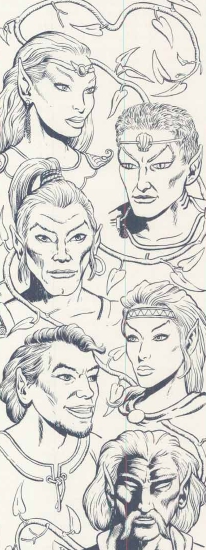
Elves are
generally somewhat smaller than humans,
slender and
graceful. They all have high cheekbones
and pointed ears; indeed, any
human having the later characteristics
may be suspected of a drop of
the elvish blood. They are for the most
part fair, including the rare green
elves, who are thought to be a distant
link to the hamadryads and other
woods spirits. This is reflected in the
charts below. Elves are not given to
freckles, malocclusion,
or several other human frailities, as the altered
Exceptional Facial Features chart shows.
They are not bearded.
For the secondary rolls, use a 6-sided die
should the appropriate
1st number be rolled.
Eyes
| 1-6 | Dark Grey | (1 in 6 jet black) |
| 7-11 | Green | (1-2 light green, 4-6 bright emerald) |
| 12-15 | Blue | (1-3 light, 4-5 bright, 6 deep blue-violet) |
| 16-17 | Silver-Grey | - |
| 18-19 | Golden | - |
| 20 | Changeable | (Roll 4-sided plus 1 to get # of colors
eyes shift
between; roll as above, ignoring further rolls of 20.) |
| 1-6 | Light Blond | - |
| 7-10 | Honey Blond | - |
| 11-13 | Red | (1-3 red-gold, 4-5 copper, 6 auburn) |
| 14-15 | Grey | (1-5 light, 6 dark) |
| 16-17 | Blue-Black | - |
| 18-19 | White | (1 metallic silver, 2-5 white, 6 pale green) |
| 20 | Metallic Gold | - |
| Worn to: | Male: | Female: |
| Ear | 1-4 | - |
| Shoulder | 5-9 | 1-2 |
| Waist | 10 | 3-7 |
| Longer | - | 8-10 |
SKIN
| 1-5 | Pale | (1 in 6 pale green) |
| 6-12 | Faint | - |
| 13-17 | Normal | - |
| 18-20 | Tanned | - |
HANDEDNESS
| 1-2 | Ambidextrous |
| 3-4 | Left |
| 5-10 | Right |
UNUSUAL FACIAL FEATURES
1. Large/small eyes
2. Sharp/soft features
3. Round/narrow face
4. High forehead
5. Large/small nose
6. Full/thin lips
7. Epicanthic fold
8. Facial scar
9. Curly hair
10. Upturned eyebrows
11. Round/narrow eyes
12. Eyes set far apart/close together
The occasional Half-Elf
should roll eyes and hair upon the Elf
tables, all else on Human charts.
DWARVES
Dwarves never have pointed ears, and are
ALWAYS bearded.
They come in several varieties, generally
recognizable & skin tone.
EYES
| 1-4 | Grey | - |
| 5-7 | Blue | - |
| 8-9 | Brown | - |
| 10 | Other | (1-2 green, 3 gold, 4-6 black) |
SKIN
| 1-6 | Tan |
| 7-9 | Brown |
| 10 | Grey |
HAIR
| 1-6 | Brown |
| 7-10 | Black |
| 11-14 | Grey |
| 15-17 | Blond |
| 18-19 | White |
| 20 | Red |
LENGTH, Hair
| 1-3 | Short |
| 5-8 | Medium |
| 9-10 | Long (past shoulders) |
LENGTH, Beard
| 1-2 | 3" - 4" |
| 3-8 | On chest |
| 9-10 | To belt |
UNUSUAL FACIAL FEATURES
1. Large/small nose
2. Large/small eyes
3. Large/small teeth
4. Large/long-lobed ears
5. Curly hair
6. Scar
7. Gap-toothed
8. Upturned brows
9. Sharp/soft features
10. Wide/narrow nose
HOBBITS
Small as the Halfling population is, there
is not a tremendous
variety within it They are not given to
extremes of coloration. Men
wear their hair about ear-length; women
wear it long, though 1 in 10
will clip it to the shoulder if adventuring.
HAIR
| 1-3 | Light Brown |
| 4-5 | Dark Brown |
| 6-7 | Blond |
| 8-9 | Grey |
| 10 | Black |
| 11 | White |
| 12 | Red |
EYES
| 1-6 | Blue |
| 7-9 | Brown |
| 10-11 | Grey |
| 12 | Green |
| SKIN | - |
| 1 | Fair |
| 2-5 | Normal |
| 6 | Tanned |
UNUSUAL FACIAL FEATURES
1. Freckles
2. Curly/very straight hair
3. Blunt/sharp nose
4. Large/small nose
5. Jutting jaw/overbite
6. High forehead
7. Large/small ears
8. Large/small eyes
9. Eyes set far apart/close together
10. Large/small mouth