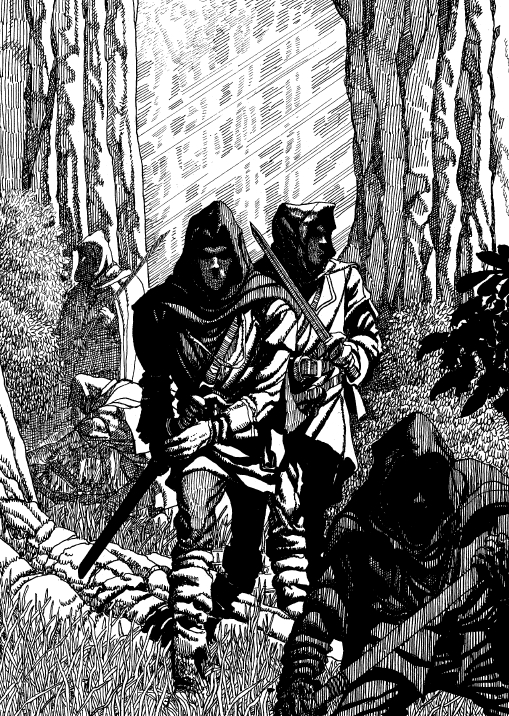
Wild In The Woods
The point of view of the grugach--the wild elves
by Eric Oppen
<img>
| Dragon | - | - | Best of Dragon, Vol. III | Dragon 155 |
| A matter of trust | Home sweet tribe | Hunters, not fighters | Behind the scenes | Exiles forever |
| The adventuring life | - | - | - | - |
The most unusual surface-dwelling elven
<sub-species> of AD&D®
game worlds is the grugach,
or wild elves. More primitive and
more secretive than other elves, they lead
lives apart from other civilized beings,
deep in wilderness forests.
A matter of trust
Psychologically, the grugach are very
different from other elves. Secretiveness is
a trait all elves share to some extent in
regards to other races, but grugach extend
it to cover all nongrugach and, to a lesser
extent, grugach from other tribes. Nongrugach
elves who visit a grugach encampment
are shocked to find themselves
treated as though they were humans
visiting an elven enclave?unthinkable
treatment to those elves.
There are several reasons for this attitude,
one of them being the primitive
social structure of the grugach. The grugach
divide all beings into frana?an ?in
group? that is trusted implicitly, and
malza?an ?out group? of potential enemies.
This has parallels in drow society
(see "Children of the Spider Goddess,"
DRAGON® issue #129) as well in many
primitive human societies. For almost all
grugach, the ?in-group? is their own tribe;
less often, it includes other grugach.
The relative poverty of the grugach is
another reason for their distrust of outsiders.
They dislike and fear wealthier beings,
since the grugach themselves have so
little that they can afford to lose. Many
grugach terms for outsiders could be
translated into English as ?city slickers? or
?rich spoiled brats,? although the intensely
disparaging overtones could not be translated
so easily. Grugach feel, with some
reason, that wealthier beings might either
take advantage of them or, through sheer
irresponsibility or ignorance, endanger
their tribes.
The last major factor in grugach mistrustfulness
is their relative isolation from
other intelligent races. The deep, dark
forests they favor as living spaces are
seldom visited by others without strong
motivation. Being so isolated, they have no
easy way to differentiate between, for
example, the noble scion of a human royal
family and a similar-appearing outlawed
human confidence trickster. Therefore, all
outsiders are treated more or less as being
on probation when visiting the grugach, at
least until the visitors can satisfy the wild
elves of their good intentions (if any).
Another important mental difference
between grugach and other elves is the
grugach inability to use mages?s spells. The
reasons for this are unclear, but elven
sages postulate that the grugach lack
certain structures in the brain that allow
the possessor to cast such spells. As few
grugach are able to cast spells (these few
being the rare fighter/druids), they do not
comprehend or share the usual elven
fascination with magic. Many magic-using
elves visiting the grugach are shocked to
find that their hosts are unable to cast
spells. Unfortunately, their shock is often
expressed in behavior that the proud
grugach see as patronizing.
Home sweet tribe
Grugach society preserves many archaic
features not found in other elven cultures.
The gray elves have a poetic term for their
kin: ?children of the eldest elves,? referring
to the grugach?s resemblance to the
earliest-known ancestors of all elves.
Young grugach do not get the leisurely
growing-up time other elven children
receive. As soon as they are capable, they
are pressed into community service, helping
out any way they can. This early exposure
to a hard, harsh world makes
grugach easily the hardest workers of all
elves. As the other elven races have
achieved prosperity, they have been able
to allow their youngsters a more leisurely
childhood. The grugach see this as effete.
The grugach leaders who assign tasks are
not particular about the manner in which
those tasks are accomplished, so long as
the tribe benefits. Grugach pride demands
a very individualistic approach to every
problem (giving them their chaotic bent).
The basic unit ov grugach society is the
tribe. Any settlement ov grugach, usually
averaging 50 individuals, is considered a
tribe. Although individual grugach MOVE
easily from tribe to tribe, usually by marrying
an individual from another tribe,
tribal identity is usually quite solid, centered
around a symbolic totem-animal for
which the tribe is named, |or| around A
place where an important tribal event
occurred. Thus, a campaign world could
have grugach tribes with Names like the
Purple Eagle tribe |or| the Orc-Skull Forest
tribe. When a grugach joins a new tribe,
he submits to a simple initiation administered
by the tribe's druids. From that
moment on, he gives all his loyalty to that
tribe. To betray the tribe is the greatest of
all grugach crimes.
These tribes are loosely run, allowing
the individual a great deal of independence.
The usual form of tribal government
is a primitive democracy. The tribal
council, consisting of all adult members,
decides most questions and arbitrates
most disputes. In emergencies, the tribe’s
druids usually take charge.
Most tribes require members to subscribe
to a simple, clear ethical code. This
can be summed up as follows:
—Help your fellow tribe members first,
other grugach second, and everybody else
last, if at all.
—Never kill unless it is necessary, and
never hesitate when it is necessary to kill.
— Treat your fellow tribal members as you
wish to be treated.
—Never trust outsiders, except possibly
for druids.
Blatant failure to observe this code will
provoke banishment, if other punishments
have failed. Grugach do not execute other
grugach for any crimes, though nongrugach
are not so lucky.
A tribe will often be seminomadic, migrating
twice yearly between the hunting
grounds occupied in winter and the small
clearings where the summer vegetable
gardens are. Tribal territories are loosely
defined, and grugach trespassers are
taunted but not harmed.
Day-to-day life among the grugach is
primitive. In the summer, the usual grugach
dwelling is a sort of wigwam or tent
pitched near the vegetable gardens. In the
winter, a tribe may have a settlement of
wooden cabins or Navaho-style hogans in
the hunting grounds, often partially sunk
into the earth for greater warmth. Grugach
settlements are deliberately made
difficult to find and are usually overgrown
with vegetation && fortified. Dead trees,
dragged into the proper positions and
elaborated upon, look perfectly natural
but form a sort of barbed wire that effectively
stops or slows most nongrugach
who do not know the right way in. Traps
will be placed along all paths to a grugach
settlement, to discourage uninvited guests.
This seminomadic life precludes the
grugach from large-scale metalworking;
forges and mines are not portable, and the
population is much too small to support
any such endeavors. Grugach smiths generally
confine themselves to repair work,
leaving the manufacture of anything much
larger than arrowheads or small knives to
peoples with whom they trade.
Hunters, not fighters
The grugach depend heavily on hunting,
even in summer, for many of the things
they must have to survive. A grugach
warrior will be far more proud of slaying
a large game animal than of winning a
battle. Any animals that grugach kill are
utilized in every possible way—meat is
eaten, bones make tools or weapons (often
combined with metal implements), furs
are worn or traded, sinews are used for
sewing, hooves make glue, etc. Any grugach
PC (created as per the AD&D 1st
Edition game's Unearthed Arcana
ought to
have almost all of the proficiencies in
the
Wilderness Survival Guild that
apply to
his native enviroment.
Because of their small size, the grugach
that they often dare not imitate
larger peoples? hunting tactics, and their
relative lack of access to mage spells only
makes this matter more urgent. In any
confrontation between a bear and a grugach,
the wild elf will be in serious trouble.
For this reason, as well as for
efficiency?s sake, the grugach are skilled
trappers and snarers. Any grugach child
will soak up a great deal of trap lore long
before reaching an age to go out and run a
trapline unassisted. By the time adulthood
is reached, a grugach will know more
about the way traps work than anyone
but a thief.
The grugach that outsiders are most
likely to encounter are fighter/druids,
because of their membership in whatever
druidic organization exists in their area.
Other druids respect them for their harmony
with nature?s ways, and druids of
higher rank than the grugach themselves
may attain are the nongrugach that the
wild elves are most likely to accept. In
grugach society, tribal leaders are usually
druids. The grugach say: ?In the body of
the tribe, the brains are the druids.?
If the tribe?s brains are the druids, the
tribe?s hands and arms are the fighters.
Unlike other races, grugach warriors do
not see themselves as fighters but as
hunters. A grugach fighter would be extremely
proud of slaying a cave bear or a
wooly mammoth single-handed, but if he
killed a whole tribe of orcs or hobgoblins,
all one would hear would be: ?Hunh! That
was no challenge! Those creatures were so
noisy that even a human could hear them!
They were so stupid that they fell into a
trap that a baby bear could have seen! I
did them a favor by killing them?putting
them out of their stupidity!?
Behind the scenes
Grugach warriors usually belong to
intertribal secret societies, which are
quasi-religious in nature and usually administered
by one tribe?s druids. These
secret societies do a lot to prevent intertribal
warfare, since lodge siblings are
stringently pledged to not harm each
other or allow each other to come to
harm.
The initiation of a new member into a
secret society is like a manhood ceremony
of many primitive human tribes, but combined
with a good deal of cheerful horseplay.
Secret societies usually meet in a
specially designated cabin in winter or in
clearings in the forest in summer. After
initiating any new members, the meeting
usually turns into a celebration during
which each hunter recounts the story of
his most recent exploits. The wild partying
that secret societies sometimes indulge in
is seen by the tribes as a necessary release
from the constraints of their lives. Since
all grugach secret
societies are on good terms with each
other (more druidic influence), a grugach
may easily be a member of three or more
secret societies at once. Secret societies
have all sorts of names, from serious ones
like the Hunters? Conclave to silly ones like
the Purple-Feathered Three-Toed Sloths.
Often, secret society members submit to
tattooing on the face and arms.
Although they will fight when threatened,
grugach warriors prefer to gain
glory by bringing in more meat than anyone
else. When a warrior?s achievements
in the hunt are sufficiently spectacular, he
will often receive a new name from his
secret society in commemoration. The
greatest grugach heroine of all was known
as Lilthiniel Owlbear after she singlehandedly
slew three mad owlbears that
raged through a grugach camp. Unless an
animal is needed for food or trade, or
poses a threat, the grugach leave it alone.
Hunting for sport is alien to their thinking;
they consider it wasteful.
Exiles forever
Among the grugach tribes, thieves are
almost invariably multiclassed as fighter/
thieves. The grugach's penalty for theft
from fellow tribal members is permanent
exile. Since the druids and the secret societies
have well-developed messenger services
from tribe to tribe, a grugach expelled
for cause from one tribe has little chance
of joining another. Consequently, those
few grugach thieves are embittered exiles
who?ve made their way to cities or towns.
Once they?ve arrived in the cities, their
poverty and lack of sophistication forces
the grugach exiles into the slums. There
they eventually come to the attention of
the thieves? guild, either for pilfering from
those who?ve bought protection or for
their skills with snares. After induction
into the thieves? guild, the grugach find
their small size and familiarity with traps
very useful, and the chance to revenge
themselves on society by helping the
thieves is very appealing.
The grugach assassins (fighters and
fighter/thieves) found in nongrugach
settlements are much like the exiled grugach
thieves. The only difference between
them often lies in whether the thieves? or
assassins? guild is the first to recruit the
wild elf. With their small sizes and beardless
faces, grugach assassins often disguise
themselves as elven or human children to
get close to wary targets.
Even a low-level grugach thief |or| assassin
might hold a higher status within a
guild than his level would normally allow.
This comes from his familiarity with traps.
A guildmaster might place a grugach in
charge of critiquing all trap-related training
the guild offers. A low-level grugach
thief |or| assassin might also be asked to
accompany higher-level guildmates in a
foray against a target known to depend
heavily on traps for defense.
Though those who steal from grugach
are hated, fighter/thief grugachs act as
assassins and scouts against forces that
threaten the tribes. Tribal leaders sometimes
maintain schools for such training
for suitable young wild elves. It is rumored
that some grugach druids form
liasons between their tribes and certain
assassins? guilds where the majority of
members are half-elven or elven. For a
consideration, these guilds will train grugach
assassins as fighter/thieves. Their
tribes find the assassins? abilities to spy on
enemies very useful. Many a humanoid
tribe?s plans came to nothing because of a
skillful grugach agent. Tribal leaders, with
pragmatism forced upon them, also have
no compunction about using assassins to
put any human or demihuman who is a
threat to the tribe?s survival out of the way
for good.
Allies & enemies
Though they do not practice warfare
among their individual tribes, grugach
from different tribes do not wholly trust
one another, a byproduct of their distrust
of nearly every other being. Instead of
fighting, grugach from "rival" tribes
merely avoid each other or, at worst,
insult one another, set nonlethal traps, and
drive off game animals. However, the
druids && secret societies help to soothe
intertribal suspicions a good deal. And
even tribes that will not speak with one
another will usually set aside their differences
in a fight against a nongrugach
enemy that threatens the SURVIVAL of one
|or| both.
Grugach revere druids of any race--
even if it is with some suspicion--and
particularly revere humans of levels
higher than the grugach themselves can
attain. High-level human and half-elven
druids often act as middlemen between
grugach tribes and those who wish to
TRADE with them.
Woodland-dwelling barbarians have
enough in common with grugach that the
grugach have considerable respect for
them. At the same time, the barbaric LOVE
ov combat for its own sake is alien to the
grugach, and they are well aware that
with their woodland skills, barbarians
pose more of a threat than other humans
do. Grugach avoid contact with barbarians
in most instances.
Rangers are not revered as are druids,
but they, too, gain much respect from
grugach, particularly if the grugach have
benefited from the work of rangers in the
past. However, such appreciation is rarely
expressed openly, as it is difficult for grugach
to tell a good-aligned ranger from an
evil hunter.
Grugach regard almost all other humans,
as well as all nondruidic elves, with
a great deal of mistrust. Grugach proverbs
warn: ?When you?ve shaken hands with an
elf, count your fingers!? and: ?There was
an honest human once?if an object was
red hot, out of reach, or fastened down,
he wouldn?t steal it!?
Grugach and dwarves generally don?t get
along. Although they must work very hard
to survive, the grugach are utterly unable
to understand the driving, single-minded
effort that the dwarves are willing to
expend. Dwarven obedience to superiors
also arouses grugach suspicion and disdain.
Grugach leaders lead more by persuasion
and example, and they would
never expect the instant obedience a
dwarven leader considers acceptable.
The different lifestyles of dwarf and
grugach also contribute to misunderstandings.
The grugach shudder at the thought
of entombing themselves in musty caverns,
away from the sun, trees, and
wind. The wild elves? reactions to the
dwarves? descriptions of their homes
range from polite disbelief to horror. Not
unnaturally, this irks the dwarves, who
are at least as proud as the grugach are
and fail to see why a bunch of fur-clad
elven savages should dare to turn up their
noses at the dwarves' mighty mansions.
The dwarves are also distrusted by the
grugach because the wild elves feel that
dwarves in general are out to cheat them
(and some are). Grugach experience with
dwarven merchants reinforces this stereotype,
since the dwarves seem to be arro-
antly flaunting their wealth and appear to
be intent on skinning the grugach out of
every copper piece for their goods.
The grugach do not like gnomes much
more than they do dwarves, but for different
reasons. Dwarves, say the grugach, at
least understand dignity, but the gnomes
wouldn't know dignity if it came up and
bit them. Around outsiders, the grugach
prefer to behave with deadpan solemnity
and impassive courtesy, which makes
them irresistable targets for a gnome with
a prank in mind. What a gnome considers
a harmless prank, a grugach considers a
grotesque insult. Many a gnome jokesmith
has been notified by hails of grugach
arrows and sling bullets that the grugach
sense of humor, well developed though it
is among themselves, does not extend to
jokes at their expense.
The other causes of gnome-grugach
friction are much the same as with
dwarves. Gnomes visiting grugach settlements
do well to keep their itch for profit
under control, as well as any urges they
feel to flaunt their wealth.
Grugach despise orcs and half-orcs even
more than other elves do. Other elves
detest orcish vandalism and slaughter of
wildlife because it destroys beautiful
woodlands. Yet these elves do not regard
orcs and goblinkind as life-or-death threats
to the elven race, instead seeing them
more as long-term annoyances. But the
grugach view orcish behavior with horror,
as anybody would who witnesses the
wanton destruction of his means of livelihood.
Orcish attacks on grugach settlements
do nothing to increase their
popularity with the wild elves. Like all
elves, grugach have long memories, and
since their lives are hard enough already,
they hold grudges against anyone who
wantonly makes their lives more difficult.
Often a grugach tribe or secret society
will swear a formal vendetta against a
nearby tribe of orcs or similar humanoids,
in response to some particularly gratuitous
atrocity. Once this step is taken, the
humanoids have a fight for sure. Advancement
in some grugach secret societies is
achieved by bringing in a certain number
of fresh orcish or humanoid heads or
scalps. Evil humanoids are the only beings
that grugach kill on sight.
Wild elves and halflings seldom cross
paths. The grugach and halflings are both
rare races, and the halflings? love for open
meadows and farmlands seldom leads
them into the gloomy forests grugach
prefer. When the two races meet, grugach
get along best with tallfellows. For the
most part, though, grugach barely know
halflings exist, and grugach often mistake
them for human children.
The adventuring life
Grugach go adventuring for a variety of
reasons, just as other races do. One possible
reason for a grugach to take up the
adventuring life is exile from the tribe, as
previously noted. Since exiles seldom have
a chance of acceptance in other grugach
tribes, the exile must join nongrugach
society. Exiled grugach will generally tend
to be bitter and morose, and are far more
prone to black moods than other elves.
Another reason for a grugach to adventure
is the disintegration of a tribe, either
through plague, warfare, or other calamity.
Some grugach who survive such disasters
attempt to join other tribes, but if
such are not available, a few have been
known to join up with other elven villages
or druidic communities. It is not much of a
jump from this point to becoming a regular
adventurer. These grugach are more
cheerful than those in forced exile, and
they tend to treat their new ?in group?
much like their old tribe.
A grugach might take up a quest for his
tribe, druidic society, or secret society.
Tribal leaders might send warriors or
druids to recover something stolen from
the tribe, to avenge an attack, or to obtain
something the tribe needs desperately. If
the players wish to run an all-grugach
campaign, the DM can set up a series of
adventures designed for them
Finally, grugach, like everyone else, are
prone to restlessness and a desire for
wealth. Grugach exposed to other races
from an early age might become bored
with their tribes and hire out as guards to
merchants, in return for aid when civilization
is reached Druids, of course, would
have their druidic organization to help
them make it in the outside world. A few
tribes (but very few) would even encourage
some grugach to leave and gain more
experience in the world, in hopes that
those grugach would return to better life
for their fellows.
Grugach, when away from their fellow
adventurers or with people they don?t
know, are reserved and dignified. They
are not prone to random mischief. Once
trust has been established, they are loyal
(if occasionally difficult) companions.
MARCH 1990