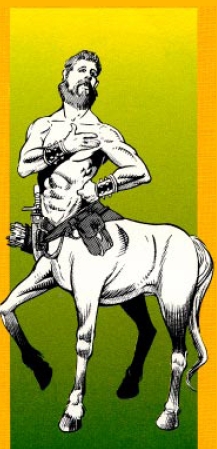
| Centaur Knight | Orc Barbarian | Lizard-man druid | - | - |
| 1st Edition AD&D | - | Dragon #163 | - | Dragon magazine |
Because of the presence of humanoid
and giant shamans and witch doctors in
the AD&D® game, it seems feasible to
allow humanoids and semihumans the
ability to study and train in other professions.
This provides the DM an opportunity
to add surprising elements to
all-too-familiar creature encounters. Such
characters should be used only as NPCs;
this article does not allow players a
greater range from which to pick their
races (see "Hey, Wanna Be a Kobold?" in
DRAGON® issue #141 for humanoid PC
races and classes). The following examples
are the centaur cavalier, the orc barbarian,
and the lizard-man druid. Similar
classes may be designed for goblins, ogres,
satyrs, and related races, as appropriate to
your campaign.
The fealty of a centaur cavalier is given
to his herd, specifically to the ruler of his
herd. Like a human cavalier, the centaur
cavalier (also called a peer) must keep
honor, bravery, and a chivalric
most important guides. A peer
code as his
must protect
his herd from outside-dangers and
keep harmony within the herd itself. Peers
are the centaurs? law enforcers and make
up the officers and the elite corps of the
militia. Note that only the more advanced
and intelligent centaur populations are
able to support peers.
Centaur cavaliers come from prestigious
bloodlines and hold very high social status
in centaur societies. With this prestige
comes responsibility. Peers must show
extreme expertise in the arts of warfare
and must display style and grace.
Peers are always lawful good. They use
the attack and saving-throw tables appropriate
to their hit dice (not levels), and the
experience-point tables (with modifications)
of cavaliers. A peer starts with 4 HD
at 1st level; for every odd-numbered level
gained above the 1st, up to his maximum
level of 7th, the centaur cavalier adds 1
HD (reaching 7 HD at 7th level).
Peers may use any weapon found in
centaur culture, but they prefer proficiency
in the following weapons: footman?s
mace or footman?s flail, dagger, club or
hammer, short composite bow, and medium
lance. These cavaliers also gain to-hit
bonuses with these weapons of choice as
levels are advanced:
-At 1st level, the peer is +1 to hit with
the medium lance.
-At 2nd level, the peer is +1 to hit with
either the club or hammer.
-At 3rd level, the peer is +1 to hit with
either the mace or flail.
-At 4th level, the peer is +2 to hit with
the medium lance.
-At 5th level, the peer is +2 to hit with
either the club or hammer (the same as
was chosen at 2nd level).
-At 6th level, the peer is +2 to hit with
either the footman?s mace or footman?s
flail (the same as was chosen at 3rd level).
-At 7th level, the peer is +3 to hit with
the medium lance.
This to-hit bonus does not apply to damage,
and it does not allow the peer to
strike monsters hit only by magical weapons.
Weapons proficiencies are gained as
per normal cavaliers. Peers have as many
attacks per round as normal centaurs. A
damage bonus of +1 hp per level is gained
when the centaur peer uses a medium
lance in a charge. They never use oil or
poison, but magical devices will be used if
appropriate.
The peer shares other abilities common
to normal <knights> described
in UA, pages 14-16: the ability to
parry, an immunity to fear, a protection
from fear aura of 10? radius (that affects
only allied centaurs), a 90% immunity to
all magical or magiclike powers that affect
the mind, saving throws at +2 versus
illusions, and the ability to function at
negative hit points. Of course, peers have
nothing to do with armor or mounts,
though they will use shields of all sizes.
The centaur cavalier shows rank with
feathers and trinkets fixed in his tail,
which is groomed continually to appear
regal and commanding. This cavalier follows
a code of conduct and ethics, but it is
much narrower compared to the other
chivalric versions. The peer?s life is also
full of glory, honor, bravery, pride, and
unbridled courtesy, but only within centaur
society. The peer gives no service nor
offers any respect to noncentaurs, be they
more powerful or not. The peer considers
any such individuals to be possible dangers
or, at best, facts of nature and circumstance
to be studied and possibly dealt
with (e.g., orcs or the weather).
[Articles on centaurs as PCs include:
“The Centaur Papers,” in issue #103,
and
“The Rest of the Papers,” in issue #105.]
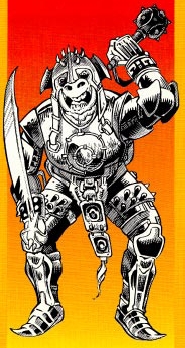
Just as the cavalier is the most elite of
the centaurs, the barbarian (or vandal) is
the most honored among orcs. Vandals do
not, however, hold any protective responsibility
toward the rest of the orcish community;
these creatures are the ruling
class. Orc barbarians train themselves,
which ensures that only the strongest
attain this ?prestigious? profession.
Vandals are always neutral evil or chaotic
evil. They use the attack and savingthrow
tables of fighters, and the
experience-point table (with modifications)
of barbarians (see UA,
pages 18-21). A vandal?s maximum level is
8th. Being the toughest of all in an orc
clan, a vandal gains bonuses to hit and
damage based on his strength, which is
always 18 (roll 1d100 for percentile value,
from 18/01 to 18/00). He also gains an
additional +1 to hit and damage for every
other level of experience gained (i.e., +1
at 3rd level, +2 at 5th level, and +3 at 7th
level). Vandals do not gain bonuses to their
armor classes based on dexterity, as human
barbarians do. Orc barbarians start
with 1 HD at 1st level, and gain an additional
hit die (1d8) for every level above
the first.
The weapon proficiency list of a vandal
depends upon what is available to orcs of
his tribe, though any sort of weapon is
possible. He may use any armor or shield,
and he may freely use oil or poison in
combat. A vandal may make one hand-tohand
attack per round.
Orc barbarians also hate magic and will
destroy magical items and spell-casters if
such are recognized. Vandals never associate
with mages or clerics, no matter the
barbarian?s level. Shamans and witch
doctors are not allowed in a tribe ruled by
a vandal, which makes the irreligious and
vulgar vandals very unpopular with orcish
gods. Of course, it is possible for an orc
barbarian to use a magical weapon unwittingly,
if he finds that it works well in
combat and is not obviously magical (like a
flame tongue or a speaking sword).
Of the other barbarian powers, the
vandal does not have the natural ability to
strike creatures normally requiring a
magical weapon to strike, but he does
have all the saving-throw bonuses unique
to barbarians. Orc members of this class
also have all other primary and secondary
abilities common to barbarians. Note that
the primary ability of leadership works on
all orcs, not just other barbarians. The
locale of the tribe dictates the use of the
barbarian?s secondary skills and determines
the number and type of tertiary
abilities the vandal has. A vandal can also
assemble a barbarian horde of orcs just as
can the barbarian upon reaching the 8th
level.
Vandals are usually found only among
orcs living in especially harsh environments.
Their tribes are primitive and
brutal in the extreme; even for orcs. A
meeting between an orc tribe ruled by a
vandal and one ruled by a normal chief
always leads to an immediate fight to the
death between both sides.
Lizard-man druid
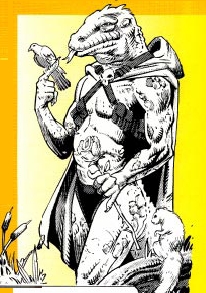
The dire erudite derives much use from
the wilderness in aiding its tribe, helping
the clan survive efficiently with little adverse
effect on local wildlife. The lizardman
druid avoids metallic objects such as
armor, weapons, and tools as much as
possible, such as the scimitar and the
khopesh sword. Armor is not used, though
shields may be employed. Oil and poison
are not used in combat.
The dire erudite is always neutral in
alignment. This class uses the normal
combat and saving-throw tables of clerics
of equal level, and it uses the experiencepoint
table of the druid (with modifications).
A dire erudite starts out with 1 HD,
gaining 1-4 hp per level after the first. Like
normal druids, this version gains additional
powers at the 3rd and 7th level.
Note that in using the shape change ability
gained at 7th level (maximum level), the
dire erudite will transform into animals
native to its environment, like frogs,
snakes, and alligators. These druids, however,
do not gain additional languages or
receive saving-throw bonuses against fire
and lightning
Spells usable by dire erudites are listed
in the Lizard-Man Druid Spell Table.
Lizard-Man Druid Spell Table
| 1st level | 2nd Level | 3rd Level | 4th Level |
| Animal friendship | Create water | Cure disease | Animal summoning I |
| Detect balance | Cure light wounds | Hold animal | Cure serious wounds |
| Detect magick | Feign death | Know alignment | Dispel magick |
| Detect poison | Locate plants | Neutralize poison | Hold plant |
| Detect snares & pits | Obscurement | Plant growth | Repel insects |
| Entangle | Slow poison | Snare | Speak with plants |
| Locate animals | Trip | Spike growth | - |
| Speak with animals | Warp wood | Summon insects | - |
NOVEMBER 1990