War of Flowers
William B. Fawcett
-
-
|
|
|
|
|
|
|
|
|
|
|
|
Only in the loosest sense, was the pre-conquest Aztec nation a
nation in the European meaning of the word. The very concept of nation
would have been virtually inconceivable to the average Aztec. He
was a Texcocan or a Tlaxcalan. The Aztec nation was, in fact, a patchwork
of city states with varying degrees of independence and mutual
animosity. An individual’s allegiance was to his clan and tribe. (Most
cities were inhabited by one tribe which was determined by customs
and deities worshipped more often than common ancestry.)
The Aztec “empire” was in fact a conglomeration of city states that
formed rather fluid coalitions which were normally centered on the
most powerful cities found in the area of present day Mexico City.
In
these coalitions there were normally 1 or 2 major powers who, by
their size and military strength, were able to compel the lesser cities
to
join in their efforts. When a city was ‘conquered’ the result was the
imposition of tribute and economic sanctions rather than social or
political
absorption, as occurred in Europe or China. This tribute was reluctantly
paid to the victorious city only until some way to avoid it was
found (such as an alliance to an even more powerful city). Any political
or military alliance was then ruled entirely by expedience, and quickly
and easily dissolved.
This constant shifting was demonstrated by the actions of Texcoco
when Tenochtitlan, then the chief power, was attacked by Cortes. Texcoca
joined with several other cities in aiding the Spanish. Just a few
years earlier Texcoco had been the reluctant ally of Tenochtitlan in
her
unsuccessful war with Tlaxcalans. (During which the Tenochtitlans arranged
to have the Tlaccalans ambush a part of the Texcocans involved.
Such treacheries were not uncommon.) Later the Spanish were
able to play these former allies against each other.
The citizen of an Aztec city was imbued from birth with the concept
that the city and tribe were important and the individual should act
only
in ways that benefited the whole. The concept of individualism we value
would have been considered anti-social and obscene to the Aztecs.
Though they amassed individual wealth and possessions most of the
land was considered to either belong to the tribe outright or to be
held in
trust for the city by the individual. Anyone dying without an heir
(male,
son) automatically left his land and possessions to the city or clan
for
redistribution. Material wealth was considered less important than
value
to the tribe, as reflected by the positions held and honors received.
If
you do not realize how deeply this selfless spirit was ingrained in
every
citizen, it will be difficult to accept the attitudes demonstrated
by captured
warriors.
War itself was viewed by the Aztecs as a part of the natural rhythms.
These rhythms were felt to permeate every level of existence and only
by keeping in step to them could an individual and (more importantly)
a
tribe or city survive and prosper. Each day was seen as a battle between
the sun and the earth. The sun losing every sunset and gladly sacrificing
himself to the earth, so that men could prosper. Many of the workings
of
nature were viewed as being reflections of the rhythm of the war between
the opposing natural and spiritual forces. War then took on a
religious and ritual nature that both limited it in extent and made
it part
of the spiritual life of the community with strong metaphysical overtones.
Rituals arose around the conducting of wars and to vary from
them would have caused the war to lose its very reason for existing.
On the more mundane level wars were fought for Revenge, Defense,
or Economic reasons. A common cause for the formal declaration
of war was that a city’s merchants were
being discriminated against
or attacked. (These merchants normally doubled as each city’s intelligence
force and so were often harassed in times of high tensions.) Behind
all political and economic justifications was always the strong force
of the religious nature of war, and a never ending need for captives
to
sacrifice.
A common proximate cause for war was the failure of a vassal state
to pay the tribute demanded. It is surprising to discover, but true,
that in
a system where tribute was one of the key ingredients, no system (such
as hostages) was ever devised to guarantee the payment of tribute from
a previously conquered area. If tribute was refused the only alternative
was to go to war again.
The process of declaring war was long and elaborate. Followed in
most cases, it left no room for the deviousness common in Aztec wars.
The procedure to be followed was set in a series of real, but ritually
required, actions. The actual declaration of war involved 3 State
visits, often by 3 allied cities planning to attack. The 1st delegation
called on the chief and nobles of the city. They boasted of their strength
and warned that they would demand some of the nobles as sacrifices
if
the war ensued. The group would then retire outside the city gate and
camp for one Aztec month (20 days) awaiting a reply. This was normally
given on the last day and if the city or coalition did not accept their
terms, token weapons were distributed to the nobles. (This was so that
no one could say they defeated an unarmed foe.)
The 2nd delegation would then approach the city’s leading
merchants. This 2nd delegation would describe the economic “horrors”
of a defeat, comparing them badly to the terms offered, and generally
trying to persuade the merchants to get the chiefs to surrender.
This delegation then also retired for a month to await a reply. Should
this also be negative a 3rd and final delegation would arrive. This
group was to talk to the warriors themselves. They would harangue a
mass meeting with reasons why they should not fight and tales of the
horrors of battle. Once more they would ask for the city to meet their
terms (normally a virtual surrender or the loss of some territory)
and
then retire to a camp for the ritual 1 month wait. Finally, after all
of
this, the armies (having had plenty of time to assemble) would meet
in a
battle. Here any deception was acceptable and a cunning general as
valuable as a courageous one.
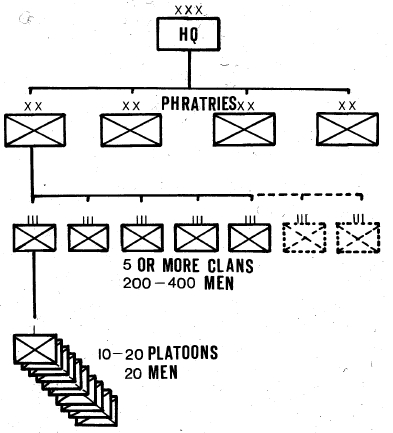
The leadership of the Aztecs was the same in times of peace and
war. Between wars the officers served as the administration, judiciary,
and civil service of the city. Heading this organization was the Supreme
War chief or Tlacatecuhtli. This was the position held by the unfortunate
Montezuma in Tenochtitlan when Cortes arrived. Each clan was assigned
to one of four phratries each having its own leader called a Tlaxcola
who served as their divisional commander in wartime, and on a
council with the other three that ran the actual administration of
the city
in times of peace. The head of each clan served as a regimental commander
and was known as a Tlochcautin. In peace he would serve in a
role similar to the English Sheriff. Below the clan level was a unit
of
approximately 200 to 400 men. This was the equivalent of our company
and was really the largest unit over which any tactical control could
be held once a battle began. The smallest regular unit was the platoon
of
20 men. This organization was rigidly observed by the major cities
and
was such an integral part of Aztec culture that the symbol for ‘20’
was a
flag such as each platoon had.
The military techniques of the Aztecs were inferior to those of
Europe or China at that time. This is probably due primarily to the
fact
that while ritually involved and religiously important, war was less
developed
as a social solution in pre-conquest Mexico. This was caused by
several factors, the major one being that the population density of
the
area was much less than in other parts of the world. In the period
immediately
preceding the Spanish only one area had really felt the pinch
of overpopulation. This was the area around Lake Titicocca occupied
today by Mexico city. Here is where the powerful and most warlike cities
developed. Even then their tradition of war (as opposed to individual
combat) was only a few hundred years old as opposed to thousands in
other lands. The result was that while having a warrior attitude and
with
war deeply ritually ingrained in their culture, the techniques of battle
were still quite unsophisticated and basic.
One reflection, of the undeveloped nature of Aztec wars was the
absence of any sort of drills. Units acted as a group only during civil
duties, or during the several religious ceremonies that they assembled
for each year. The tactics of a battle then most often resembled the
mass
or swarm tactics of biblical times.
Another factor mitigated in favor of only limited military activities.
This was the fact that it was extremely difficult for an army to engage
in
an extended campaign. Since the army was also the work force, a campaign
during the planting and harvest seasons was prohibited. This is
especially true since the agriculture was not so efficient as to be
able to
support the massive priests hierarchy and a standing army of any size.
Nor could an army live off of the country, since it was likely that
the area
they would travel through would be inhabited by several city states
that
were not involved in the war and were independent of those involved.
This meant that it was necessary not only to set up supply depots along
any proposed route, but also to negotiate permission to trespass on
other cities’ lands.
The marginal nature of the agriculture was also such, that sieges
that lasted any length of time were virtually impossible. The besieging
army would as likely starve as the besiegers. The result of this was
that
formal walls and other fortifications were rare. In their place canals
(useful
in trade also) were often used with portable bridges. Many cities were
also located in easily defensible terrain such as on a mountainside
or on
the end of a narrow isthmus. There has also been no evidence that siege
weapons of any sort were developed or used to any extent.
Despite all of the problems listed the Aztecs were able to wage
campaigns over a wide area of Mexico. Most often these were fought
with armies made up chiefly of local allies with a contingent of Aztecs
to
stiffen them. In some cases it is recorded that the Aztecs were forced
to
engage in the laborious technique of having to subdue each of the
towns and cities on their route.
The weapons and tools of the Aztecs were basic and simple in
nature. Rather than developing new variations of weapons the efforts
of
the Aztecs went into elaborate decorations on them. There were four
main weapons used by the Aztec warrior. A wooden club with sharp
obsidian blades was used. Javelins were common and often used with
a
throwing stick called an atl-atl. The bow and arrow was also found
in
most armies as was a heavy javelin or lance for in-fighting. Occasionally
a clan would have a tradition that caused some of them to employ the
sling or spears. Axes were used as tools, but do not seem to have been
a
regularly used weapon.
The bulk of the weapons in a city was kept in an arsenal called the
Tlacochcalco or roughly the “house of darts.” One of these was found
in each quarter of a city and held the weapons for five clans (one
phratrie).
These arsenals were always located near the chief temples and
were designed with sloping walls that enabled them to serve as a fort.
The Tlacochcalcos served as the headquarters, assembly points and
rallying points for the defenders of a city. Religious ceremonies were
also held there by the military leaders and “Knights.”
The shields of the Aztecs were wickerwork covered with hide. Most
were circular and elaborately painted and decorated. Skins and feathers
were also often attached to augment their beauty. The warriors who
used the clubs carried shields, but those using the large javelin or
lance
were unable to as they needed both hands to employ their weapon.
Body armor was made of quilted cotton hardened in brine. This was
quite successful against the weapons used by other Aztecs, (and useless
against crossbows and steel swords). This cotton armor was in fact
quickly adopted by the conquistedores as being effective enough and
much cooler than their own metal armor. The quilted armor was often
dyed bright colors, brocaded and embroidered with intricate designs
and symbols.
Wooden helmets were worn by some warriors and the chiefs, (who
rose to chief by being outstanding warriors). These quickly became
elaborate and bulky. It was often necessary for them to be supported
by
shoulder harnesses. Most headdresses or helmets were stylized animals
or protecting deities. The more elaborate the helmet the more renown
the warrior in battle. There is mention of copper helmets in a few
codexs, but none have been found and in any case would have been
extremely rare. Metal working for tools and weapons was not advanced
and obsidian was the basic (and effective) material.
As during comparable periods on other continents the Aztecs wore
no uniforms. Each side would identify itself with a prominently worn
badge or insignia. This often would be elaborated to show also the
rank
of the wearer. With the myriad of colors in the cotton armor and the
elaborate helmets an Aztec battle was a kaleidoscope of swirling colors.
A young warrior was taught the use of weapons as part of his
schooling. (All males were soldiers.) All boys were required to either
be
tutored or to attend the Telpuchcalli or public school. Later, in lieu
of
unit training and drills, a new warrior was attached to veteran for
his
first battles. This program was actually quite similar to the apprenticeship
or squire systems developed for the same purpose in medieval
Europe.
The tactics and weapons of the Aztecs were greatly influenced by
the goal of their wars, captives and whatever tribute or land demanded.
It was the ultimate sign of ability in a warrior to bring back from
a battle a
live enemy suitable for sacrifice. Warriors then often strived not
to kill
their enemy, but to knock him out or deliver a non-fatal, but disabling
wound. A victory was valued then by the number of enemies captured,
not killed. To this end warriors were trained rigorously in individual
combat, with little emphasis on formations or teamwork. The best warriors
were admitted to select societies of “knights.” Only the most skillful
(as judged purely by the number of captives taken) were allowed to
enter. These were known as the Knights of the Eagle, the Knights of
the
Ocelot (Tiger), and a less common group the Knights of the Arrow.
Helmets depicting their namesakes were often worn and ceremonial
costumes that copied their coloration were worn in ceremonies and into
battle. These orders performed dances and participated in rituals at
the
Tlacochcalco. They also participated in the mock battles of sacrifice.
These Knights received large shares of land when conquered territories
were divided between the warriors. (This practice gave an occupation
force a way to support itself.)
A warrior who was slain in battle or sacrificed after a defeat was
guaranteed entry into a special warriors heaven. This was to be found
in
the East and a special heaven for women who died in childbirth was
in
the West (they were felt to have sacrificed themselves for a potential
new warrior). To die in these ways was the greatest honor a defeated
warrior could receive. (Non-warriors and cowards were sold into slavery.)
To some it was the culmination rather than the ruin of the lives.
There is recorded the story of Tlahuicol who was a Tlaxclan chief.
Having
been captured in battle he was given the honor of the mockgladitorial
sacrificial combat. This meant that he was chained to a large
round stone representing the sun and given wooden weapons, (no obsidian
points or edges), and attacked one at a time by members of the
Knights of the Eagle. In single combat he managed to kill a few and
wound several more. The combat was stopped and Tlahuicol was offered
the choice of the generalship of the Tlaxclan army or to be the
sacrifice in their highest ritual. He choose to be the sacrifice, viewing
it
probably as the greater honor.
These sacrifices were viewed then not as a punishment (criminals
were killed or enslaved, but never sacrificed), but as an opportunity
to
give their final great contribution to their communities. It was believed
that the sacrifices were needed to prevent the wrath of the gods and
bring anything needed such as the rain or spring. Perhaps the only
close
honor was to obtain a prisoner in battle.
A typical Aztec battle consisted of both sides coming upon each
other, quickly forming up to charge and then rushing at each other
amid
fierce cries. Quickly this would break down into many combats between
individuals and small groups. Both sides would contend, until one
seemed to be gaining an advantage. The other would then break and
run, avoiding capture to minimize their enemy’s victory. Often the
defeat
and capture of a major chief was enough to cause the morale of one
side to break.
Many stratagems were used. Feints and deception were common,
especially in the battles between the major cities. It was a common
maneuver for one side to fake a route and then lead their pursuers
past a
second force in hiding. This force would then fall on the rear of their
pursuers while the routing force rallied. A cunning war chief was considered
as valuable as a courageous one. Whoever won, sacrifices were
assured and the gods appeased.
If there was no war occurring, then an artificial war was instituted
to
assure sacrifices and give the warriors an opportunity to prove their
skills. This was incongruously named the “War of Flowers.” Though it
was an artificial war those participating in it fought a very real
battle.
Many died and many more were captured for sacrifice before one group
would concede defeat.
Invited to participate were the best Knights and warriors of two or
more rival states. The best warriors contended to be able to participate.
If he won, a warrior would gain in renown throughout the cities. If
he
was killed, the warrior was given the honor of cremation. Reserved
only
for warriors, cremation guaranteed entrance to the special warriors’
heaven. Finally, if defeated and captured a warrior was given the supreme
honor of being sacrificed. So popular were these Wars of Flowers
that some were repeated annually for years.
The institution of war among the Aztecs evolved into something
quite different from that which we perceive. It was foremost a means
by
which an individual could serve the all important tribe or city. It
was an
inherently ritualized and mystic event of deep-meaning and necessity.
It
was the only means by which captives needed to appease their bloodthirsty
gods (actually it was the hearts they tore out and offered still
throbbing). In a truly collective, military society it was the one
area
where an individual could gain renown and prestige.
Aztec Command Structure
Tlacatecuhtli —War chief, C in C
Tlaxcola — Phratry Commander (4)
Tlochcautin — Clan Commander