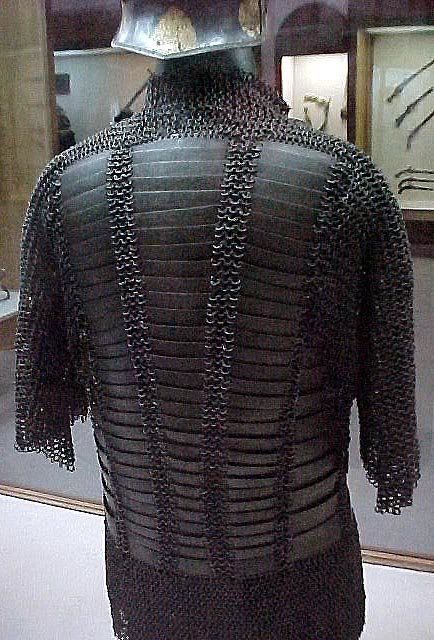
AC 4
MOVE 9"
Weight is somewhat distributed.
BANDED MAIL is horizontal strips of articulated armor plates worn over
a suit of chain mail.
BULK:
WEIGHT:
BASE MOVEMENT:
COST: 90 g.p.
PP: -50
OL: -20
FRT: -20
MS: -60
HS: -50
HN: -30
CW: -90 (WSG: -20, a character
in anything heavier than chain cannot climb any severe slope || cliff)
Effects of Armor on Thief Functions
| Thief Function | Scale or
Banded |
| Pick Pockets | -50 |
| Open Locks | -20 |
| Find/Remove Traps | -20 |
| Move Silently | -60 |
| Hide in Shadows2 | -50 |
| Hear Noise | -30 |
| Climb Walls | -90 |
General note:
No dexterity bonuses apply to thief functions (though penalties do) when
wearing armor other than simple leather.
2: Assumes
that armor worn is covered by another garment. Elfin chain mail is light
and thin, and can be worn under normal clothing. All
other types of armor except simple leather are stiff and/or bulky, and
can only be covered by a full body cloak.
<note: this contradicts what is written in "Dressing for the Weather",
in the WSG>
TW:
PV:
HJ:
BJR:
BJS:
TA:
TE:
TF:
PT, <0: +x
PT, 0-30: +x
PT, 31-75: +x
PT, 76+: +x
PUMMEL DAMAGE: -x% (protection)
GRAPPLE 'AC': +x% (penalty)
GRAPPLE DAMAGE: -x% (protection)
|
|
|
|
|
|
|
|
|
|
|
|
I am
writing in protest of the use of banded
mail in the AD&D®
game. Banded mail is a type
of armor known only in illustrations
of the 12th
and 13th centuries. These
illustrations reveal
alternate rows of linked
solid disks, which is
manifestly impossible. Many
people have tried
to explain banded mail, but
all these explanations
have a serious problem.
One explanation suggests the
armor was made
with rings sewn on linen
in overlapping rows. It
was then covered on both
sides with strips of
leather with the stitching
passing between the
rows of rings. The lower
edges of the leather
would be turned up and would
cover the upper
edges of the strips beneath.
This would increase
the thickness of the leather
between the rings
sixfold.
Another explanation is that
banded mail is
simply normal chain mail
with leather thongs
drawn through the links.
Oriental mail that is
very similar to this explanation
is in existence,
and has considerable resemblance
to some of
the illustrations mentioned
in the opening
paragraph.
The serious problem with these
explanations
is that all of the construction
methods that have
been proposed make for very
stiff armor, and in
the old illustrations this
fact tends to be shown
most widely in the areas
that need the most
flexibility (e.g., elbows,
neck, and knees). As a
matter of fact, no suit of
mail looking like that in
the pictures has ever been
found. It is most
likely that the different
methods of picturing
mail all represent the same
thing and were used
to prevent monotony.
What does this mean in game
terms? That is a
matter of opinion. In my
campaign, I have
banished banded armor completely.
My players
must be content with having
their characters
look at pictures of banded
mail in books and
drawings. If banded armor
is to be kept in any
campaign, the 9" move base
stated on page 27
of the DMG is ridiculous.
It should be changed
to 6" at the very fastest.
The weight, however,
does not need to be changed.
Alan Ristow
Saline MI
(Dragon
#123)
I am writing in response to
Mr. Ristow's protest
against banded mail in issue
#123. I know
something of armor, being
the proud owner of a
set of homemade chain mail,
and the description
given by Mr. Ristow would
indeed be both
difficult to manufacture
and uncomfortably stiff
to wear. However, the description
in the DMG,
page 27, of both banded and
splint
mail
presents a more feasible
approach. While it
does not specify what the
bands of armor on
banded mail are, I am assuming
that plate is
meant. Although this would
still be difficult to
construct without the aid
of a blacksmith and
forge (as are all armors
that are more protective
than chain mail), it would
not be nearly as
difficult to wear. This type
of armor would
probably be less constricting
than splint mail
which, according to the portrayal
in the DMG,
would restrict waist movement
in a manner
akin to wearing a barrel
(metal breastplates
share this disadvantage).
I share Mr. Ristow?s
desire to hear from others
more knowledgeable
of armor, especially of true
descriptions of
medieval armors.
J.R. Porter
Yongsan, Korea
(Dragon
#126)
I just read the letter by
Alan Ristow in the
Forum (issue #123)
concerning banded mail. He
is right - ?banded mail?
never existed. The
12th- and 13th-century illustrators
of manuscripts
who found themselves filling
in row
after row of tiny circles
to represent warriors?
ring mail resorted to drawing
only a fragment
of a fighting man?s cuirass
with a representation
of ring mail, and then filling
in the rest of the
illustration with what appeared
to be a different
type of armor entirely -
?banded mail!? Sometimes,
they did half the work, accurately
portraying
ring mail on one line and
alternating
that with a simpler line
of ?mail? which didn?t
have individual rings or
circles - just shading,
which was quicker to draw.
The cover of issue #97, "Music
Lover," has a
fantastic painting of a dragon.
The commentary
on the painting by the artist,
Robin Wood,
includes her apology for
her lateness in delivering
the painting to TSR, Inc.,
with words to the
effect that ?there were all
these scales, see.?
Once it came time to do the
detail work and
actually draw each individual
scale on the
dragon, Miss Wood had the
same labor before
her as the medieval illustrators
did. Being less
industrious than the esteemed
Miss Wood, they
took shortcuts rather than
portraying ring mail
realistically.
By the time historical research
had reached a
professional level in the
19th century, it had
been a long time since anyone
had actually
worked with or used armor;
wholly apocryphal
armor types were invented
by historians poring
over the old manuscripts,
trying to identify
what they saw. Hence came
?banded mail.? Only
late in this century did
historians think they had
the truth. A piece of banded
mail had never
been found or unearthed.
The ?lazy-illustratorand-
credulous-historian? explanation
for the
controversy of banded mail
is found in Sean
Morrison?s Armor (New
York: Thomas Y. Crowell
Company, 1963), a ?juvenile?
book I?d recommend
as an excellent introduction
to armor.
Other types of armor which
never existed are
found in older books on the
subject. These
include ?mascled,? ?rustred,?
and ?trellised?
armor, and also ?chain mail:?
though this last
term suffices when used to
mean a ring mail
byrnie or shirt, which is
an unbroken sheet of
interlocking rings (versus
a cuirass of rings)
stapled to a leather base.
This is what the term
?ring mail? means in D&D
game terms.
In summary, ?banded mail?
never existed and
should be abandoned from
a campaign for this
reason. Doubtlessly, E. Gary
Gygax got his
original information from
one of the older
authorities on medieval armor.
My campaign
hasn?t had banded mail in
years. Ring mail and
chain mail are historically
viable.
As a postscript, old ads for
FGU?s CHIVALRY &
SORCERY game included
a drawing of a knight
with his armor?s pieces each
identified, including
something called a ?tace.?
Wrongo. Morrison
insists that there was never
such a piece of
armor. (These have been incorrectly
deduced
from ?tassets,? which did
exist.) Morrison?s book
is really quite good for
that.
Jay Kaufman
Moorhead MN
(Dragon
#126)
I am writing in response to
Alan Ristow?s
letter printed in issue #123.
In Mr. Ristow?s
letter, he spoke out against
the use of banded
mail on the pretense that
it had never existed in
history, except as a different
representation of
the same armor. This letter
prompted me to do
a little research of my own.
In the information I uncovered,
banded mail
as an armor type was never
mentioned. However,
certain descriptions of unnamed
armor
resembled the explanations
given in Mr. Ristow?s
letter. Unfortunately, the
problem of stiff and
bulky armor still stands
in all descriptions given.
This evidence does not mean
that banded mail
should be banished from the
game, although I
agree that it is a matter
of opinion. The description
in the DMG may still
be used, but it needs
some clarification.
Banded mail is described as
layers of padding,
light chain, and a ?series
of overlapping bands
of armor in vulnerable areas.?
What kind of
armor are we talking about?
One might think of
metal bands, but leather
must be used or banded
mail would then become as
protective as
plate mail. So, banded mail
may be defined as a
base layer of padding, topped
by light chain,
which is reinforced by a
cuirass of horizontal,
?clinker-built? (partially
overlapping) bands of
hardened leather. Legs and
arms would be
protected by greaves and
knee guards strapped
over the light chain.
This configuration would allow
banded mail
to keep the superior movement
rate over splint
mail (9? as opposed to 6?)
because the horizontal
bands would allow more forward
movement
than the vertical bands of
splint mail (a man
must lean forward to run).
In addition, the
vertical bands mentioned
with splint mail would
also have to be hardened
leather instead of the
?pieces of plate? as stated
in the DMG.
Whether or not you allow banded
mail in
your campaign is up to you;
it is really just a
matter of whether or not
you, as DM, prefer a
historically accurate campaign.
My purpose in
writing this letter is to
show how banded mail is
possible. In any case, enjoy
the game.
Anthony Speca
Kingwood TX
(Dragon
#126)
I am writing to comment on
Alan Ristow's
letter
on banded mail in DRAGON® issue #123.
He is correct in saying that
the type of armor
known in textbooks as ?banded
mail? did not
exist and is infeasible.
However, the armor
mentioned in the AD&D®
game, particularly the
description of it in the
DMG is not ?banded
mail.? The AD&D
game books mistakenly apply
the term ?mail? to nearly
all types of armor,
when it should in fact be
only used for chain
mail and ring mail. A better
nomenclature might
be to replace the word ?mail?
in the names with
?armor? with the exception
of ?plate mail?
which should perhaps be called
?plate and mail?
or ?transition armor? (as
it was transitional
between mail and plate).
The banded armor
described in the DMG
seems to resemble the
Roman Lorica Segmentata,
worn over light mail
and padding. Such armor,
with most of its bulk
and protection concentrated
on the torso and
little on the legs (unlike
some others which have
greaves and other encumbrances),
would probably
slow down the wearer no more
than chain
mail. It should therefore
retain the movement
base of 9? and perhaps be
reclassified as ?fairly
bulky? due to the fact that
it would allow relatively
free movement of the limbs.
On the subject of armor, I
would like to bring
up the armor used by the
svirfnebli (as described
in the FIEND FOLIO®
tome), which does
not seem to fit the system
of armor previously
defined, and might be an
interesting addition. It
is described as a leather
jack (sleeveless tunic)
sewn with mithral-steel rings,
worn over fine
chain mail. Previous rules
have not covered the
wearing of two types of armor
together, but
could surely be extended
to cover this. The
armor-class decrease caused
by wearing the
mithral-ring jack in addition
to chain mail can
be derived by comparing the
standard armor
classes of chain mail armor
(AC 5), ring/studded
armor and shield (AC 6),
svirfnebli (AC 2 wearing
chain mail and jack), and
surface gnomes
(AC 5 wearing ring/studded
and shield). It can
be seen that the effect of
a mithral-ring jack
would be +2 (assuming surface
and deep
gnomes have the same bonus
to armor class due
to size, dexterity, etc.).
Of course, the jack could
be worn on its own or could
be made of rings of
different metals.
I suggest the following system:
The jack
should have a base armor
class of 8 (if worn on
its own) or +1 (if worn with
chain mail) if it is
made of meteoritic iron (the
lowest quality
metal possible to make rings
of the required
quality). If the rings are
made from mithral
steel, there would be an
additional bonus of +1;
if adamantite steel is used,
the bonus is +2. The
jack would have an encumbrance
of 10 lbs., be
nonbulky, and be worn only
over ordinary or
elfin chain mail. It could
be worn by thieves, but
at the same penalty as elfin
chain mail (or as
studded, if worn with elfin
chain).
Timothy Makinson
Dunedin, New Zealand
(Dragon #131)
I am writing in defense of
banded mail armor
which was undeservedly slighted
in DRAGON
issue #123's "Forum."
I strongly disagree with
Mr. Ristow?s opinions on
the matter, and, yes,
Mr. Ristow, I am quite knowledgeable
of armor
types, uses, designs, etc.
In his letter, Mr. Ristow
states: ?Banded mail is
a type of armor known only
in illustrations. . . ."
Might I point out that the
AD&D game is a game
of fantasy, not fact, as
that letter makes it out to
be. Case in point: Dragons
were also found only
in drawings, paintings, and
stories. This can be
said of all fantasy-type
monsters in books.
Mr. Ristow also states: ?In
my campaign, I
have banished banded mail.
. . . My players
must be content with . .
. banded mail in pictures
and drawings." As a DM, this
tells me that
you are not playing the AD&D
game, but only
trying to copy history (as
evidenced by your
letter). But Gary Gygax said
it best in the Players
Handbook (p. 7): "ADVANCED
DUNGEONS &
DRAGONS is a fantasy
game of role playing
which relies on the imagination
of participants,
for it is certainly make-believe."
There is one thing on which I do agree with
Mr. Ristow: the fact that
banded mail armor
does not exist in the real
world. Still, there is no
reason for it not to exist
in a fantasy game such
as the AD&D game.
Daryl Short
Riverside CA
(Dragon #131)
In reference to Alan
Ristow's letter in issue
#123 and the letters
by J.R. Porter, Jay Kaufman,
and Anthony Speca in issue
#126: Banded
armor most certainly did
exist. The Romans
called it lorica segmentata
and it was the standard
armor of the Roman legionnaire.
It consisted of pairs of front
and back plates
covering the upper part of
the chest and back,
while the trunk was protected
by six or seven
overlapping metal strips
hinged at the back and
fastened at the front with
hooks laced together.
They were arranged so as
to give complete
freedom of movement and were
held together
with leather strips or riveted
to a leather jerkin,
so that each strip had independent
movement.
Over this was a pair of shoulder-pieces,
each
with five or six strips carefully
shaped and
buckled on to the plates
or strips.
Other examples include an
ancient Japanese
armor, tanko, from
around the 4th to 7th centuries
A.D., the Yoke-hagi-do
and the Hishinui-do,
both 16th-century Japanese
cuirasses.
Finally, in the Metropolitan
Museum of Art,
New York, there is a complete
set of 15thcentury
Turkish armor. The cuirass
is of banded
armor, with a steel helmet,
lamellar skirts,
banded vambraces, plate greaves
and kneecaps,
and mail elsewhere.
I notice that many people
tend to consider (or
discuss) only medieval European
technology and
society when discussing armor,
weapons, armies,
mythology or whatever. Note
that none of
the banded armors discussed
are of medieval
European origin; I believe
that may have contributed
to their being overlooked.
As has been
pointed out, the AD&D
game is a fantasy world
and does not need to reflect
historical reality.
The existence of magic means
that an AD&D
game society won?t look quite
like any premodern
culture, but I find that
borrowing some
historical detail adds to
the flavor of the game.
However, gamers are limiting
themselves if they
draw only from medieval European
history. In
some of our campaigns, we
have taken elements
from the cultures of Imperial
Rome, ancient
Egypt, the Islamic Caliphate,
and ancient Persia;
a campaign that we are developing
has elements
drawn from Minoan Crete,
Mycenaean Greece,
Celtic Europe, pre-Columbian
America, and
ancient China.
Steve & Cynthia Higginbotham
Columbus MS
(Dragon
#132)