GENERATION OF ABILITY SCORES
-
GENERATION OF ABILITY SCORES
-
| <GENERATION OF ABILITY SCORES, Player Characters :> | Method V | - | - | - |
| <GENERATION OF ABILITY SCORES, Non-Player Characters :> | Non-Player Characters | General Characters | Special Characters, Including Henchmen | - |
| - | - | - | - | - |
| CREATING THE PLAYER CHARACTER | DMG.11 | - | AD&&D | DMG |
| What are the odds? (3d6) |
As AD&D
is an ongoing game of fantasy adventuring,
it is important to allow
participants to generate a viable character of the race and profession
which he or she desires.
While it is possible to
generate some fairly playable characters by rolling 3d6,
there is often an extended
period of attempts at finding a suitable one due to quirks of the dice.
Furthermore, these rather
marginal characters tend to have short life expectancy --
which tends to discourage
new players,
as does having to make do
with some character of a race and/or class which he or she really can't
or won't identify with.
Character generation, then,
is a serious matter, and it is recommended that the following systems be
used.
This method gives the player an opportunity
to generate a character of a desired
class (subject to the DM’s approval) and
be assured that the ability
scores for the character will meet the
minimum requirements for the
class in question.
After the player’s selection of a class
is approved, he or she rolls a
certain number of six-sided dice for each
ability score to be generated,
as indicated on the following table. The
best three die rolls for
each ability are added together to produce
the score. (For example, a
fighter’s strength is determined by rolling
9d6 and keeping the three
highest results.) If the total of the three
highest die rolls is below the
minimum requirement for an ability in a
certain class, then the player
takes the minimum number (e.g., 15 for
a monk’s strength) as the
character’s ability score. Similarly, if
a rolled score is greater than the
maximum allowable (such as for a barbarian’s
wisdom), then the
score is lowered to the maximum number.
| Class Desired | Str | Int | Wis | Dex | Con | Cha | Com | Per |
| Cavalier | 8 | 6 | 4 | 7 | 9 | 3 | 5 | 4 |
| Paladin | 7 | 5 | 8 | 3 | 6 | 9 | 4 | 4 |
| Cleric | 7 | 4 | 9 | 5 | 8 | 6 | 3 | 4 |
| Druid | 7 | 4 | 8 | 5 | 6 | 9 | 3 | 7 |
| Fighter | 9 | 3 | 5 | 7 | 8 | 6 | 4 | 4 |
| Barbarian | 9 | 3 | 5 | 7 | 8 | 6 | 4 | 7 |
| Ranger | 7 | 6 | 8 | 5 | 9 | 4 | 3 | 8 |
| Magic-User | 4 | 9 | 7 | 8 | 6 | 5 | 3 | 4 |
| Illusionist | 3 | 8 | 7 | 9 | 5 | 6 | 4 | 4 |
| Thief | 6 | 5 | 3 | 9 | 7 | 4 | 8 | 7 |
| Assassin | 6 | 7 | 4 | 9 | 8 | 3 | 5 | 7 |
| Monk | 7 | 5 | 9 | 8 | 6 | 4 | 3 | 6 |
<
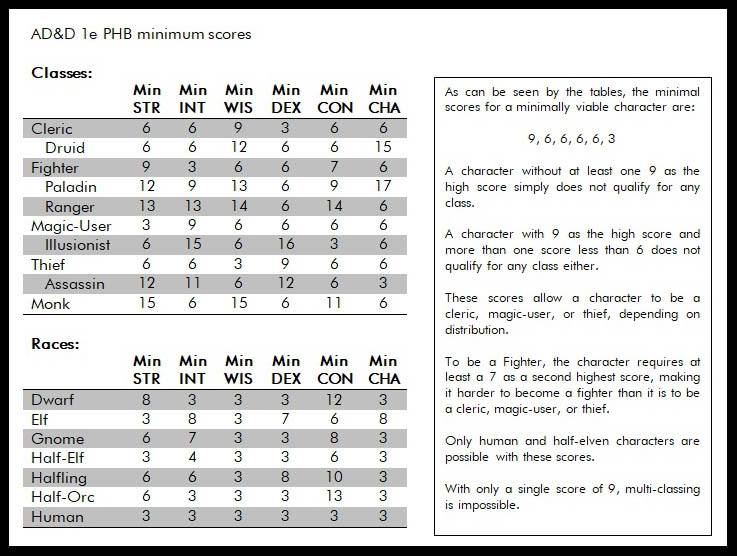
PCs, TABLE OF MINIMUM ABILITY SCORES
| Class | Minimum Score or Adjustment
to
Ability Dice Roll* |
| Paladin | S12, I9, W13, D6, C9, Ch17 |
| Cleric | S6, I6, W9*, D6, C6, Ch6 (* 13 if multi-classed half-elf cleric) |
| Druid | S6, I6, W12, D6, C6, Ch15 |
| Fighter | S9, I3, W6, D6, C7, Ch6 |
| Ranger | S13, I13, W14, D6, C14, Ch6 |
| Magic-User | S3, I9, W6, D6, C6, Ch6 |
| Illusionist | S6, I15, W6, D16, C3, Ch6 |
| Thief | S6, I6, W3, D9, C6, Ch6 |
| Assassin | S12, I11, W6, D12, C6, Ch3 |
| Monk | S15, I6, W15, D15, C11, Ch6 |
Prime
Requisite: 16+ grants a 10% XP bonus.
Two
fifteens: A PC needs at least two fifteens. Without two fifteens,
the character enters into the Hopeless
class.
<theoretically, could be extended for all of the demi-humans>
>