Inspirational and Educational Reading
|
|
|
|
|
|
|
|
|
|
|
|
|
|
|
|
|
|
Inspiration for all of the fantasy work
I have done stems directly from the
love my father showed when I was a tad,
for he spent many hours telling
me stories he made up as he went along,
tales of cloaked old men -- who
could grant wishes, of magic rings and
enchanted swords, or wicked
sorcerors and dauntless swordsmen.

Then too, countless hundreds of comic books
went down, and the long-gone EC
ones certainly had their effect. <EC
Archives>
Science fiction, fantasy, and horror movies
were a big influence.
In fact, all of us tend to get ample helpings
of fantasy when we are very young,
from fairy tales such as those written
by the Brothers Grimm and Andrew Long.
This often leads to reading books of mythology,
paging through
bestiaries, and consultation of compilations
of the myths of various lands
and peoples. Upon such a base I built my
interest in fantasy, being an avid
reader of all science fiction and fantasy
literature since 1950. The following
authors were of particular inspiration
to me. In some cases I cite
specific works, in others, I simply recommend
all their fantasy writing to
you. From such sources, as well as iust
about any other imaginative writing
or screenplay you will be able to pluck
kernels from which grow the fruits
of exciting campaigns. Good reading!
Inspirational Reading:
| Anderson, Poul. | THREE HEARTS AND THREE LIONS; THE HIGH CRUSADE; THE BROKEN SWORD |
| Anthony, Piers | "Split Infinity" series <Grognardia: 2008.11.25> |
| Bellairs, John. | THE FACE IN THE FROST |
| Brackett, Leigh. | <PF: The Sword of Rhiannon, Skaith series, et al.> |
| Brown, Fredric. | - |
| Burroughs, Edgar Rice. | "Pellucidar" Series; Mars Series; Venus Series |
| Carter, Lin. | "World's End'' Series <6 books> |
| de Camp, L. Sprague. | LEST DARKNESS FALL; FALLIBLE FIEND; et al. |
| *de Camp & Pratt. | "Harold Shea" Series; CARNELIAN CUBE |
| Derleth, August. | - |
| Dunsany, Lord. |  |
| Farmer, P. J. | "The World of the Tiers" Series; et al. |
| Fox, Gardner. | "Kothar" Series; "Kyrik" Series; et al. |
| *Howard, R. E. | "Conan" Series |
| Lanier, Sterling. | HIEROS JOURNEY <2nd book - GG> <Grognardia: 2008.11.25> |
| *Leiber, Fritz. | "Fafhrd & Gray Mouser" Series; et al. |
| *Lovecraft, H. P. | - |
| *Merritt, A. | CREEP, SHADOW, CREEP; MOON POOL <audiobook, from archive.org>; DWELLERS IN THE MIRAGE; et al. <PF: The Ship of Ishtar> |
| Moorcock, Michael. | STORMBRINGER; STEALER OF SOULS; "Hawkmoon" Series (esp. the first three books) |
| Norton, Andre. | - |
| Offutt, Andrew J. | editor SWORDS AGAINST DARKNESS III. |
| Pratchett, Terry | Disc World <Grognardia: 2008.11.25> |
| Pratt, Fletcher | BLUE STAR; et al. |
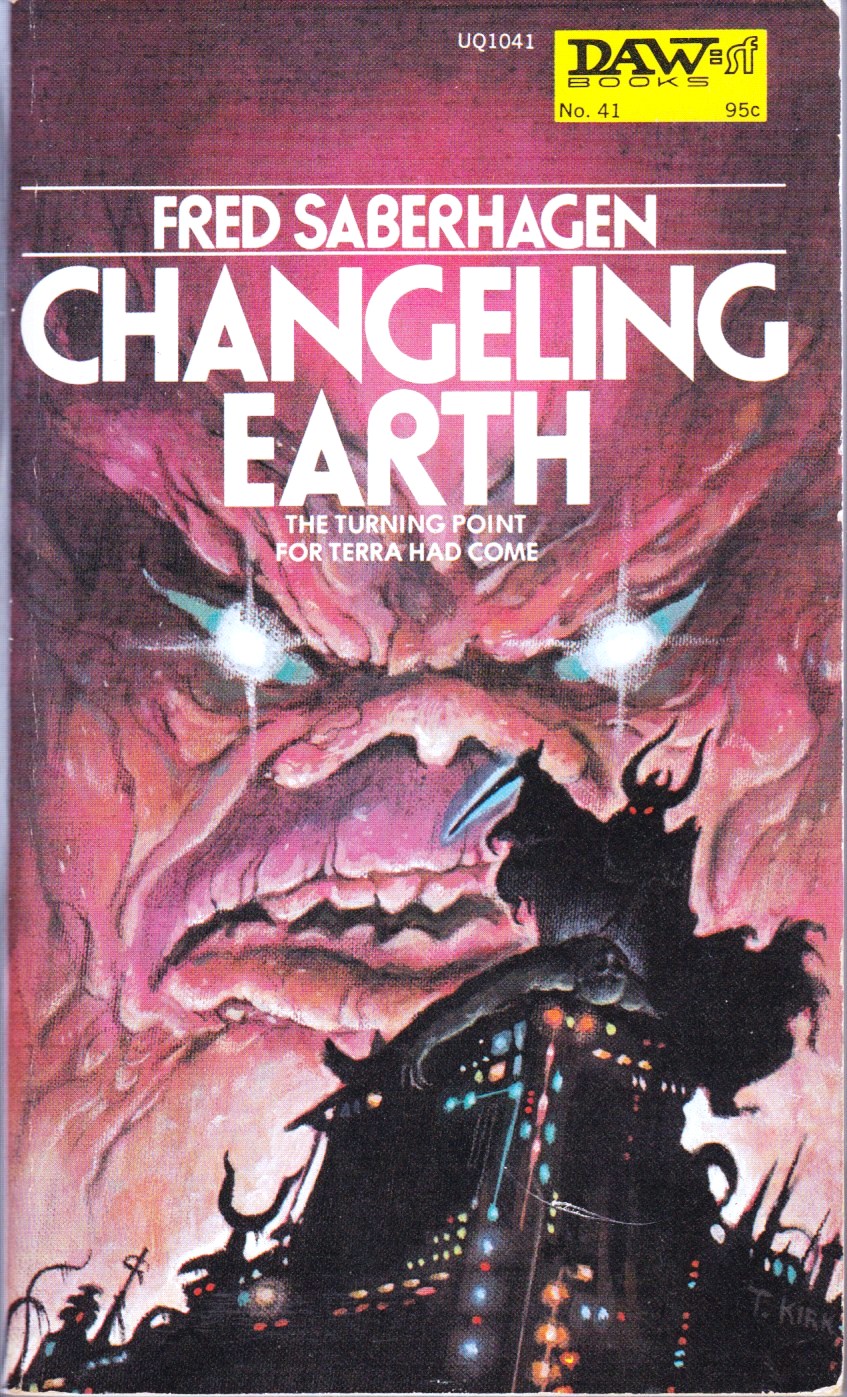
| Saberhagen, Fred. | CHANGELING EARTH; et al. |
| St. Clair, Margaret. | THE SHADOW PEOPLE; SIGN OF THE LABRYS |
| Tolkien, J. R. R. | THE HOBBIT, "Ring Trilogy" |
| *Vance, Jack. | THE EYES OF THE OVERWORLD; THE DYING EARTH; et al. |
| Weinbaum, Stanley. | - |
| Wellman, Manly Wade. | <PF: John the Balladeer series, et al.> |
| Williamson, Jack. | - |
| Zelazny, Roger. | JACK OF SHADOWS; "Amber" Series; et al. |
* The most
immediate influences upon AD&D were probably
de
Camp & Pratt,
REH,
Fritz
Leiber,
Jack Vance, HPL,
and
A. Merritt; but all of the above
authors, as well as many not listed, certainly
helped to shape the form of the game. For this reason, and for the hours
of reading enjoyment, I heartily recommend the works of these fine authors
to you.
ADAMS, ROBERT
BIBLIOGRAPHY: Revenge of the Horseclans
(paperback, Pinnacle
Books), A Cat
of Silvery Hue, The Savage Mountains, and The
Patrimony (paperbacks, Signet Books),
all by Robert Adams.
SIR GEROS LAHVOHETTOS
9th-level
Lord (GITE)
ANDERSON, POUL
BIBLIOGRAPHY: The
Merman’s Children (hardback, Berkeley
Publishing Corporation) by Poul Anderson.
The Merman’s
Children by Poul Anderson.
(48, underwater)
3 Hearts & 3 Lions (The gnomish point of view)
Holger Carlson (14th level paladin)
(Dragon #49)
Hugi (gnome 5th level fighter) (Dragon
#49)
ANTHONY, PIERS
SOL
OF ALL WEAPONS
REFERENCE: Battle Circle (paperback,
published by Avon
Books). Battle Circle is a collection of
three previously published
novels: Sos the Rope, Var the
Stick, and Neq the Sword,
all by Piers Anthony.
APPEARANCE
I’ll start off by saying that I borrowed
some of
this from the Warlock rules printed in
the
Spartan,
#9 — the idea of a Size characteristic,
at least. But
the concept is here heavily modified and
made more
rational. (I hope.)
THE BIBLE
Corinthians 15:33
Besides, many
Biblical stories are more awesome than
myth
and fiction and are an excellent source
of inspiration.
(d41.cleric)
Old Testament, catapults (d52)
BOWS
Suggested reading list
CASTLES
Anderson, William, Castles of Europe,
Random
House, N.Y., 1970.
Fry, Plantagenet Somerset, British Medieval
Castles, A.S. Barnes & Co.,
1975.
Hindley, Geoffrey, Castles of Europe,
Paul
Hamlyn Ltd., 1968.
Koch, H.W., Medieval Warfare. Prentice-Hall.
1978.
Oman, Charles W.C.. Castles, Beekman
House.
1978 Edition.
Warner, Philip, The Medieval Castle.
Taplinger
Publishing Co., 1971.
Wise, Terence, Forts and Castles. Almark Publications, 1972.
DICKSON
Dickson’s “Dorsai,”
(bd1.dungeons)
DINOSAURS
Recent evidence, however (Desmond, Adrian
J:, The Hot-Blooded Dinosaurs,
Warner Books, N.Y.; 1977), indicates that
pteranodons
may have been more intelligent than previously
thought.
DOYLE, ARTHUR CONAN
The favorite books of the judge can be
turned into parts of
the castle, or worlds that adventurers
can be transported to, like
Larry Niven’s Ringworld, Tolkien’s
"Moria,"
Clark Aston
Smith’s Hyperborea, Arthur Conan
Doyle’s Lost World, or Fritz
Leiber’s "Newhon." (Hints for D&D
Judges: Dungeons, Best of Dragon I)
FAIRIES
the lovely and powerful “fairies” of Le
Cabinet des Fes, (d41)
FOX, GARDNER
The Thing From The Tomb (TD23)
The Eyes of Mavis Deval (TD33)
The Cube from Beyond (TD36)
The Lure of the Golden...
GAS, POISON
(45)
Information on poison gases was obtained
from the Encyclopaedia Brittannica, 1969. Vol. V, pp. 382-387.
GATES
1. Michael Moorcock, The
Vanishing Tower, p. 152 (DAW paperback).
2. See Schmitz’s
The
Lion Game— a DAW paperback—for a huge dungeon of
rooms connected by portals, with many traps
and ‘lost’ sections.
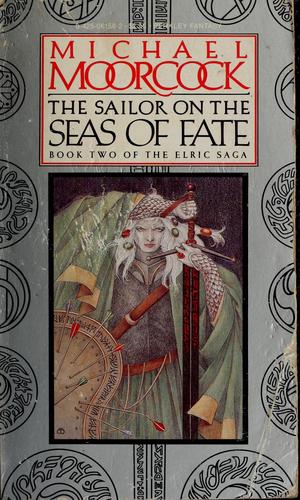
4. Michael Moorcock, The
Sailor On The Seas Of Fate, p. 58 (DAW
paperback).
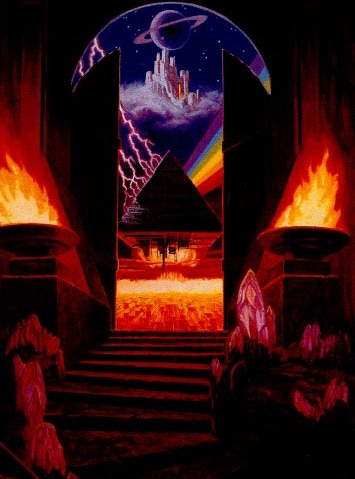
5. The books, available
in Ace paperbacks, are (in chronological order): The
Maker Of Universes;
The
Gates of Creation; A Private Cosmos; Behind
The
Walls Of Terra; and The
Lavalite World. Essential references, all.
6. One such ‘killer gate’
was a doorframe revolving rapidly in midair. Identification
of the ‘safe side’ was of course very difficult.
Another might be a
doorframe, only the upper half of which
is a gate, so that anyone stepping
through the gate in a normal manner (rather
than leaping) will be cut in half as
only their upper body gates away.
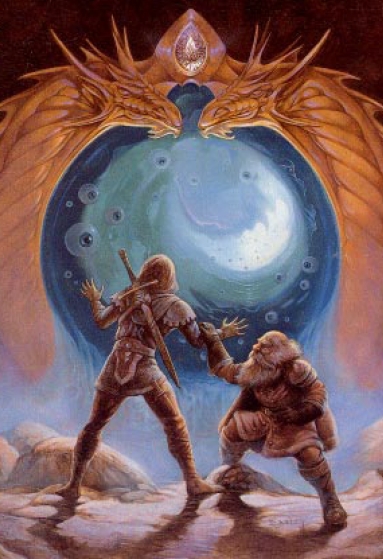
7. Gate of Ivrel; Well of Shiuan; Fires of Azeroth (DAW paperbacks).
8. In chronological order:
The
Magician’s Nephew; The Lion, The Witch & The
Wardrobe;
Prince Caspian;
The
Voyage of the Dawn Treader;
The Silver
Chair; The Horse and
His Boy; and The Last Battle, available in Puffin
paperbacks in Canada and Macmillan paperbacks
in the States. The first five
bristle with material of interest to D&D
players. The Wood Between The
Worlds appears in Chapter 3 of The
Magician’s Nephew.
GIANTS IN THE EARTH
The Hobbit and
Rings books will require careful
planning and some
time. “Sword of Shanarra” and “Urshurak”
are
two distinct possibilities. The many books
of E. R.
Burroughs
have many mighty and well-known
warriors. Conan
is not the only famous fighter to be
presented by R.
E. Howard. Red Sonja, Belit, and <link>
even Thoth Amon should be attempted. What
of <link>
Ivan Hoe, or Sinbad?
(Dragon #41)
THE GOLDEN BOUGH
(by Sir James Frazer)
GREEK
The Aethiopia (39, women)
The Aeneid
(39, women)
BIBLIOGRAPHY: Aeneid,
Books VII and XI,
by Vergil (P. Vergilius Maro)
Bibliography: Medea is a common figure in
Graeco-Roman literature. The best sources
are Euripides’ tragedy, Medea, Apollonius
of
Rhodes’ epic poem, The Argonautica,
and
Ovid’s Heroides, Epistle XII.
47, gite
HAGGARD, H. RIDER
BIBLIOGRAPHY: Allan Quatemain (paperback
published by
Ballantine Books, also many other editioins
from many other publishers)
by H. Rider Haggard.
BIBLIOGRAPHY: Wisdom’s Daughter,
She
and Allen, She,
Ayesha: the Return of She (paperbacks,
Ballantine Books), all by H.
Rider Haggard.
Ayesha.
HERBERT, FRANK
Or the terrible sand worms of Frank Herbert’s
Dune.
(Hints for D&D Judges: Dungeons, Best
of Dragon I)
HOLLAND
BIBLIOGRAPHY: The
Kings in Winter (paperback, Pocket
Books) by Cecelia Holland.
HOWARD, ROBERT
E. / CONAN
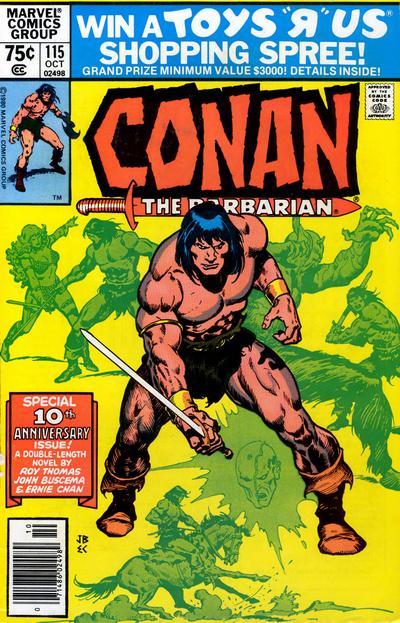
BIBLIOGRAPHY: “Red
Nails” in Conan the Warrior (paperback,
Ace Books) or in Red
Nails (paperback, Berkeley Books). by Robert E.
Howard.
Valeria.
HAROLD SHEA
This expansion
into sympathetic magic follows the magic
portrayed by L. Sprague de
Camp and Fletcher Pratt in their superb
“Harold Shea” stories, for
example. (TD, Gygax)
As some readers of (semi-) heroic fantasy
may
recall, L. Sprague de Camp and Fletcher
Pratt
proposed in The Mathematics of Magic,
one of
their Harold Shea stories, that there are
6
dimensions -- 3 in space, 1 in time, and
2 defining the relations of the planes
to each
other.
KUTTNER
BIBLIOGRAPHY: The
Dark World (out of print paperback, published by Ace Books) by Henry
Kuttner.
LEE, TANITH
ZORAYAS
REFERENCE: Night’s Master (paperback, published
by DAW Books)
by Tanith Lee.
LE GUIN, URSULA
K
BIBLIOGRAPHY: The Earthsea Trilogy
(A
Wizard of Earthsea, The Tombs
of Atuan, The
Farthest Shore) (paperback, Bantam
Books)
by Ursula K. Le Guin. (d48)
LEIBER, FRITZ
The favorite books of the judge can be
turned into parts of
the castle, or worlds that adventurers
can be transported to, like
Larry Niven’s Ringworld, Tolkien’s
"Moria,"
Clark Aston
Smith’s Hyperborea, Arthur Conan
Doyle’s Lost World, or Fritz
Leiber’s "Newhon." (Hints for D&D
Judges: Dungeons, Best of Dragon I)
LEWIS, C.S.
An Experiment in Criticism.
Perelandra.
Reepicheep
+
Professor
Challenger +
BIBLIOGRAPHY: Prince Caspian and
The
Voyage of the “Dawn
Treader”, books 2 & 3 of the
Chronicles of Narnia (paperback, Collier
Books) by C. S. Lewis.
LOVECRAFT, H.P.
But when it
comes to those special treasures, then
look to the fantasy writers
like H.P. Lovecraft and his gods
and demi-gods to help you.
(Hints for D&D Judges:
Dungeons, Best of Dragon I)
MOORE, C. L.
Jirel of Joiry (paperback, out of
print),
“Black God’s Kiss”
in The Best of C. L. Moore (paperback, Ballantine
Books) by C. L. Moore
MORGAN, T. J.
Ellide
(d49)
MUNDY, TALBOT
Tros
of Samothrace (15th level paladin)
REFERENCE: Lud of Lunden, Avenging Liafail,
The Praetor’s Dungeon,
Cleopatra. (paperbacks, published by Zebra
Books) Lud of Lunden, Avenging
Liafail, and The Pfaetor’s Dungeon are
parts one, two, and three of the original
hardback: Tros of Samothrace. All by Talbot
Mundy.
MYTHOLOGY
**
The Hero With A Thousand Faces,
Campbell, Joseph
(Morality in Fantasy
II)
(Fantasy Needs Reality,
Too: d40)
NIVEN, LARRY
The favorite books of the judge can be
turned into parts of
the castle, or worlds that adventurers
can be transported to, like
Larry Niven’s Ringworld, Tolkien’s
"Moria,"
Clark Aston
Smith’s Hyperborea, Arthur Conan
Doyle’s Lost World, or Fritz
Leiber’s "Newhon." (Hints for D&D
Judges: Dungeons, Best of Dragon I)
Larry Niven’s “Puppeteers,”
(Hints for D&D Judges:
Dungeons, Best of Dragon I)
Kzinti were discovered by science fiction author Larry Niven, and revealed
to the rest of the universe in short stories
and his novels, RlNGWORLD, and THE
RINGWORLD ENGINEERS.
(Dragon #50)
NORSE
SOURCES: Prose Edda of Snorri Sturlusun:
Tales from Norse
Mythology, translated by Jean I.
Young (paperback, University of
California Press); and Saga of the Volsungs,
translated by Margaret
Schlauch (hardback, Scandinavian
Classics: volume 35, American
Scandinavian Foundation)
(d41: Sigurd
Fafnirsbane)
SOURCES: Though Starkad is the second greatest
hero in Norse
legends,
his saga has not been passed down intact. Principal sources
for Starkad’s life appear in the out-of-print
History
of Denmark by <Danmark>
Saxo, and Gautrek’s Saga and
Other Medieval Tales, translated by
Hermann Paulsson & Paul Edwards (hardback,
NYU Press). He also
appears in the out-of-print Half’s
Saga and the Heimskringla, History
of the Kings of Norway by
Snorri Strulusun, translated by Lee M.
Hollander (hardback, American Scandinavian
Foundation). A good,
short account of Starkad’s life (and Norse
legends in general) appears
in Norse Mythology, Legends of Gods
and Heroes by Peter Andreas
Munch, revised by Magnus Olsen, translated
by Sigurd Bernhard
Hustvedt (hardback, The American Scandinavian
Foundation).
Starkad
(d41.gite)
SOURCE: Arrow-Odd: A Medieval Novel,
translated by Paul
Edwards and Hermann Palsson (hardback,
NYU Press).
(Orvar-Odd)
SOURCE: Hervor’s Saga (sometimes
titled Heidrek’s Saga), an
out-of-print medieval novel which includes
fragments of poetry from
an older, unwritten saga.
(Dragon #42)
PLANES
Readers interested in interplanar and dimensional
relationships may find several books interesting.
Flatland, by Edwin Abbott,
and its sequel
Sphereland, by Dionys Burger,
are especially
useful. Also interesting, although focusing
more
on the application than the theory, are
the aforementioned
Harold Shea stories, collected into two
volumes: The Compleat Enchanter,
from Del
Rey Books, and Wall of Serpents,
published by
DAW Books.
PLANETS
The best primary sources, for
those who may wish to consult them, are
the three books of Occult
Philosophy or Magic by Henry Cornelius
Agrippa (originally pub-
lished in 1533, and available on microfilm
in most larger libraries).
SABATINI, RAFAEL
BIBLIOGRAPHY: Captain
Blood (hardback, Larlin Corp.), Captain
Blood Returns (paperback, Ballantine
Books), The Fortunes of
Captain Blood (paperback, Ballantine
Books); all by Rafael Sabatini.
(TD36, Captain Blood)
SABERHAGEN, FRED
SIEGE WARFARE
Beeler, John, Warfare In Feudal Europe,
730-1200 (Cornell University Press,
1971)
Koch, H. W., Medieval Warfare (PrenticeHall,
1978)
Oman, Charles, A History of the Art
of War
in the Middle Ages, Volumes I &
II (Burt Franklin, 1969)
Spaulding, Nickerson & Wright, Warfare,
the Infantry Journal (1937)
Tunis, Edwin, Weapons, World
Publishing,
(1954)
Warner, Philip, The Medieval Castle
(Taplinger Publishing Co., 1971)
Wise, Terence, Medieval Warfare
(Hastings
House, 1976)
Yadin, Yigael, The Art of Warfare in
Biblical
Land, Volumes I & II (McGraw-Hill,
1963)
SMITH, CLARK ASHTON
MAAL DWEB
REFERENCE: Lost Worlds (Hardcover, published
by Arkham House;
paperback edition published in UK) by Clark
Ashton Smith.
The Dragon #2, Dungeons:
(For example
see Clark Ashton Smith’s story “The
Weird of Avoosl
Wuthoqquan” in his book Hyperborea)
The favorite books of the judge can be turned
into parts of
the castle, or worlds that adventurers
can be transported to, like
Larry Niven’s Ringworld, Tolkien’s
"Moria,"
Clark Aston
Smith’s Hyperborea, Arthur Conan
Doyle’s Lost World, or Fritz
Leiber’s "Newhon." (Hints for D&D
Judges: Dungeons, Best of Dragon I)
Influence on "The Temple of Poseidon" (Dragon #46)
THE SONG OF ROLAND
The Role of the Cleric (d52)
STAR TREK
The Empath (episode, 39.htm)
the creatures and
peoples of the Star Trek Series
(bd1.dungeons)
(Note: For those into Star Trek, 1.86 ×
106 miles/second
is Warp Factor Two.)
(d41.hut)
SWANN, THOMAS BURNETT
BIBLIOGRAPHY: Cry Silver
Bells (paperback, DAW Books) by
Thomas Burnett Swann.
SWORDS
Most people are acquainted with the classical
heroic epics like The Iliad and
The
Aeneid,
but many are less familiar with the later
European epics, such as Beowulf and Das
Nibelungenlied, in which swords
such as
those found in fantasy gaming are best
represented.
Beowulf is the earliest extant poem
in a
modern European language.
The Germanic Nibelungenlied also
contains many typical fantasy motifs, such
as dwarves,
dragons, and magic cloaks.
Based on an earlier oral legend, this epic
is
perhaps the best example of heroic literature
from the Christian era.
The 12th-century Scandinavian Edda, Brot,
tells of
Siguro’s gold-bedizened
sword Gram,
which had fire-tempered
edges, and was
bated inside with venom. From this source,
and many others, an unknown, early 13th
century Austrian poet
created Das Nibelungenlied, which
tells of the death of Siegfried
(Siguro), and his wife Kriemhild’s revenge.
The French Chanson de Roland and
the Italian Orlando
Furioso tell of Charlemagne’s 12
Paladins,
the most famous of whom are Orlando
(Roland), Rinaldo, and Ogier the Dane.
In his Historia Regum Britanniae,
Geoffrey of
Monmouth tells of Arthur and his great
sword Caliburn, which, through
the centuries (and the tellings of many
writers) finally
became, in the writing of Sir Thomas
Malory, the great sword Excalibur,
the symbol of Arthur’s divine right to
kingship.
(Dragon #46, Swords)
TESSERACTS
A tesseract, as everyone (or at least readers
of Robert A. Heinlein)
knows, is a four dimensional cube or “hypercube”.
(TD17)
To all you fellow dungeon masters, have
fun! I'm planning to. To
all you intrepid adventurers, beware! Go
read Heinlein's "And He
Built A Crooked House" and get a
copy of Escher's "Relativity",
because you never know when your DM may
have things other than
Carrion
Crawlers attacking from the ceiling. (TD38)
TIANA HIGHRIDER
(d48)
BIBLIOGRAPHY: Demon in the Mirror
and
The Eyes of Sarsis (paperbacks,
Pocket Books)
by Andrew Offutt & Richard Lyon.
TOLKIEN
1“On Fairy-Stories,” The Tolkien Reader,
Ballantine Books, New York
The favorite books of the judge can be turned
into parts of
the castle, or worlds that adventurers
can be transported to, like
Larry Niven’s Ringworld, Tolkien’s
"Moria,"
Clark Aston
Smith’s Hyperborea, Arthur Conan
Doyle’s Lost World, or Fritz
Leiber’s "Newhon." (Hints for D&D
Judges: Dungeons, Best of Dragon I)
The dragon
Smaug, as pictured in the television version
of The Hobbit, had a
weIl developed thumb and fingers at the
wing-hand, similar to
bats and flying dinosaurs. I personally
prefer this idea.
(Dragon #50)
TRAPS
The Fantasy Life book contains a
fairly extensive list of traps, many of which can be alaborated on. - Gary
Gygax, xg.htm
VANCE, JACK
This mnemonic power system was exceedingly
well articulated
by Jack Vance in his superb The Eyes
of The Overworld and
Dying Earth novels, as well as in
various short stories.
IUCOUNU,
THE LAUGHING MAGICIAN
Jack Vance's
Cugel
the Clever (14th level thief)
REFERENCE: The Eyes of the Overworld (paperback,
published by Ace Books) by Jack Vance.
WAGNER
Kane (30th
level fighter, 20th level Archmage, 14th level Assassin)
REFERENCE: Death Angel’s Shadow, Bloodstone,
Dark Crusade, Darkness
Weaves, Night Winds. (paperback, published
by Warner Books) All by Karl Edward
Wagner.
WARGAMING
The History of Wargaming
(Wargame Design, New York, Simulations
Publications Incorporated, 1977).
<Keep
'Em Guessing>
WELLS, H.G.
H.G. Wells’ Martians
(bd1.dungeons)
WINGS
Roger Caras,
in his book Dangerous To Man, reports
several instances of fatal
injuries being inflicted by the blows
of a swan’s wings.
(Dragon #50)
ZELAZNY
Shadowjack
+
REFERENCE: Jack of Shadows (paperback,
published by Signet
Books) by Roger Zelazny.
ZORK
(See “Zork A Computerized Fantasy Simulation
Game”
in the April 1979 issue of Computer.
Zork is like single-player
D&D
without role-playing or campaign background.)
DURATHROR
(13th level Lord/Dwarvish paladin)
REFERENCE: The Weirdstone of Brisingamen
(paperback,
published by Ace Books) by Alan Garner
JOHN
CARTER OF MARS
30th level Lord
REFERENCE: A Princess of Mars,
The
Gods of Mars, The
Warlord of Mars,
Thuvia, Maid
of Mars, The Chessman of Mars,
The Master Mind of Mars, A Fighting
Man of Mars, Swords of
Mars,
Synthetic Men of Mars,
Llana
of Gathol, John Carter of
Mars. (paperbacks, published by
Ballantine Books) All by Edgar
Rice Burroughs.
BRACKETT, LEIGH
ERIC
JOHN STARK
REFERENCE: People of the Talisman
and The Secret of Sinharat
(paperback, published by Ace Books as a
double). The Ginger Star,
The Hounds of Skaith, and The
Reavers of Skaith (paperbacks, published
by Ballantine Books). All by Leigh Brackett.
WELLERAN
REFERENCE: “The Sword of Welleran”
from Gods, Men, and
Ghosts: The Best Supernatural Fiction of
Lord Dunsany (paperbound,
Dover Publications, Inc.), or, The Young
Magicians (paperback, Ballantine
Books, Inc. edited by Lin Carter), or,
The
Sword of Welleran
(hardback, copyright 1908, long out of
print), by Lord Dunsany (Edward
John Moreton Drax Plunkett, 18th Baron
Dunsany).
DWARVES
Norse Mythology,
Brooks Sword of Shannara, C.S. Lewis’ Chronicles of
Narnia, and the Tolkien
Trilogy.
JUNGLES
H. Rider Haggard and Edgar Rice Burroughs
achieved literary
fame by writing novels dealing with the
jungle. Haggard, in particular,
specialized in fantastic civilizations
isolated from time and man’s interference,
located in deep jungles, usually in a hidden
valley, or on top of
a jungle-girt mountain. I can only recommend
that you peruse their
works for inspiration in establishing your
jungle adventures.
J. Eric Holmes wrote an excellent supplement
to SOURCE OF
THE NILE dealing with fantasy civilizations
that goes into much detail,
and is very useful in setting up jungle
adventures. (See TD #24, April
’79, LOST CIVILATIONS, and watch for a
reprint of it in TRIBUTARY
2, the SOTN supplemental magazine, to be
released soon. —Ed.)
KARL MERRIS
Eager’s Half Magic and Heinlein’s
The
Rolling Stones.
BOOKS ARE BOOKS,
GAMES ARE GAMES (TD31, by Gary Gygax)
There is certainly much to be learned from
scholarly writers, and
they can often point the reader toward
the source material they used As
a case in point, L. Sprague de Camp and
Fletcher Pratt cite Faerie
Queen and Orlando Furioso as sources for
parts of THE INCOMPLETE
ENCHANTER and THE CASTLE OF IRON. The latter
stories are
exceptionally fine examples of heroic fantasy
adventure. The former
works are excellent inspirational sources.
The “G Series”
modules (STEADING OF THE HILL GIANT
CHIEF, GLACIAL
RIFT OF THE FROST GIANT JARL, and HALL
OF THE FIRE GIANT
KING) were certainly inspired by the de Camp
and Pratt INCOMPLETE ENCHANTER.
The three “D Series”
modules which continue the former series
owe little, if anything, to fiction. Drow
are mentioned in Keightley’s
THE FAIRY MYTHOLOGY, as I recall (it might
have been THE
SECRET COMMONWEALTH—neither book is before
me, and it is not
all that important anyway), and as Dark
Elves of evil nature, they served
as an ideal basis for the creation of a
unique new mythos designed
especially for AD&D. The roles
the various drow are designed to play in
the series are commensurate with those
of prospective player characters.
In fact, the
race could be used for player characters, providing that
appropriate penalties were levied when
a drow or half-drow was in the
daylight world.
CHESS
(TD 36, )
A less sensational interest in game
morality and its everyday effects was noted
by Emanuel Lasker, a renowned chess
master of the late 19th and early 20th
centuries. He asks rhetorically in his Manual
of Chess, “How should our poor
little
game, even in smallest detail, bear
comparison to infinite Life?”
LEJENDS & DOOMS
Legacy, by David Feldt (d40)
NINJAS
(TD 16, TD 30)
These rules for ninja
were based on the book The Art of Invisibility:
Ninjutsu by Donn Draeger. The book
was published in 1971 by
Simpson -- Doyle & Company; Shibuya
P.O. Box 235; Shibuya-ku,
Tokyo, Japan.
These rule extensions for the ninja are
based on the book, NINJA:
The Invisible Assassins, by Andrew
Adams, published in 1970 by
O’Hara Publications, Inc., Los Angeles,
Calif.
SIMAK
Enchanted Pilgrimage,
by Clifford D. (The gnomish point of view)
SOLOMON
N.B. The Lesser
Key of Solomon warns that when conjuring Asmodeus,
the summoner must not be wearing anything
on his head, or
else Asmodeus will deceive the summoner.
TOLKIEN
What happens if your Character falls below
1? If you are an elf,
there is a 10% chance per point below 1
of you degenerating into an
orc (The
Silmarillion indicates that orcs are twisted and perverted
elves)
VAMPIRE BATS
Save the Flying Toad (OMNI magazine, June
1980)
BORGES
Another author who can be consulted in
this matter is Jorge L. Borges. In his
works
compiled in Labyrinths is the short
story
“Tlön, Uqbar, Orbis Tertius.”
Derleth, August.
Dunsany, Lord.
Farmer, P. J. "The World
of the Tiers" Series; etal.
The Maker of Universes
(1965), The Gates of Creation (1966), A Private Cosmos (1968), Behind the
Walls of Terra (1970), The Lavalite World (1977) and More Than Fire (1993).
Lanier, Sterling. HIEROS JOURNEY
Leiber, Fritz. "Fafhrd & Gray Mouser" Series; et al.
Lovecraft, H. P.
<H.P. Lovecraft Omnibux,
vol. I : At the Mountains of Madness>
<H.P. Lovecraft Omnibux,
vol. II : Dagon and Other Macabre Tales >
<H.P. Lovecraft Omnibux,
vol.
III : The Haunter of the Dark>
<The above 3, published by Grafton, should contain everything that he
wrote that was published><check>
<H.P. Lovecraft :
A Biography, by L. Sprague de Camp, Barnes & Noble Books - being written
by LSDC, this one may be of interest>
Merritt, A. CREEP, SHADOW, CREEP; MOON POOL;
DWELLERS IN THE MIRAGE; et al.
Moorcock, Michael. STORMBRINGER; STEALER
OF SOULS; "Hawkmoon" Series (esp. the first three books)
Norton, Andre.
Offutt, Andrew J., editor SWORDS AGAINST DARKNESS Ill.
* Pratt, Fletcher, BLUE STAR; et al.
Saberhagen, Fred. CHANGELING EARTH; et al.
St. Clair, Margaret. THE SHADOW PEOPLE; SIGN OF THE LABRYS
Tolkien, J. R. R. THE HOBBIT; "Ring Trilogy"
Vance, Jack. THE EYES OF THE OVERWORLD;
THE DYING EARTH;
et al.
Happy that you have
read a couple of the greats of fantasy and enjoyed them. As for style,
I find that of Jack Vance more compelling than any other author in the
genrs.
Cheers,
Gary
Planet of Adventure is my favorite work of his, if i actually have one.. -- GG
Weinbaum, Stanley.
Wellman, Manly Wade.
Williamson, Jack.
Zelazny, Roger. JACK OF SHADOWS; "Amber" Series; et of.
The most immediate influences**
upon AD&D were probably de Camp & Pratt, REH, Fritz Leiber,
Jack Vance, HPL, and A. Merritt; but all of the above
authors, as well as many not listed, certainly
helped to shape the form of the game. For this reason, and for the hours
of reading enjoyment, I heartily recommend the works of these fine authors
to you.
<*>, added to list?

Howdy Predavolk,
As with many things, naming a favorite isn't my bag. I must say, though, that I enjoyed the full length novel about Conan, and "Red Nails" is an outstanding tale of chilling adventure action that I would love to be able to emulate in an RPG module.
JRRT's "rings Trilogy" was too slow paced for me, although I did enjoy The Hobbit.
High on the list of other influences for
my FPR game design are:
Jack Vance, de Camp & Pratt, Fritz
Leiber, Saberhagen, Merritt, and Moorcock. So many excellent old fantasy
yarns...
Cheers,
Gary
Quote:
Please forgive the long post. I'm really
not one of those Tolkien crackpots you adore so much :wink: . I'm mostly
just trying to get a handle on these two NPC's, as they figure prominently
in my own Greyhawk campaign. If, indeed, the "Creator" modelled them after
the Tolkien characters, then I would have a wealth of background flavor
for them at my fingertips, and could develop them thusly. As always, your
thoughts are greatly appreciated. Thanks!
The NPCs are as they are prensnted in the text, no more, no less. Certainly individual DMs can alter and augment the information as desired, for that was the express purpose for the work as presented.
Gary
St. Clair, Margaret. THE SHADOW PEOPLE;
SIGN OF THE LABRYS

Tolkien, J. R. R. THE HOBBIT; "Ring Trilogy"
Williamson, Jack.
The most immediate influences*
upon AD&D were probably de Camp & Pratt,
REH,
Fritz
Leiber, Jack Vance, HPL, and
A.
Merritt; but all of the above
authors, as well as many not listed, certainly
helped to shape the form of the game. For this reason, and for the hours
of reading enjoyment, I heartily recommend the works of these fine authors
to you.
<*>, add
to list?
<NOTE: REMEMBER TO CHECK MYTHUS FOR SPECIFIC
EXAMPLES>
<this should be the correct one: just
2b extra thorough, check the xx file ...>
<fini links>
<series: fini listings>
<image source: usu. Grognardia>
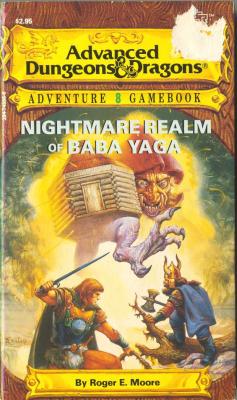
GAMING FICTION
Adventures
in the Improbable (TD #29)