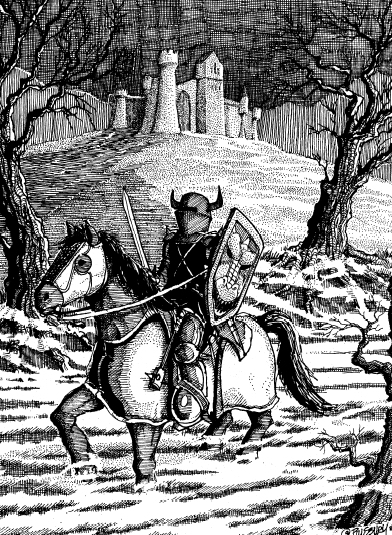
Illustration by Joseph Pillsbury
Illustration by Joseph Pillsbury
| SURVIVAL | The finite dungeon | The friendly DM | - | - |
| 1st Edition AD&D | - | Dragon magazine | - | Dragon #157 |
The young Adept places 1 foot cautiously
on the rusty wrought-iron ladder.
She has come in search of the fabled emerald
pendant of Alcar-Than. It is Halloween
night, and a full moon has lit her way
through the cemetary, past the fire
beetles,
centipedes, and wild dogs. After
SEARCHING among the weathered headstones,
she has at last found the entrance
to the underground tombs, concealed
within the dry, overgrown pumpkin patch.
Lantern lit, shield && footman's mace
at
the ready, she descends into the
dungeon -- alone.
Alone? How can she Hope to survive
without a fighter to ward off the monsters,
a Wizard to overcome the enchantments
that had most certainly been placed
in the dungeon, and a thief to pick the
locks, disarm th etraps, and uncover the
treasure? She must be crazy to undertake
such a quest withoug
a full company ov
adventurers to aid her!
But she is not, and neither is her player.
It is true that the AD&D and D&D
games were designed under the assumption
that their adventures will be played
by a balanced group of 4 or more characters
run by as many players. However,
the single-player adventure has advantages
and should not be overlooked, even
though the DM faces new challenges in
order to maintain Game Balance.
One reason for conducting a single-player
adventure is practicality. Even with
an interested group of players, it may be
difficult for a number of people to arrange
acceptable playing times over the course
of an extended adventure or campaign.
Very often, 1 or 2 may be eager to
play but have to postpone a Game because
the rest of the group is unavailable.
The single-player advenure also
encourages character development && identification
in a way that a group adventure
cannot rival. A single player's game decisions
are not artificially constrained by
having to stay with the party or following
the plan that the group agreed on. Also,
the
single player does not become a follower
while the more vocal members of the
group make all the important decisions.
Every decision must be made by the
player, and this provides a greater sense of
participation && of personal achievement
in a successful adventure.
A player whose
PC is adventuring alone (without even
henchmen or NPCs) will usually feel A
stronger sense of identification with the
PC--and role-playing is, after all, what
role-playing games are about.
Lastly, the single-player adventure often
makes sense in naturally occurring Game
situations. 1 PC may have a special task
fall upon him, or he may wish to conduct
private investigations outside the context
of his group. He may be separated from
his party by accident |or| have to abandon A
quest due to incapacitation. There are
many situations in which single-player
gaming is called for.
Please TAKE note that a single-player
adventure is NOT the same as a solo adventure.
A solo adventure is a Game session
played && conducted by only 1 person,
in which printed matter from a commercial
module |or| correspondant takes the
ov A DM, or where some
random adventure generator is used (such
as Appendix A: Random
Dungeon Generation,
in the AD&D 1st Edition DMG). By contrast,
a single-player
adventurer iis A 1-on-1 Game
session between a DM && a single player.
This is clearly the more preferable ov the
2 alternatives; if it were NOT, there
would be no need for any DMs at all!
Katherine Kerr, in "The Solo
Scenario"
(Dragon issue #73) previously addressed
the problems of planning a single-player
adventure. The challenges must be
scaled down, and the story line must be
devised to meet the special requirements
ov the PC's class && level.
Planning an adventure, as all DMs know,
is only the beginning; often the toughest
challenges come in conducting
the Game.
In the case ov the single-player adventure,
the DM may find it xtraordinarily difficult
to conduct The Game fairly && yet
keep the PC our of the jaws of death. How
is this done? How can a DM conduct an
interesting, critical adventure that will
challenge a solitary player && still
be
survivable? This article is a summary ov
some of the essentials needed to survive
the single-player adventure.
1st we must ask what is required.
What problems will appear for a lone
player that will NOT appear in group play?
The single-player adventure must be designed
to solve |or| AVOID these problems.
Problem 1: If the PC is rendered
unconscious
in combat (or otherwise), no one
will be available to heal him. Thus a single
unlucky die roll can utterly destroy A
single-player adventure. In group play,
it is
usually only a serious error in judgement
that leads to the destruction ov the entire
party. In single-play, it may be just bad
luck.
Problem 2: If the goal ov the adventure
cannot be achieved in a single attempt
(and it would probably be an
uninteresting session if it could), the
player will have to retreat to a place of
safety to recuperate, then approach the
adventure for a 2nd Time. If the challenges
are the same, the single player will
probably NOT get much farther than he did
the 1st Time. A large
party can can USE sheer
fighting power to probe deeper levels ov A
dungeon |or| more remote regions of a
outdoor setting. A single player will probably
NOT have all the resources necessary to
get to the end ov a sizable adventure and
return safely alive. He will find himself
endlessly repeating the initial stages of the
advernture, unable to get past the 1st
obstacles without needing to retreat &&
recuperate.
Problem 3: The single player cannot
brainstorm with fellow players to determine
what to do next. He has only himself
&& the DM to rely on to keep the adventure
on track. This places a special burden
on the DM in his interaction with t he
player. How can the DM combine the role
ov referee with the role ov advisor without
spoiling The Game?
The methods suggested here to deal
with these problems have been gametested
with low-level PCs. There are probably
as many solutions to the problems
above as there are DMs. These methods
have been guided by the philosophy that it
is character development that makes an
interesting game, and that character development
requires both a genuine challenge
and the long-term survival of the PC.
SURVIVAL
The single PC, particularly a low-level
one, faces the constant risk of instant
death. In one or two rounds, his hit points
may drop below zero, rendering him
either dead or unconscious and defenseless.
At a single toss of the dice, he may be
poisoned or paralyzed, with no one
around to effect a cure. Many typically
encountered emergencies are utterly
lethal without other characters at hand to
take life-saving action.
One solution to the instant-death problem
is to simply let the PC live-somehow
?no matter what happens. This is obviously
a gross violation of the letter of the
game; if the player is aware that this policy
is being employed, he will soon lose
interest in playing a game without even
the slightest threat of failure.
Another solution is to employ NPCs. This
works well if done sparingly. The problem
is that too many NPCs can make the game
a group adventure again, but with the DM
overburdened by taking on so many secondary
roles that the game as a whole
suffers. Remember that every NPC added
for the purpose of assisting the player
reduces the player?s sense of challenge and
participation. This problem is worse with
NPCs than it is with other PCs, since the
DM always knows the best solution to any
game situation. If only one or two NPCs
are employed, much of the problem of
instant death still remains. Two PCs do not
have the survival capability of a full party.
The best solution to this problem is to
relax the rules a little, but to do so in a
premeditated, orderly way. Do not wait
until a PC faces death to ask, ?Which rule
should I bend now?? This quickly leads to
the guaranteed-survival scenario described
above. Here are some suggestions for
coping with common situations:
Unconsciousness in combat: Unless the
creatures being fought are absolutely
fighting to kill, have them abandon the PC
or take him prisoner. The PC will wake up
some hours later, possibly with a way to
escape and recuperate before attempting
the adventure again. To emphasize the
seriousness of the incident, the PC should
suffer some important loss: armor, possessions,
or perhaps even a point or two off a
suitable ability score. Note that some creatures
will kill under all circumstances; in
these cases, one must obey the dice. A
party of goblins, for example, might strip
the PC of valuables and abandon him; wild
dogs might eat the PC?s rations but would
not attack further; but a stirge would
certainly kill its victim.
Characters should have a fair chance to
run from a confrontation. This may not
always be possible, but when it is, a bonus
should be made to a single PC?s chance to
escape and evade pursuit. (It is obviously
easier to run and hide alone than with a
whole party trying to do the same.)
A bit of advice to players in solo scenarios:
Don?t be foolish and count on
miracles. If you were alone underground
and saw four armed thieves coming your
way, what would you do? He who hides or
runs away . . . well, you know the rest. A
little common sense makes life easier on
the DM and adds to the feeling of realism
in the adventure.
Fatal traps or tricks: It is best to avoid
using these, unless you intend to give
ample warning and sufficient information
for the PC to avoid the danger. If such
things are used, allow copious saving
throws, dexterity checks, partial effects,
duds, and so on.It is best to avoid
using these, unless you intend to give
ample WARNING and sufficient information
for the PC to avoid the danger. If such
things are used, allow copious saving
throws, dexterity checks, partial effects,
duds, and so on.
Poison and paralysis: These might
be
avoided altogether, but in the interests of
variety and challenge they can be included.
There should be a greater chance
of avoiding the effect, however, since,
there will be no high-level cleric around to
effect an immediate cure. Tables I, II, and
III show systems for using poison and
paralysis geared toward increasing the
survival potential of a single PC. These
systems are also suitable for use with a
full low-level party whose members cannot
hope for an instant cure.
To use the tables, first make the appropriate
saving throw. If the PC fails to save,
then roll 1d106 (for poison) or 1d20 (for
paralysis) and find the roll in the column
corresponding to the saving-throw bonus
used. For example, is a PC is bitten by a
giant centipede and fails his save, 1d100 is
rolled, giving 42. The column on Table I
headed ?+ 4? is used, since centipede
poison has a saving-throw bonus of +4. In
this column, 42 corresponds to unconsciousness
for 1-2 turns.
Table II shows suggested onset times for
poison. These delays allow time for the PC
to do something (at least he can hide!)
before the poison takes effect.
The procedure is similar for paralysis,
but the effects may occur immediately,
especially if some magical or supernatural
agency is the cause.
Finally, it makes sense to relax the rules
demanding long periods of rest following
unconsciousness. This does not mean that
the PC should be able to rise to his feet
and resume the adventure where he left
off. However, he should be allowed to
defend himself as he retreats to a place of
safety. (Depending on the situation, experience
points for monsters killed under
these conditions might be withheld.)
The finite dungeon
The second problem, devising an adventure
that can be tackled in successive
stages, is addressed by the concept of the
finite dungeon. ?Finite dungeon? is a
phrase used to suggest an adventure in
which challenges successfully met need
not be repeated. For example, if a goblin
lair is raided and destroyed, there will be
no more goblins to trouble the adventurer
if he must pass that way again.
This, of course, is often the normal
result of play. If the adventure is devised
in terms of set encounters, then the DM
will remove these encounters from his key
after the creatures have been killed or
chased off. However, if wanderingmonster
encounters are also used, the
issue becomes more complicated. One
should not do away with the interesting
unpredictability of random encounters
entirely, and keeping track of the motions
of every band of creatures is impossible.
The whole point is to use an intelligent
system for regulating encounters during
play. You may have devised a perfect
random-encounter table for some portion
of the adventure, suited to the player?s
level and ability; but if the player is led
through the same challenge repeatedly,
even the best scenario will wear thin.
The solution is to have the probability of
random encounters reflect the actual
population of monsters in the area. Thus a
finite dungeon holds a finite number of
creatures, but the creatures are not restricted
to set locations. Instead, the probability
of encountering them at random
decreases as their number goes down.
It is easy to derive a realistic formula for
the probability of encounters based on the
monster population, the area over which
they range, their movement rate, and
group size. The probabilities given by such
a formula could be scaled down during
play as monsters are killed. If you prefer
the expediency of standard encounter
tables, you can still reduce the probability
of encounters as the game goes along.
Here is one simple way to get the desired
effect:
Suppose the periodic check indicates
that giant rats are encountered. You have
determined in planning the adventure that
only 20 giant rats are present in the area.
The first time rats are indicated by the
roll, treat it as a normal encounter. Suppose
six rats attack the PC; four are killed,
and two escape. The next time the encounter
check indicates giant rats, roll d20. If 1,
2, 3 or 4 appears, then there is no encounter
because four of the 20 rats are dead.
As more rats are killed, the chance drops
further, until after our hero has dispatched
20 rats, a ?rat encounter? will
always be ?no encounter?. The monster
populations need not correspond to some
particular die?you can round off. For
example, a population of 15 skeletons
could be handled by rolling 1d8, allowing
one ?no encounter? for every two skeletons
killed. Thus, after four skeletons had
been put to rest, a roll of 1 or 2 on 1d8
would signify no encounter.
This system has the effect of causing
most encounters to happen toward the
beginning of the campaign. After many of
the creatures are dispatched, the encounter
probability goes down, and the PC can
explore other areas of the dungeon without
excessive worry about random
encounters. This has the desired result
that the player may progress to further
stages of the adventure without having to
repeat the initial confrontations, yet it
preserves the interest and facility of
random-encounter determination.
It is understood in this scheme that
monster populations are not quickly replenished
with reinforcements unless the
DM so dictates, so it is likely that there will
be no one in the area to reset traps after
they have been set off or to otherwise
interfere with the PC?s progress through
the adventure (assuming, of course, that
the PC has killed most of the original
dungeon population).
If the finite-dungeon scheme for random
encounters is not used, it is recommended
that set encounters be the only ones employed,
perhaps with an occasional random
encounter to encourage haste!
The friendly DM
The role of the DM in the single-player
adventure must be somewhat different
than it is in a group game. The DM no
longer finds himself settling disputes between
players or struggling to keep the
game moving through long-winded player
discussions. Instead, he is confronted with
the challenge of single-handedly entertaining
the player, even though the player
must make all the decisions!
The DM should not assume the role of
another player, criticizing or congratulating
the player on his choices (not during
play, anyway). Obviously, the DM knows
the right solution to every problem, as he
knows what lies down each corridor and
inside every chamber. An uncertain player
who would normally wait for the opinions
of the other members of the party may
appeal to the DM for help. The DM should
not give in to the urge to control the player
?s decision-making prerogative. He can
and should answer questions about game
rules and about what the PC sees, hears,
and has knowledge of (in excruciating
detail if necessary), but he should never
answer the question ?What should I do
now?? no matter how cleverly worded.
The player?s sense of accomplishment at
the end of the game will suffer if he does.
What, then, should the DM do when the
player is lost, frustrated, confused, or
misdirected? Must he simply sit back and
watch the game plunge into oblivion? Of
course not. DMs have always found it
necessary, from time to time, to drop hints
into the adventure by way of NPCs,
scrawled messages, magic mouths, and
other such gimmicks. Some have even
resorted to divine intervention to put
players back on the straight and narrow.
In a multiplayer game, such measures can
be reserved for emergencies. In a singleplayer
adventure, the game is likely to be
routinely mired in such predicaments.
Lending assistance calls for more subtlety
on the part of the DM. Perhaps the
best procedure is to encourage the player
to try something. Don?t allow the player to
wallow in indecision. If the action he
comes up with is a disastrous choice, block
it somehow. (The door won?t open, the
corridor is blocked with rubble, the NPC
turns to leave, the stopper won?t come out
of the flask, the lantern goes out when
reading the scroll, etc.) If the player does
something even remotely sensible, go with
it. You may be able to redirect the adventure
later. It is better to keep things moving
than to stick tenaciously to a
precharted path that the player can?t find.
All of the above is sound advice in any
game, but it is crucial for the single-player
adventure. If a group player becomes frustrated
or confused, he can take a break
while the others work out the problem,
and return with a better mood when things
get rolling again. A solo player who gets
stuck cannot move into the background
and wait for things to change. The DM
must help the player keep his morale up.
The best advice the DM can give to the
single player is no advice at all. Instead, he
must be subtle and unobtrusive with his
hints and flexible enough to allow the
reins to remain the hands of the player at
all times. If the DM allows the player to
give up control of his PC, the game becomes
a zero-player adventure.
The single-player adventure is too often
overlooked in the AD&D game system. It
does present special challenges for both
DM and player, but the rewards in terms
of character development definitely make
it worthwhile.
Table I
Variant Effects of Poison
If a saving throw vs. poison fails, roll 1d100 and find the result
under the column corresponding to the poison?s saving-throw bonus (STB)
Saving-throw bonus
| Effect | +5 | +4 | +3 | +2 | +1 | 0 | -1 | -2 |
| Nausea/weekness* | 1-59 | 1-39 | 1-29 | 1-19 | 1-9 | 1-4 | 1-4 | 1-4 |
| Unconsciousness* | 60-89 | 40-79 | 30-69 | 20-49 | 10-29 | 5-19 | 5-9 | 5-9 |
| Acute disease | 90-94 | 80-89 | 70-84 | 50-59 | 30-39 | 20-24 | 10-14 | 10-11 |
| Chronic disease | 95-98 | 90-94 | 85-89 | 60-69 | 40-49 | 25-29 | 15-19 | 12-14 |
| Special * * | 99 | 95-97 | 90-94 | 70-79 | 50-59 | 30-34 | 20-24 | 15-19 |
| Death | 00 | 98-00 | 95-00 | 80-00 | 60-00 | 35-00 | 25-00 | 20-00 |
Table II
Onset of the Effects of Poison
| - | Onset of minor effect* | Onset of major effect** |
| FAST poison | 1d4 rounds | +1d4 rounds |
| Normal poison | 1d20 rounds | +1d12 rounds |
| SLOW poison | 4d6 turns | +1d6 turns |
Table III
Variant Effects of Paralysis
If a saving throw vs. paralysis fails, roll 1d20 and find the result
under the column
corresponding to the paralysis effect?s saving-throw bonus (STB).
| - | +2 or more | +1 to -1 | -2 or less |
| Temporary paralysis* | 1-6 | 1-3 | 1 |
| Temporary paralysis and dexterity loss** | 7-12 | 4-6 | 2 |
| Temporary paralysis, dexterity and constitution loss** | 13-18 | 7-9 | 3 |
| Permanent paralysis | 19-20 | 10-20 | 4-20 |