| The initial constructions | - | - | - | - |
| Dragon #121 | - | 1st Edition AD&D | - | Dragon magazine |
The location is Japan, sometime in the
1580s. You are a great and powerful samurai
in the service of Toyotomi Hideyoshi,
the man who will someday unify Japan.
But no one knows this yet. For now, you
sit in your shoin (audience hall). The
messenger
has brought word of a great honor
? that you are allowed to build a great
castle within your domain. Hideyoshi has
entrusted you with the protection of the
western frontier. Your province controls
the routes from east to west, so controlling
your province is the key in this
protection.
So ordered, you set about the task. The
first things you must do are choose a site
and prepare a plan. For centuries, armies
have fought for control of your province,
and many times forts have been built and
destroyed. Dotted throughout the province
are the remains of these simple fortifications.
These fall into three groups ?
yamajiro, hirajiro, and hirayamajiro. Of
these, the yamajiro, a castle built on
a
mountain, is the oldest. Raised as places
of
final retreat, the earliest of these castles
were little more than watchtowers built
on the hard-to-reach (or attack) mountainsides.
Here, a samurai and his retainers
could hold off an army of attackers, even
when all else had been lost. But the yamajiro
is not a good site for your castle. The
mountainsides are far away from the
people, so no town can grow around your
castle. You will not be able to control
the
main roads from the mountain. No, you
need a place closer to the highway and
to
your city.
The hirajiro, or a castle on the plain,
is
another choice. These castles (of which
there are a few in your province) are built
on flat ground, near the highway and the
main port. Hirajiro allow you to stay close
to events and watch over your people.
They are, however, hard to defend. Hirajiro
rely on natural defenses, such as rivers,
swamps, or elaborate moats. Rivers
can be dammed upstream, swamps are
unpleasant and unhealthy, and moats are
costly to build. There must be some better
place to build than on the plain.
Fortunately for you, the province does
have one other good location ? the hirayamajiro,
or castle on a hill in the plain.
Rising up just behind the small port city
that provides most of your trade is a rugged
hill. In fact, this site has already been
used for a simple fortification for almost
a
century. It offers the best of both the
hirajiro and the yamajiro. The steep slopes
of the hill raise the castle above the
surrounding
land, giving it a commanding
view and making it harder to attack. The
closeness of the hill to the port and the
highway allow you to keep close control
over the common people and the trade of
the province, both vital to your survival.
The hill is not so high that you cannot
dig
a well inside the castle (a serious problem
with mountainside castles) nor so low that
you need worry about the poisonous air
of
swampland. It is a good site from which
to
rule. However, although you have a good
location, you must still consider three
other things before you build: feng shui,
kengosandan, and nawabari.
There is no doubt Lord Toyotomi has
assigned you to build one of the most
important castles in his domain. Thus,
you
decide to take no chances and consult a
feng shui master visiting from the mainland.
Feng shui is the magical art of placement.
The fortunes of a family depend not
only on their own actions and those of
the
gods, but the placement of a house or
castle can also bring good or bad luck.
Using his mystic arts, a feng shui master
reads the power lines hidden in the earth
and learns the best arrangement for a
building to avert evil influences. After
careful study of the the hill you intend
to
build on, the feng shui wizard pronounces
the site good. He cautions you, however,
against building any gate that faces to
the
north, while gates to the south will
improve your fortunes.
At the same time, as ruler of the province,
you must consider kengosandan or
?three-part security.? Kengosandan helps
you think about your defenses and your
safety. First, build your castle at the
political
heart of your province. This is not the
same as the center of your province;
rather, it is the best place were you can
be
close to your friends and watch over your
enemies. The port town at the base of
your hill certainly satisfies this part
of
kengosandan. Next, you must locate your
castle in the best position around the
town. You could build it on the shore,
where it could watch over the docks, but
this is far from the highway. You could
build along the highway, but the enemy
would have the advantage of the high hill
behind you. Clearly, by the second principle
of kengosandan, the hirayamajiro is
best.
The third principle of kengosandan is to
make your defenses as strong as possible.
For this, you must know the arts of nawabari,
the skill of building defenses of a
castle to complement the ?three-part security
?. A tower of wood and plaster, which
are the materials with which the tower
will be built, cannot withstand a powerful
attack. Instead, it must be hard for your
enemies to reach the castle proper. Therefore,
your castle?s strength is not in its
massive walls and strong towers, but in
how well your moats, earthworks, walls,
and towers keep the enemy away. If the
enemy crosses one moat or breaks
through one wall, there must be another
to stop him. If your defenses are numerous
and strong enough, your enemy will
exhaust his attacks before your castle
falls.
With these things in mind, you and your
architect draw up the plans for the castle.
The initial
constructions
With your planning finished, you are
ready to begin the actual work. The first
task is to assemble the workers and their
materials. Lord Toyotomi wants the job
done quickly, so you will need a huge
number of men. Osaka Castle kept 30,000
men working for three years; Fushimi
Castle took 30,000 men two years; Nagoya
was finished in less than a year, but
needed 200,000 men to complete the task!
Deciding to finish quickly, you need
100,000 to perhaps 200,000 laborers. You
order your retainers to supply you with
men: 30 men for every 1,000 koku of
property or stipend. Still, with your own
resources, you are far short. To aid you,
Lord Toyotomi orders other lords, particularly
those who might become powerful
enemies, to supply labor. This also suits
his
purposes, since it drains their resources,
weakening their power. The men, working
around the clock (and without supernatural
aid), should be able to finish the job
in
a year or two. One group works by daylight,
while another continues the efforts
by torchlight.
As they arrive, the first thing the workers
do is build their own homes and organize
themselves into labor brigades.
Arrangements are made to see that they
are fed and their needs are met. As the
workers arrive, so also come merchants,
tradesmen, and others who will eventually
form a town.
Before actual construction begins, the
slopes of the hill need to be cleared.
The
top, where the main courtyards and towers
will stand, must have the older fort
torn down and the ground leveled. At the
same time, work will begin in the three
moats that will ring the castle. The dirt
from all these excavations will be used
to
build the outermost ring of earthworks
and to fill in the marshy ground near the
harbor. About 20,000 men work at each
task, shoveling and hauling the baskets
of
dirt. The outermost moat is 20? deep and
60? wide. The second moat is 20? X 100?
and the third, innermost moat is 24? X
200?. The first moat is kenkubori (bowlshaped),
while the other two are hakobori
(box-shaped) and faced with stone. The
doi
(earthworks) that stands just inside the
outer moat is 20? high and 30? wide, made
from the excavated dirt carefully tamped
into place.
Other laborers work at gathering stone
from quarries in the province and lumber
from the forests. Great trees are shipped
from the north to be used for the support
pillars of the main towers. Skilled stonemasons
begin cutting stones to form the
sangi zumi, the carefully cut stone walls
that will form the corners of the stone
foundations.
As the moats near completion, the special
features are added. Doibashi (broad
causeways) cross the outer two moats
while wooden hashi (bridges) are built
across the third. These bridges can be
chopped down or burned in time of war,
making the maru (innermost baileys)
harder to attack.
As you near completion on the moats
and earthworks, the workmen begin the
task of building the walls and foundations
of your castle. The first step is to place
the
suteishi, the base block for the castle?s
foundation. This is done with great ceremony,
for the spirit of this stone literally
gives its life for your castle. Once it
is
placed, the foundation work continues at
full pace. Most of the walls are carefully
piled stones, rough and irregular, not
carved in any way ? a style called nozura
zumi. In a few places, the stones have
been slightly chiseled and shaped into
kirikomi hagi (cut rice cake) or uchikomi
hagi (sweet rice cake) styles. For the
corners,
where attackers could damage the
foundation easier, the sangi zumi ? carefully
fitted stones ? will be used.
Some of the foundations will form the
bases of the walls that surround your
castle. But, unlike city walls of China
that
you have heard about, the bulk of your
walls are not made of stone. Stone is too
difficult to work with and too hard to
find.
Furthermore, stone is hard and inflexible.
During an earthquake, stone walls would
crack and shatter. Therefore, the walls
that line the moats and defend your castle,
called hei or tsuji hei, are made of plastered
earth and wood. While even these
walls will suffer in an earthquake, they
can flex and bend without breaking, and
they can be quickly rebuilt.
Following the plan of the castle, the
workmen begin building the walls. Each
wall begins as a wood and bamboo framework.
This framework is packed with
earth and stones. Wooden boards are
fastened over these to make a smooth
surface. To reduce the danger of fire,
three layers of plaster are applied to
the
walls. A narrow roof of tiles runs the
length of each wall. Finally, for effect,
the
walls are whitewashed to a shining, clean
white.
To defend the walls, your architect has
planned zama (loopholes) every 3-6?. The
jugan (square) and teppozama (round)
loopholes are for gunners. Yazama(long,
narrow slits) are cut for archers. The
broadest walls have tamon (long buildings)
set atop them. You can use these as barracks,
armories, and storehouses while
still defending from their windows. But
the weakest part of the walls will be the
gates; special measures must be taken for
these.
Experience has shown the best type of
gate is the masugata or measuring gate.
This gate is composed of three different
parts: the yagura mon (watchtower gate),
the masugata (courtyard), and the watari
yagura (inner gate). The yagura mon has
towers to either side and a tamon over
the
entrance. The massive gate doors are
wood, shod in iron. In one side is a smaller
door for everyday use. Beyond this gate
is
the masugata, a small courtyard, just large
enough to hold 240. This courtyard is
protected by loopholed walls. At right
angles to the yagura mon is the watari
yagura. This gate is similar in construction,
but smaller in size. There are several
gates like this in your castle. Each will
need a guard of 30 to 70 men. In addition,
there are other types of gates in your
castle ? some open onto broad steps,
others make 90° turns underneath fortified
towers. All are intended to make life
difficult for anyone foolish enough to
mount an attack. When all is done, you
have built the gates for your castle ?
more than 20 of them. They range from
the imposing ote-mon (main gate) to the
ornate sakura-mon (cherry blossom gate)
and the small karamete (rear gate).
With earthworks, moats, walls, and
gates finished, your castle is almost complete.
The workmen have been busy for
10 months, but nothing has delayed your
progress. The fortunes that have been
spent building the castle are enormous.
To
keep funding the work, you are forced to
take daring adventures, both for treasure
and to repay obligations. It is clear that
you will be paying for this place for many
years to come.
Now, after several adventures, your
finances have been refreshed and you are
ready to begin the final phase ? the building
of the donjon (tenshu-kaku). Many
months ago, you laid out the plan for the
tower. You had several choices. Easiest
to
build would have been a single, unconnected
donjon: a dokuritsushiki tenshu. It
would not have been a strong defense if
attacked. This arrangment could be made
stronger if a tower were added to it, making
it ukugoshiki tenshu. Still, this does
not
seem strong enough for such a major
castle. Another choice is a connected
series of towers, none tremendously huge
(the renketsushiki tenshu). However, this
is
not nearly as imposing as a single donjon.
This castle, with all its walls and gates,
must impress people with its might. This
is, after all, a good way to ward off potential
enemies. The best choice is the one
you finally settled upon, the renritsushiki
tenshu ? a main donjon connected to
several smaller towers by covered corridors.
Basically a square structure, this
donjon is both imposing and defensible.
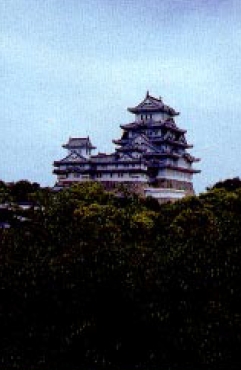
The tenshu-kaku is built upon a massive
stone foundation. At its highest point,
this
mass of stone stands 78? high. The main
donjon towers another 70? above this. Still,
there are greater towers: Osaka and
Aizuchi castles both have towers standing
taller than yours. Standing almost 150?
above the surrounding land, however,
your tower will do quite well. With six
stories of added perspective, you will
have
a clear view of any approaching enemies.
Furthermore, the donjon has several
special features to make it difficult to
attack. The stone foundation is built in
the
tarumi style, the base gradually curving
out at the bottom. Other walls of the castle
are built with a sharp, jutting angle at
the
bottom, following the sagenawa style. At
the top of this wall, the floor of the
tower
juts out over the edge, creating an hanedashi
(
overhang). This blocks climbing
attackers and conceals sharp iron spikes
that angle down. Built in the floor of
this
overhang and in special projections are
trapdoors ? ishiotoshi or stone-dropping
chutes. From these openings rocks, boiling
water and oil can be poured on attackers,
again discouraging them from climbing
the walls.
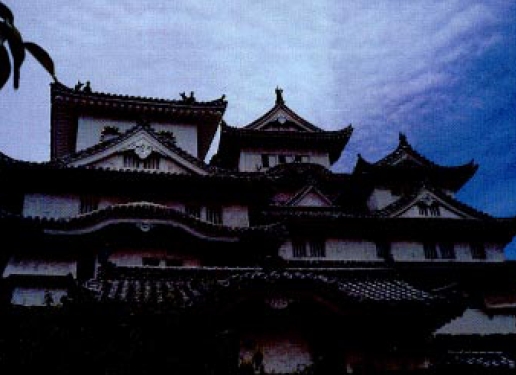
The tenshu-kaku is designed to be more
than just imposing. Effort has also been
made to make the building artistically
pleasing and impressive. After all, you
want your castle to be a display of more
than just power ? wealth and taste are
equally important. The roofs of the different
floors are embellished with elaborate
gables ? chidori-hafu (triangular) and
karahafu (rounded) shapes stand out. The
ends of these are fitted with gegyo or
ornaments. At the ends of the ridge poles
are cast statues of leaping shachihiko
(dolphins), whose powers will help ward
off disastrous fires. The upper walls of
the
tower (beyond the range of attackers) are
pierced with many windows ? katamado
(bell-shaped) and renji (slatted rectangular)
ones. Inside, each floor is simply furnished.
Most are a single large room. The
walls are lined with racks of weapons,
and
there is a well in the basement. However,
the tower is not used for daily life; you
will only live here in times of emergency.
Instead, most of your time will be spent
in
one of the mansions on the castle
grounds.
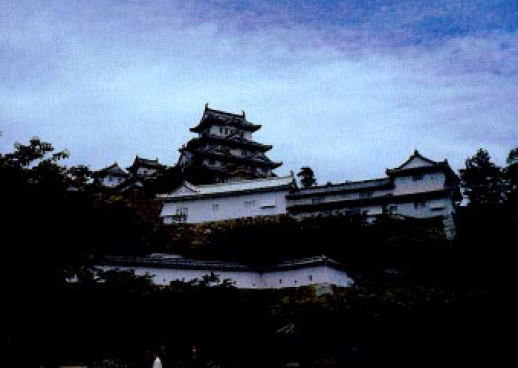
The castle walls, from the outermost
moat to the tenshu-kaku, divide the
grounds of the castle into a series of
maru
or compounds. The innermost of these,
where the main tower stands, is the honmaru.
Surrounding this are the ni-no-maru
(second courtyard) and the san-no-maru
(third courtyard). Attached to these are
other courtyards, some named for directions
or other more poetic titles. Within
these maru are the mansions of the
yashiki (nobles). Further out, between
the
second and third moats, are the residences
of your lesser samurai.
But a castle by itself is little good. You
and your samurai need the services that
only a town can provide. Naturally, many
merchants, craftsmen, and laborers are
drawn to the walls of your castle. You
have built it in a strategic location,
after
all, and you and your retainers have
money to spend on goods and services.
But, to attract more people, it is useful
to
offer special incentives. Other daimyo
have increased their jokomachi (castle
towns) by exempting merchants from
taxes, offering special monopolies on trade
or special status privileges (such as the
right to live within the walls of the castle).
These, along with the protection the castle
provides to all, encourage the common
folk to build outside your walls. Only
the
wealthiest, most powerful, or (especially
in
the case of artisans) most useful commoners
are allowed to live within the walls.
You also find it useful to grant land within
the castle to the influential temples and
shrines. After all, it is always better
to
strengthen an ally than make a powerful
enemy. Over the years, the jokomachi
grows until your castle looks down upon
a
sizeable town.
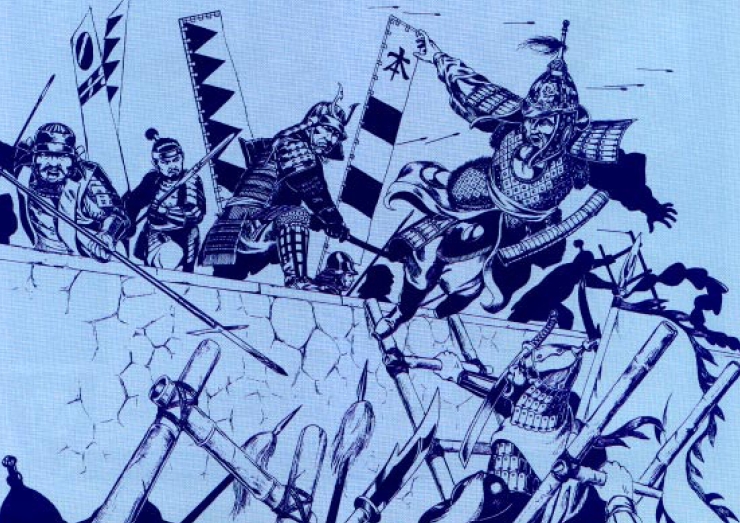
For many years after the castle is completed,
peace rules the land. Then comes
distressing news. Lord Toyotomi has died,
and the struggle for rulership of Japan
has
begun anew! More and more reports come
in of armies on the march. Wisely, you
decide to side with Tokugawa Ieyasu, the
strongest power of the contenders. Knowing
the vital importance of your province,
Lord Ieyasu?s enemies gather to attack.
Taking a castle is no easy matter, so they
assemble 50,000 men and march on your
lands. Cut off from Lord Ieyasu, you and
your 8,000 men are forced to take shelter
behind the walls of your castle. The siege
begins.
The attackers, knowing they need to win
a swift victory, prepare to storm the castle
Simple siege towers of lashed bamboo
are built. These allow the attackers to
watch the defenders inside and surmount
the walls in the attack. Others build
?tortoise-shell wagons? of fire-cured hides.
Once close to the walls, men protected
by
these will be able to pull the stones away.
More men are put to work draining the
outer moat ? a dangerous task, since they
must work within bow and musket range
of your men. Finally, however, the work
is
completed.
The assault begins at night, with the
enemy filling the dry moat with bundles
of
bamboo. By morning, parts of the moat
are filled. The attackers surge across
and
are met at the walls. Ranks of bowmen
shoot flaming arrows over the wall, attempting
to set numerous fires. By noon,
the outer wall has fallen. The battle continues
into the streets beyond. Here, the
streets are short and twisting, laid out
in a
confusing pattern. These give you an
advantage, since your men know the way
and the attackers do not. Furthermore,
you are able to watch the progress of the
battle from the main tower ? a luxury
and advantage the enemy lacks. By midafternoon,
the battle begins to swing to
your favor. Then the attackers use a new
strategy. Fires break out in the mansions
? more than your men can control. The
streets become an inferno, and both sides
are forced to retreat. Your men fall back
behind the safety of the next wall. For
all
that night and the next day, the buildings
of the outermost ring burn. As the fires
dwindle, the enemy advances again.
However, the battle has convinced them
that they cannot hope to take the castle
by
storm. Resolved, they settle down for a
siege. Camps are established and defenses
are built: caltrops, log barricades, sharpened
bamboo stakes. The invaders are
determined not to let you or your troops
break out. With the bulk of their defenses
finished, the majority of the army leaves,
marching to prevent any relief by Lord
Ieyasu. The days pass by slowly. Shots
are
occasionally fired on both sides. The attackers
mount assaults, searching for
weaknesses. When you can, you mount
raids on their camps, hoping to demoralize
them. Your stockpiles of food, arrows,
and
powder begin to dwindle.
Finally, rescue comes. Lord Ieyasu?s
armies force your enemies to withdraw.
The siege has been lifted. Your castle
has
withstood its greatest test.
In the centuries to come, the castle will
pass through the hands of many owners.
Some will make improvements and repairs;
others, unwilling or too poor to
maintain it, will let it suffer from neglect.
Only a few decades after it was built,
your
castle becomes unnecessary, a relic of
a
more violent time. Eventually, it falls
into
decay, until the Imperial Restoration
comes. The army uses it to house troops
until it is not even suitable for that.
Parts
are sold as scrap and firewood for mere
pennies or even for the cost of hauling
it
away. Finally, Allied bombs fall and
destroy the rest.