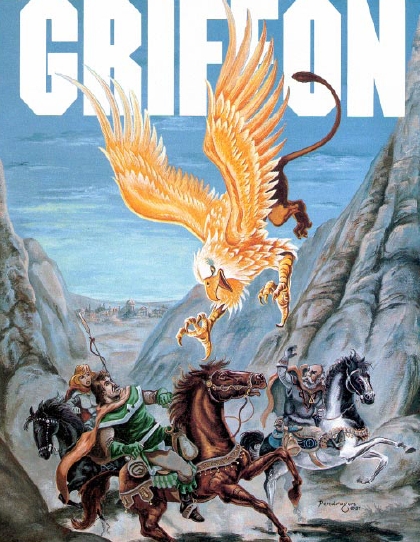
The Ecology of the Griffon
Taking flight with Felis aquila
by Christopher Kederich
Art by Pendragon
| Anatomy | Flying | Hunting | Family matters | Treasure |
| Training | Abilities | Friends | Miscellaneous | Game information |
| Advanced Dungeons & Dragons | - | Dragon #161 | - | Dragon magazine |
From a popular lecture by forest warden
Defaeben Knazzer, of the Royal Zoological
Gardens of Zinfinjord:
One of the best known of all fantastic
creatures, the griffon is seen both as a
feared monster and a much-desired flying
mount. The griffon is accurately described
by sages as a ferocious avian carnivore,
and it is probably the most successful
large flying predator, being more common
and voracious than any sort of dragon. It
is the true king of the air.
The origins of the griffon are unclear.
Some scholars have speculated that it was
the result of magical experimentation by
an ancient civilization. Yet the legends of
griffons seem to be older than the earliest
records, older than this theory would
explain. Like the centaurs, griffons are
probably the result of natural magical
forces granting an adaptable creature the
traits of different mundane animals. In the
griffon, these forces produced a powerful
being indeed.
Anatomy
In appearance, griffons resemble great
lionlike cats with the taloned forelimbs,
wings, and heads of great eagles, but with
prominent tufted ears. Their body fur
colors range from golden bronze to dark
brown, the colors darkening with age.
Males have touches of red on their breast
feathers; females have duller coloration
than males.
The size of an adult griffon is on the
order of the largest of lions and tigers,
being of similar proportions though with
an especially heavy chest and with the
shoulders to accommodate wings and
flight muscles. While standing on all fours,
the overall length from beak to rump
measures 7-10?. An adult male may weigh
up to 1,100 lbs., with females averaging
one-third less.
Artists and heralds have incorrectly
pictured griffons as having thin, sticklike
forelimbs. In fact, a griffon?s forelegs are
as heavy as a lion?s and are capable of
striking like clubs with sufficient force to
break a victim?s neck. The raptor?s talons,
which are up to 6? long, can not only
slash but can clench in a bone-crushing
grip. Like lions, griffons can bowl over
large animals with one sweep of a foreleg.
With pinions fully stretched, the griffon
?s wingspan is often eight or nine yards
across, a magnificent and awe-inspiring
sight. Though without tail feathers and
looking entirely lionlike, the griffon?s tail
helps it steer and stay balanced in flight.
The moderately pointed wings are well
suited for soaring and for diving onto
prey. A griffon?s feathers are gold in color,
often with patterns of black washing
across them.
The eyes of the griffon have been said to
resemble living flames, usually being ruby
red, burning yellow, or icy blue. Griffons
have the same keen vision that giant eagles
have, being able to see a horse from two
miles away in the air. It is said that if a
griffon could read, it could see normal
print clearly from 100?. It lacks infravision
but can see clearly in the dark as its eyes
gather the faintest of light. Its sense of
smell is only average for a predatory animal,
still much better than that of humans
but inferior to that of dogs. It might be
possible for a griffon to track quarry by
scent alone, and one would certainly be
able to detect most enemies approaching
from upwind, but not as readily as could
many of its prey. A griffon?s sense of hearing,
on the other hand, is very sharp. It
can hear hoofbeats on packed earth from
at least a mile altitude, and a trainer?s call
will reach it from the same distance.
Flying
Eagles can roll completely over in midair
and griffons can do likewise, but not without
some difficulty. Due to their great size,
it would take longer to correct an error or
regain height, making aerobatics dangerous.
Midair loops and somersaults may be
possible under good conditions but probably
not with a rider. Nevertheless, the
griffon is a nimble and powerful flyer,
though less so than the Pegasus, which is
both faster and more agile in flight. The
griffon is built to catch moderately quick
prey and carry it back to a high nest.
Griffons can fly in almost any weather,
having an elemental feel for the sky and
its conditions. They can sense changes in
the weather and can detect downdrafts
and thermals. Griffon riders need at least
as much training to learn how griffons fly
as their griffons need to learn how to
carry their riders. Griffons can be intractable
at times and simply may not want to
fly, much less convey a rider, though usually
not without good reason; they are
quite sure of themselves in the air.
Hunting
Very few carnivores are as superbly
capable of hunting as is the griffon. With
its combination of speed and agility, as
well as its natural armament, the griffon is
a tenacious predator. Although a griffon
can strike large prey out of the air, it favors
hunting ground-dwelling animals,
especially herd animals and most especially
horses, which it craves. The variety
of potential prey is very large, as griffons
are opportunistic hunters; they feed on
almost anything from the size of a rabbit
to a buffalo?including, at times, humans.
Unlike lions, griffons are not scavengers
and will usually ignore food that isn?t
fresh. A griffon can locate prey in near
total darkness, but it normally hunts during
the day as it is easier to fly on sunheated
thermals and many herd animals
are up and about during this time. Open
plains, savannahs, and rolling grasslands
are its preferred hunting grounds.
If it is injured, a griffon can function as a
land predator as well as an aerial one,
though it will be slow and is then most
likely to become a man-eater. When acting
as a land hunter, it will behave much as a
big cat, though it shows some flexibility in
adjusting its hunting techniques. It may
stalk and pounce like a leopard, or stalk
and charge like a tiger; if there are two or
more griffons, a group charge, as per the
lion, might be used. If the griffon?s wings
are partially functioning, it is then able to
drop onto its prey from a tree or cliff.
Although griffons can and do hunt a
large variety of prey, equine flesh is their
obsession. Griffons wing their ways at
once toward any horses they see, selecting
the group that offers the best feeding with
the least danger. Young griffons pay no
heed to warriors who may be riding or
leading horses, attacking with no regard
for swords or arrows. An older griffon,
however, devotes a few moments to consider
such an attack in advance. An unprotected
wild horse is an immediate target,
but a column of cavalry may be given up
as too much trouble unless the griffon is
extremely hungry, stupid, arrogant, or has
never fought warriors before.
Griffons are not often clever, but experienced
ones have learned a few tricks.
Adventurers tell tales of griffons that bide
their time until after dark when a large
mounted party is bedded down, then
approach on the ground from upwind to
spook the horses into bolting from the
camp. The griffons then follow the horses
for a safe distance before making the kill
to minimize the hazards from the party. If
horses are tied down, a quick kill from the
air and an immediate escape will ensure
something worth eating after the party is
gone. The less-intelligent lion is well
known for similar tactics.
Family matters
The griffon's range is extremely wide,
from the tropics to the subarctic, and
from coastal areas to high mountains.
Because of the wide variety of prey it can
hunt, and its ability to fly long distances
for food or water; the griffon is the dominant
predator in most areas unsuitable for
other large hunters.
A griffon?s preferred nesting place is in
the most remote and inaccessible part of
its territory. High places commanding a
wide view of the surrounding countryside
are typical, including cliffs, mountaintops,
mountainous caves, and large ruins. Even
some great trees can support the weight
of a griffon?s nest. These nests are normally
far apart, but if prey is plentiful
griffons can be gregarious and live among
a small cluster of nests within earshot of
each other.
As with eagles, griffons are monogamous
and mate for life. They are devoted
parents and will defend mate and young
unto death. The young are fed first from
any family kill. It is the male that hunts
while the female guards the nest, again
much as with eagles. Typically, two agatecolored
eggs are laid at a time, hatching in
four weeks. The hatchlings are ravenous
and eat at least their weight in food a day
for the first three months of life. At four
months, the fledglings are the sizes of
large dogs and can climb and move about
on the ground. The parents now begin to
teach their young hunting methods without
using wings. At six months, the young
begin flight training and aerial hunting,
which lasts at least six more months. The
nest is moved if necessary until the young
can fend for themselves. Leaving the parents
after two years, the young travel
great distances before establishing their
own home ranges.
On occasion, two or more griffons (usually
males, typically brothers) team up and
hunt together. This may last for a short
time, a lifetime, or until one finds a mate.
Less cautious than mated pairs, these
bachelor groups are more likely to be seen
than others and are the basis on which
most people form their impressions of
griffons. Intensely loyal to each other,
these griffons will back each other up in
almost any situation.
Griffons rarely fight among themselves
in the way many other predators do. The
males are very protective of females, even
if they are not mates. It is this instinctive
sense of loyalty and discipline that makes
a griffon a much more dependable battle
mount than a horse or most other flying
steeds. Griffons are naturally combative
and fear almost nothing, yet neither will
they fight for no apparent reason.
Treasure
Suspicious and bold, griffons may investigate
anything that interests them despite
possible danger. Attracted to shiny objects
to decorate their nests, some griffons
collect assorted treasures solely for their
looks and will fight strenuously to protect
what is theirs, but may trade precious
items for something more interesting.
The treasure types to be found in a
griffon?s nest are those that have survived
examination and rough handling. Potions
are likely to be broken because the griffons
like to toss colorful things about and
try to catch them in their beaks, or drop
them to hear how they sound upon hitting
the rocks. Furs, clothes, and leather goods
are apt to be employed in tugging matches
or claw sharpening. Scrolls similarly suffer
unless well protected. Only durable metal
objects will last.
An exceedingly rare species of griffon is
known to have a peculiar sense that allows
it to detect gold up to 10? away. Since gold
is of little value to griffons except as nest
decorations, they do not often exercise.
this ability. Even so, this species can tell a
fake piece of gold at a glance. A narrow
strip of dark fur over the middle of the
chest seems to grant this ability. It is possible
to use this fur to enchant an item to
locate gold. The difficulty in this is that the
fur must come from a live griffon, and few
if any are willing to part with their fur. If
fur is removed from a live donor (which is
necessary in order for this power to be
transferred), the griffon?s gold-detecting
ability fades for a year while the fur
grows back on its chest.
Being both possessive and curious, even
a trained griffon will not take kindly to
being completely left out of the division of
the adventure?s spoils, especially if the
griffon?s sense for gold helped to locate
the treasure. On the other hand, a nestless
griffon is likely to quickly tire of its valuable
?toys? and will soon discard them.
Training
Griffons can be trained to be companions
and mounts with striking loyalty,
though not without unique problems.
Horses are tamed and trained with ease by
comparison; domesticated horses find the
company of other horses or herbivores
often makes them feel secure. Griffons are
more solitary and dislike crowds. They do
poorly in captivity, needing open spaces to
exercise. Most would eventually refuse to
eat if caged, making it difficult to hold
them against their will.
Gaining a griffon is difficult at best.
Griffon eggs and fledglings command a
high price?2000 and 5,000 gold pieces
each respectively on the open market.
Raising the young is often more trouble
than most adventurers expect. Fledglings
must be captured before their first feathers
grow in at three months of age in
order to bond with an owner. If taken
later, the griffon will not readily accept its
new ?family? and has a 10% per month
chance of deserting (if mistreated, 20%
per month; confinement is considered
mistreatment).
Training the young must include hunting
in order to make the fullest use of the
griffon?s abilities and to maintain a balanced
mind. Here, the outdoor skills of the
trainer become the common ground between
rider and griffon. Although flying is
instinctive, the fledgling must be coaxed
into flight. During the training, a trainer
may teach the griffon special skills to be
used on an adventure, such as dropping
bombs or grabbing ground-based objects
from the air.
Unlike the griffon, any adventurer will
find learning how to fly competently very
difficult. The time required is usually about
11-16 weeks. Use of speak with animals
spells or the like will lessen the time by
another 2-5 weeks. Those with less than
normal agility and dexterity cannot fly with
any competency, but they may be tied on
and carried about as baggage. Characters
with low endurance will not be able to fly
without becoming helplessly ill from motion
sickness. Griffons bob up and down a
great deal in their flight, unlike pegasi,
making riding one rather like being a
jockey in a steeplechase. A large part of
riding one lies not merely in being strapped
down but in hanging on, resisting the wind
and moving with the animal to make it
easier on both parties.
On occasion, adventurers may earn the
gratitude of a griffon by releasing it from
a trap or saving it from some illness or
injury. If made to feel a part of the ?family,
? such a griffon is more likely stay with
a group indefinitely. Since only adult griffons
are likely to be encountered in this
way, there will be no need for flight or
hunting training. The griffon will be most
likely to bond to an adventurer to whom
loyalty is an important virtue.
One cannot subject griffons to the indignities
commonly placed upon horses, like
corralling, hobbles, and branding. Bit and
bridle would, at best, interfere with their
own defenses and would probably be
intolerable. Vocal commands and body
movements are sufficient for nearly all
situations, and a hackamore helps for
special ones. The best battle-trained horses
are trained to obey complex vocal commands;
griffons are both more intelligent
and naturally battle-ready creatures, and
they can obey even more complex orders.
A horse saddle will not fit on a griffon.
Any saddle made for a griffon must take
into account its wings and should not
hamper flight. Sidesaddles are out of the
question. If made out of horse leather, a
saddle may even be eaten. The saddle may
be positioned in front of or behind the
wings; it may be less tiring to the griffon
for the weight to be behind the wings but
will restrict the rider?s vision and ability to
fight. Barding is rarely used, as it always
lowers flight speed and maneuverability.
Simple and light head, neck, and chest
armor should create no problems as long
as it weighs much less than a rider.
A rider should be able to do anything
that can generally be done ?in a high wind
while bobbing up and down strapped
between the flapping wings of a large
predator that will probably object if the
rider sits up and creates drag. If properly
buckled in, the rider will have at least one
free hand much of the time and be able to
fight or grasp objects. Flight clothing
should take into consideration wind chill,
weather, weight load, etc.
As mounts, griffons should not be
counted on to travel overland even though
they can handle rough terrain easily. If
you are going to ride?fly. Griffons may be
more argumentative and uncooperative
than horses, but they don?t spook at rabbits,
birds, or shadows. On the other hand,
horses are not often known to hungrily
chase rabbits, deer, or other horses, and
they don?t eat riders who?ve been abusive
to them. Griffons are fearless if aggressive
and loyal if moody. Griffon males usually
make better mounts, being not only larger
and stronger than females but also calmer
and more patient.
Unfortunately, there are other problems
involved in owning a griffon mount. For
example, after long contact with griffons,
a rider may walk upwind of someone?s
horse; what will the horse do upon smelling
its worst enemy? After an adventure,
heroes may want to relax in town for a
while?and so might their loyal griffons,
whether or not the townspeople agree.
Naturally, the disappearance of any horses
will be blamed on the griffons. And if a
character is eating steak, his griffon will
not easily tolerate left-over iron rations.
Abilities
Just how strong griffons are is a matter
of measurement. Griffons can fly carrying
loads as great as their own body weight,
though not for long periods. With their
taloned forelimbs, griffons can grasp
objects and hold them, probably damaging
anything fragile. If so trained, they have a
40% chance to bend bars or lift gates.
With the same basic strength as a lion, a
griffon will be far stronger than any normal
humanoid. On the ground, a griffon
should be able to do the same sort of feats
that a huge lion or tiger can manage.
A griffon?s appetite is remarkable. Even
if not flying, a griffon will eat more than a
similarly sized lion, typically on the order
of at least 25-30 lbs. of fresh meat a day. If
flying, it will eat half again to twice as
much when possible, depending on
whether or not a load is being carried.
When hungry, a griffon becomes very
irritable and aggressive. Although a person
to whom the griffon is loyal is in no
danger of being eaten, anything else is
considered fair game.
Without proper food, the griffon will be
a poor flier and very uncooperative. When
food is available, griffons sometimes consume
tremendous amounts and may be
too gorged to fly well, but won?t require
another feeding for some time. Riders
should make sure that their griffons don?t
overindulge themselves between adventures
and become lethargic.
Friends and foes
Being choosy, griffons will not serve as
mounts or companions for humanoids
prone to mistreat animals. These are such
beings as the griffon would consider dirty,
disgusting, and incapable of returning
trust, such as orcs, gnolls, and kobolds.
A
griffon will also not hunt other griffons.
A griffon has very few natural enemies,
and none count it as regular prey. Only
humanoid species present a significant
threat. Some creatures will nevertheless
always be enemies with griffons. Hippogriffs
and pegasi are no match in a fight
and will normally be chased if rarely
caught. Manticores are slower if more
difficult prey. Harpies will always be attacked
at the first opportunity. The hypnotic
song of the harpy does not affect the
griffon as it does a human, but if such a
song is heard, it will enrage the griffon
and bring it winging in to attack. Perytons
are another natural adversary; although
invulnerable to most nonmagical attacks,
they are subject to predation by the innately
powerful griffons. Thus griffons
help clear the skies of certain hazards that
threaten humanity.
Having as few natural allies as they have
enemies, griffons are compatible with
giant eagles, for example, and are generally
on good terms with them. Those races
and classes more attuned to nature, such
as elves and druids, are best apt to understand
and be compatible with griffons.
Centaurs, on the other hand, and other
quasi-equine species (even if they don?t
taste like horses) will be in perpetual strife
with griffons.
Sacred to Apollo, griffons are said
to
draw this gods chariot home from his
winter retreat. Several other deities have
held griffons sacred and may have had
something to do with their creation, but
whatever their origins, the griffon is such
a successful predator that it needs no
guiding force to sustain it. There are even
reports of sentient griffons which may
represent a separate species largely indistinguishable
from the familiar one and
which may wish to remain unrecognized.
Miscellaneous
Griffons have a language that sounds
like a collection of squawks and growls to
other creatures. It is composed mostly of
words relating to flying, hunting, weather,
and the visual appearance of things. It is
not suited to abstract concepts.
Like tigers, griffons can swim, but if
their feathers are wet they must dry off
before flying. By nature compulsively neat
and tidy, enjoying baths and frequently
preening for hours, griffons are not likely
to accept filthy would-be riders or accommodations.
The lifespan of a griffon is very long,
some serving several generations of a
family. Actual lifespan is dependent on
many factors but may extend as long as
several centuries. One hundred and fifty
years is considered average in the wild.
A griffon is a magnificent creature to be
treasured by all humanity. Dangerous it is,
but marvelous, too. As long as it wings
through the skies, we can look up at it and
know the meaning of courage.
Game information
In combat, griffons prefer to use their
beak and talon attacks first, If diving onto
a victim from a greater height (at least 60?)
or a victim that is flying more slowly (MV
fly 24 or less), the griffon will double its
claw damage and gain a + 2 to hit, but not
be able to employ its beak in the same
round. If a griffon can strike an enemy on
the ground with both of its foreclaws, it
can employ its rear claws for an additional
1-4 hp damage, but at a -2 to hit because
they are not accustomed to doing so unless
so trained. A griffon can use the rake
even in midair, but it loses altitude rapidly
and disengages as soon as possible. Its last
means of defense may include a wing
buffet, but this does only 1-2 hp damage
per wing because the wings are feathered
and soft. If a flying griffon snatches someone
from the ground (requiring one to-hit
roll), it causes 1-6 hp damage from roughness
even if it does not mean any harm.
Training the griffon in this snatch can
lessen the damage to 1-4 hp.
For more information on flying, see
"Flying the Friendly(?) Skies," in DRAGON®
Magazine #124.
SEPTEMBER 1990
LETTERS
. . . and Canada...
Dear Dragon,
In DRAGON issue #161, you ran an article
on
the ecology of the griffon. Assuming that many
of the characteristics of the griffon were supposed
to be based on eagles, some of them were
incorrect. First, female birds of prey (raptors)
are larger than males, because they need the
?room? to carry eggs. Also, raptors cannot see
well in the dark. That is why a falconer puts
a
hood over his bird?s head; without eyesight,
the
bird goes into a state of calmness bordering
on
stupor.
The major problem I had with the article was
with the amount of damage a griffon can do. An
average-sized hawk has enough strength in its
grip to cut off the circulation in a person?s
arm,
so a griffon should certainly be able to do more
than 1-4 hp damage per foot! (Damage of 1-8 or
1-10 hp would be more likely.) Further, birds
of
prey generally do not attack with their beaks,
which are used to cut up dead prey.
Finally, even through their wings are made up
mostly of feathers, the strength of a blow [from
a raptor?s wing] would be more than enough to
bowl someone over or even knock him out.
These may seem like nitpicky details, but it is
just as easy to get things right as to get them
wrong. Of course, it all depends upon just how
much like eagles you think griffons are.
Dawn Nelson
St. John's, Newfoundland
(Dragon #166)
A griffon is a mixture of eagle and lion, with
a
large dose of fantasy biology to boot. For
example,
the Monstrous Compendium notes that
griffons screech like eagles and live in prides
like lions, but they are also addicted to
horseflesh
and can be trained by humans to be loyal
mounts. I would say that griffons are as much
like eagles as the DM wants them to be.
Nonetheless, you do make interesting points
about the damage done by a griffon?s foreclaws
and wing buffet. Most griffons are shown with
thin forelimbs (perhaps accounting for the
low
damage assigned to those claws), but the article
in issue #161 opts to make the forelimbs stronger.
A DM could create a new species of griffon
(the
?royal griffon?) that does 1-10/1-10/2-16
hp damage,
which seems reasonable. A wing buffet
could do 1-6 hp damage (like a club) per wing,
with a dexterity check on 4d6 required for
mansized-
or-smaller victims to avoid being knocked
down. The rear-claw rake, mentioned under
?Game information? in "The Ecology of the
Griffon,
" could also be uprated to do 2-8/2-8 hp damage
if the foreclaws catch larger-than-man-sized
prey.
Of course, these changes will make the new
griffon a terrifying opponent, one that even
12th-level characters will not enjoy meeting.
(I
once killed off a whole group of adventurers
with one old-style griffon when I was DMing.)
Horses, of course, will be very unhappy with
the ?royal griffon,? and even dragons will
be
wary of griffon prides.