| Amorphs | Fungi | - | - | - |
| Illithidae | Cessirid | Embrac | Kigrid | Saltor |
| 1st Edition AD&D | - | Dragon #150 | - | Dragon magazine |
The Dragon's Bestiary
All life crawls where mind flayers rule
by Stephen Inniss
Illustrations by Thomas Baxa
The homeworlds of the Illithids (mind
flayers) and the depths of the Earth most
thoroughly colonized by the Illithids,
as
described by the sages in "The
Sunset
World,"
share a number of common features.
There are three major classes of
creatures always associated with Illithid
activity: amorphs (jellies, oozes, trappers,
ropers, and company); fungi; and Illithidae
(alien beings of which the Illithids themselves
are the most notable examples).
Some of these creatures are well known
to
adventurers in the Underdark; others are
known only from areas fully colonized by
Illithids. Table 1 shows
some life forms
typically associated with Illithid lairs.
Amorphs
Most of the amorphs are found in the
same regions of Illithid homeworlds as
the
Illithids themselves, with the exception
of
a few such as the dun pudding of the
Sunside deserts and the white pudding of
the Nightland glaciers. Their ranges seldom
overlap. Of the intelligent amorphs,
most avoid and are avoided by Illithids.
Illithids
do not prey on amorphs, which
seem to be unpalatable to them. Because
amorphs are so commonly distributed
across the known worlds, it is likely that
Illithids allow them to breed where found
or else transport them from world to
world for reasons unknown to others.
Fungi
Gas
spore. Gas spores were apparently
developed as part of the Illithids
defensive
array. Domestic forms, though mindless,
ignore Illithids but approach other life
forms. The resemblance to the beholder
is
too close to be coincidental, particularly
since beholders are notorious allies of
Illithids in the Underearth. Despite this,
gas spores are found on Illithid homeworlds
while beholders are not. Possibly
beholders have been eliminated from the
homeworlds by the Illithids because of
their potential for danger, or possibly
the
Illithid worlds are simply too windy for
beholders. Other hypotheses have been
advanced as well: that gas spores were
developed in the Underearth and have
spread to other Illithid habitations, or
that
beholders and gas spores were both developed
by Illithids. This last is considered
unlikely.
Mold,
brown. Brown mold is unaffected
by the reddish light of the suns under
which the Illithids live, and is common
in
the warmer regions. The forms encountered
there, however, do not drain heat
from living creatures (Illithids apparently
eliminate such varieties) and are often
used to cool Illithid towers in the hotter
part of the year.
Shrieker:
The shrieker?s habits are eminently
practical on Illithid homeworlds.
Any commotion is likely to attract a number
of predators, so only the most formidable
creatures attempt to graze on a
patch of shriekers.
Illithidae
All of the Illithidae have four limbs with
four digits each if they are terrestrial;
all
have tentacles arranged around a beaked
mouth in some multiple of four; all possess
both gills and lungs (though airbreathing
forms use the gills only during periods
of
great exertion); and all have a tough skin
typically covered with a slime that is
proof
against the glues of such amorphs as the
mimic and roper. All Illithidae have a
larval form that lives for a period inside
some other organism, typically a creature
killed by its parent.
Many of the Illithidae are equivalent to
mammals or reptiles of the surface world.
The cessirid resembles a wolf,
for instance,
while the saltor is much like a
monkey or baboon, and the kigrid fills
the
role of a bear, pig, or hyena (the embrac
is
most like some carnivorous plants). It
is
possible to define other such equivalent
Illithidae by converting the statistics
of
typical mammals, reptiles, or dinosaurs.
Armor classes are typically two or three
places better; hit dice are either quadrupled
or increased by six (whichever is
less); and intelligences (for adult forms)
are increased by several points so that
the
usual range is from low intelligence to
very intelligent. Alignments are typically
neutral or evil. These creatures generally
exhibit some degree of magic resistance,
and the more intelligent ones may have
psionic abilities, including disciplines
appropriate
to their modes of life. All are
predators at least on occasion. Attacks
include the effects of the feeding tentacles,
which may paralyze, kill, induce pain,
or
possibly act as Illithid tentacles do.
Skin
colors are typically some shade of purple,
red, black, or gray, or possibly white
in
those forms that lurk near the icecaps
and
g l a c i e r s .
On homeworlds, where light is dim at
best and sometimes absent, all of these
creatures are vulnerable to illumination
equal to normal sunlight. Light of intensity
equal to a light spell or brighter causes
them to strike at -1 to hit (if they are
capable of attacks and have eyes). Additionally,
in full sunlight, they take 1 hp
damage per turn.
The "frequency" values given for the
following four Illithidae apply only to
Illithid homeworlds or subterranean lands.
These creatures are not encountered
elsewhere.
Note: A fraction of the Illithids whose
psionic strength is exceptional (5% chance
<do away with psionic strength>
if the total is over 275) have other psionic
abilities in addition to the usual Illithid
powers (determine as if for a human
magic-user). There is a 20% chance that
such an individual will have 0-3 (1d4 -
1)
additional attack modes and 0-3 additional
defense modes.
FREQUENCY: Rare (common near Illithids)
NO. APPEARING: 1-20
ARMOR CLASS: 4
MOVE: 18?//15?
HIT DICE: 8 + 16
% IN LAIR: 5%
TREASURE TYPE: Nil
NO. OF ATTACKS: 1 bite
DAMAGE/ATTACK: 2-16
SPECIAL ATTACKS: Poisonous bite,
psionics
SPECIAL DEFENSES: Psionics
MAGIC RESISTANCE: 5%
INTELLIGENCE: Average
ALIGNMENT: Lawful neutral (evil
tendencies)
SIZE: M (2? at shoulder)
PSIONIC ABILITY: 90
Attack/Defense Modes: B,E/F,G
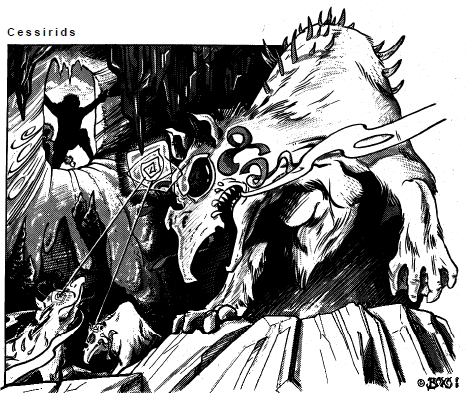
Cessirids travel in packs. A cessirid?s
body is canine, with a large head, outsize
eyes, and a rending beak in place of teeth.
There are four short tentacles around the
mouth. Short spines jut from the back.
The skin is smooth, slimy, and pale gray
in
color. The spaces between the toes are
webbed. Though small, cessirids are
shockingly powerful.
In combat, a cessirid leaps and bites at
its adversary, inflicting horrible damage
with its outer jaws. The tentacles around
the mouth cause a stinging and burning
sensation upon contact with flesh (save
vs.
poison for each bite that hits; failure
yields
a -3 penalty to armor class, saving
throws, and to-hit rolls) that lasts for
3-12
turns.
Cessirids may use the following psionic
disciplines at the 6th level of mastery:
body equilibrium, ESP and dimension
door They use these in the pursuit and
detection of prey, or to escape if attacked
by a superior force.
These creatures live in tightly knit
packs, working together silently and efficiently
to bring down prey of any sort
(they can communicate with others of
their kind telepathically over distances
of
up to 24? at no cost to psionic strength).
<do away with psionic strength>
Though they are willing at times to negotiate
with other intelligent creatures, they
have little desire for anything but food
and reproduction. In general, they are
wily and treacherous. On occasion, if they
are not hungry, cessirids will harry and
torment prey for hours before killing it.
Rivalry between cessirid packs is sharp,
but. they will generally band together
against other creatures.
Thanks to millenia of training and breeding,
the dogs of the githyanki (kaoulgrim,
from "Hounds
of Space and Darkness," in
DRAGON® issue # 117) and the
cessirids
are fanatic enemies, and will fight one
another regardless of other constraints
(even magical charms). Szarkel,
the dogs of
the githzerai (from the same article and
issue as kaoulgrim) will always avoid meetings
with cessirids. Szarkel can detect the
approach of cessirids within one mile,
probably by detecting the use of the latter
?s psionic talents.
FREQUENCY: Uncommon (common near
Illithids)
NO. APPEARING: 1
ARMOR CLASS: 2
M O V E : 3 ?
HIT DICE: 11+22
% IN LAIR: Nil
TREASURE TYPE: C
NO. OF ATTACKS: 8
DAMAGE/ATTACK: 2-8 each (tentacles)
SPECIAL ATTACKS: Paralysis, constriction,
surprise on 1-3, psionics
SPECIAL DEFENSES: Psionics
MAGIC RESISTANCE: 20%
INTELLIGENCE: Low
ALIGNMENT: Neutral evil
SIZE: L (10? body, 20? tentacles)
PSIONIC ABILITY: 80 + 1d20
Attack/Defense Modes: A/F
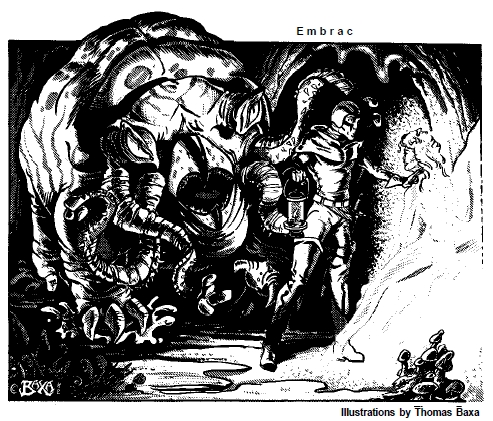
Embracs are solitary predators that lie
in
wait for prey. They are slow and trouble
to move themselves only when the supply
of game in an area has been exhausted.
An
embrac?s body is short, stocky, and rather
sacklike in shape. It has stout limbs that
are heavily clawed at the tips. These are
used to anchor the embrac while it wrestles
with prey. The head is large and bears
a saw-edged beak. An embrac?s feeding
tentacles are as thick as a man?s waist
at
their base, and taper to three separate
points that serve as fingers. The tentacles
bear numerous spikes and hooks on their
undersides. The body color and pattern
of
an embrac are variable: usually spots and
stripes in shades of black, gray, white,
or
dull red that conceal the outlines of the
embrac. The skin is slimy and bears bony
plates just under the surface.
Embracs may employ the following
psionic disciplines at the 5th level of
mastery:
empathy,
ESP invisibility, and mind
bar. They may also produce illusions that
are like a spectral force at the 5th level
of
casting in all respects except that the
illusion has no potential to cause direct
damage. The cost of this latter psionic
discipline is two strength points per
round.
An embrac typically lies in wait, concealing
itself as best it can (surprising prey
on
a 1-3 on 1d6). At the approach of prey,
it
may attempt to lure it with some illusion
that seems appropriate from an ESP scan.
Anything that comes within 20? is vulnerable
to the embrac?s tentacles. The tentacles
inflict 2-8 hp damage on the first and
each
following round of combat unless the
victim forgoes other activities and makes
a
successful bend bars/lift gates roll. Those
held by an embrac strike at -2 to hit.
In
addition to the constricting damage, the
spikes on the tentacles exude a poison
that
causes paralysis for 2-12 turns unless
a
saving throw vs. paralysis is successful.
Embracs are occasionally known to use
some of the few manufactured items that
their body forms allow, and they have
been known to stockpile precious goods
for use as bargaining tools. They generally
lair in caves or similar dwellings, and
close
the entrances with boulders if they detect
formidable enemies. Embracs hold all
other life in low regard. They reproduce
in the same manner as cessirids. Like
cessirids, embracs are occasionally seen
as
servitors among Illithid communities.
FREQUENCY: Rare (common in Illithid areas)
NO. APPEARING: 1-3
ARMOR CLASS: 3
MOVE: 12?//15?
HIT DICE: 9+27
% IN LAIR: 20%
TREASURE TYPE: C
NO. OF ATTACKS: 2 claws and 1 bite
DAMAGE/ATTACK: 2-8/2-8/2-16
SPECIAL ATTACKS: Poisonous bite, psionics,
rear claws for 2-12/2-12
SPECIAL DEFENSES: Surprised only on a 1
in 10, psionics
MAGIC RESISTANCE: 35%
INTELLIGENCE: Very
ALIGNMENT: Chaotic evil
SIZE: M (5? long)
PSIONIC ABILITY: 90 + 2d20
Attack/Defense Modes: A,E/F,G,H
Kigrids may be found singly or in small
groups. They are always hungry and will
attack and eat any vulnerable creature.
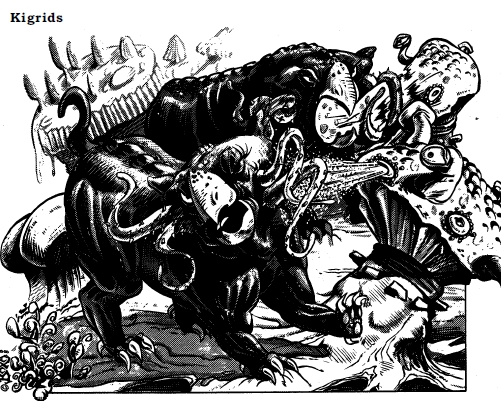
A
kigrid is a stocky, four-legged creature
with a short tail, powerfully built legs,
a
short neck, and broad head. It has sharp
claws, and there are four tough, spiky
tentacles around the broad, beaked
mouth. The skin is black and the eyes a
dull red. These beasts are cunning and
malicious, and generally unreliable.
In combat, a kigrid will strike with claws
and teeth. If the forepaws both score hits,
the rear claws may be used for additional
attacks. If the beak hits the opponent,
a
saving throw vs. poison is necessary. A
failed saving throw means the poison
causes swelling and pain that lasts for
2-5
rounds (penalty of -2 to armor class,
saving throws, and rolls to hit).
Kigrids have the psionic disciplines of
ESP, body
equilibrium, levitation, and
invisibility They are perfect mimics and
often use sounds to deceive prey. Their
tentacles allow them a limited ability
to
manipulate objects, and they may rig
simple traps.
Kigrids generally avoid one another
unless they are closely related; the more
powerful individuals generally regard the
less powerful as food. They reproduce in
the same manner as cessirids and embracs.
On occasion, large kigrids are used
by Illithids as beasts of burden; how this
is
accomplished without constant supervision
is unknown.
FREQUENCY: Rare (common in Illithid
areas)
NO. APPEARING: 10-40
ARMOR CLASS: 4
MOVE: 12?@12? (argid) or 15?@9? (jendrid)
HIT DICE: See Table 2
% IN LAIR: 50%
TREASURE TYPE: C in lair, M, L
NO. OF ATTACKS: 5 (four tentacles plus
bite or weapon)
DAMAGE/ATTACK: See Table 2
SPECIAL ATTACKS: Tentacles
SPECIAL DEFENSES: Nil
MAGIC RESISTANCE: 40%
INTELLIGENCE: Low or average
ALIGNMENT: Neutral
SIZE: S to M (see Table 2)
PSIONIC ABILITY: Nil or 130 + 2d20
Attack/Defense Modes: Nil or A/F,G
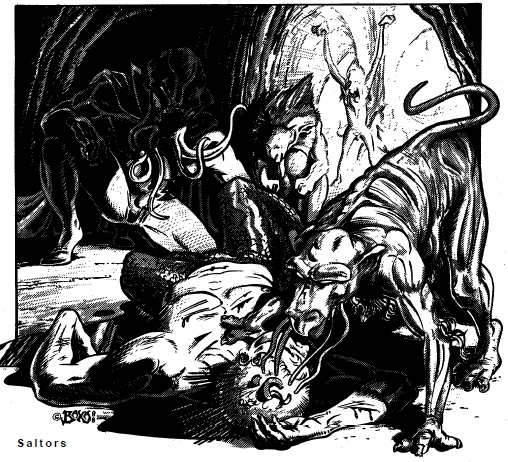
Saltors are akin to Illithids as baboons
are to men. A saltor somewhat resembles
a baboon in form, but it possesses four
tentacles about the mouth, three-fingered
hands that bear opposable thumbs, the
ability to stand upright, and slimy skin.
Saltors are of varying color (generally
white or black, but occasionally gray,
violet, or red), and of varying build and
size according to the needs of their Illithid
masters, though a few saltors live independently
and determine their own tribal
characteristics. A saltor?s statistics
vary
with size, as shown on Table
2.
Within each size class there are two
distinct physical forms. The more common
of the two is of typical baboonlike build:
the argid. The other sort, the jendrids,
is
longer limbed (a foot taller than the statistics
indicate for size). Argids and jendrids
are both agile climbers, but jenrids are
faster on the ground and slower in the
branches.
A saltor may attack with its tentacles
and bite, or it may attack with tentacles
and use a weapon. The tentacles have the
same effect as Illithid tentacles (q.v.),
but
the time between implantation and death
is 2-5 rounds. A saltor makes tentacle
attacks at -3 against creatures whose
heads are more than 3? higher or lower
than its own and cannot use tentacle attacks
at all against creatures whose heads
are more than 5? higher or lower. Saltors
use crude spears that do damage as per
the thrower?s bite (the variation is due
to
size). Spears are typically used either
before melee or against opponents that
cannot be touched. Unarmed saltors may
throw rocks (range 1?/2?/3?, short/
medium/long) for damage equal to the bite
minus 1 hp, at the rate of one rock per
round.
Saltors of low intelligence have no psionic
abilities; those of average intelligence
have psionic power plus the disciplines
of
levitation, ESP and body equilibrium, all
at
the 5th level of mastery. Among populations
controlled by Illithids, only the
smaller two sizes possess psionic power.
Saltors are bold if they outnumber their
opponents, and they are unswervingly
obedient when ordered by superiors.
Their actions are always orderly and well
coordinated. Though they may be bred for
almost any manual task and have diverse
talents, they are universally cruel, take
delight in tormenting and coercing lesser
creatures, and consider underlings to be
the greatest delicacy. They reproduce,
as
Illithids do, by destroying the brains
of
other creatures and planting their larvae
to grow in the empty skulls.
Wild populations of saltors are more
variable than those controlled by the
Illithids. The members of a group tend
to
be of the same type, size, and color, but
these bands will include 1-4 exceptional
individuals if they are far removed from
an Illithid settlement. Exceptional saltors
have 1-3 of the following psionic disciplines,
determined at random:
| 1d6 | Discipline |
| 1 | Diminution |
| 2 | Hypnosis |
| 3 | Dimension door |
| 4 | Dimension walk |
| 5 | Mind Bar |
| 6 | Astral projection |
-
| HD | Damage | Size |
| 3+6 | 0/0/0/0/1-2 | S (2' tall) |
| 4+8 | 0/0/0/0/1-3 | S (3' tall) |
| 5+10 | 1/1/1/1/1-4 | S (4' tall) |
| 6+10 | 1/1/1/1/2-5 | M (5' tall) |
-
Table 1
Monsters Associated With Illithids
| Amorphs | Fungi | Illithidae |
| Gelatinous cube | Ascomoid | Carrion crawler |
| Gray ooze | Basidirond | Cessirid |
| Lurker above | Fungus, violet | Embrac |
| Mimic | Gas spore | Illithid |
| Ochre jelly | Mold, brown | Kigrid |
| Pudding, deadly | Mold, yellow | Saltor |
| Roper | Obliviax | - |
| Scum creeper | Phycomid | - |
| Slithering tracker | Shrieker | - |
| Trapper | Ustilagor | - |
| Crystal ooze | Zygom | - |
| Mustard jelly | - | - |
-