The Mind of the Vampire
Role-playing powerful -- and "twisted" -- undead
by Nigel Findley
The lightless crypt is silent, as only a
grave can be. No movement stirs the dust
on the floor, no stray currents of air disturb
the delicate drapery of cobwebs that
embellishes the ceilings and walls. Even
the tiny but venomous spiders that dwell
in the webs are motionless. The crypt is
waiting, endlessly waiting.
Then in the blackness something moves:
a figure lying on a bier of black stone.
Eyelids spring open to expose a sullen red
glow burning in the sockets. The figure
sits up and pulls its moldering garments
closer about its gaunt frame. It knows that
intruders are in the chapel above. Its
arcane senses can detect them; it can smell
their blood. The figure?s thin pale lips
draw back from its fangs. The waiting is
over, Now it is time to feed.
This is the way vampires (and undead in
general) are usually played in AD&D®
games: as lurking creatures of the darkness
whose one goal in (un)life is to kill
heroes. When they?re not draining blood
or life levels, the undead are usually hanging
around in dusty crypts, doing nothing
except waiting for a hapless intruder to
wander by so they can drain blood or life
levels. It?s a rather empty existence, and it
makes you wonder if vampires and their
undead kin haven?t been shortchanged.
The undead aren?t the only ones who?ve
been shortchanged, of course. DMs who
play powerful but one-dimensional undead
are cheating themselves and their players
of some great role-playing. Remember,
high-powered undead are free-willed and
are often as intelligent, if not more so,
than many of the PCs who hunt them.
Liches and vampires have supra-genius
and exceptional intelligences, respectively,
and even spectres have high intelligence.
Here we have creatures who were once
humans or demihumans, but have undergone
a change and now must come to
terms with new powers, new limitations,
and immortality. What must their worldviews
be like? What goals and aspirations
do they have? What motivates a vampire?
This article points out some of the options
that DMs have when handling
ghosts, liches, and vampires. Many of
these options are based on representations
of undead in fiction and cinema; others
are logical outgrowths of the creatures?
characteristics as described in the Monstrous
Compendium. Scattered throughout
this text are concrete examples of atypical
undead. DMs should feel free to mix and
match options or replace them with ideas
of their own.
According to the Monstrous Compendium,
ghosts are the souls of creatures
who were either so evil or so emotional
during life that, upon death, they were
cursed with undead status. Their central
motivations are usually revenge (a desire
to ?get even? with people who wronged
them during life) or the discharge of obligations
or obsessions that drove them
while alive. These obsessions might have
driven these beings to their deaths.
Revenge is an easy motivation to roleplay,
but only when the DM knows exactly
what happened to generate such hatred in
the ghost, Obvious examples involve a
person who was murdered by another or
was put into a situation in which death
was inevitable. Thus a ghost might be
motivated by a desire to kill its murderer
or the superior officer who sent it on a
suicide mission.
Other situations are a little more tricky.
It?s been said that love and hatred are
closely allied emotions, very similar in
their depth and power. This offers a convenient
?character tag? for ghosts in the
AD&D world. For example, take the case
of a person hopelessly in love with another
(in literature, this is often a young
girl who?s fallen for a heartless cad). When
the girl realizes that her love is unrequited,
she falls into despair and kills
herself. Her passion is so strong, even in
death, that her soul remains bound to the
Prime Material and Ethereal planes as a
ghost. The ghost might respond to this
situation in one of two distinct ways; however,
each is based on the desire to kill.
Undying love: In the first scenario,
the
ghost doesn't hate the love interest at all.
If only she can be reunited with her beloved
(so she believes), she can persuade
him to love her. Unfortunately, since the
ghost is dead and her beloved isn?t, the
only way this reunion can come about is if
her love interest dies as well. Think it
through: The poor, despairing girl finds
existence without her beloved intolerable.
She responds by killing herself, terminating
her existence and her despair. But then
she finds that death doesn?t bring oblivion
after all; consciousness and despair remain.
This realization might be enough to
unhinge even the most stable of psyches?
and a mind that would choose suicide as
an escape from pain probably isn?t particularly
stable. Thus the trauma of death, and
the realization that the end of life isn?t the
end of pain could easily unhinge the
ghost?s reason.
In this case, the ghost could be roleplayed
as a tragic, pathetic figure, adding a
new twist to the phrase ?undying love.?
Her undead status is such that anyone
who sees her is subject to fear, and anyone
she touches is aged by 10-40 years, but she
has no desire to inflict these horrific effects
on anyone. She won?t actively attack
anyone other than her beloved, either
physically or through her magic jar power,
unless attacked first. She would probably
try to communicate with anyone who
came near, asking pathetically for information
on her beloved and asking that the
intruders take a message to him, begging
him to dwell with her forever.
If she encounters her beloved, she?ll
probably beg him to come with her, an
invitation he would certainly refuse. Her
response would depend on his reactions. If
he insulted the girl or demeaned her
?love? for him, she could easily fly into a
rage and attack him or anyone nearby. If
he didn?t, she might concentrate her attentions
on trying to kill him alone.
An attack on the lover brings about an
interesting role-playing opportunity: How
would the ghost respond when she saw
the aging effect her touch had on her
beloved? A sensitive ghost might be horrified
at seeing her beloved aging before her
eyes, and might stop the attack. She might
simply withdraw to the Ethereal plane and
spend the rest of eternity wallowing in her
own despair. A more selfish personality
wouldn?t care what ravages her attentions
were having on her beloved and continue
to attack him until he died.
Undying vengeance: William Congreve
said it best: "Heaven has no rage,
like love to hatred turned, nor Hell a fury,
like a woman scorned." What's true for a
woman is true for a man. The ghost's
suicide might not be an attempt to escape
from pain, but rather an act of anger, a
spiteful "grand gesture." In this case, anger,
quickly turning to hatred, will be the
ghost?s primary motivation. His hatred
might easily extend to everyone (after all,
they?re alive and he's not), driving him to
attack anyone who comes near. The ghost
would, of course, show the greatest ferocity
in attacking his one-time beloved, but
others might attract more than their fair
share of his wrath. Any other man who
shows even the slightest attraction toward
his beloved would be hated above all, as
might others who have found the love that
the ghost was denied. Thus, obvious lovers
or man-and-wife couples would be among
the ghost?s preferred targets, In this scenario,
the ghost wouldn?t be a pathetic
character, but a ravening killer.
In either scenario, the ghost?s goal would
be achieved with the death of the love
object. What follows depends on the alignments
involved and on the DM?s preferences
as a storyteller. Ghost and beloved
might end up on the same Outer Plane,
where either true love might blossom or
their enmity might continue. Alternatively,
their spirits might go to totally different
planes where they?d be separated for
eternity. In both cases, once the ghost?s
goal is achieved, the spirit would fade
away and never return.
Obsession: A ghost?s obsession might
run in a direction totally different from
the pursuit of love (or revenge springing
from unrequited love). As with haunts
(Monster Manual II, page 74), people who
die leaving a vital task unfinished might
remain bound to the world by their own
indomitable will or sense of duty.
Since a ghost is noncorporeal, the creature
might be unable to discharge its obligation
and might need the help of the
living to complete the task. Such a ghost
would probably try to communicate with
living characters, trying to persuade or
threaten them (depending on the creature
?s alignment when alive) into discharging
the duty. The use of magic jar here is
almost guaranteed in order to gain a physical
body as a last resort.
Imagine the frustration of such a ghost.
Most attempts to communicate would
cause the potential helpers to flee in fear
or to instantly attack. Since the ghost is
duty-bound to complete its task, it would
be forced to fight back, no matter how
much it regrets the necessity.
Possible focuses for such an obsession
might be a binding oath or other duty.
Such a ghost could be role-played as a
strong, almost noble (but obsessive) personality,
like the spirit of Hamlet's father,
Such a ghost can be found in Tanith Lee's
novel, Kill the Dead (required reading for
any DM who wants to add new depths to
undead). The ghost would fade away
forever as soon as its task was complete.
Spiritual anchors: A ghost might be
bound to the world not by its own will,
but by the existence of a particular object.
In literature, this ?spiritual anchor? is
sometimes an item that was of great emotional
importance to the ghost while alive,
hut more often it is a piece of the ghost?s
mortal body. In either case, the ghost?s
psyche is somehow linked with this anchor.
Destroying the anchor permanently
destroys the ghost. While the anchor still
exists, however, the ghost?even if apparently
destroyed?will return and manifest
itself again weeks or months later. A ghost
is usually but not always aware of the
importance of this anchor, though it often
protects it to the best of its abilities.
?Anchored? ghosts have no great goal,
whether revenge or the completion of a
task, toward which they strive. Instead,
they?re simply here. Just as mortals fear
death, either because it?s the great unknown
or because they hate the idea of
nonexistence, anchored ghosts fear their
own destruction. Although they know
they?re not really alive, they sometimes
cling to the fiction that they live and that
the memories of their death are actually
nightmares. Such ghosts go through the
motions of mortal life, trying to convince
themselves that they never really died.
They often frequent areas where people
rarely come, since the reactions of intruders
force them to recognize their
undead status. Anchored ghosts will often
attack intruders on sight as a way to remove
these unpleasant reminders of their
true nature.
Sometimes, other mortals will play along
with this self-deception. A living person
who was very close to the ghost while
alive, particularly a parent or twin sibling,
might be immune to the ghost?s fear effect
and might delude himself that the ghost
never actually died (see the film comedy
High Spirits for examples). Thus, adventurers
might meet twin sisters, living far from
any town where one sister is actually
undead. Or they might find a widowed
mother caring for and protecting her
ghostly son. (Such mortals will try to drive
away or kill anyone who tries to take their
ethereal companion away from them, or
even anyone who poses a threat to their
fragile self-deception.) Again, such ghosts
might be more pathetic than horrific.
Alignment: The Monstrous Compendium
classes ghosts as lawful evil in alignment,
but this reflects our prejudices
more than it does the nature of ghosts
themselves. The lawful component is
appropriate for ghosts bound to this plane
by an undischarged obligation, but ghosts
with other motivations could easily have
other alignments.
The evil component is more obviously a
human perception. The merest touch from
a ghost can kill an older individual, It?s
easy to see how this can be interpreted as
an active antipathy to life. The ghost itself
might have a totally different view of its
own alignment; take, for example, the case
of the jilted lover or the soldier whose
duty was interrupted. In many cases,
however, the definition of evil as given in
the AD&D 2nd Edition Player's Handbook
will apply: lack of recognition that what
the creature does is destructive or disruptive,
and the belief that people and things
obstructing the creature?s plans are mere
hindrances that must be overcome.
Many of these considerations could also
be applied to the other noncorporeal
undead, such as spectres or wraiths.
Liches are arguably the most powerful
and most intelligent of all undead. All
liches are mages or priests of great skill
and power, and all are highly formidable
opponents.
But must all liches be opponents? From
the description in the Monstrous Compendium,
it seems so. But a creative DM can
ring in some interesting variations on the
lich's personality.
Unperceived change: Horror literature
contains many tales of people who
were too involved in their pursuits, often
magical research, to even notice their own
deaths. Their concentration is intense
enough to bind their spirits to their
bodies, and to the Prime Material plane.
Characters like this present fascinating
possibilities for role-playing, and liches
represent the best such candidates.
The Monstrous Compendium explains
the process by which prospective liches
achieve their undead status, and certainly
this is the way most liches come into existence.
The world is wide, however, wide
enough to contain atypical liches as well.
These atypical creatures are unaware of
their true state or, like some ghosts, are
unwilling to admit it. Perhaps at the time
of their physical death, their concentration
and willpower was intense enough to bind
them to the material world, or perhaps the
transition was the whim of a deity. In any
case, NPCs like this might guess that
?something has changed? only when they
realize that they haven?t eaten or slept for
months or years, or when their familiars
start hiding from them.
Initially, these ?accidental liches? would
have no reason to change their alignment
or world-view. Thus PCs might encounter
a kindly, reclusive mage still completely
immersed in her research-but one whose
body has taken on a withered, decayed
appearance. Perhaps the researcher isn?t
so kindly; her reaction to the interruption
of her work might be a blinding rage that
she is now uniquely able to vent on anyone
unfortunate enough to be nearby.
These accidental liches may be of any
alignment and may vary in personality
almost as much as living NPCs. DMs
should remember, however, that only
reclusive and obsessive personalities
would ever get into this situation in the
first place. (For an example, see the lich
Azimer in the adventure "Lashan's
Fall"
from the DM's Sourcebook of the Realms,
in the FORGOTTEN REALMS boxed set.)
Facing the change: Eternity is a long
time, and even the most single-minded
researcher would eventually realize his
true nature. The lich?s reaction would vary
from individual to individual. Some would
be horrified and might go so far as to end
their own existence. If they cannot face
self-destruction so directly, perhaps they
could enlist the help?voluntary or
otherwise?of a band of doughty adventurers.
One means to gain such unknowing
?helpers? might be to spread rumors
that a wealthy lich abides in a certain
place (the lich?s actual home), then wait for
the ?lichbusters? to come and finish the
lich itself off. Other liches might send
charmed intermediaries to actually hire
adventurers capable of destroying them.
Other NPCs would see lichdom as a boon
rather than a curse, focusing on their
immortality and the whole of eternity in
which to continue their work. Liches like
these would be protective of this ?gift?
that fate has given them. Whatever their
alignment, they would probably use their
considerable powers to ward their homes
and would fight furiously to ensure their
continued existence.
Whatever their outlook, liches will find
that eternity is a long time. Liches who
don?t destroy themselves or have themselves
destroyed would eventually change
their outlook. As they forget the day-today
details of their mortal lives, they?d lose
their sense of kinship with the living.
More and more, the concerns of mortals
would seem petty things, and the liches
wouldn?t concern themselves with mortal
affairs. Such liches would eventually consider
the death of a mortal as nothing
important. What does a human lose when
he?s killed before his time, after all? Thirty
or forty years, perhaps as many as fifty.
How can that seem important to a creature
who?s existed for a thousand years
and might continue for eternity? For this
reason, most accidental liches will eventually
swing further and further toward evil.
The key word in the previous sentence
is ?most.? Some few liches might see the
boon of immortality and their continually
expanding power in a different light. They
might decide that with privilege comes
responsibility. From their reclusive retreat,
they might use their great powers to further
the cause of good or perhaps neutrality.
Their actions would almost certainly
be indirect, but even the indirect actions
of a creature as powerful as a lich would
be significant.
Another consequence of accidental
lichdom is that these creatures won?t
create a phylactery in which to store their
life?force-at least, not until they?ve realized
(or admitted) their true nature. Even
then, certain liches won?t bother.
FREE WILL: The majority of liches have
chosen and actively sought their current
state. These are the individuals that use
the process described in the Monstrous
Compendium to achieve lichdom.
Why would a powerful mage or priest
seek this rather horrific form of immortality?
(Remember, the outcome isn?t guaranteed,
and the price of failure is instant
death.) The motivation to take this gamble
will certainly vary.
As an aging mage feels the chill winds of
approaching death, he might decide to risk
the chance of instant death, and the avoidance
of perhaps a decade of diminishing
facilities, senility, and pain, against the
chance of gaining an eternity in which to
continue his work. There are interesting
nuances here. Does the prospective lich
fear the waning of his abilities and eventual
death? Or is what he fears the fact
that his work might remain unfinished?
Both motivations reflect different world
views and different personalities for the
lich. Dedicated researchers who choose to
gamble death against the freedom to continue
their work will probably share many
characteristics with the accidental liches
discussed earlier. Those who fear personal
death will probably tend more toward evil
in alignment; at least, the alignment shift
will probably take place earlier.
The most common motivation for choosing
lichdom is probably power. Again,
however, there are various nuances that
can be interesting to explore. What kind of
power is the prospective lich seeking, and
why is he willing to risk instant annihilation
for that goal?
One candidate for voluntary lichdom is
the despot of a country or region, a ?magocrat
? or autocrat who rules mainly by
virtue of his magical prowess. The decision
might be made when the despot starts
to feel the ravages of age and realizes that
his position as ?President For Life? might
be coming to an end. For an individual like
this, there might not be too much of a
choice. Age brings with it diminishing
capacities, that in turn brings with it the
possibility, developing into a certainty, that
someone will eventually stage a coup. The
despot might quickly decide that the possibility
of becoming ?President For Eternity?
is worth any risk. If the process is successful,
the lich-king can continue his rule, his
authority backed up by his new power.
Despots rarely show concern for the
lives and well-being of their subjects to
begin with. How much worse this would
be when the ruler is undead. A lich-king
would be pragmatic in all its decisions,
quite willing to ?spend? an entire army if
that?s what it takes to achieve his goals.
(After all, the dead could conceivably be
animated and would thus be less likely to
question orders than they were in life.)
There are other kinds of power than
rulership, of course, such as the power to
change the course of history. Powerful
spell-casters might take the lichdom gamble
in order to acquire power that they?d
never have while alive. (For example, a
magic-using ruler has been deposed by
overwhelming outside forces. Although
the desire for vengeance still burns in her
heart, she recognizes that she?s not powerful
enough to ever turn the tables?at
least, not while she?s still alive. The mage
might decide that risking death to gain the
power to finally wreak her vengeance is a
good gamble. After she?s completed her
revenge, the mage might try to take back
the reigns of government or might be
completely satisfied and go about other
concerns.)
There?s another kind of lich that actively
sought its undead status but for very
different reasons. This is the good-aligned
archlich, from the SPELLJAMMER accessory,
SJR1 Lost Ships. Archliches are caring
individuals who?ve deliberately become
undead so they can better serve a cause or
protect a beloved being or place. While
the archlich is classed as a unqiue type of
monster, there's no reason why some
good-aligned characters might not engineer
their transformation into "normal"
liches.
Liches in society: Liches are almost
exclusively played as reclusive monsters or
as the rulers of evil empires. There?s another
possibility, of course: partial assimilation
into society. Because of their
incredible ?life? spans, liches have the
opportunity to develop unique spells.
Some liches might develop dweomers that
disguise their true nature: spells that mask
the power to detect or affect undead, for
example, or that temporarily counteract
the liches? fear aura. Using these spells,
coupled with disguise spells like change
self liches could conceivably dwell in the
close company of mortals.
Why would they
choose to do this,
though? Perhaps some
liches are simply lonely;
they don?t feel the
distancing effect from
mortals that immortality
usually brings with it,
and they ache for the
company of others.
These liches might be
helpful, if sometimes irascible, purveyors
of magical wisdom. Or maybe a lich?s
intricate plans require the unwitting aid of
many people. (Remember, with the whole
of eternity to play with, liches can afford
to be eminently patient. Their plans might
take centuries to complete, and their dayto-
day actions, when viewed without the
long view of immortality, might not make
much sense.)
Liches who dabble in society are taking
serious risks. While the population of an
entire town might be unable to physically
harm a lich, it can certainly slow or destroy
any plans that the creature might be
brewing. Only the most confident or
heart-sick lich would take the chance.
Ars longa: When dealing with liches,
the old Latin aphorism vita brevis, ars
longa could have a second translation:
?Life is short, but the Art is longlasting.?
Although the concept is already discussed
in the Monstrous Compendium, it?s worth
stressing again that a lich has literally
unlimited time in which to research and
develop new or ?customized? versions of
familiar dweomers. The nature of these
idiosyncratic abilities depend on the lich?s
personality.
A power-driven lich, for example, would
obviously concentrate on spells that increased
its influence on those creatures
around it. This kind of lich might wield
enhanced versions of mass charm or domination,
and combat spells of hideous lethality.
A lich whose dominant emotion is
scientific curiosity might have developed
extended versions of scrying or divination
spells such as speak with dead or contact
other plane. Finally, a lich fascinated with
the aesthetics and nuances of magic,
rather than its eventual outcome, might
have eccentric versions of familiar spells:
magic missiles that look like multicolored
sparks, or fireballs that explode accompanied
by a musical tone, for example.
Like any other high-powered spellcasters,
liches can be great sources of new
magical powers. A PC mage who acquired
a lich?s spellbook is in a marvelous position.
Of course, getting the spellbook is no,
easy task. Even a lich of the most benign
personality will defend its spellbook with
wards and traps, some of which might
never have been seen before.
A ?living? lich can also be a source for
new spells, if the PCs are lucky enough to
locate one with the right alignment, outlook,
and personality. No matter how
friendly the lich may be, the principles
common to mortal spell-casters will hold
true. Liches won?t freely reveal the details
of spells that they know, particularly any
?customized? dweomers they?ve developed.
Everything will be quid pro quo; the
lich might exchange a spell for another
spell of equal level (and good luck finding
a spell that the lich doesn?t already know!)
plus an interesting magical item. Acquiring
something that a lich might accept as
barter could develop into a series of
adventures.
Although not as powerful as liches,
vampires can be even more interesting
NPCs than their magically inclined kin.
The recent overwhelming popularity of
vampire-related books and movies show
how compelling these creatures are. DMs
who prefer the dark and labyrinthine
trappings of psychological horror to
simple-minded slash-?em-up combat could
find few monsters better suited to that
playing style than vampires. (DMs will also
find the new AD&D RAVENLOFT supplement
fits this style perfectly.)
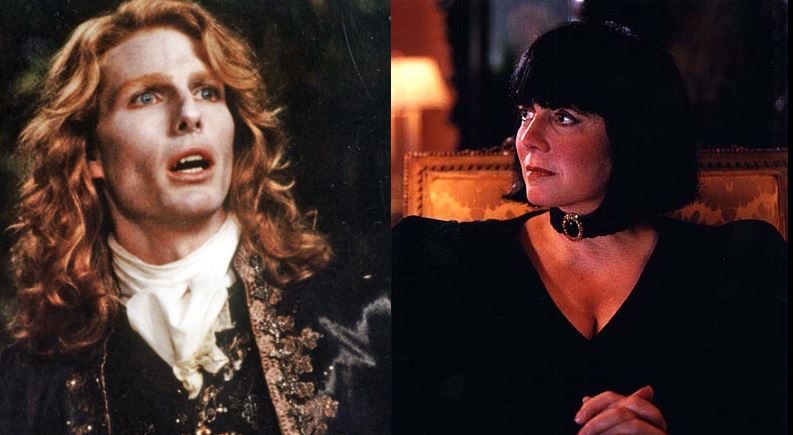
In her cycle of
vampire novels, Anne Rice uses the phrase
?the Dark ?Trick? to describe the transition
from life to vampirism. The circumstances
of the Dark Trick, when and how it happens,
as well as the nature of the victim
can have a great effect on the personality
of a vampire. Take a young, naive man,
raised in a sheltered household, who fell
prey to a vampire that was stalking the
region. The man knew nothing about the
vampire until it attacked and killed him.
Compare this case with a determined
vampire-hunter who was cut down by her
quarry in the heat of battle. When the
new vampires arise from their graves,
their views of the world will be totally
different.
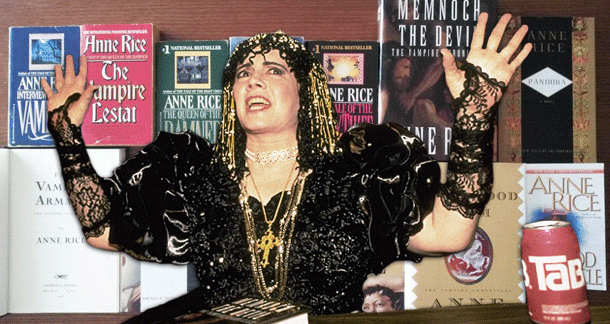
The naive man might at first be totally
unaware of his true nature. He might
come to the (seemingly reasonable) conclusion
that he actually never died but merely
was badly wounded and then buried prematurely
by his overzealous family. At
first, he wouldn?t understand why people
run when he tries to explain to them their
mistake, or he might decide that the
townsfolk have wrongly assumed that he?s
?risen from the dead? (how ludicrous!).
Evidence of his true nature would quickly
build up, however: the fact that he doesn?t
cast a shadow or appear in a mirror, the
fact that he feels an uncontrollable urge to
return to his coffin when sunrise is imminent,
and the steadily growing urge to
feed. When he finally realizes his fate, the
shock might drive him mad, turning him
into the ravening monster that is the
stereotypical vampire. Alternatively, he
might hang onto his sanity but believe that
since fate has decreed that he become a
monster, he has no option but to act the
way he thinks such a monster should act.
A third possibility?and maybe the most
interesting of the three?is that the poor
wretch is unable to fully renounce the life
he once had. A pathetic figure, the vampire
?haunts? his old home, watching from
the darkness and trying to pretend that
he?s still part of mortal life, if only as a
spectator. Such a vampire would feed
rarely and would never deliberately kill,
stopping before he?d drained all his victim
?s life levels. Using his charm abilities,
the vampire could easily make sure that
his victims don?t remember what happened
to them, thus sparing them the
emotional trauma they?d otherwise suffer
(and, incidentally, protecting the vampire
from detection). Pathetic or not, such a
creature would be likely to viciously attack
any vampire-hunters who came after him.
After all, the adventurers are taking away
even the semblance of his old life.
The intrepid vampire-hunter who rises
as an undead would certainly have a different
view of the world. Since she?s very
familiar with her one-time quarry, she?d
immediately realize what happened. Her
reaction would probably depend on her
motivation for becoming a vampire-hunter
in the first place. If she took up the career
as a moral duty, to rid the world of vicious
monsters, then the shock to her sanity
would be profound: suddenly she?s become
exactly what she?d once dedicated
herself to fight. She might easily go mad.
Alternatively, the new vampire might
make best efforts to destroy herself immediately.
Since only the strongest-willed of
vampires could overcome their ?instinctive
? revulsion to sunlight or running
water, the creature might take the easier
way out and enlist the (voluntary or involuntary)
aid of adventurers, as was previously
mentioned for liches. Or the vampire
might continue to dedicate herself to her
former life?s work. She might use her
powers as an undead to help her track
down and destroy others of her kind. (See
Tanith Lee's Kill the Dead for a portrait of
such an undead ghost-hunter.)
But what if the one-time adventurer
originally got into the vampire-bashing
business for other reasons: the money, for
example, or the adventure? The undead
character might decide that being a vampire
isn?t that bad after all, since she?s got
a much better chance now of reaching her
goals than she did when she was alive.
As with ghosts, the fact that vampires
are described as chaotic evil says more
about human perceptions than it does
about the creature?s true personality.
?Chaotic? simply means that these creatures
put their personal interests over
those of the masses?understandable,
considering that they?re immortal. And
since ?evil? is defined as ?holding life in
low regard,? a creature who must drain
life force to survive could be classed as
evil, despite its other behavior.
Vampirism is Fun: In most roleplaying
games, the main motivation for
creatures such as vampires is to simply kill
the living. Why is this the be-all and endall
of a vampire?s existence? Vampires are
exceptionally intelligent, which means
they?re capable of abstract thought.
They?re also immortal. When you?ve got
the whole of eternity spread out before
you, the simple pursuits of draining innocent
maidens and trashing adventuring
parties would eventually grow stale. Immortality
must be a pretty bleak picture if
all you?ve got to look forward to is your
next kill.
Assume that a character can make the
transition to vampirism without being
driven insane by moralistic shock and
without otherwise becoming the stereotypical
?exists to kill? vampire. What, then,
would be the character?s motivation? It
can be almost anything.
Vampires have powers far beyond the
capabilities of most mortals: exceptional
strength, the ability to charm with a
glance, superhuman combat abilities, the
power to change to gaseous form or polymorph
into a giant bat, etc. To the right
kind of personality, these powers would
be boons beyond price. The person would
relish his new-found powers, constantly
pushing their limits and ?living? an existence
of otherwise unattainable fun. (?Can I
spy on Lady Maretha?s mansion? Sure. Can
I move the ceremonial cannon from the
town square into the mayor?s office? Why
not??) Feeding is still a necessity, but he
would probably do it in the most humane
way possible, never killing his victim and
only rarely leaving any evidence behind.
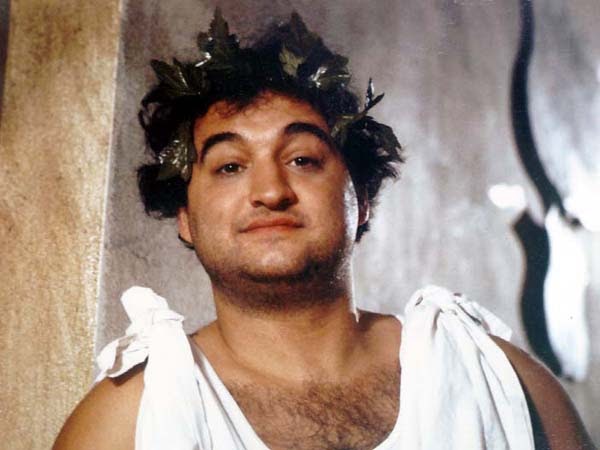
Fun-loving DMs could easily develop a
vampire who?d fit well into the movie
Animal House.
On a more serious note, a thief turned
into a vampire would find her supernatural
abilities tailor-made for her career.
Who needs grappling hooks when you can
spider climb, or needs lockpicks when you
can assume gaseous form? A thief-vampire
might cut a swath through the rich inhabitants
of a city, cleaning out their valuables
in daring raids that leave the constabulary
scratching their heads. The vampire?s den
would be full of opulent furniture and
fittings. (If the character couldn?t enjoy
luxury while alive, why not take advantage
of the opportunity afterward?)
A compelling figure from many historical
novels is the gentleman adventurer, the
person who?s as much at home in polite
society as he is outside it (often way outside
it). A vampire would make a perfect
gentleman adventurer. A somewhat aloof
manner and a very daunting reputation
would keep others distant enough that
they?d never learn the vampire?s true
nature, while the character?s habit of
dropping out of sight to go on adventures
would be a perfect cover for the vampire?s
?hunting trips.? (Presumably, such a vampire
would fast while within civilization,
and then gorge himself once away from
polite company.) Some of the vampire?s
acquaintances within the social milieu
might suspect or know the creature?s true
nature, but not take any action because
the vampire is such a ?jolly good chap.?
The gentleman adventurer vampire is
quite a different creature from the typical
monster described in the Monstrous Compendium.
That rampaging killer ?lives in
areas of death and desolation where they
will not be reminded of the lives they have
left behind.? The social vampire has come
to the conclusion that he doesn?t have to
forego all the pleasures of his life after all.
Social vampires soon learn ways to disguise
their true nature. They?ll avoid mirrors
and brightly lit areas (where their
lack of shadows might be noticed), and
they?ll devise plausible justifications for
their ?allergy? to garlic and their ?moral
offense? when they see openly displayed
holy symbols. As with liches, magically
capable vampires have eternity in which
to develop new spells. Thus a social vampire
might be warded with dweomers that
block powers that detect undead, and
perhaps even calm the fears of dogs and
other creatures.
Social vampires are well documented in
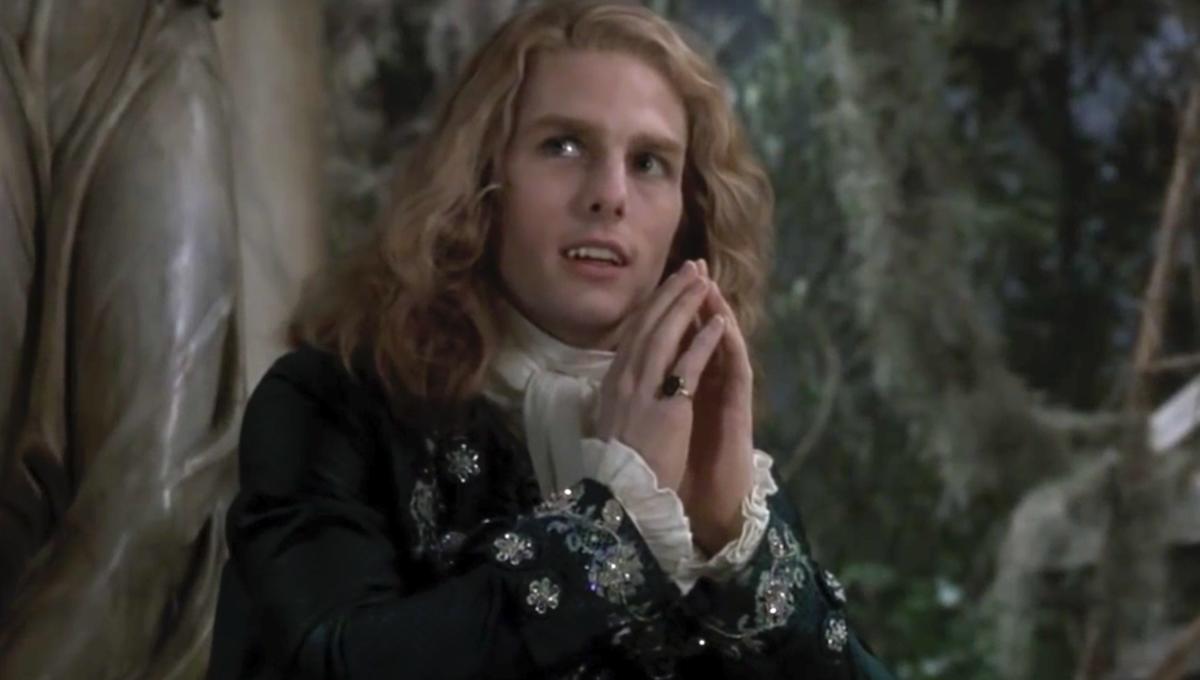
literature. One of Anne Rice?s vampire
characters was a participant in Parisian
aristocracy?s social whirl, while another
pursued a career as a rock star. Even the
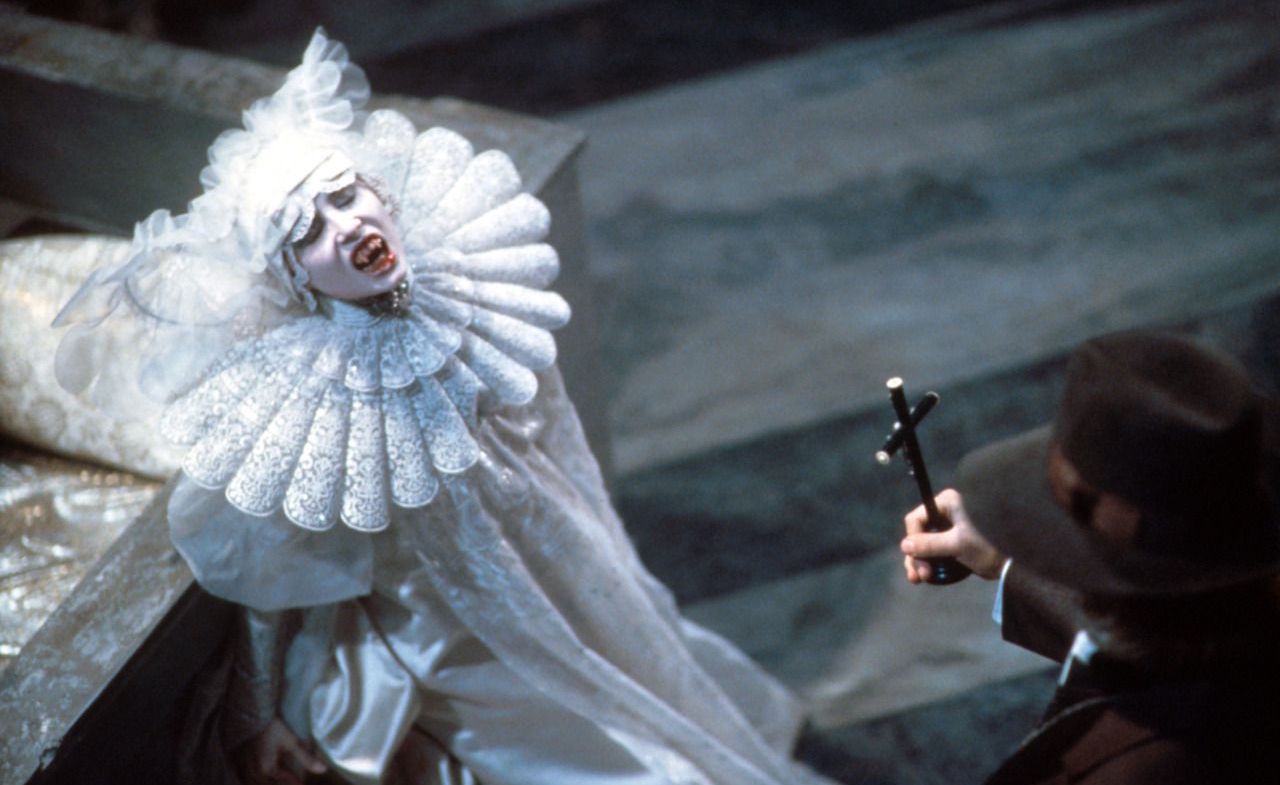
archetypal vampire, Count Dracula,
proved himself a charming and debonair
host when it suited his purposes. While
multidimensional characters like these
might exist in any given campaign world,
the majority of vampires will be the superficial
killers described in the Monstrous
Compendium. DMs should use just enough
?complex? vampires to make the PCs wonder
what they?re going to meet next.
Gifts of un-life: Why do vampires
?work the Dark Trick? and create other
vampires? The accepted theory, as stated
in the Monstrous Compendium, is that
vampires use chattel creatures as slaves
and, if necessary, cannon fodder. There
are other, more interesting possibilities,
however.
How about a vampire who used to be a
very social personality while alive and is
now suffering from his enforced withdrawal
from society? (In short, he?s devastatingly
lonely.) The idea of creating
another vampire?a creature like him,
someone he can share his thoughts and
fears with?might become too attractive to
resist. Unfortunately, since ?secondary?
vampires aren?t truly free-willed, the
lonely vampire wouldn?t find the companionship
he was seeking. In fact, he might
start to see the secondary vampire as a
horrible parody of the friend he sought:
nothing more than a mirror or echo chamber,
feeding back to him his own beliefs
and thoughts.
Another possible reason for creating a
vampire is to ?save? a loved one from
death. Imagine the feelings of a sensitive
vampire knowing that a relative or close
friend is dying. The vampire is immortal
and knows that he has the power to make
the dying person immortal as well. The
temptation to work the Dark Trick might
become almost irresistible. Of course, once
the deed was done, the master vampire
would find the same horrible situation: the
loved one, remembered as an independent
personality, would have lost all free will
and become a mindless slave of the master
vampire. (Both these motivations for creating
new vampires are worked through in
Ann Rice?s vampire cycle.)
The descriptions above assume that
secondary vampires aren?t free-willed
entities. This is implied in the Monstrous
Compendium entry, in the corrected version
published in DRAGON® issue #150,
but isn?t stated explicitly. The entry merely
says that ?the new undead is under the
complete control of its killer.? The question
remains: What form does this control
take? Is the new vampire merely a mindless
puppet? Is it controlled by some variation
of the master?s charm spell? Or does
the new vampire follow the master?s commands
simply because it believes, rightly
or wrongly, that the master is more powerful
than itself? The latter two theories
are the more interesting from a roleplaying
perspective, since they imply that
the secondary vampire might somehow be
able to escape the control of its creator.
The possibilities are interesting. For example,
a ?social? vampire has created a secondary
vampire. This secondary vampire
is slowly resisting the control of the master
and reverting to its true personality: a
ravening, heartless monster?the complete
opposite, philosophically speaking, of the
primary creature. (Again, Ann Rice explores
this concept in her novels.) Alternatively,
cunning PCs might be able to turn a
secondary vampire against its evil master.
Good vampires: Can a vampire be
good? Not according to the Monstrous
Compendium, which states that a vampire
is ?a thing of darkness that exists only to
bring about evil and chaos.? But if we
assume that these are ?typical? vampires,
and that atypical individuals exist, then the
answer might well be ?yes.? Theoretically,
a vampire isn?t restricted to feeding on the
life force of sentient creatures; it could
feed on unintelligent creatures as well.
Thus a vampire could ?live? without ever
having to kill a human or demihuman.
Imagine the case of a good-aligned human
who fell prey to a vampire. While the
first vampire existed, the new undead was
under its sway, forced to commit horrifying
and sickening acts. When the master
vampire was destroyed, however, the
secondary vampire became free-willed.
How would it react? The Monstrous Compendium
states that ?In most cases, vampires
do not lose the abilities and
knowledge which they had in life when
they become undead.? Thus the secondary
vampire might still remember his one-time
moral and ethical stance. Now that he?s
able to act freely, he might decide to use
his powers to set right, at least partially,
the damage that he and his master did.
This creature could become a secret benefactor
to a community: performing good
deeds late at night (e.g., using his great
strength to repair walls) and defending the
village from marauding monsters. The
townsfolk may never suspect the true
nature of their benefactor. Those few who
might have some suspicions would be
careful to keep them silent, in case someone
tries to destroy their benefactor. Since
vampires?particularly magic-capable
individuals?can often successfully ?pass?
for human, the vampire might even be
known to some of the townsfolk, perhaps
as ?that strange hermit who lives in the
cave.?
Eternity is a long time, however, and
vampires? attitudes would probably shift.
Eventually, they?d lose their kinship with
the living and consider the fates of mortals
as petty things, unworthy of their attention.
Thus, vampires too would eventually
swing toward a passively evil alignment.
Conclusion
It?s not necessary that every powerful
undead in your campaign world have
complex motivations. Sometimes motivation
should take a back seat to convenience.
Take Bram Stoker's Dracula, for
example. What was Count Dracula?s motivation?
Nothing consistent, that?s for sure.
The sole purpose of his actions seemed to
be to drive a good story. (Take, for example,
when he crawled like a lizard down
the outside of his castle, apparently just
for the fun of it, since he could turn into a
wolf, a bat, or a cloud of fog at will.) If the
story you?re telling as DM requires a
straightforward, kill-crazy ghost or vampire,
use one. What I?ve provided here are
just suggestions, ways to throw a little
further complexity at your players.
Many DMs won?t feel the urge to use
any of these suggestions. After all, undead
are conveniently simple villains. Players
and their PCs don?t have to feel any moral
qualms about destroying creatures that
are played as thoroughly, unquestionably,*
and unrepentently evil. Lots of DMs and
players like to have at least some monsters
where the instant response to sighting
them is?and should be ? ?Kill it!? It?s good
to have something with which you can get
into a knock-down, drag-out fight, and yet
not feel guilty afterward. For these reasons,
many players and DMs will always
enjoy beating on undead guys.
For those DMs and players who enjoy a
little more complexity?both moral and
tactical?in their role-playing, atypical
undead can be interesting and exciting.
They add a few more decisions to the
player characters? already confusing lives.
When PCs meet a ghost, should they attack
it or commiserate with it? When they
encounter a lich, should they destroy it or
exchange magical trivia?
It?s your choice. Happy role-playing!
OCTOBER 1990
LETTERS
. . . and Berkeley
Dear Dragon,
I really appreciate your printing the article
"The Mind of the Vampire" in the Halloween
issue (#162). I always had a sort of sympathy
for
vampires, probably because my friends always
talked me into being Dracula when we played
vampire when I was a kid. I just want to mention
that Anne Rice does not have the monopoly
on undead psychology. Sunglasses After Dark,
by Nancy Collins, is an amazing book in which
a
full range of demons, undead, and half-breeds
is
explored. If you could never imagine a ?social
vampire,? read this book.
Eleanor Kincaid
Berkeley CA
(Dragon #166)
When I was a kid, my friends always talked
me
into being either Godzilla or a Tyrannosaurus
rex
when we played. I love dinosaurs to this day,
and
it's rubbed off on my son. It's good to hear
from
someone else who has "a sort of sympathy"
for a
particular monster. I wonder what critters
other
readers have sympathies for. . . .