
| Languages | Ability Checks | Magic and Science | Search for the Forbidden Chamber | Lankhmar |
| Hints for D&D Judges: The Wilderness | - | The Gnome Cache | - | The Eldar |
| D&D | - | - | - | Dragon |
| <The Strategic Review | - | - | - | #2> |
Editor:
I have some comments on the first issue of The
Dragon. First, though, I want to recommend Stith
Thompson’s Motif Index of Folklore Literature to
any D & D referee who is
looking for new ideas. The
multi-volume book is rare, but invaluable if you can
find a copy in a large library. It lists virtually all
motifs appearing in the myths and legends of most
western countries, in great detail. It is well organized
into sections such as “Magic,” “The Gods,” and so
on. Just going through the volume on magic can give
a referee many ideas for magic items and episodes in
the wilderness, and there are other volumes nearly as
useful.
Sincerely,
Lewis Pulsipher
[edit]
Sirs,
In partial response to Mr. Pulsipher’s letter
October ‘76): I really cannot see what his problem
is. He himself acknowledges his debt to Stith
Thompson for many magical items and wilderness
episodes, so when he states that fiction is a total
waste of time, it leaves me wondering. Now I agree
with his statement that one could probably find better
material elsewhere, yet if The Dragon ceases
to
publish these stories, many new writers would be left
out in the cold. After reading his letter, I don’t think
that Mr. Pulsipher would object to that at all, but in
doing so, he is actually cutting his (and our, collective)
throat. Just how does he think that all this got
started? Yet allow me to regress for a moment in
order that I might elaborate on this point.
To begin with, Mr. Pulsipher seems to have forgotten
one of the fundamental rules of existence,
namely that you have to take the good with the bad.
Not all (perhaps none) of these writers are going to
be Malorys or Tolkiens, but one should still give
them a chance (at least tolerate their efforts) in the
hopes that they one day might achieve that higher
plateau of artistry. For these are the people that enable
the genre to survive, and I think that Mr. Pulsipher
should be thankful to them for enabling him
to stand upon that height of literary excellence from
whence he dispenses his wisdom. But how, you may
ask do they enable him to do so? Why, by being the
pile, of course. Perhaps Mr. Pulsipher has forgotten
just who he is standing on. But then, pure air always
was a little thin, and, as such, liable to go to one’s
head.
Sincerely,
Garth Wilcoxson
Ard-choille!
(The Dragon #5)
Hear! Hear! Ed.
* * * *
Dear Sirs,
Allow me to congratulate you on your new
magazine, as well as to order a copy of The Dragon
#1. Although not a D&D
player myself, I still find
many of the articles and rules most interesting.
However, I begin to wonder where it will all end. My
meaning is this: I fear you are going to become
bogged down in such a plethora of rules, sub-classes,
etc. that, if all are used, the game could easily become
practically unplayable. I wonder how many
players use more than a tithe of them now? Overcomplication
can be as bad as oversimplification.
I’m not saying it should be a game for the lowest
common denominator, but it’s not impossible to
foresee a loss of interest in it due to its becoming almost
incomprehensible. The most successful games
are those which do not require one eye on the game
and the other on a rule book. They’re also the most
enjoyable.
I must at this point disagree with the readers
who oppose fiction in The Dragon. Frankly,
I would
like to see much more. I was especially pleased to see
Gardner Fox writing for you. I find his
heroes to be
considerably more original than most of the “Conan”-
types most other authors offer us. I missed the
first installment of “Gnome Cache” but
the
author’s writing seems to be improving from the second
to the third. If he keeps up, he may be another
L. Sprague DeCamp (who Ernst’s writing seems to
be resembling more and more). It was also gratifying
to see you’re offering new writers a chance to submit
their works.
Yours truly,
Mike Lueders
[edit]
(The Dragon #5)
The purpose of THE DRAGON is to provide
a
forum for communication pertaining to fantasy
gaming. (By fantasy, I include S&S, SF and roleplaying
as well as boardgaming.) I certainly don’t
recommend that every DM adopt every item that I
publish. I just publish them so that discriminating
DM’s can pick and choose as they see fit, within the
confines and limitations of their campaigns.
The D&D
field is sharply polarized between
those who feel that every single contingency should
be anticipated (and rules already laid out) and those
that prefer to pick and choose the elements of their
campaigns, and wing it whenever new alternatives
present themselves. I try to satisfy both of these dissimilar
camps, as well as those in between the two
poles.
ED.
* * * *
| 1 | The Mind Flayer | Appendix A | - | - | - |
| 2 | Sage Advice | The Ranger | Medieval Pole Arms | - | - |
| 3 | Creature Features | Monster Reference Table, Additions* | The Unicorn Song | Deserted Cities of Mars | - |
| 4 | Medieval Pole Arms | The Illusionist | Clay Golem | Ioun Stones | - |
| 5 | D&D / WW2 Crossover | Mighty Magic Miscellany | Creature Features | - | - |
| 6 | Alignment | The Bard | Instruments of the Bards | Greyhawk Errata | - |
| 7 | The D&D Magic System | Hints for D&D Judges: Towns | Mighty Magic Miscellany** | Creature Features** | D&D is only as good as the DM |

The Hatchling Magazine
A look at The Strategic Review -- DRAGON Magazine's ancestor
by A.D. Young
Gaming sparks many avenues of
interest in addition to actual play. One of
these avenues is collecting gaming magazines.
It is interesting to note the way in
which such magazines develop, often from
very humble beginnings. Some fall by the
wayside, of course, while others grow to
sizes and influences undreamed of by
their founders. There are perhaps
4,000,000 D&D® and AD&D® game players
worldwide today, yet only 15 years ago
there were almost none at all. It was a
time when DRAGON® Magazine had not
even been thought of, even in its earlier
form, The Dragon.
Prior to 1973, there was a Castle &
Crusade Society, whose founding member
was one E. Gary Gygax. The C&C Society
was formed by the Lake Geneva Tactical
Studies Association, which prepared the
final version of a set of fantasy miniatures.
rules called CHAINMAIL. These rules
evoked much excitement and interest,
with several groups adopting them. Dave
Arneson began a medieval fantasy campaign
surrounding his Blackmoor setting,
which greatly expanded upon the existing
rules. Gary Gygax soon heard of this, and
the two collaborated on a new set of fantasy
rules. Tactical Studies Rules was formed
in October 1973 and published the original
D&D game in early 1974.
And as for magazines?in the beginning,
there was TSR ? no, not Tactical Studies
Rules, the publishers. TSR referred to The
Strategic Review, the soon-to-be, first-ever
fantasy role-playing game magazine (often
referred to as SR in the issues). Not that it
called itself that at the time; the world was
too young in those days for such ideas.
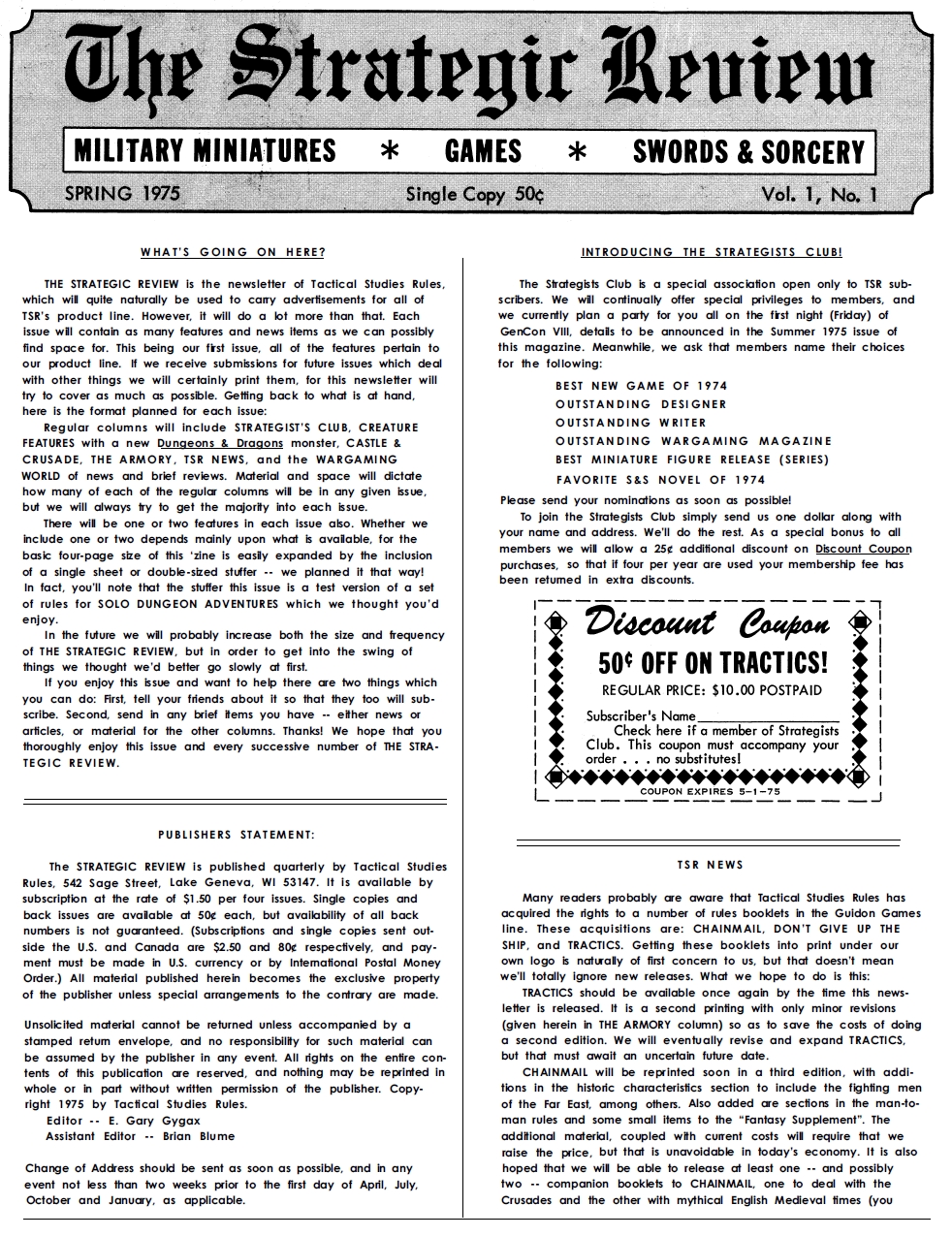
The Strategic Review billed itself as ?the
newsletter of Tactical Studies Rules, which
will quite naturally be used to carry advertisements
for all of TSR?s product line.? It
made its appearance in Spring 1975 and
cost $0.50
The Strategic Review #1
That 1st issue consists of just 6 pages,
a double quarto folded lengthwise as front
and back cover, with a single-sheet insert.
The issue is properly typeset and printed
in dark green ink on light-weight white
paper. The title is set in a shaded box and
printed in Old English characters. Below
that appears: * MILITARY MINIATURES *
GAMES * SWORDS & SORCERY.? There is
no mention of the D&D game. In fact, the
DUNGEONS & DRAGONS® game is listed
only once on the title page, with far more
space being given to the CHAINMAIL and
TRACTICS games (the latter a World War
II miniatures rules system).
There is no table of contents (let?s face it,
there are hardly any contents). Instead, a
list of intended regular columns is given,
including: ?Strategist?s Club,? ?Creature
Features? (with a new D&D monster per
column), ?Castle & Crusade,? ?The Armory,
? ?TSR News,? and the ?Wargaming
World? of news and brief reviews. The
editorial (?What?s Going on Here??) continues
with some comments concerning
expansion and concludes with: ?tell your
friends about it so that they too will subscribe.
? Evidently, they told.
The Strategic Review was to be published
quarterly by TSR for $1.50 per four
issues. E. Gary Gygax was the editor, and
Brian Blume was assistant editor. The
Strategists Club was a special association
open only to TSR subscribers. The club
offered special discounts, the first being a
coupon printed on the front page. Thus,
for a $0.50 discount on a set of TRACTICS,
subscribers had the opportunity to cut a
large hole in this historic issue. Fortunately,
I resisted the temptation, but I
sometimes wonder how those who did not
may feel today.
Page 2 gives us the first ?Creature
Feature??the mind flayer, with its major
weapon, the mind blast. ?Wargaming
World? tells us of things that are no more,
but mentions that SPI had begun competing
with The Avalon Hill Game Company
(simply called Avalon Hill then, and TAHGC
herein) in the store market, and TAHGC
had retaliated with direct-mail games.
(Who won that competition?) ?The Armory
? supplies a TRACTICS amendment for
armor penetration, with nary a broad
sword in sight. The last item on the page is
for postal D&D gaming, which only goes
to prove that PBM gaming was in there at
the beginning.
On page 3, Gary Gygax discusses "The
Spear in Man-to-Man Combat" in the "Castle
& Crusade" column?an addition to the
CHAINMAIL rules. And here at last is the
first special D&D feature
article, "Solo
Dungeon Adventures," again by, Gygax.
Extending over pages 4 and 5, this article
consists of a set of rules for solo dungeon
exploration in the form of tables for periodic
dungeon-construction checks, doors,
side passages, turns, and so forth, later
appearing as Appendix A in the AD&D
1st
Edition Dungeon Masters Guide. This is all
fairly basic stuff, which was curiously
neglected in the D&D game for a long time
afterward. It was left to Flying Buffalo's
TUNNELS AND TROLLS game to establish
rules for running solo RFPG scenarios:
Only recently did TSR take up solo adventures
again, particularly in the ENDLESS QUEST
books and related book lines.
In the bottom right corner of page 5 is a
small, crudely drawn, and unsigned illustration
of three knights standing on pedestals
in what might be an armory. This is
the sum total of artwork for the first issue.
Page 6 gives a list of possible subjects with
which The Strategic Review might deal in
future issues, given sufficient reader interest.
The subject list (and mispellings)
appears at right.
This list tells us one thing with
stark clarity: TSR hadn?t the
faintest idea what it had in its
hands. It did not envision
what the D&D game would
become and was prepared to
go in any direction the market
seemed to want. It had
started a newsletter, but of
DRAGON Magazine there
was not an inkling.
Topics of interest to readers, from issue #1
NOW (or soon) Covered by SR:
Ancient Period
Medievla Period
English Civil War
Napoleonic Wars
American West
WWII/Modern
Space Exploration/Warfare
Fantasy/Swords & Sorcery
Other Periods/Wars:
30-Years War
7-Years War
Revolutionary War
American Civil War
Franco-Prussian War
Colonial Wars
W W I
From the above lists we can do the following kinds of articles:
Rules Additions
Rules Varients <sp>
Battle Reports
Campaign Set-Ups
Organizations
Weapons & Uniform Data
Play-Test Rules
DIPLOMACY Varients <sp>
Design Explanations
Design Justifications
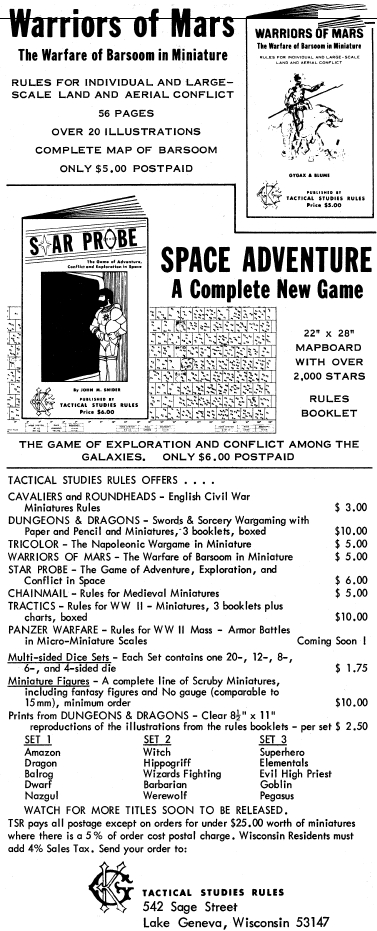
Fourteen years
ago, TSR's game catalog
could fit in one column.
(The address and
prices are out of date, and
only the DUNGEONS &
DRAGONS game survived.)
The Strategic Review #2
This issue was published in Summer
1975 and has the same format as the firs
This time, black ink was used and there
are eight pages (two folded quarto) gummed
at the spine. The editorial, ?TSR?
Why We Do What We Do,? by Brian Blume
makes interesting reading: ?The member
of TSR are long-time gamers who have
found that there is a great deal of satisfaction
in creating and/or publishing a good
set of game rules or an enjoyable game,
and please note the emphasis on the term
gamers . . . In a nutshell, we do not believe
that we can ever work too closely with
our fellow war-gamers.?
The issue contains: "CAVALIERS AND
ROUNDHEADS Rules Additions," "Wargaming
World," |" Questions Most Frequently
Asked About DUNGEONS & DRAGONS
Rules" (the 1st "Sage Advice" column),
"Creature Feature" (revealing the roper),
"Rangers! An Exciting New DUNGEONS &
DRAGONS Class" by Joe Fischer, "Medieval
Pole Arms" by Gary Gygax, "Panzer Warfare"
by Brian Blume, and "TSR News."
There was an advertisement for ORIGINS I
in Baltimore and another for "GEN CON
VIII" in Lake Geneva. We were also invited
to cut a hole in the back page for a $0.25
discoun ton games this time.
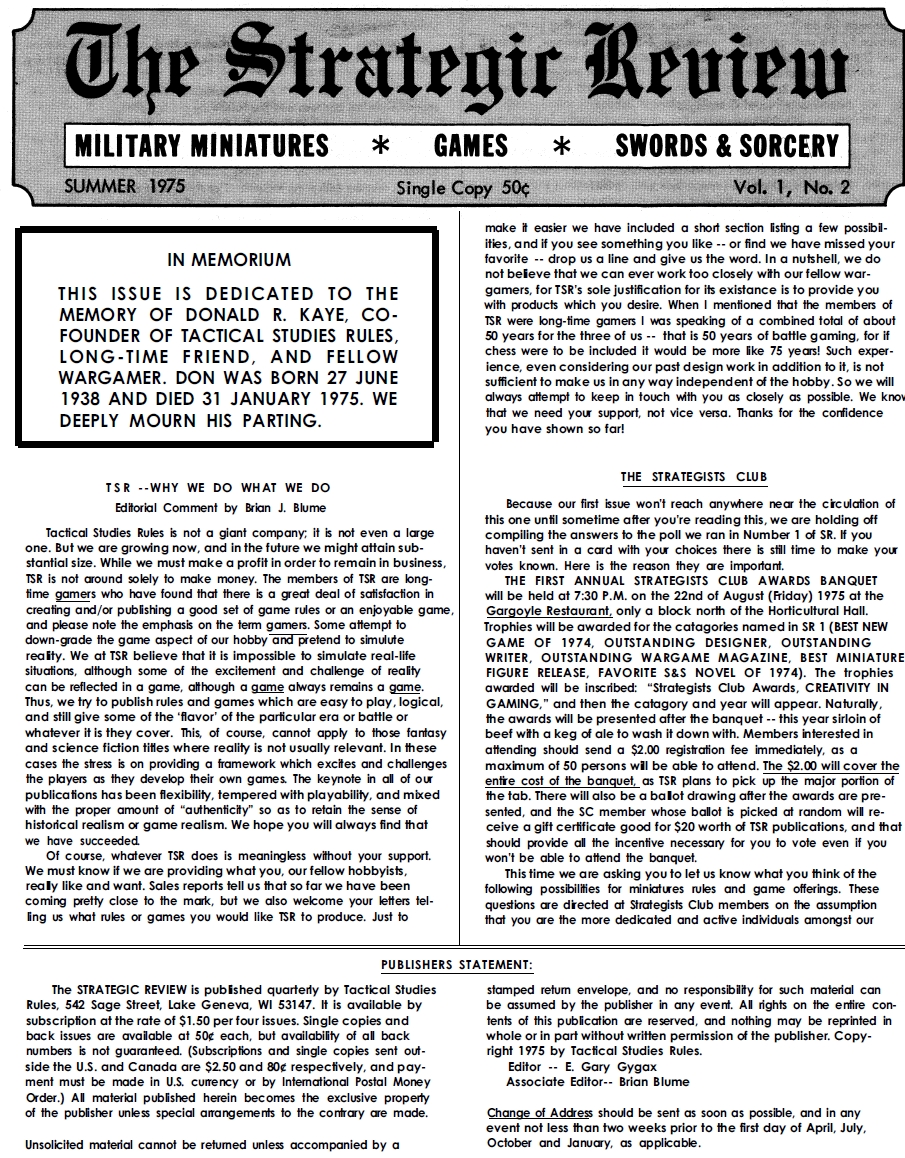
Above: The passing of Donald Kaye, a co-founder of TSR, is nooted
on the cover of issue #2.
The Strategic Review #3
This issue was published in Autumn
1975. Although similar in format to its
predecessors, issue #3 is printed on glossy
paper, in black ink, and runs to 8 stapled
pages. The editorial by Gary Gygax
waves indignant over some bad reviews
for CHAINMAIL and the D&D game by
Arnold Hendrick, who has offered a competing
rules set. "TSR News" announces
the formation of a new division, TSR Hobbies
(which sells miniatures), and proposes
yet another, TSR Games (which introduce
games). "Creature Features" and the
humorous "Monster Reference Table Addition,
Hostile & Benign Creatures" take up
most of pages 2 and 3, but the remainder
of the issue is given over to Napoleonics,
gunfighters (for the BOOT HILL game),
SF ("Deserted Cities of Mars,") by Jim
Ward), news, and advertisements. In "Mapping
the Dungeon," Dave Arneson
describes an encounter between "The
Great Svenny, Marty the Elf, Richard the
Hairy, and 5 berserkers against 26 soldiers
with 2 cars, 2 trucks, 4 light mg's, 2
motars [sic] (60 mm) and the usual bevy of
small arms." (The Nazis lost!) There is also
a list of D&D game GMs and clubs--8
of them, in fact.
FROM THE RIVENSTAR SONGBOOK
THE UNICORN SONG
by Moonwulf of Rivenstar*
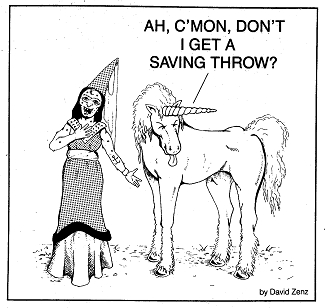
Well, you know I once had a unicorn for a friend,
One time, a long time ago.
His horn was of twisted gold, pointed on the end,
And his coat was of silver-white snow.
Sometimes he’d let me climb up on his back,
And we’d ride through the mountains all day;
He told me the secrets that unicorns know,
And I missed him when he went away.
I once knew a dragon, a cousin of Puff,
All yellow and bright golden-red.
He looked ferocious, but he never breathed fire,
He just blew big smoke rings instead.
Sometimes he’d let me climb up on his back,
And we’d fly through the mountains all day;
He told me the secrets that all dragons know,
And I missed him when he went away.
And now I’ve got a manticore for a friend,
And he sure is ugly to see.
He’s nasty and vicious, and he’ll eat anything,
And he’s standing right behind — (GOBBLE, SLURP, CRUNCH, CRUNCH!)
(*also know as Michael Longcor)
The Strategic Review #4
Published in Winter 1975, the color of
this issue is blue, with 12 pages and the
format much the same as before; the
price, however, is now $0.75. In this issue,
there are a few matters of note. Gygax
tells us in the editorial that TSR is expanding
so fast that neither he nor Brian Blume
can keep up with correspondence. They
have received so much excellent D&D
game material from readers that it cannot
all be published in The Strategic Review,
even now that it is going bimonthly. More
hands are called for. Timothy Kask has
joined as periodicals editor, Terry Kuntz as
service manager, and Dave Arneson is
about to join the regular design staff.
Inside, there is: ?Castle & Crusade? (?A
Few More Words On Medieval Pole Arms,?
by Gygax); ?Panzer Warfare: Additional
Unit Organizations,? by Brian Blume; an
advertisement for DUNGEON! (the board
game); ?The Armory? (?TRACTICS
Weapon/Vehicle Gun Changes? by Mike
Reese); ?Illusionists!? a new D&D game
character class by Peter Aronson; ?Tsolyani
Names Without Tears? (Professor M.
A. R. Barker?s explanation of the Tsolyani
language used in the EMPIRE OF THE
PETAL THRONE game, then published by
TSR); ?Creature Features? (the clay, golem);
and ?Mighty Magic Miscellany? (presenting
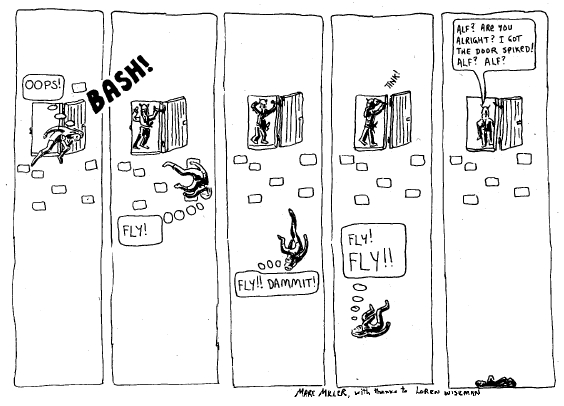
ioun stones). A cartoon by Marc Miller and
Loren Wiseman, now of Game Designers?
Workshop, appears on page 5, with the
first ad for a non-TSR game, GDW?s EN
GARDE!, on page 10. FRPG topics are
noticeably dominant in this issue, now
occupying the majority of the games
space. And there is one other announcement,
repeated through the issue: ?THE
DRAGON IS COMING!?
The Strategic Review #5
It is not the purpose of this article to
discuss precisely which publication constitutes
the first FRPG magazine. The Strategic
Review (issues #1-4) could be described
as that, but it is not. The Strategic Review,
in fact, mentions two other publications as
?D&D oriented magazines? in The Strategic
Review #4: Alarums & Excursions and
Kranor-Rill. In The Strategic Review #6,
Alarums & Excursions is even awarded a
Major Triumph and described as ?far and
away the best D&D ?zine.?
Later advertising for The Strategic
Review describes the periodical as ?The
Journal of Military Miniatures, Swords &
Sorcery, Games and Wargaming News
featuring the TSR line,? which falls somewhere
between the original newsletter
concept and the FRPG magazine it rapidly
became. In addition, there were various
other newsletters, newszines, and proposals
offering similar coverage around
the same time. Nevertheless, they all drew
their FRPG inspiration from, The Strategic
Review, so there is no question of the
original source. The very terms ?FRP? and
?adventure gaming? were not in general
use (if at all) until the appearance of this
magazine. The first example of an evolving
concept is often difficult to pin down, but
in this case, the event is clearly defined.
The Dragon may have been coming, but
with The Strategic Review #5, the FRP
magazine had already arrived; of that,
there is no doubt. Published in December
1975, The Strategic Review #5 has an
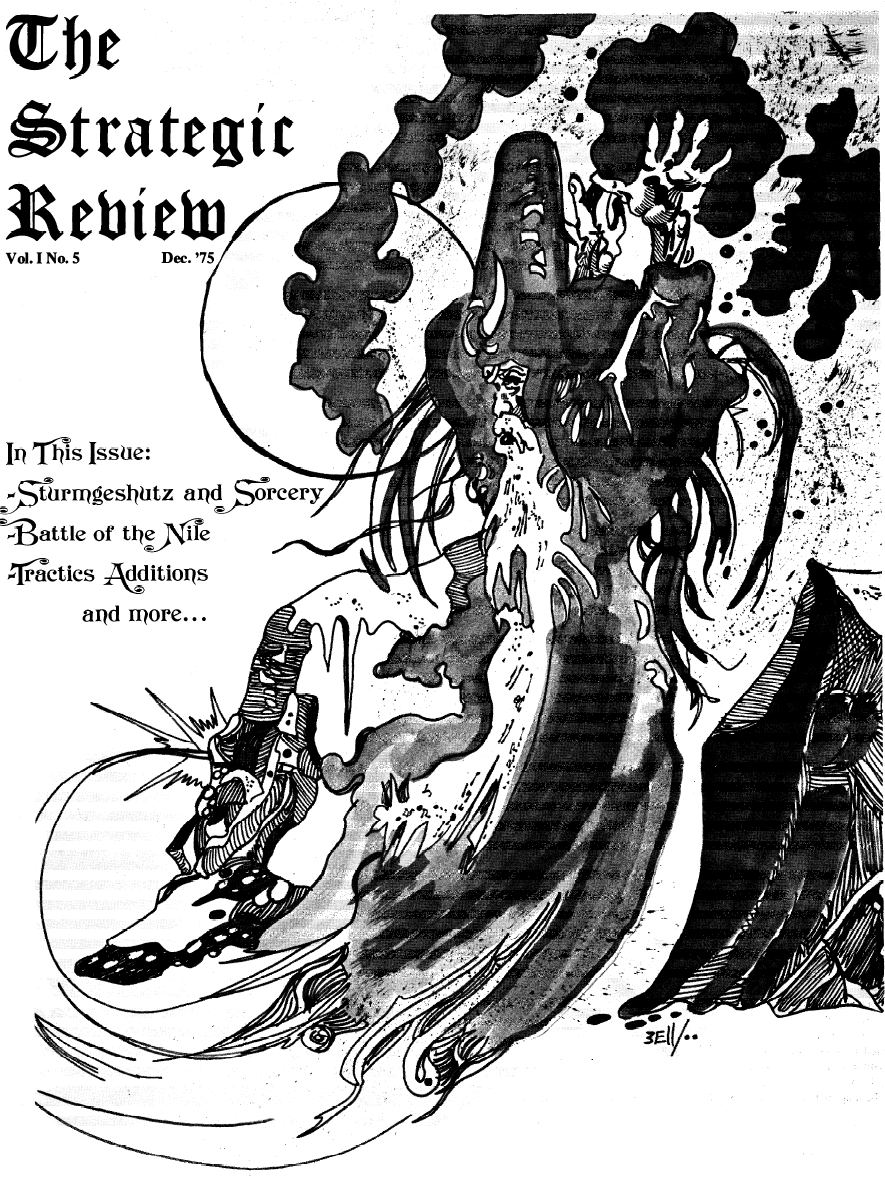
entirely new look. Gone is the old title
block and three-quarters-text page. In the
newest issue, we have a wizard conjuring
the elements in a full-page, black-andwhite
cover art by Greg Bell. The title is
moved to one side, and the only other text
announces three items ?In This Issue.?
Issue #5 has artwork on most of its 16
pages as well.
The magazine?s changes, however, are
not purely cosmetic. The Strategic Review
is now bimonthly. Inside, we have ?In the
Cauldron? written by the editor, Tim Kask,
as a replacement for ?TSR News.? There
are short autobiographical profiles of
Gygax, Blume, Robert Kuntz, Theron
Kuntz, and Kask. The remainder of the
issue is taken up by solid FRPG material,
except for Dave Arneson?s ?The Battle of
the Nile Refought? and a page of TRACTICS
additions in ?The Armory.? There is
the ?Gallery of Gunfighters, Part III, about
gunslinger Ben Thompson, and Gygax?s
?Sturmgeshutz and Sorcery, or, How Effective
is a Panzerfaust Against a Troll,
Heinz?? In this latter piece, Gygax offers
suggestions for combining the D&D game
with TRACTICS (?At this moment the orcs
broke cover, hoping to continue their luck;
after all they had not yet been fired upon.
Six automatic weapons opened up and cut
the lot to bits.?) Other materials include
?Creature Features? (the rakshasa, the
slithering tracker, and the trapper) and
?Mighty Magic Miscellany? (the robe of
scintillating color and prayer beads).
Reader-generated material on the D&D
game was still pouring in, and the DM list
had grown to 20.
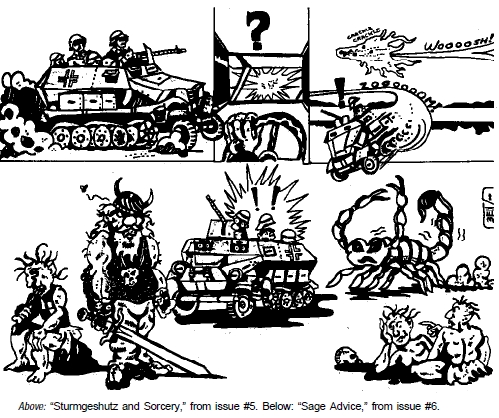
There are two items that make particularly
interesting reading in the light of
later developments. The first is Gygax?s
article, "Sturmgeshutz and Sorcery." It
opens with these words: ?D&D is a game
of many facets, and occasionally we cook
up a few little surprises. . . . How could we
mix moderns with swords & sorcery? The
structure of D&D is such that it easily
lends itself to such adaptation.? Contrast
this with the call for orthodoxy and the
use of only ?authorized material? in
DRAGON issue #67, "Poker, Chess,
and the
AD&D System: The Official
Word on
What's Official" by the same author:
The second item is entitled ?What is the
National Wargame Convention?? This
article compares (from TSR?s point of
view) ORIGINS I and ?GenCon? (now the
GEN CON® Game Fair). It also provides a
brief history of the latter from its inception
as a one-day-affair in 1968. The item
takes umbrage at TAHGC?s ?misleading
claim? that ORIGINS was the sole national
convention, and figures are produced to
prove that GenCon VIII was bigger and
better in every way. The article concludes
with the following words: ?We support
Origins, and when the second convention
is held we will be in Baltimore ready to
play! Yet we will allow no other event to
steal GenCon?s glory.? Ah, how things did
change. . . .
With the birth of the true FRPG magazine,
it is clear that the D&D game is
beginning to take off. The mailer that
came with the issue offered a lifetime
subscription to The Strategic Review (by
Crom, now there was a bargain). There is
another call to the readership for guidance
on which direction to take, but that direction
is now only perceived in terms of the
D&D game.
The Strategic Review #6
Though TSR's direction was centered on
the D&D game, other influences
lingered.
Issue #6 was published in February 1976,
and sports a group of World War I triplanes
on the cover, presumably in honor
of the FIGHT IN THE SKIES game, which
had been added to the TSR line. The issue
is printed entirely in purple ink. Its
contents
are very interesting in a number of
respects. We are told in ?In the Cauldron?
that TSR is moving into its new shop, The
Dungeon. We are also informed that Dave
Arneson has joined the team at Lake Geneva
as a full-time employee. ?Wargaming
World? repeats the offer from issue #5 of
D&D Volumes 1 and 2 with pullouts and
box?for $4! And, it seems that there was
an abysmal response to the suggestion of
D&D game seminars (by Gygax, Arneson,
and Rob Kuntz) at the upcoming GenCon
(?If we are to decide by the response we
have had by now, there won?t be one.?).
Gygax gives his first exposition on ?The
Meaning of Law and Chaos in DUNGEONS
& DRAGONS and Their Relationships to
Good and Evil,? a subject long puzzling to
the devoted. ?Triumphs & Tragedies?
awarded a Triumph to a new gaming
magazine called The Space Gamer. Next
comes fiction by Rob Kuntz, ?The Quest
for the Vermillion Volume,? which presumably
accounts for the issue?s ink color.
Changes to Professor Barker?s WAR OF
WIZARDS game are proposed, and a solitaire
gaming version is provided. ?Statistics
Regarding Classes: (Additions)?BARDS,? by
Doug Schwegman, adds a new PC class.
?Mighty Magic Miscellany? deals with
bards? harps by the same author. There is
a BOOT HILL experimental rule by Blume,
and ?Dwarves and Clerics in DUNGEON!?
by Gygax. Dennis O?Leary expounds upon
the ANCIENT CONQUEST game in ?New
Game, New Strategy,? and some corrections
to the D&D booklet Greyhawk are
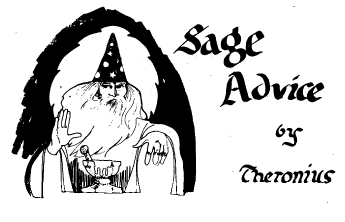
offered in a new column called ?Sage
Advice,? by one Theronius. ?Mapping and
Dungeons? lists all known DMs and D&D
game clubs; there are now 52 of them.
Apart from a page on the FIGHT IN THE
SKIES game, the entire 16 pages are concerned
with FRPGs?and, as a note on
page 7 reminds us, The Dragon still
approaches!
The Strategic Review #7
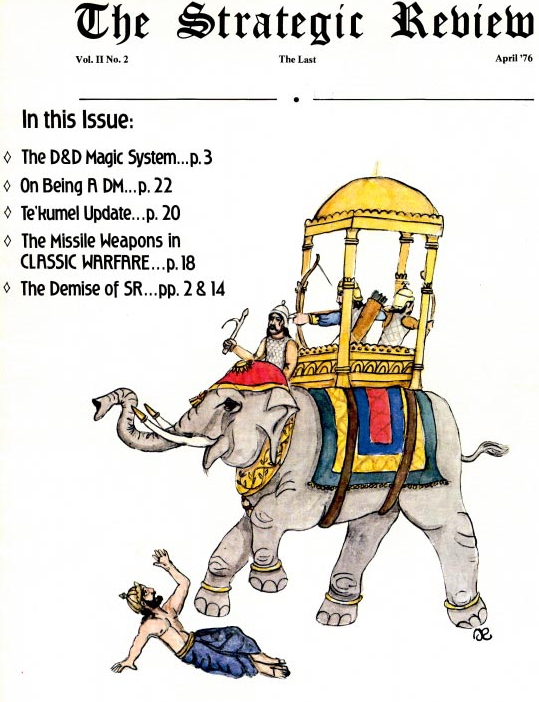
"The Last? (as it is subtitled) issue of The
Strategic Review was published in April
1976. It is priced at $1 and has a full-color
cover of a rampant elephant about to
stomp some poor soldier. Illustrations
abound inside among the 24 pages, and
although it is announced that The Dragon
has arrived (with the next issue), it was
very close to being there already.
?In The Cauldron? tells us that ?For some
time now, we have felt that our title was
somewhat misleading, particularly so since
we have drifted deeper and deeper into
fantasy and science fiction, not to mention
swords & sorcery.? So the upshot was that
yet another division of TSR Hobbies, Inc.
was formed: TSR Periodicals. This new
division would produce two magazines:
?one devoted to S&S, Fantasy, Sci-Fi and
roleplaying games, and the other to deal
with the established types and periods of
wargaming.? Is this the first use of the
term ?roleplaying games?? It seems
unlikely, but it is the first usage in The
Strategic Review. Thus were born The
Dragon and Little Wars. They were eventually
to amalgamate with issue #22 (February
1979) of The Dragon?but that is
another story.
The editorial takes up the question of
ORIGINS vs. GenCon. The comments in
issue #5 have ?stirred up a veritable hornet
?s nest,? that make fascinating reading
from today?s vantage point. Don Greenwood
from TAHGC is quoted extensively as
putting forward the proposition that no
convention can claim to be national unless
TAHGC and SPI are there. TSR takes
exception to this and is greatly put out by
the suggestion that GenCon is merely
regional. There is a good deal of storm and
fury that goes on for half a page, the gist
of which is that the battle lines are drawn.
Indeed, the new letters column, ?Out On a
Limb,? features not one but two letters by
E. Gary Gygax himself, one on the very
same subject.
The first article is ?The DUNGEONS &
DRAGONS Magic System,? by Gygax, in
which he expounds upon the ?Vancian?
magic system (after Jack Vance) as used in
the D&D game. The BOOT HILL game is
represented with ?The Fastest Guns That
Never Lived,? by Blume, Gygax, and Kask.
?What Price Gold & Glory?? by Jim Hayes,
is the issue?s fiction piece. The first ?Hints
for D&D Judges,? by Joe Fischer, appears
in this issue, along with ?Ancient and
Medieval Standard Military Symbols,? by
Gygax. In addition, ?The Missile Weapon in
Classic Warfare? (by Gygax), ?To the Everlasting
Glory of the Petal Throne (more
EMPIRE OF THE PETAL THRONE material
by Professor Barker), and ?D&D is Only as
Good as the DM? (by Gygax) help round
out the issue. This last article is aimed at
Monty Haul DMs. Herein, Gygax states
that ?BLACKMOOR is the only campaign
with a life of five years, and GREYHAWK
[has] a life of four. . . . To my certain
knowledge no player in either BLACKMOOR
or GREYHAWK has risen above
14th level.?

"Creature Features" presents the Denebian slime devil and the catoblepas,
and
"Mighty Magic Miscellany" provides the
cup and talisman of Akbar, the staff of the priest kings,
and the brazen bottle.
Another interesting feature is the double-page
center spread advertising the opening
of The Dungeon, TSR's hobby shop.
There are 5 photos of the shop interior,
3 of which show Gygax, Blume, and
Terry Kuntz hard at work on our behalf.
The last words belong to E. Gary Gygax
(?Out On A Limb,? February 14,1976):
?The STRATEGIC REVIEW was originally
conceived as a magazine, dealing with all
sorts of wargame subjects, but popular
demand has made it into an almost wholly
fantasy-oriented publication (and the name
is thus quite appropriate!). . . . Therefore,
we are changing the name of the SR to
THE DRAGON, a name more indicative of
its content; and there will continue to be
more and better articles therein, all of
primarily fantasy-oriented nature,
although some sci fi or other
type of wargaming may slip in occasionally.
Your eager subscription to our publication
has give us the message loud and
clear. You want a 'zine dealing with fantasy
wargaming, and that is what you shall
have."
[Some of the most entertaining articles
from The Strategic Review are reprinted
in the Best of DRAGON Magazine anthology,
volume 1]