The Dragon’s Bestiary
Never forget, never forgive: the wang-liang
by Sylvia Li
| - | - | - | - | - |
| Advanced Dungeons & Dragons | - | Dragon magazine | - | Dragon #151 |
Wang-Liang
FREQUENCY: Very rare
NO. APPEARING: 1 (see text)
ARMOR CLASS: 4 (improved by armor)
MOVE: 12”
HIT DICE: 6 + 3 to 8 + 3 (see Table 1)
% IN LAIR: 10% (see above)
TREASURE TYPE: Variable
NO. OF ATTACKS: 2 claws
DAMAGE/ATTACK: 1-10/1-10
SPECIAL ATTACKS: Magical devices
SPECIAL DEFENSES: Regeneration, detect
invisibility, psionic invisibility, limited
spell immunity, polymorph self, magical
devices
MAGIC RESISTANCE: Standard
INTELLIGENCE: Exceptional to genius
ALIGNMENT: Lawful evil
SIZE: L (10’)
PSIONIC ABILITY: See text
The wang-liang are closely related to the
ogre magi,
being exceptionally intelligent
and long-lived, with their own unique
brand of magic. They are implacably hostile
to human beings and rarely pass up a
chance to kill, injure, humiliate, or
frighten them. Toward humans, their
behavior is destructive; among their own
kind, there are no known instances of
cruelty to each other. The wang-liang pay
their debts and keep their promises. Other
nonhuman races are treated as humans if
they are accompanied by humans. If nonhumans
are encountered without humans,
the wang-liang do not initiate hostilities.
There is good reason for their hatred of
humans. Wang-liang have a long lifespan?
about 2,000 years?but with a corresponding
low birthrate. They are intelligent
enough to extrapolate the human ability
to
multiply and the human disregard for
long-term consequences, and so have long
been able to predict their own extinction.
They are not charitable enough to forgive
humanity and go quietly. They are bitter.
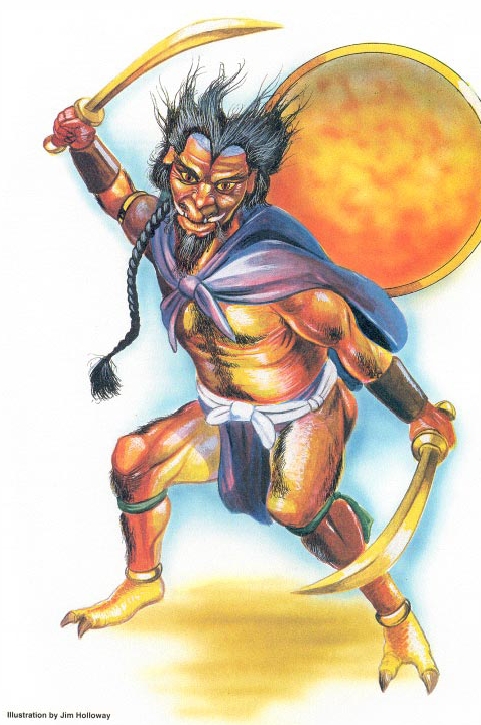
Physically, they are tall (10?), carnivorous
beings with soft pelts of lustrous dark
brown or black hair. Their eyes are wide
and large, having black irises rimmed with
luminous, fiery red. They have the sharp,
pointed teeth of a carnivore (doing 1d4
hp
damage if needed), but biting is not their
natural attack form. The teeth are set
in a
protruding and delicate muzzle.
Wang-liang are very strong (each with
18-percentile strength) and have good
natural armor class and weaponry. The
retractable claws don?t cut like swords;
instead, they operate with a scooping
action that tears off chunks of flesh.
Their home territory is among forested
mountains, but single individuals may be
found anywhere?on a country road, in
towns and cities, even ranging as far as
the lands of the gajin.
Wang-liang are not savages. They have
their own civilization. They wear clothes
or, if going into battle, various kinds
of
armor that modify their armor classes as
appropriate. They can use the full range
of swords, spears, bows, and pole arms
available to human bushi but in a larger
size. They do not use iron or steel, but
they have a method of hardening bronze
to make it nearly as hard as low-grade
iron. Despite the larger weapon sizes,
the
quality of the metal limits damage to
standard by weapon type, with strength
bonuses. Weapons and armor used by
these creatures should be determined by
the DM as desired.
There is no difference in strength or
fighting ability between adult males and
females, but individuals encountered may
range from 6 + 3 HD to 8 + 3 HD depending
on fighting experience (use Table 1).
Wang-liang do not have classes and do not
advance in levels with experience but gain
hit dice instead.
Wang-liang know the human passion for
gold, silver, and gems, but they do not
share that passion. In fact, they find
greed
to be repulsive. They are, however, quite
willing to use this human weakness as a
tool for manipulation, and for that reason
they sometimes carry gems or other items
that would be valued by humans. Amounts
carried should be determined by the DM.
Like their better-known relatives the
ogre magi, wang-liang are not considered
?persons? for the technical purposes of
such spells as charm person or hold person.
Their innate abilities are similar to
those of the ogre magi, though not quite
as
powerful. They can regenerate wounds at
the rate of 1 hp per round while conscious;
they can polymorph into any
human or humanlike form (4-12? tall); they
can easily see creatures and things rendered
invisible either magically or psionically;
and they can become psionically
invisible at will to certain total numbers
of
Like their better-known relatives the
ogre magi, wang-liang are not considered
?persons? for the technical purposes of
such spells as charm person or hold person.
Their innate abilities are similar to
those of the ogre magi, though not quite
as
powerful. They can regenerate wounds at
the rate of 1 hp per round while conscious;
they can polymorph into any
human or humanlike form (4-12? tall); they
can easily see creatures and things rendered
invisible either magically or psionically;
and they can become psionically
invisible at will to certain total numbers
of
hit dice of creatures (see Table 2). These
abilities do not require concentration
to
begin or to maintain. The wang-liang also
have a limited telepathic ability that
functions
only between members of their own
race. This has a range of about 33 miles
outdoors but is blocked by stone walls.
This telepathy requires concentration.
In addition, they nearly always carry
various magical items of their own. These
are of two sorts: items bestowing useful
magical abilities for the wang-liang?s
own
use, and cursed magical items for ?trade?
with humans.
One useful magical item common among
wang-liang is a straw hat that bestows
magical invisibility, just like the ring
in the
DMG. (This lets them combine the effects
of magical and psionic invisibility to
become
extremely hard to detect.) There
may also be some fairly powerful offensive
magical items, some of unique design. Any
item of useful wang-liang magic is subject
to one serious inconvenience: The wanghang
will not permit anyone other than a
wang-liang to keep or use such an item.
They will always try to recover a lost
or
stolen item, and they will not give up
until
they have succeeded. The DM should feel
quite creative in designing such items,
using those from the DMG as bases to
work from.
The other category is of ?trade? magical
items, designed for the specific purpose
of
being palmed off on unsuspecting humans.
To call them cursed would be like saying
that Juiblex is ugly: While true enough,
it
doesn?t quite cover the full scope of the
situation. These are highly ingenious,
vicious, and imaginative practical jokes,
no
two of them alike. DM fiendishness is
encouraged.
Think of it from the wang-liang point of
view. Suppose you have a lifetime of a
couple of thousand years in which to
wander around a world infested with
stupid, greedy, treacherous, despicable
scum who don?t deserve to take over the
world but are going to do it anyway.
There?s really no point in killing them.
Humans do a better job of killing each
other than you possibly could, arranging
battles that slaughter hundreds of
thousands?yet 50 years later, they?re just
as numerous as they were before.
No matter what you do, it won?t help in
the long run. So you amuse yourself by
selecting individuals to torment. You don?t
really care whom you choose as your
victim; they?re all humans. Maybe you?ll
dismember one here or there, but there?s
not much satisfaction in that as they die
much too easily. Besides, a physical attack
lays you open to physical retaliation,
and
you aren?t suicidal.
So you distribute booby-trapped magical
items. Whether lethal or otherwise, they
are designed to embarrass and humiliate
or else to terrify (and possibly to kill).
You?re getting even, either way.
For example, here?s an item adapted
from an actual folk tale: a magical boot
which, the victim is told, can make the
wearer feel as rested and refreshed as
though he had just had a full night?s sleep.
However, when this is tested, the victim
finds that the boot transforms into a coffin
enveloping him. Not only that, but within
a single round, the coffin sinks 6? underground.
If the victim is alone, this is the
end of him. If friends dig him up and
break open the coffin, they find him in
a
state of suspended animation that cannot
be distinguished from death except that
the body does not decay. The spell can
be
broken only by destroying the coffin.
Meanwhile, the victim?s spirit wanders
the
lands of the dead somewhere on the outer
planes, where he may meet influences
either kindly or malevolent. If one of
these
spiritual encounters proves fatal, his
body
also dies.
The parameters for designing a ?trade?
item are as follows: The item must be
something the wang-liang can easily carry
without danger or inconvenience to himself;
there must be a way to activate it or
(preferably) to trick the victim into activating
it; lethal results are okay, but nearlylethal
results are better, and humiliation is
best of all; the more flashy and flamboyant
the better; and the device should not be
reusable. (Some jokes are only funny
once.)
A few individuals among the wang-hang
may be prepared to admit that humanity
is
only 98% scum, and that very rare humans
might have one or two redeeming
qualities. That?s about as far as they?ll
go
toward friendliness. If a wang-liang finds
himself unavoidably obligated to a particular
human (e.g., saved from a fate worse
than death), he may repay the obligation,
by his own standards, by telling the human
some of the above information and
warning the human not to accept magical
items from his people.
The biological fact that has ensured the
eventual extinction of the wang-liang
under the ecological pressure of expanding
human populations is very simple: No
wang-liang female can give birth more
than once in her lifetime. Normally, there
are two young born at this time, a male
and a female. Very rarely, about as often
as identical twins occur among humans,
there are four infants instead. The time
from birth to maturity is about 40 years.
However, a female may not be ready to
mate and give birth for hundreds of years
after she reaches maturity.
While their young are immature, a
mated pair is impelled by instinct and
tradition to live in seclusion in the wild,
using only their natural abilities to survive
and to care for the young. This early experience
ensures that every wang-liang is at
home in the wilderness. They are invisible
during most of this time. A family grouping
of four (or, rarely, six) individuals,
called a ?pod,? is under the fiercest protection
of every member of the race. Harm
done by any human to wang-liang in this
most vulnerable phase of their lives will
be
avenged in a ratio of 100 human deaths
for each wang-liang killed.
The period of caring for the young in
the wilderness is apparently viewed by
wang-liang as the happiest time of their
lives; a short, idyllic interlude of perfect
intimacy. Once the young have reached
adulthood, they join wang-liang society.
The young adults band together for mutual
protection and live in remote areas in
groups of 50-150. Here, they build structures,
engage in handicrafts, make weapons
and tools, raise domesticated deer for
food, and provide the broad structural
base of the wang-liang civilization. The
average intelligence of wang-liang is very
high, and they are able to adopt human
devices or invent their own. The apparent
simplicity of their lives does not mean
that
the wang-liang are primitive.
The time a young female spends in this
village environment varies from one individual
to another. In extreme cases, it may
be as short as 20 years or as long as 1,300
years. The average period is about 400
years. When her time comes to mate, the
female knows it instinctively, and she
chooses a mate from among the young
males in the village. (There is a recorded
instance in T?u Lung of a sorcerer who,
out of curiosity, managed to kidnap and
imprison a young female wang-liang just
as she entered this phase. According to
his
notes, she appeared to suffer greatly over
a period of several months, pleaded incessantly
for release, and was on the verge of
expiring when his notes abruptly ended.)
A wang-liang male remains in the village
until he is chosen by a female.
Parents still have many years of life
ahead of them after their offspring have
been placed in a suitable village. They
do
not remain together.
The talent to learn magic is present in
the race only among some of the older
females. These retire to an Elder Circle
where they are supported by all the villages
in their efforts to learn, preserve,
and expand the body of magical knowledge
available to their people. Only 1-4
wang-liang mages may be found in a village,
each mage being of level 1-20. The
Elder Circle is the source of all magical
items used by wang-liang.
Older males and older females who do
not possess any talent for magic are free
to engage in any pursuits that take their
fancy: arts, history, music, gardening,
social planning, or personal vengeance.
These last become wanderers who enter
the human scene, invisibly and alone,
observing with contempt and cold hostility
the rabble destined to extinguish their
race. They carry with them the items
made by the Elder Circle.
Most encounters with wang-liang will be
with a lone traveler, one of these older
individuals. This is an occasion for the
Dungeon Master to exercise his ingenuity
in devising a magical ?trade? item. Remember
that the wang-liang are intelligent and
will have devised ways to ensure their
own personal safety before starting any
trouble. Unless the player characters are
either very clever or very lucky, the wangliang
should get away.
A resourceful wang-liang may be the
brains behind any number of unpleasant
schemes. He may devote a few decades to
the construction of a classic trap-laden
dungeon baited with the usual rumors of
danger and immense treasure. Or he may
encourage a bandit gang, masterminding
raids of ever-increasing audacity until
the
final, most daring job turns out to be
a
carefully prepared trap leading to a
bloody battle and the capture and execution
of the bandits. The wang-hang will be
nowhere to be found; it was he who
tipped off the authorities! He may supply
a
crime lord with generous supplies of a
viciously addictive drug. He may induce
shape-changing goblin rats to act as front
men to foment trouble and eventual war
between two human political factions.
If a wang-liang is using evil humans as
his tools to cause trouble for humanity,
the
joke is liable to be on them in the end.
He
holds nothing but contempt for any beings
who are willing to turn upon their own
kind, as witness the previous example of
the bandits.
There is no recorded instance of a wangliang
bargaining in good faith with a human.
If the wang-liang has some scrap of
respect for the human, he will refuse to
negotiate at all. Otherwise, he will spin
a
clever and elaborate deceit which does
not
bind him in the slightest. However, if
a
wang-liang voluntarily offers an actual
promise, it can be relied upon absolutely,
for then his honor is engaged and he will
die sooner than break his pledged word.
Only in their remote forested mountain
homelands will wang-liang ever be found
in groups—a 5% chance at best. If adventurers
encounter a pod (60% likely out of
the multiple-being encounters), the wangliang
flee immediately using invisibility; if
this is not possible, the adults will sacrifice
their lives to ensure the escape of the
children. Remember that wang-liang warriors
will avenge any harm done to a pod,
not only upon the offenders but also upon
the nearest humans at hand, innocent or
otherwise, in a ratio of 100 to one.
Young adult wang-liang in a village (40%
likely to be encountered) do not engage
in
offensive warfare but will defend themselves
if attacked. Villages typically do not
have much magic lying around. The call
will go out, however, and any older wangliang
in the area will come to the assistance
of a village under attack. If the threat
is serious enough and there is time, any
village can also call upon the Elder Circle
to send help. This will be a spell-caster
of
power appropriate to the level of the
threat, which gives the DM a chance to
use spells of his own invention since wangliang
magic cannot be learned by anyone
outside the Elder Circle.
An encounter with the full force of the
Elder Circle should be avoided unless you
are trying to end your campaign by
slaughtering the entire party in a blaze
of
nonstandard magic. In that case, you’re
on
your own.
This NPC race will not work as a player
character race, for reasons evident in
this
article. It does provide the DM with an
opportunity to challenge the players with
a clever and unpredictable opponent.
| 1d100 | HD |
| 01-60 | 6+3 HD |
| 61-90 | 7+3 HD |
| 91-00 | 8+3 HD |
-
Table 2
Wang-Liang Invisibility
| HD | Invisible to total levels or HD |
| 6+3 | 21 |
| 7+3 | 28 |
| 8+3 | 36 |
NOVEMBER 1989