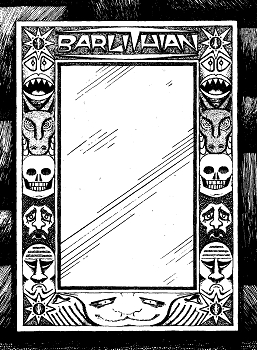
There have been but few who could excel
in each of the Seven
Deadly Sins as well as the “great” Illusionist
Barlithian. Although
he was an excellent craftsman, no Illusionist
alone could create
such a magical mirror, no matter what his
level. Upon completion of the so-far unmagical mirror, pride typically
swelled within Barlithian’s head. He bragged that not even the gods themselves
could meet his mirror’s perfection. At first the deities
ignored the obnoxious Barlithian, but when
he was still spouting
his glories for a year after the mirror’s
creation, 2 gods joined
forces to teach him a lesson. One evening
the beautiful Egyptian
goddess Isis
and the handsome Greek god Hermes came
before
Barlithian and told him that they
would turn his wondrous mirror
into a great magical item. Barlithian was
overjoyed and the mirror
was rendered magical. Later, Barlithian
realized the problems and
frustrations of owning such an artifact.
(In roughly translated Greek,
the mischievous Hermes’ final
words were, “He wanted it, now he
can choke on it!”) Because of his
lusty <lustful?>
Love for femmes fatales, Barlithian had 3 wives, each oblivious to the
others’ existence. He
wasted the magnificent magic mirror by
using it to keep tabs on his
wives’ faithfulness.
His trigamy ultimately led to Barlithian’s
demise. Upon discovering
his indiscretions and each others’
identities, the 3 wives joined
forces and, after binding and gagging him,
had him dropped into an
active volcano.
Since then the mirror has had several owners. The
next one could be you.
Physically, the mirror and its
frame stand 7 feet tall, 5 feet
wide and 8 inches thick, weighing 1,000
pounds (10,000 gp). The
mirror’s 3-by-5-foot glass
center surface is surrounded by a
massive, ornately carved 1-foot-wide mahogany
frame. In
each of the 4 corners of the frame there
is a fist-sized 250gp
tigereye stone. On the front and sides
of the frame there is also
decorative gold leaf
worth 80gp. The mirror’s non-detachable
back is one unadorned, flat piece of mahogany.
Finally, on the
upper front portion of the frame there
is boldly carved in the
common tongue “BARLITHIAN,” evidence of
its creator’s ego.
Barlithian’s Mirror(BM) has 3 permanent
magical powers,
but only the first 2 are generally known
of. The first 2
powers are known to 50% of all Illusionists,
25% of all Magic-Users and 10% of all members of other classes, while the
3rd
power is known to only 5% of all Illusionists,
2% of all Magic-Users and 1% of all other classes. Any character who happens
to
know of the 3rd power will also automatically
know of the 1st
two powers. When seeing the word “Barlithian”
at the top of the
mirror, any character who knows
about any or all of BM’s powers will
immediately recognize the artifact
and remember the legend of Barlithian.
(Of course, a character does
not have to tell the others what
he/she knows.) BM is of True
Neutral alignment, so Detect Evil
or
Detect
Good will show nothing —
but if a Detect
Magick spell is used,
BM’s glass will glow with a rainbow
of colors which will blind all beings
within 30 feet of the mirror for 1-4
turns if they fail their saving throws
vs. spell, and will blind any
being within 10 feet for 1-6 turns
with NO saving throw. Characters
behind BM (on its flat, unadorned
side) will not be affected. This detect
magic idiosyncrasy has never
been mentioned in any legend, so
no characters will know about it
before it happens to them.
The 1st “known” magical power
is always in operation except when
the 2nd power is being used.
The 1st power is that BM will reflect images
as a spell of True Seeing, with
some additional abilities:
Characters cursed with lycanthropy
will see their alter-egos; a Medusa
can view her reflection without
turning into stone; those that normally
fear mirrors (such as Vampires) can
see themselves with
no ill effects. The greatest added ability
of this nature is that any
character that is not a greater or lesser
god and has any form of
Charm
ability will inadvertently charm himself/herself (no saving throw) and
will act as if under a FRIENDS spell
for 24 hours
towards BM’s owner or, if the owner is
not present, the 1st seen
member of the owner’s family. If neither
the owner nor his/her
family is present or if BM has no owner,
the charmed character
will return or try to return to its home/lair
and sleep for the
duration of the spell. While thusly charmed,
characters will
never jeopardize their alignment nor, upon
the spell’s end, remember anything that happened while charmed. All charmed
characters, once recovered, are ever afterward
immune to this
effect of the mirror.
Once BM’s location is publicly known,
there is a 1 in 20 chance
per day that from 1-4 monsters of average
Intelligence or higher
will stop by for a good look at themselves.
The DM will decide
which unwelcome visitors will appear. Thankfully,
Isis cajoled
Hermes into softening BM’s monster-attracting
practical joke so
that when a monster is viewing its reflection,
the monster will not
attack unless an attack or an attempted
attack is made towards
it. The monster will be at its friendliest
(or as friendly as it can
become). This feeling of good will lasts
from 1-20 turns, after
which that monster becomes immune to BM’s
“taming” effect
for a year. There is a legend that Alkee
Frinde, an undernourished sage of mosses and ferns,
was awakened in his bedchamber one night by some noises coming from his
front room.
Upon investigating, he discovered a Wraith,
a Titan and a Night
Hag,
each vainly admiring his/her/its own reflection. Being a
man of action, Frinde took action. He fainted
on the spot.
The next morning when he awoke on the floor,
he was surprised to find himself alive and in one piece. He didn’t find
out
why the 3 visitors of different alignments
had not tried to kill
each other— or him. What Frinde did find
was 10 gp, 15 ep and a
small Carpet
of Flying, apparently the way the “customers”
showed their appreciation for the mirror.
That day Alkee Frinde sold the mirror and moved.
The 2nd power of BM is its ability
to give a 100% accurate
vision of a particular person or creature.
Any character class can
operate it and get a visual response, but
only an Illusionist or
Magic-User
can get an audio response as well. (A 50% chance
for Illusionists, a 25% chance for Magic-Users.)
To operate the
power, the user must mix even amounts of
any type of oil with
any type of ash, add a drop of his/her
blood and, in the common
tongue, write with this fluid at the bottom
of the glass the name
of the subject to be seen. For 1 minute,
a vision of the requested subject will appear on the glass. When the power’s
duration is
over, the image and the written name will
vanish.
There are stringent limitations to this 2nd power:
It can be used only once a week. If this
2nd power is called
upon more often, nothing will happen.
The viewer must use the full name the subject
is known by.
Although middle names and maiden names
are not always
needed, pet names, nicknames, aliases,
last names only, first
names only, etc., will not work. (Example:
To see Leo Gwaffusi
IV, the viewer must use “Leo Gwaffusi IV.”
“Leo Gwaffusi” will
not work because you might mean Gwaffusi
II or III. “Prince of
the Hanshire Elves”
is a title but not a particular character, while
“Head Elf
at Hanshire Castle” is only an address.) If the user
does not know the subject’s full name,
the power cannot be
employed.
The subject must be at least partially in
the same plane of
existence as the mirror, and only that
part of the subject in that
same plane can be seen.
The subject is seen in the light or lack
of light of his/her
surroundings. The viewer cannot cause light
to be created in
any way near the subject. Neither infravision
nor ultravision can
be used to enhance what is shown in the
mirror. If the subject is
in complete darkness, the mirror will be
black.
If audio is possible, the viewer/listener(s)
will hear only what
the subject could possibly be hearing and
nothing more. If the
words are garbled or faint, there is nothing
the listener can do.
There is almost no way to determine precisely
where the
subject is in relation to the viewer. The
vision will be just as clear
if the subject is in the next room or on
another planet. The vision
is focused on a close picture of the subject
only, not a full picture
of the setting the subject is in. Unless
objects or other characters are very near or touching the subject, they
will not be seen.
As for background, such as scenery seen
over the subject’s
shoulders, the farther away it is, the
blurrier it becomes. (Example: Leo Gwaffusi IV appears in the mirror. He
has been obviously tortured, because he has a cut above one eye and bruises
all
over his body. He is dirty, tired-looking
and chained to a massive
stone wall.
There is someone chained next to him but you can
only see his/her humanoid arm. The only
light source is a flickering yellow flame
that is beyond the field of vision. Because you
have sound, you hear numerous beings moaning
and crying,
but no words are said. Although this vision
is packed with information, you do not know where Leo is, who put him there,
why
he is there, who is chained next to him....)
The subject never knows he/she is being
viewed even if the
subject is using a Detect
magick spell, Wish spell, etc. Conversely,
the viewer can in no way communicate with the subject. This
includes magical “communication” or non-physical
contact.
Spells cannot be stored in the mirror,
nor transmitted through it.
Psionic ability will not function through
the mirror.
Only beings can be the prime focal point
of the vision, never
objects. (Example: The Sword of Jusiana
cannot be seen; it is a
magick weapon with a full name, but it
is still only an object.)
Beings will be seen as they are at the moment
of viewing, no
matter what condition they are in or what
they are doing. The
vision seen and perhaps heard is always
happening at present,
never in the past or future.
The 3rd power of the mirror is not widely
known — because
the knowledge of it can often cost the
discoverer his/her life. BM
can differentiate between normal usage
and vandalism. Under
normal usage, BM will allow pegs, nails,
screws, spikes, drill bits
or whatever to be used in order to hang
it on a wall, hinge it on
one side to become a secret door, put it
on a floor base, etc. An
observant character will be amazed to discover
that BM is always in mint condition, because old screw holes and nail holes
will heal and tiny chips and cracks accidentally
made will mend
themselves. When the glass is being cleaned
or the frame is
being polished, a contented “thrum” will
emanate from the mirror as if it has a life of its own.
Any being which harms BM deliberately or
accidentally will
reap the terrible vengeance of the third
magical power. At first,
the mirror will absorb the actual damage,
but once the damage
has been done, within 4-9 turns (d6+3)
BM will, within 1 segment, magically heal itself and cause certain types
of damage to
the one/ones who harmed it. (If 2% or less
damage is accidentally done to BM during a 24-hour period, the mirror will
consider it
due to normal daily wear, heal itself and
take no retribution.) If
more than 1 character causes damage to
the mirror, each 1
will receive an equal share of damage regardless
of his/her
degree of participation. An exception to
this equal-injury rule is
when an unwilling character is forced by
another to damage BM.
In such a case the unwilling character(s)
will be spared and the
one(s) who did the forcing will receive
all damage. Any removed
parts, such as the tiger-eye stones or
the gold leaf, will at the time
of repair teleport back to their settings
on the mirror. There is no
saving throw against magic allowed for
characters or creatures
who are damaged after harming the mirror.
If the damage is quickly repaired before
BM has time to retaliate (within 4-9 turns, as above), nothing will happen
to the
one(s) who harmed it. Depending on the
amount of damage, any
spell that repairs non-magical items or
cures beings will help
repair the mirror — because it wants to
be repaired! Any spell so
employed will be effective up to the limits
of its power and
ability. Example: A Mending
spell is powerful enough to reset a
tiger-eye stone but not strong enough to
repair the shattered
glass.
Any acts of the gods that harm BM
will be countermanded by
other acts of the gods that will prevent
the harm or repair it.
Barlithian’s Mirror will last an eternity.
BM always follows certain courses
of action against those
who harm it:
Anyone removing the tiger-eye stones will
lose 1 eye for 1
stone, 2 eyes for 2 stones, 2 eyes and
1 ear for 3 stones and 2
eyes and 2 ears for all 4 stones. (Loss
of an ear includes the loss
of the ability to hear plus the outer ear
itself.) <cf. deafness>
Carving out hunks of the wood for non-normal
usage will
result in the carver losing an equal volume
amount of fingers,
toes, nose(s), hands, feet, etc. (Example:
Leo cuts out a 1-square-inch hunk of wood and the mirror takes a one-square-inch
hunk of Leo, namely his big toe,)
Any cutting of names, initials, words, numbers,
symbols, pictures or any other types of identification marks on BM will
result
in them magically appearing on the cutter’s
chest in the same
size and depth of cut as they were inscribed.
Any removal of the gold
leaf will result in an equal percentage
of the taker’s skin/hide being removed.
If 15% or more of a
character’s skin/hide is removed, a saving
throw against bleeding to DEATH must
be made. To calculate a character’s chance of
bleeding to death, add the percentage of
the gold leaf remaining
on BM and the character’s present
Constitution. A successful
saving throw would be that number or less.
(Example: Leo has
removed 60% of the mirror’s gold leaf.
His number needed to
save against bleeding to death would be
40 (% of the gold leaf
remaining) + 15 (Leo’s Constitution) =
55; a roll of 01-55 would
spare Leo while a roll of 56-00 would let
him bleed to death.) If
uncared for, a character bleeding to death
will lose 5% of his/her
HP per turn until, after 20 turns, no hit
points are left and
the character is dead. If a character loses
30% or less of his/her
skin/hide, a Cure
serious wounds spell will heal him/her, but if
31% or more skin/hide is lost, a Cure
critical wounds spell (or
better) must be used. All lost skin/hide
left untreated will leave
some permanent scarring. If 20-39% of a
character’s skin/hide
becomes scarred, there is a 10% chance
of that character losing
1 Charisma point; a 20% chance of losing
2 Charisma points for <Comeliness, not Charisma>
40-59% scarred flesh; a 30% chance of losing
3 Charisma points
for 60-79% scarred flesh; and so forth.
Burning BM will cause the arsonist
to suffer equal damage in
the same way that BM suffered: flaming
torch for flaming torch,
Fireball
for Fireball and the like. Heat, electricity and Wood
warp
spell damage behaves similarly, with the
latter causing the caster’s bones to become misshapen, making the caster
lose 1 point
of Dexterity.
BM is immune to any form of gas,
water, ice, cold, acid, or
dispelling of its magick. Nothing will
happen to the character who
attempts such an attack on the mirror,
because nothing will
happen to the mirror.
If the mirror’s glass is shattered by a
character, the punishment is DEATH. The smasher explodes into tiny pieces
with the
noise, force and shrapnel damage potential
of a bomb. (Note: If
more than one character shatters BM, EACH
will take 100%
damage and explode. This is the only other
exception to the
equal-injury rule.) Everything, creature
or object, magical or
not, within 10 feet of the exploding victim
will be destroyed, with
no saving throw, by the shrapnel. Except
for BM, which will heal
itself, everything within that 10-foot
circle is forever unsalvageable. Beyond that circle, everything within
50 feet of the victim
will take 4-24 (4d6) points of damage if
it fails its saving throw vs.
spell. The noise of such an explosion always
attracts, within 1-4
turns, wandering
monsters of the DM’s choice.
Experience point value: --- (Artifacts
bring no XP).
Gold piece sale value: 120,000.
| Dragon | - | Magic Items | - | Dragon 50 |
| - | - | AD&&D | - | - |