| Monsters | Magic | Money | Miscellaneous | Putting it to use |
| 1st Edition AD&D | - | Dragon #161 | - | Dragon magazine |
"It's sort of like a wand":
So what's missing?
by Gary Coppa
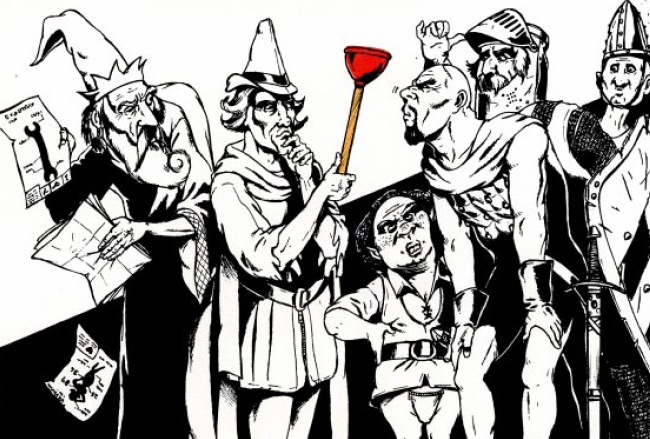
Art by Jim Holloway
Player 1: "Whew! That was a tough battle!
I thought those 4 kuo-toa had us for a second!"
Player 2: "Yeah, good thing I had my
sword +2! I only needed an 8 to hit
their AC of 4!"
Player 3: "You mean it's a good thing my
3rd level fighter/thief henchman, Gondam,
picked one of their pockets and found that
potion of SPEED. His 2 attacks per round
did it."
Player 1: OK, guys, lets NOT fight
aboot it. We all did well. Now [rubbing
his hands together], the treasure! [All players
turn to look at the DM.]
DM [shuffling papers and rolling a few
dice]: "You find a spear +1, a potion of fire
breath, a wand of metal and mineral detection
with only 5 charges left, 100
EP, and 5 gems."
Player 2: "How much are the gems
worth?"
DM [rolling more dice]: "20 GP
each. You are splitting up the treasure
when suddenly . . ."
What's wrong with this picture of an
AD&D game? It seems perfectly fine. The
treasure is rich but not excessive; the
monsters were tough but not too easy or
too hard; the magickal items are reasonable
and did NOT upset Game Balance. In fact,
the DM did an admirable job ov avoiding
all the usual Game-Balance pitfalls.
The answer is mystery. The players
know everything. They know exactly what
their player characters? magical items can
do and what their PCs? limits are, how
skilled the PCs? henchmen are, what the
PCs are fighting and what its abilities are,
and how much the valuables are worth
without getting them appraised. What is
lacking is the sense of the unknown, the
feeling that there are secrets left in the
game world for the characters to unravel.
Even a seasoned PC of 18 years? experience
will have only a tiny amount of
knowledge about the myriad of monsters
and artifacts listed in the AD&D Dungeon
Master’s Guide and Monstrous Compendium.
So how can he possibly recognize a
potion of flame breath, especially if he has
never seen one before?
13
What this campaign needs is a dose of
good old-fashioned mystery. There are
many ways this mystery can be introduced,
and these can be divided into four
general categories: monsters, magic,
money, and miscellaneous.
Monsters
Monsters are the most common obstacle
the characters are likely to encounter, but
this does not mean that the monsters
should be common, RUN-OF-THE-MILL automatons
that seem as if the DM pulled them
off the assembly line. Monsters are supposed
to be horrifying nightmares from
myth and legend, and each encounter
should be a new, exciting challenge for the
characters, not just: ?Ho hum, another
eight-hit-dice hydra.? The characters
should never be allowed to be entirely
sure about their opponents? capabilities.
How is a poor DM to do this, you ask,
when the players have memorized the
vital statistics of every monster in the
Monstrous Compendium? The answer:
Remember that monsters are more than
lists of vital statistics. The descriptions
given of them in the books are there for a
reason; an orc is an orc is an orc, right?
But consider this verbal description: ?You
see some humanoids, approximately six
feet tall, wearing ring mail and carrying
spears and shields. They are wearing
helmets, so you can?t quite make out their
faces.? Now suddenly the opponents could
be orcs, hobgoblins, short gnolls, a character
party, any lycanthrope in human form,
preserved (or recently slain) zombies,
dopplegangers, animated statues, or githyanki.
Of course, some extra description
may be required in many cases (at close
range, a death knight would be easy to
distinguish from a hobgoblin), but not
always (a thief might not realize that the
creature at whose back he just threw a
dagger was not actually a death knight but
was an allied cavalier). The DM must use
his own judgment, but the idea is to always
keep the characters on their toes.
After a few attacks on giant snakes that
turn out to be guardian nagas, the characters
will be a bit more thoughtful before
going into battle.
This idea can be expanded by not always
strictly following the statistics for monsters
given in the books. And while any
alterations made by the DM should not be
completely off the wall, they should keep
characters guessing. For instance, to take
a variation on an example from an old
DRAGON® Magazine article, consider a
goblin with 18/76 strength?not an extremely
big change, but the characters
may have pause when the creature does
up to 10 hp damage with its short sword.
When the goblin?s sword breaks, and it
grabs Arthur?s heavy lance and
hurls it at
Galahad, the characters will be
more wary
of those puny creatures they once thought
were such pushovers. This doesn?t have to
be done very frequently (in fact, once
often suffices) to make the players far
more wary about what their PCs attack?
which is as it should be. A fighter who
attacks everything he sees is a very shortlived
fighter.
Given monsters that the characters have
previously encountered, it is probable that
the PCs will know what they face (any
2nd-level idiot can recognize a kobold). On
the other hand, if the monster is actually
some rare, exotic creature that simply
looks like something the characters recognize,
then the DM is justified in describing
it as such. In the case of the humanoids
mentioned previously, the characters
would probably assume that the armored
humanoids were really orcs, until the foes
turned into wolves, threw a fireball, or did
something similar. Humans make observations
based on past experiences. If there's
no reasonable clue that a monster is different,
then the characters will logically
believe their opponents are orcs. Then,
when the 1st fireball hits the party, the
DM can say, "Well, they looked like orcs."
As another example, a mage wh has encountered
a manticore in his travels will
most likely believe a lammasu or androsphinx
to be another of that species, not
having any idea that there are entirely
different monsters that LOOK almsot exactly
the same. When the mage 1st sees the
creature, describe it like this: "It's got the
body of a winged lion and the face of a
man. It looks like a manticore." The mage
will have to be careful |or| else risk fighting
a beast with whom he would prefer to
negotiate. The existence and appearance
of some monsters are common knowledge
(there isn't much you can do with a unicorn),
but even these often have lesser-known
relatives that just add to the
confusion (how many people, even adventurers,
know how to tell a dragon from a
wyvern??). Even the ranger who knows
goblins inside and out (literally speaking)
might not realize that nilbogs exist and
look exactly like goblins, and so would
have no idea why his sword was not working
against this monster. (Nilbogs, from the
FIEND FOLIO tome, are some of my
favoriate creatures.)
Another way to add mystery is to remember
that the PCs cannot see |or| hear
everything; their senses are limited. A
descriptoin of a monster a mile away
should be very different than a description
when it is within 20 yards; on the open
plains, it would be practically impossible
to tell a storm giant 2 miles away from a
berserker at a 1/3 of that distance.
Something may seem much larger or
smaller when it is far away, and the PCs
will notice fewer details. Characters advancing
on a group of orcs from a half-mile
away will not be able to tell that those
orcs are all carrying bows, with which
they will pelt the party with arrows while
the characters close for melee. The characters
need not to be told everything.
Another way that limited senses comes
into play is with numbers of the enemy. In
a forest, it would be very hard to tell the
exact number of orcs attacking you, even
if they are in front of you. The best
thing to do is to give the players an estimate
(e.g. "You think there are about 15 of
them."). If the players ask for a more exact
number, say, "Are you going to stop fighting
to take a head count?" The characters
have to cope with not being entirely in
control of the situation, not knowing
whether there are more orcs than they
can reasonably expect to handle. This adds
realism to the Game and gives the players the
uncertainty their characters would experience
in wandering through the great
unknown.
Magic
Webster's 9th New Collegiate
Dictionary defines magic as: "extraordinary
power or influence seemingly from a
supernatural force." In a FRP
system like the AD&D game,
magic is the mystical force that heroes,
monsters, and gods draw on to perform
feats unattainable in the modern world,
and as such is better understood by those
who live in fantasy worlds than by us--but
if is not much understood. Why are there
so few wizards in fantasy worlds? Magic is
such a complex and variable force, taking
on myriad aspects in the Game universe,
that it takes years or centuries of devoted
study to even begin to understand it. Yet
many DMs allow players to blithely identify
and interpret magical signs as if the
PCs were the most studied of mages.
One of the most common problems is
with magical items. Most magical items do
not glow or make funny noises without a
command word being spoken first, so
there is no way to tell if items are magical
without a detect magic spell. However,
even if the DM does not immediately list
all items with magical dweomers, the
characters may still infer what is and isn't
magical from what the DM does or does
not mention. If certain rings, brooches,
bracelets, etc. are only mentioned by the
DM when they are magical, it will be a
sure tip-off to the players. Most fighters
will wear nonmagical gauntlets, belts,
cloaks, boots, and jewelry of almost any
sort, and most items the characters find
will be normal ones. But my players have
frequently sold magical gems for their
jewelry value, simply not realizing that
little things like coins and gems can be
magical, too. If you do not mention "normal
items" in t he loot when characters
search defeated opponents, then do not
mention any magical items that resemble
normal items, either. If the characters take
everything that "looks magical," they will
take the wands and scrolls but will probably
not take the dead wizard's robe of
eyes. Conversely, it would be practically
impossible to cart off all the "normal stuff"
from every battle to have it checked for
magic in town. PCs will soon learn the
value of having a detect magic spell with
them on the road.
Another common mistake made by
inexperienced DMs is to tell the players
what a magical item is and what it does,
whether or not the characters can be
reasonably expected to know this. For
instance, in the example at the beginning
of the article, the DM told the characters
that they had found a wand of metal and
mineral detection. Most likely, none of
them had ever seen one before; even if
they had, all such wands by no means look
identical. Some may have ancient carvings
depicting the wands use, others may have
magical command words inscribed on
them, and still others may be entirely
featureless. True, an amulet of the planes
might be very easy to tell from a phylactery
of long years, but it would most likely
be indistinguishable (barring any descriptive
carvings on its surface) from a medallion
of ESP. This especially applies to
potions, which can be of any color, consistency,
taste, or odor. No guarantee exists
that if your last transparent green potion
was a potion of extra-healing, your next
transparent green potion will be, too?or
even that your next extra-healing potion
will be transparent green.
This is not to say that the characters will
be forever in the dark about the functioning
of their magical items. There is the
identify spell, expressly designed for that
purpose. If the PCs wish to be safe, they
can instead go to a mage?s guild, where
wizards have the facilities and the specialists
to safely identify the party?s magical
treasure (for a stiff fee, of course). This
method could also be used to determine
the number of charges in a rod, staff,
wand, or other charged item, information
that should be withheld from the players
until they have to resort to this or similar
options. (If the mage?s guild didn?t have a
monopoly on needed services, it wouldn?t
be much of a guild, would it?) Also, the
PCs may meet high-level characters in
their travels who may be able to perform
research to find command words (though
they might not know what function it will
command), offer snippets of information
from ancient tomes or legend lore, or
simply refer the PCs to an acquaintance
who may have more knowledge on the
subject. In one of my campaigns, a cleric
possesses a magic ring, given to him by his
gypsy mother, that not even the most
powerful mages have been able to identify.
He has been referred from place to place,
gradually gathering what little information
they could give him, and after two game
years he has still not found the answer.
This kind of adventure not only makes the
players feel rewarded when they finally
do discover the item?s properties, but it is
tures.
(Consider a magical wand, unidentifiable
by any local mages, which bears a
strange, magical mark identified as the
signature of a hermit illusionist who lived
on top of a distant mountain. . . .)
We come to the problem of players who
have memorized the magical item lists.
Consider a player?s comment that took
place in a game run by a friend of mine:
?Magic boots, huh? Well, let?s see. There?s
dancing, speed, striding and springing,
levitation. . . . Try jumping up and down.?
How can this be changed? There are
many ways. First and possibly best, the
DM can make up magical items that the
players have never encountered. A PC
who jumps up and down to test his new
magical books will be very surprised when
he finds that his boots of earthquakes
have just demolished his castle, where he
was testing his magical loot. There are
many game aids out that have lists of
interesting new magical items; if you get
these lists, don?t let your players see them.
Another method, one that is much easier
than buying scads of new books or taking
the time to make up new magical items, is
to use a small variation on random
magical-item determination: Roll once to
find out what the item is (a ring, wand,
potion, etc.), then roll again to determine
the powers of the item. For instance, on
Table III, on page 84 in Unearthed Arcana,
the DM rolls 47, indicating miscellaneous
magic, then rolls a 14, referring him to
Table III.E.1. A roll of 69 on this table
indicates that the magical item is a set of
bracers (normally bracers
of defense).
Now the DM rolls for powers, getting a 36,
which indicates rings, and another 69,
indicating Table III.C.2. A roll on this table
results in 00, a ring of truth.
Thus, the
character has a completely new item:
bracers of truth. This method takes
slightly longer than simply rolling once on
the tables, but it provides a vastly larger
array of items that the characters might
otherwise encounter.
Another problem, and one that has
always been sort of a pet peeve of mine,
concerns magical-weapon ?pluses.? This
seems to go against the fantasy feeling that
game designers have worked so hard to
build up. Consider Malakon the Mighty,
arrayed in his plate mail of etherealness,
resplendent in his girdle of storm giant
strength, and wielding his mighty long
sword +4. Armor, swords, and other
weapons are magically enchanted, and are
no more numbers than a wand of fireballs
is a simple ?6-36 wand.? The magic and
mystery of enchanted weapons seems to
be lost somewhere in the number shuffle.
When I first tried to remedy this in my
campaigns, I introduced a sword +2 to
my players as ?a beautifully wrought long
sword, enchanted so as to magically guide
the wielder?s hand.? The players looked
astounded and proceeded to vie for the
chance to possess this amazing artifact. I
no longer tell the characters what the tohit
bonuses of their (few) magical weapons
are; if they consult a mage to identify an
item, he can deduce some small idea of the
relative powers of two magical swords,
but the characters have no absolute scale
for judgments. It is an easy thing to keep a
small note pinned to the inside of the DM?s
screen, noting the magical bonuses of each
character?s weapons. To me, it adds spice
to an otherwise boring topic.
A final aspect of magic that I feel the
characters often know too much about is
magical spells. How many times have you
heard a DM say something like, ?The wizard
looks angry after that last remark. He
starts casting a cone of cold. You have five
segments to act. What do you do??
This seems very unreasonable. Mages
must study for decades to be able to learn
the complex motions involved in spellcasting,
so how can fighters interpret
those motions with no trouble? Instead of
saying that the wizard is casting a cone of
cold, the DM can say that he is casting a
spell; if the PCs are close enough, they
might see what material components (if
any) the wizard is using. Of course, the
players will want to look at the AD&D
Player’s Handbook to evaluate the spell?
but don?t automatically let them! If a wizard
PC has enough levels to cast the spell,
his player can check the Player’s Handbook;
otherwise, tell him he has never
encountered that spell. If the spell is fairly
standard, such as magic missile, any but
the most inexperienced wizards would be
able to identify it immediately. But classes
having no experience with spells should
not be allowed to know what spell is being
cast or how long they have in which to
act; they must stay on their toes and be
ready for anything, as anyone would have
to do in the world of adventuring.
Money
Player characters can accumulate vast
amounts of gold and gems in almost no
time. The abundance of monetary treasure
in the world is exceeded only by the
characters? greed to obtain more. And
when characters gain hundreds and thousands
of pieces of gold, they have everything
under control. Why should they not?
They know how much everything costs,
from the smallest dagger to Baba Yaga’s
hut. In our world, prices are never constant;
in a world with so much less communication
and trade than ours, think
about how much prices would vary from
place to place and from time to time, even
for something as simple as a arrow.
One way to remedy this is to roll for
prices whenever anyone buys anything. I
suggest rolling 1d100, with 01-35 indicating
underpriced by 5-50% (5 x 1d10) of
the normal cost, and 51-00 indicating
overpriced by 10-200% (5 x 2d20). These
adjustments can be used not only for
normal items but for magical items, sage
expenses, training, and whatever else the
characters have to pay for in town. This
adds realism as it sometimes makes it
necessary for characters to shop around
for bargains.
An even better way to do this is to assign
price ratios for certain items in specific
places. For example, consider a city
involved in a war; prices in general will be
high, metal weapons can be bought or sold
for possibly double or triple their normal
costs, and magical weapons might go for
up to 10 times their listed value! Training
would be hard to come by but might be
financed by the city if the characters
agree to stay and serve a term in the city?s
garrison; food and housing might fall in
price because of the inns competing for all
the new business from soldiers and from
people displaced by the war, or skyrocket
due to a shortage of supplies and money.
As another example, villagers from a
town located in a barren mountain chain
might buy wooden objects for three or
four times their normal worth, but metal
objects and weapons might be of little
value due to the proximity of dwarven
mines and traders. The local wizard might
be a cranky old man who would charge
many times the normal price to waste his
time training Allan, the Annoying Aspiring
Apprentice, or he might be a seeker of
knowledge who will not ask for money but
might ask the PCs to find some snippet of
information or perform some task for him
in return for the training. (This is a wonderful
way to get characters into an adventure.)
In all cases, remember that
money is not the only thing that makes the
world go round, but most NPCs will take
the characters for as much as they think
they can get. There are very few kind,
generous, wealthy merchants who remain
wealthy for very long.
In the same vein, gems may have varying
prices depending on the area in which
they are sold or appraised. The chart
on
page 26 of the AD&D 1st Edition DMG (or
Table 86, page 134, of the AD&D 2nd
Edition DMG) helps account for varying
gem markets, but feel free to amend this
chart based on individual circumstances.
Also remember that few characters, with
the exception of thieves, will have any
practical experience in appraising gem
values. They might discover that the huge
gems they thought would be worth fortunes
are flawed and worth only a few
gold each. Huge, flawless gems are extremely
rare, and most novices to the field
cannot tell a diamond from a glass fake.
The exchange rates of gold and other
precious metals are not always the same,
either, and a DM can make a platinum piece
equivalent to six or seven gold pieces (or
even one or two), based on the relative
abundance or scarcity of the metals in that
region. Ancient Egyptian artificers made
hundreds of works in gold; silver, which
was scarce in the Nile valley, was considered
far more valuable than gold. Maybe
there are fantasy towns in which the characters
? gold will be worthless, but any
copper they have on them will be worth an
equivalent number of platinum pieces!
There are endless variations on this theme,
enough to keep the campaign challenging
even to the richest characters.
Another problem the characters may
encounter is that of hauling all their loot
around; carrying thousands of gold pieces
is hard work! The characters may get it
into their heads to change their gold into
platinum or even into gems of equal value
in order to accumulate even greater
masses of treasure. For this, the characters
will have to go to the moneychanger.
But do you think any businessman would
be involved in a venture that doesn?t stand
to turn a profit? Most moneychangers will
charge a stiff fee to change the characters?
cash, typical from 1-10% of the amount
changed. If the characters think it is ludicrous
that they should have to pay for
simple moneychanging, they can go
through the thieves? guild or less established
intermediaries, but they?d better
look out for fool’s platinum (a variation on
the second-level mage?s fool’s gold spell)
and glass gems. They?ll be in big trouble if
they try to pay for anything with this
bogus money! You get what you pay for,
but you never get something for nothing.
Which brings up one more topic relevant
to the characters? money (or impending
lack thereof) ? the thieves? guild. It?s not
called that for nothing, you know. Apprentice
and journeyman thieves spend their
time in town loaded down with so much
stolen gold that they?re practically trailing
it behind them. Characters will probably
be lucky if they even get to their hotel
rooms without a good portion of their loot
falling to the seamier side of society. In my
campaigns, thieves know a ?secret signal?
to warn other thieves away from their
party when they get into town, but any
party traveling without an ?escort? is fair
game for the guild (and any party can be
hit by free-lance and probably more experienced
thieves). Of course, thieves are
even more rewarded when they pick the
pockets of those characters who have just
had their money changed to a more transportable
form.
Miscellaneous
A few more topics under the theme of
mystery in the campaign do not fit nicely
into any of the other three categories. One
of these is the concept of ?levels.? How
many times have PCs asked NPCs, ?What
level are you?? Levels are a means for the
DM to gauge the relative strengths of
characters to monsters, and for players to
ascertain the extent of their own character
?s abilities?not those of other characters
or NPCs. In the actual game universe,
there should be no real concept of character
levels any more than there should be a
concept of monsters? hit dice; a monster
may be ?really tough? according to rumors
from adventurers who have encountered
the critter, but this may be because it has
a high armor class (?Our swords just
couldn?t get through its hide!?), high dexterity
(?It moved so fast, we just couldn?t
hit it!?), some magical defense (?Our
swords just passed right through the
beast!?), or a lot of hit points (?We kept
hitting it and hitting it, but the sucker just
wouldn?t lie down and die!?). Similarly, an
NPC can surprise us, just as even our
closed friends do sometimes. NPC henchmen,
hirelings, or traveling companions in
all likelihood have abilities that the character
would not guess at, or conversely lack
an ability that the character felt sure the
NPC must have. NPCs are people, not lists
of statistics, and it is important that the
characters learn a little about the NPCs at
a time, just as they would a new friend in
real life. Level titles are a questionable
case, although they can add spice to the
AD&D 1st Edition game, as in the case of
the cleric who finally gains the status of
?High Priest? in his church, or the mage
who finally attains the title of ?Wizard?
and all the benefits thereof. I let the PCs
call themselves by level titles and will
usually remark when an NPC has reached
name level (e.g., a Wizard instead of just a
magic-user, a Master instead of just a
monk; but a fighter is only a Lord when
he owns land, a thief only a Guildmaster
when is the head of a guild). I am not
usually more specific about NPC levels. If a
player has the audacity to actually ask an
NPC, ?What level are you?? he receives the
response, ?What are you talking about??
Perhaps the most important point I can
make pertains not to any individual problem,
but to the way a DM should speak in
general: the problem of semantics. A DM
may try to institute some of the ideas
outlined in this article, but often his own
words reveal what he is trying to keep
secret. The DM should never be too specific.
When the players ask if the chasm is
short enough for the PCs to jump across,
say, ?I think so.? When players ask if the
monster the PCs have just fought for an
hour is really dead, instead of saying ?Yes,?
say, ?It looks like it.? In the real world, we
are never completely sure about anything;
we have to rely on our judgment. One of
my favorite replies to questions is along
the line of ?You don?t know.? (?Can I pick
the lock?? ?You won?t know until you try.?)
These are the kinds of responses that
the DM should get in the habit of using, to
reflect the characters? uncertainty about
even their own capabilities. As mentioned
on page 19 of the AD&D 1st Edition DMG,
PC thieves should not be certain of their
success. If one asks, ?Am I hidden in
shadows?? the response should be to the
effect of, ?You?re trying.? Finding and removing
traps is another problem. Too
many times, when the player asks, ?Are
there any traps?? the DM responds ?No.?
Whether the player missed his roll or
there were simply no traps present, the
DM should say ?You didn?t find any.? This
is much more indicative of the character?s
state of mind after checking; it is his opinion
that there aren?t any traps, but some
might have escaped his notice.
Putting it to use
The ideas presented in this article are
little things at most, but they add spice
and excitement to a campaign. It is often
difficult to get started using these ideas, as
they go against the grain of telling the
players everything you know, but once
you develop the habits, they seem to come
naturally. Not letting players know more
than they should soon becomes second
nature. My players are fond of citing a
time during a campaign when I was asked,
?Did it feel like a spell was cast?? and I
responded, ?Possibly a little bit, but not
really.? It is little things like this that keep
the players on their toes, which is as it
should be when they go adventuring in
the dangerous but exciting world of
AD&D games.
Let?s take a look at the encounter at the
beginning of this article, revised to take
into account the principles herein:
Player 1: ?Whew! That was a tough
battle! I thought those lizard men had us
for a second!?
Player 2: ?Yeah, I can?t believe how well
they fought! It was a good thing I had my
enchanted sword, Narsil. It clove through
their slimy green scales like butter!?
Player 3: ?You mean it?s a good thing
Gondam here grabbed that potion! [To
Gondam.] I never knew you could pick
pockets!?
DM [playing the part of Gondam]: ?Well,
I moonlighted as a thief a while back to
supply money for my weapons and armor.
I guess the subject just never came up.?
Player 3: ?Well, good job anyway. How
did you know that potion would speed up
your reflexes??
DM [as Gondam, sheepishly]: ?Well, I
didn?t, actually. It looked like a potion of
healing, so I drank it.?
Player 3: ?You did what?! Talk about an
ungrateful??
Player 1: ?Okay, guys, let?s not fight
about it. We all did what had to be done.
Now [rubbing his hands together], what
did the lizard men have on them? [All
players turn to look at the DM.] Did they
have any pouches??
DM [shuffling papers and rolling a few
dice]: ?Only one of them is even wearing a
belt, but there is a pouch on it. Inside are
five gems?rather small, but they seem to
be of good quality. Gondam looks at them
for a moment, and says you might be able
to get thirty or so gold pieces for each of
them in town. In the same pouch are three
vials, each about the size of a standard oil
vial. All three liquids are transparent,
though one is bright red and the other
two are colorless. These items are mixed
up with some electrum pieces, probably
close to 100. What looks like a wand is also
thrust through one creature?s belt.?
Player 1: ?Did they have any other stuff
on them??
DM: ?They wore only loincloths and
gaudy bracelets. The bracelets are inset
with lewd and baroque designs depicting
what appears to be a woman with clawed
hands and the head of a squid performing
various disgusting acts. The lizard men
wore no boots or any other clothing or
ornamentation.?
Player 1: ?Gondam, are the bracelets
worth anything??
DM [as Gondam]: ?No, not really. The
gold plating is fake, and the gems are
glass. Pretty poor imitations, too. Wouldn?t
get a gold for any of them.? [One set could
be bracers of defense, but the players
might never know.]
Player 1: ?Well, okay. Leave them behind.
We?ll need all the carrying space we
can get. The lizard men all had spears?
Any other weapons??
DM: They did have spears, although one
broke, if you remember. All three spears
are of good quality but don?t seen to be
exceptional in any way. The lizard man
that had a pouch also had a dagger thrust
into his belt. The dagger?s of lousy quality;
it?s rusted.?
Player 1: ?Okay, we?ll take the spears for
now. I?ll strap them to my back.?
Player 2 [arguing with Player 3]: ?I tell
you, those things weren?t lizard men! They
fought too well! And what about those
bracelets? Isn?t there a race that has a
godlike lobster lady? They?re called kuantoon
or something like that, I think.?
Player 1: ?Yeah, and her name is Blibdrool-
poop or something. They?re
called. . .
yuan-ti, yeah, that?s it! [to the DM] Is that
what they?re called??
DM [shrugging]: ?Sounds okay to me.?
Player 1: ?Okay, they must inhabit the
cliffs we saw down the coast. We can
backtrack to town, hire some men, get
that wand identified, then take on those
yuan-ti.?
Player 2: ?I?ll check the libraries. Aren?t
yuan-ti immune to fire or something??
I guarantee you a much more interesting
game. Enjoy!
Other helpful articles on maintaining
mystery in fantasy RPGs include: “‘Keep
‘Em Guessing,” by Ed Greenwood, in
the
Best of DRAGON® Magazine anthology vol.
V; and “Also Known As... the
Orc,” by
Ethan Ham, in DRAGON issue #158.
SEPTEMBER 1990