| The AKA system campaign | How to use the AKA list | Bibliography | - | - |
| 1st Edition AD&D | - | Dragon magazine | - | Dragon #158 |
Also Known As... the Orc
An orc is a norke, of course, of course-- using the AKA
system
by Ethan Ham
When players begin to memorize the
monsters' abilities, The Game loses much of
its mystery. The encounters become nothing
more than target practice, and THE
CAMPAIGN takes its 1st steps toward becoming
a Monty Haul dungeon instead of A
suspenseful adventure into the unknown.
The problem is: How does a DM maintain
an air of mystery in a Game where monster
stats && Game rules are available
to every player of The Game?
The approach described by Ed Greenwood
in the article :"Keep 'em Guessing"
(in
the Best of DRAGON Magazine Anthology,
Volume V) is a good way to maintain the
suspense && mystery of THE CAMPAIGN.
Mr. Greenwood suggests giving the players
only a vague idea of their characters'
abilities. The AKA (Also Known As) system
described in this article is complimentary
to this idea. Instead of focusing on the
characters, however, the AKA system uses
"mystery monster" encounters.
DMs often forbid players to discuss
monster attributes while in the dungeon.
This doesn't solve the basic problem, however,
since the players still know the information.
Another technique is to constantly
USE new monsters in the dungeon. While
this works, creating these new monsters is
a real challenge and can strain the creativity
of any DM.
The AKA system gives the official monsters
alternative names. THis method can
be used in the AD&D Game without
difficulty. The AKA system is based on the
fact that each different society has different
names for the same monsters. We
could, of course, just START calling an ogre
a "refrigerator," but much of the FUN in
RPGs is in confronting lejends
hand-to-hand. The AKA system uses
the many authentic regional names by
which AD&D Game mosnters were known
throughout history. e.g., the
leprechaun has various Names in different
areas of Ireland: lurican in Kerry, clurichaun
in Cork,
lurikeen in Kildare, etc.
The AKA system campaign
When using the AKA system, you must
be careful to prevent the players from
thinking you are taking unfair advantage
of your power as a DM. The method of
introducing an alternative name is crucial
and must be well thought out.
The most effective way is by means of
an NPC encounter. If the characters are
being hired by villagers, have the NPCs
describe the monster that has been plaguing
them as a ?fetch? rather than a doppleganger.
Then, instead of searching for the
doppleganger, the party will look for a
new and unusual monster that just happens
to have shape-changing abilities.
The second, more difficult method is
done without any NPCs. For example,
when the party is confronted by orcs, say
something like, ?Several large humanoids
with piglike faces are attacking you! You
recognize them from stories you have
heard. They are norkes!? The main drawback
to the second method is that once
you have established a particular alternate
name for a monster, you must continue to
use it. As a result, it is very likely the
players will soon catch on to that alias.
One solution to this problem is to have a
different alternative name for the same
monster for each different player. (Perhaps
each of them learned the name of the
monster from a different source.) You pick
the alternate name based on who is viewing
the monster at the time. Once you
establish an alternative name, you must
stick with it.
Note that some of the alternate names
for certain monsters in this AKA system
are also the names of separate and sometimes
unrelated monsters in the AD&D
game (e.g., the gorgon is called the catoblepas
in Roman folklore, and the stone giant
and storm giant might be confused with
the fomorian giant). Indeed, some people
in fantasy countries might lump all large
reptilian monsters together as ?dragons:
or all humanoids as ?orcs.?
How to use the AKA list
Listed alphabetically by official
AD&D game names is a thesaurus of
alternative monster names. Under the
official name of each monster are two
groups of entries. The first group is the
AKA list. These names can be interchanged
as equivalents of that monster
?s name. Below this is a second set
of entries: the subraces of each monster
type. These subraces are closely
related to, but not the same as, the
official monster; descriptions of subraces
follow. All AKA names for the
subraces are listed in the AKA Thesaurus.
All alternative names are endnoted to
describe the cultural origin of the monster.
For the names that come from
true folklore, the country of origin is
shown. Several names, however, are
from J. R. R.
Tolkien's The Lord of the
Rings,
and these are so noted. A more
complete description of the source is
given in the bibliography.
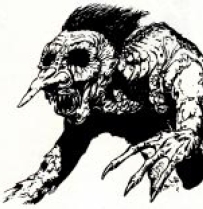
Bjerg-trolde
The bjerg-trolde's abilities are identical
to those of an ordinary troll. However, it
lives in desert and hilly regions, and its
hide is brown to tan.
Bug-a-boo
CLIMATE/TERRAIN: Any subterranean
FREQUENCY: Rare
ORGANIZATION: Tribal
ACTIVITY CYCLE: Any
DIET: Carnivorous
INTELLIGENCE: Low (5-7)
TREASURE: Individuals J (C)
ALIGNMENT: Chaotic evil
NO. APPEARING: 4-24
ARMOR CLASS: 7 (10)
MOVEMENT: 12
HIT DICE: 1 + 1
THAC0: 19
NO. OF ATTACKS: 1
DAMAGE/ATTACK: By weapon type
SPECIAL ATTACKS: Opponents have -2
on surprise
SPECIAL DEFENSES: Nil
MAGIC RESISTANCE: Nil
SIZE: M (5’ tall)
MORALE: Steady (11-12)
XP VALUE: 65
Bug-a-boos look like small and frail bugbears,
and they are often mistaken for
their larger kin, especially since they can
often be found on the outskirts of bugbear
territory. The ?boos live off whatever they
are able to scavenge from bugbear activities.
If seven or more ?boos are encountered,
it is 30% likely that they have a
bugbear leader close by. Occasionally,
?boos may be taken in by a bugbear tribe
and used as expendable front-line troops.
?Boos use whatever weapons are available,
usually ones of inferior craftsmanship.
?Boos speak their own dialect of the bugbear
tongue, which anyone who knows
the latter language can understand. They
get along well with other humanoids.
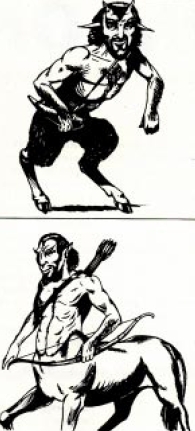
Callicantzari
Callicantzari
(singular: callicantzaros) is a
name most often used to describe centaurs,
but it may also be used in naming
forlarren, hybsil, korreds, satyrs, lamia,
and wemics. See "The Ungrateful Dead" in
DRAGON issue #138 for a description of
this creature as an undead, ghoul-like
monster.
Cwn wybr
The cwn wybr are simply hell hounds
with wings (MV 12, 24 fly (D); XP + 1 HD
modifier). Although too small to make
good mounts, cwn wybr make formidable
opponents in the sky. Cwn wybr will hunt
down any flying creature they can catch,
and they are sometimes tamed by fire
giants. They interbreed with normal hell
hounds to produce either winged or normal
offspring.
Far darrig
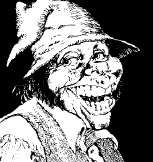
These larger than usual leprechauns (HD
1 - 1; SZ S (3? tall); XP 420) travel in groups
of 1-4 and dress in red?but, unlike red
caps, they don?t use blood for a dye. Far
darrig possess a mildly dangerous sense of
humor; their favorite pastime consists of
playing practical jokes on lawful beings
(e.g., putting a beehive in a paladins armor).
In addition to the usual leprechaun
powers, a far darrig can cast one cantrip
spell per round. It can also cast mage
spells from scrolls and, if a spell book is
available, can memorize one-first-level
spell per day.
Geanncanac
The geanncanac are closely related to
the far darrig. The only noticeable difference
between the two subraces is that the
geanncanac are more malicious, having an
alignment of chaotic evil. They will play
cruel and often deadly tricks on all who
fall into their clutches.
Hound-of-the-hill
The hounds-of-the-hill are large dogs
with white coats and red ears. They share
the statistics for war dogs (see the Monstrous
Compendium, ?Dog?) except for
having 3 HD, THAC0 17, a bite doing 3-9
hp damage, and the ability to run at 15
when following prey in a straight line (XP
65). The hounds-of-the-hill are close cousins
of the cooshee
(Monster Manual II),
and they may even be a cooshee/commondog
crossbreed. Though the hounds have
been known to run with the cooshee, the
cooshee seem to regard the hounds-of-thehill
as inferiors. Because of their poor
camouflage, the hounds-of-the-hill are not
highly valued by the sylvan elves. These
hounds are most commonly seen in the
company of half-elves, who feel some
kinship to these animals. Once dally, a
hound-of-the-hill can bark loudly, causing
all within 120? to make saving throws vs.
spells or be confused for 2-8 rounds.
Lidevic
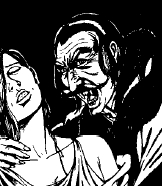
The lidevic is a vampire without the
ability to shape change into bat form (so it
cannot travel aerially except into gaseous
form), and it cannot summon animals to
assist it. However, the lidevic can polymorph
itself three times a day (for an
unlimited duration) into the image of a
victim's absent or dead loved one; the
lidevic has continuous ESP and can search
a potential victim?s mind while the lidevic
drifts nearby in gaseous form. This tactic
is especially effective at night when the
moon is full. The lidevic can be destroyed
in the same ways as can a vampire, and it
has all other traits that vampires share
(XP 3,000).
Makva
Makva are basically identical in game
statistics to night hags, except that they
cannot travel into the Ethereal or Astral
planes. Thus they cannot ?ride? sleeping
victims, nor do they need or make special
periapts. They cannot cast gates to summon
evil creatures, either. Because of this
deficiency and their chaotic-evil alignment,
makva are banished from night hag ?society
? and are usually found on the edges of
wild forests. Like night hags, makva are
able to employ magic missile and ray of
enfeeblement three times a day, at the
eighth level of ability. They are also able to
cast know alignment, sleep, and polymorph
self at will (the sleep power is of
the normal sort). Additionally, they have
the ability of advanced illusion, this being
the source of many gingerbread houses
that lost wayfarers report; they can cast
this spell four times per day.
Makva are invulnerable to charm; sleep,
fear, and fire- and cold-based attacks.
Silver or or +3 (or better) magical weapons
are required to harm a makva. Makva
have olive-green skin and coarse black
hair (XP 4,000).
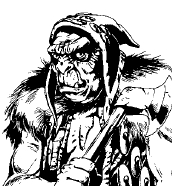
Norkes are closely related to orcs (perhaps
with a little hobgoblin in their veins)
and look very much like their kin, sharing
the same game statistics except as follows:
AC 4 (10); MV 9 (12 w/o armor); HD 1 (5-8
hp); Dmg by weapon type, + 1 for
strength; XP 35 and up; chain mail usually
used. Norkes live only in mountainous
areas, where they attack unwary travelers.
They look down on orcs and smaller
humanoids, enslaving them if possible.
Oread
Oreads are a subrace of nymphs found
in mountainous regions. Their abilities and
attributes are the same as nymphs, with
the addition of the ability to cast control
winds as 12th-level druids; they may do so
three times per day.
Prikolic
CLIMATE/TERRAIN: Any
FREQUENCY: Very rare
ORGANIZATION: Nil
ACTIVITY CYCLE: Night
DIET: Nil
INTELLIGENCE: Non-
TREASURE: Nil
ALIGNMENT: Neutral
NO. APPEARING: 1-6
ARMOR CLASS: 7
MOVEMENT: 6 (9 in werewolf form)
HIT DICE: 4
THAC0: 17
NO. OF ATTACKS: 1 weapon (1 bite in
werewolf form)
DAMAGE/ATTACK: 1-8 (3-8 in werewolf
form)
SPECIAL ATTACKS: Nil
SPECIAL DEFENSES: See below
MAGIC RESISTANCE: Nil
SIZE: M
MORALE: Special
XP VALUE: 270
The prikolics are dead werewolves that
have been animated as zombies. Prikolics
initially appear to be normal zombies, but
there is a 25% chance each time one takes
damage that it will change into an undead
"wolf-man" form, dropping its weapons
and biting savagely. In werewolf form,
only + 1 or better or silver weapons will
hit them. Cold-based, sleep, hold, charm,
and all mind-affecting and death-magic
spells have no effect on the prikolics,
although they may be turned by a cleric as
shadows. Holy water does 2-8 hp damage
to these creatures.
Ragnhilder
CLIMATE/TERRAIN: Rocky or mountainous
terrain
FREQUENCY: Very rare
ORGANIZATION: Group
ACTIVITY CYCLE: Any
DIET: Carnivore
INTELLIGENCE: Low
TREASURE: Q (C)
ALIGNMENT: Chaotic evil
NO. APPEARING: 1-8
ARMOR CLASS: 7
MOVEMENT: 15
HIT DICE: 4
THAC0: 17
NO. OF ATTACKS: 3
DAMAGE/ATTACK: 1-6/1-6/1-8 or by
weapon type
SPECIAL ATTACKS: Hurl rocks
SPECIAL DEFENSES: Regeneration,
camouflage
MAGIC RESISTANCE: Nil
SIZE: L (9’ tall)
MORALE: Elite (14)
XP VALUE: 420
The ragnhilder are as large as normal
trolls but are weaker (18 strength, +2
damage) and sometimes use hand-to-hand
weapons. Their favorite form of attack is
to hurl 5-10 lb. rocks out to 60?, doing 1-6
hp damage. The ragnhilder have stonegray
hides that conceal them 60% of the
time in rocky terrain.
Red cap
CLIMATE/TERRAIN: Temperate forests and
ruins
FREQUENCY: Very rare
ORGANIZATION: Solitary
ACTIVITY CYCLE: Any
DIET: Omnivore
INTELLIGENCE: Exceptional
TREASURE: G (reduce coinage by 90%)
ALIGNMENT: Chaotic evil
NO. APPEARING: 1
ARMOR CLASS: 4
MOVEMENT: 15
HIT DICE: 5
THAC0: 15
NO. OF ATTACKS: 3
DAMAGE/ATTACK: 1-6/1-6/1-3 or by
weapon type
SPECIAL ATTACKS: Hurl rocks
SPECIAL DEFENSES: See below
MAGIC RESISTANCE: Nil
SIZE: S (4’ tall)
MORALE: Steady (12)
XP VALUE: 420
Believed by some authorities to be a
subrace of leprechauns, the red caps are
closely related to the far darrig and geanncanac.
Red caps are remarkably strong,
having strengths of 18 ( + 2 to weapons
damage). Red caps occupy abandoned
castles and towers, from which they drop
rocks onto passersby for 1-4 hp damage
per 10? fallen. The red caps use the victim
?s blood to dye their hair and caps.
Though they aren?t undead, the red caps
may be turned by a cleric as shadows
because of their innate terror of priests.
Only swords (magical or not) of all weapons
will do damage to these creatures;
spells have normal effects, however. Red
caps have long claws and sharp teeth
which they use in combat. Red caps often
(70%) carry staves, of which 10% are
magical.
Saint Elmo's fire
Saint Elmo?s fire are will-o?-wisps that
live over water. They usually appear before
a violent storm, during which they
feed off the life-force of the dying sailors.
Skovtrolde
The skovtrolde are neutral-evil wood
trolls found in dark forests. Their statistics
are the same as for normal trolls, except
for these changes: #AP 1-20; HD 8; THAC0
13; SZ L (8? tall). They have low to average
intelligence and often make their lairs in
trees. Some skovtrolde (30%) carry crude
long bows; their arrows are -2 to hit and
do 1-4 points damage. These wood trolls
have skin that is dark-green and covered
with brown blotches. It is 85% likely that
the skovtrolde will not be seen in a vegetated
environment. If 15 or more trolls are
present, they are 70% likely to have trea-
sure type E.
Bibliography
Asbjornsen and Moe. Norwegian Folktales.
New York: Pantheon Books, 1960.
Barber and Riches. A Dictionary of Fabulous
Beasts. London: W & J MacKay
&
Co., Ltd., 1971.
Briggs, Katherine M. An Encyclopedia of
Fairies. New York: Pantheon Books,
1977
Briggs, Katherine M. Folktales of England.
Chicago: University of Chicago Press,
1965.
Christiansen, Reidar. Folktales of Norway
Chicago: University of Chicago Press,
1964.
Degh, Linda. Folktales of Hungary
Chicago:
University of Chicago Press, 1965.
Domotor, Tekla. Hungarian Folk Reliefs.
Bloomington, Ind.: Indiana University
Press, 1981.
Evans-Wentz, W.Y. The Fairy-Faith in Celtic
Countries. Secaucus, N.J.: University
Books, Inc., 1966.
Finlason, Jay. Hack. USENET, public
domain.
Haginmayer, Fanny. Ancient Tales in Modern
Japan. Bloomington, Ind.: Indiana
University Press.
Herm, Gerhard. The Celts. New York:
St.
Martin's Press, Inc., 1977.
Jones, T. Welsh Folklore and Folk Custom.
London: Reedwood Burn, Ltd., 1930.
Keightley, Thomas. Gnomes, Fairies, Elves,
and Other Little People. Avenel
Books,
1978.
Annis = Gentle Annie+9.
Aquatic ogre (merrow) = Moruand+41,
murduac+41, soetrolde+41, skrimst+44.
Berserker = Furors+29, vadember+19,
wut16.
Boggle = Bogy+9, bug+9,
kankas+19, koko+19.
Brownie = Bodachan sabhaill+42,
bwbachod+43, bwca+43,
dobie+9, domovik+31,
fenoderee+43, grogan+42,
kaukas+24, kobito+21,
niagruisar+44, nisse+44,
para+13, pukys+24.
Buckawn = Bwca+43, bwciod+43.
Bugbear = Bogy+9, bodach+41,
bugan+43, bull-beggar+9,
busbus+19, mormolux+17,
mumus+19.
Subrace = Bug-a-boo+9.
Centaur = Apothami+17, gandharva+18,
kentauroi+17,
kinnara+18, kimpurusha+18,
phere+17.
Subrace = Callicantzari+17.
Cockatrice = Calcatris+14,
calcatrix+29, icheumon+17.
Cooshee = Ce sith+42, cir
sith+42.
Subrace = Hound-of-the-hill+9.
Cyclopskin = Arimaspi+34,
kuklops+17.
Doppleganger = Brag+9, co-walker+9,
fetch+42, fylgja+44, vardogr+44,
waff+9.
Dragon, general = Gwiber+43,
vipera+29, WURM+16.
Dragon, brass = Moko+28.
Dragon, green = Linnorm+44.
Dragon turtle = Payshitha+44.
IN THE FLESH?
Dryad = Aloustinai+17 (may
also be oread), hulder+44,
jashtesme+1, rusalka+31
(may also be nereid).
THE THIN ICE
Duergar = Jugenderinnerugen+40.
ANOTHER BRICK IN THE WALL, PART I
Dwarf = Abac+41, arndt+40,
avanc+43, corrigan+42,
dvergar+44, dverge+44,
dvorgurin+41, fain+41,
guerrionet+42, hairdmandle+37
(plural:
hairmandlene), hosegueannet+42,
marchen+40,
nain+42, oennerbanske+15,
poulpiquet+42, tusse+44,
vui+28, wui+28,
zwerge+16.
THE POST-WAR DREAM
Elf = Alfar+44, ellyllon+43,
esprit follet+42, fadet+14,
follet+42, hidfolk+44,
hulder+44, huldrafolf+44
huldukona+44(female), liosalfar+44,
lutin+14,
ouph+9, vaettir+44,
vattar+12.
YOUR POSSIBLE PASTS
Elf, drow = Daimones epichthonioi+17,
dock-alfar+44,
henkie+42, trow+42.
ONE OF THE FEW
Elf, sylvan = Dames vertes+14.
THE HAPPIEST DAYS OF OUR LIVES
Elfin cat = Cait sith+41.
ANOTHER BRICK IN THE WALL, PART II
Faeries, generic = Daoine maithe+41,
denee shee+41, sheehogue+41,
shingawn+41, tylwyth teg+41,
wichthln+16.
MOTHER (MOVIE VERSION)
Genie = Genius+29 (singular
form of genni), juno+38
(female), lares+29, stoicheia+17.
WHEN THE TIGERS BROKE FREE
Ghost = Bhut+18, gangferd+44,
hantu+25, kasa+21, kuei+5,
maneen+41, mora+31,
nair+44, onyudu+21, siabrae+41,
taidhbhse+41, tais+41.
GOODBYE BLUE SKY
Giant, general = Athach+42,
jatte+44, orchi+20, stalo+23.
WHAT SHALL WE DO NOW? (OUTTAKE)
Giant, hill = Fanggen+37.
YOUNG LUST (COMPLETE VERSION)
Giant, stone = Foawr+43,
fomorian+42.
ONE OF MY TURNS
Giant, storm = Foawr+43,
fomorian+42,
Fankenmannikin+37, fomor+41,
jotun+44, orculli+23.
DON'T LEAVE ME NOW
Gnome = Berg-monche+16, coblynau+43,
heinzelmannchen+16, husse+44,
genemos+17,
gommes+14.
ANOTHER BRICK IN THE WALL, PART 3
Goblin = Bakemono+21,
bogy+9, coblyn+43 (plural:
coblynnau), fossegrim+44,
fuath+42, ghello+17,
grim+44,
kirkegrimm+44.
THE LAST FEW BRICKS
Gorgon = Catoblepas+29.
GOODBYE CRUEL WORLD
Griffon = Grup+17, gryphus+29,
karga+39, kirni+21,
senmurv+31, sumargh+31.
HEY YOU
Grippa = Kappi+21.
IS THERE ANYBODY OUT THERE?
Groaning spirit (banshee) = Aine+41,
baobhan sith+42, bean chaointe+41,
bean-nighe+42, bean-tighe+41,
caoineag+42,
caoteach+42, cwn mamau+41,
gwrach y rhibyn+43.
NOBODY HOME
Guardian familiar = Mikanko+21.
VERA
Hobbit =
Banakil+45, holbytla+45, kud-dukan+45,
kuduk+45,
periannath+45.
BRING THE BOYS BACK HOME
Harpy = Arpuiai+17.
THE HERO'S RETURN
Hell hound = Cwn mamau+48,
devil's dandy dog+9.
Subrace = Cwn wybr+43.
THE GUNNERS DREAM
Hobgoblin = Bwgan+43, dobby+9,
lob+9, puki+41.
PARANOID EYES
Hound of ill omen = Cwn annwfn+43,
gabriel hound+9, ratchet+9, yellhound+9.
COMFORTABLY NUMB
Succubus (female), incubus (male) = Alp+23(female),
mara+35, mare+9, mora+19,
painajainen+23 (female).
GET YOUR FILTHY HANDS OFF MY DESERT
Kobold = Alraune+16, biersal+16,
galgenmannchen+16,
oarauncle+16.
THE FLETCHER MEMORIAL HOME
Korred = Corriquets+14, crion+14,
guerrionets+14, hommes
cornus+14, korriks+14.
SOUTHAMPTON DOCK
Leprechaun = Clurican+41,
leith brog+41, luchorpain+41,
luchryman+41, lurican+41,
lurikeen+41.
Subrace = Far darrig+41
(also called fear deara+41 and
redman+41).
Subrace = Geanncanac+41
and red caps+41 (also called
bloody caps+33, dunters+33,
powries+33, and red
combs+33).
THE FINAL CUT
Merman = Ben-varrey+43, ceasg+42,
daoine mara+42,
dinny-merra+43, gorgona+17,
hakenmann+44,
havfrue+16, havmand+44,
maigndean-mhara+42,
maigndean-mhara+42, maighdean
na tuinne+42,
maremind+44, meerfran+16,
meerweiber+16,
morgan+42, murughach+41,
watermome+16,
wut-ian uder4.
THE SHOW MUST GO ON
Nereid = Naiad+17.
IN THE FLESH
Nighthag = Cailleach bheur+42,
calill eaca+41, haetes+9 (the
ae is a ligature), hexe+16,
krisky+31, nocnitsa+31,
plaksy+31.
Subrace = Makva+3
(also called a wood hag)
RUN LIKE HELL
Nixie = Dracae+14, fenetten+14,
fossegrim+44,
fuath+42,
hakelmanner+16, kallraden+44,
nacken+44,
nakineiu+10, nakk+10,
nakki+13, nickelmanner+16,
nikkisen+43, seemannlein+16,
stromkarl+44,
vough+42.
NOT NOW JOHN
Nymph = -
Subrace = Oread+17
(also called anemikais+17 and
anemogadzoudes+17)
WAITING FOR THE WORMS
Ogre = Drakos+17, drakaena+17(female),
lamid+17
(female), malbrou+14, tengu+21,
yamauba+21.
THE TRIAL
Orc = -
Subrace = Norke+37.
TWO SUNS IN THE SUNSET
Pegasus = Arion+17.
OUTSIDE THE WALL (MOVIE VERSION)
Penanggalan = Azeman+36.
Pixie = Meryon+9, duine sith+42, pobel vean+6, tylwyth+43.
Phoenix = Bennu+8, feng+5, ho+21, hwang+5, o+25.
Roc = Angka+2, bar yachre+22, pyong+5.
Satyr = Callitrice+11, fauni+20, pane+17, urisk+42, silvani+20.
Troll = Elfor+44, ellefolk+44,
foddenskkmaend+12 (the ae
is a ligature), fulde+12,
huldre+44, maanvaki+13,
pysslinger+44, thusser+44.
Subrace = Bjerg-trolde+44,
skovtrolde+23 (also called
skogsra+23), ragnhildur+44.
Unicorn = Biasd na srogaig+41, ch'i-lin+5, monokeros+17.
Vampire = Bampuras+17, sukuyan+38,
tumpaniaios+17,
upior+27, upir+31,
vrykolakas+17 (plural:
vrykolakes)
Subrace = Lidevic+19.
Werewolf = Borbolakas+17,
kuldottfarkas+19, legarou+38,
loup-garou+14.
Subrace = Prikolics+30.
Wight = Haug-bui++41, tuath de danaar+41, vitr+44.
Will-o-the-wisp = Annequins+14,
chandelas+32, chere dansante+14,
culards+14, eclaireux+14,
elf fire+9, ellylldan+43,
fioles+14, fuochi fatui+20,
heerwische+16,
huckepoten+16, ignis fatuus42,
irrbloss+14,
irrichter+16, jack o' lanthorn+9,
joan-in-the-wad+9, loumerottes+14,
luctenmaneken+16, lygteman+44,
lyktgubbe+44,
merry dancers+42, nimbleman+42,
rusalky+31,
spunkies+9, swetylko+7,
tan noz+14.
Subrace = Saint Elmo's fire+26.
Wyvern = Wivre+14.
Yeth-hound = Wish hounds+9.
Endnotes
l--Albanian;
2--Arabic; (Yarbay, Al-Qadim,
Calimshan, Baklunish nation-states)
3--Bulgarian;
4--Cheremissian;
5--Chinese; (Chinese
Mythos, Ch'in, Shou Lung, T'u Lung)
6--Cornish;
7--Czechoslovakian;
8--Egyptian (Egyptian
Mythos, Aegypt);
9--English;
10--Estonian;
11--Ethiopian;
12--Faroese;
13--Finnish (Finnish
Mythos);
14--French (Francia);
15--Friesian;
16--German (Germania);
17--Greek (Greek
Mythos, Achaea);
18--Hindu (Indian
Mythos);
19--Hungarian;
20--Italian (Italia);
21--Japanese (Japanese
Mythos, Nippon, Kozakura, Wa);
22--Jewish;
23--Lapp;
24--Lithuanian;
25--Malayan;
26--Mediterranean;
27--Polish (Poland);
28--Polynesian;
29--Roman;
30--Rumanian;
31--Russian; (Rus);
32--Sardinian;
33--Scottish Lowland (Caledonia);
34--Scythian;
35--Slavic;
36--Surinam;
37--Swiss (Helvetia, Savoy);
38--Trindadian;
39--Tukish;
40--Vendish;
41--Celtic, Irish, and Goidelic
(Celtic Mythos);
42--Brittany, Brythonic, and
Highland Scottish (Caledonia);
43--Insular Brythonic,
Manx, and Welsh (Cymru);
44--Danish, Icelandic, Norwegian,
and Swedish (Norse Mythos);
45 -- The Lord of the
Rings, Tolkien.
LETTERS
Also known as...
Denmark
Dear Dragon:
I am writing in response to Ethan Ham?s
recent article, "Also Known As . . . the Orc"
(issue #158). Using alternate monster
names is a
good way to keep players guessing?especially
in a low-level campaign in which characters
shouldn?t automatically know what they?re
fighting and how to defeat it. However, as a
student of Scandinavian languages, I was very
disappointed to see several errors in the lists
of
names:
?The names sotrolde (for aquatic ogres),
havmand and havfrue (for mermen),
and skovtrolde
(for wood trolls) are all Danish--not
Celtic, German, or otherwise.
?The name haug-bui (for wights) is not
Celtic,
either, but Old Norse (compare the Norwegian
word for the ?walking dead?: haugebonde).
?The names mara (for the succubus) and
skogsrå (for female wood trolls)
are both
Swedish.
?Finally, the name huldrafolf listed for
elves
is indeed Scandinavian, but it is a misprint;
the
correct spelling should be huldrafolk.
Most DMs, I realize, care little about those
technicalities. But to me, having a Celtic NPC
call
a monster by a Nordic name would ruin the
whole idea behind Ham?s article (that names
vary from culture to culture).
Kimberley E. Usher
Charlotte NC
(Dragon #161)
Your input is appreciated. Having done a fair
amount of research in the past, I know that
such errors often lie in the source material
itself. I would like to point out that name
confusion
among cultures can be helpful to the DM; a
Celtic NPC might have heard a dying Nordic
NPC refer to his slayer as a skrimst, which
is the
Scandinavian name for an aquatic ogre (known
in Celtic society as a soetrolde). The Celtic
man
might then spread rumors about this “new
monster” and have the foreign word produce
much confusion as to the killer’s true identity.
On another topic, I know from experience
that renaming a monster and making minor
changes in its appearance or abilities may
seem
simplistic, but it has dramatic effects in
actual
play, often generating fear and respect for
the
creature far out of proportion to the monster’s
actual power. I once wrote about a gaming
episode in which a party (including one of
my
characters) had a night encounter with a red
dragon that shot beams of light from its eyes
like spotlights (like Smaug in the animated
version of The Hobbit); when the dragon
asked
for our mules and treasure, we gladly gave
them up. I’m fairly sure we could have killed
the
monster—but we lost our nerve and ran for
it
instead.
Word from Israel...
In issue #158, you?ve published an article
called "Also Known As . . . the Orc." In this
article, you mentioned a language called "Jewish.
" I'm sorry to tell you, but there isn?t such
a
thing as a Jewish language! The "Jewish" language
is called Hebrew.
The above article didn't mention many Hebrew
monster names, like the ones that follow:
Elf: Ben lilit (male), bat
lilit (female)
Dwarf: Gamad, gamdaii
Faeries: Feyah, shafririt
Gnome: Nanass
Demon: Shedon, mezick
Vampire: Arpad
Skeleton: Shaeled
Dragon: Derakon, leteah ma'chonefet
(ch as in loch)
In spite of the above, the magazine is great.
Shay Ceasry
Rehovot, Israel
(Dragon #166)
In "Also Known As . . . the Orc," the label
"Jewish" did not refer to a language; the
word
was among a group of endnotes showing the
cultural origins of the monster names, as
noted
in the section, ?How to use the AKA list.?
Several
of the other names given in the endnotes on
page 31 of that issue are not languages, either.
However, your additional ?AKA? names for
AD&D® game monsters is much appreciated.