| Enameling | Engraving | Metal plating | New metals | Conclusion |
| AD&D | Dragon magazine | - | - | Dragon #148 |
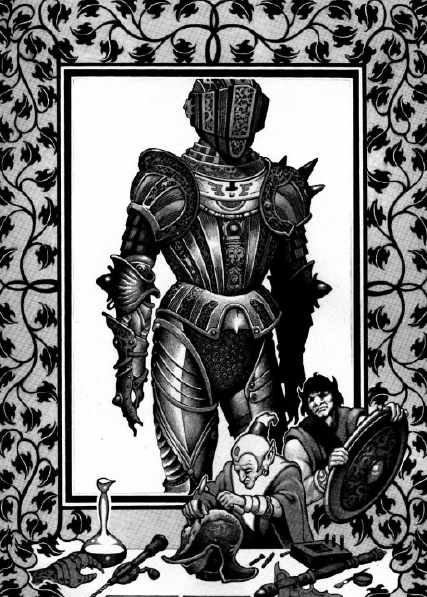
Appearances count in
fantasy
campaigns, particularly for
fighters, cavaliers, paladins, and
other glory-seeking warriors. If
such warriors are short on impressive
magical items, then with or without decoration-
be it enameling, engraving, or plating
with a unique metal-can make even
mundane weapons and armor unique and
attractive. Herein are some suggestions
for
outfitting fighters, whether magical arms
and armor are available or not.
Assuming that the majority of weapons,
suits of armor, and horse barding in the
many AD&D®
game worlds are forged
from iron and steel, much room is left
to
elaborate on various means of decoration
and various optional metals to be used
as
either base material or plating. Some campaigns
may limit the metals and means of
decoration that are available; a land still
in
its Bronze Age will not likely employ mithral.
The DM must place restrictions as he
sees fit to harmonize these guidelines
with
his game world.
The decoration of personal arms and
armor can indicate the identity of the
owner and his social class, or can simply
be an expression of current fashion. Decoration
beautifies and increases the value of
many items, bringing both greater wealth
and distinction to the owner. The knowledge
that he alone owns plate armor made
by a famed craftsman, or a sword forged
of a metal not employed in his native land,
can do much for a warrior?s social standing,
if not his ego.
Decoration need not be based upon an
individuals personal taste. Rather, it
may
indicate membership in an organization
or
nationality in much the same way heraldry
does. For instance, mercenaries of
the Bloody Hand Company may all carry
swords with hilts enameled red; soldiers
from the royal palace may wear silverplated
armor; and so on.
Almost any combination of the various
methods of decoration described below
can be used. By employing one or more of
them, players and Dungeon Masters alike
can create interesting items of worth to
enhance everything from individuals to
entire societies.
ENAMELING
Applied to a suit of armor or horse
barding, enamel certainly makes a character
stand out in a crowd, regardless of the
color of enamel chosen. Red and black,
because of their association with blood
and death, are commonly favored colors
among warriors. The enameling has no
effect whatsoever on combat, nor does it
significantly increase an item's encumbrance
for game purposes: However, the
value of the item is generally increased
by
10% if properly enameled. Enamel cannot
be used on leather, studded leather, or
padded armor, and is rarely used to coat
more than the hilt or handle of most
weapons. Limners and some specialized
armorers can do enameling; see Table 1
for details.
The drawback is that enameled items
frequently chip and flake, especially during
rigorous movement or combat, decreasing
their overall value. Thus,
enameled armor and weapons must be
touched up frequently. This repair work
costs 1-10% of the original value of the
repaired item.
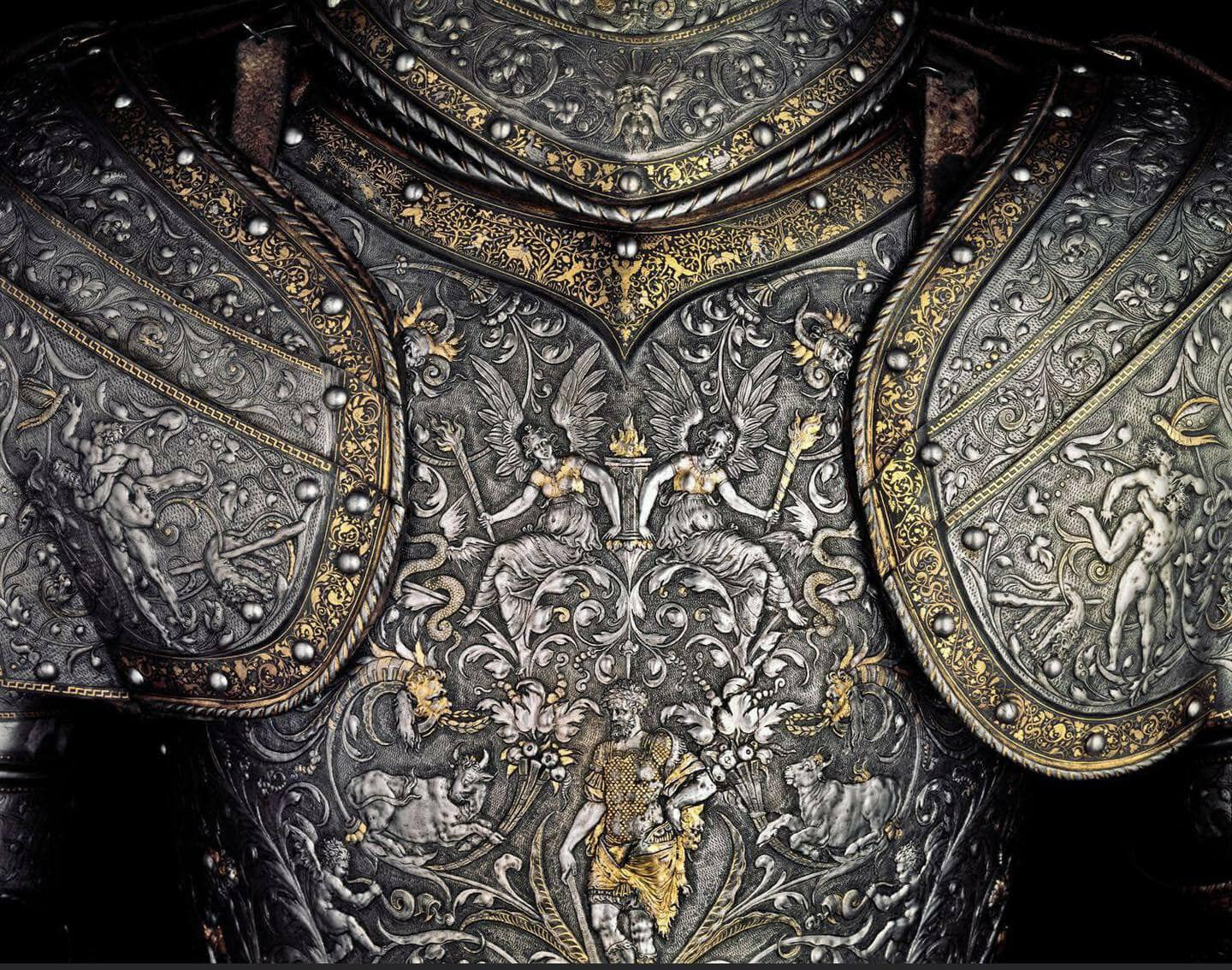
ENGRAVING
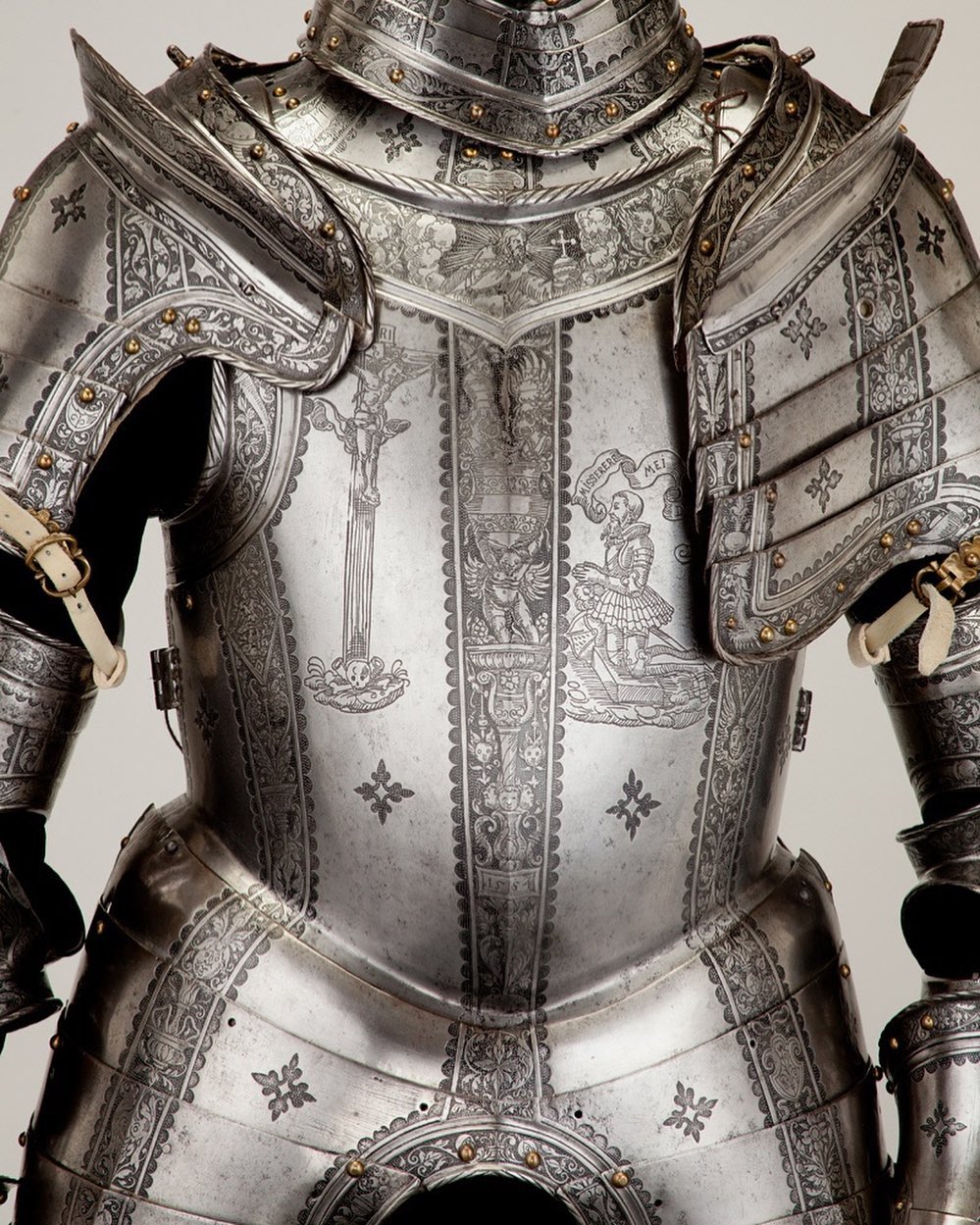
Engraved armor became popular in
15th-century Europe and was commonplace
among kings and lesser nobles. It
was worn at ceremonies and social functions,
and soon became a mark of social
status and high fashion. By that time,
because of the increased use of gunpowder,
armor was of little military use anyway.
In pregunpowder fantasy worlds,
PCs may still deck themselves out in such
finery.
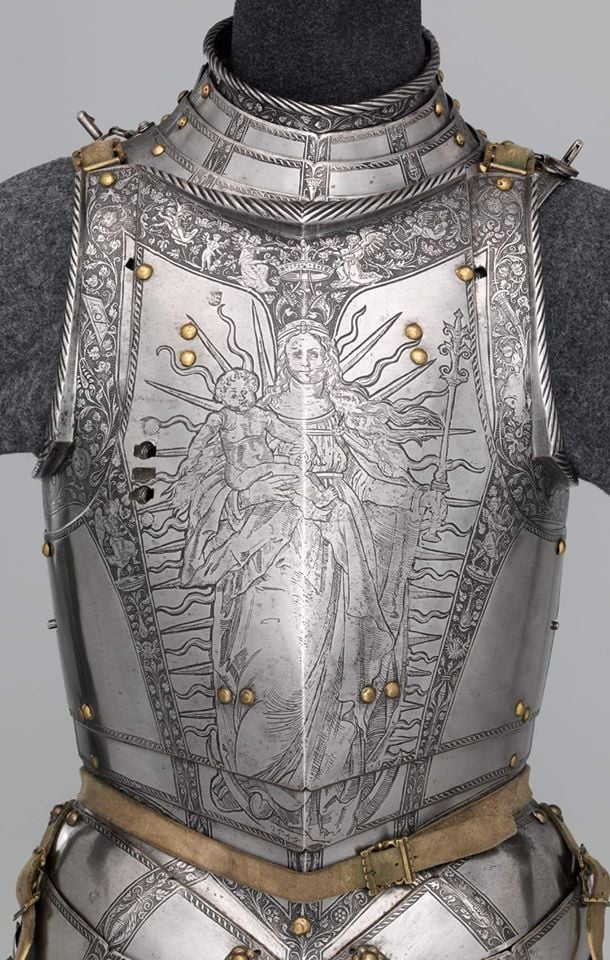
Simple engraving denotes uncomplicated
lines and basic etchings on the armor or
weapon in question. Table 1 gives details
on fees, time involved, and results. Simple
engraving on a short sword costs 16 sp,
but the finished sword is worth 12 gp.
Complex engraving, in addition
to adding
complicated decorative etching and
symbols, includes the addition of heraldic
devices and nonmagical runes and script.
Table, 1 has details on this type of work.
The fee for having a two-handed sword
engraved with complex designs is 15 gp,
but the new value of the sword is 60 gp.
Elaborate engraving denotes fine, origi-
nal artwork, incredible detail, and the
overall resulting beauty of the item
worked upon. The fee for this type of
work is equal to the item?s original cost;
see Table 1 for other
details. Simple plate
mail can be worth 2,000 gp, and a dagger
worth 10 gp!
Engraving work is generally reserved
for various types of plate armor, but
leather and studded leather may also be
worked, as well as shields and various
weapons. These items so decorated are
not proper for combat purposes; if they
are taken into battle or into any other
situation in which the DM decides they
incur damage, they lose l-20% of their
value, and repair work may not be possible.
Damaged metallic items (plate mail,
barding, etc.) with simple engraving have
a 25% chance of being suitable for restoration;
metallic items with complex engraving
have a 10% chance of being suitable
for restoration; all leather items and
those
metallic items with elaborate engraving
cannot be restored at all. Repairs, when
possible, cost 25% (for simple engraving)
or 50% (for complex engraving) of the
original value of the damaged item. It
is
easy to see why this type of decoration
is
so often reserved for social functions.
Unfortunately, professional engravers
are few and rare, and their work is highly
coveted by kings and noble lords. It will
be
difficult for the average character to
obtain
the services of such an individual,
because it is not just a matter of having
the money available. A king may want to
keep all high-quality work for himself.
Elves are master engravers, and the DM
may add 25% to all stated fees and 50%
to
all resulting values of the items obtained
through elves. Gnomes are also quite
skilled and may add 15% and 30% to these
values, respectively.
Table 1
Decorations for Arms and Armor
| Decoration for Arms and Armor | Cost of decoration* | Increase in value of item* | Time Required |
| Enameling | 5% | 10% | 1-6 days |
| Simple engraving | 10% | 50% | 1-2 weeks |
| Complex engraving | 50% | 100% | 1-3 |
| Elaborate engraving | 100% | 300-500% | 7-12 |
Table 2
Plating With Precious Metals
| Useable metals | Cost of plating* | Increase in value of item* | Time required |
| Copper | 100% | +10 | 1-4 weeks |
| Bronze | 100% | +25 | 1-4 weeks |
| Silver | 100% | +50 | 1-4 weeks |
| Electrum | 100% | +100 | 1-4 weeks |
| Gold | 100% | +150 | 1-4 weeks |
| Platinum | 100% | +200 | 1-4 weeks |
| Mithral | 100% | +200 | 1-4 weeks |
| Adamantite | 100% | +500 | 1-4 weeks |
Table 3
Base Metals For Arms and Armor
| Usable metals | Cost of item made from metal * | Encumbrance increase | Bonus or penalty |
| Copper | 75% | -50% | Weapons break on a to-hit roll of 1-3; +2 to AC |
| Bronze | 90% | - | Weapons break on a to-hit roll of 1-2, +1 to AC |
| Meteorite iron | Special | +50% | Weapons gain +1 to hit**, no bonuses for AC |
| Mithral | 500% | - | Weapons gain +1 to hit and damage***, -1 to AC |
| Adamantite | 1,000% | - | Weapons gain +2 to hit and damage****, -2 to AC |
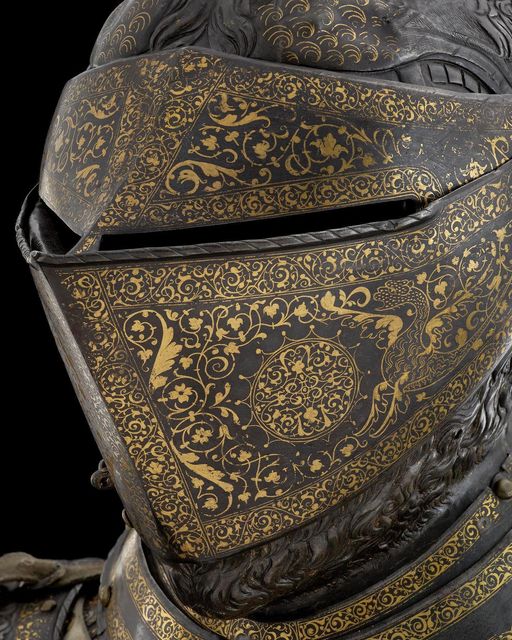
Metal plating
Silver, electrum, gold, and platinum are
generally considered too soft for the forging
of armor and weapons used in combat,
However, it is possible to have a character
?s arms and armor plated with such.
Copper, bronze, mithral, and adamantite
platings are also available, even though
these latter metals can be used as pure
or
alloyed base materials for making metallic
items. Some fighters simply can?t afford
such extravagances as mithral and adamantite,
but they won?t settle for anything
less than silver or gold.
The process of plating with any metal
will cost the buyer the exact value of
the
item to be worked upon; the buyer must
also provide the armorer with the equivalent
of 25 coins of the desired metal (see
Table 2 for other details).
Plating has no
effect on combat, nor does it add to the
encumbrance of the plated item. Any sort
of engraving on precious-metal plating
can
create a valuable item indeed.
New Metals
Iron and steel are the metals commonly
employed in the making of arms and armor
in most AD&D® game worlds.
Man,
however, did not always have access to
these superior metals?and in most fantasy
worlds, even better metals are available.
Here are a few metals for use in forging
armor and weapons, with the bonuses and
penalties they incur.
Copper: One
of the first metals to be
used in the making
of armor, weapons,
and various other
utensils, copper is a
relatively soft metal
compared to steel or
iron. (Try hammering
a penny to see how
pliable it is.) Any
weapon forged from
copper will break
if it makes a natural tohit
roll of 1, 2, or
3. Likewise, copper
armor is two armor
classes below what it
would normally be
(a suit of copper chain
mail would be AC
7), but it is much lighter
than a normal sort
of armor (see Table 3).
Copper tarnishes
quickly, so copper items
require weekly upkeep
to look nice; other
wise, they eventually
turn blue from oxidation.
For all their penalties
and problems,
copper items are
beautiful when
polished and cared
for.
Bronze: An
alloy made from copper and
tin, bronze is an
attractive metal but still
inferior to common
iron and steel. Table 3
reveals the costs
and penalties of using
bronze in making
armor and weapons.
[The bronze
plate mail in Unearthed Arcana,
page 75, uses
leather or padded
underarmor instead
of chain mail, and it is
nor constructed
like normal plate mail—
back protection
is worsened, and the
armor is very
heavy,] Like copper, bronze
is beautiful when
cared for properly.
Meteorite iron:
This material is composed
of iron and carbon,
and is exceptionally
good for the making
of weapons
and armor. DIVINE
INTERVENTION may warn
a character of a
meteorite strike, even
allowing him time
to set up a forge and
work the metal while
the meteor is still
hot; Table 3 has
details on this metals use
in weapons and armor.
The weapons and
armor made from meteorite
iron are often
considered holy and
are frequently magicked
into greater weapons
still. Excalibur
was one such weapon
made by this
process.
Mithral: Coveted
by elves, mithral is a
rare and beautiful
silvery metal, quite
superior to iron
and steel. Armor and
weapons forged from
mithral-alloyed iron
are generally only
obtainable from elves.
The elves almost
never sell mithral, so
unless the item is
a gift, the average adventurer
would never have
a chance of
owning anything made
from it. Table 3 has
details on mithral-alloyed
items. [Interested
readers can consult
DRAGON®
issue
#123, "Fire
For Effect!” for more details.]
This rare metal is
made rarer still because
of the extensive
hoarding practiced by the
elves. Some of this
race?s greatest magical
weapons are forged
from mithral.
Adamantite:
Superior to and even rarer
than mithral, adamantite
alloys are second
to none in terms
of strength. Adamantite
itself is pliable
but very difficult to work
when alloyed. Adamantite
can only be
found deep beneath
the earth, and so the
black metal is very
hard to obtain; human
miners simply don?t
go that deep. Drow,
the dark elves, are
rumored to have an
abundance of it,
but they have somehow
tainted the forging
process with their dark
magicks so that drow-forged
adamantite
immediately deteriorates
when exposed to
sunlight on the surface
world. Luckily, a
few clans of deep-delving
dwarves have
come across the metal
and utilized it to
meet their own needs.
The few
adamantite-alloy
items that exist on the
surface world are
most certainly dwarfmade.
[See DRAGON®
issue #l23, “Fire For
Effect!”
for other details.]
CONCLUSION
These suggestions can put more variety
into a game, allowing the players to make
their characters unique. Aside from this
and the overall increase in value of common
arms and armor, decoration allows
for many role-playing situations. An engraved,
gold-plated suit of plate
mail can
sweeten the pot in a joust in which the
armor is exchanged or ransomed at the
end. Perhaps the local king or lord will
present a beautifully crafted suit of mail
or an elaborately decorated sword to a
character who has performed some great
deed in service to the realm. Such items
will sometimes be found in treasure
hoards. The Dungeon Master can make
them available in many ways.
Remember: The mundane need never be
dull and boring.
AUGUST 1989