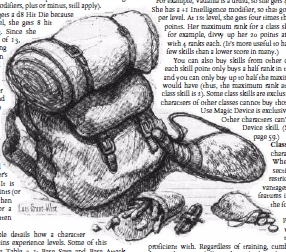
by Ian Chapman
| - | - | - | - | - |
| 1st Edition AD&D | Dragon magazine | - | Master Equipment List | Dragon #124 |
| Backpack Slinger-Slasher | - | - | - | - |
According to the D&D® game rules, a
backpack is a container worn on the back
that is able to hold up to 400 cn (or 300 gp,
in the AD&LD® game) of material, while
leaving both of the wearer's hands free.
While that description is partly accurate,
there is no encumbrance difference
between carrying a sack of goods, having
goods strapped to the body, or carrying
them in a backpack. Anyone who has used
a backpack for real-life mountaineering
knows that this is wrong.
There is a good reason why modern
soldiers, mountain climbers, and hikers
use backpacks almost exclusively for carrying
equipment. I?ve had hiking experience
in the Olympic Mountains, and I can
say that there is a tremendous difference
between carrying 60 lbs. of assorted goods
in your arms and carrying 60 lbs. of goods
in a pack. When something is in a backpack,
there is no extra encumbrance
beyond the item?s own weight; if an object
is carried, there might be some extra
encumbrance from the resulting uneven
weight distribution.
Any given backpack holds a certain
amount of material, as determined by the
amount of available space within the backpack.
The AD&D game system (in the
Permanent Character Folder's wraparound
cover) gives the volume within a backpack
as 3 cubic feet, equating 100 gp with 1
cubic foot. Because the backpack essentially
eliminates the portable aspect of encumbrance,
only the actual weight for most
items needs to be considered. A caltrop is
not especially encumbering if you don?t
have to deal with the sharp edges. Thus,
for purposes of figuring the porter?s
encumbrance, a revised encumbrance
figure (the item?s actual weight) should be
used. For purposes of packing things within
the backpack, however, the old figure
for encumbrance is used, to note the
difficulty in packing oddly shaped items
together within a limited space.
Unfortunately, calculating actual item
weights involves a lot of judgment calls
and estimations, since both the D&D and
AD&D games fail to give exact weights
(only encumbrance values) for most items.
A table showing some of my own estimations
appears with this article. Assume
that, for all practical purposes, 1 cn (D&D
game) equals 1 gp (AD&D game) throughout
this article.
Thus, when calculating the encumbrance
of materials in a backpack, the
weights of the contents are totaled and
added to the 20-cn encumbrance of the
backpack itself. If a spell book takes 450
gp of encumbrance within a backpack, it
might only encumber the person by 150
gp. When adding weights together for the
bearer's encumbrance, use the chart
included in this article.
Though a backpack has very distinct
advantages (particularly to spell-casters), it
also has a couple of equally distinct but
unavoidable disadvantages. First, no object
over 3' long may be placed in a backpack
(this restriction obviously applies to many
items). Second, it takes two rounds to get
something out of a backpack: one to drop,
open, and rummage through the pack; the
second to find and withdraw it. Certain
backpacks have pockets, however, as
explained below. An object carried in a
pocket takes but one round to retrieve.
Rangers learn the efficient use of the
backpack out of necessity. As a result, they
know how to maximize efficiency and are
able to apply good judgment when using
a pack. Instead of throwing everything
randomly into a pack, which is usually
assumed to occur, rangers are capable of
prioritizing items in packing. Rangers
get a 10% bonus to the encumbrance
capacity of any type of pack (including
individual pockets -- explained later).
This never reduces the weight of the
packed items. Also, a ranger usually
knows what items will be needed the
most or the quickest. Thus, the ranger is
not assessed the one-round penalty
when retrieving an object from the backpack
(though it still takes a round to
actually open the pack). This ability may
be gained by other character classes as a
nonweapon proficiency.
Weights Of Standard Items
| Item | Weight in gp or cn |
| Belt | 1 |
| Belt pouch, large | 5 |
| Belt pouch, small | 2 |
| Book, large metal-bound | 50 |
| Boots, hard | 30 |
| Boots, soft | 10 |
| Bottles, flagons | 30 |
| Caltrop | 1 |
| Candle | 1 |
| Cord, 10' | 1 |
| Crystal ball | 100 |
| Flask, empty | 3 |
| Flask, full | 10 |
| Gem (with protective wadding) | 1 |
| Hand tool | 3 |
| Holy water, potions | 25 |
| Jewelry, large | 40 |
| Jewelry, small | 1-5 |
| Lantern | 50 |
| Mirror | 1 |
| Purse | 1 |
| Rations, iron | 49 |
| Rations, standard | 150 |
| Robe/cloak | 25 |
| Sack, large | 5 |
| Sack, small | 1 |
| Scroll case, bone | 10 |
| Scroll case, leather | 5 |
| Spike | 2 |
| Tinderbox | 1 |
| Torch | 10 |
| Wand: bone/ivory case | 30 |
| Wand: box | 40 |
| Wand: leather case | 10 |
| Waterskin, empty | 1 |
| Waterskin, full | 50 |
Some of the backpacks listed in this
article have a certain number of pockets.
Each pocket has an encumbrance capacity
of 25 cn, or 28 for a ranger. This encumbrance
capacity is added to the base capacity
of the backpack. Each pocket must be
treated as a separate entity within the
pack. Thus, if a pack has three pockets, an
extra item of 75 cns encumbrance cannot
be added, though three items of 25 cn
each can be.
Historically, there are many different
types of backpacks. As a general rule, all
fall within the following categories: soft,
one-chamber rucksacks; soft, twochamber,
large backpacks; and woode-nframed
two-chamber, large backpacks. All
three varieties of backpacks are available
with or without pockets.
The soft, one-chamber rucksack without
pockets is the backpack that all AD&D
game players know. This backpack holds
up to 450 cn (495 cn for a ranger) of
encumbrance. It can also be made or
bought with up to three pockets (25 cn
each). Without pockets, this backpack
costs 2 gp; with pockets, it costs 5 gp
(special order).
The soft, two-chamber, large backpack is
a larger version of the rucksack. One large
chamber is generally for foodstuffs; the
other is for clothing and other equipment.
This backpack holds up to 800 cn (880 for
a ranger) of encumbrance and can be
made with as many as six pockets (25 cn
each). It costs a base of 10 gp, or 30 gp
with pockets (special order).
The wooden-framed, two-chamber, large
backpack is similar to the soft, twochamber
backpack, but it?s the supporting
frame makes the framed pack more rigid
(and thus more efficient and roomier).
This backpack holds up to 1,600 cn (1,760
cn for a ranger) of weight plus tent and
bedroll. It can also be made with six pockets
(25 cn each). All framed packs must be
specially ordered and cost 100 gp without
pockets and 120 gp with pockets.
All backpacks have a base encumbrance
value to which the total weight is added.
Rucksacks have a base encumbrance of 20
cn; soft, large backpacks have a base
encumbrance of 40 cn; and framed, large
backpacks have a base encumbrance of
100 cn. Any large backpack (soft or
framed) must be made for the character?s
approximate height. If this is not done, the
backpacks total encumbrance (base value
plus contents weight) is multiplied by
150%.
Finally, the weight of each individual
item should be considered. A list of commonly
used items that fit into a backpack
is included here. I?ve generally assumed
that any weapon carried in a backpack
weighs half its encumbrance value. If a
question arises concerning items not
included in this list, that item weighs
exactly half its encumbrance value (or a
reasonable amount to be decided by the
DM). Note that certain items weigh far less
than half their encumbrance value; this is
due to a difference between the space that
object occupies and its actual weight (such
as a caltrop). Other objects offer a negligible
advantage by being carried in a pack.
In this case, the object?s weight is also its
main encumbrance (as is the case with
water skins or flasks of oil). This table is
not intended to replace the encumbrance
table on page 225 of the Dungeon
Masters
Guide; it is used only to find the total
weight of objects in a backpack for encumbrance
purposes.
AUGUST 1987
Back Pack Slinger-Slasher (Inert Weapon)