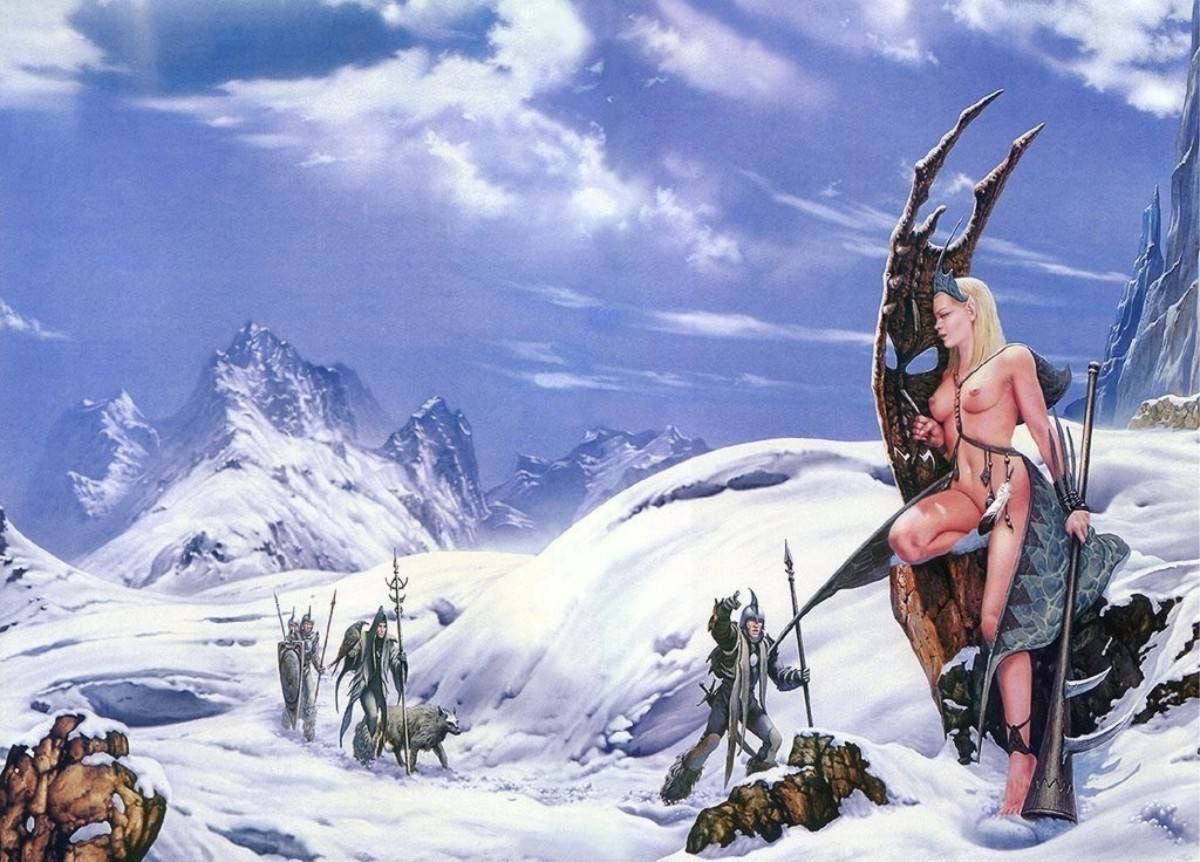
IN THE FROST
AND THE SNOW
A new elven character race: the snow elves
| Chilling appearances | An icy history | The cold clans | Matters of worship | - |
| 1st Edition AD&D | - | Dragon #155 | - | Dragon magazine |
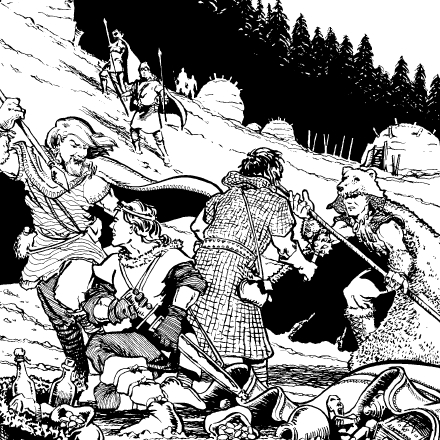
Illustration by Jamie Lombardo
Chilling
appearances
The appearance of the snow elves has
perhaps given the other elven races reason
to doubt their lineage as being truly
pure. They are the shortest lived of the
elves, with average lifespans of 750 years
(900 being incredibly ancient). Additionally,
snow elves are the tallest of the elven
races and generally tower above humans.
Females occasionally reach 6?4?, and it is
not unknown for males to have grown to
7?. While very thin, snow elves are extremely
wiry and tough individuals. Snowelf
PCs gain one point to both dexterity
and constitution, but lose two points of
charisma when dealing with all races but
their own due to haughtiness and disdain
of lowland society. Snow elves have light
brown or tan skin, white or pale blond
hair, and silver eyes. They strongly favor
white clothing and bone jewelry, trading
for silver from valley
elves.
In addition to the standard elven characteristics
of resistance to sleep and charm
spells, infravision, moving silently, and
detection of secret doors, snow elves have
developed several unique adaptations to
their hostile environment. All snow elves
gain a +1 on their saving throws against
any form of cold attack or condition. They
also gain +1 to hit with any spear or
javelin, but gain no to-hit bonuses with the
sword or bow. Snow elves also have the
ability to set traps with a 90% chance of
success, providing they are in snowy,
mountainous regions. Each trap, of any
type, does a maximum of 2d6 hp damage
per level of the elf who sets it.
Snow elves could best be described as
neutral with insufferably arrogant tendencies.
With the exception of the valley
elves?whom they tolerate and occasionally
befriend?snow elves actively dislike
all races other than their own, and they go
out of their way to make that fact known
if given the opportunity. Drow incite a
kind of madness in snow elves, and only
overwhelming odds will prevent a snow
elf from attacking any drow or drow ally.
An icy history
Most closely related to their only ally,
the valley elves, snow elves are an aloof
people. Accepted by neither elves nor
men, they have simply withdrawn from
both and carried on their lives. They inhabit
the snow-covered Crystalmist
Mountains
of the WORLD OF GREYHAWK®
setting, but might be found in similar
areas elsewhere in the Flanaess.
The rift between the snow elves and
During their ages of seclusion, snow
their cousins stems from the same wars
that drove the drow underground. The
elves have focused their studies on fields
snow elves were deceived into allowing
passage (for a large profit) of the drow
that would aid their survival in the harsh
through a mountain pass they controlled,
not knowing?so they claimed?that the
drow were serving Lolth and had recently
declared war on their cousin elves. While
never formally condemned by their relatives,
the snow elves have been universally
shunned by them ever since. Valley elves,
themselves largely disliked by others,
tolerate snow elves perhaps because each
views the other as sharing a similar
plight?neither race is considered ?true
elves? by their cousins.
Mankind?s quarrels with the snow elves
also stem from twilit history. The snow
elves were ever taller and more haughty
than other elves?or even men?and they
sought once to dominate or destroy the
men who entered their mountain valleys
and homes, earning forever the hatred of
the more numerous race.
During their ages of seclusion, snow
their cousins stems from the same wars
that drove the drow underground. The
elves have focused their studies on fields
snow elves were deceived into allowing
passage (for a large profit) of the drow
that would aid their survival in the harsh
environment in which they are fated to
dwell. Thus magic, particularly the magic
of cold, has waxed while clerical studies
have waned. Druids and rangers have
become prominent. All the while, snow
elves have become more reclusive and
secretive as lowland societies have grown
unaware and indifferent. Indeed, the snow
elves might be a dying race.
The cold clans
Dwelling in tight-knit, extremely isolationist
families or clans of 3-30 members,
snow elves are very territorial and hostile
toward trespassers. These clans live in
small villages consisting of 2-10 domeshaped
huts of woven trees, covered with
furs and skins and packed on the outside
with snow. Such villages house members
of one clan only and lie generally near the
center of that clan?s territory. Territories
average two square miles in size for each
member of a clan?s village. Communities
numbering more than 30 undergo a
branching off, wherein two or more family
groups pack their belongings in early
spring and set out in search of new territory.
This prevents overpopulation and
starvation in a rugged environment that
offers no bountiful harvests for large
communities. Such branching off is now a
rare event.
Snow elves develop classes as do any
other sorts of elves. They may become
fighters, rangers, druids, wizards, or
thieves. Level limits for snow elves are
given in the table herein. By tradition,
males are most often found as fighters,
rangers, and thieves; females are usually
wizards, and either sex may become
druids. Fully half of any clan will belong to
a character class (the rest are zero-level
characters). Those snow elves having a
class will be 1st level, usually fighters (if
male) or wizards (if female). Half-elves
whose elven parents were snow elves are
treated as any other sort of half-elf,
though they are extremely rare.
Higher-level characters are often encountered
in snow-elven clans. For every
five snow elves, there will be an additional
2nd-level male ranger, a 2nd-level female
wizard, and a 2nd-level druid. With a
group of 10, there will also be a 3rd-level
male ranger. Groups of 20 will be headed
by a 4th-level male ranger, a 3rd-level
female wizard, and a 3rd-level druid. The
largest groups (25-30) will be led by a 5thlevel
male ranger (the ?father?), a 5th-level
female wizard (the ?mother?), and a 4thlevel
druid (the ?priest?) with a 2nd-level
druid understudy. Mixed-class snow elves
are uncommon, with a 10% chance per elf
of having a second class; classes are mixed
as per any other elf, with the druid class
being substituted for the cleric.
Snow elves have no ability to work
metal?no small surprise as they use but
dislike fire?and disdain all metal armor,
including studded leather and even elven
chain. They prefer to wear leather, skins,
or their own special garb. Snow elves are
renowned for their ability to manufacture
a strong and beautiful type of armor from
the hide of the white dragon. Due to their
carefully guarded secrets for curing and
treating, this armor grants AC 4 while
hindering movement no more than elven
chain. Only the 7th-level druids are taught
the secrets of its crafting, and all armor is
manufactured at the shrines. Other snow
elves (including any PC) will have no
knowledge of the construction process.
The higher-level druids at the shrines will
always wear this armor, though other
snow elves may also: 2nd-level ranger,
15%; 3rd-level ranger, 20%; 4th-level
ranger or 3rd-level druid, 30%; 5th-level
ranger ?father? 75%; any other 5th-level
ranger, 45%; and 2nd-level druid, 5%. The
valley elves will occasionally own a set of
this armor as they are the snow elves?
connection to the outside world, giving
them metal weapons and tools, and certain
alchemical products. Magical suits are
known to exist, though they are obviously
very rare.
Adventurers passing through an area
inhabited by snow elves are 35% likely
(+10% per day) to encounter traps set by
the elves (snares, deadfalls, and triggered
avalanches of snow or rock) or to be attacked.
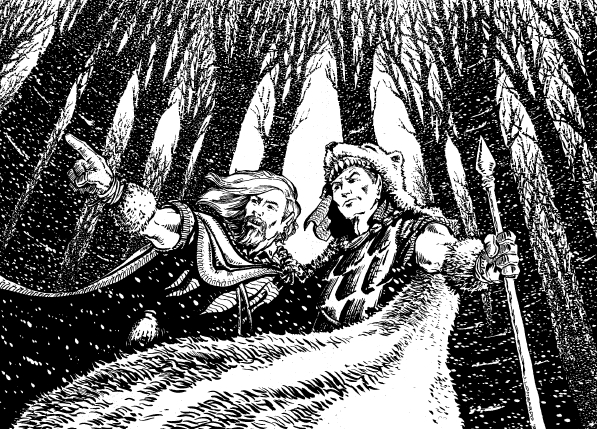
Snow elves use hoar foxes (90%) or
trained bears (10%; any available sort) as
pets and guards.
Half-elves who have snow-elven parents
sometimes take up the career of a bard.
Though such characters wander widely,
they are shunned by snow elves for their
human ?taint.? These bards are almost
legendary to other races due to their
rarity. They often play an instrument used
to some degree by nearly all snow elves.
The keras (Keh-rahz) is a large instrument
very similar to the alpenhorn used by
Swiss shepherds. Keras range in size from
4? to just under 20? and are usually made
of wood (although the best are said to be
constructed from the tusk of the wooly
mammoth) with bone mouthpieces. In
their native environment, snow-elven
clans often use keras to communicate
across vast distances, having developed a
complex code for signaling. Some of the
largest of these instruments may be found
at the shrines and are sounded only in
times of great need or grand celebration.
The bards use the smaller versions of the
keras to play mournful and powerful
ballads as majestic and sad as the mountains
themselves.
Snow-elven clans, while not at all interdependent,
will not hesitate to aid one
another in repelling invaders or raiding
high-altitude settlements. Clans often come
together in spring and fall for various
festivals and religious holidays. A snow elf
will never turn another of his kind away
empty-handed, although the proud snow
elf only rarely admits the need of another
?s assistance.
Though a snow-elf PC will, of course,
travel as he likes, a snow-elf NPC will
seldom be encountered below the snow
line. Occasionally, their clans will dwell for
brief periods just below the tree line in the
dead of winter. Snow elves will never be
encountered in a city, and they go into the
foothills or lowlands only on urgent clan
business or to raid for food.
Matters of
worship
Snow-elven religion centers around their
secluded druidic shrines. These holy
places, tucked in the wildest and most
remote nooks and crannies of the mountains,
house elven druids of the highest
levels. The shrines are reportedly places of
great power, and each is headed by a
druid of no less than 11th level, assisted
by one 8th-level ?assistant,? three 7th-level
?attendants,? four 5th-level ?caretakers,?
and a host of 2-20 lesser druids and servants.
Druidic spells cast from these areas
are reported to be of double strength and
duration. It is also rumored that the
shrines gain this special power by being
located in areas of ?elemental weakness?
?a misgiven name, for these houses of
worship are centered on fissures between
the Prime Material plane and one or more
of the various elemental and paraelemental
planes, particularly those of
Earth, Air, and Ice. The elven druids of the
shrines, dwelling as they have in such
close proximity to the elements over the
ages, have developed heightened powers
in summoning and controlling elementals
and para-elementals while near their
shrines or homes. This talent applies only
to NPC snow elves, because it is a skill
gained individually and requires decades
(at least) of study and association. Despite
the elves? familiarity with fire, this element
remains distasteful to even the most powerful
snow-elven druids.
The shrines are considered by all snow
elves to be extremely holy areas and will
be aggressively defended. Most often,
these shrines are dedicated to Tarsellis
Meunniduin (a lesser elven deity detailed
hereafter), though a few are said to honor
other gods. Tarsellis Meunniduin is the
chief deity of the snow elves. They, in fact,
explain away some of their differences to
their elven kin as due to their being direct
descendants of his (such is the haughtiness
of the snow elf). While most scholars of
elven lore remain rather skeptical on this
point, Tarsellis does not seem displeased
with his ?children?s? dedicated worship.
Tarsellis Meunniduin
(god of mountains and wilderness)
Lesser god
ARMOR CLASS: -4
MOVE: 15"
HIT POINTS: 290
NO. OF ATTACKS: 1
DAMAGE/ATTACK: 3-30
SPECIAL ATTACKS: Never misses in combat
SPECIAL DEFENSES: Immune to fire, cold, lightning; elemental control
MAGIC RESISTANCE: 75%
SIZE: L (8')
ALIGNMENT: Chaotic neutral
WORSHIPER'S ALIGN: All nonlawful and nonevil rangers, druids, and dwellers
in the wilderness (elves)
SYMBOL: Snow-capped mountain
PLANE: Olympus (see below)
PRIEST: 12th-level druid
WARRIOR: 22nd-level ranger
MAGE: 8th-level wizard
ROGUE: 8th-level thief, 12th-level bard
S: 24(+6,+12)
I: 19
W: 20
D: 25
C: 25
CH: 19
Tarsellis Meunniduin always appears as
a tall, blonde male elf, deeply tanned and
clad in luxurious furs. Though he is a
legendary hunter, Tarsellis is deeply devoted
to the wilds and the creatures that
dwell therein. Thus, he spends a great
deal of time and energy roaming the wilderness
in search of evil creatures and
great monsters to slay or drive from his
domain.
Tarsellis was once great friends with
(and, indeed, was superior to) the elven
god Solonor
Thelandira, and the two
would often hunt together in the days of
old. But before the elves yet walked the
earth, Tarsellis fell in love with a beautiful
but dark goddess named Megwandir.
Solonor objected to Tarsellis? romance, not
trusting the dark goddess, and the ensuing
quarrel has left the two gods bitter ever
since.
Tarsellis both hunts and fights with a
giant spear that strikes for 3-30 hp damage
and never misses. Only he can wield this
weapon. Attacks based on heat, cold,
wind, lightning and other natural forces
have no affect on Tarsellis. Any elemental
summoned in his presence can be immediately
controlled by him. If pressed, Tarsellis
can summon all woodland creatures in
a two-mile radius to aid him.
A solitary figure, Tarsellis Meunniduin is
considered somewhat of a rustic by the
other elven deities. He spends the greater
share of his time in the mountains and
forests of the Prime Material plane, and
his worshipers build temples and shrines
to him there. His followers offer him furs
of the finest quality and bring live animals
of the greatest size as presents to the
druids of his temples. Snow elves consider
Tarsellis their patron deity.
Above all else, Tarsellis detests drow. If a
worshiper of his prays for aid while doing
damage to the drow, there is a slight (1%)
chance that Tarsellis will send help in one
form or another. The reason for this hatred
is traceable to his quarrel with Solonor.
For the goddess Megwandir?so
named before the elves yet walked the
earth?has come to be known as Lolth,
and no longer dwells with the elven deities.
The feelings Tarsellis once felt for
Megwandir have become hatred.
Snow Elves: Class Level Limitations
| Ability* | Druid | Fighter | Wizard | Thief | Ranger |
| 16 | U | 5 | 11 | U | 5 |
| 17 | U | 5 | 11 | U | 7 |
| 18 | U | 6 | 12 | U | 9 |
| 18/51 | U | 6 | 12 | U | 10 |
| 18/76 | U | 6 | 12 | U | 11 |
| 18/91 | U | 8 | 12 | U | 11 |
| 18/99 | U | 9 | 12 | U | 12 |
| 18/00 | U | 10 | 12 | U | 12 |
| 19 | U | 11 | 13 | U | 13 |
| 20 | U | 13 | 15 | U | 14 |
| 21 | U | 13 | 17 | U | 14 |
| 22 | U | 13 | 18 | U | 14 |