|
|
|
|
|
|
|
|
|
|
|
|
|
|
|
|
|
|
|
|
|
|
|
|
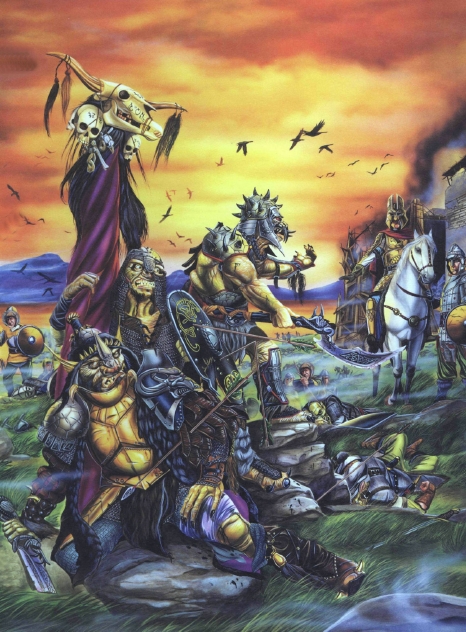
Name that cover
The request for possible titles for the cover
painting of DRAGON issue #127 led to some
amusing entries. Among them were:
“Mowing the Front Lawn,” from Tim Emrick
(Whitestown IN);
“So, Whaddya Think of the Party?" also from
Tim Emrick;
“I Still Say It Tastes Great,” from Andy Rodich
(Emporium PA); and,
“Does the Name ‘Custer’ Mean Anything to
You?” from Aaron Johnson (Houston TX).
Thanks to all who entered.
A number of people continue to express
interest in acquiring copies of the cover art
for
DRAGON Magazine. You may write a letter
to an
artist, c/o DRAGON Magazine, P.O. Box
110,
Lake Geneva WI 53147. We’ll forward the
letters as best we can to the artists. Be sure
to
enclose an SASE for the artist to use in writing
back to you.
The name of artist
Jeff Menges was
misspelled on page
26 of DRAGON® issue
# 127. We apologize
for the error.
We wish to credit
Stephanie Tabat for
her excellent DRAGON
Magazine logo
design, which premiered
in issue #128.
Thank you, Stephanie!
The articles on the fighter
class in issue #127
were much appreciated. However,
there continues
to be little discussion on
how to role-play
a fighter in the current
AD&D
game system and
to what goal. What follows
is my opinion on
how to make the fighter a
more interesting role.
I have always preferred the
fighter class ever
since I began playing D&D
games in May 1976.
This preference is based
on the traditional
heroic concept of the warrior
as the defender
or champion of his people
or society. In the
myths and tales based on
this concept, the
priest and wizard were sources
of advice or
treacherous opponents, and
the thief was at
best an annoyance or the
warrior?s companion.
However, it was the warrior
who was regarded
as the leader.
As originally established,
the fighter could be
role-played as anything:
knight, barbarian,
scout, mercenary, etc. However,
the fighter class
had only one skill: weapon
use. It was not
surprising that players eventually
preferred
clerics, magic-users and
thieves, with a broad
variety of skills. In reaction,
there developed the
split classes and the fighter
subclasses of
cavalier/paladin, berserker,
ranger, bard, and
barbarian, each with their
special capabilities
that made them as fun to
play as the other
classes. This development
has resulted in the
fighter class itself being
even less desirable.
There are two solutions to
help the fighter.
One is to not permit the
fighter subclasses in
the campaign, placing the
role of cavalier, ranger,
or barbarian in the imagination
and not the
rules. The other is to find
a role for the fighter,
given its subclasses. If
the subclasses are used,
the role of feudal lord or
knight errant is filled
by the cavalier, the savage
outsider by the
barbarian, and the wanderer
in the wild by the
ranger. The remaining roles
that a ?generic?
fighter can fill are those
of soldier or thug.
The role of thug is basically
the use of the
fighter as a strong-arm thief.
The fighter class
doesn?t need any embellishment
to be played in
this role. It could be argued
that this is how
most fighters are role-played
anyway.
The soldier role is more complex.
It relates to
leading the military forces
in the service of a
state or potentate. The other
fighter subclasses
are unsuitable for this task.
A cavalier would
lose status by associating
with mere troops, a
barbarian would prefer to
raise a horde of his
own people, a ranger would
rather be alone in
the woods, and a split-classed
character has the
other profession to spend
time on. The fighter is
the class that has the inclination,
expertise, and
opportunity to raise and
lead military forces. It
is a role that fits the class.
In order to fill this role,
the fighter needs to
have skills based on his
charisma, intelligence,
wisdom, and experience. One
skill is leadership,
which is the most difficult
to define but is
necessary to unify a group
to a common purpose.
Knowledge of that, and an
ability to train
soldiers in weapon handling
and battle drill, are
necessary, as these are the
foundation of a unit?s
quality. Additionally, there
are other military
skills, such as engineering
to build and take
fortifications, the matter
of arming and supplying,
strategy and tactics, etc.
that could be
assigned to the fighter class.
The DMG ties the number
of troops NPC
hirelings can command to
their level. This is
also a good rule of thumb
for PC fighters. It is
not necessary for the PC
to control all the
troops he possibly can. If
the PC prefers, he can
remain a small-unit leader.
However, a PC
should not be able to jump
from being a leader
of 10 men to being a marshal
of 10 field armies
overnight. After all, no
ruler is going to entrust
such a force to someone with
no experience in
or reputation for leading
large bodies of troops.
The progression from small
commands to large
should be based on successes,
not the level of
the fighter.
The quality of a unit depends
on its leadership,
equipment, and the time spent
on and
rigor of the training. DMs
can initially adjust the
morale and skill of the commanded
troops
based on the charisma, intelligence,
and wisdom
of the leader PC, and the
amount of time spent
on training. Further adjustment
can be based on
the successes and failures
the PC encounters in
completing the assigned missions,
and the
number of casualties taken
in doing so. DMs
should remember that success
justifies the
sacrifices made by the troops.
Failure exacerbates
the impact of deaths and
wounds.
In poor quality units, each
soldier will fight as
an individual and the unit?s
cohesion will breakdown
under stress. High-quality
units will fight
as a group with each individual
supporting the
others. Fighting as a unit,
the impact of each
individual soldier will be
as if he were a higher
level. Also, well-trained
or experienced men-atarms
should not be treated as
zero-levels. These
men-at-arms have the skill
to defend themselves.
I would suggest that men-at-arms
trained by a
fighter should be considered
1st level for melee
and saving throws.
Many possible scenarios for
a soldier player
character would fit nicely
into a wilderness
campaign. Border patrols,
scouting, route reconnaissance,
raiding parties, etc. can
lead to some
interesting situations. For
example, a general is
considering sending his army
through a mountain
pass; the PC could be assigned
to determine
if it is possible to move
wagons through it, and
also check out rumors of
an abandoned castle.
Or the PC could be sent into
orc territory to
bring back a couple of prisoners
for interrogation,
to determine where the orc
tribes are
going to raid this summer.
In an underworld
setting, the fighter could
be assigned to clear a
particular section of a dungeon.
Instead of
providing a room-by-room
kick-in-the-door and
trash-the-occupants scenario,
the DM should
provide a sustained struggle
with opponents
who are very resentful that
their particular
home is being trespassed.
Regardless of the
setting, the DM should award
experience points
on how well the fighter soldiered
and led; e.g.,
did he properly train and
supply his troops for
the mission, complete the
mission, keep losses to
a minimum, recognize the
opposition was too
stiff in time to cut losses
and extricate his command,
etc.
Gregory D. Scott
Ocean NJ
(Dragon
#134)
The letter by Gregory D. Scott
(issue #134)
was absolutely correct in
pointing out the
problem of the fighter class.
The other warrior
classes are so much more
interesting that the
plain old fighter isn?t much
fun. There are
several small problems with
all the fighter
classes, all of which could
be easily corrected.
Taking them one at a time:
Fighter: All the warrior
classes have some
unique skills; the fighter
should have one also.
The best choice is weapon
specialization. This
skill and others like it
should be removed from
the other classes. If only
fighters can specialize,
this provides incentive to
play the class.
Ranger: Remove weapon
specialization from
the class, for the reasons
noted above. Rangers
have enough skills already.
Cavalier: Remove the
weapon of choice and
lance-damage rules. These
are very similar to
the weapon specialization
rules and should be
deleted for the reasons noted
above. I would
also recommend removing or
toning down the
cavalier?s resistance to
mind attacks, but keep
the immunity to fear. The
cavalier should be
officially made into a fighter
subclass instead of
a class of its own.
Paladin:
I can?t see why the paladin?s powers
were combined with the cavalier.
After running
one for six levels, I found
that the new paladin
is an overly powerful class,
immune to half of
everything thrown at it and
continually improving
four-of its ability scores.
Why not keep the
paladin as originally designed
in the Player's
Handbook? This class
was already interesting
and fairly powerful.
Barbarian: This class
needs a lot of trimming.
I?d say remove the ability
to detect magic and
illusions, ability to hit
monsters immune to
normal weapons, and saving-throw
bonuses. All
of these powers are too strong
and unnecessary.
The surprise rules need to
be adjusted; as it
stands now, it is easier
to surprise a wild panther
(1 in 6) than a barbarian
(1 in 10).
The fighter class is the most
basic and simple
of the AD&D game characters.
This leads to
problems in making the class
interesting, but it
wouldn?t take much. A few
small corrections to
all of the warrior classes
can provide incentive
to play them all and keep
each class unique.
David Howery
Dillon MT
(Dragon
#137)
I recently finished reading
the ?Forum? letters
written by Gregory Scott
and David Howery
[issues #134 and 137, respectively],
and I feel I
must disagree with their
thoughts on the fighter
class. I completely support
the idea that fighters
are becoming a dead class,
their subclasses
being much better characters
to play ? but only
if you look at it their way.
The fighter class attracted
me when a dead
campaign was resurrected
last summer. I created
a new character, a fighter,
because the
class of my old character,
the bard, was a crock.
My PC started at 3rd level,
about two levels
below the average party level,
and worked his
way up to a 5th-level fighter
before the campaign
died once again. Throughout
the entire
time, he was not a thug or
a soldier; he was a
fighter. He had no need to
work for anybody
and did not quite feel inclined
to. He picked up
jobs as he wandered the land
searching for a
lost friend of his, until
he joined a group of
adventurers at a tournament.
There was no
desire to put him into a
role like scout, knight,
mercenary, or whatever. He
may have become a
privateer like others in
the group, if it wasn?t
for the death of the campaign.
Any fighter could
fit into any of the areas
filled by its subclasses,
except for the ranger, who
needs to be modified
so he cannot be a walking-tank-type
scout.
(Whoever heard of secretively
tracking an
elusive enemy in a loud,
clanging suit of plate
mail, anyway?) If my fighter
would ever be
resurrected, he would surely
become a ranking
member on a pirate ship and
maybe go on to
become a leader at the base
camp of the privateering
operation. He might even
make a complete
alignment change and rule
a small part of
a kingdom, but he would still
be a fighter, and
nothing else.
I would like to add some house
rules that are
used in the campaigns I play
in and the one I
run. First of all, European
barbarians are not
allowed simply because they
are overpowered.
Paladins have remained a
subclass of fighters,
and cavaliers have been limited
in their starting
assets; they also cannot
increase their ability
scores. Rangers, simply out
of the desire to play
them as they were meant to
be played, may not
specialize and cannot wear
armor heavier than
chain mail. This helps bring
the fighter back to
a decent strength among his
peers, even though
there are more ?frilly? and
attractive characters.
To me, the fighter is great
just the way he is.
Mike Speca
Kingwood TX
(Dragon
#142)
I recently bought a copy of
DRAGON
Magazine,
issue #127 (yes, I
know this is a bit late,
but DRAGON issues
are either six months late in
this country, [South Africa]
or they don’t arrive
at all; incidentally, the
cost was about 40 times
what the average newspaper
costs here). I have
had nearly six years of intensive
AD&D
game
experience, and in that time
I have completely
revised the game’s weapons
system for my own
purposes about 12 times.
I am also a member of
a small group called the
Medieval Weapons
Society, all the members
of which are avid
AD&D game players.
We found a weaponsmith
(Mr. P. Weissnar of Phidag
Arts & Crafts) who
has been making exact replicas
of ancient and
medieval weapons and armor
all his life. We, of
course, bought as many weapons
as our
finances would allow and
have been using them
in combat against each other
(being careful, of
course, though naturally
we have all suffered
several minor injuries).
Therefore, when I opened issue
#127, I was
pleased to see all the articles
on combat in it. I
found most of these to be
outstanding articles,
with two exceptions.
"No
Quarter!" by Arn Ashleigh Parker was
sort of confusing.
I mean, I am accustomed to
rolling ability checks on
<1d20>, but here we have
ability and level checks
on 1d30, 3d10, 2d12,
and 3d8 variously.
I also would have though
that fighters would be trained
how to parry in
their normal training.
And don't cavaliers ever
learn combat maneuvers, or
are they expected
to hack and slash their way
through life?
[Regarding] the 2nd article,
"Two Hands Are Better Than One," by Donald D. Miller: I regularly use some
of the weapons he discusses.
May favorite weapon is a
5 lb. bastard sword,
which I can use easily in
one hand, while holding
either a shield, a dagger,
a short sword, a
3'2" long sword, or nothing
in the other. (I am
partially ambidexterous,
so it doesn't bother me
which hands holds which weapon,
although I do
tend to favor the right as
a primary; I write left-handed.)
A bastard sword in each hand
requires
a bit more coordination,
but using them is still
easy. Just so people
don't get the wrong ideas, I
am 20, stand 5'11", and weigh
155 lbs. If the
average person of today is
taken as a yardstick,
I have an AD&D game strength
of 11-12 and a
dexterity of about 13 (if
10 1/2 is average).
I also don?t see why the article
discriminates
against demi-humans; a friend
of mine is 4?11?,
weighs 115 lbs., has only
mild difficulty in using
a bastard sword in one hand,
and has no problems
with a long sword in one
and a short
sword in the other. Perhaps
there was a misinterpretation
of available data: Contrary
to the
[1st Edition] Players Handbook
figures, the
average length for a long
or broad sword was
about 3?, and for a bastard
sword 3½? (Weapons,
MacMillan: 1980, and Weapons
Through
the Ages, by W. Reid, Crescent
Books: 1986). I
would suggest that DMs treat
the Players Handbook
figures for all weapon sizes
as maximums,
the minimum being the maximum
size of the
weapon one step below (e.g.,
knife, dagger,
short sword, long/broad sword,
bastard sword,
two-handed sword). Also,
weight and height (the
latter to only a small extent)
should be the
determinants of whether a
weapon is used
single- or double-handedly.
Only halflings should
have to use a long sword
with two hands; all
other races are heavy enough
for one.
As a matter of interest, I
have tried both an
11-lb. Bidenhander and a
7-lb. battle-axe. The
two-hander I could handle
(very clumsily,
though), but the axe was
really difficult to
handle ?I found it virtually
impossible to
recover from a chop.
By the way, the encumbrance
figure for the two-hander
given in the
Players Handbook
does not reflect weight; a
heavy two-handed sword weighs
about 14 lbs.
(like the 6' Flamberge I
have also tried). The
only reason a two-handed
sword can be recovered
after a swing is because
of its 20" hilt.
Graeme Adamson
Gemiston, South Africa
(Dragon
#145)