Need a random fortress in your fantasy game campaign?
by Daniel Salas
-
-
| 1st Edition AD&D | - | - | - | - |
| Dragon magazine | - | - | - | Dragon #145 |
When the AD&D® 1st Edition
Dungeon Master's Guide indicates that
a randomly generated fortress is encountered,
the players' attention is undoubtedly
boosted. How does the DM deal with
their curiosity? Appendix C of the
DMG
helps, but new tables are needed to add
more detail to such encounters and to
include new character classes from
Unearthed Arcana and Oriental
Adventures.
R2
Castle Table I (DMG, page 182)
needs the
following change. For the sake of simplicity,
the fortress types are classified herein
using letters: type A (small shell keep), B
(tower), C (moat house or friary), D (large
shell keep), E (small walled castle with
keep), F (medium walled castle with keep),
G (concentric castle), H (large walled castle
with keep), and I (fortress complex).
Castle Table II and Sub-Table
II.A. (DMG,
182-183) can be left unchanged. However,
Sub-Table II.B. is out of date; instead of
using it, roll on Table 1 or Table 2 of this
article to determine a stronghold?s master.
For the social class of a castle's master in
non-Oriental settings, refer to the "Typical
members of a class" chart
on page 82 of
Unearthed Arcana. The master's class and
level determine the character's social rank.
Add one social level if the master rules a
medium-size castle, or add two social
levels if the character rules a large-size
castle.
H4
For the birth rank of an Oriental
master,
roll 2d8 + 4 on Table 38 in Oriental
Adventures, page 31. Samurai NPCs
receive an additional + 10 bonus. Also add
+ 1 if the master rules a medium-size
castle, or +2 if he rules a large-size castle.
Castle characteristics
Table 3 herein deals with the major
physical characteristics of the fortress.
Each listing is described as follows.
Moat: In coastal and swampy areas, add
10% to the chance of a castle having a
moat. In deserts and mountains, no castle
has a moat because of the scarcity of
water (unless magic is used, of course).
Across each moat is placed a permanent
bridge or a movable drawbridge, either of
which leads to the main gate of the castle.
The bridge is usually guarded by the castle
's artillery weapons. The specifics of the
moat (width, depth, inhabitants, etc.) must
be chosen by the DM.
Wooden: This is the percentage chance
that the fortress is constructed of wood,
rather than stone. If wood is more abundant
in the area than stone (such as in a
forest), add 10% to this chance. If stone is
more abundant (such as in the mountains),
subtract 10%.
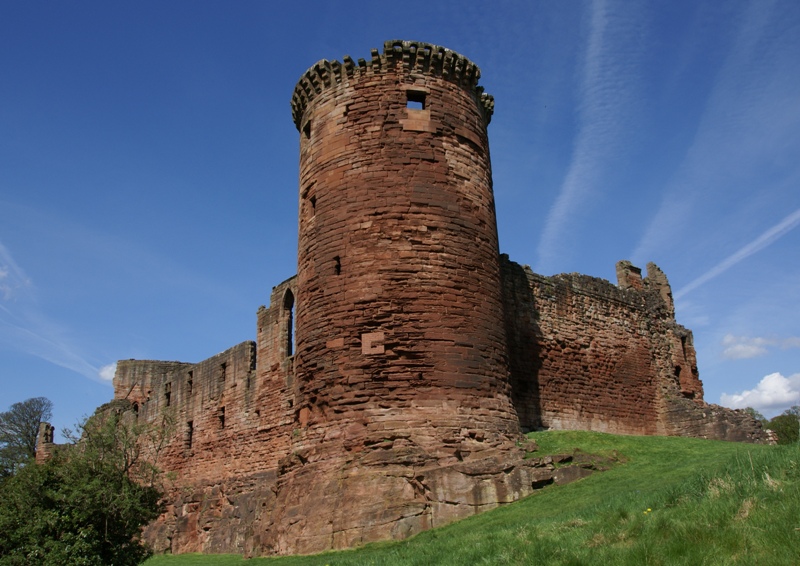
WALLS: This column gives the number of
curtain walls that completely encircle the
castle. The innermost curtain wall can
enclose an open space between itself and
the innermost buildings, or it can contain
rooms like a single fortified building.
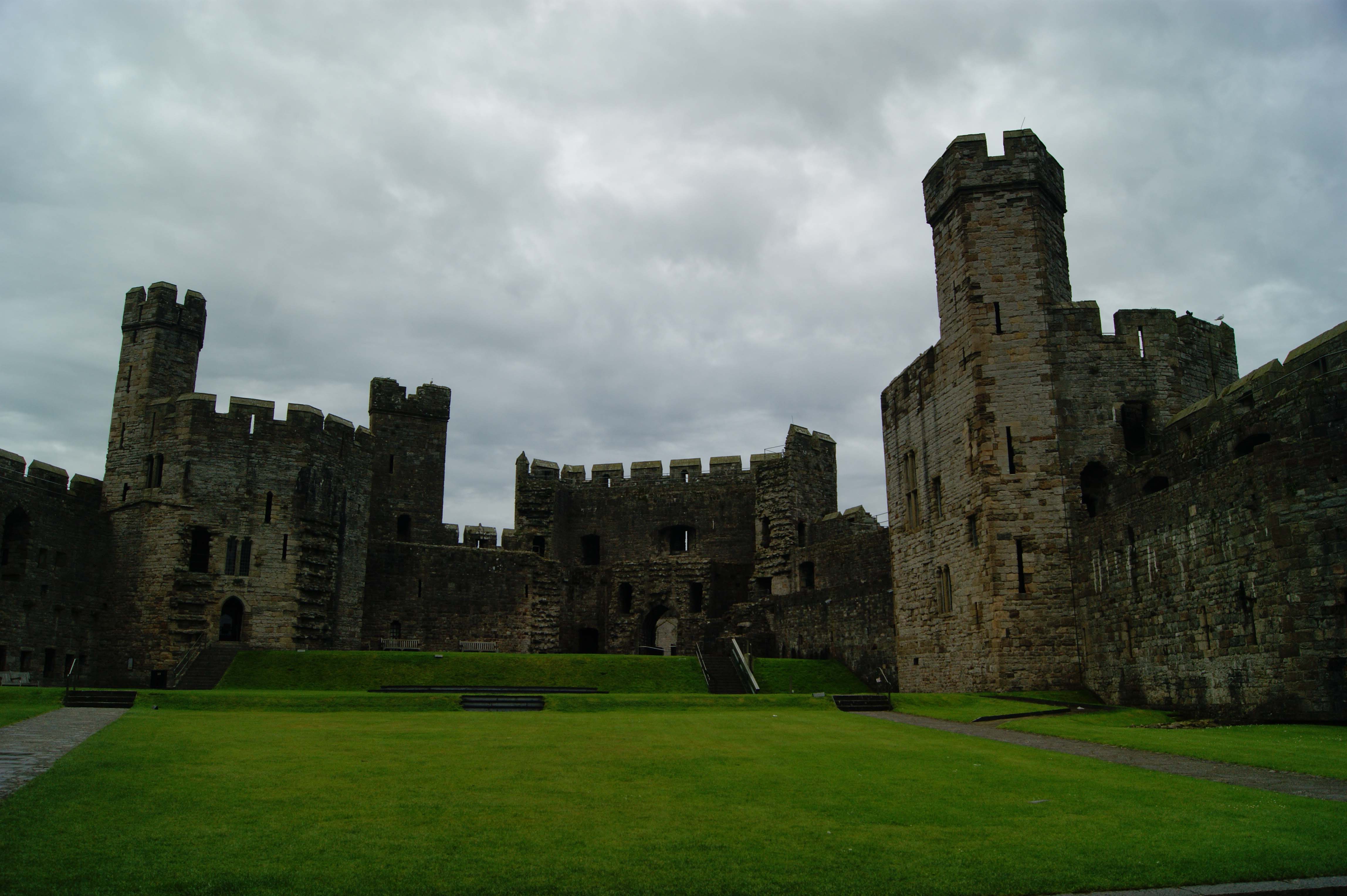
Towers: This column gives the number
of tall structures that serve as watch posts
and strategic promontories during battles.
Castle type B is a tower, with no other
heavily fortified structures except for the
curtain wall and possibly a gatehouse. For
castle types E through I, the number of
towers listed applies to each curtain wall.
A castle with flat sides has its towers at its
corners, so that the towers project out
from the sides of the castle. A castle with
curved walls has towers placed at regular
intervals along its walls. This arrangement
increases the surface area of the wall that
can be covered by missile-firing troops
and artillery. At least one tower overlooks
the main gate of the fortress.
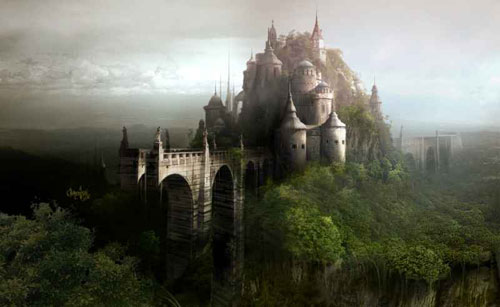
Gatehouse: This column gives the percentage
chance that there is a small building
at the main entrance of the outermost
curtain wall. Here, guards inspect visitors
and defend the main gate against unwanted
intrusions. For a castle with a moat, the
gatehouse is located outside the ?moat and
is connected to the outermost curtain wall
by a bridge (either a permanent one or a
drawbridge).
Tunnels: This column gives the percentage
chance that there is an underground
tunnel system beneath the castle. In
swampy areas, subtract 20% from this
chance. The random dungeon generation
system (DMG, pages 169-172) can be used
to determine the arrangement of the tunnel
system. Small castles have 1-4 dungeon
levels, medium castles have 2-8 levels, and
large castles have 2-12 levels. At the lowest
dungeon level, consider downward-leading
passageways to be dead ends. If the tables
indicate that the dungeon extends into an
impossible area (such as aboveground or
out the side of a cliff), place a concealed
door at the end of an apparent dead end.
This door opens to the outside wilderness.
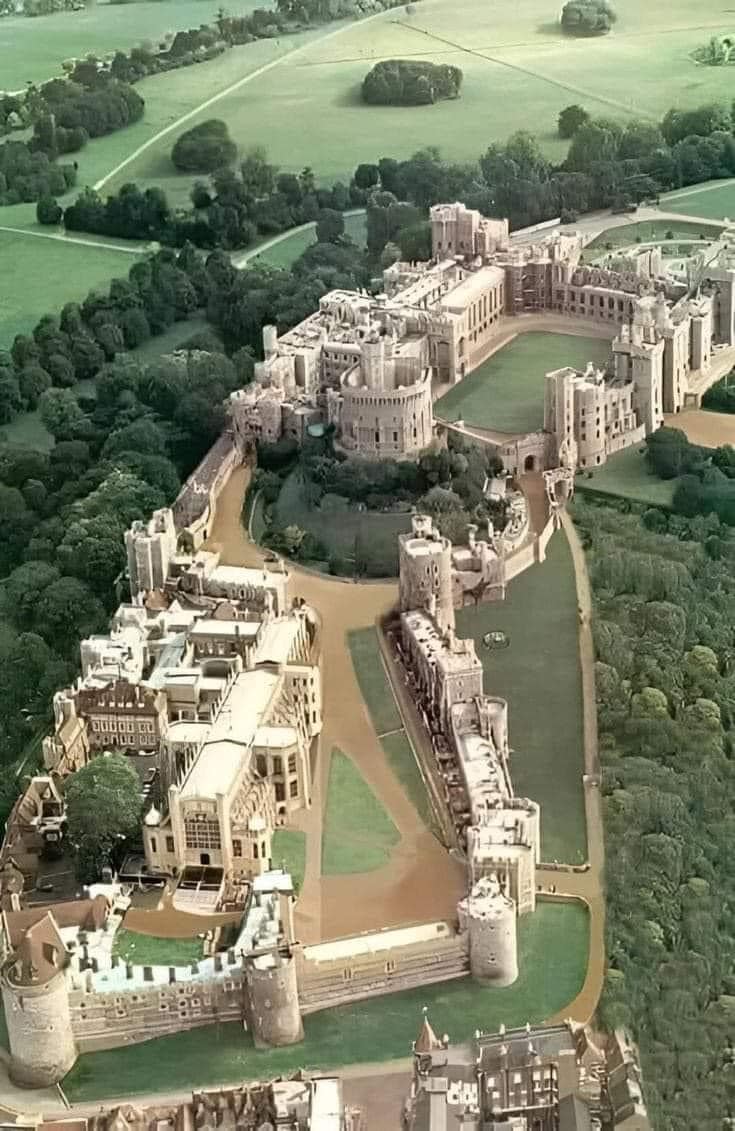
Windsor Castle
Castles inhabited by characters do not
normally have any monsters in their
dungeons. Exceptions include the family
?pet? or an unwanted or secret intruder.
Dungeons that are not shrouded in secrecy
often have guards at regular intervals,
especially near prison cells and treasure
chambers.
Table 1*
Castle Masters
(Non-Oriental Settings)
| 1d100 | Class | Level |
| 01-15 | Cavalier | 9th-12th |
| 16-20 | Paladin | 9th-10th |
| 21-35 | Cleric | 9th-12th |
| 36-37 | Druid | 12th-15th |
| 38-65 | Fighter | 9th-12th |
| 66-70 | Barbarian | 8th-13th |
| 71-72 | Ranger | 10th-13th |
| 73-80 | Magic-user | 11th-14th |
| 81-85 | Illusionist | 10th-13th |
| 86-90 | Thief | 10th-14th |
| 91-93 | Thief-Acrobat | 9th-12th |
| 94-97 | Assassin | 14th |
| 98-99 | Monk | 9th-12th |
| 00 | Bard | 23rd |
Table 2*
Castle Masters
(Oriental Settings)
| 1d100 | Class | Level |
| 01-30 | Bushi | 9th-12th |
| 31-40 | Kensai | 9th-12th |
| 41-50 | Monk | 8th-13th |
| 51-55 | Ninja / bushi | 9th-12th / 9th-12th |
| 56-60 | Ninja / sohei | 9th-10th / 9th-10th |
| 61-80 | Samurai | 9th-14th |
| 81-90 | Shukenja | 9th-12th |
| 91-00 | Sohei | 9th-12th |
Table 3
Physical Characteristics of a Castle
| Type | Moat | Wooden | Walls | Towers | Gatehouse | Tunnels |
| A | 5% | 40% | 1 | - | - | 5% |
| B | 5% | 30% | 1 | 1 | 10% | 5% |
| C | 100% | 20% | 1 | - | 10% | 3% |
| D | 15% | 10% | 1 | - | 15% | 10% |
| E | 20% | - | 1 | 2-5 | 30% | 15% |
| F | 25% | - | 1 | 3-6 | 55% | 20% |
| G | 35% | - | 2-5 | 4-7 | 100% | 30% |
| H | 40% | - | 1 | 3-6 | 80% | 30% |
| I | 45% | - | 3-6 | 5-8 | 100% | 40% |
-
Table 4
Settlement Adjacent to Castle
| Type | None | Hamlet | Village | Town | City |
| A | 01-10 | 11-90 | 91-00 | - | - |
| B | 01-05 | 06-85 | 86-00 | - | - |
| C | 01-05 | 06-85 | 86-00 | - | - |
| D | - | 01-60 | 61-00 | - | - |
| E | - | 01-50 | 51-00 | - | - |
| F | - | 01-30 | 31-90 | 91-00 | - |
| G | - | 01-10 | 11-80 | 81-00 | - |
| H | - | - | 01-75 | 76-95 | 96-00 |
| I | - | - | 01-70 | 71-90 | 91-00 |
Table 5
Political Position of Castle
| Type | Independnet | Allies | Under com. | In com. |
| A | 10% | 20% | 80% | 5% |
| B | 10% | 20% | 80% | 5% |
| C | 10% | 20% | 80% | 5% |
| D | 15% | 25% | 65% | 15% |
| E | 20% | 30% | 50% | 30% |
| F | 25% | 35% | 35% | 45% |
| G | 30% | 20% | 20% | 60% |
| H | 30% | 20% | 20% | 60% |
| I | 35% | 10% | 10% | 75% |
Greenfield Garrisons
Local settlements
Table 4 determines the type of settlement
that stands within one mile of the
fortress. Because of the difficulties in
establishing civilized life in certain terrain
types, use a - 20% modifier in swamps,
- 15% in deserts, and - 15% in mountains.
In coastal areas, add 10% to the roll,
since the possibilities of a steady food
supply (fish, shellfish, etc.) and a shipping
port affect the size of the community.
If the castle is deserted, or inhabited by
unfriendly or isolated bands of monsters
or humans (as defined by Castle Table
II
and Sub-Table II.A. on pages
182-183 of the
DMG), the settlement might be in a similar
situation. In this case, roll on Castle Table
II for the settlement?s inhabitants. For this
table, consider a hamlet to be ?small,? a
village to be ?medium,? and a town to be
?large.? A city is also considered to be
?large,? and it receives an extra 10% bonus
to the die roll. If humans or charactertypes
are indicated, consider the settlement
to be occupied by typical members
of that type of settlement (farmers for a
village, townspeople for a town, etc.).
The "Inhabitation" chart on
page
173 of
the DMG gives the population of each
settlement type. Use this chart for a settlement
that is not deserted or does not
contain monsters. Also note that you do
not have to place new major cities in the
campaign if you have not planned for
them; these results can be rerolled.
Strongholds (TSR/SSI)
The relationship between a characterruled
fortress and the settlement must be
chosen by the DM. Perhaps the castle?s
master rules over the people of the settlement,
which is most likely where hamlets
and villages are concerned. Perhaps the
castle serves as a protector of the settlement,
such as for a city. The castle and
settlement might even be locked in an
unofficial conflict, such as when a warlord
and a civilian governor are competing for
political power.
Local politics
Table 5 determines the political position
of a fortress inhabited by character-types.
Few castles are independent and unknown
to the rest of the world, especially those
that are large and militarily powerful. To
use Table 5, roll under the first column for
the chance of independence. If the number
rolled is over this chance, then roll on
the other three columns; the results of
these 3 may all apply at once. If none
of the 4 columns indicate a political
position, then start again in the first
column until a position is found. The
columns are explained below.
Independent: Except for an adjacent
settlement, this fortress stands alone politically.
Its inhabitants are naturally suspicious
of strangers (-10% reaction
modifier).
Allies: The master of this castle holds
treaties with 1-4 other castle masters, each
of whom rules a castle of the same type
(A, B, C, etc.). A treaty can include a promise
of peace, mutual protection, political
support, or anything else the DM chooses.
Under command: The master of this
castle is the vassal of another lord, who
rules a fortress that is up to four types
larger on the DMG's Castle Table
I scale
than this one (maximum of type I). The
relationship between the two masters is
similar to the relationship between allies,
though the lord in the smaller castle must
take orders from and pay taxes to the lord
in the larger castle. The larger castle is
placed 1-12 miles from the smaller one.
In command: The master of this castle
rules over 2-5 vassals, each of whom commands
a castle that is up to four types
smaller than this one (minimum of type A).
These extra castles are placed in the campaign
by the DM, each within 1-12 miles of
the major castle.
These tables are intended to clarify, not
complicate, the DM?s job of creating a
random castle. Obviously, they can only
serve as general guidelines; the DM must
be able to put together the jumble of information
which this article and the DMG?s
tables will provide. It might take
some
time and effort, but the final outcome
should provide a setting to interest (and
challenge) PCs for many hours.
MAY 1989