Dragons
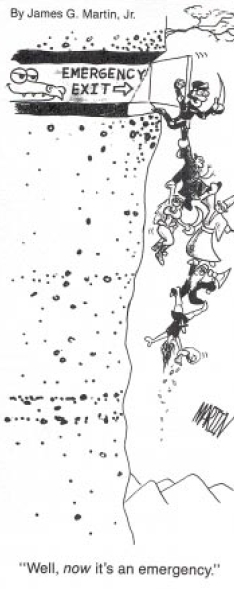
Dragon hunting
Dear Dragon:
Concerning Mr.
Moore’s editorial in issue
#148, I remember seeing
the gray and rainbow <gray dragon, gray
dragon, rainbow dragon>
dragons in issue #146, but
I don’t remember
seeing the brown, stone,
rock, or purple dragons
anywhere. Have they appeared
in any other
issues of DRAGON Magazine?
If so, which ones?
The purple dragon sounds
interesting.
Chris Connelly
Dearborn MI
(Dragon
#152)
We’ve published brown
dragons in issue #38,
grey dragons (not the same
as gray dragons) in
issue #62, purple
dragons in issue #65, and
stone
dragons in issue #134 (we’ve rejected all
rock dragons as a result).
One can never have
too many dragons, we always
say.
THE FORUM
Finally, you?ve done something
to beef up
dragons!
[Special attraction on dragons in
DRAGON issue #134.]
I don?t know how many
people have laughed at the
game because they
?tried the AD&D®
game, went out and killed a
dragon, and it was boring."
So few Dungeon
Masters have the skills necessary
to make even
a demon lord a challenge!
In the group I DM,
the players have told me
that they would rather
face a dragon than a group
of eight orcs just
because the dragon is quicker
about wiping
them out! The editorial about
Tucker's
kobolds
[DRAGON issue #127]
really hit home as it
reminded many of the players
about my orcs.
I?m not a killer DM, but
I don?t believe orcs have
survived this long because
they are stupid, and I
always give the monsters
even breaks! What
those articles did was explain
to everyone how
to make dragons a bit more
like their legendary
cousins. The only problem
is that merging those
changes with those presented
in the FORGOTTEN
REALMS setting boxed
set makes for a
mean dragon!
In "Sage Advice" in issue
#134, the question of
house rules was brought up.
If there is one
thing I hate, it?s a player
who challenges a house
rule. The DM had a reason
for making the rule,
and if players don?t like
it, they can find another
game. In my own world, elves
cannot be clerics.
The reason for this is that
an elf can be almost
any class, and it is usually
advantageous to be
an elf. Aside from the bow
and short-sword
adjustments, elves each have
infravision and the
ability to find secret doors.
Combined with any
class, an elven character
will dominate a game if
the PC is played correctly.
My house rules also
make dwarves most powerful
as clerics (I loved
the dwarven
cleric in issue #129) and humans
most powerful as fighters.
I have corrected a
major imbalance in the game
regarding elves,
and I have given other races,
notably humans
and dwarves, a chance. If
I had to make one
recommendation for the revised
AD&D
game
books, it would be to make
the elves less powerful
and other races more powerful.
Dean Wright
Security CO
(Dragon
#140)

With
respect to all the letters to ?Forum?
concerning
dragons, I?d like to know what
everybody
is so excited about. I swore that I
wouldn?t
become involved in all this, but with
the
last letter in issue #150, I just couldn?t help
myself.
It seems that every time I read this
column,
I find one letter or another telling us all
about
how this or that dragon could either
utterly
destroy a well-equipped party of adventurers
or
else be destroyed. In this latest travesty,
the
dragon in question seems more like a
coven
of witches or an entire thieves? guild than
a large
reptile. Mr. Myers has this dragon sporting
a spy
network that could put many an
assassin?s
guild to shame! And the traps! Why
don?t
we just house all the dragons right in town
and
save them the trouble of having to shop for
the
latest gadgets?
Look,
isn?t a dragon supposed to be lying in a
cave
on top of his huge mound of treasure, far
away
from man and his petty affairs? The
heroes
are supposed to trek up a mountainside
and
gain access to this hidden lair. The dragon
wakes
up (usually because somebody steps on
the
equivalent of a dry twig), breathes his
terrible
breath weapon, claws and bites a few
times
(possibly taking a few party members
with
him), then dies from the mighty blows of
some
knight or wizard or something.
Let?s
all keep in mind that the toughest 1st
Edition
dragon is only in the neighborhood of
10
to
12 HD. Special abilities aside, it is absolutely
ludicrous
to assume that such a creature should
be
able to give a well-equipped party of adventurers
of
equal level any more than a marginally
tough
workout, not to mention the previously
mentioned
25th-level party. I fail to understand
why
people assume that just because it is a
dragon,
it should have some special right to
have
it?s life preserved by the DM.
The
point is that no matter how tough you
make
the dragon, a party of adventurers is
going
to come along and kill him. I imagine that
sooner
or later, we?re going to have the same
problems
with the 2nd Edition dragons that
we?re
having with the 1st (but it?ll be a while).
When
that time comes, if the DM can?t handle it,
then
he shouldn?t be running a game.
On another
topic, I?ve just finished reading the
?Forum?
letter in issue #151 submitted by an
unknown
author. Those of us who like castles
are
no different from those who like magic,
weapons,
ships, cars, planes, or whatever. We
don?t
really like them because they make sense;
we
like them because they?re neat! To me, it?s
not
an issue of whether or not a castle can be
effective,
but more a matter of how I can make
it
effective.
Now
I hate to sound like one of these people
who
will fanatically defend a concept to the
exclusion
of all reason, but our unknown author
seems
to have overlooked a few simple ideas.
First
of all, adventurers are supposed to be
uncommon.
Similarly, an army flying around on
pegasi
or griffins should be equally, if not more,
uncommon.
The walls of a castle are supposed
to
keep the riff-raff out (?riff-raff? meaning
marauding
tribes, orcs, kobolds, and on rare
occasions,
ogres and opposing human armies).
In
this respect, a castle is more than effective. In
fact,
in a fantasy setting, a castle is even more
practical
than in reality, because humanoids are
commonly
the only attackers and are the easiest
to
keep out because of their disorganization and
low
intelligence.
However,
Mr. Unknown?s campaign seems to
have
more than the average number of gatecrashing
adventurers
and monsters. But if we
shift
gears a little bit, most (if not all) of the
attack
modes mentioned in his letter can be
eliminated.
First
of all, if it?s cheap and easy to destroy a
castle,
it is equally as cheap and easy to build
one.
In a fantasy setting one need not spend five
years
digging foundations and moats when the
work
can be done by the aforementioned experts
(dwarves,
orcs, etc.) in no time at all?not
to
mention using move earth, dig, or conjure
elemental
spells. Given the easier job of digging,
more
elaborate foundations can be designed
which
can prevent tunneling?say, underground
waterways
or superdeep moats.
As for
knock, passwall, phase door, etc., a
simple
look at the spells will solve this problem.
For
the price of a simple dead-weight bar and
some
thin metal sheeting, one can cancel all
three
of the above spells. I?m going to assume
that
the outer wall can be flown over, so I?ll roof
off
the exposed areas and segment the arrow
niches
so that fireballs won?t spread. If I?m
really
serious, I?ll buy some magical effects to
help
support the structure, use illusions, charm
my
own creatures, and maybe research some
special
magical defenses that nobody could
possibly
know about until it?s too late. Of
course,
I?m going to hire a mage to do some of
my
own summoning and spell-casting, and a
thief
to advise me in the area of his expertise. In
fact,
as long as we?re going to get nasty and
start
a fantasy war, I imagine that your troops
are
going to pay all kinds of hell standing
around
on an open plain waiting for your spellcasters
to
sneak up on the gates. Cover can be a
wonderful
thing!
Obviously
the point here is not that there are
defenses.
The points are that there are just as
many
defenses as there are attacks, and that the
defender
has a much greater advantage. The
attacker
has absolutely no idea what defensive
maneuvers
are being used, and he must find out
the
hard way. Also, the defender pretty much
knows
all the methods of attack, whereas the
attacker
is not so lucky. Special spells can be
placed
on structures, much as a mage creates
magical
items. The castle?s owner can spend
years
doing whatever he likes, whether it be
researching
special magical effects or just digging
more
extensive dungeons. Inversely, anything
an
attacker uses for assault must be
portable
and is thus predictable. The defender
is
also better off financially. His defenses can be
paid
for over years and years, whereas the
attacker
must finance his operation on the spot.
I imagine
that one would have to pay a pretty
penny
for the casting of an earthquake, conjure
elemental,
or disintegrate spell.
As one
can imagine, it might be a lot of fun
thinking
up and designing castles, then making
one?s
players attempt to assault them. One could
also
possibly find from all this that there could
be
an adventure or two to be had.
R. J.
Wenzel
Lancaster
CA
(Dragon #155)

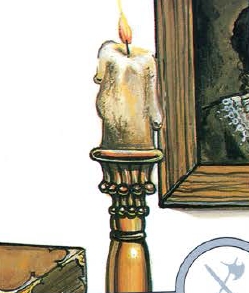
Candle of Invocation
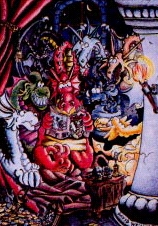
Dragon Mountain box set
Dragon Mountain box set
-
-
-
-
-

-
-
-