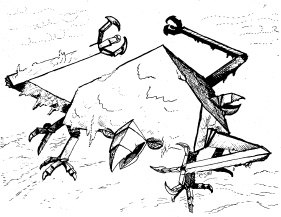
| Shiverbug | Iceling | Snowfury | Frigidarch | - |
| Advanced Dungeons & Dragons | - | Dragon #129 | - | Dragon magazine |
There
are quite a few monsters from the
planes of Air, Earth, Fire, and Water, but
as yet, the only creatures from the para-elemental
planes are the para-elementals
themselves. Now, what DM
could resist a challenge like that? Presented
for your enjoyment are 4 denizens
of the para-elemental plane of Ice, ready
to be summoned by wizards or slip
through nexus points to your local glacier
or snowstorm.
FREQUENCY:
Rare (Common on home
plane)
NO.
APPEARING: 3-18
ARMOR
CLASS: 5
MOVE:
9?
HIT
DICE: 2
% IN
LAIR: Nil
TREASURE
TYPE: Nil
NO.
ATTACKS: Up to 4 (claw/claw/claw/
bite)
DAMAGE/ATTACK:
1-3/1-3/1-3/1-4
SPECIAL
ATTACKS: Shiver venom; surprise
on
1-5 in snow or ice
SPECIAL
DEFENSES: Resistances to various
attack
forms
MAGIC
RESISTANCE: Standard
INTELLIGENCE:
Semi- to low
ALIGNMENT:
Neutral
SIZE:
S (2-3' diameter, 1-1½? high)
PSIONIC
ABILITY: Nil
LEVEL/XP
VALUE: III/44 + 2 per hp
Shiverbugs
are very minor elementals
from
the plane of Ice. Their flattened
bodies
are hexagons with alternating long
and
short sides, with a short leg ending in
a trifurcate
claw at each vertex (six in all).
Between
and above each pair of legs on
the
three short sides of the body is a 2?-
long
arm ending in three-fingered nippers.
In
the middle of each long side is a trifurcate
beak
between a pair of eyes. Shiverbugs
are
composed entirely of cloudy
white
ice, except for their eyes which are
of
glittering clear ice.
In each
round of combat, shiverbugs
have
a single biting attack and up to three
pincer
attacks; they can only use two of
their
pincers on a single target, so unless
there
are two or more properly placed
opponents
near a shiverbug, it gets only
two
nipper attacks. If a bite attack succeeds,
the
shiverbug also injects a frigid
venom
into the victim, who must save vs.
poison
or immediately start shivering from
extreme
cold (dexterity drops 1-3 points,
automatic
-1 on ?to hit? rolls, effects last
for
one turn). The effects of multiple or
sequential
attacks are cumulative.
Being
used to extreme cold, shiverbugs
are
immune to all cold-related attacks;
being
inorganic and chemically- inert, they
are
not affected by chemical attacks ?
acid,
alkalis, poison, or even ghoul paralysis.
Fire
and intense heat, however, do
double
damage.
Like
many of the lesser elementals,
shiverbugs
do not look for trouble, but
they
are easily annoyed. For instance,
stepping
on one shiverbug will rile the
whole
pack. This event is not as improbable
as
it might seem, since shiverbugs are
easy
to overlook when they squat motionless
in
the snow and ice in which they
dwell
while on the Prime Material plane.
They
do not collect treasure and do not
have
true lairs.
FREQUENCY:
Very rare (Common on home
plane)
NO.
APPEARING: 1-6 (4-24 on home plane)
ARMOR
CLASS: 7
MOVE:
9?
HIT
DICE: 4
% IN
LAIR: Nil
TREASURE
TYPE: Nil
NO.
ATTACKS: Up to 3
DAMAGE/ATTACK:
1-6/1-6/1-6
SPECIAL
ATTACKS: Spells
SPECIAL
DEFENSES: Resistances to various
attack
forms
MAGIC
RESISTANCE: Standard
INTELLIGENCE:
Low
ALIGNMENT:
Neutral
SIZE:
M
PSIONIC
ABILITY: Nil
LEVEL/XP
VALUE: IV/150 + 4 per hp
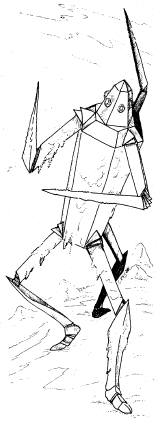
Icelings
are lesser inhabitants of the
plane
of Ice. Like the other minor elementals,
once
in a while they slip through
nexus
points to the Prime Material plane.
Naturally,
icelings are usually met on or
near
glaciers or other icy, snowy regions.
They
are triradial beings standing about as
tall
as a man, with three arms, three legs,
and
a hexagonal body. The head is also sixsided,
with
one bright eye in each side,
and
it rises to a blunt, pyramid-like point.
Icelings
are made entirely of cloudy ice.
They
radiate the intense cold of their
home
plane, but not enough to do damage
at
a distance. One-third of the 1-6 hp damage
done
by a stab from an iceling?s arm,
however,
is from the effects of intense
cold
on soft body tissues; opponents who
are
immune to cold take only 1-4 hp damage.
Icelings
are immune to cold attacks
themselves,
as well as chemical attacks,
while
fire attacks do double damage to
them.
Icelings
also have limited magic powers.
Once
per turn, each iceling can create a
snow
cloud: a 20? x 20? x 20? zone of
whirling
snow lasting 4 rounds. Its effects
are
much like those of a stinking cloud, as
those
caught within are blinded and disoriented,
stuck
within for 2-5 rounds (the
snow
cloud?s effects can last a round longer
than
the cloud itself), unless they save
vs.
poison. Even those who make the save
will
be occupied with clearing eyes and
nose
of snow for a round. Special circumstances,
like
a visored helm or some other
protection,
may reduce or even totally
negate
the snow cloud?s effects. Characters
suffer
the usual penalties for inability
to
see an opponent while they are in a
snow
cloud. Also, once per day three
icelings
together can create an ice storm
equal
to one cast by a 6th-level magic-user.
They
have no other magical powers.
Icelings
do not collect treasure and are
usually
inoffensive if not disturbed. Sometimes
they
spontaneously throw snow
clouds
around other creatures, apparently
just
for the fun of it.
FREQUENCY:
Very rare (Uncommon on
home
plane)
NO.
APPEARING: 1 (1-4 on home plane)
ARMOR
CLASS: 5
MOVE:
/18? (MC: C)
HIT
DICE: 6
% IN
LAIR: Nil
TREASURE
TYPE: Nil
NO.
ATTACKS: 3
DAMAGE/ATTACK:
2-5/2-5/2-5
SPECIAL
ATTACKS: Blinding; envelop
SPECIAL
DEFENSES: Cold affinity; weapon
resistance
MAGIC
RESISTANCE: Standard
INTELLIGENCE:
Low
ALIGNMENT:
Neutral
SIZE:
M (large volume, but diffuse)
PSIONIC
ABILITY: Nil
LEVEL/XP
VALUE: V/450 + 6 per hp
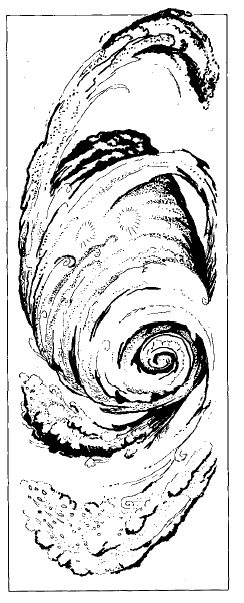
Like
the other ice para-elementals, snowfuries
occasionally
slip through nexus
points
to wander glaciers and snowfields.
Usually
they seem to be no more than
snow-laden
gusts of wind. In this condition,
they
are harmless and probably
won?t
be noticed. Fire enrages them, however,
and
on sensing a fire, they gather
themselves
into denser form and rush to
put
out the offending fire. A snowfury will
also
attack any nearby creatures its limited
intellect
connects with the fire. High
winds
put snowfuries into a manic state in
which
they may randomly attack other
creatures.
Fortunately, snowfuries are not
very
persistent; indeed, they are a bit
scatterbrained.
In combat,
the snowfury continually
extrudes
and reabsorbs tentacles of snow
and
ice pellets. It can attack with three of
these
tentacles per round, each tentacle
doing
2-5 hp damage from the combination
of
intense cold and impact by numerous
sharp
bits of ice. All three attacks can
be
on a single target. Opponents who are
resistant
to cold still take 1-3 hp damage
per
attack. If the snowfury gets a 20 on its
attack
roll, it has managed to get snow in
its
opponent?s eyes, blinding him for a
round.
A snowfury can also try to envelop
a single
human- or smaller-size opponent;
to
do this, it must make a special attack
roll,
foregoing all other attacks in that
round.
The victim takes 2-7 hp damage
that
round and on all subsequent rounds
until
he escapes the snowfury?s grip.
Escape
is made by making a successful
attack
against the snowfury. The victim is
also
blinded, as if by a snow cloud (see the
iceling?s
description) while enveloped, and
this
special ?escape attack? is the only
attack
he can make that will not be penalized
because
of his blindness. Even after
escaping,
the victim is still blinded for one
round.
While holding an enveloped victim,
a snowfury
can still make one normal
attack.
Attacks upon a snowfury have a
strong
chance of also hitting an enveloped
victim,
who takes half the damage the
weapon
does. The only way to avoid this is
to
make a second ?to hit? roll against the
snowfury:
the first to hit the snowfury,
the
second to avoid hitting the trapped
victim.
Snowfuries
are not hard to hit, but their
diffuse
nature means that weapons ?
even
magic weapons ? only do half damage
to
them. (Flame tongue swords
are an
obvious
exception; see below.) Their icy
composition
means that snowfuries take
1½
times normal damage from all fiery
attacks.
On the other hand, they regain hit
points
from cold-based attacks like white
dragon?s
breath or ice storm: if cold damage
is
measured in dice, then 1 hp per die
of
the attack is healed; otherwise, the
number
of hit points healed equals oneeighth
the
hit-point damage of the attack
(round
fractions down). Finally, if the
ambient
temperature is below freezing
and
there is ice or snow in the vicinity,
snowfuries
regenerate 1 hp per five
rounds.
FREQUENCY:
Very rare
NO.
APPEARING: 1
ARMOR
CLASS: 1
MOVE:
9?
HIT
DICE: 12
% IN
LAIR: 75%
TREASURE
TYPE: Nil
NO.
ATTACKS: Up to 6
DAMAGE/ATTACK:
2-12/2-12/2-12/2-12/
2-12/2-12
SPECIAL
ATTACKS: Spells; cold aura;
summoning
SPECIAL
DEFENSES: See below
MAGIC
RESISTANCE: 60%
INTELLIGENCE:
Exceptional
ALIGNMENT:
Neutral
SIZE:
L (6’high, 8’ diameter, 15’ arms)
PSIONIC
ABILITY: Nil
LEVEL/XP
VALUE: IX/9,600 + 16 per hp
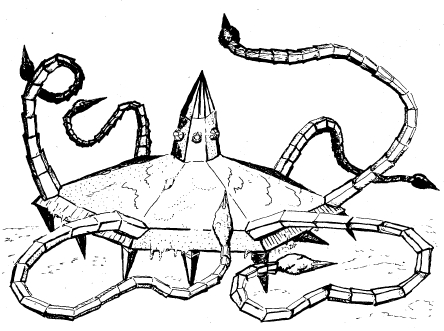
These
beings, known as the ?Frost
Kings,?
are the most powerful of the ice
para-elementals,
second only to mighty
Cryonax.
Only six of them exist. Although
not
very tall, frigidarchs are quite broad.
They
are shaped like shallow, faceted
pyramids
about 4? high and 8? in diameter.
They
scuttle on 12 short, spike-shaped legs
set
in the underside of the body, while
around
the rim are set six long, slender
tentacles.
These many-jointed arms are
surprisingly
flexible, considering their icy
nature.
At the apex of the body is the
mouthless,
noseless head with its ring of
six
gleaming eyes and coronet of icicles.
Because
this creature can see in all directions
at
once and has very quick reactions,
it
is not normally possible to surprise it.
Each
of the six tentacles can attack each
round,
as long as there is an enemy within
reach,
each doing 2-12 hp damage ? 1-6
hp
from jagged flakes of ice, and 1-6 hp
from
the frigidarch?s intense cold. Anyone
not
immune to cold takes 2-5 hp damage
from
contact with a frigidarch, and even
resist
cold only reduces this to 1-3 hp
damage.
(This only applies to contact other
than
the frigidarch?s attacks, of course.)
This
cold extends in an aura 10' out from
the
main body, doing 1-3 hp damage per
round
to those not resistant to cold or not
warmly
dressed.
Naturally,
frigidarchs are immune to all
cold
attacks; in fact, such attacks heal
damage
to a frigidarch, 1 hp healed per
die
of normal damage, or one-eighth normal
damage
if the attack damage isn?t
measured
in dice. Fire, on the other hand,
does
1½ times normal damage (round
down).
The frigidarchs are only hit by
weapons
with a +1 or better enchantment,
and
they are immune to poison, gas,
acids,
alkalis, all other chemical attacks,
paralysis,
and petrification. In a pinch,
frigidarchs
can meld into ice and snow
exactly
as a xorn merges with stone. They
regenerate
2 hp per round if the temperature
is
below freezing.
Finally,
frigidarchs have magical powers.
They
freeze water by touch, up to 100
square
feet per round, and the ice will be
1"
thick for every segment the frigidarch
spends
creating it (to a maximum thickness
of
6?). Beyond that, the ice insulates
the
water beneath, so that further freezing
is
impractical. Frigidarchs are also
uncannily
skilled at fracturing ice with
slashes
of their tentacles. Fractures are
not
more than 10? long or over 1? deep,
but
the limits and uses of this skill are left
to
the DM?s imagination. Once per five
rounds,
frigidarchs can use change temperature
(always
producing colder temperatures),
snow
cloud (equal to that of an
iceling,
but lasting 12 rounds), chill metal
(the
reverse-of heat metal), or wall of ice.
Three
times per day, once per turn, they
can
use cone of cold, ice storm, or summon
creatures
from the plane of Ice with
80%
success. These will be:
| 1d100 | Result |
| 01-30 | 3-12 shiverbugs |
| 31-60 | 2-7 icelings |
| 61-80 | 1-4 snowfuries |
| 81-00 | 1-2 ice para-elementals |
All
spells are cast as if by a 12th-level
spell-caster
of the appropriate type. Frigidarchs
are
capable of fighting with three
tentacles
while using the other three to
cast
these innate magical powers. Finally,
once
per week, a frigidarch can control
weather,
lowering temperatures by 30°F
within
a one-mile radius for 5-8 hours; if
the
temperature began at 40°F or less, the
temperature
change and duration are both
1½
times greater, and the frigidarch can
add
a stiff wind to make an impressive
local
blizzard. Damage from exposure to
such
inclement weather is covered in the
Wilderness
Survival Guide.