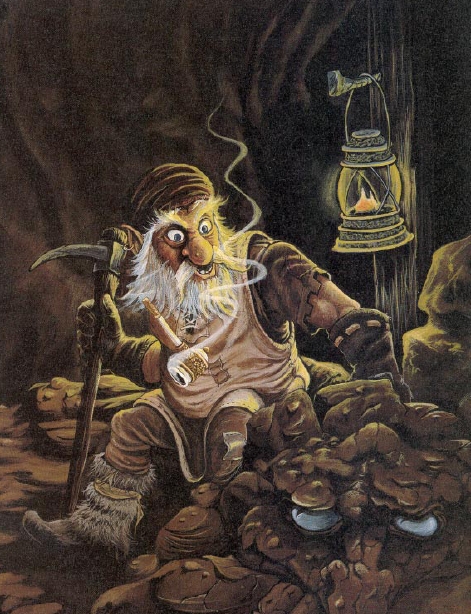
In a Cavern,
In a Canyon...
Mines and metallurgy in fantasy campaigns
Thomas M. Kane
| To find a mine | Assaying | Mines and the law | Wheels, gears, & pulleys | Perils underground |
| Digging | Smelting | Ending a mine | ||
| 1st Edition AD&D | - | Dragon magazine | - | Dragon #152 |
"Certainly, though it is but one . . .
method of acquiring wealth . . . a careful
&& dilligent man can attain this result in
no easier way than by mining"
Georgius Agricola, De Re Metallica
Every dwarf knows how important
mines are. As Agricola stated, there are
few better ways for someone to get rich
than discovering ore and digging it up.
Mines also make ideal ?dungeons.? Adventurers
can comb through abandoned tunnels
or active shafts owned by their
enemies or creatures from below.
The AD&D® Dungeoneer’s Survival
Guide presented some basic information
about mining on pages 48-55. This
article
expands that material with information
about medieval prospecting and metallurgy,
based on Georgius Agricola's De Re
Metallica, a German text written in A.D.
1550. Dwarves, gnomes, drow, and humans
with the miner secondary skill or
mining proficiency should have access to
this knowledge in AD&D games.
To find a mine
In medieval times, prospectors began
their search for valuable ores in early
spring. They looked for far more than telltale
ore-bearing rocks. Agricola stated that
a warm and dry ?exhalation? comes from
underground metal, preventing hoar-frost
from forming on short new grass. By
observing the patterns of frost on grassy
ground, one can see where ore veins run.
Furthermore, trees absorb metal through
their roots, and such metal causes the first
leaves of the season to blacken or fall off if
the trees stand over a vein.
Medieval prospectors knew to look for
natural springs because water often congeals
in mineral veins and flows along
them. This gives the water a distinctive
taste. Salty springs (found inland) indicate
underground salt, and salt would be precious
in any medieval-style fantasy society.
In our own world, a few ounces of salt
were worth more than two slaves as recently
as the 1700s. An experienced miner
could also taste for soda (nitrium), alum,
vitriol, sulfur, and bitumen, all of which
were used in smelting ore, in alchemy, and
in medicine. In the AD&D® game, bitumen,
sulfur, and alum are also used as
material spell components.
The DM can role-play this search, making
a map of the area of interest and letting
PCs explore it (dwarves might
appreciate this activity most). It takes one
week for a miner to prospect four square
miles, longer if the ore is particularly
difficult to find. As noted beforehand, the
searchers must examine springs and herbs
as well as stones. A group containing
characters with knowledge of mining as
well as wilderness-wise rangers, elves,
druids, and NPC treants (or trees contacted
through speak with plants spells)
can finish the search in half the normal
time. Of course, these latter experts may
refuse to despoil the earth by mining.
Clever NPCs (or PCs!) might guide prospectors
away from veins, to avoid having
forests cut down for timber used in building
the mine itself.
After this exploration, PCs may attempt
mining proficiency checks (explained
on
pages 25-26 and 48-49 of the DSG, and on
pages 54 and 61 of the AD&D 2nd Edition
Player’s Handbook). If the checks succeed,
the DM tells PCs where they find springs,
colored trees, or bits of ore (and what
these may mean). Of course, the PCs might
discover monsters or claim jumpers, too,
as the DM wishes.
Miners in medieval times practiced a
whole branch of sorcery. They believed
that ore radiated an aura or ?field?; when
a magician walked over such a field with a
forked divining rod, this field caused the
stick to twist in his hands. Some diviners
employed hazel rods, while others claimed
that hazel could find only silver. The latter
used ash rods for copper, pitch pine rods
for lead or tin, and iron wires for gold.
Others preferred to use magic rings for
divining, and others looked for an ore?s
field by observing the area in a magical
mirror or through an enchanted crystal.
Agricola did not believe in diviners, although
he suggested that such magic
might have existed in ages past. In AD&D
games, a ring of x-ray vision,
might help
prospectors find dense metal ore, and a
wand of metal
and mineral detection could
locate veins (see the AD&D 2nd Edition
Dungeon Master’s Guide, pages 151 and
157, respectively, for more information).
Mages can research spells or develop
items to find ore, using the items described
above as guidelines. Of course, all
magic flirts with peril. New spells might
invoke the elemental plane of Earth, and
powerful but miscast spells could unleash
volcanoes, earthquakes, or malign beings
from other planes.
Despite their lore, prospectors depend
on luck. Some mines begin in farmers?
fields when plows turn up metallic stones.
Other veins are found after landslides or
earthquakes, and once a wildfire melted
ore near the grounds surface, causing
rivulets of gold to trickle down a mountainside.
The DSG contains guidelines for <Excavating
a Tunnel Mine>
placing ore veins, but ore can appear
wherever the DM wants it. Furthermore,
if mining would slow the campaign, no
amount of successful dice-rolling should
produce a vein. Charlatans, ?fool?s gold?
(iron pyrite), and the simple absence of
metal can frustrate the wisest prospectors.
Humans did not practice scientific geology
until the 19th century. However, in a
fantasy world, different races may be
intimately familiar with the patterns of ore
placement underground. Drow and
svirfneblin, among others, certainly know
where the earth hides its metals. Prospectors
might venture underground to beg
the advice of such races, but might eventually
fight these races bitterly. Surface and
underworld miners often clash because
each group desires the same resources.
PCs digging down into ore beds might
meet beings chipping their way up.
Deep-dwelling races know that the earth
is formed in layers of stone and dirt, with
new layers forming over the old. Veins of
ore usually appear where something disrupts
these layers, concentrating minerals
in one place. For example, magma can
squeeze its way into other stones, carrying
ore with it. It forms vertical dikes, horizontal
sills, blisterlike laccoliths, and vast,
rippling batholiths. Diamonds collect in
kimberlite pipes, cones of volcanic rocks
that project upward. Tectonic plates also
alter the geology of an area. A rising plate
might lift metals or oil, creating a chain of
'deposits along the edge of a continent.
Underground peoples might also know
about oil. Petroleum collects where the
layers of earth curve, forming a trough or
a trap for it. Petroleum is likely the ?flaming
oil? adventurers hurl at monsters; the
only oils in the Middle Ages came from
animal or vegetable fat and were unsuitable
as weapons. Perhaps fantasy warriors
import their oil from the underworld.
Dungeon explorers may grow rich trading
in oil they recover. Petroleum deposits
might also interest Oriental characters; the
ancient Chinese drilled for oil and salt
water with bamboo derricks. Some Chinese
emperors tried to tax these wells, but
rural landlords resisted by posting scouts
who dismantled the drills before inspectors
arrived.
Assaying
Once prospectors discover a vein, they
must evaluate it by assaying (testing) the
ore. Miners often judged unknown ores by
chewing them. They also suspended earth
in water so it could be studied with colorchanging
slips of paper, like the litmus
paper used by modern chemists. Roman
craftsmen made this paper by dipping
parchment in shoe-black. It turned green
when exposed to vitriol, a sulfate often
found with metallic ores.
When these tests seem promising, assayers
then heated ore in crucibles. Pure
metals melt smoothly and at precise temperatures.
Medieval assayers used flammable
compounds to measure the melting
points of ores. The craftsmen knew the
temperature at which the powdered compounds
would, combust, so if a molten
metal ignited them, that showed how hot
the metal was. These tests also helped
miners choose fluxes for smelting. Fluxes
are substances that aid the separation of
slag from pure metal in the smelting process.
Different colors of smoke created
during these tests suggested different
chemicals for use as fluxes, and deep
purple smoke meant that the ore needed
no flux at all. Each such test had to be
performed in a cupel, or dish of ashes.
The ashes were especially pure so they did
not absorb the metal. Assayers preferred
ash burned from beech or other trees that
grow slowly.
Experts on metallurgy did more than
test mines. They hunted counterfeiters
and set values for metals. Grossly adulterated
gold (used in forged coins or as part
of a fake gold-mine scam) turns black in a
candle flame. More sophisticated counterfeit
metals appear real but will not melt
until treated with lead flux. Once an assayer
determined that a metal was genuine,
he tested it with a touchstone to
reveal its purity. The sample was beaten
into a needle shape and scratched against
black slate until it left a streak. By looking
at the mark, a learned metallurgist could
determine the ratio of metals in any alloy.
A character must make a smelter profi-
ciency check to assay a sample (see the
DSG, pages 25-26). The tools required for
assaying cost 50 gp, more if pure ashes are
unavailable. DMs should make this check
in secret. If the character succeeds, he
learns the exact purity of the ore or coin
being tested. The DM can determine a
mine?s value with the results on Table 33:
Ore Quality, on page 51 of the DSG. If the
check fails, the assayer believes that the
mine is either far more or far less valuable
than it really is (there is a 50% chance of
either result). PCs might then abandon a
priceless mine or be convinced that a mine
should be producing more than it does
(and thus conclude that their workers are
stealing ore).
Mines and the law
It appears to be a basic law of mining
that once someone finds metal, the government
will certainly interfere. In Agricola
?s Germany, each miner was required to
register his mine with the local burgomaster
or town mayor, so he could divide the
ground above the mine into meers. Whoever
possessed a meer owned all ore
found beneath it. Meers were of different
sizes, and the mine?s discoverer always
received the largest one. Smaller portions
belonged to business partners and landowners.
The law reserved other meers for
the king, his consort, his master of horses,
his cupbearer, his groom of the chamber,
the bishop, and the burgomaster himself.
The local baron did not automatically
receive a meer. Miners were legally vassals
of the crown and paid tribute directly to
the king.
Metal brings wealth, technology, and
independence in war, so most rulers want
their people to mine. Some kings granted
prospectors permission to dig wherever
they found ore, no matter who owned the
land above it. Other kings allowed miners
to seize only ?wastrel land? that was not
being farmed. These laws usually included
another provision requiring miners to
work their mines. If a mine owner failed
to produce ore for nine weeks, the baron
often confiscated his holding and awarded
it to the informer.
Medieval laws also covered labor in the
mines. Shifts could not exceed seven
hours, and foremen had to warn workers
when their time ended. Bosses communicated
with subordinates in deep tunnels
by ringing a great bell called a campana,
by stamping rhythmically on mine timbers,
or by relaying codes of hammer taps
from miner to miner. If miners missed
these messages, their shifts were still
legally over when their lamps burned out.
For this reason, foremen filled the miners?
lamps and weighed them to be sure that
nobody had too little. Most burgomasters
refused to allow foremen to work their
miners at night or for two shifts in a row,
except during emergencies. The miners
usually resented these rules, since they
wanted two shifts? worth of pay. (As a side
note, many miners fell asleep in lonely
tunnels even during a single shift. Miners
sang to stay awake, and Agricola noted
that the singing ?is not wholly untrained
or unpleasing.? Dwarves, gnomes, humans,
and other races that are not accustomed
to eternal existence underground might do
the same; the dwarves in J. R. R. Tolkien's
The Hobbit sang--and quite well, too.)
Wheels, gears, & pulleys
Ingenious machinery filled medieval
mines. Agricola considered the idea of
carrying ore out on workers? backs barbaric
because mine carts had replaced
porters for centuries. Carts were rolled
into a mine on tracks using the force of
gravity, then pulled out by mules or pack
dogs. (In AD&D game terms, pack dogs
are treated as war dogs and carry 20 lbs.
at normal speed or 50 lbs. at half speed.)
Outside the mine, daredevil sledge drivers
guided loads of ore down mountainsides,
steering themselves with poles. Agricola
mentioned that these sledders worked
?not without risk of life.? Other loads were
lifted out of vertical mine shafts by cables.
Hand-powered windlasses and cranes
operated by treadmills dotted the ground
above mines. Miners did not even have to
climb down the shafts to work. They slid
on chutes or clung to rope elevators powered
by treadmills.
Some mines flooded constantly, so organlike
pump arrays descended into the
tunnels, powered by treadmills or water
wheels in nearby streams. Some pumps
used a single plunger, while others involved
dragging a chain with bundles of
watertight leather set at given intervals
through a pipe. Pumps become inefficient
when the distance they travel is too long,
so deep mines used other systems. Some
dragged chains with buckets attached
through the water. Others required pump
relays, each one raising water one level
using buckets or Archimedes? screws.
Relayed pumps could use relayed water
wheels, in which water poured down a
deep shaft and turned a different engine
on each floor.
Nothing could be more important than
oxygen to miners of any race. Medieval
engineers dug horizontal shafts into mountainsides
so air could flow freely into some
mines, but many lodes were too deep to be
reached in that manner. In windy spots,
miners used funnels and pipes on the
surface to ventilate tunnels. These devices
had fans that rotated in the wind using
vanes and sails. Deeper tunnels required
miners to invent various air pumps, including
men fanning air into shafts with
linen sheets, feathered propellers, vast
blower boxes powered by water wheels,
and gigantic bellows. Gearboxes allowed
these air pumps to be powered by treadmills
or water wheels as well as by hand.
When these devices break (or are sabotaged)
in game campaigns, characters
might be trapped without fresh air. A 10'
cube (NOT "10 cubic feet"
as noted in the
DSG, page 36) contains enough oxygen
to
last one man for one day. If the character
exerts himself by exploring, fighting, or
digging, he needs twice as much oxygen.
Fires also consume oxygen. A torch
consumes a 10? cube of oxygen in eight
hours, and a small bonfire uses this much
in two hours. Burning oil uses 10 times as
much oxygen as a wood fire, so an oilburning
fire uses up a 10? cube?s oxygen in
only 12 rounds. An adventurer can hold
his breath for a number of rounds equal
to one-third his constitution, rounded up.
After this, the character must attempt a
1d20 roll against his constitution each
round, with a penalty of +2 per round.
When this roll fails, the victim suffocates.
More information on this topic
is contained
in the DSG, pages 36-38.
Perils underground
Medieval miners believed that a whole
host of demons and gnomes lived in the
shafts with them. Most tunnel spirits were
benign. They appeared to work vigorously
and carry away ore, but they never
seemed to deplete the veins. These creatures
threw pebbles at workmen who
teased them but did no harm. Other
haunts were invisible but made knocking
noises. A few demanded offerings before
they allowed anyone to dig their favorite
lodes. Anyone who refused to give an
offering would die by falling down a shaft,
being buried by a cave-in, or becoming a
victim of one of the mishaps so common
underground. The same spirits befriended
kindly people and led them to riches. In
AD&D games, these creatures could be
pech, booka,
and underground pixies.
Miners dread the more fearsome
creatures. They considered it impossible
to keep kobolds out of mines, and these
small, evil beings supposedly sabotaged
elevators, allowing people to plunge into
the depths. (Miners also believed that
cobalt, a gray metal later used in alloys
and paints, was a worthless metal substituted
for silver by kobolds in the mines.)
Deadly ants and solifuga (sun spiders,
tiny
versions of those in Monster Manual II)
stung people who sat on them. Many
believed that each mine had its own breed
of poisonous bugs; nothing could SAVE
their victims except a drink from one
particular hot spring that was hidden
somewhere within the same mine (which
DMs may wish to include).
The earth that miners dig can kill them,
too--and it does so in real life. Ordinary
dust scars the windpipe and causes lung
diseases ni old age. Other powders corrode
the lungs at once, and Agricola reported
that in the Carpathian mountains
most women married at least 7 husbands,
as 1 by 1 each man smothered
underground. A black dirt called pompholyx
settled in open wounds and ate them
to the bone. It also destroyed iron , so
wooden tools were used in the mines it
infested. Cadmia dust does even more
harm; it can burn into uninjured skin
when moistened. A greenish metal called
kobelt was said to devour the feet of men
who walked over it. This was the origin of
the word ?kobold,? because people assumed
that little goblins laid kobelt traps
on purpose. Miners protected themselves
from these dusts with sealed leather coveralls
and breathing masks made of animal
bladders.
Poisonous dusts like pompholyx do no
harm to healthy characters, but they
infect any wound that is not bound within
1 round after contact. Pompholyx
causes 1 HP damage per round to such
open wounds until 1/2 again as much
damage is taken as the character originally
suffered. Any iron exposed to pompholyx
(including armor) must SAVE vs. acid every
hour or be damaged. Armor loses 1
AC of protection; weapons suffer
a -1 on damage rolls, and small items
break. Intelligent enchanted swords plead
NOT to be xposed to pompholyx. Cadmia
dust causes 1-4 HP damage per round, |or|
1-8 HP damage if the victim has wet skin.
Kobelt destroys boots after 1-10 turns (if
not brushed off) and causes 1 HP damage
per round to bare feet. When characters
stand on kobelt without shoes, they must
SAVE vs. poison or be unable to stand
thereafter until their wounds are healed,
otherwise falling to the ground in the
kobelt for 1-10 HP damage (Kobelt might
also be green slime.) Protective clothing
prevents damage from dusts, but such
clothing is useless once perforated. Whenever
a PC suffers damage, he must make a
dexterity check on 1d20 to protect his suit.
People who get any corrosive dust in
their eyes (for whatever reason) must save
vs. poison or go blind. Dusts have a 20%
chance of blinding both of a person?s eyes
even if only one eye is exposed, due to
sympathetic eye syndrome.
Stagnant air in mines could be cleared
with pumps, but poisonous gases killed
victims nonetheless. Dangerous fumes
arose from some ores but could usually be
detected with candles (which burned in
different colors) or with canaries (which
died when exposed to methane,
as per the
DSG, page 37; checking for methane
with
open flame is dangerous, as it will cause
an explosion). The most common poisonous
gas was carbon monoxide, created
when workmen set underground bonfires.
These fires were necessary to heat rock so
that it could be cracked open with cold
water. Miners usually did this chore on
Friday, evacuated their tunnels, and did
not return until Monday. Some smoke
settled on water, forming an arsenic film
that floated into the air when the pools
were disturbed. Those who survived the
fumes reported that their limbs swelled
until their hands and feet were spherical.
Agricola reported watching men climb
ladders to escape arsenic gas, only to fall
as their fingers grew too bloated to grip
the rungs.
Sulfurous fumes, present with volcanic
activity, suffocate victims as if there were
no oxygen in the air (see the DSG,
page
36). Carbon monoxide smothers any character
in only 1-3 rounds because of its
potent poisons: Anyone exposed to arsenic
gases must save vs. poison; if the roll fails,
he is immobilized by swelling. Arsenic also
smothers victims as if it were carbon
monoxide. When this material settles in
pools, characters can walk past safely.
However, when anything disturbs the
water, gas is released. If a character actually
touches the water, he must save at -3
or be paralyzed and begin to choke. Furthermore,
anything wetted with arsenictainted
water exudes poisonous gas in a
10' radius until it is scrubbed.
Some PCs may want to use these chemicals
against enemies. If so, the DM should
remember the dangers of carrying these
poisons and being caught in one?s own gas.
None of the gases but arsenic have any
effect aboveground in open air. Even inside
buildings, they disperse too quickly to
kill most people, given an open window or
two. The corrosive dusts cannot cause full
damage except when concentrated. A few
handfuls of kobelt or cadmia should be
treated like the acid described in the
1st
Edition DMG on page 64. Pompholyx cannot
harm living things aboveground. PCs
might use it to sabotage iron objects, but it
would have to be applied directly and
allowed to sit undisturbed for one hour.
Mines can also collapse. Tunnels in
AD&D campaigns must be supported by
timbers or stone every 10', and these
supports require four man-hours to construct,
given a source of wood or worked
stone along with ways of transporting it to
the mine. With supports, there is a 2% per
day chance of a cave-in somewhere within
the mine; without them, there is a 10%
chance per turn that a once-reinforced
tunnel collapses. The DM should decide
where the cave-in occurs, placing
it wherever
miners have weakened the ceiling
most recently (also see the tables on pages
39-40 of the DSG). Damage
from falling
rock is given in the DSG
on page 40. Even
if cave-ins miss characters entirely, they
may trap the PCs underground. Table
27:
Mining Rates, on page 50 of the DSG,
shows how fast rescuers can dig. Victims
may try to scoop their way out, but unless
they have picks and shovels, they dig at
one-quarter the usual rate.
<Table 17: CAVE-IN
LOCATION>
<Table 18: CAVE-IN
CHAIN REACTION>
Digging
Determine a mine?s output by calculating
the amount of ore its workers can dig
each day, using Table 27: Mining
Rates, on
page 50 of the DSG. Some magic,
including
dig and move earth spells and spades of
colossal excavation, may speed the work.
The tables in this article show how difficult
ore is to dig, what it weighs, and how
much metal can be extracted from it.
Tables on pages 50-52 of the DSG
help the
DM determine other details, such as the
location of veins and their composition.
Remember that ore not only needs to be
dug, it must be transported to a smelter.
<Table 27: MINING
RATES>
<Table 28: MINERAL
VEIN DIRECTION>
<Table 29: VEIN
PATH ALTERATIONS>
<Table 30: MINING
PRODUCTS>
<Table 31: MITHRIL
CHECK>
<Table 32: GEMSTONES>
<Table 33: ORE
QUALITY>
<Table 34:
GEMSTONE QUALITY>
Table 1 herein describes common sorts
of ore and the ease of mining them. The
classification of an ore as ?hard? or ?soft?
applies to the Mining Rates table previously
noted. Weights are given in pounds
per cubic foot.
Ore appears in vertical columns called
vena profunda, horizontal veins called
vena dilatata, or lone masses called vena
cumulata. Use Table 28
and Table 29 on page 50
of the DSG to determine where the
vena
dilatata go or else choose the direction.
Vena cumulata and vena profunda can be
approached from above and are easy to
excavate using vertical shafts. Miners dig
vena dilatata while lying down; this keeps
miners from wasting time digging useless
stone but forces them to work in cramped
positions, Dwarves excel at this job because
they fit into. these narrow tunnels.
Larger miners can only mine these passages
at 75% their normal rate, or one-half
the normal rate if they insist on digging
tunnels n which they can stand upright.
When characters smelt their ore, you
will need to know how much metal the
ore contains. Table 2 herein converts the
Ore Quality table on page 51 of
the DSG to
the gold-piece weight of actual metal per
25 cubic feet of ore, the typical daily production
for a human miner in hard rock
(this is about the size of a 3' cube). When a
mineral can be extracted from different
sorts of ore, a letter code indicates what
sort of ore is present.
No one mined platinum until the 18th
century. It was first found in riverbeds as
part of a native alloy. This metal had to be
dissolved in aqua regia and reprecipitated
to form platinum. The exact methods used
remain trade secrets even today.
Smelting
Once the ore is aboveground, it is sent
though a new series of machines. Workers
sort ore from stones by hand because
plain earth soaks up metal when the two
are placed in a furnace together. Each
metal requires different treatment. Antimony
had to be treated gingerly, because
alchemists warned that it might turn into
lead. Pliny the Elder, a Roman naturalist,
recommended mixing silver and gold ores,
claiming that the electrum produced
would create magical lightning and detect
poison by turning black. When gold or
silver mingles with lesser ores, acid is used
to dissolve the unwanted metal. Adept
miners could then reconstitute the other
metals from solution. Some miners were
even brave enough to dissolve the gold
with a mix of hydrochloric and nitric
acids, then precipitate it (check a basic
chemistry text for details).
Gold can usually be washed out of its
ore without heat or acid. There were an
amazing variety of machines for purifying
it, all based on the principle that gold is
heavier than dirt and settles to the bottom
when suspended in water. ?Panning? by
hand is the most basic version of this
method. Other systems involved placing
the ore on a screen with a tray underneath
and running water over it, or lining
streambeds with collector plates. Workmen
patrolled these chutes with hoes to
push lumps of gold back into the plates if
they were washing away.
Ore that is to be smelted in a furnace
must first be crushed. Some mine owners
employed men with hammers to beat the
stones, but mines with nearby streams
used water wheels to power huge automatic
hammers or grindstones to grind
soft ore like wheat. (Orcs or other foul
creatures might enjoy pounding people in
this machinery.) Smelters roasted ore in
open fires to burn away sulfur and bitumen
before placing it in the furnace. In
the smelter, ore was mixed with appropriate
fluxes to make metals melt easily and
at regular temperatures. Copper will not
melt until all traces of iron with it have
melted, so it is never worked with iron
tools. Most furnaces required large bellows
or mechanical blowers, and some
were so large that operators needed
cranes to open them. However, even these
furnaces were not always large enough. A
few miners preferred to build hills of ore
against windy mountainsides and smelt
hundreds of tons at once. Other smelters
completely automated the process of refining
metal, using water-powered conveyor
belts and engines to crush, rinse, strain,
and heat the ore.
It is always worthwhile to recycle processed
ore. Some smelters accepted their
slag instead of a fee, knowing that the slag
still contained valuable metal. In the case
of gold, even the water that washed it
remained precious. Many miners strained
gold dust from waste water with sheep’s
wool, and Agricola suggested that this was
the origin of the Greek myth concerning
the Golden Fleece. Clever miners could
always extract even more gold by mixing
mercury with the ore. Smelters put the
most promising pieces of stone in a cloth
bag with mercury and squeezed the bag
until the quicksilver trickled out. The
material left inside appeared to be pure
gold; it was actually an amalgam, but not
even experts could tell.
Table 1
Metallic Ores and Gems
| Ore | Element | Hardness* | Weight** | Notes |
| Argentite | Silver | Soft | 450 | Silvery crystals |
| Bornite | Copper | Hard | 312 | Bronze color, purple sheen |
| Cassiterite | Tin | Hard | 437 | Fibrous masses |
| Chalcocite | Copper | Soft | 344 | Gray-black |
| Cinnabar | Mercury | Soft | 506 | Red, used in dyes |
| Copper, native | Copper | Hard | 556 | -4 on smelting rolls |
| Galena | Lead | Soft | 469 | Gray crystals |
| Gem minerals | Varies | Hard | 162 | See the DSG, pages 51 and page 53, for output |
| Gold ore | Gold | Soft | 600 | Gray |
| Hematite | Iron | Hard | 312 | Red stone or gray crystal |
| Limonite | Iron | Hard | 219 | Rounded ochre lumps |
| Magnitite | Iron | Hard | 325 | Black, magnetic (lodestone); see the DSG, page 42 |
| Malachite | Copper | Hard | 231 | Ornamental (azurite) |
| Pentlandite | Nickel | Hard | 287 | Brassy, contains iron: miners once considered it cursed |
| Pyrite | Iron | Hard | 312 | "Fools' gold" |
| Siderite | Iron | Hard | 237 | Brown crystals |
| Skutterudite | Cobalt | Hard | 406 | Gray clusters |
| Sphalerite | Zinc | Hard | 250 | Yellow-brown, brittle |
** Figures show the weight of excavated ore in pounds per cubic foot. The amount of actual metal extracted from this ore can be determined using Table 2.
Table 2
Ore Purity
__________________________1d10 roll* ________
| Metal | 1 | 2 | 3 | 4 | 5 | 6 | 7 | 8 | 9 | 10 |
| Cobalt | 5 | 10 | 20 | 40 | 75 | 90 | 110 | 150 | 200 | 250 |
| Copper | 16 A | 33 B | 41 A | 50 C | 58 A | 66 C | 83 A | 125 C | 166 D | 333 D |
| Gold | 2 | 4 | 8 | 16 | 32 | 50 | 67 | 83 | 125 | 166 |
| Iron | 33 E | 50 F | 83 F | 116 F | 150 G | 200 H | 266 G | 333 H | 500 H | 660 E |
| Lead | 16 | 33 | 41 | 50 | 58 | 66 | 83 | 125 | 166 | 333 |
| Mercury | 16 | 33 | 41 | 50 | 58 | 66 | 83 | 125 | 166 | 333 |
| Nickel | 15 | 30 | 40 | 50 | 60 | 70 | 80 | 120 | 170 | 300 |
| Platinum | 1 | 2 | 3 | 4 | 12 | 17 | 42 | 67 | 134 | 167 |
| Silver | 4 | 8 | 16 | 32 | 50 | 64 | 83 | 125 | 167 | 166 |
| Tin | 30 | 60 | 90 | 100 | 130 | 135 | 140 | 150 | 160 | 170 |
| Zinc | 15 | 30 | 40 | 50 | 58 | 66 | 83 | 125 | 166 | 333 |
An alchemist could also use quicksilver
to separate gold from silver. The process
involved heating a gilt object in mercury,
then rapping it sharply. All gold would
crumble off, leaving the surface below
intact. Other chemists used a powder of
sal ammoniac and sulfur that could be
applied to an object with oil. Gold would
then flake away as soon as the object was
heated. These methods were usually used
by craftsmen who wanted to remake fine
gilt items, but they have obvious applications
for theft. A dose of this solution costs
50 gp and can remove 10 lbs. of gold.
Miners leeched salt and chemicals from
their ore. Medieval chemists made lye by
soaking the ashes of reeds and distilling
the water. Saltpeter could be made the
same way, but it came from the earth on
cellar walls and oak ash instead of reeds; it
was usually purified by heating it in a
copper pot. Bitumen did not even need to
be fully dried; it floated to the top of water,
where workers skimmed off the oily
substance with goose wings. Alum came
from certain porous rocks, which were
heated and dissolved in human urine. The
reconstituted material could be used in
many ways. Doctors prescribed alum to
stop bleeding, as mouthwash, and to cure
dysentery. Dyemasters made a remarkable
pigment from alum that did not appear to
have any effect on cloth at first but gradually
became colored. Cloth dipped in a
single vat of alum dye could take on many
different shades. Miners prized salty hot
springs, since these not only contained
minerals but their natural steam could
power an apparatus designed to draw out
water and automatically evaporate it with
geothermal heat. The spring did all the
work; its owner simply came at the end of
each day to collect his minerals.
Smelting is partially described on page
26 of the DSG. Every 200 gp weight
of ore
requires 5 gp worth of fluxes and one
worker. Automatic machinery costs 1,000
gp to install but reduces the need for labor
by one-half. Have the character in charge
of a smelter make a smelting proficiency
check (see the DSG, page 25). Smelters
suffer a +3 penalty on this roll if they
have not successfully assayed the ore. If
the check fails, half of the metal is lost,
and the rest must be resmelted. If the
check succeeds, the character obtains 75%
of the available metal. Smelters must pass
a second check to get the rest.
Ending a mine
Eventually, miners will have dug all the
metal they can safely take from a mine.
During Roman times, people hoped that
ore would grow back in an exhausted
mine, as if the earth were a living thing
healing its wounds. This might be true on
the elemental plane of Earth in a fantasy
world. However, even Agricola knew that
this was wrong, and he warned that no
one should abandon a mine without leaving
a record of why it was unsuitable.
Many miners wasted fortunes trying to
reopen empty mines. Mines in fantasy
could be abandoned because of gases or
monsters, or because the shafts had nearly
tapped underground lakes or magma. But
many an adventure might unfold as unknowing
characters make their way
though old shafts and tunnelings, in
search of dangerous beasts or lost and
forgotten riches beneath the ground.
Bibliography
Agricola, Georgius (translated by Herbert
Clark Hoover and Lou Henry Hoover).
De Re Metallica. New York: Dover Publications,
1950. (Yes, the translator was
a President. This book contains numerous
woodcuts of elaborate late-medieval
machinery, much of it
applicable to AD&D campaigns.)
Edwards, Richard, and Keith Atkinson.
Ore Deposit Geology New York: Chapman
and Hall, 1988.
French, Roger, and Frank Greenaway
(translators and commentators). Science
in the Early Roman Empire. Totowa,
N.J.: Barnes and Noble Books,
1986.
Park, Charles and Roy MacDiamaid. Ore
Deposits. San Francisco: William Freeman
& Company, 1975
Peters, William C. Exploration and Mining
Geology New York: John Wiley & Sons,
1978..
Strangway, D. W, The Continental Crust
and Its Mineral Deposits. Waterloo,
Ontario: Geological Association of Canada,
1980.
van Andel, Tjeerd. Tales of an Old Ocean.
Stanford, Calif.: Stanford Alumni Association
Press, 1977.
Zim, Herbert S. and Paul R. Shaffer. Rocks
and Minerals. New York: Golden Press,
1957.