
| Hierarchy of lawmen | Into the melee | Good versus evil | Sample encounters | Rewards of service |
| 1st Edition AD&D | - | Dragon #151 | - | Dragon magazine |
Soldiers of the Law
When you need help, call for O.A.
Law -- Oriental Adventures Law
by Dan Salas
The cities of Kara-Tur
are alive with
danger. Samurai warriors are ready to
draw swords at the slightest insult. Bushi
and ronin samurai start trouble to test
or
display their fighting skills. Kensai duels
erupt suddenly and end just as quickly.
Yakuza thugs make their demands at knife
point to terrified commoners. A wu jen
takes action to defend his honor against
someone who has mistaken him for a
peasant. How do the craftsmen and merchants
conduct their businesses under all
the flashing swords and flying arrows?
Police forces are necessary to keep
order in the cities of Oriental Adventures
campaigns. PCs might be accustomed to
tavern brawls and street duels unhindered
by the law, but what would happen if
every NPC was allowed such freedom?
The result would be a wasteland of
burned buildings and dead bodies. Only
an
alert, aggressive police force can prevent
such a disaster.
The ruling clan of each territory maintains
its own police force within its own
boundaries. This force is commonly one
of
two types: military police drawn from the
regular army, or local police made up of
commoners, mercenaries, and a few soldiers.
In either case, the police are always
backed up by the army in emergencies. All
types of lawmen serve as military police
with jurisdiction over commoners, travelers,
strangers, and the clan?s warriors.
Against such crimes as theft, assault,
murder, and duelling (which is considered
by samurai warlords to be a waste of
manpower), the police act swiftly. Their
dedication to uphold the law is as serious
as a samurai?s loyalty to his lord.
Hierarchy of
lawmen
The organization
of the law courts is
described in Oriental Adventures
(page
140). On the street level, the warriors
are
arranged as follows:
The town commissioner is the Chief of
Police for a single town or city. He is
often
a bushi of 7th-9th level, though in major
settlements (such as a city or strategically
important town) he is a samurai of 9th-
12th level. He supervises the police of
the
settlement, examines reports of illegal
activities in the area, and determines
which criminals are to be apprehended.
Occasionally, he personally helps to arrest
a major criminal or a suspected (and resistant)
official. A samurai town commissioner
always has at least 3d10 samurai
under his command, along with the bushi
police.
Beneath the town commissioner are the
common policemen. They are often called
watchmen or patrolmen, and these names
explain their most common duty. Military
police consist of samurai soldiers (1st
and
2nd levels) and samurai officers (3rd-5th
levels), while local police consist of
bushi
warriors (1st-3rd levels) and samurai or
bushi officers. Up to 25% of these bushi
are commoners who have been given the
warrior?s right to use weapons, though
upon reaching 4th level, a bushicommoner
becomes a full-class warrior.
Secretly employed by the police are the
censors. These undercover agents
are
ninja/bushi, ninja/yakuza, and genin ninja
(see DRAGON® issue #121, ?The
Genin?).
Rarely drawn from normal ninja clans,
these agents are employed directly by the
samurai clan?s leaders. Their jobs are
to
gather information for the police and to
watch the police themselves for corruption
and conspiracy. Along with their ninja
abilities, the abilities of NPC censors
include
the ability to investigate as yakuza
and to interrogate prisoners.
Lowest in rank are the era policemen:
zero-level bushi with 2-5 hp each. The
eta
are given the worst jobs: prison guarding,
executions, and the guarding of characters
who are paraded publicly as punishment.
Into the melee
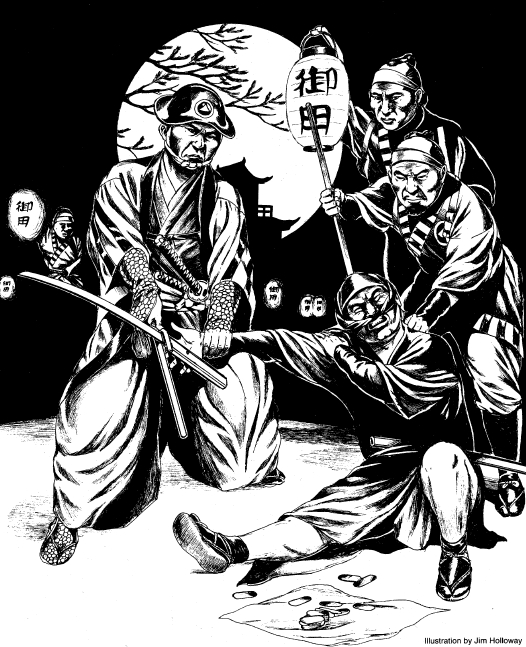
The armor and weapons of the police
are specialized to their needs. Combat
is a
constant threat but rarely a daily reality
for a lawman, so a warrior cannot simply
be transferred from the battlefield to
the
street and called a policeman.
Full suits of armor are affordable only
by rich officers and are worn only in the
most extreme situations. On a typical day
of patrols, the lawmen wear padded armor
and small metal helmets. For dangerous
tasks in which combat is expected, the
officers wear chain mail armor or, more
rarely, full suits of armor.
Eta police carry only spears. All other
policemen have at least one sword, while
policemen who are not commoners wear
the two swords (katana and wakizashi)
that their warrior status permits. The
police also use man catchers, hooked
spears, and sode garamis. Man catchers
are clumsy to carry, so are used only
when a specific criminal is sought. Hooked
spears can be used for martial-arts special
maneuvers; each lawman has a 5% chance
per level of knowing Weapon Catch; if
capable of that maneuver, he has a 5%
chance per level of knowing Weapon
Breaker. Sode garamis can be used to
entangle a loose sleeve or pants leg; a
normal to-hit roll is necessary, then the
victim attacks at - 4 to hit and - 2 to
damage. These penalties are cumulative
when an opponent is entangled by more
than one sode garami.
Each officer carries a jitte as a status
symbol. The jitte can be used for Weapon
Catch and Weapon Breaker. Officers are
often creative in their preferences for
weapons, so it is not unusual for one to
wield a chain weapon, lasso, or whip, all
intended to entangle an opponent without
causing harm.
Since they prefer to capture live prisoners,
many policemen are skilled in unarmed
combat, especially jujutsu. Each
lawman has a 20% chance per level of
knowing a martial art and is then skilled
in
one special maneuver per two class levels.
When encountering criminals, lawmen
will first attempt to capture the offenders
for judgment in the courts. They will
demand the criminals? peaceful surrender.
If disobeyed, the police will attempt to
disarm, entangle, or subdue the lawbreakers.
Note that when NPC samurai,
kensai, and ninja are subdued, they usually
attempt suicide by seppuku, leaping
over a ledge or cliff, or any other fatal
maneuver. The chance of this reaction is
5% per level, plus the NPC?s honor score.
The NPC must be physically restrained
from the self-destructive act or will automatically
succeed (this does nor apply to
PCs, who may act as they wish).
As a last resort, the police use deadly
force with their edged weapons. On rare
occasions, they use long bows against
dangerous criminals. When faced with
overwhelming odds, the town commissioner
can appeal to the local daimyo for
military support. This request is rarely
denied.
Good versus Evil
An uneasy relationship exists between a
city?s police force and the yakuza
gangs.
Where both sides are equal in strength,
the best reactions between the two groups
are suspicion and tolerance. Where the
yakuza are stronger, the police tend to
be
tough in appearance but timid in their
encounters with the gangs. Where the
police are stronger, they are strict toward
the commoners and brutal toward the
criminals, striking violently at the gangs
at
every chance.
Whether they are yakuza or policemen,
the number of protectors in a settlement
can drastically affect the encounters there.
Where there are few protectors, crime
and violence are everyday problems. People
tend to be suspicious and prone to
violent reactions in self defense. Commoners
live in fear of the bullies and shorttempered
warriors who wander the
streets. As for equipment and goods for
sale, quality is poor and quantity is low
because the merchants don?t like to risk
their necks in dangerous settlements. The
few merchants who conduct business in
such places always surround themselves
with a bodyguard of bushi and ronin
samurai.
In well-protected settlements, the commoners
thrive amidst the law and order.
Rich merchants bring the best equipment
to the markets, while craftsmen and
farmers sell their goods with little fear
of
strangers? weapons. Only the most violent
or foolish warriors unleash their combat
skills without good reason.
Sample encounters
The following encounters will help to
establish the police in any Oriental
AD&D
campaign city, though only the first two
should be used regularly.
The gate watch: At every main city
gate
are 2-5 watchmen. Small cities and towns
may have fewer guards. These men keep
watch on all peasants, travelers, and samurai
who pass through the gate.
In Shou Lung, the guards take action
only against wanted criminals or if there
is
trouble. Otherwise, they remain patiently
at their posts.
In Wa, written passes are required for
travel through a main city gate and sometimes
through a district gate (especially a
castle district). These papers are to be
presented by important people such as
officials and samurai, not by clergy or
peasants. The passes must be signed or
approved by the lord of the settlement.
In T?u Lung and Kozakura, the guards
question characters if the characters look
suspicious (e.g., are heavily armed foreigners,
are carrying drawn swords and
bows with knocked arrows, are displaying
unusual magical talents, etc.). As the
characters
answer questions, the guards make
reaction checks until a hostile
or friendly
reaction is reached. Hostile means
that the
guards will not allow the characters to
pass through the gate; friendly
means that
the guards allow them to pass.
In T?u Lung, the guards can be bribed by
persons whom they are questioning. The
cost is typically one tael per watchman
and two tael per officer. That cost is
doubled
if the guards have already showed a
hostile reaction. In any other country,
an
attempt to bribe is an insult to the guards?
honor.
Wandering patrols: Watchmen travel
in
groups of 2-5. Each turn, there is a 25%
chance that a group wanders down any
given street. These men keep watch on
everything that happens around them. If
there is open combat in a street or within
hearing range of the street, make the
check twice each turn. Unless the fight
is
an approved vendetta duel, the police
demand that the offenders cease hostilities.
If disobeyed, the police enter combat
to capture the offenders.
Prison: Each city or large town has
a
single-room prison where captured criminals
are detained. The prison is usually
located at the edge of the city, often
near
an eta community. Depending on its size,
each prison is guarded by 5-20 eta and
half as many bushi, all overseen by a bushi
officer. At any time, there are 20-80 people
under guard, depending on the size of the
settlement and the country (e.g., T?u Lung
has more prisoners due to its corrupt
society, while Kozakura has fewer prisoners
because the police are free to use
deadly force at their discretion, with
no
questions asked).
Mistaken identity: A group of watchmen
surround the PCs in the street. Though
the police do not attack, they hold out
their weapons in defensive positions.
Within a few rounds, an officer arrives,
looks at the PCs, and declares that they
are not the criminals he seeks. He apologizes
for the mistake and he and his men
hurry away. If the PCs push a fight, the
police will assume that they are guilty
and
will attempt to capture them for transfer
to the prison.
Public execution: A crowd of peasants
surrounds a wooden platform where
criminals await execution. At least one
officer and six patrolmen conduct the
event, while eta police perform the actual
slayings. Thieves, murderers, pirates,
and
other low-life villains are boiled alive
in
huge pots of oil, while yakuza characters
receive fast beheadings. On rare occasions,
the PCs may recognize some of the
criminals as old friends, acquaintances,
or
needed sources of information. A rescue
might be in order.
The trapped fugitive: The PCs see
a
crowd of peasants in one of the streets.
Upon closer inspection, they find a dozen
police and a half-dozen soldiers surrounding
a building (an inn, teahouse, merchant
?s walled compound, or whatever).
The lawmen have cornered a dangerous
fugitive but are afraid to storm the building.
The fugitive might be a high-level
member of any character class, especially
a kensai, monk, samurai, or wu jen. Also,
the fugitive might be holding a kidnapped
child, rich merchant, or Maiden of Virtue.
The police will not ask for help, but they
will accept the PCs? offer of assistance
if
the PCs charge a reasonable price. If no
PC attempts to help, the lawmen charge
into the building and kill the fugitive,
losing half their men in the process.
Collective responsibility: A desperate
criminal bursts into the PCs? inn room
and
begs for help. The criminal might be a
luckless commoner, a low-level yakuza,
a
treacherous ninja, a pretty girl, or other
appropriate unfortunate. If possible, the
NPC will offer a valuable reward for the
PCs? help. Soon after, the police arrive
and
demand to search the rooms. If the PCs
are caught trying to protect the criminal,
they become outlaws themselves.
The informer: If the PCs become involved
in illegal activities, they find that
the police remain one step ahead of them.
Lawmen appear at the most inopportune
times to foul up the PCs? plans. Somewhere,
an informer is spying on the PCs.
The informer might be a beggar, a shopkeeper,
or even one of the yakuza with
whom the PCs are dealing. Occasionally,
the informer is a censor who watches
unseen from the rooftops or under various
disguises.
Strike force: As the PCs encounter
the
local yakuza clans, they are surprised
by
the appearance of a police strike force.
This group is assigned to capture (if not
kill) an upper-level yakuza leader. The
police fight only with characters who get
in the way of their goal. Depending on
the
hunted yakuza?s level and guards, the
strike force can consist of 5-20 watchmen
and one or two officers. All are dressed
in
as much armor as possible. Rarely, 10-20
regular soldiers assist in the capture
of a
boss or underboss.
War in the streets: The police and
yakuza
forces are involved in increasingly
violent encounters in the streets. Rumors
abound that the censors and the yakuza
killers are fighting a war of assassinations.
The reason for the conflict is not clear.
Perhaps the lawmen executed an underboss
or the yakuza thugs beat up the town
commissioner?s brother. The war has
affected the entire city, filling it with
terror.
Men on both sides become violent at a
moment?s notice, and the commoners are
caught between them. However, the yakuza
gangs are doomed, since a troop of
heavily armed foot soldiers will eventually
arrive to restore order. Many yakuza are
already deserting the city, though most
will fight until the end, even if they
must
go into hiding for a few years. The PCs
might be recruited into either side of
the
war, or they might get into trouble on
both sides. Their own actions will determine
how the conflict affects them.
Rewards of service
Many adventures can develop when the
PCs perform their own police activities.
They can join an existing police force
or
form their own force where none exists.
Upon reaching 9th level, a samurai PC
might be offered the position of town
commissioner in a city. Note that this
job is
roughly equal in power to the stewardship
offered at 7th level. However, it commands
as much respect as the job of constable
because crime fighting is a tougher, more
dangerous job. A constable rarely, draws
his sword in combat, while a town commissioner
often deals with the possibility
of such an occurrence.
Normally, the local government pays
four tael per level per month to its policemen,
double that to officers, and triple to
town commissioners. However, the true
rewards are the honor points and experience
points to be gained.
The Honor Awards table herein lists
honor-point awards for characters employed
by an officially recognized police
force. Experience points must he gained
from encounters with the thugs, troublemakers,
yakuza gangs, ninja clans, and
common criminals of the settlement. The
PCs can declare an all-out war to “clean
up
the town,” or they can seek a peaceful
(if
uneasy) compromise with the gangs. The
PCs are sure to find that crime fighting
is
one of the most dangerous and thrilling
occupations in Kara-Tur!
Honor Awards: Oriental Police
| Circumstance | Award |
| Has proficiency in martial arts | + 1 per two special maneuvers |
| Takes a bribe | -1 |
| Makes false arrest | -3 |
| Lets prisoners escape | -1 per prisoner |
| Retrieves stolen goods | + 1 per 100 ch’ien value |
| Saves a life | +5 |
| Discovers true identity of a ninja NPC | + 1 per two ninja levels |
| Discovers true identity of a yakuza NPC | + 1 per two yakuza levels |
| Captures a wanted criminal | + 1 per two levels of criminal |
| Crushes a yakuza gang | + 1 per 20 disbanded yakuza |
| Solves a minor crime | +2 |
| Solves a major crime | +5 |