
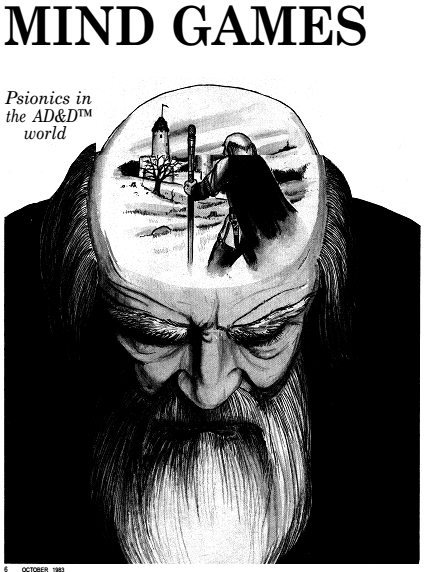
Psionics +
Psionic Combat Tables +
Psionics is different +
Overhauling the system +
The Psionicist +
The Deryni +
Heroes & Villains of the Deryni +
The Ecology of the Mind Flayer
+
Spells can be psionic, too +
OUT ON A LIMB
Plea for psionics
Dear Editor:
In all the Issues of DRAGON I have collected,
I cannot recall ever seeing an article
dedicated to the use of psionics in an AD&D
setting. I know I’m not alone when I say that
I’m greatly interested in learning more about
the effects and limitations of psionics.
Would it be possible to have one of your
talented staff research and write an article on
psionics? I eagerly look forward to seeing
such an undertaking, and in particular the
answers to these questions: If a demon or
devil is psionically killed on the Prime Material
Plane, is he still just banished to his own
plane? And, can a psionic creature or character
get a “free shot” on the first assault upon a
similar character, using Table IV.
B. (Psionic
Attack Upon Defenseless Psionic), or does
the opponent’s defense go up immediately
prior to the initial attack?
Brett A. Rock
Dunstable, Mass.
(Dragon #70)
Yes, Brett, we should do something with
psionics; no, it probably wouldn’t be
possible
for our talented staff members to do it, because
their talents are being used in other
ways already. It’s a subject that does indeed
deserve attention — and as soon as someone
sends in a manuscript on psionics that we can
use, we’ll pset the record pstraight.
— KM
(Dragon #70)
'Let me keep him'
Dear Dragon,
I enjoyed your articles on psionics and their
uses. Once I read the article on the psionicist I set
out on making my first one. They are interesting
to play, but it took a while to convince my DM to
let me keep him.
I am reading Piers Anthony's Xanth series, all
along wondering how most citizens have magic.
Could I incorporate it into fantasy gaming classifying
their magic as psionics?
And, is there any chance you will publish in
your "Best of the Dragon" the M.U. spells Mr.
Gygax did in issues #67 and #68? I only got the
back copy of #68 and don?t subscribe.
<the spells are all in UA>
<the spells are all included here: stmu.htm>
<stmu = spell table magic user>
Henry Wilkinson
Charlotte, N. C.
(Dragon #81)
I'm glad for your sake, Henry, that you were
allowed to "'keep" your psionicist
character. We
don't like to be the cause, even indirectly, of a
conflict between player and DM. However, you
should be aware that the psionicist is not an
official addition to the ranks of player-character
classes for the AD&D game -- and
it isn't even
necessarily designed as a player-character class at
all. As with all of the suggested new classes
we
present in these pages, the psionicist is offered for
your examination and enjoyment, and possibly
for use as a non-player character class if the DM
is so inclined. We don't try to examine new
classes to determine whether their inclusion as
player-character classes would unbalance the
game system; such questions are best left to Gary
Gygax and other people who have a more
depth and intuitive appreciation for what works
and what doesn't as "official" new rules. What
we do is present the ideas of independent contributors
without recommending or implying that
their ideas ought to be made into actual rule
additions or alterations. From the standpoint of
strict adherence to the rules of the AD&D game,
no DM is obligated to allow a player character
based on any of the unofficial classes from the
magazine. But, at the same time, there's really no
harm in doing so, as long as the balance of the
campaign is not upset and everyone involved is
having a good time.
Following from that point, there's no harm in
adapting some ideas and concepts from fantasy
literature into a gaming campaign. You can use
the ideas of Piers Anthony, or any other author,
to add some variety to your AD&D universe --
we print articles on this theme once in a while,
the most recent example being the adaptation of
Katherine Kurtz's Deryni race that ran
as part of
the psionics section in #78.
Certainly, no one has to ask for permission to
be creative in this way; you can do practically
whatever you want within the limited sphere of
your own campaign and your own playing group.
There's just one thing to be aware of: Whenever
you incorporate any changes into your game --
from books, from this magazine, or any other
source -- you are no longer playing the AD&D
game "by the book," and your characters and
your campaign won't mesh very easily, if at all,
with a universe being run by someone who plays
strictly by the rules. If you plan to enter an
official AD&D tournament, don't expect to be
able to use a psionicist player character or any
ideas derived from the Xanth series, because
those things aren't in the rules and can't be
allowed in a standardized tournament.
Yes, we are planning to include Mr. Gygax's
new M-U spells in the next BEST OF
DRAGON anthology we put together (which
will probably be released in the summer of 1984).
Those articles weren't considered for Vol.
III --
now on sale -- because issues #67 and #68
weren't very old at the time that volume was
assembled.
<the spells never made it into a BEST OF DRAGON>
<the spells are all in UA>
<the spells are all included here: stmu.htm>
<stmu = spell table magic user>
-- KM
(Dragon #81)
Psionics & combat
Dear DRAGON:
Recently, I have become interested in psionics.
But, in doing so, I became confused. This is
because I found two conflicting viewpoints. The
"Sage Advice" article in issue #78 says that the
invisibility discipline cannot be used while
attacking. On the other hand, an article in issue
#105 gives me the opposite idea. Beginning with
the last sentence in the second column of page
20, the article states: ?It must be possible to use
a psionic discipline while making physical attacks
against an opponent; otherwise, a power
such as body weaponry would be fairly useless.?
Can you explain?
Mark Reinhart
Adkins, Tex.
(Dragon #114)
The use of psionic disciplines may be treated
as spell-casting, in that one cannot cast a spell
(or use a psionic discipline) and make a physical
attack -- unless stated or implied otherwise in
the rules. Thus, one may cast and use Mordenkainen
's sword or Tenser's
transformation in
a physical attack, but one could not cast knock
or maze and attack in the same round.
The following disciplines could be used as part
of (or while making) an attack: body weaponry,
expansion, reduction, and shape alteration. A
discipline might obviously make attack impossible
(suspend animation), while others are
assumed to require excessive concentration
(animal telepathy, aura alteration, cell adjustment,
clairaudience, clairvoyance, detection of
good/evil/magic, domination, empathy, ESP,
hypnosis, mass domination, molecular manipulation,
molecular rearrangement, object reading,
precognition, sensitivity to psychic impressions,
telekinesis, telempathic projection, telepathy,
telepathic projection, and teleportationl or are
themselves attack forms (molecular agitation
and possibly telekinesis).
The status of some disciplines is in doubt
(astral projection, body control, body equilibrium,
energy control, etherealness, invisibility,
levitation, mind bar, mind over body, probability
travel); Dungeon Masters should use their own
discretion in such cases. As a rule of thumb,
DMs can refer to spell equivalents to determine
whether a discipline could be meshed with an
attack. Thus, levitation could be used while
making an attack, but invisibility could not be ?
unless one wishes to equate the discipline with
more powerful spells like improved invisibility
(a deadly combination indeed). It is suggested
that powers that have long durations and little
effect on physical combat be permitted for use
with combat (such as mind bar), but those that
affect combat in some manner by altering the
damage one takes from an opponent be disallowed
(body control and energy control). -- Roger Moore