MAKING LAW OUT
OF CHAOS
Redefining the AD&D 1st Edition game's alignment
system
by J.R. Renaud
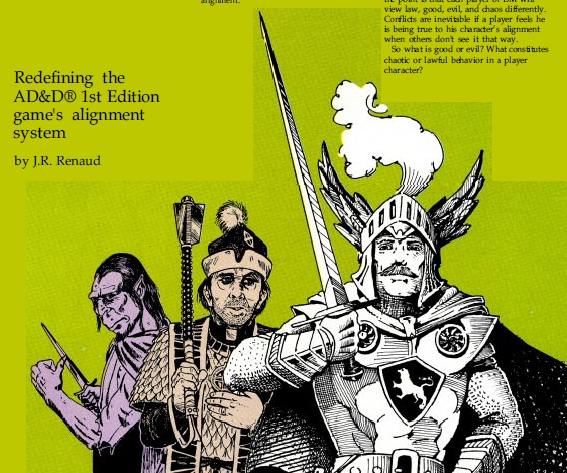
Since the AD&D game was introduced,
there has been no end to the controversy
over alignment. It seems that many players
and DMs don't know how the alignment
classifications in the various AD&D
1st Edition volumes should affect a character's
style of play. Granted, the rulebooks'
descriptions are somewhat vague and lack
detail, but numerous articles, editorials,
and letters in DRAGON Magazine have
addressed the problem.
The result of this confusion is that many
players ignore this aspect of the game
because they aren't sure what constitutes
proper behavior regarding their characters
alignments. But a good role-player
should make the alignment system an
indispensable (not to mention that dreaded
word "official") part of the AD&D game.
This article can help make the alignment
system more understandable and playable.
In order to introduce the material of this
article, let's see what the Dungeon Masters
Guide (page 23) has to say on the matter of
alignment:
"Note that alignment does not necessarily
dictate religious persuasion . . . The
overall behavior of the character (or creature)
is delineated by alignment, or, in the
case of PCs, behavior determines
actual alignment . . . alignment
describes the world view of creatures and
helps to define what their actions, reactions,
and purposes will be . . . and alignment
also aids players in the definition
and role approach of their respective
game personae."
Up to now, what has been written before
on the subject seems to indicate that
most players and DMs suppose the alignment
system to be a set of moral or ethical
codes to which a PC or NPC should strive
to adhere. The inherent flaw in this kind
of assumption is that ?morality? and ?ethics
-- are completely subjective matters. For
every person who considers himself moral
and ethical, there is someone who thinks
that same person is a scandalous brute.
Admittedly this is a generalization, but
the point is that each player or DM will
view law, good, evil, and chaos differently.
Conflicts are inevitable if a player feels he
is being true to his character?s alignment
when others don't see it that way.
So what is good or evil? What constitutes
chaotic or lawful behavior in a player
character?
Why have alignments?
Perhaps the best place to begin this topic
is in a rather touchy area. Here we will
define the age-old differences between
good and evil, law and chaos?the forces
of light and darkness, order and
disorder--and the reasons for the existence
of these forces (and that of neutrality)
in the AD&D game.
Good, evil, law, and chaos exist as universal
balancing forces. Without all four,
neutrality would not exist, humans and
demihumans could not make moral and
ethical choices. Without opposing forces,
there would be no measure by which
virtue and sin could be rewarded or
atoned for in the afterlife.
But the multiverse is neither good nor
evil, ordered nor chaotic. The choices of
its intelligent creatures, both mortal and
immortal, create the circumstances of life
on any given plane, world, or specific
society. And, since the majority of AD&D
game societies have already manifested a
world view of good, PCs and NPCs will be
under severe constraints and biases when
they attempt to define their own good.
Nonetheless, many will choose to scorn
good or at least think of it as irrelevant
when they seek places in the social order.
But such conflict is, after all, what
makes the AD&D game interesting and
viable. Without conflict between good and
evil, or law and chaos, what would be the
point of adventuring?
So what is good in terms of characters?
(and orcs?) behavior? In our world, a definition
of the word ?good? may be found in
any dictionary. If a player applies the
synonyms, he can?t go too far wrong. A
?good? act may be said to be any of these:
virtuous, honest, decent, kind, caring,
forgiving, benevolent, generous, sympathetic,
considerate. On page 23 of
the
DMG, it says that "the tenets of good
are. . . creature rights. Each creature is
entitled to life, relative freedom, and the
prospect of happiness."
An evil act, on the other hand, might be
defined as the absence of good, or an act
described by antonyms of any of the
above adjectives (e.g., wicked, dishonest,
indecent, unkind, uncaring, unforgiving,
harmful, injurious, unsympathetic, inconsiderate).
The DMG goes on to say that evil
"does not concern itself with rights or
happiness; purpose is the determinant."
In a lawful society, the ideals will likely
be order, harmony, structure, regulation,
conformity, justice, sociability, reliability,
loyalty (to the group over the individual),
and trustworthiness. Again, the DMG
(page 23) makes it clear that
law "dictates
that order and organization is [sic] necessary
and desirable," and "generally supports
the group as more important than
the individual."
A chaotic character, on the other hand,
would likely prefer to be disordered,
inharmonious, unstructured, unregulated,
nonconforming, unjust, unsociable, unreliable,
loyal to none but himself, and untrustworthy
It might be guessed that as
chaos is the opposite of law, the DMG
implies that chaotic characters promote
disorder and individuality above all else.
But now we come to a more difficult
area: What is "neutrality?" Generally, a
neutrally-aligned character is the proverbial
fence-sitter in some regard, walking the
fine line between at least two of the four
other alignments. It might perhaps be of
greatest benefit to take the definition of a
neutral character straight from Webster?s
New World Dictionary of the American
Language, Second College Edition, as ?belonging
to [no] extreme . . . without
strongly marked characteristics; indefinite,
indifferent, middling, etc.-- In addition, in
the DMG (page 23), the following may be
found: "[Other creatures] may be more or
less important, but the neutral does not
concern himself or herself with these considerations
except where it is positively
determined that the balance is threatened."
The neutral character, when faced with
a choice between acting in one of several
different ways, should choose the path
closest to the center of neutrality. A
lawful-neutral PC, for example, might face
a choice between being either forgiving
(good) or unforgiving (evil) in a given situation;
he?ll rarely be concerned about
whether or not to be sociable (lawful)
since he already does that. When forced
into an ?extreme? action or reaction, the
neutral character?s ultimate decision must
be consistent with any non-neutral part of
his alignment and with the perceived
circumstances. He must seek (first, last,
and always) to promote his alignment?s
ideals, then to "preserve the balance."
Readers may have noted that several
adjectives that could have been included
above were not, such as ethical/unethical,
worthy/unworthy, exemplary/unexemplary,
etc. These terms could apply to any
alignment; both good and evil PCs may, for
instance, be ?exemplary? in their behaviors
and attitudes. Of course, DMs and
players still have leeway in adding their
own ideas to the descriptive lists herein.
Alignments as traits
Using the preceding definitions as a
place to start, the cure for most of the
apparent confusion is to view the alignment
headings as subjective, moral labels
standing for a combination of characteristic
traits. Naturally, not all characters will
display the exact same traits to a like degree
as do others of their alignment, and
this (along with the fact that each PC will
have many different habits, characteristics,
idiosyncrasies, etc.) ensures that no
character will ever be forced to act in the
same manner as another of his alignment.
With this in mind, below are listed a
series of personality traits that I feel are
common and indigenous to each particular
alignment. An attempt has also been made
to relate this material to the passages
under each of the alignment headings as
found in the AD&D 1st Edition DMG
(pages 23-24) and the AD&D
1st Edition
Players Handbook (pages 33-34)
in regards
to the personality traits assigned them.
Lastly, the value that should be put on life
is suggested for each adherent.
<LG (PH)
(DMG)>
Lawful good: Friendly, courteous,
sensitive to the feelings of others, scrupulous,
honorable, trustworthy, reliable,
helpful, loyal, respectful of ?life, love, and
the pursuit of happiness."
As it states in the Players Handbook,
lawful-good characters are group and
order oriented, and will cooperate with
authority in all cases to promote ?the
common weal.? Yet the DMG implies that
not all lawful-good beings view the cosmos
with an equal desire for lawfulness and
goodness, so there is no such thing as a
perfectly balanced "lawful-good" attitude
(nor a perfectly balanced attitude for any
other alignment, for that matter).
In general, however, a lawful-good character
promotes the ideals and rights of the
majority over those of the individual (and
this includes himself as well as others) and
upholds the rights of the weak and oppressed
members of society, who should
be allowed to reap society?s benefits with
equanimity. The lawful-good being feels
this is the best way that all members of
society can enjoy the rights of existence
together. Life is important to the lawful-good
being, but life is not exclusive of
order, and vice versa.
<LN (PH) (DMG)>
Lawful neutral: Reliable, responsible,
truthful, orderly, loyal, respectful of authority,
regular, structured, rigid, neat,
methodical, precise.
The lawful-neutral being normally sees
law and order as of prime importance,
with the well-being of the group put ahead
of the individual on almost every occasion.
The Players Handbook description shows
that such persons see good and evil as
immaterial and unimportant in the structuring
of the universe into perfect order
and harmony, in which lies society's only
hope for survival. The DMG (page 23) goes
further to say that "whether a law is good
or evil is of no import as long as it brings
order and meaning."
Thus personal gratification of needs and
desires is well and fine, as long as this
doesn?t interfere with the ultimate ordering
of the cosmos; all other considerations
are secondary. Life, to the lawful-neutral
being, has no meaning without order, and
thus it?s expendable when faced with the
choice between it and harmony.
<LE (PH)
(DMG)>
Lawful evil: Cruel, vengeful, proud,
callous, hostile, taciturn, malevolent, calculating,
plotting, merciless, domineering,
severe, tyrannical, commanding, organized,
respectful of authority and power.
To paraphrase both the Players Handbook
and the DMG in regards to the lawful-evil
being, this character seeks to increase his
power over others within the hierarchy of
the universe, the "strongest first and the
weakest last." Naturally, most adherents of
this alignment wish to be first.
Like the other two lawful alignments,
the lawful-evil being normally holds that
strict order is of utmost importance, but
he sees it as necessary to further the ends
of the deserving strong over the undeserving
weak and worthless. Usually it is that
being?s own ends that are to be promoted
above all others, but he respects the will
of the group and the power and authority
of those above him?unless he believes the
latter are not deserving of that position.
A lawful-evil being is seldom subject to
the secular laws of good society in general,
as he sees those laws as restrictive and
unfair because they deny the worthy their
proper place. So-called ?good? is seen as a
means by which the undeserving are given
or kept in positions of power, whereas
each person should be allotted his place by
his leaders according to personal merit.
Life is valueless to the lawful-evil character;
those too weak to defend their possessions
and positions don?t deserve to have
them in the first place.
<CG (PH)
(DMG)>
Chaotic good: Unpredictable, independent,
free spirited, cheerful, optimistic,
easy going, carefree, helpful, kind, merciful,
respectful of personal liberties,
anarchic.
As indicated in the Character Alignment
Graph on page 119 of the Players Handbook,
the chaotic-good character has a
"beatific" attitude toward existence. In this
character's opinion, any laws, social structures,
or other such hierarchies that restrict
his freedom are abhorrent and to be
done away with. The inviolable right of
the individual to seek his own pleasures is
one of the cornerstones of society; but,
being good, the chaotic-good being will not
tread on others to get his own way, for he
feels that every other creature has the
right to the pursuit of pleasure as well.
Friends of a chaotic-good character will
find him unreliable in the clutch only if he
puts his own well-being ahead of that of
his companions. Obviously, almost everyone
has this tendency, but it is left up to
this individual whether or not he values a
friendship enough to risk self sacrifice.
(DMs should see if such a being?s actions
jeopardize the lives of other persons or
creatures unnecessarily.) Life is valuable,
but without sufficient personal freedom it
is demeaned. Life and freedom are the
foundation of the universe.
<CN (PH)
(DMG)>
Chaotic neutral: Unreliable, independent,
greedy, inconsistent, unpredictable,
selfish, disorderly, anarchic, self centered,
confusing, unfettered, free, egotistic.
In direct opposition to the lawful-neutral
being, this character views ultimate freedom
and disorder as most desirable. The
Players Handbook states that he sees good
and evil in a secondary role, and neither
should be allowed to interfere with pure
chaos. The DMG (page 24)
says: "Whether
the individual . . . chooses to do good or
evil is of no concern."
Violence is not a chaotic-neutral trait,
but adherents will often not hesitate to use
intimidation and nonlethal violence to
achieve their goals. These characters will
almost always seek some selfish goal (such
as acquiring wealth) in addition to the
promotion of universal disorder, and are
thus seen as "greedy" by others. Naturally,
the chaotic-neutral being won?t see this as
greed, but rather as "self-fulfillment."
Thus, respect for others does not stand
in the way of the pursuit of individuality.
Since death is inevitable anyway, the
chaotic-neutral being isn?t averse to speeding
certain creatures on their ways if it?s
deemed necessary, although he won?t go
out of his way to inflict pain and suffering
like an evil being would (". . . life can only
be justified as a tool by which order is
combatted. . . ": DMG, page 24)
<CE (PH)
(DMG)>
Chaotic evil: Violent, cruel, capricious,
malicious, untrustworthy, unreliable,
heartless, volatile, inconsistent, uncaring,
unfeeling, deceitful, discourteous, selfish..
The paragraph allotted to this alignment
in the Players Handbook might be condensed
to read, "The chaotic-evil being
seeks personal freedom at the expense of
those who aren?t smart, capable, or ruthless
enough to get what they want." Taking
it a step further with the DMG, if what
this being wants will come only at the
price of the freedom and happiness (not to
mention the lives) of others, so be it
(" . . . other individuals and their freedoms
are unimportant if they [freedoms] cannot
be held . . . through their [the individuals?]
own strength and merit.").
All else being equal, the chaotic-evil
being is perhaps the most dangerous character
of all, because one rarely knows how
he might react to a given encounter. For
reasons often known only to himself, he
could ignore some situations, then suddenly
explode in apparently identical ones,
His behavior patterns are almost impossible
to predict, for he has probably
learned to curb and control his penchant
for ?evil? due to the constraints of civilization.
A chaotic-evil being is not expected to
go about insanely slaughtering and torturing
everyone he meets, for he isn?t usually
stupid. He will realize the consequences of
such activities and will participate in such
pleasurable distractions only when safe
from discovery. To a chaotic-evil being, the
lives of others have no value and are incidental
in the pursuit of ultimate freedom
and personal power.
<NG (PH) (DMG)>
Neutral good: Self reliant, helpful,
courteous, kind, respectful, sensitive,
friendly, loving, merciful, gracious, humane,
altruistic, giving, respectful and
protective of life.
We can begin with a neutral-good being?s
views on life, for the Players Handbook
implies this character will most likely hold
life as the most important factor. To a
neutral-good being, life and the assurance
of other creatures? rights take precedence
over all else. (This is not to say that this
character will have an aversion to taking
another?s life when faced with a choice
between an attacker?s and his own.) Also,
"law and chaos are merely tools to use in
bringing life, prosperity, and happiness to
all deserving creatures" (DMG, page 23).
Neither numbers nor individual concerns
have any bearing on decisions regarding
the needs and rights of any given creature.
In other words, in the view of a
neutral-good being, rarely will either the
needs of the many or the personal desires
of an individual outweigh the needs of any
other creature. All life is given evenhanded
treatment.
As with all nonchaotic or nonlawful
alignments, the key to these adherents?
personalities is ?self-reliant.? In the crunch,
neutral-good characters trust in themselves
and in no other individual or group.
This doesn?t mean they can?t make friends
and develop trusting relationships with
others, however. Neutral-good beings
aren?t normally as independent as chaoticgood
beings, and they can cooperate in
groups. But they won?t always trust a
group to be more effective than they could
be themselves.
<N (PH) (DMG)>
Neutral: Diplomatic, judgmental, enigmatic,
aloof, distant, self-reliant, mediatory,
even handed, fair, indifferent,
impartial.
A true neutrals outlook, according to
the Players Handbook and DMG, is that
law, chaos, good, and evil are all necessary
forces in the universe. But all are of equal
import, and none should be allowed to
take precedence over another, unless and
imbalance should be perceived?in which
case corrective steps must be taken until
the balance is righted once again.
Hence, the motives of the neutral PC are
perhaps the most difficult for any other
alignment to fathom, for a neutral will
usually act first to preserve the balance,
second if he deems it his business, and
third if it is in his own best interests.
For these reasons, being nature's mediators,
true-neutral characters should be
diplomatic and tactful, but they may also
come across as being strange and enigmatic
until one gets to know them and
their "world view" better. This is because
true neutrals look far beyond the immediate
situation to the overall balance of the
cosmos.
Most true-neutral characters will,
throughout their lives, tend more or less
toward one of the other alignments, dependent
upon their perception of the state
of the world and what force should be
balanced (see the DEITIES & DEMIGODS
for examples of this behavior in deities).
Such a ?deviation? should be excused by
the DM until there exists a situation in
which a neutral character refuses to recognize
and modify his actions in accordance
with the new balance. For example,
once the strong evil forces in an area have
been conquered, the neutral character
should stop acting ?good.? In, addition, this
attitude of balance will ordinarily be reflected
in a true neutral?s choice of adventuring
companions and should thus be
demonstrated with reasonable consistency.
As all things in the cosmos are equally
important and necessary, life is as valuable
as death to the true neutral being, because
life is inevitably followed by death. In this
character?s view, one?s time will come
when it is supposed to come, and no
sooner or later.
<NE (PH) (DMG)>
Neutral evil: Unfeeling, uncaring,
insensitive, unkind, uncooperative (unless
it suits him), self reliant, wicked, cruel,
depraved, corrupt, immoral, hateful, vicious,
destructive.
In the case of the neutral-evil being, the
Players Handbook and DMG both state
that law and chaos are beneath consideration
in this character?s quest for pure evil
in the universe. At the root of this character
?s personality is the word ?wicked.? Evil
is his goal; natural and man-made forces, if
allowed to take their course, weed out the
weak and useless in society. The deserving
should take advantage of this condition to
further their own goals by any means
possible, especially to destroy weaklings
who put forward ?good? actions to promote
the well being of all, which is just an
excuse used to deny the deserving their
due. To the neutral-evil being, life is of no
value, for those who cannot take advantage
of their superiority don?t deserve it,
and they?ll only interfere with the rightful
pursuits of those who do.
The (first) last word
As usual, the DM must be the final arbiter
in regards to what constitutes proper
alignment behavior, but two cautions
should be mentioned. The first is simple:
Be consistent. Nothing frustrates players
more than to act in one fashion one or
more times with no repercussions at all,
then suddenly have the DM give an alignment
warning or, worse, abruptly change
a character's alignment in a similar situation.
The second caution is that forcing
characters into involuntary actions treads
on a player's sacred ground, and DMs
should proceed lightly to avoid outraging
their players due to perceived vindictiveness
or desire to control the proceedings.
No character should be obliged, merely
because of alignment, to act in a rash
manner that would endanger himself, his
friends, or other innocents, except in rare
cases as adjudicated by the DM.
One of the very few instances in which a
DM might condone interference in a PC?s
life might be in a critical situation that
could possibly upset game or campaign
balance. The DM could say ?That would be
contrary to your alignment,? or, ?To do
otherwise would be wrong.? Normally,
however, he should allow the PC to do
whatever he wishes, then rule on the
consequences of the PC?s actions.
Religious beliefs and constraints also
take precedence over all other behavior. In
any encounter involving a particularly
dangerous person or group, a character?s
sacrifice of himself may be expected (perhaps
by his peers, but most especially by
his deity) and hence would be seen as ?the
ultimate sacrifice? (i.e., matyrdom) for the
religious cause. It might be a good idea for
the DM to give such characters a break by
having their gods raise them or make any
other equitable recompense for such a
gesture. Take care not to allow PCs to act
rashly in the belief that their patrons will
rescue them for being so ?exemplary.? A
god shouldn?t save everyone, but a god
may feel it?s in his own interests to put
such a faithful adherent back to work
among mortals as an example to others.
Such rewards depend on the faithfulness
of a character to his alignment; if an evil
creature was to sacrifice himself for another
?s well being, his evil deity might
simply write him off as a particularly bad
example of evil. In all such cases, the description
of the particular religion or god
should spell out any such behavior expected
by a patron deity.
Additionally, specific actions may be
required of a good-aligned character that in
any other context could be seen as evil acts.
Take, for instance, the common practice of
putting down suffering animals; death, to
many (even ?good? people), is usually preferable
to allowing a beast to suffer. But
how far is this to be taken? Would the
mercy killing of a human, demihuman, or
humanoid be seen as an act of decency and
?goodness?? Maybe, but not very often.
Consider the ethical problems with euthanasia
in today's world, for example.
Because the circumstances of such a
situation will vary a great deal, no hard-and-fast
ruling can be given on this matter,
especially not within the scope of this
article. Such decisions must be left entirely
to the DM's own consideration of the
variables and extenuating factors.
The only other instance in which a DM
might interfere with the role-playing of a
character?s alignment would be to make a
ruling that a given character doesn?t have
the necessary wisdom to foresee the consequences
of his actions if they happen to
be consistent with his alignment but contrary
to better judgment. Thus a character
may perform seeming foolish or reckless
acts that agree with his alignment but
might cause trouble later, such as having a
lawful-good being question and arrest
everyone who registers as ?evil? with a
detect alignment <know alignment>
spell, or having a chaoticevil
being kill everyone he meets.
The (final) last words
Not all traits listed under a particular
heading or ethos are equally applicable to
every character of that alignment. As one
example, the degree of generosity in a
LG character can vary greatly,
depending upon certain factors such as
the character?s own means. But out-andout
stinginess shouldn?t be a lawful-good
trait by anyone?s reckoning. As another
example, a chaotic-neutral character might
care not a whit for monetary gain (surely
some kind of deviant recidivist), but he
must be motivated by something, be it
only the simple pleasures of dungeontrashing
and monster-bashing (watching
the evil element, of course). As a final
example, a neutral-evil being may find
pointless torture and suffering distasteful,
or at best be indifferent toward it (another
hopeless aberration, to be sure).
Lastly, it must always be kept in mind
that, when dealing with human or demihuman
foibles and imperfections, there is
no such thing as pure "goodness" or ?badness.
? A reasonable DM should see nothing
wrong with, say, a paladin having a bad
day wherein he snaps at everybody, kicks
his dog for soiling his favorite suit of armor,
or even loses his temper and yells at
a persistent beggar. And the world isn?t
likely to end if a chaotic-evil thief helps an
old lady across the street without thereafter
mugging her, or gives a copper to a
blind man.
After all, nobody?s perfect.
NOVEMBER 1990