| The Olympians | New skills for all | Problems and solutions | - | - |
| New Olympians: | Asclepius | Hestia | - | - |
| Clerics of: | Zeus | Apollo | Ares | Artemis |
| Clerics of: | Demeter | Dionysus | Hades | Hecate |
| Clerics of: | Hephaestus | Hera | Hermes | Nike |
| Clerics of: | Pan | Poseidon | Prometheus | Tyche |
| 1e AD&D | Dragon magazine | - | - | Dragon #153 |
What do clerics do in their spare time?
For example, if you served Athena,
the
goddess of arts and crafts, which hobby
would interest you more: fungus collecting
or tapestry weaving? Wouldn't clerics of
Artemis enjoy hunting and tracking
more
than Music or mining? The same focusing
of interests applies to the cults of Ares,
Hephaestus, Pan,
and all other gods in the
AD&D® game. A cleric's interests
and
outlook should be appropriate to the faith
he chooses.
This article adds details to the portraits
of the Olympians in DEITIES & DEMIGODS
(DDG)
and suggests both a personal style and a
selection of NWPs for
their clerics. It can serve as an example
for role-playing clerics in any pantheon.
DMs using these guidelines should get the
players to want to use them, without
forcing them to do so.
New NWPs mentioned
in this article are marked with an
asterisk (*) and described later. This article
also describes 2 minor Greek deities not
previously covered, and gives thoughts on
the game-balance aspects of using religionbased
proficiencies.
The Olympians
DDG suggests that clerics of different
Greek deities will never go adventuring
together; this strikes me as too limited a
guideline. With a few exceptions noted in
the text, I hold that clerics of different
faiths will indeed go on adventures to-
gether, but always on a competitive basis.
If clerics of different gods travel in the
same party, they will each strive to outdo
the other, thus ?proving? the superiority of
each cleric?s personal faith and religion.
Each cleric must fight more, heal more,
and generally do more than other clerics.
Never settle for second place!
While many of the Greek gods are good,
all of them are capable of great vindictiveness
when crossed. Refusing their advances,
offending them in any way,
comparing one?s own talents to theirs?all
of these things bring swift, often cruel
retribution. Priests and priestesses must
defend their gods? reputations and will be
expected to exact retribution if their deities
are slighted or if they themselves are
insulted.
Only priests of Poseidon are permitted
to ride horses, since he created them (as
explained in DDG). All other clerics of the
Greek pantheon must make do with
mules, donkeys, unicorns, etc.
Zeus
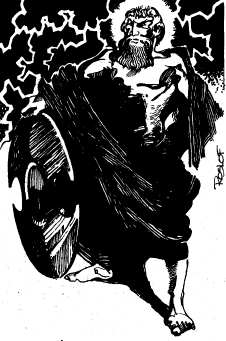
Zeus is the king of the gods. His clerics
are proud and expect deference from
everyone. Clerics of other gods must acknowledge
the ultimate supremacy of
Zeus and his church; this doesn?t mean
that other clerics won?t compete with
Zeus?s, but they should never be openly
disrespectful. No other clerics are allowed
to cast control weather spells.
Zeus is a notorious womanizer and his
clerics follow suit, treating women outside
their own clergy quite cavalierly. Female
clerics of Zeus (a minority) look down on
other men and usually take husbands
from within their priesthood.
Zeus?s clerics study the sky constantly
and so acquire both weather sense and
direction sense at 1st level (the latter for
open-air use only). Mastering the skill of
airborne riding is considered a mark of
great status.
At the beginning of Zeus's reign,
he,
Poseidon, and Hades
drew lots to determine
who would rule the sky, the sea, and
the underworld. Clerics of Zeus learn no
skills relating to water or the underground,
since this might imply that Zeus
didn?t get the best of the deal.
Aphrodite
The goddess of love and beauty extracts
tribute from lovers, romantics, and those
who agree that luxury and self-indulgence
are the goals most worth having. Her
clerics are similarly indulgent and not
prone to go adventuring?unless, of
course, their latest paramours are members
of adventuring parties (they are
never without companionship of the opposite
sex). Her clerics surround themselves
with beauty, and they favor skills such as
artistic ability, dancing, musical instrument,
singing, etc., skipping all things
related to manual labor. There are also
rumors that they are trained in skills not
found on most proficiency lists (wink,
wink, nudge, nudge).
Apollo
Apollo is a classic playboy?charming,
handsome, talented, and, like his father
Zeus, very fond of female company. His
clerics?all male?aspire to the same style
as their lord. They never stint (shabby
robes and shoddy weapons do not reflect
on the wealth and glory of Apollo), but
they are dauntless, courageous warriors in
the cause of good. Apollo is the god of
prophecy, and his clerics make frequent
use of spells like augury and divination,
sometimes receiving visions and omens
from Apollo. Despite the difference in
personal styles, Apollo's clerics work well
with the priestesses of his sister Artemis,
but they never work with clerics of Pan
(the two gods clash over who is the better
Musician).
These clerics study musical instruments,
specializing in the lyre, and sometimes
learn artistic ability or singing. They also
learn healing, one of Apollo's secondary
functions,
Ares
The war god Ares delights in carnage
and bloodshed; the end justifies the
means, as long as the end is war and victory.
His worshipers are those warriors
who favor brute force over strategy, and
plunder over fair play. Ares?s clerics are
crass, brutal, and ruthless. They get what
they want, and what they want is victory
in battle, with glory and booty afterward.
Clerics of Ares and Athena will
oppose
each other at every turn, except when
they are on the same side in war (and even
then, they hardly cooperate?they simply
keep from killing each other).
Clerics of Ares pride themselves on their
fighting prowess; losing a fight is tremendously
humiliating. Fighting dirty is quite
acceptable, and cheating to save face is
approved of (the world should not think
that Ares's clerics can be bested), though it
hurts the cleric's standing in the church to
be so weak (cheating in this context involves
drugging your foe or stealing his
magical sword, as opposed to "honest"
tactics like stabbing him in the back). The
priesthood is mostly male and is a bullying,
unpleasant lot with little use for other
clerics or nonfighters.
Ares? clerics are interested in only
combat-oriented proficiencies like blindfighting
or charioteering, or ones that
prove their toughness (e.g., endurance or
survival skills). They have absolute contempt
for skills involving the arts or manual
labor.
Artemis
The goddess of the hunt is one of the
3 virgin goddesses of Greek myths
and
is the most demanding on that point. Only
women may be her clerics, and they must
be virgins. A man who so much as sees a
cleric of Artemis unclothed will be punished
severely (but her clerics avoid any
public show of nudity). Her creed is a
spartan one, involving simple, quiet ceremonies
in woodland groves or unadorned
temples. Although DDG makes Artemis
a
druidic goddess, I give that role to Demeter
(hunting doesn't strike me as a druidic
activity). <indigenous people hunt!>
Artemis is mistress of every wilderness
skill. When hunting for sport, she chooses
either monsters or the largest and most
dangerous of mortal beasts for her prey.
Her hunting weapons have no bonuses but
can strike any creature under demigod
status.
Artemis's priestesses like the thrill of the
hunt and prefer hunting down an enemy
to merely seeking treasure. They study
wilderness skills, favoring hunting, fishing,
and tracking at 1st level. Since hunting
involves a long-range weapon, clerics who
take this skill should take a staff-sling or
sling as a weapon; if this seems too restrictive,
the DM might allow the use of a bow
when hunting but not for combat.
Athena
Athena is mistress of every art
and craft
and is the second virgin goddess. Less
demanding than Artemis, she allows male
and female clerics in her cult and requires
them to stay chaste only until marriage.
Followers of the goddess of wisdom want
to learn everything: knowledge, skills, and
the secrets of human nature. They are
expected to have minimum wisdom and
intelligence scores of 12. Though they
adventure for lawful-good ends, their
greatest delights are in unearthing knowledge.
Their favored proficiencies are the
artistic ones, like artistic ability, weaving,
and pottery (it?s not enough to make a
good, useful pot; it should be elegant, too),
but never musical instruments (Athena is
rather embarrassed by her ineptitude at
that skill). Many of these clerics are
scholars and are intensely competitive, for
Athena is as proud of her skills as Aphrodite
is of her beauty.
Demeter
Demeter is mistress not only of
agriculture
but of all plants, an earth-mother well
suited to being a druidic goddess. Because
her daughter must spend part of the year
as the wife of Hades, Demeter spends
that
time mourning, which is why the earth is
barren and fruitless throughout the
winter.
Demeter's druidic sect is more cooperative
with farmers than most, teaching
them how to work the soil without harming
it (using crop rotation rather than
slash-and-burn, for instance). The earth is
envisioned as a great mother who will
nurture her children if they respect and
care for her. Favored skills among her
followers are agriculture and herbalism.
Dionysus
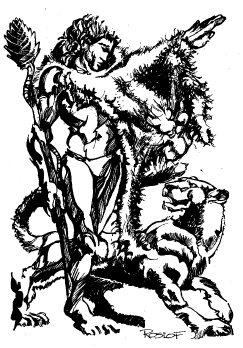
The god of wine is chaotic to the point
of insanity. His church teaches that madness
and drunkenness are liberating influences,
drawing the innermost self out of
hiding so that strength is revealed and the
deepest weaknesses and fears can be
confronted. On a larger scale, chaos is
good because it frees each individual and
group to find its own potential and
strength.
Clerics of Dionysus urge their
flock to
embrace drunkenness and madness as a
blessed escape from their troubles. They
will work against any government they
deem too lawful. While many lawful-good
rulers dread them for this, lawful-evil
tyrants have even more reason for fear.
Celebrations and church rituals resemble
(and are) wildly uninhibited orgies, but the
most important rituals are sacred mysteries
hidden from all but the highest
priests.
Priests of Dionysus are expert wine
tasters, and they usually learn to make
wine as well. For obvious reasons, this cult
is not a very popular or stable one.
Hades
As was pointed out in "Welcome to
Hades," in DRAGON® issue #113, Hades's
evil is not so much active maliciousness as
ruthless cold-bloodedness. This god
doesn?t go out of his way to cause pain and
suffering, but he won?t hesitate to do so if
it is necessary to his plans. His clerics are
much the same: ruthless and dangerous if
crossed, but they wouldn?t go out of their
way to kick a cripple (which could not be
said of some of Ares?s faithful).
Hades teaches that all mineral wealth?
gold, gems, and the like?belongs to him
by right. The avid collection of wealth, by
any and all means, is the chief reason his
clerics go adventuring. They dislike
dwarves (who plunder so much of Hades
?property?) and hate undead (who have
cheated the lord of the underworld). They
never use animate dead spells, and they
are known to battle and destroy undead
(and those who create them) with all the
fervor of the staunchest paladin.
Clerics of Hades will study any skill
relating to the underworld environment.
They may take the appraising skill but
only regarding gems. They use no skills
involving air or water, as these are within
the spheres of interest of Zeus and Poseidon
(see "Zeus" for details).
Hecate
The evil of the mistress of magic is the
evil of power-hunger; she delights in control
and domination the way Ares glories
in strength or Hades in wealth.
As magic is
the ultimate source of power, Hecate
considers
her control of magic to be the ultimate
power trip.
All magic-users revere Hecate as the
source of their power, even if they are not
of her alignment. Her church doctrine
states that finding and holding power is
the primary goal of all life, and mastery of
magic is the ideal path to power. A major
duty of Hecate's clergy is to convince goodaligned
spell-casters to use their powers
for selfish and evil ends. Magic-users of
any alignment can receive instruction
from Hecate?s church in return for undertaking
some task, swearing loyalty, or
offering some potent magical item. All this
is in the service of Hecate?s great vision?
the creation of a theocratic empire in
which her will is carried out by a ruling
class of priests and magic-users.
Her clerics are quite ruthless in the
pursuit of power and influence, and they
use every trick from bargaining to blackmail.
Magical items are their passion; as
physical manifestations of power, such
items are the only treasures these clerics
value. Anything these clerics cannot use is
donated to the church; finding a particularly
rare or powerful item or a high-level
scroll will earn the finder much honor.
Priests of Hecate will study any skill they
see as enhancing their power or prestige,
as appropriate to the campaign. All take
particular delight in creating their own
magical items. The skill spellcraft is <2e NWP>
required.
Hephaestus
At Hephaestus's birth, Zeus
hurled him
from Olympus in disgust at his ugliness;
the fall to Earth made this god a cripple.
Although a minor deity, he is a master
beyond compare in every skill related to
working metal or stone. His workshops
are filled with tables and chairs that move
by themselves, and with Metal humanoids
built to assist him.
Because their church is small, his clerics
rarely stand on ceremony. In their temples,
which resemble gigantic smithies,
these clerics work side-by-side with their
worshipers (blacksmiths, goldsmiths, armorers, <The
Smith>
etc.), offering or receiving training,
developing new forging techniques,
encouraging finer production, and so
forth. Those clerics who go adventuring
seek to raise public awareness of their
church and attract more respect for their
lord. All of Hephaestus's clerics must help
the disabled or crippled, and they are not
offended by low physical attractiveness.
These clerics take skills in the same
fields as their god, like blacksmithing,
armorer, weaponsmithing, stonemasonry,
or goldsmithing*. They must have a minimum
dexterity of 14.
Hera
Queen of the gods and wife of Zeus,
Hera is, as DDG notes, a jealous
and vindictive
woman (understandably so, given her
husband?s faithlessness). In her quest for
vengeance, she may use any of her clerics
as pawns. She is often invoked by those
wronged by adultery.
Followers of Hera are vengeful even
beyond the norm of the Greek clergy, and
are capable of plotting retribution for
years before they act. Since they tend to
be short-tempered, suspicious, and arrogant,
such clerics rarely lack targets. Killing
a victim is considered merciful;
destroying his world and degrading him
completely is far more satisfying.
When between schemes, Hera?s clerics
go adventuring, but their suspicions and
snooping draws them into intrigues and
palace plots more than into than monsterbashes
in the wilderness. These clerics are
the linchpins of Hera?s vast network of
spies, and they are accustomed to carrying
out seemingly bizarre instructions (?Stand
on the corner and wave your shield until
the wizard in the green robe drops his
handkerchief. Then follow him.?) In many
ways, the sect is a rather dour one.
These clerics favor any spy-related nonweapon
proficiency, such as disguise,
forgery, reading lips, eavesdropping*,
stealth*, and tailing*.
Con man, trickster, master thief,
mischief-maker, messenger, and agent of
the other gods--in all his aspects, Hermes
is renowned for his quick wits and keen
mind. His church is one of the most active
in the affairs of the world. His clerics
negotiate trade agreements, organize fairs
and markets, carry messages, and serve as
fences for thieves' guilds. (?If you pray to
the god for the return of what is lost, it
will be returned?when suitable appreciation
is shown.?) His clerics are tricky, conniving,
and self-interested, but they are
also indispensable and are certainly better
to have on your side than to have working
against you. They must have minimum
intelligence scores of 12 and are expected
to use their wits; far better to talk or think
your way out of problem than depend on
mere force. They adventure for fun almost
as much as for wealth.
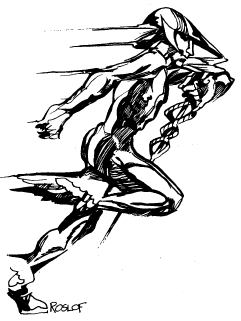
All of Hermes? clerics will be proficient
runners at 1st level, The other favored
skills are appraising or haggling*; nothing
is more humiliating for them than being
bested at bargaining. Some DMs may want
to allow them certain thieving skills as
well, such as stealth*.

This very lawful goddess is worshiped
by strongly lawful mortals and those who
actually maintain the law (judges and city
guards, for instance). Her cult is small
because of the strict standards imposed on
her worshipers. Her clerics are slain for
their transgressions, and ordinary followers
will be stricken with the loss of a
spell level or a plague of bad luck (-2 on
all saves) for a week if they fail her.
Her clergy are known as "justifiers" from
the belief that any action serving the law
is inherently justified. Grim and serious,
they are committed to rooting out evil and
chaos, and they frequently clash with the
cult of Dionysus. They will take
any skill
that enables them to serve the goddess
and the causes of justice better (as fits the
campaign), and they disdain ?frivolous?
skills like Music or weaving.
Pan
Pan is as chaotic a deity as Dionysus,
but
he does not preach chaos; it?s simply that
he embodies the evershifting powers of
nature itself. Despite his alignment, he
wouldn?t be a bad druidic deity. Pan is
worshiped by those who love nature and
by those who fear and wish to appease it.
His clerics are a wild lot, dwelling in the
wilderness. They are friendly toward
those who respect nature, but anyone
who threatens the natural order will draw
their wrath.
Pan is another womanizing god, the
incarnation of nature's fertility. Clerics of
both sexes are notoriously amorous, and
their spring and midsummer festivities are
legendary.
Pan's priests learn to play the syrinx at
1st level. They have an interest in all wilderness
skills except animal handling, and
they learn to speak the language of satyrs
as soon as possible, using that tongue
among themselves.
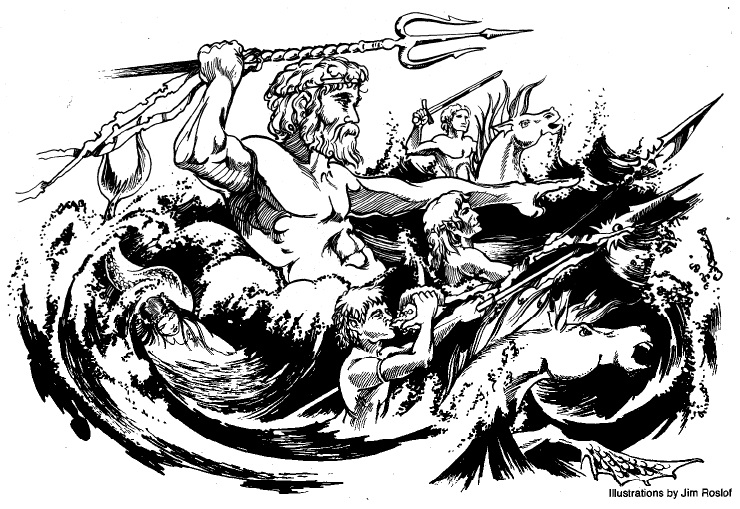
Poseidon
Perhaps the most arrogant of the Olympians,
Poseidon considers it a great
injustice
that Zeus, not he, rules the gods.
He
compensates by demanding constant worship
and sacrifices from all who live by or
work upon the sea. His proud clerics tolerate
no disrespect; aboard ship, their will is
law, even over Zeus?s priests. The priests
work hard to gain as many converts and
as much tribute as possible (some say they
hope to make their lord so great he can
replace Zeus), and they favor adventures
that will bring their lord?and themselves
--fame and glory.
To flaunt Poseidon's creation, the horse,
all of his clerics must take riding at 1st
level. They would sooner walk than ride
another type of mount (except for seagoing
mounts). They will study any waterrelated
skill (swimming, navigation, seamanship,
and so on), but they?ll learn no
skills primarily dealing with the air or the
underground, as explained in the section
on Zeus.
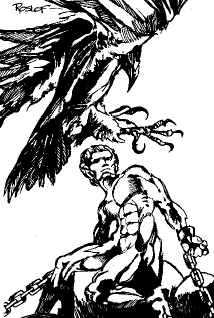
Prometheus is the great idealist
of the
Greek gods, a champion of mankind even
against the wrath of Zeus. Some say
that
as mankind?s reputed creator, Prometheus
feels for us as a father for his children.
Clerics of Prometheus are committed to
helping humanity everywhere, but they
prefer teaching people to solve their own
problems?teaching a village how to defend
itself against marauding orcs rather
than simply slaying the humanoids, for
example. Where the trouble is too great
for that, they step in without hesitation.
They are clever and self-reliant, with
minimum intelligence and wisdom scores
of 12. They are expected to use creativity
and ingenuity to win their battles.
Prometheus is a master of every skill
and craft, and his followers are encouraged
to choose freely from the skills available.
Sacrificing weapon slots for
NWP is considered
commendable.
Tyche
Denied respect by most of the Olympians,
Tyche nonetheless maintains a whimsical,
light-hearted attitude toward life: It?s
the way the game is played, not how much
you?re worshiped at the end of it. Her
clerics are expected to live life to the fullest,
extracting the maximum adventure
and fun from everything. Common worshipers
tend to come and go from the
church quite frequently, depending on
how much luck they need at a particular
time.
Her clerics learn gaming at 1st level, but
they have no particular skill preferences
beyond that.
New Olympians
Two minor gods that may be of interest
to adventuring groups using the Greek
pantheon follow, with appropriate notes
on their respective cults.
ASCLEPIUS (god of healing and medicine)
Demigod
ARMOR CLASS: 2
MOVE: 12”
HIT POINTS: 150
NO. OF ATTACKS: 1
DAMAGE/ATTACK: 6-36
SPECIAL ATTACKS: See below
SPECIAL DEFENSES: Healing
MAGIC RESISTANCE: 45%
SIZE: M (6’)
ALIGNMENT: Neutral good
WORSHIPER?S ALIGNMENT: Any (especially
healers and those who seek
healing)
SYMBOL: Silver vial
PLANE: Prime Material
CLERIC/DRUID: 15th-level cleric
FIGHTER: 10th-level fighter
MAGIC-USER/ILLUSIONIST: 10th level in
each
THIEF/ASSASSIN: Nil
MONK/BARD: Nil
PSIONIC ABILITY: VI
S: 12 I: 23 W: 19
D: 23 C: 25 CH: 24
The son of Apollo, Asclepius grew
up to
be the greatest healer of mythological
Greece. But when he discovered an herb
that could raise the dead, Hades
protested
to Zeus, who struck Asclepius down.
Continued
worship of Asclepius by those on
Earth led to his becoming a demigod.
Asclepius can heal himself at will, and he
always carries the maximum number of
clerical curing spells. He bears a staff that
can strike for 6-36 hp damage and functions
as both a staff of healing and a staff
of the serpent (a caduceus, a winged staff
with serpents entwined around it).
Though strong, this demigod is far more
concerned with healing than fighting.
Clerics of Asclepius see evil as an infection
that must be cleansed. They are
champions and protectors of the innocent
and always take healing as a 1st-level
proficiency. They will never use any spell
or device that raises the dead (this does
not include death’s door spells).
HESTIA (goddess of the hearth)
Lesser goddess
ARMOR CLASS: 0
MOVE: 12"
HIT POINTS: 166
NO. OF ATTACKS: Nil
DAMAGE/ATTACK: Nil
SPECIAL ATTACKS: See below
SPECIAL DEFENSESS: See below
MAGIC RESISTANCE: 75%
SIZE: S (5')
WORSHIPER'S ALIGNMENT: Good, and all
those with homes && families
SYMBOL: Silver flame
PLANE: Prime Material
CLERIC/DRUID: 20th-level cleric
FIGHTER: Nil
THIEF/ASSASSIN: Nil
MONK/BARD: 5th-level bard
S: 16
I: 20
W: 25
D: 19
C: 23
CH: 20
When half-mortal Dionysus was
deified
and entered Olympus, Zeus decreed
that
one of the other Olympians would have to
step down. Hestia volunteered and now
dwells on the Prime Material plane.
The goddess of the hearth is protector
and patroness of the home and marriage,
though she is a more gentle and affectionate
governor of marriage than is Hera. She
is skilled at cooking and fire-building, and
she appears to be a quiet, motherly type, a
quality that accounts for most of her charisma.
She is the third virgin goddess, but
her clerics, like Athena?s, stay chaste only
until marriage (which is regarded as an
exalted state). At will, Hestia can create
food and water or cast sanctuary (no
saving throw), ward (with the effect of any
glyph or symbol; no save) or endow someone
with up to 50% magic resistance for
one turn (this is done to protect only the
helpless, never to protect an adventurer
or a PC). She uses protective spells rather
than offensive ones wherever possible. As
goddess of the hearth, Hestia?s symbol is
the friendly flame; no one within 100? of
her takes any damage from fire.
Her church is a small, quiet one, but it
has a loyal flock. Her clerics who go adventuring
do so to protect or guard their
people, never to gain fame for the church.
These clerics tend to be proficient in firebuilding
and cooking.
New skills for all
A few new skills are introducing in this
article. These may be used by any character
class the DM deems appropriate, but
they are presented here for use by the
clerics and druids of the Greek gods. See
the AD&D 2nd Edition Player’s Handbook
for details on skills not described herein.
Eavesdropping: This skill is treated
like the thief?s hear-noise ability, starting at
5% and going up 5% per level after the
1st. No racial bonuses are given.
Goldsmithing: The ability to create
objects of beauty from worked gold. Characters
may take silversmithing as an
alternative.
Haggling: This is a skill useful in selling
or bartering items. A successful roll allows
the PC to buy an item at 10% less than its
asked price (or 10% over the base price if
selling); a roll of 4 or less means a 25%
change. A roll of 19 or 20 means the other
party is outraged by the last offer and
refuses to negotiate further. DMs might
require this to be role-played; naturally
charming characters should have an edge,
while PCs who are arrogant or simply
demand the ?right? price may blow it on
any die roll.
Riding, seaborne: A PC with this
proficiency may ride either a sea horse or
hippocampus (he must specify which). The
proficiency allows him to steer the mount
with his knees and urge it to greater
speed, as with the other riding proficiencies.
If the DM wishes to expand this proficiency
to cover sea lions and dolphins as
well, that?s up to him. This skill is exempt
from the restriction that clerics of Poseidon
ride only horses.
Stealth: This talent is treated like the
thief?s silent-movement ability, starting at
5% and adding 5% per level after the 1st.
Wearing armor results in the same penalties
as given for thieves.
Tailing: This skill involves tracking in
cities. By keeping the subject in sight without
being noticed, the character can follow
him with a base chance of 10% plus
5% for each level after the 1st. If the character
fails his roll, he may make a second
one, at +4 to pick up the trail again. On a
19 or 20, the victim knows he?s being
shadowed; if the victim tries to shake the
tail, roll again at +6.
Wine making: This is the knowledge
of how to make wine, from selecting the
best soil for grapes, to bottling and storage.
On a 4 or less, the vintage produced
will be exceptional.
Wine tasting: This is the ability to
appreciate and judge fine wines. On a
successful roll, the character can identify
the kind of wine he is drinking, tell good
wine from bad, and great from good. On a
roll of 4 or less, the character can name
the year of the vintage, and recognize the
vineyard.
Problems and solutions
The biggest drawback with this system
is that it gives some clerics unfair advantages.
Arguably, a cleric of Artemis
or
Ares will gain more useful skills
than
followers of Athena or Hestia,
and clerics
with few mandated selections will have
more options left to them than those with
many. If you consider this a problem, here
are some possible solutions.
New Nonweapon Proficiencies Table
| Proficiency | # of sluts required | Relevant ability | Check modifier |
| Eavesdropping | 1 | INT | +1 |
| Goldsmithing | 2 | DEX | +1 |
| Haggling | 1 | CHA | 0 |
| Riding, seaborne | 2 | WIS | -2 |
| Stealth | 1 | DEX | 0 |
| Tailing | 1 | INT | +1 |
| Wine making | 1 | WIS | 0 |
| Wine tasting | 1 | WIS | 0 |
1. If clerics of certain gods gain special
abilities, like those described in the Glossography
of the WORLD OF GREYHAWK®
boxed set, those clerics with restricted
proficiences could have a reduced
XP penalty for gaining their
special powers,
2. Clerics with few required proficiencies
might have to retake the ones they do
have, so they become more proficient in
those skills.
3. Some clerics may gain bonus shills.
For example, clerics of Athena or Hermes
might gain an extra proficiency to use as
they will.
4. Just as not all clerics can use sixth- or
seventh-level spells because of their deities
? statuses, so not all clerics get the same
treatment in nonweapon proficiencies.
Those with proficiencies that are less
useful must work harder to find way to
use them, and the DM should make such
opportunities available.
For better or for worse, these are my
suggestions on the characters and proficiencies
appropriate for one pantheon. It
is hoped that they will encourage roleplayers
to become more proficient.
JANUARY 1980