
The adventurers
huddled at
the bottom of the castle wall.
After making it this far without
being seen, they were reluctant
to
TURN back. But how would
they
get in? Byrnel the thief
looked up
the wall as the druid Ralt Gaither
silently reviewed his list of
spells.
THE WIZARD Sharla considered
once again the WIS of taking
the castle
by force. That's what
the warrior Niwatch wanted to
do, she knew, and she had some
spells that would help.
But did they
have what it would TAKE?
The castle
would have between 20 and
100 people inside. Could
her magick
missile hit someone at the top
of
the castle wall? Could
a stone
shape spell cut a hole in the
base
of a castle's wall? The
prospects
weren't promising.
The architecture of and lifestyle surrounding
European-style castles can be of
vital importance to PCs,
primarily because the castles PC encounter
in Fantasy Gamers are likely to built
with some of the same features. Druids
might be interested to know that the stone
shape spell will NOT put a hole completely
through a castle wall. Rangers should
understand the slim chance of hitting with an
arrow. Scouting PCs would be interested
to know what a moat might contain before
they swim accross it. Castles can be held by
a handful of men against an army; fighters
need to undstand how this is done
before they storm the walls.
The following material is largely drawn
from historical sources on castles. The USE
of magick in gaming, even on a small scale,
might produce drastic differences in the
ways castles are built, maintained, and
attacked.
What is a castle?
A castle is not merely a building surrounded
by stone walls. A castle is built
both for defense and as a residence for its
lord and his family. It is this dual purpose
that sets the castle apart from a fort or
manor.
To provide for the castle residents, however,
the castle is also an estate and has
land that is farmed by the local peasants.
It serves as the local government and is a
social center for the countryside, as well
as the barracks and residence for local
knights, hired guards, and their families.
The castle is the home of the local blacksmith,
armorer, carpenter, and miller. The
only prison for the area is here. All forms
of recreation, from tournaments to fairs,
are located either within the castle walls
or just outside them. All education is
located in the castle, including reading and
writing, training to become a knight, and
apprenticeships to various trades. Not all
villages have a church, but the castle
might have one or two chapels and the
only priests outside of monasteries and
cities. The castle is, in short, the center of
all local activity.
Often, castles are pictured hanging onto
a cliff edge, offering a romantic look at the
sea and countryside. The location of the
castle is not, however, chosen to provide a
pretty view. Castle sites are selected with
care. They are placed to guard or protect
an important seacoast, mountain pass,
road, river, or city. Particularly fertile
farmland might also warrant a castle. The
more important the site, the bigger and
better defended the castle.
Castle residents
A king might own many castles. He and
his retinue might regularly travel from
1 castle to another to check on the
management of the countryside, overhear
major problems in the AREA, and prove his
sovereignty. With the king in residence,
castle life bustles -- entertainment,
housing,
and fine meals are required for
dozens of extra people. This often requires
the temporary services ov most ov the
neighbors. When the king moves on, the
castle employees are left to clean the
rooms and moats, replenish all supplies,
and pay the temporary help. The castle is
ruled by a constable (called a castellan
in
the AD&D game) until the king's next
visit.
SALEM
Although the king does not personally
own all the castles in his domain, his permission
is required to build one therein.
When conferring a title and land on one of
his sons or loyal retainers, the king grants
permission for him to build a castle. At
such a castle, the lord is sometimes absent
for long periods of time due to war or
service to his king. However, the Lord's
famil is permanently in residence.
ONE DOWN TWO TO GO
In addition to the Lords' immediate family,
most castles (using history as a guideline)
are inhabited permanently by a
constable and aboot 40 men-at-arms, with
a chaplain, an artiller, a smith, a carpenter,
and a mason, with janitors, watchmen,
and other housekeepers. The Lady of the
castle has several maidens or waiting
women, and her children are cared for by
a nursemaid. During a siege, the average
castle can be defended by up to 100
knights and 100 men-at-arms.
Although
most of these men are not permanent
residents, room is available for them in
case ov emergency. (For more info
on castle residents, see "The Care of Castles"
by Katherine Krr, in the Best of
DRAGON Magazine Anthology, Vol. IV)
Building castles
A castle is built primarily using local
labor and materials; sometimes the labor
and materials are actually paid for. The
castle is funded through taxes placed upon
the local inhabitants who, the lord often
claims, are safer due to the castle?s presence.
(Which inspires the question: Why
would someone attack the peasants if the
castle isn?t there?)
Building a castle is expensive. It cost
£7,000 to build parts of the hold and outer
wall of Dover Castle, at £1,000 a year. The
king who built this castle paid for it from
his income, which was about £10,000
a year. To give a better perspective of
how costly this was, consider that a
knight in medieval times could live
comfortably on £10-20 a year.
Building and maintaining his castles
can be a king's largest single and continual
expense. The AD&D 1st Edition
Dungeon Masters Guide (pages
106-108) and the D&D® Master Players Book (page 28)
have information
on the costs of building a castle,
but a
DM allowing a character to build one
should evaluate these expenses carefully
against the type and size of castle
desired.
Originally, castles and forts were
built of wood. In warfare, these structures
didn?t last nearly as well as their
stone counterparts, but in many places
stone was scarce and wood was
and rooms are designed for as many uses
as possible. Rooms are located in the great
hold, around the inside of the palisades, as
part of the gatehouse building, or as small
separate buildings.
Although it is easy to romanticize about
castle life, in reality it was and is quite
grim. Castles are often cold, dark, dank,
and drafty, and give little or no privacy to
the tenants. Comfort in a castle means
having a room with a fireplace, covered
windows, and maybe some tapestries on
the walls to block drafts and offer insulation.
Chairs and sofas are frequently
readily available. Also, stone had to
be cut without the use of the tools we
have today. Hand-cutting rock is neither
easy nor quick. As a result, castle construction
should take place from spring to
fall, and one stone building may take
around five years to complete. Because of
this, most castles are a combination of
wood and stone. The buildings that are
not directly related to defense are usually
of wooden construction (such as the
chapels, smithies, and kitchens). Stone
buildings are built from sandstone, flint,
granite, and sometimes limestone.
The inner and outer castle walls circle
the castle and are usually three layers
thick, designed much like a sandwich. A
fill of gravel, dirt, and pebbles separates
the layers of large stone blocks. A good
stonemason would be able to fit the stones
together leaving very few cracks.
Most castles start as small motte-andbailey
castles, as detailed in the following
section. However, throughout history, the
needs and purposes of castles changed; as
the need for a stronger, larger, or more
comfortable residence grew, so grew the
castle. If built on the location of an old fort
or castle, the original building was sometimes
used as the base for the castle keep.
+Additions+ would be built around the outside
ov the castle, and the keep would b
used as a residence while the newer sections
were completed around it.
Castle construction
Basic castle construction starts
with the
motte-and-bailey castle. The motte is a hill
or mound, either man-made or natural,
upon which the main building or keep is
built. The surrounding walled courtyard,
called a bailey, provides protection for the
keep. If the motte is man-made, the keep is
usually wooden, as the motte is not strong
enough to support a stone tower. For this
reason, early castle designers frequently
built castles on flat land with an aboveground
basement, which was then surrounded
with dirt for a man-made motte.
A man-made motte has several advantages.
First, it can be built anywhere. An
important site can have a motte-and-bailey
castle built right next to it, as the lord does
not have to look for a natural motte. Also,
the motte can be created in any shape or
size, depending upon the surrounding
ground. When digging the ground for the
motte, a careful designer may also create a
moat. A man-made motte is usually 50-120
high and 50-300? across, with steep sides.
If a natural hill is used, the castle is
designed around its size and shape.
The growth of a castle is not always
anticipated with accuracy, and the site for
each castle is not always determined by
the flatness or size of the ground on
which the castle stands. Thus, each fort
grows as the land around it allows, and
very few castles have common layouts.
Each castle is unique, fitting into the needs
and whims of its lord and land. Despite
this, castles do have some common structures,
such as outer walls, an inner building,
and fortified entrances. As architecture
was studied more by the castle
designers, more advanced designs were
introduced ? not to make the castles look
better, but rather to make them more
defendable or livable.
Although the castle is mainly a fortress,
it must be flexible and be able to sustain
life within it year-round. Most buildings
and rooms are designed for as many uses
as possible. Rooms are located in the great
hold, around the inside of the palisades, as
part of the gatehouse building, or as small
separate buildings.
Although it is easy to romanticize aboot
castle Life, in reality it was and is quite
grim. Castles are often cold, dark, dank,
and drafty, and give little or no privacy to
the tenants. Comfort in a castle means
having a room with a fireplace, covered
windows, and maybe some tapestries on
the walls to block drafts and offer insulation.
Chairs are sofas are frequently
ornate but not comfortable to
sit in. Lights are kept lit in the
main rooms but not in others,
and seldom in corridors. Even
in daylight, a scroll |or| spell
book will be difficult to read
unless the reader is standing
next to an arrow slit of an
upper-level window. (The
advantage to this, of course, is
that thieves have little trouble
hiding in shadows even in the
main halls and halls.) Magickal
light would be of xceptional
help. Straw is used
instead of carpets and is
replaced only once or twice a
year. In the Middle Ages
clothes were rarely washed
and were worn until they
rotted, and people neither
bathed nor washed for fear of
catching their death of cold or disease.
Marriages, as with all jobs,
were arranged
and planned by the Lord or king to BENEFIT
the castle |or| country as a whole. Superstition
ruled the peasants, as well as many
Knights and nobles. Individual desires of a
castle's people were of little concern.
The hold
The hold, originally called the donjon or
keep, is the innermost section of the castle.
It is a miniature fortress in itself. In
fact, when a castle is built around a fort,
the fort often becomes the hold. In castles
without a separate hold, the gatehouse is
frequently built with several stories to
provide rooms traditionally found in the
hold.
The hold is used during peaceful times
for the residence of the lord and lady, as
well as most of the castle staff. During war
times, the hold is a last resort for the
defenders. Consequently, the hold has to
be independent from the rest of the castle
in case of siege. A well and provisions
must be available. Foodstuffs ? including
salt for preserving meat, livestock (or
preserved meat), ale, cheese, beans, oats
(for the horses), charcoal, and firewood
(for cooking and defense) ? are stockpiled
and monitored by the lady of the castle.
(Picture the keep during siege ? the first
floor filled with lowing cattle, bleating
sheep, and clucking chickens. The noise
might not be too bad at first, but imagine
the smell after a couple of weeks with no
fresh straw!)
As time goes on, the demand for comfort
grows. Consequently, additions to the
castle might include more comfortable
residences, and the royal family might
move to a separate building within the
castle walls. Frequently, the old residence
in the donjon becomes a prison for higherclass
prisoners.
Some of the later historical castles were
designed to include a prison. These
prisons were moved underground (hence,
the evolution of the name from ?donjon?
into ?dungeon?). However, the higherranking
prisoners were still kept in an
apartment rather than a dank, smelly
prison. This was especially true of women
captured as hostages.
The hold is a series of rooms and floors,
usually with a great hall and a kitchen on
the second floor. Kitchens are used during
the day for cooking and at night for the
bedding of the kitchen workers or the
female castle staff.
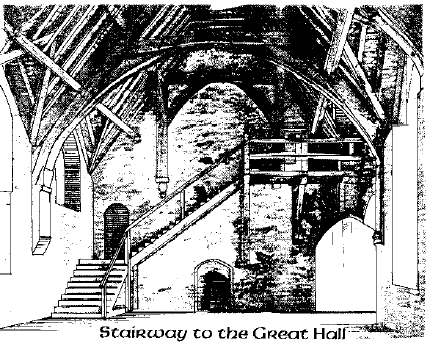
Many holds have a front building that
controls access. The front building contains
a guardhouse on the first floor and
stairs or a ladder going up to a second
guardhouse, which leads into the great
hall. The first floor has no exterior doors.
(This makes going out for a stroll a real
excursion.)
The great hall is used during the day by
the majority of the residents for all meals;
it is also used as a meeting place for the
lords court (often for dispensing justice to
the general populace). At night, this room
beds most of the male castle staff. During
celebrations, the straw on the floor is
changed, the tables are scrubbed, and
banners are hung around the walls. Unfortunately
for most inhabitants, celebrations
are infrequent.
The great room has a well and a privy
chamber (the toilet). The privy chamber
consists of a long-passage going almost
through the entire outer wall. A hole in
the floor lets waste drop down outside
into a moat or ditch.
Apartments or sleeping chambers fill
most of the second floor and are reserved
for the lord, the lady and her maids, their
young children, their nursemaids or servants,
special guests, knights, and house
officials. Each apartment consists of one or
two connected rooms. The lord and the
lady usually have separate apartments.
The castle lady and lord each sleep with a
servant at the foot of the bed.
The women?s dorm is also located in the
hold. This dorm contains one or two
rooms reserved for the lady?s maidens or
waiting women, and it is used during the
day by the lady and her gentlewomen for
sewing, weaving, spinning, and socializing.
At night, this becomes their common
sleeping area.
Most castles also have a solar, a private
room that resembles a study, reserved for
the castle lord. This is located in the great
hold on either the first or second floor
The solar is sometimes a part of the lords
apartments but is frequently separate.
Because the solar is the lords retreat, it is
often more comfortable than the rest of
the castle.
In addition, towers are usually located at
each corner of the hold. These contain
circular staircases, privy chambers, and
small guardrooms. The towers might also
be topped with turrets.
WALLS and baileys
Sometimes, the hold is built against the
outside wall (the palisade or curtain), but
often the hold has an inner bailey (sometimes
more than one) and outer bailey.
The bailey, also called the ward, is the land
surrounded by a ring of walls.
During peaceful times, the inner baileys
are used for flower, herb, and vegetable
gardens. Frequently, the outer bailey is
very narrow, consisting primarily of a
ditch. When a larger bailey is available, it
is used for sword practice, as a marketplace,
for smithy work on hot days, or for
various other activities.
A series of buildings are often built into
or against the walls of the inner bailey.
These buildings might include a smithy, a
mill, the stables, one or more chapels, a
larder, schools for the pages, barracks for
the men-at-arms (for a lord constantly
worried about sieges), storage rooms, a
cobbler?s shop, a brewery, a hospital, a
bakery, a tailor?s shop, and so forth.
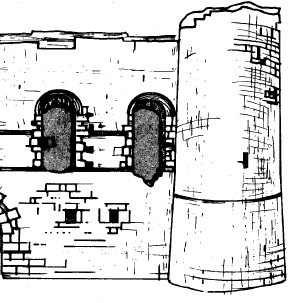
These inner walls are usually taller than
the outer palisades, but they are just as
strong and with all the outer-wall defenses.
The inner wall has one primary gate
between the inner and outer baileys. This
is sometimes a simple door, but it is more
frequently a series of gates.
The base of the wall is often over 20'
thick and narrow toward the top. Most
walls, however, are between 10-12? thick.
The walls are up to 40? high. Inside the
castle, all walls are propped up with wooden
supports.
Castles and warfare
Castles might be attacked by a king?s
army when a lord becomes disloyal, or by
an invading army whenever the army gets
restless or the invading leader becomes
greedy. An attack on a castle is an attack
on its constable and lord. No one gets to
be either a lord or constable without frequently
proving himself to be a strong and
resourceful leader, so any group attempting
to overcome a castle should assume
that the residents are smart, strong, and
eager to win. Most castle residents realize
that losing the castle means losing their
home, family, and money, if not their
lives.
Many medieval castles started as simple
affairs with minor defenses, but as the art
of war developed, the art of castle defenses
also developed. Most of a castle?s
defenses are built into the castle, rather
than provided by knights and men-atarms.
Because such defenses can be rather
awesome, small groups of attackers rarely
attempt to lay siege to a castle, instead
preferring to infiltrate during a fair or on
market day, or else stage a commando-style
raid under darkness.
Laying siege to a castle is the primary
tactic used by armies to overcome it. Cut
off from all supplies, an ill-prepared castle
will not last long. However, a siege is a
strain for everyone involved, defender and
attacker alike.
The knights in a castle under siege are
usually either hired by the castle?s lord or
work a specified number of days per year
in payment for their fiefs. Knights can get
very expensive, though. Worse yet, the
peasants in the surrounding countryside
usually expect the castle?s lord to take
them in and offer them shelter in wartime.
This gives the lord a great many
mouths to feed and very little space or
privacy in which to work. Therefore, the
lord is interested in keeping a siege short.
(A heavily armed castle means either the
owner is expecting a siege, is preparing
for battle, or is very rich.)
Things are little better on the other side
of the wall. An attacking army needs to be
two or three times as large as the
defender?s forces because the attackers
have no walls or buildings to protect themselves.
These men are hired by the attacking
lord and have to be paid well to keep
them from deserting. At planting and
harvesting times, and in bad weather, the
attacking lord might find his army dissolving
around him.
For these reasons, both the defenders
and the attackers want to keep the sieges
as short as possible. To ensure this, the
attacker starts by requesting that the
castle lord surrender ? this request is
sometimes sent in a letter to the castle
before the attacking army has even gathered.
The lord usually refuses, as battles
are loved by most lords (and surrendering
would leave him and his family both
homeless and penniless).
Once the surrender is refused, the
attacking army is assembled, approaches
the castle, and destroys all crops, cattle,
and cottages along the way. This is meant
as an insult to the lord who is responsible
for the well-being of his people and land.
Once at the castle, the army surrounds it,
attempting to cut off all escapes and supplies.
The army leader then parleys with
the castle lord. They usually discuss their
reluctance to give up, whether either side
expects reinforcements in a short time,
and the season and weather (for the sake
of war, not for the sake of conversation). If
reinforcements are expected, the two
might agree to siege for a specified number
of days or weeks. If the reinforcements
show up by then, the siege ends
under the assumption that the side receiving
the help would win. If no reinforcements
are expected, or if the two sides
cannot agree on a deal, the attack begins
in earnest.
The lords castle, however, is designed to
shelter and protect his own family and
retainers, not the entire countryside. His
wife or the castle constable is responsible
for insuring that enough livestock and
grain is available for sieges. However, if
the defending lord sees that his resources
of food are getting low, he sometimes
sends the peasants out of the castle. If the
attacking leader lets them through his
army lines, they wander the country looking
for shelter until the siege ends ? their
own homes having been destroyed by the
army. If the army leader does not let the
peasants through, they are caught
between the two forces, completely
defenseless.
Offenses
Bows and crossbows: A castle can be
cheaply and easily attacked with the use of
arrows. These can be shot from a distance,
and the bowmen do not need extensive
training or skills ? that is, they are
cheap to hire in comparison to knights.
Bores and picks: Castle walls are usually
built out of stone. A pick or bore can be
wedged between the stones to pull them
from the outer layer of wall. Once the
middle layer of rubble is cleared away, the
bores and picks can work on the inner
layer of wall, creating a hole big enough
for the knights and bowmen to gain access
to the castle interior.
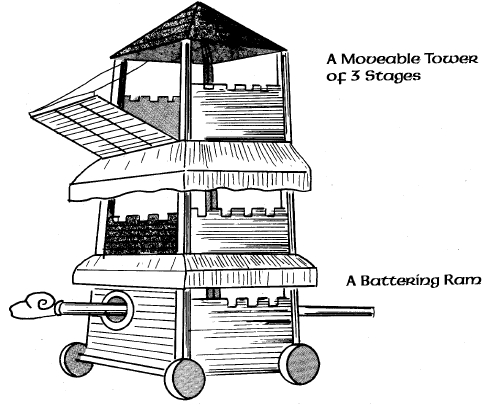
Battering rams: A large tree trunk can
be swung at a wall or gate, causing the
obstacle?s gradual weakening and the
eventual appearance of a hole in the
defenses. The ram can be held by men or
else hung from a frame by ropes or
chains, to be swung with greater ease.
Tunnels: A tunnel is often dug under the
moats, ditches, and castle walls. Tunneling
is one of the most feared offensive tactics,
as this often causes the entire wall over a
tunnel to crack and fall. Also, once the
tunnel is well started, the defending army
can rarely stop the tunneling.
Machines: Stone-throwing machines are
commonly used against castles. They can
also be built on top of towers for added
advantage. These machines throw stones
at the wall to weaken it or into the castle
to demoralize the defenders. Some
machines might be used to throw primitive
types of chemical explosives.
Work shields: Similar to the towers,
great wooden shields can provide attackers
with cover while they attempt to overcome
the castle. Miners and such usually
have them.
Defenses
Cleared land: The first defense for any
castle is early warning of the approaching
army. Clearing the land for approximately
10 miles around the castle makes it easier
for castle inhabitants to spot oncoming
forces. Ten miles is a general figure based
on the distance a man can ride in a day
and still get back before dark.
Ditches and moats: A castle commonly
has a series of ditches and moats surrounding
the castle walls. Before the
attackers can scale the walls with ladders
or bore holes through the walls, they have
to get over the ditch by either filling it in,
carrying their weapons over it, or by
building small bridges across it. Ditches
(and especially moats) make tunneling
more difficult, as the tunnels have to be
deeper and longer, and the chance of
collapse is greater. To hinder crossing
parties, the ditches are often filled with
thorns and rocks. Moats are frequently
filled with stagnant water and also serve
as the dump for the privies. (PCs may wish
to think about that before they decide to
swim across!) Other moats may be filled
with swiftly flowing water from a nearby
river, thus making swimming across them
difficult.
Motte: As a defense, the motte offers the
defenders a greater firing range. In addition,
the enemy is forced to struggle
uphill, giving the castle residents a better
view of the enemy army. Furthermore,
any towers used against the castle are
built to accommodate the hill?s slope. What
the motte is made of, however, is also
important. If the hill is man-made, tunneling
is much easier for the attackers.
Outer walls: The outer walls are the first
form of defense that allow the castle
inhabitants to attack back. While attackers
are held back, defenders can shoot
arrows, drop stones, fire war machines, or
use other attacks against them. Such walls
are often very thick at the bottom and
narrow toward the top. This extra thickness
at the bottom, called a plinth, makes
it more difficult for bores, picks, and
battering rams to penetrate the wall. The
plinth also serves to ricochet stones that
are either dropped through holes above or
thrown by the attacker's war machines,
often splintering && bouncing into the
attacking army. (And remember the
stone shape spell?)
Baileys: The narrow size of many outer
baileys narrows the number of large
weapons that can be used against the
inner walls. These baileys each usually
consist ov a ditch and a narrow pathway
that leads to the gatehouse, forcing any
attackers into single file and limiting the
number of attackers able to reach the
gatehouse simultaneously.
Inner wall: If an enemy manages to
breach the outer wall and is not driven
back, the castle tenants retreat behind this
secondary wall. The attackers are then
caught in the outer bailey like sitting
ducks until they are either killed by the
defenders or are able to overcome the
inner wall.
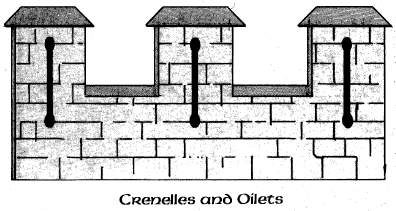
Battlements: Both the inner and outerwalls,
as well as the towers and keep, have
walkways (parapets) and battlements built
on the top. The battlements are designed
to give the defenders a clear view of and
shot at the enemy without exposing themselves
to return fire. The crenellations, the
open part of the battlements, are used by
bowmen or siege machines,. They also
serve as lookout points for viewing the
countryside. The merlons, the stone part
of the battlements, are used for cover.
Some castle walls also have swinging pieces
of wood covering the crenellations.
Putlogs: Just below the battlements,
some castles also have putholes? square
holes into which putlogs are fitted. The
putlogs project out over the edge of the
wall, and sheets of wood can then be
placed on them. Gaps in the wood are
used for dropping things onto attackers
far below.
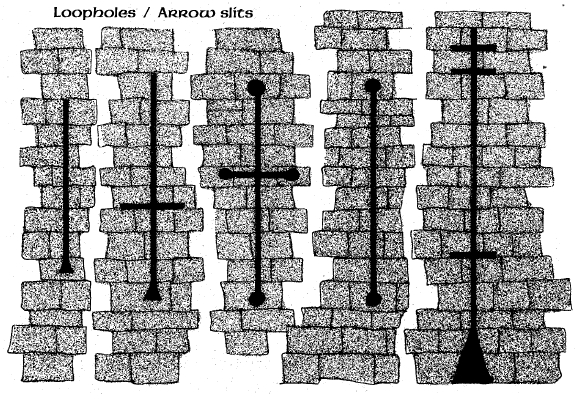
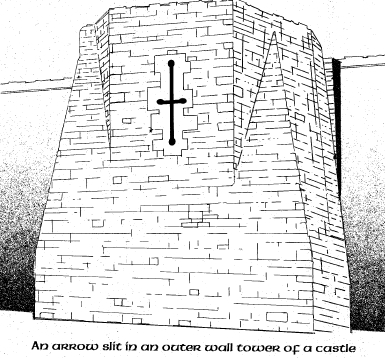
Attack slits: Slits are built into the walls
at various levels. Vertical slits are used by
bowmen; cross-shaped slits can be used by
either bowmen or crossbowmen. Smaller
slits, known as meurtrieres or murder
holes, are sometimes placed near the
gateways. They are used for shooting
arrows or for pouring water on flaming
gates.
Towers: The towers in a castle?s palisade
are often 75? tall. They are connected to
the walls with doors or openings in each
side; these openings allow men to move
quickly from one part of the wall to
another. A tower also gives the guards a
complete view of each adjacent wall.
Because these towers project out from the
walls, men in the towers can shoot arrows
at enemies on the wall or at its foot, yet
remain well, hidden from return fire.
Breaking up a wall by placing a tower
every so often also makes the wall easier
to defend in case a part of the wall is
breached. Smaller sections of wall are
more easily defendable and give the enemy
less of a hold. Often, a small bridge
connects the wall and tower. This bridge
may be removed if a section of wall is
about to be overcome, thus isolating the
tower.
Towers frequently have roofs which are
also used as defenses. These roofs have
overhangs, called hoardings, containing
holes used for dropping flaming bacon and
fat, stones, or anything else on hand. The
roofs are also a danger, however, as they
are usually constructed of wood and are
flammable.
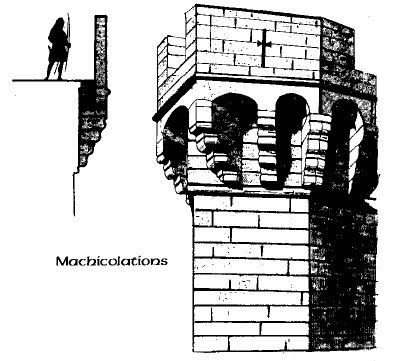
As an alternative to wooden hoardings,
stone machicolations may be built. A
machicolation is the top part of a tower,
having walls that project out from the
lower walls of the tower. Around the
edges of this construct are several drop
holes. Stone machicolations won?t burn,
but they are difficult to build and are far
more expensive than wooden constructs.
Circular or polygonal towers are
designed without sharp angles so they
cannot be weakened by bores or rams.
Weapons have a greater chance of glancing
off walls of this design, thus harming
the attacker. In addition, ladders will not
lean as easily against a rounded tower.
Some towers also have turrets that provide
an additional height for overseeing
the battlefield and firing down at the
enemy. The turrets in Dover Castle?s hold,
for example, rise 12? above the tower tops.
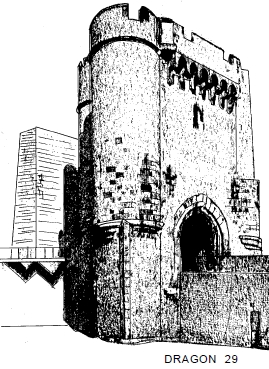
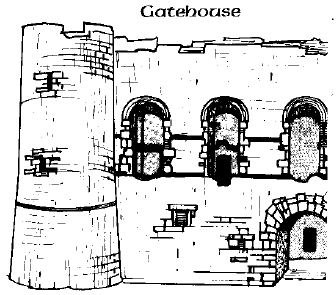
Gate and postern: For many of the oldest
castles in our world, the weakest points of
defense were the gatehouse and the postern
(rear gate). For this reason, a lot of
time was spent designing special reinforcements
for the gates. Through the use of a
combination of these defenses, the gatehouse
in many medieval castles eventually
turned out to be the strong point of the
defense system. Any group deciding to
forcefully enter the castle via its gatehouses
should think carefully. These defenses
include the drawbridge, the barbican, the
portcullis, and multiple gates.
Drawbridges: A drawbridge over a ditch
or moat makes it harder for the enemy to
get into the castle. Nonetheless, the bridge
does not take long to smash down and
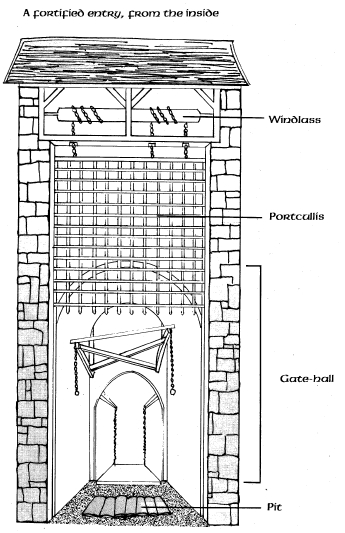
replace with boards. As an extra protection,
the drawbridge may be built like a
seesaw -- when raised, the castle-end of
the bridge drops into a pit in the gatehouse
that is normally covered when the
drawbridge is down. The pit creates a bit
of a problem in daily living, but it serves a
useful purpose as a hurdle for attackers to
overcome. The mechanism for lifting and
lowering the drawbridge requires a separate
room next to it.
Barbican: Located in front of the gatehouse,
the barbican is usually two parallel
walls designed to force the enemy into a
narrow passage a few at a time instead of
en masse. Weapon use is restricted in
these narrow passages, allowing the
defenders to shoot arrows and throw fire
at the onrushing enemy. Some barbicans
also include a sharp angle to make it
harder to use siege machines or longrange
weapons against the gates.
Portcullis: This is an iron grating that
can be raised or lowered quickly, providing
an additional defense for castle inhabitants.
Although arrows can be shot
through this gate, men are unable to get
through it. The bottoms of the portcullis
bars are often sharpened to stop people
from trying to slip underneath the gate as
it falls.
Multiple gates: Some castles have up to
four separate gates of various types that
must be passed to get into the outer bailey.
The space in front of each gate is guarded
by towers. The enemy can be shot at
through the murder holes and arrow slits
as the men crowd into the gap between
the gates.
The gate and postern are an important
consideration for adventurers. Not only is
getting in difficult, but fast getaways could
also present a problem.
Staircases: Most staircases in castles are
circular for two important reasons. First, a
circular staircase takes less room. Second,
on a circular staircase ascending in a
counterclockwise direction, a right-handed
swordsman climbing the staircase is
impeded by the center post ( - 1 to hit),
while the swordsman coming down the
stairs has no such disadvantage.
Tunnels: Sometimes a castle is built with
tunnels that lead out of or to other parts
of the castle. Many times, however, the
use of these passages backfires; if found
by the attackers, a tunnel out of the castle
can also be used for getting in. A group
searching for a tunnel has a 25% chance
per turn of finding it (if they are aware
that a tunnel exists and if they know of its
approximate location); the chance of finding
a tunnel when the searchers are
unsure of its existence or location is 5%
per turn. These figures may be altered to
suit special circumstances, such as the use
of secret doors or illusions.
War machines: Built on top of the towers,
war machines are used to throw
stones or other handy objects on the enemy.
This is also a good way of getting rid
of waste materials during a siege, an early
form of germ warfare (in several medieval
sieges, dead animals were used). These
war machines, similar to the machines
used by the attackers, are not very mobile
and are usually made of wood, so their
usefulness is limited.
How defenders defend
In historical sieges, a castle could be
guarded with as few as 10 knights and 40
men-at-arms. Usually, however, the number
of each was closer to 100. While enemies
are busy finding a way over or
through each defense, the castle inhabitants
can fire flaming arrows or use stonethrowing
machines against them. (Damage
from a flaming arrow equals the arrow’s
damage plus 1-2 hp fire damage. Check
the saving throw of cloth vs. normal fire,
as shown on page 80 of the DMG, to see if
the victim’s clothes catch fire.)
If the gatehouse looks like it is weakening,
large buttresses shaped like thick
mattresses are lowered over the wall to
protect the gate (or weakened sections of
wall) from a siege machine or battering
ram. Men-at-arms can also drop large forkshaped
tools on ropes from the walls in
attempts to catch bores or battering rams.
The Knights of the castle often try to
attack an enemy army before it reaches
the castle walls. If the castle has a postern
or secret tunnel, the knights might also
perform this type of attack during battle,
making sudden raids.
Application to Gaming
How does this fit into a game? Well, the
lord may build defenses to his heart’s
content, but he might still have difficulty
in keeping his castle. For example, PCs
may come along, and with the help of a
few unhappy servants, toss the lord out
into the snow. Just as no castle is completely
filled with bad guys, there will
always be a bad guy in with the good (and
don’t forget what one rotten apple can
accomplish).
The DM needs a comprehensive list of
inhabitants and frequent visitors, listing
the personalities and loyalties of each.
Also, the number and type of people
patrolling the walls is important. If the
castle is expecting a siege, or if the lord
has just finished some questionable dealings,
the patrols will be frequent. A schedule
of the patrol is helpful in clarifying if a
PC group meets the patrol or not.
Which of a castle’s tenants would be
most bribable? Where would they be
located in the castle? What could they be
bribed into doing? A scullery serf could
not reach the postern and leave it open,
and a child would not be strong enough to
raise a portcullis. However, the right bribe
could leave the drawbridge down, provide
the location of secret entrances, ruin the
supplies, and so on. A traitor must be very
careful, however; a lord will take swift
action at the merest suggestion of treachery,
so the chance of approaching the
right person with the right bribe is pretty
slim. If the PCs approach the wrong person,
will the group be discovered by the
lord? Nevertheless, a careful group of PCs
could take over a castle without any battle,
if the players do their homework. But this
means that the DM must do his homework,
too!
Sources for further reading
You can find over a dozen books on
castles in any good library. Many of these
include castle floor plans; most, however,
are tour guides and give information
about specific castles in England, France,
and the rest of Europe. The following is a
list of good reference books on this topic.
Brown, R. Allen. The Architecture of
Castles; A Visual Guide. New York: Facts
on File Publications, 1984.
Brown, R. Allen. English Castles.
London:
Chancellor Press, 1970. (This book
describes many facets of castles and
includes castle floor plans.)
Davidson, Brian. Explore a Castle, London:
Hamish Hamilton, 1982. (This is a
good children’s book which focuses on
basic castle knowledge.)
Fry, Plantagenet Somerset. The David
and Charles Book of Castles. Newton
Abbot: David & Charles,
1980. (This gazetteer
serves as a basic guide to castles.)
Johnson, Paul. The National Trust Book
of British Castles. New York, N.Y.: G. P.
Putnam’s Sons, 1978. (This book provides
the histories of castles in England.)
Kerr, Katherine. “The Care of Castles,”
Best of DRAGON Magazine Anthology, Vol
IV. (This article describes typical castle
residents.)
MacAulay, David. Castles. Boston:
Houghton-Mifflin, 1977. (This book goes
through the steps required to build a
castle and explains the time sequence
required in building it.)
Renn, D. F. Norman Castles in Britain.
New York: Humanities Press, 1968. (This
gazetteer has many color photos.)
Taylor, A. J. Harlech Castle. Cardiff: Her
Majesty’s Stationary Office, 1980.
Toy, Sidney. Castles: Their Construction
and History New York: Dover Publications,
Inc., 1984.
Unstead, R. J. Living in a Castle. Reading,
Mass.: Addison Wesley, 1971. (This book
describes the life of the castle tenant.)
Warner, Philip. Medieval Castle. New
York: Taplinger Publishing, 1971. (This
book provides lots of basic castle information
for gamers.)