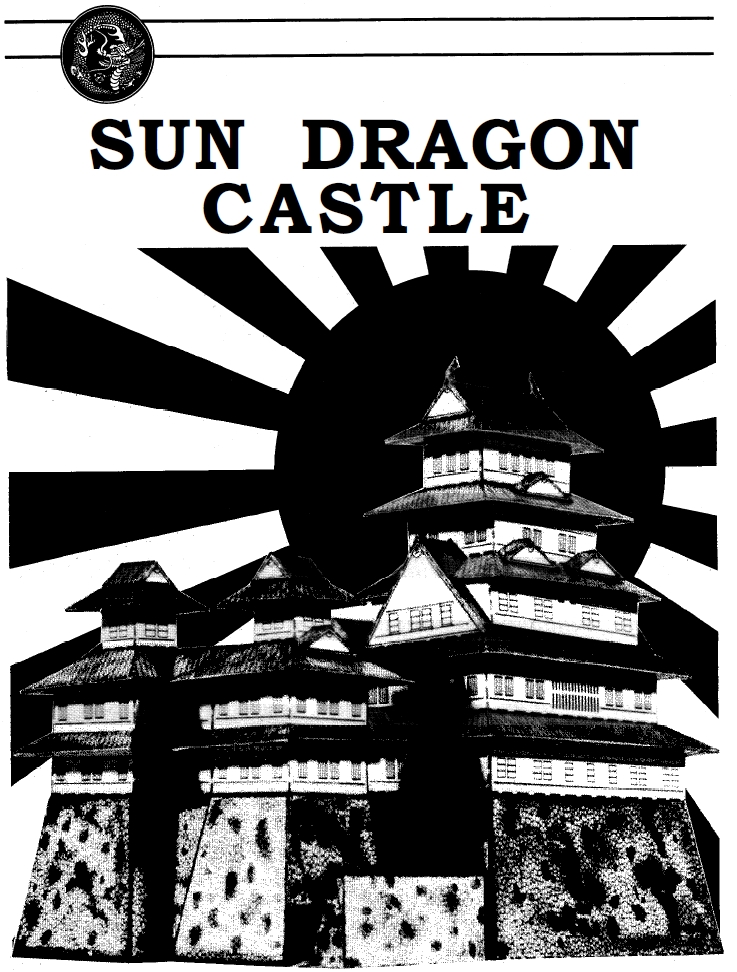
A tour of Sun Dragon Castle
The plans for
Sun Dragon Castle, the
Oriental fortress which appears
in this
issue, are based on Himeji
Castle, from a
region known as the Harima
country. Built
nearly 400 years ago, this
castle still stands
as a monument to Japan's
feudal culture.
The ground plans which accompany
this
text show details of Sun
Dragon Castle
(much like Himeji's environs
over 300
years ago). If based in Kara-Tur,
Sun
Dragon Castle is located
in of Wa.
Maps 1 and
2 correspond directly with
each other; thus, references
made to Map
2 also
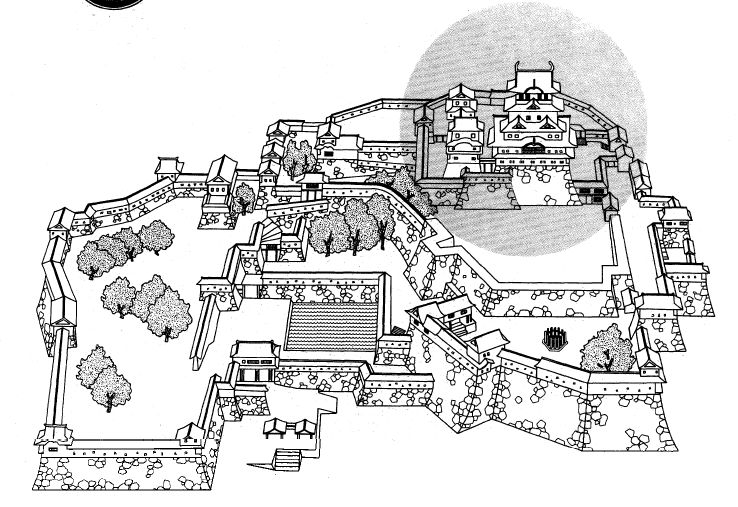
apply to Map 1. Map 1 is a birds-eye
elevation of Sun Dragon Castle.
This map
provides a three-dimensional
perspective
of the castle grounds immediately
surrounding
the tenshu, or main citadel.
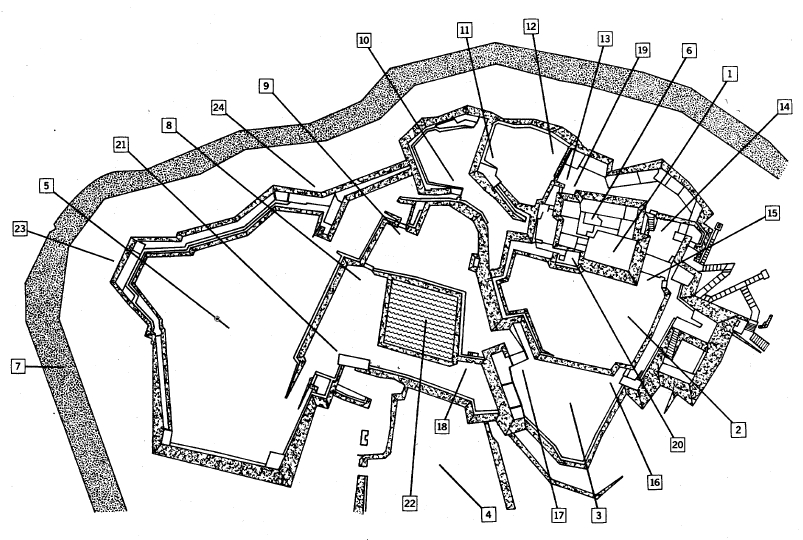
These structures are more
accurately
illustrated in Map
2, which shows an overhead
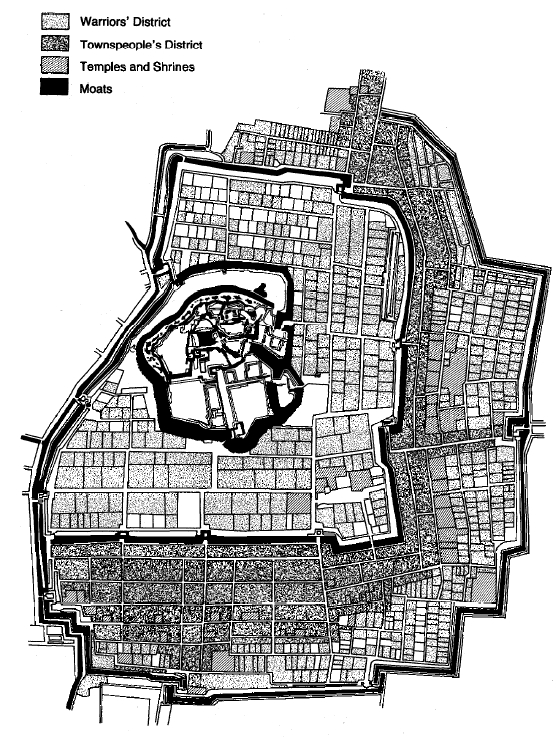
plan of the same area. Map
3 shows
the outlying environs --
the castle town,
outer moats, and peripheral
structures ?
around the inner construct.
The castle
model is of the tenshu only:
the main
tower and the structures
immediately
attached to or surrounding
it. These areas
are the daitenshu indicated
on Map 1 as 1.
The rest of the maps, plans,
and illustrations
accompanying this model are
provided
as supplements.
The inner
complex
Maps 1
and 2 show the tenshu and its
surrounding compounds. As
a frame of
reference, the main tower
(the cardboard
castle) highlighted on Map
1. The tenshu is
the innermost defense of
Sun Dragon
Castle; it is the one point
to which all
nobility retire in the event
of attack. The
floor plans for these structures
are shown
on the following pages.
Surrounding the main citadel
are the
other outer compounds, their
gates, and
other constructs. These compounds,
which are also known as maru,
are illustrated
in detail in Maps 1
and 2. These
compounds are constructed
in a mazelike
fashion and are connected
by a series of
gates; this construction
is instrumental in
adding a degree of constriction
to the
winding path to the tenshu.
In moving
through these compounds,
the attackers
must move in thin ranks,
thus slowing
their movement considerably.
Furthermore,
the defenders are able to
block
attacks by sealing off certain
compounds.
As can be seen from Map 1,
each compound
is slightly higher in elevation
than
the preceding one; this makes
it easier for
the defenders to fire at
attacking forces.
The mazelike structure of
the compounds
may also cause a degree of
disorientation
in attacking forces, causing
them to follow
mistaken routes to the tenshu.
Connecting each compound to
the next
is a series of gates. The
types of gates and
their construction are detailed
in Zeb
Cook's article, "The
Life and Death of a
Castle,"
which appears elsewhere in this
issue; DMs are free to place
any of these
gate constructions at the
gate locations.
These locations are marked
on Map 2 as 8-
18 (Gates A-K). The Diamond
Gate, or Gate
Hishi, is the main gate into
the inner compounds.
As a general note, this gate
is
usually the most sturdily
built, most defensible
gate in the complex. It is
important
because it separates the
outer living complexes
from the inner defense complexes.
It is these inner complexes
that the nobles
close off in the event that
attacking forces
reach the castle compounds.
Key to Map 2
| 1 |
Main tower complex |
| 2 |
Bizenmaru |
| 3 |
Okikuido |
| 4 |
Sannomaru |
| 5 |
Nishinomaru |
| 6 |
Daitenshu |
| 7 |
Inner moat |
| 8 |
Gate A (to Ninomaru) |
| 9 |
Gate B |
| 10 |
Gate C |
| 11 |
Gate D (to Ichinomaru) |
| 12 |
Gate E |
| 13 |
Gate F |
| 14 |
Gate G |
| 15 |
Gate H |
| 16 |
Gate I |
| 17 |
Gate J (to Okikuidomaru) |
| 18 |
Gate K |
| 19 |
Water gate 1 |
| 20 |
Water gate 2 |
| 21 |
Hishi gate (Diamond Gate) |
| 22 |
Sangoku moat |
| 23 |
Watari Yagura (vanity tower) |
| 24 |
Kesho Yagura (vanity tower) |
The moats listed on Maps 1
and 2 ? the
inner moat and the sangoku
moat ? are
the main water defenses for
the inner
compounds. The inner moat
is shown only
briefly and incompletely
on Map 2 (not at
all on Map
1); Map 3 gives a more complete
view of this expansive moat.
This
series of water defenses
marks the inner
complex from the surrounding
city. On
Map 3,
an outer moat (which feeds the
inner moat) gives the inner
complex the
appearance of an island within
an island.
The moats are much more concentrated
in
the inner complexes than
in the outer
ones. This concentration
of water defenses
makes it difficult for attacking
forces to
move through these compounds;
their
greater width also prevents
attackers from
moving siege weaponry through
the areas.
In peacetime, these moats
provide a water
source for agricultural and
sanitation
purposes. For instance, the
sangoku moat
not only defends the castle
walls between
the nishinomaru and the ninomaru,
but
also provides a recreational
water source
for the residents of these
maru.
The water gates listed on
Map 2 are
marked as if they appear
in two of the
maru compounds. In actuality,
these water
gates appear inside the daitenshu
compound,
and are gates to the tengu
itself.
The term ?water gate? is
merely a term for
the innermost gates; they
are not used to
let water into moats, nor
are they protected
by water defenses. The reference
to
water is a misnomer. With
the exception
of the sangoku moat, there
are no other
water defenses in the interior
complex of
Sun Dragon Castle. These
gates do not
appear on the model.
Two structures shown on Maps
1 and 2
are the watari yagura and
the kesho
yagura. These structures
are known as
vanity towers. They provide
a promontory
for reconnaissance; they
also provide
points of defense to the
outer maru and
minor defenses to the nishinomaru.
Plans
for these towers are not
included; their
interiors are fairly basic
in design, being
mostly open and unfurnished.
They are
used only for military purposes,
not to
house the noble family in
an attack.
Not shown on the maps are
the smaller
buildings (houses, sheds,
outbuildings,
stables, etc.) which occupied
much of the
maru compounds. In times
of peace, the
inner maru were used as living
compounds
for the noble family. Each
adult
member of the noble family
occupied one
of the maru. The tengu was
only used as a
defensible position in times
of war. DMs
may feel obliged to denote
the various
living quarters and outbuildings
on a
photocopy of Map
2, marking and placing
these structures as desired.
Okikuido on Maps 1
and 2 is the location
of a well (originally from
Himeji Castle).
Translated as ?Okiku?s well,?
Okikuido is
named for a young woman who
was killed
by her master for carelessly
breaking
some porcelain. It is rumored
that the
mournful voice of the young
woman?s
ghost can be heard counting
her dishes on
a stormy evening.
Outer
compounds and jokomachi
Moving outward from the inner
compounds
of Sun Dragon Castle, we
find the
Sannomaru compounds; these
compounds
house the servants and retainers
of the
noble family. Though these
lands lie outside
the walls of the inner compounds
(and outside the Gate Hishi),
they are
protected by the inner moat
and a solid
main gate. At the southernmost
point of
the castle island, this main
gate connects
the castle island with the
jokomachi (the
castle town). Various bridges
connect the
island to the jokomachi;
these are composed
of wood and can be burned
easily to
impede advancing forces.
The sannomaru
compounds occupy the lower
region of
the castle island; the harakirimaru
marks
the compound to the east
of the inner
compounds. These outer compounds
were
made up of both farmland
and housing.
The structure of the jokomachi
is illustrated
by the various shadings listed
on
Map 3.
The warrior?s district is closest to
the inner complex, providing
a military
buffer between the jokomachi
and the
castle island. This district
is separated
from the townspeople?s district
by the
inner moat. The inner moat
is connected
to outer moat and is crossed
by several
wooden bridges. Numerous
sections of
wall circumscribe the periphery
of this
section. Since these constructs
are not
marked on Map
3, it is up to the DM to
place them based on personal
discretion.
Outside the warrior district
is the townspeople
's district. This district
is comprised
of shops, bazaars, houses,
tents, and farmland,
all of which are occupied
by the local
merchants, farmers, and peasants.
For the
most part, this section of
the jokomachi
resembles the layout of a
medieval city,
except that the buildings
are most often
constructed of wood, plaster,
and paper ?
rarely of stone. Outside
this district,
between the townspeople's
district and the
outer moat, is another warrior's
district.
This district provides the
advance guard
for defense and the support
strength for
maintaining order in the
townspeople?s
district. This area is separated
from the
outlying farmlands and smaller,
peripheral
villages by an extensive
outer moat.
Bridges cross the moat at
various places.
That's how it all looks, working
outward
from the tengu and inner
compounds to
the edges and outer moat
of the jokomachi.
As always, the model and
maps are
merely guides for the construction
and
use of Oriental castles in
an Oriental
AD&D® game
campaign ? or even Fantasy
Games Unlimited?s BUSHIDO?
game or
Land of the Rising Sun
CHIVALRY AND
SORCERY game supplement.
All it takes to
incorporate these elements
into a campaign
is a bit of ingenuity, a
bit of planning
and plotting, and a bit of
work on the part
of the DM. With these, Sun
Dragon Castle
can easily be customized
to fit into any
Oriental game campaign.
MAY 1987