Artwork by John Stanko
Artwork by John Stanko
| Feudal Chivalry | - | Religious chivalry | - | Courtly LOVE |
| Gaming chivalry | - | Other codes of behavior | - | Putting it into practice |
| 1st Edition AD&D | - | Dragon #178 | - | Dragon magazine |
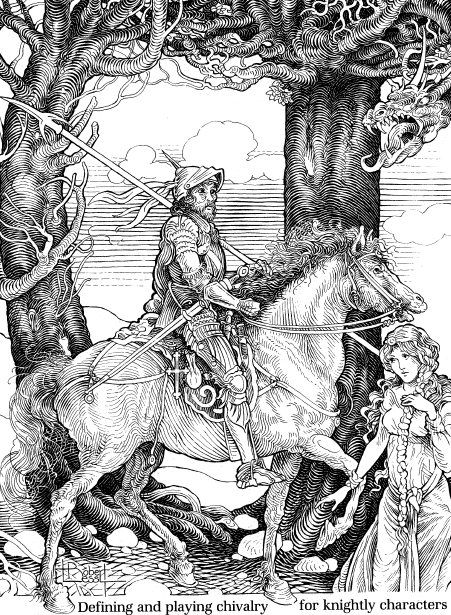
Artwork by Robert Lessl
Ever since the publication of Unearthed
Arcana for the AD&D®
1st Edition game,
players and DMs have debated the respective
roles of the paladin
and cavalier classes.
The changes made in the AD&D 2nd
Edition rules with the appearance
of a
new Player’s Handbook and The
Complete
Fighter’s Handbook have added more
options for the players of knightly characters,
but have also added to the muddle of
controversy.
For those having trouble distinguishing
between the play of cavaliers and paladins,
a look at how chivalry was actually viewed
in the Middle Ages can prove helpful in
reducing confusion and disputes. The
different chivalric codes touted by medieval
authors can aid players in portraying
the forms cavaliers and paladins can assume
in AD&D games, as well as inspire
the DM in creating the chivalric codes
known in the campaign world.
In his outstanding work, French Chivalry,
historian Sidney Painter argues that
there never was a common code of chivalry
recognized in medieval times. Writings
that survive from the Middle Ages describe
a wide variety of opinions offered
by knights, ladies, ecclesiastics, and
troubadours
on which characteristics embody
the ideal of knighthood to be emulated
by
nobles. Painter groups this diversity of
beliefs into three major categories, which
he calls feudal chivalry, religious chivalry,
and courtly LOVE.
Feudal
chivalry
Feudal chivalry emerged from the ruins
of the western Roman Empire as a martial
code inspired by the warriors of Germanic
legend. Warfare was the chief occupation
of the Teutonic and Frankish nobility,
so
the nobleman was defined by those traits
that make an effective soldier: personal
bravery, physical strength, hardiness,
skill
at arms, and fortitude. To be preux, to
possess martial prowess, was the minimum
expected of every nobleman. In the
violent centuries following the fall of
Rome, a nobleman who could not fight
was of little use to his feudal lord.
Loyalty joined prowess to form the two
major qualities admired in the knight.
To
the feudal world, loyalty primarily meant
upholding the personal obligations that
bound a knight to his liege lord and a
lord
to his vassals. A knight who couldn?t be
relied upon to act as a trustworthy soldier
in his lord's service was also useless,
if not
dangerous, to his feudal lord. Only by
observing the mutual contracts that held
feudal society together could total chaos
in
a fragmented Europe be averted.
The knight was taught to faithfully serve
the lord above him and in turn be obeyed
by the vassals and peasants below him.
In
return for the goods produced by the
peasantry,
the knight provided protection
from external threats. When obligations
were ignored and internal dissention
present, a fief became ripe for plunder
or
conquest. The ethical duties of a knight
to
his society proved crucial in a time when
competition among rivals was fierce and
the disunited perished.
A tradition of knightly courtesy later
emerged with growing political stability
and class consciousness among nobles.
Courtesy was a matter of practical sense
shown by noble to noble to preserve and
protect the members of an exclusive club.
A courteous knight, according to the
feudal code, should face a fellow noble
on
equal terms and should neither attack an
unarmed knight nor take advantage of an
unfair opportunity. A knight must always
be ready to accept a defeated knight?s
surrender, to spare his life, and promptly
release him on parole.
A captor must treat a noble prisoner
with respect and must never demand an
excessive ransom from a vanquished
knight. (Haggling was little known, since
a
knight?s vanity was satisfied by the high
ransom he could command.) In return, a
knight taken prisoner and then released
on his word of honor must never violate
the terms of his parole and should pay
his
ransom in reasonable time.
The yearning for glory came to be as
much a part of the nobleman as the desire
for land, plunder, and ransom. Every
knight dreamed of having his deeds live
on
beyond him in song and story, just as the
Germanic heroes of old did. The pursuit
of
glory through the accomplishment of
heroic feats was declared the chief goal
of
the true knight; the earning of booty was
merely a side benefit?at least, that?s
what
knights said in public.
The virtue of generosity, lauded in early
Germanic literature, was also valued in
later medieval times. Great honor could
be
won by the open-handed noble who gave
lavishly to his vassals and allies. Hungry
minstrels and landless knights seeking
employment spread the message that
largesse ranks high among the chivalric
virtues. A rich nobleman who lacked
martial prowess but who gave his wealth
freely could always find knights to fight
for him and minstrels to sing his praises.
The nobleman who lived within his
means was despised by some medieval
writers. Often living on the edge of bankruptcy,
a noble should think nothing of
mortgaging his lands to hold extravagant
banquets and to bestow costly gifts. A
disregard for fiscal responsibility came
to
mark the true nobleman from the frugal
townsman, who was always ready to
exploit the poverty of knights in order
to
buy or marry his way into the landed
nobility.
While warfare was considered the true
vocation of knights, the tournament offered
an acceptable substitute to break up
the monotony of peacetime. For a landless
knight with no steady source of revenue
and no war to earn him regular pay and
booty, the horses and armor captured or
ransoms claimed through tournament
victories provided an exciting way to earn
a living.
Tournaments brought prestige to the
noble who sponsored them. The spirit of
hospitality and social activities accompanying
a tourney reinforced the feeling of
comradeship among nobles, encouraged
the use of chivalric courtesies, and further
separated tournaments from the horrors
of war, in the process changing tournaments
from a practical exercise of the
skills needed in battle into a grand sport
to
be enjoyed for itself.
The 13th-century knight William Marshal
personified the spirit of feudal chivalry.
On one occasion, while Marshal waited
for a tournament to begin, a young herald
asked William in song for a gift. Marshal
promptly overthrew the first knight he
faced and gave the loser?s horse to the
herald, impressing all present with his
knightly skill and impetuous generosity.
At its core, feudal chivalry in AD&D
game terms embraces the lawful-neutral
ethos. Feudal chivalry concerns itself
primarily with the ethical contracts binding
society together, while also closely
regulating the rights, powers, and duties
of the various classes of society. The
morality
of the actions performed by individual
knights merits far less attention.
Religious
chivalry
Religious chivalry emerged as the
church tried, though with only middling
success, to restrain the violence and greed
of feudal knights. The church worked to
replace the knight's sense of loyalty to
his
feudal obligations with an even higher
loyalty to the church. A knight, clerics
proclaimed, should serve the church first
and obey other worldly contracts second,
devoting his life to serving the clergy
and
adhering to the edicts of the church in
all
matters.
Knighthood is not an accident of birth,
priests maintained, but a divinely instituted
order like the priesthood. The act of
conferring knighthood upon a noble became
a holy ritual. The church taught that
a nobleman, no matter how high his birth,
betrays his knighthood if he follows an
irreligious and immoral life.
The religious knight aspires to be honest,
temperate, frugal, charitable, humble,
and strictly monogamous, if not chaste.
He
also shuns greed, luxury, extravagance,
and the desire for worldly honors. The
only deeds worthy of a knight are those
that serve the church, not those performed
to win glory in the eyes of others.
The feudal knight viewed his prerogative
to make war on his neighbor as an
inalienable right of his class. The church
strove to curb this propensity for violence
by forbidding a knight from warring on
his fellow Christians. The church believed
the only war a Christian knight could
justifiably wage was a religious crusade
called by the church. Moreover, the noble
who failed to go crusading when called
upon was denounced as a worthless
knight and a false Christian.
The church also preached against the
taking of booty in war and the plundering
of the weak and innocent. Condemning
the seizure of goods from a fellow Christian
defeated in war or tournament, the
church restricted the knight?s hunger for
the fruits of war to only those goods taken
from the unrighteous while in the act of
enforcing justice against evildoers, never
for the simple lust for profit.
Despite the church?s declaration that no
knight could be saved who had not returned
all the goods taken from others,
William Marshal remained unrepentant
for all the wealth claimed from the 500
knights he had vanquished in tournaments.
He insisted on his deathbed that
the church?s teaching was false and unfair
to knights.
While a few ecclesiastics approved of
the tournament as a training ground for
the necessary skills of knighthood, the
church in general abhorred tournaments,
where the seven mortal sins of pride,
envy, hate, avarice, luxury, extravagance,
and homicide thrived. The knight?s quest
for glory was mere vainglory in the opinion
of priests. The bloodshed inherent in
tournaments was repugnant to the
church, and the seizure of the horses and
armor of fellow knights was decried as
an
unjust profit. The pomp and pageantry
surrounding the tournament was scorned
as a wicked waste of resources better
employed in more charitable ways.
Yet all the threats to excommunicate the
participants in tournaments and to deny
church burial to anyone who died in a
tournament were in vain. The church
never extinguished the love of rough
melees and splendid jousts in the hearts
of
knights and commoners alike.
In the AD&D game, religious chivalry
will likely be allied with a dominant god
or
goddess of lawful-good alignment, a deity
concerned with both the well-being of
society and virtuous personal behavior.
The patron of paladins and many goodaligned
cavaliers, this deity will charge his
priests to instruct knights on how to follow
the path of righteousness, as well as
chastise knights who lead an immoral or
unethical life.
Courtly LOVE
The origins of courtly love have been
debated endlessly by scholars, but the
chief ideals of the code emerged from the
lyrical poetry of southern France in the
11th and 12th centuries. The content of
romantic poetry varied widely as poets
throughout Europe explored love in all
its
many forms: dreamy and mystical, coarse
and bawdy, platonic and chaste. The most
flowery of poets described the sweet
agony of longing from afar, never to be
fulfilled. Their poems recounted the unquestioning
worship of and subservience
to a noble lady, and portrayed knight and
lady as equals in the service of Lady Love.
Most poets did agree that love is a strong
source of goodness in the world. Love
makes a knight more valiant, more noble,
more preux. Where the feudal knight
gains strength through devotion to his
liege lord and the religious knight through
dedication to the church, the romantic
knight grows mighty through adoration of
a noble lady. A nobleman who has no highborn
lady to love lacks the essence of true
knighthood. A lady who has no knight to
worship her and no minstrels to praise
her should feel clearly out of fashion.
Knights were advised to practice the
social graces and courtly arts to win the
favor of cultured ladies. A knight must
possess charm, eloquence, taste, civility,
and a ready wit if he wants to stay popular
at court. A knight who wishes to win
the heart of a lady of gentle birth should
be as adept at singing, dancing, playing
a
musical instrument, and composing poetry
as he is at jousting and fencing.
Romantic literature described loyalty to
one?s paramour as preeminent over all
other obligations. True love places a knight
and his lady above all laws of state or
church. Nothing should stand in the way
of true love?not even marriage. In an age
when marriages were arranged to forge
political alliances or because of economic
necessity, few persons married for love.
As nobles often married young, the only
ladies available to be worshiped from near
or afar were already married. The intractable
laws of the church and deeply rooted
customs of feudal lords ensured that the
ideals of courtly love remained more the
stuff of literature than of everyday life.
The most famous tales of courtly love,
which recounted the affair between Lancelot
and Guinevere, broke sharply from
the ideals of the past. Not only was Lancelot
?s adulterous love for his queen a sin
in
the eyes of the clergy, it also violated
Lancelot
?s sworn obligations to honor his lord,
King Arthur.
In a romance written by Chretien de
Troyes, Lancelot journeyed the land on
incredible adventures for no better reason
than the approval of Guinevere. During
a
quest to rescue his queen from a villainous
knight, Lancelot lost his horse and was
compelled to ride in a hangman?s cart
carrying condemned criminals. Lancelot
hesitated a moment before boarding the
cart and thus subjecting himself to a humiliating
way for a knight to travel. When
Guinevere later heard of Lancelot?s momentary
hesitation, she considered that a
flaw in Lancelot?s love for her. Guinevere
required Lancelot to set forth on yet another
series of adventures before she
finally forgave him.
In another test of Lancelot?s love, Lancelot
entered a tournament in disguise but
Guinevere recognized her champion anyway.
Lancelot defeated every knight he
faced until Guinevere sent him a note
ordering him to fight poorly. Lancelot
allowed himself to be soundly thrashed
and driven from the field in disgrace.
He
continued to fight badly the next day until
the queen sent him another message commanding
him to fight at his best. Thereafter,
no knight could stand against
Lancelot.
Courtly love at its most extreme, and as
played in the AD&D game, describes
a
chaotic system of ethics advocating lovers
to flout any laws or customs that hinder
the course of true love. The romantic
knight owes loyalty to his paramour only;
all other duties are shown to be meaningless
when the two fall under the spell of
Lady Love.
Gaming
chivalry
These three chivalric codes should be
seen as separate and, in their entirety,
irreconcilable standards of conduct. Feudal
chivalry chafed at the moral restrictions
laid down by the church and
regarded the beliefs of courtly love a
threat to the proper business of arranged
marriages, as well as a weakening influence
on the rigorous life a warrior should
lead. Religious chivalry struggled to limit
the excesses and violence inherent in
feudal chivalry while vigorously opposing
the wanton behavior of proponents of
courtly chivalry. Courtly love sought to
throw off the prohibitions imposed by
feudal custom and religious doctrine to
give freer reign to the passions of nobles.
While these codes could never be wholly
combined into a single ideal acceptable
to
all, some medieval writers succeeded in
merging particular features of two or even
all three codes to form a composite model.
The DM, too, will need to make compromises
to blend aspects of each code to
form the knightly codes that add color
to
the campaign world.
The DM will typically find three types of
warriors involved with chivalry. The first
is the cavalier,
depicted as a character
class in Unearthed Arcana and as
a warrior
kit in The Complete Fighter’s Handbook.
Feudal chivalry will be the major
influence on these knightly characters.
Next is the pure paladin,
drawn strictly
from the 1st or 2nd Edition Player’s
Handbook,
whose abilities and attitudes are
little influenced by any warrior kit he
may
adopt. Like a Galahad radiating an aura
of
otherworldly purity and holiness, this
paladin is driven exclusively by the principles
preached by the temple he serves.
The concerns of class, politics, and worldly
ambition seem trivial to the pure paladin
when compared to the glory of serving
his deity.
Most complex of all is the paladin-cavalier,
drawn from the paladin
subclass
of the cavalier
class of Unearthed Arcana,
or created when an AD&D 2nd Edition
game paladin fleshes out his background
by adopting the cavalier or noble warrior
kit. This character is shaped by both religious
and feudal chivalry in roughly equal
parts.
Most cavaliers will align themselves with
the cause of good. Many such cavaliers
will draw on aspects of religious chivalry
to add a needed dose of morality to the
traditions of feudal chivalry. Unearthed
Arcana properly reflects the benefits
that
accrue to good cavaliers
while penalizing
cavaliers who follow neutral or evil alignments.
The Complete Fighter’s Handbook,
however, mandates that all warriors
choosing the cavalier kit must be good.
As
I?m inclined to ignore the noble warrior
kit
and instead mix parts of the noble warrior
description into a broadened cavalier kit,
I
suggest that DMs who use the
AD&D 2nd Edition rules consider
permitting
cavaliers--even if only as NPCs?to
follow nongood alignments.
A campaign trying to capture the spirit
of the feudal age should contain a high
proportion of lawful-neutral cavaliers
upholding the ideals of feudal chivalry.
Other knights will drift over toward the
true-neutral or chaotic-neutral alignments,
or will descend into the moral abyss of
the
evil alignments. Meanwhile, heroic cavaliers
vigorously oppose their wicked brethren.
Nobles of all stripes must be present
to form a credible world.
Even a good cavalier with strong religious
values will respect the traditional
values handed down through generations
of feudal nobility. Always an avid adventurer,
the cavalier sees warfare as a thrilling
game with glory its ultimate goal. Best
of all is a battle settled neither by a
lengthy siege nor by the intricacies of
strategy and logistics, but by a courteous
combat between equal parties of knights,
bringing honor to all participants.
The cavalier is always eager to joust in
a
tournament or duel with a fellow knight
in
order to defend his honor and to prove
his
skill. The true cavalier never hesitates
to
throw down the gauntlet before one who
challenges the cavalier?s reputation or
who
insults his paramour. Fearless in battle,
the
cavalier hopes his knightly deeds will
live
on in the words of troubadours and the
works of artists.
The booty earned through conquest or
tournament victories passes freely
through the cavalier?s hands. Largesse
is
acknowledged as an important part of
winning prestige. To maintain an aristocratic
image, the cavalier will spend his
money on appearance rather than creature
comforts. His clothing must be fashionable
and extravagant, his jewelry top
quality, his armor stunning, and his residence
opulent. ?It is better to look good
than to feel good? is a truism to the cavalier.
Never worry about saving for the
future, the cavalier is told; frugality
is for
common merchants. So what if bankruptcy
seems imminent? The next adventure
will provide more wealth.
The pure paladin follows a different set
of principles. The paladin doesn?t boast
of
his prowess as cavaliers do, but cherishes
the value of humility. Never confusing
egotism with self-respect, the paladin
never duels merely to defend some petty
point of honor. The pure paladin never
seeks glory for its own sake; he is more
interested in tangible victories over evil.
The only approval the paladin needs is
the
thanks shown by his temple for valiant
service to the cause of good.
The paladin never involves himself in an
unjust war. Even in a just war, the paladin
doesn?t lust after plunder, but collects
only
what profits his temple deems acceptable
after the battle has been won. The
paladin
will then donate most of this profit to
his
temple or other worthy charities. To dress
lavishly and dine on rich foods while others
go threadbare and hungry is a sin that
no paladin can condone.
To the cavalier, war is a splendid game;
to the paladin, it?s a serious business,
The
paladin believes in getting the job done
as
quickly and as humanely as possible to
restore peace to the land, and as a result
will study the strategies of warfare with
thoroughness and intelligence.
<rw>
Never taking prisoners for the sake of
ransom, the pure paladin advocates the
lawful judgment of evildoers by a court
of
law or military tribunal; some societies
may give the power to judge to the paladin
himself. The paladin would sooner see a
dangerous criminal or vicious monster
imprisoned or executed than ransom back
an enemy who is then free to wreak havoc
once again.
The pure paladin decries the violence
and greed of the tournament. No true
paladin need prove his worth by fighting
for the amusement of a bloodthirsty
crowd. By participating in a tournament,
a
knight risks committing the sin of homicide
to satisfy a base craving for worldly
honors and wealth. Besides, why waste
time on a frivolous tournament when
there are so many wrongs to be righted
and villains to be undone?
The paladin strives to thwart evildoers
and suppress hostile infidels no matter
how high their birth. A cavalier can tolerate
and perhaps even relish the company
of fellow knights though they worship
different gods or serve foreign kings.
Not
so the paladin, as a pure paladin has little
patience with neutral cavaliers and none
for evil knights. Loyalty to temple always
supersedes loyalty to social class.
The paladin-cavalier is perhaps the most
difficult of all characters to play. More
Roland than Galahad, the paladin-cavalier
serves not one religious cause only, but
many worldly duties as well. Both temple
and liege lord demand his obedience, and
he struggles to serve each equally well.
But when the character?s feudal and religious
obligations differ, and his soul feels
torn between conflicting drives, he must
ultimately submit to his deity before any
mortal. This internal conflict makes the
paladin-cavalier a real challenge to roleplay
well.
While the cavalier may too strongly love
the privileges of his class, the paladincavalier
pays more attention to the responsibilities
and obligations a noble birth
confers. Noblesse oblige guides
paladincavaliers
(and the most lawful and good
cavaliers, for that matter) in every aspect
of life. Respect and obedience cannot
simply be demanded: They must be
earned. The paladin-cavalier thinks nothing
of laying down his life for the most
lowborn of peasants for a just cause, or
sharing his last loaf of bread with a hungry
vassal.
Where the neutral cavalier sees peasants
as a resource to be exploited, the paladincavalier
views them as beings of value.
Charity to the poor always takes a high
priority with the paladin-cavalier, even
if
he must deprive his own manor of stylish
furnishings. The noble taste for luxury
is
tempered by a moral drive to provide for
the needs of others before his own.
Exposed to the thrill of jousting
since
early childhood, the paladin-cavalier understands
how the tournament hones a
knight?s skills. The paladin-cavalier may
not relish war as cavaliers do, but he
does
recognize the need to keep himself in
fighting trim for those times when his
temple or lord calls upon him to engage
in
a regrettable but necessary battle. So
long
as a tournament is conducted in a civilized
and orderly manner?e.g., regulated jousts
or a mock assault on a wooden castle to
rescue its ?captive? maidens, rather than
a
savage melee?and the paladin-cavalier?s
temple or lord doesn?t forbid his participation,
the tournament can be enjoyed.
IMAGINE, however, the misunderstanding
when Lady Bess the paladin-cavalier unhorses
Sir Brian the cavalier in a joust, yet
she doesn?t claim from him a ransom.
She?s in it for the practice, after all,
not the
profit. Sir Brian might believe she rates
him a knight of such poor prowess he
doesn't merit a ransom, treating him like
a
common foot soldier. To avenge the unintended
insult, Sir Brian might turn the
courteous joust into a bloody duel of
honor.
The ideals of courtly love will likely
influence most knights to varying degrees.
Cavaliers will embrace courtly love for
the
sophisticated pleasure of the games of
courtship or for simple bawdy fun.
Whether a gracious knight adoring a lady
or a female cavalier courting a famous
prince, the knight who can boast of championing
a noble paramour and who
proudly wears the paramour?s scarf or
kerchief in tournaments adds greater
glory to the knight?s name.
The courtly arts also mark the cultured
noble as someone distinct from the common
townsman or yeoman farmer. A
knight with political aspirations will
be
well served by mastering the talents that
can win favor at court and attract the
attention of high-ranking patrons.
Few cavaliers, however, will go so far as
Lancelot in placing service to a paramour
above their own pride as warriors. Most
lawful cavaliers will also not permit themselves
to fall so headlong into love that the
traditional practices of marriage are endangered
by jealousy or the complications
posed by bastard offspring.
A truly romantic knight will likely follow
the chaotic-good alignment, believing that
devotion to his paramour and to the games
of courtly love represents the highest
ideals of knighthood. The romantic cavalier
will never let the ethics of a faceless
and unfeeling society stand in his way
when he sees the moral good of a person?s
individual liberty and happiness is threatened,
especially when that person is his
paramour.
The chaotic-neutral knight, in contrast,
practices the most selfish aspects of courtly
love. He views personal pleasure as
more important than respect for the traditions
of society or the feelings of those
whose lives he touches.
Paladins and paladin-cavaliers will certainly
concede love is a tremendous power
for good, but their romantic activities
will
be guided by the tenets of their religion.
If
not restricted to lives of chastity, they
will
still honor their temples? teachings regarding
courtship and marriage. They treat
love as a more serious matter than cavaliers
typically do, and they respect commitment
and honesty over frivolous games
of flirtation, seduction, and courtly
intrigues.
Other
codes of behavior
Of course, not all AD&D campaigns
will
limit themselves to the milieu of feudal
Europe. The DM whose campaign world
embraces a wide variety of colorful societies
should draw inspiration from the
warrior codes of many historical cultures.
The samurai,
like the knight, was drawn
from the lesser ranks of Japan?s highly
cultured landed nobility. The characteristics
and qualities of this exotic warrior,
shaped by a different culture, will naturally
differ from those of Western cavaliers.
Bushido rather than European
chivalric codes is a better guide to the
DM
whose world reflects an Oriental flavor.
Other societies of a fantasy world may
know noble warriors inspired by Byzantine
cataphracts armed with bow and
lance, ancient Near East charioteers, or
Indian nobles who waged war with elephants.
Such warriors will likely obey
standards of behavior distinct from those
identified with the European heavy cavalry
lancer.
Consider, for example, a nation where
the sons of the landed gentry are trained
to fight as traditional cavaliers. Aristocratic
daughters, using their smaller and
lighter frames to their advantage, are
instead born and bred to fight as lightly
armored horse archers. Equipped with
asymmetrical composite long bows capable
of being fired from horseback, they
favor maneuver over mass, firepower over
shock power. While products of the same
culture, the siblings who master disparate
combat styles cannot help but reflect
different martial philosophies and conduct
themselves according to different chivalric
codes.
Even more unusual are demihuman
cavaliers. Elven cavaliers might despise
the
rigid legalities of feudal chivalry and
instead
throw themselves into the fun and
games of courtly love with more passion
than any human could muster. Viewing
the long bow rather than the lance as the
ultimate symbol of warrior nobility, elven
cavaliers may not scorn fighting at long
range as human knights do and consider
discretion an important part of valor.
Rejecting the frivolity of courtly love,
dwarven cavaliers may abide by unyielding
laws and traditions of dwarven chivalry
so fervently that human feudal chivalry
seems lax in comparison. With combat
from horseback so impractical for the
dwarven stature, they may prefer the
thrill of driving a war chariot pulled
by
stout mountain
goats or fierce rams. Chariot
racing and the exchange of axe strokes
on foot may replace jousting in dwarven
tournaments.
In addition, paladins and paladincavaliers
too may differ markedly from
campaign to campaign. One worlds paladins
serve a benevolent sun goddess, another
world?s following a wrathful storm
god. Paladins across many campaigns
wield different spells, fight different
enemies,
practice different rituals, obey different
marriage customs, and preside over
different legal systems. Paladins in some
campaigns might even adopt unusual
warrior kits that make sense in their own
particular culture. While rooted in historical
study, the chivalric codes of any world
must be tailored to fit in with the campaign
?s cultural environment-its institutions,
mythologies, races, fighting arts,
economic realities, and political struggles.
Putting
it into practice
Once the DM has fully developed the
chivalric codes of the campaign, he must
then explain them in detail to the players.
The DM can hardly fault a PC cavalier or
paladin for violating a subtle point of
the
code the character professes to serve
when that code had never been outlined
to the players in the first place. The
DM
should never assume the players know the
same historical facts he knows.
Historical research can prove valuable
but shouldn?t be followed slavishly. It?s
the
DM?s prerogative to remake fact into fantasy,
to create societies whose elite warriors
embrace novel philosophies and
traditions in rulership, religion, and
romance.
[Other articles on this topic have appeared
in DRAGON® Magazine.
These include: "From the Sorceror's Scroll:
Good Isn't Stupid...." (issue #38,
reprinted in The Best of DRAGON® Magazine anthology,volume II);
"The Anti-Paladin"
(issue #39, reprinted in The Best of DRAGON® Magazine anthology,
volume II);
"It's
Not Easy Being Good" and
"Thou
Shalt Play This Way" (issue #51 for both, <the 1st reprinted
in volume III of The Best of DRAGON Magazine anthology);
"From the Sorceror's Scroll: The
Chivalrous Cavalier" (issue #72, Unearthed Arcana);
"A Plethora
of Paladins" (issue #106);
"The
Elven Cavalier" (issue #114);
"Feuds and Feudalism"
(issue #117);
"The Code of
Chivalry,"
"Meanwhile,
Back at the Fief...,"
"Lords
& Legends," and
"Glory,
Danger, and Wounds" (issue #125);
"Lords
& Legends" (issue #127);
"The Corrected
Cavalier" and
"Good
Does Not Mean "Boring" (issue #148);
"The
Making of a Paladin" (issue #154).