Blasters & Blunderbusses
A look at firearm laws: past,
present, and future
by Peter R. Jahn
Any game master running a game campaign
in which characters use guns will,
sooner or later, have the same problem
--
characters who have more firepower than
most artillery divisions. Few things are
more obnoxious than a ?typical? modernday
espionage or mercenary character
who travels about freely with a pair of
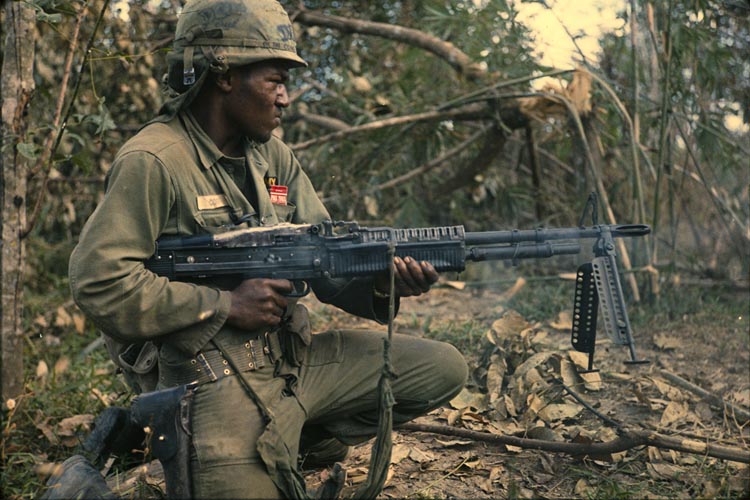
Skorpions in his arms, an M-60 on his
back, and a half-dozen LAW rockets in the
car. Luckily, GMs aren't the only ones
making rules to control this problem. Most
modern and historical cities, states, and
national governments have passed weapons
restrictions. Knowing something about
past and present gun laws can keep a
game campaign " any campaign " in
balance. The earliest gun laws can even
be
adapted in various ways to fantasy game
settings, and a basic grounding in the
history of weapons laws is especially helpful
for players involved in time-travel
games, like Pacesetter's TIMEMASTER
or
FASA's DOCTOR WHO games.
Because world-wide gun laws vary so
much, most of the information below
applies only to campaigns set in the United
States. A trip to the library is called
for in
other situations. Also note that in war-torn
areas of the world, weapons restrictions
are enforceable only at gunpoint. Military
personnel and civilians alike are probably
heavily armed, and the only practical
restriction on firearms is encumbrance.
Early gun laws
Many RPGs are set in Medieval
fantasy, Caribbean pirate, and swashbuckling
campaigns, with technological
levels approximating the period from
prehistoric times to the 1600s. Gun laws
during the Middle Ages and Renaissance
periods were merely the latest form of
weapons regulation. Very small and
wealthy nobilities dominated very large
and poor populations. The fear of a peasant
revolt ran through all of the European
monarchies, and as a result they passed
laws preventing landless persons from
having any weapons. A character with low
social status was often put to death for
the
possession of a glaive,
which was merely a
tool for trimming branches straightened
into a weapon for trimming Knights.
Peasants
occasionally did perform some Knighttrimming,
but the laws almost always kept
weapons solely in noble hands; anyone
running a fantasy or Medieval campaign
(using TSR?s D&D®, DRAGONQUEST?,
or
AD&D® games; Chaosium?s RUNEQUEST®
or PENDRAGON games; or, FGU?s CHIVALRY
& SORCERY? Game, among others)
should
remember this. Carrying weapons and
armor is usually illegal, or at least in
very
bad taste, in many civilized areas. Conspicuous
components for offensive spells may
also be restricted to the ruler?s mages,
making possession of them by PCs illegal.
As firearms developed, restrictions on
who could own them developed as well.
Characters in many swashbuckling campaigns
(FGU?s FLASHING BLADE? game,
for example)
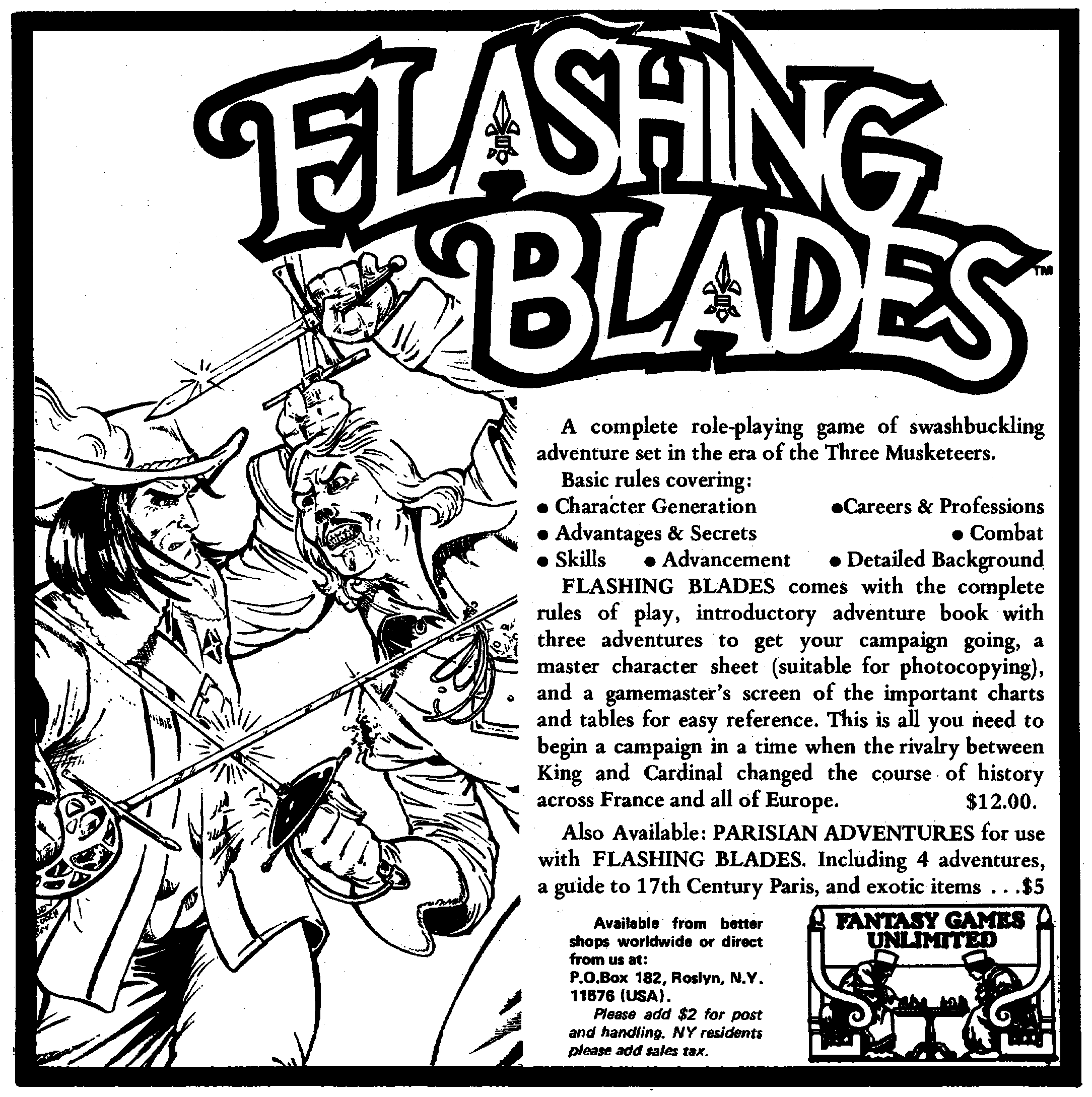
will be well armed if they are
serving in the military or in some major
noble?s retinue. The common man and
even lesser nobles were not permitted
much firepower. English law allowed a
small-time landowner to possess a
longarm, and landowners with larger
estates could have a couple of rifles and
a
blunderbuss, while a major noble could
add a pair of pistols to the above. Possession
of firearms by the masses was inconceivable
the nobility formed the army and
had the sole right to hunt, so the masses
had no need for weapons? and no right
to own them. Remember this when one of
the PCs starts waving his weapons around
a bar in more civilized areas, especially
if
he has a low social status.
In the American colonies and in pirateruled
enclaves in the Caribbean and the
Mediterranean, however, this was not the
case. The early colonists were faced with
danger from hostile Indians and wild
animals, and needed to hunt game or
starve. The settlers were armed; indeed,
the captains bringing new colonists from
England were required to make sure each
colonist brought a rifle. America never
had a history of firearms prohibitions,
so
it shouldn?t be too surprising that the
first
laws and regulations involving guns were
hunting laws. In 1677, Connecticut passed
the first wildlife protection laws. If
you?re
running a campaign in colonial America,
gun laws won?t help control PC excesses;
you?ll have to rely on the weight and bulkiness
of the guns involved to limit firepower.
The 19th century
Games set in the American Old West
(like TSR?s BOOT
HILL® game), the Age of
Sail (FGU?s PRIVATEERS & GENTLEMEN?
game), and Victorian England (the Cthulhu
by Gaslight supplement to Chaosium?s
CALL OF CTHULHU® game) present
a
different problem in firearms control. By
the 1850s, America?s casual attitude
toward weapons had changed. In the
settled eastern areas, the citizens no
longer
needed to be constantly vigilant. The
habit of carrying rifles to church had
disappeared from the North, although fear
of slave revolts kept it alive in some
areas
of the South. The higher social circles
considered carrying guns barbaric. Even
the police were unarmed; the first police
force to be issued guns was Nashville?s,
and that happened in 1871. New York City
police did not receive pistols until the
1890s, although New York gangs had been
carrying pistols since the 1840s, and some
officers had ? unofficially ? begun carry
ing them around 1850.
The federal government had not passed
any firearms legislation through this period,
but many cities had. By the time of the
Civil War, nearly all major cities had
passed laws prohibiting the carrying of
concealed weapons. The degree of
enforcement varied, as did the penalties,
but one thing was sure: Anyone making
enough of a nuisance of himself could be
arrested and lose his gun.
While the eastern cities had a fairly
uniform policy on firearms, western
towns varied widely. Many allowed citizens
to carry and possess any weapon at
any time. Others had ordinances requiring
guns to be checked while in town, or
prohibiting the carrying of a gun in a
saloon. There were no standards or patterns;
a GM can get away with practically
any restrictions on firearms, especially
if
backed up with a fast-draw sheriff and
a
few shotgun-toting deputies to supplement
the local gun laws.
Between world wars
The 1920s and 1930s are the times for
adventures using TSR?s GANGBUSTERS?
and THE ADVENTURES OF INDIANA
JONES?, Chaosium?s CALL
OF CTHULHU,
FGU?s DAREDEVILS?, Pacesetter?s
CHILL?,
and Hero Games?s JUSTICE, INC. game
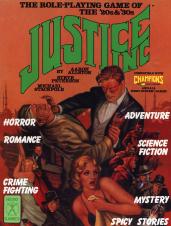
systems. Gun laws at this time are similar
to
those from 1850 on, although slightly
tougher in some areas. Parts of the West
had become settled, and even some
cities in Texas had prohibited concealed
weapons. In settle d areas, concealed weap
ons were forbidden everywhere, although
the penalty was often limited to a fine
and
confiscation of the weapon. One major
exception, however, was New York. The
Sullivan Law required all New Yorkers to
have a permit to own firearms and a second
permit to carry one, and made it a
felony to possess a pistol without one.
(Prior to the Sullivan Law, it had been
a
felony to carry a concealed knife, brass
knuckles, etc., but it was only a misdemeanor
to carry a pistol.) After the 1916 law,
characters carrying a pistol illegally
stood a
fairly good chance of going to a New York
State penitentiary. (The Sullivan Law is
still
in force in New York.)
The federal government?s first major law
only affects campaigns running in 1934
and after. The National Firearms Act of
that year required licensing of firearm
dealers and collectors, and required serial
numbers on all guns. More important, it
required a special license to own a sawedoff
rifle or shotgun, a machine gun or
submachine gun, a silencer, or trick guns
hidden in swords or canes. Violations
were made felonies with stiff jail sentences.
The law also added a heavy fee to the
required license, and a $200.00 tax on
the
purchase of any restricted weapon.
Prior to 1934, FBI agents were not
allowed to carry guns as law officers,
though they could do so (and did) as private
citizens. After January 1, 1934, however,
FBI agents could use virtually any
weapon and had much expanded powers
of arrest and jurisdiction. Most police
officers of this period could carry many
sorts of firearms as well, and they had
broader powers of arrest then than they
have today. These facts may prove useful
to a harried GM with a gun-happy group.
In 1937, the government decreed that
only federally licensed dealers could ship
or sell weapons from state to state. The
licenses weren?t difficult to obtain; the
annual fee was $1.00, and at one 1930s
GANGLAND(Iron Maiden)
convention the majority of the
participants were federally licensed firearms
dealers. This did not change until the
1968 Gun Law, which raised the fee and
strongly tightened the requirements. The
1986 amendments legalized interstate sales
and shipments of rifles and shotguns.
Mail order and World
War II
Another problem dealt with during the
1920s and later concerned mail-order
firearms. A criminal (or a character) wishing
a nearly untraceable gun could order
one anywhere, usually under a false name.
Mail-order gun ads appeared everywhere,
even in medical journals. The practice
came under fire (ahem), and most magazines
had stopped publishing the ads by
1920. In 1922, Sears, Roebuck and Company
began requiring copies of carrying
permits if such were required in the purchaser
's town. (Company executives
claimed that decision cost them half a
million dollars a year, an indication of
the
extent of illegal or semilegal mail orders.)
In any case, Sears stopped selling pistols
by mail two years later. Federal law prohibited
the sale of pistols by mail completely
in 1927. Such sales are still illegal.
Mail ordering other weapons was still
legal, however, and boomed following
World War II. Europe was flooded with
war-surplus weapons, and most were
imported and sold here by mail order.
Almost anything was legal, provided you
had a federal dealer or collector license.
Ads touted a submachine gun as ?the
perfect Father's Day Present,? and claimed
the Lahti antitank gun as good for shooting
?deer or bear,
or cars or even a tank if
you should happen to see one.? My favorite,
though, listed a mortar and ammunition
for only $99.00: ?perfect for demolishing
buildings, getting even with the neighbors
or just plinking in the backyard!?
Although security was fairly tight, it was
possible to fraudulently obtain restricted
weapons through the mails. Several newspaper
editors ordered machine guns in the
names of convicted felons or the editors?
baby daughters, and still received the
weapons. President Kennedy?s assassination
in 1963 did much to damage the
future of mail-order firearms, as Lee Harvey
Oswald had purchased his rifle in
exactly this manner. This situation eventually
led to the banning of all mail-order
firearms as part of the 1968 gun laws.
These laws also limited the availability
of
small, cheap handguns.
As a side note, and as one would expect,
practical restrictions on firearms possession
and use was extremely chaotic in
Europe after the D-Day. invasion in 1944.
Military personel used any available weapon,
as did civilians and resistance groups,
and heavy firepower was not difficult to
acquire. This time period and locale would
prove dangerous in the extreme to timetraveling
PCs. The most relevant game
campaign in this time period is the
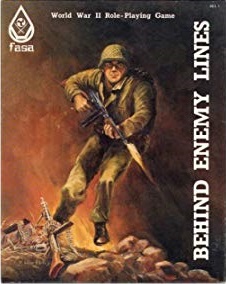
BEHIND ENEMY LINES? game (originally
by FASA Corporation, currently produced
by The Companions).
The modern
and near-future eras
The modern era is considered to extend
from about 1946 to the current date, and
it can also be extended into the near
future; the year A.D. 2000 serves well
as a
cutoff date for near-future vs. science-fiction
campaigns. Game systems involving
modern-era campaigns include TSR?s TOP
SECRET® and TOP SECRET/S.I.?,
Hero
Games? DANGER INTERNATIONAL?, Task
Force Games? DELTA FORCE?, Sleuth
Publications
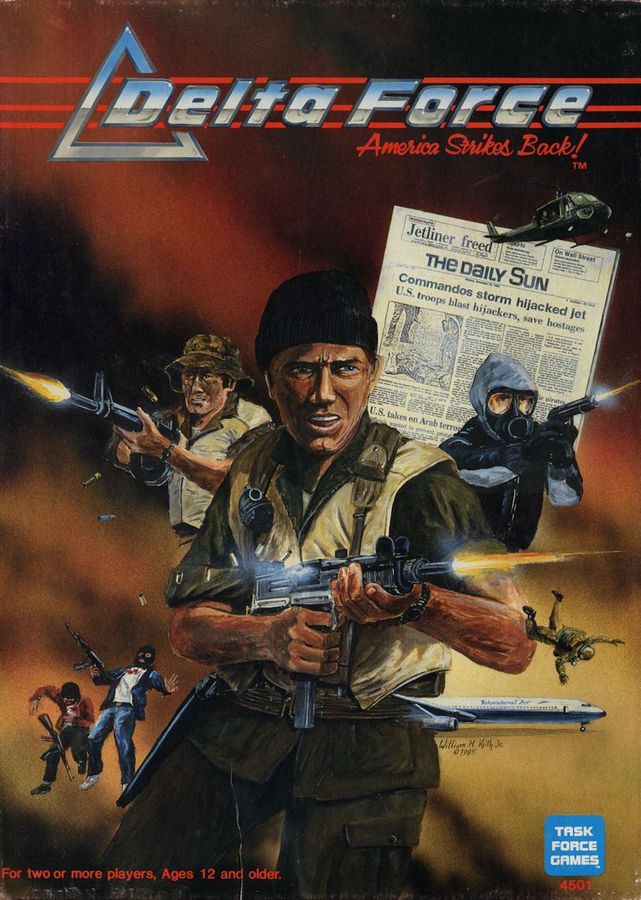
? MERCENARIES, SPIES & PRIVATE
EYES?, Victory Games? JAMES BOND
007,
and Palladium?s Revised RECON®
games.
The PSI WORLD? game from FGU, though
placed in the near future, is assumed to
take place in a world in which gun laws
are very much like those in force today.
Note that several of these games focus
on
or could take place in regions of active
warfare (e.g., Vietnam), where weapons
restrictions discussed here do not apply.
Modern campaigns come under all the
laws noted in the last section, in addition
to state and local ordinances which vary
widely even across America (see the table
in this article for the laws of any particular
state). Cities often have more restrictive
ordinances; GMs should check on
those cities around which their campaigns
revolve. New York has not rescinded the
Sullivan Laws, and Chicago has legislation
nearly as strict, but Los Angeles? laws
are
not significantly tougher than those of
California in general. Spies who travel
a
lot could get into trouble quickly!
It is still possible to lay down some general
guidelines for modern campaigns.
Almost all states have provisions in their
statutes to confiscate illegal weapons
or
those without permits. Most states require
permits to carry concealed weapons, and
these permits are issued only by the local
court or police chief. There is no national
permit to carry arms. Only authorized
federal agents and police officers are
exempted from the permit requirements
under most state laws. The GM can decide
whether the cover papers issued to a PC
include a weapons permit; if not, the PCs
might consider leaving the extra ammo
and holster rigs at home. Carrying a single
gun that can be thrown away at a
moment?s notice does have its advantages.
Carrying submachine guns, silencers, or
heavy weapons requires a federal license
currently costing $500.00 per year, plus
$200.00 per weapon purchased. As of May
1986, no new permits for the possession
of
any type of machine gun can be issued;
those people who had one at that time
may keep it, but machine guns are illegal
for anyone else (except for the military
and on-duty police officers.) Federal permits
include the owner?s address, and
many states require a separate state permit
to own silenced or fully automatic
weapons, or may outlaw them completely.
In some states, the use or possession of
such weapons carries a mandatory jail
sentence. Finally, carrying a weapon in
the
open is not always illegal, but is certain
to
invite police attention. (Only two states?
laws specifically allow carrying holstered
guns; several outlaw the practice.)
The main thing that PCs should remember
is that the police rarely approve of
anyone using grenades and auto-fire weapons,
even in self-defense, and that a local
officer is usually within his rights to
confiscate
the weapons if the owners don?t
carry permits. Even if the characters are
cooperating with the police, the local
cops
still have to explain all the dead bodies
once the PCs have gone home, so confiscating
the heavier firepower is not only
legal, it's often good politics. PCs are
advised to comply (SWAT teams are
unforgiving).
The laws in most foreign countries are
at least as strict as those in the United
States. Both Great Britain and Japan, for
example, have very restrictive handgun
laws; encounters with armed NPCs should
be very rare in either country. Most European
and Soviet Bloc laws are tougher
than ours, and average criminals have less
access to firearms, but exceptions do exist.
Countries engaged in warfare, like Lebanon,
Iran, Iraq, Vietnam, and parts of
Central America, have unpredictable reactions
to the appearance of firearms in
anyone?s hands; playing tough is not
advised.
Though the above guidelines apply to
certain ?normal? near-future game campaigns
some game systems take place in
unusual near-future environments, such
as the post-World-War-III campaigns of
FGU's AFTERMATH, GDW's TWILIGHT:
2000, and TimeLine's THE MORROW
PROJECT games.
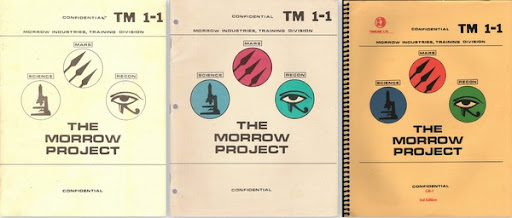
(True, THE MORROW
PROJECT game actually takes place
in the
mid-22nd century, but it fits the same
post-atomic genre.) All restrictions on
the
ownership and use of weapons in post-atomic
worlds are assumed to have vanished
with the onset of global warfare
and destruction; only the America of the
TWILIGHT: 2000 game and similarly
"civilized" nations would have anything
resembling firearms laws, and these
would not be uniform from place to
place. The same situation in a non-nuclear
"dark future" campaign exists in
the CAR WARS® game from Steve
Jackson
Games. If you can carry it, it's yours
--
unless someone takes it from you.
West Ends THE PRICE OF FREEDOM
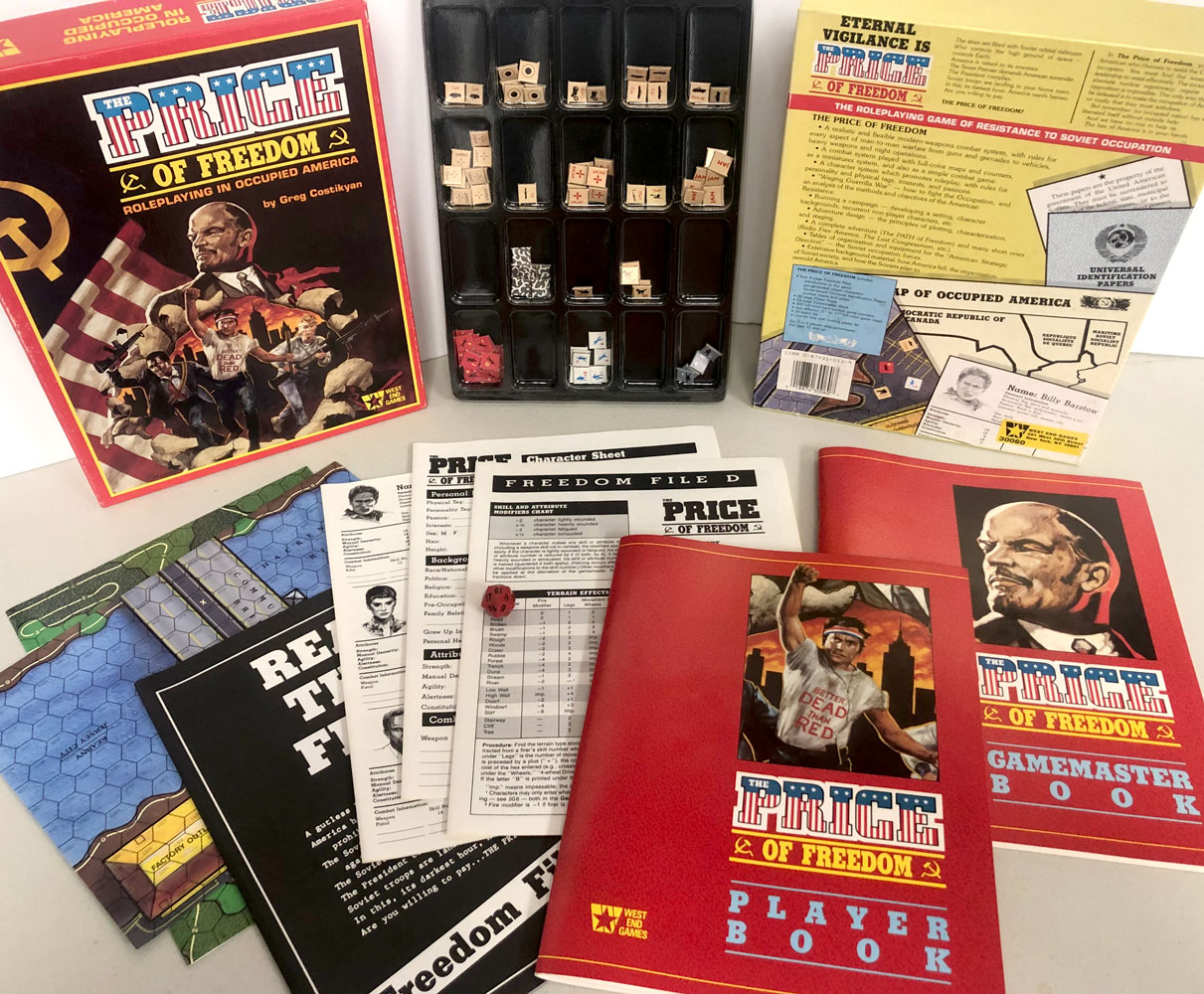
system involves a conquered America, and
gun laws would logically be extremely
restrictive (making guns invaluable possessions,
especially to guerilla groups that
could possess any sort of weapon). Communist
military personnel are likewise
unencumbered by most restrictions, and
fighting is likely to be widespread and
deadly in the extreme.
Futuristic societies
THE FINAL FRONTIER(Iron
Maiden) for role-playing games
lies in the future. TSR's STAR FRONTIERS®
game, GDW's TRAVELLER® and
TRAVELLER: 2300 games, ICE's SPACE
MASTER set,
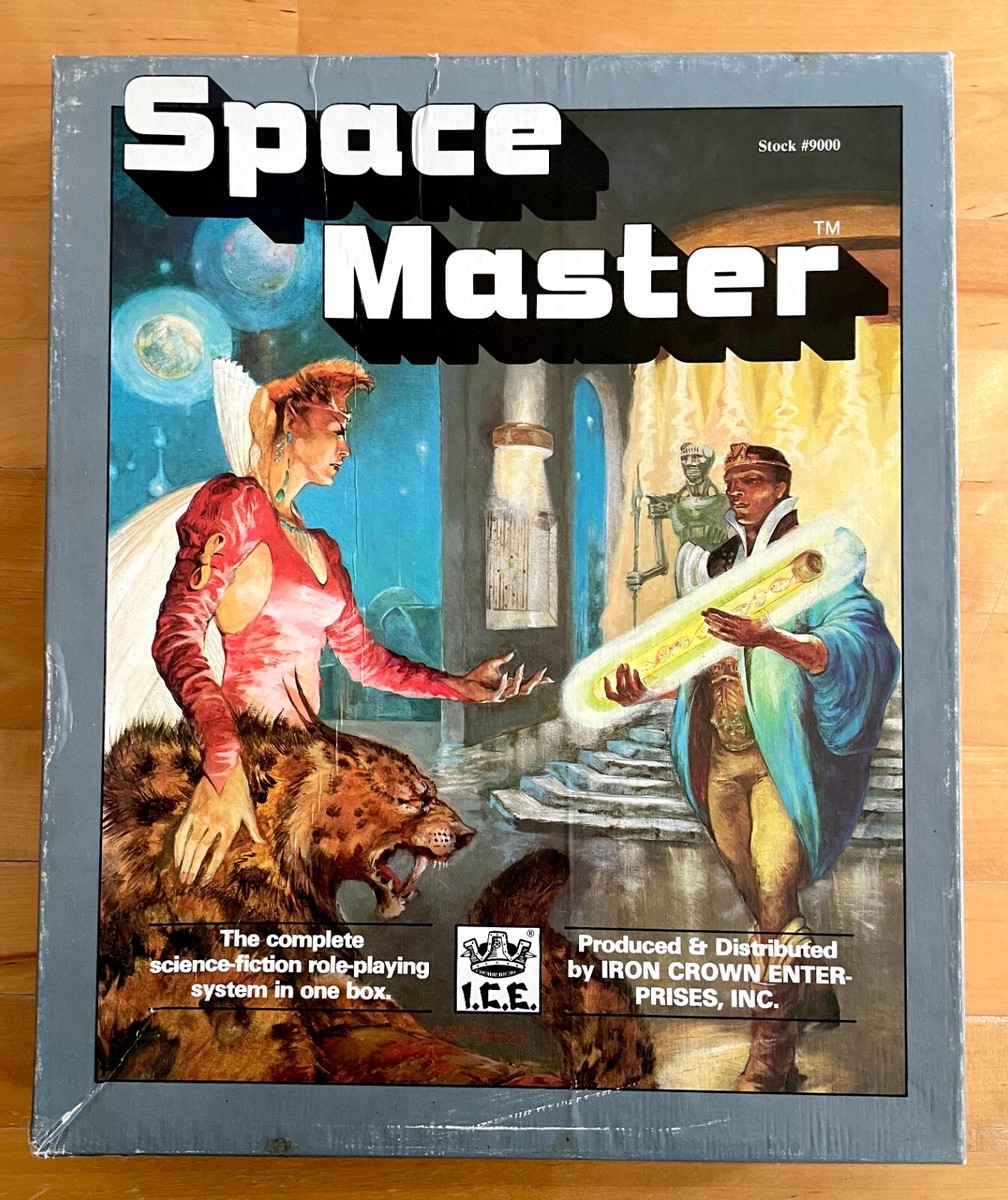
FASA's STAR TREK®: The
Role-Playing Game, and Chaosium's
RINGWORLD game depict other-world
human and alien societies in which the
possession (or lack) of a firearm can make
all the difference between success and
failure in a mission, as well as life or
death.
The laws in futuristic settings vary widely
and depend greatly on the flavor of the
individual campaign. In unsettled or frontier
worlds, especially those with hostile
inhabitants, the restrictions on weapons
would be fairly lax. Most individual weapons
will be legal, but heavy military weapons
will still be unavailable to civilians.
(Even in the Old West, the Army frowned
on private ownership of cannon.)
In more civilized areas, the trend toward
restricting weapons will probably continue
All military weapons will be illegal,
and civilian weapons less and less common.
Purely defensive, non-lethal weapons
like stunners may or may not be legal,
at
the GMs option. (Remember that TASERs
and stun guns are widely restricted at
present.) Radically new weapons not
developed by the military may be legal
for
a brief period, until the authorities realize
a criminal element is using them. (Thompson
submachine guns were legal and sold
in hardware stores for ten years, TASERs
for five.) Finally, badly outdated military
weapons might be permitted in private
collections, but this policy is by no means
universal, even today.
Beyond this - the game master is on his
own. Hopefully, this article will reduce
the
number of Rambo-type PCs and increase
the ranks of PCs who look before they
leap ? or shoot.
Bakal, Carl. The Right to Rear Arms.
New York: McGraw-Hill Book Co., 1966.
Federal Regulation of Firearms and
Ammunition. Washington, D.C.:
Bureau of
Alcohol, Tobacco and Firearms -- Department
of the Treasury, 1980.
Kennett, Lee, and James Anderson. The
Gun in America. Westport,
Conn.: Greenwood
Press, 1975
Nispel, David H. "Gun Control: A Look
at
the Various State and Federal Laws."
Legislative
Reference Bureau, State of Wisconsin:
Madison, May 1981.
"President Signs New Gun Law." Federal
Firearms Licensee News. Washington,
D.C.: Bureau of Alcohol, Tobacco and
Firearms -- Department of the Treasury,
July 1986.
Sherrill, Robert. The Saturday Night
Special. New York: Charterhouse,
1973.
Shields, Peter. Guns Don't Die -- People
Do. New York: Arbor House, 1981.
State Laws and Published Ordinances
—
Firearms. Washington, D.C.:
Bureau of
Alcohol, Tobacco and Firearms -- Department
of the Treasury, 1976.
Your Guide to Explosives Regulation
1976. Washington, DC.: Bureau of Alcohol,
Tobacco and Firearms -- Department of
the Treasury, 1976.
Your Guide to Federal Firearms Regulations.
Washington, D.C.: Bureau of Alcohol,
Tobacco and Firearms ? Department
of the Treasury, 1984.
AUGUST 1987
Firearms Statutes in the 50 States
| State | A | B | C | D | E | F | G | H |
| Alabama | NP | 2 | X | NP | X | - | - | - |
| Alaska | - | - | - | - | - | - | - | - |
| Arizona | NP | - | - | - | - | - | X | - |
| Arkansas | X | - | - | D | - | - | X | <?> |
| California | NP | 15 | X | X | X | X | |NP | R |
| Colorado | NP | - | - | - | - | NP | NP | - |
| Connecticut | NP | 14 | X | X | - | NP | - | R |
| Delaware | NP | - | X | - | - | X | X | - |
| Florida | NP | - | X | - | - | - | NP | S |
| Georgia | NP | - | - | - | - | NP | NP | - |
| Hawaii | NP | 10 | - | X | - | X | X | B&R |
| Idaho | NP | - | - | X | - | - | - | - |
| Illinois | X | 3 | - | X | X | X | X | B |
| Indiana | NP | 7 | - | NP | X | - | - | - |
| Iowa | NP | - | - | NP | - | X | X | - |
| Kansas | X | - | - | - | X | X | - | - |
| Kentucky | X | - | - | - | - | - | - | S |
| Louisiana | X | - | - | - | X | NP | X | - |
| Maine | NP | - | - | - | X | X | X | - |
| Maryland | NP | 7 | X | - | - | - | - | R |
| Massachusetts | NP | - | - | - | - | X | NP | B&R |
| Michigan | NP | - | X | - | X | X | X | - |
| Minnesota | NP | 7 | - | NP | - | - | X | R |
| Mississippi | X | - | - | - | - | X | X | R |
| Missouri | X | 7 | - | - | - | X | NP | R |
| Montana | NP | - | - | - | - | X | NP | - |
| Nebraska | X | - | X | X | - | - | NP | H |
| Nevada | NP | - | X | X | X | - | - | S |
| New Hampshire | NP | - | - | - | X | - | - | S |
| New Jersey | X | - | - | X | X | X | NP | B&R |
| New Mexico | X | - | - | - | - | - | - | - |
| New York | NP | - | - | NP | - | X | X | B&R |
| North Carolina | - | 20 | - | - | - | NP | NP | R |
| North Dakota | NP | - | - | - | - | X | - | R |
| Ohio | X | - | - | - | - | NP | NP | - |
| Oklahoma | X | - | - | - | X | - | - | - |
| Oregon | NP | 5 | - | - | - | - | NP | S |
| Pennsylvania | NP | 2 | - | NP | - | - | - | - |
| Rhode Island | NP | 3 | X | NP | X | X | NP | - |
| South Carolina | NP | - | - | IT | X | - | - | - |
| South Dakota | NP | 2 | - | U | X | NP | NP | S |
| Tennessee | NP | 15 | - | - | X | - | NP | S |
| Texas | X | - | - | - | - | NP | NP | - |
| Utah | NP | - | - | X | - | - | - | - |
| Vermont | X | - | - | - | - | X | - | - |
| Virginia | NP | - | - | X | X | - | NP | - |
| Washington | NP | 5 | - | NP | - | - | X | S |
| Washington, D.C. | - | 2 | X | - | - | X | X | B&R |
| West Virginia | NP | - | - | - | - | - | NP | S |
| Wisconsin | X | 2 | <?> | - | - | X | X | B&R |
| Wyoming | NP | - | X | - | - | - | - | - |
Key to table columns
A: Carrying concealed weapons: X = illegal,
NP = need a state permit.
B: Waiting period: a period of time between
asking a dealer to sell the gun and actual delivery. This was designed
to prevent an
angry person from purchasing a gun during
a fight, and to allow a police check on the buyer. The table shows the
number of days?
wait required.
C: Mandatory penalty: X = a non-parolable
jail term for any felony conviction involving use or possession of firearms.
This can
include carrying without a permit.
D: Vehicular carry: X = illegal to carry
a loaded firearm in a car, NP = need a state permit, IT = only in a closed
compartment
or trunk, U = only if unloaded. (Federal
law made it legal to carry an unloaded weapon in the trunk while traveling
through a
state, as of November 1986.)
E: Armor-piercing ammunition: X = illegal to possess AP ammunition.
F: Silencer: X = illegal, NP = need state permit to possess.
G: Automatic weapons: X = illegal, NP = need state permit to possess.
H: Possession permit required to own gun:
N = none, H = at home, W = at work, B = both, R = all guns registered with
police, S = all sales reported to police.
If a state's statutes do not directly address
a topic, the column receives a dash ( For example, Alabama does not specifically
outlaw silencers or automatic weapons,
nor does it require gun owner permits. (Note that a secret agent possessing
a machine gun
in Alabama must still comply with all federal
laws.)