FREQUENCY: Rare
NO. APPEARING: 1-20
ARMOR CLASS: 7
MOVE: 10"
HIT DICE: 2-4 HP
% IN LAIR: Nil%
TREASURE TYPE: All possible (guardians)
NO. OF ATTACKS: 1
DAMAGE/ATTACK: 1-4 blow, 1-6 grip (on
unarmored target only)
SPECIAL ATTACKS: Nil
SPECIAL DEFENSES: Magick weapons have
only normal weapon effects
MAGIC RESISTANCE: Immune to all mind-related
and polymorph spells
INTELLIGENCE: Non-
ALIGNMENT: Neutral
SIZE: S (e.g. human hand)
PSIONIC ABILITY: Nil
Attack/Defense Modes:
Nil
LEVEL/X.P. VALUE:
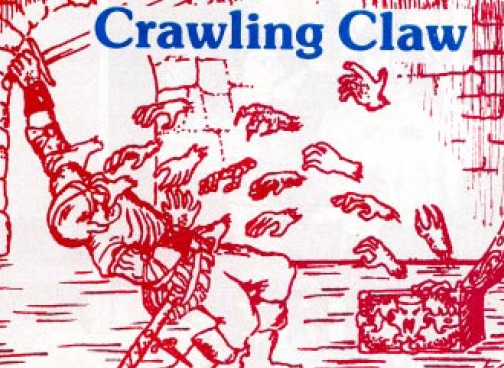
Crawling Claws are said to have been
the invention of THE
NECROMANCER
Nulathoe, who devised a series of spells
whereby small parts of once-living bodies
could be almost perfectly preserved, and
(once animated) controlled. Nulathoe’s
arts were too crude to be practical in
controlling
organs of any complexity, and at
his death only their most useful application—
the control of hands or paws—
survived, through his two apprentices.
Creation of a claw requires an intact
human hand, or a claw (which must be
from a creature existing entirely upon
the
Prime Material Plane), either freshly
severed or in skeletal form. Creation
is
usually a cooperative effort, and is begun
with application of Nulathoe's
Ninemen
(a 5th-level Magic-User spell involving
the fresh blood of an animal of the same
biological class as that of the claw and
the
destruction of a moonstone of not less
than 77 gp value, which is powdered and
sprinkled over the claw) or a similar
spell
researched by the magic user concerned.
This serves to preserve the claw, protect
it
against decay and corrosion, and
strengthen its joints with magical bonds.
Within four turns after casting the Ninemen,
an Animate
Dead spell must be cast
upon the claw.
Claws are controlled either directly or
by ‘programming’ (see below) and cannot
be changed from one method of control
to the other after the final incantation
is made. This spell either names the controller,
who must be a Magic User or
Cleric involved in the creation, or (in
the
case of ‘programming’) contains a command
stating (in 24 words or less) what
action the claws are to take. This operates
in the same way that a Magick
Mouth spell
can be set to speak when a certain condition
is met—i.e. “a bearded man in black
and silver
approaches the altar.”
Direct control, on the other hand, is
enacted by concentrated force of the will.
This cannot be maintained for more than
3 consecutive turns without a 1-turn
REST, and must be exercised within a
(1” + ½”/level of controller) range.
It is
imperfect, precluding actions requiring
manual precision. Ongoing control obviously
prohibits spellcasting on the controller’s
part, although control can be
maintained by an individual who suffers
injury unless unconsciousness or loss
of
over half total HP occurs. Claws will
continue
to enact their last command if their
(direct) controller withdraws control
or is
slain.
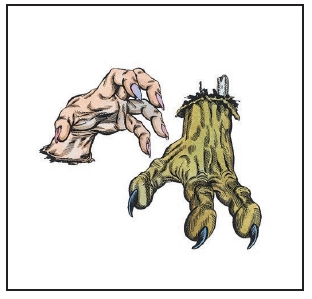
Claws move in the manner their
name describes, scuttling upon their fingertips.
They can grip with crushing force,
and leap for short distances (up to 1½”)
to strike or clutch. They may be commanded
to seek specific targets (e.g.
jewelry, throat, eyes) and can drag small
objects (or in groups, larger items such
as
spears
or swords), but cannot lift or wield
them. Large numbers
of Claws are
needed to shift objects of any weight.
Claws cannot be turned, but a Resurrection
spell will render them immobile.
Note that neither Death
nor Raise Dead
spells have any effect. Edged weapons
do
them half damage; magical weapons
have only normal weapon effects. Cold
makes Claws more brittle, so that 1 pip
is added to each die of damage they take.
Claws are commonly used as
guardians, lying within chests, atop or
amidst the treasure.
They can sense
vibrations and temperature differences,
and locate targets accordingly when not
under direct control. Claws created together
have a (very) limited form of intercommunication;
when one Claw has
located a target, all of the other Claws
will
move towards its location.
| - | - | The Dragon #32 | - | - |
| Dragon magazine | - | Monster Manual | - | AD&&D |