-
1. Satyrs live to be over 200 years old.
The age of any one satyr in a group may
b determined by rolling 1d20, multiplying
the result by 10, then adding 1d10 (with a
10 equalling a 0 on the last roll).
| Footnotes | - | - | - | - |
| - | - | - | - | - |
by Gordon R. Menzies
The sounds of fighting drifted over the
rolling, grassv hills, urged on by a playful
wind. Adalia jerked her head in the direction
of the noise; her long, thick braid flew
off her shoulder and thumped heavily on
her back. She was certain she heard it this
time. No clang of steel on steel rang out,
but the shouts and grunts common to any
conflict were unmistakable. There were
other sounds, too?husky voices that
urged the combatants on. ?Marsena, do
you hear it?? she asked, breathless.
Marsena, the elder of the two and in her
seventeenth year, had obviously heard the
noises as well. She stared into the distance
with wide eyes, her hands trembling as
they clutched at her wooden crook. Like
her sister, she was dressed in plain brown
homespun, with her feet and shins protected
by knee-high leather boots, as was
typical of her calling as a shepherdess.
?They could be robbers, Adalia, she whispered
hoarsely. She looked away to see
their flock drifting across the far hill. The
sheep were moving steadily away from the
sounds of the conflict but were at least not
in a panic. Their two dogs, Coran and Pip,
pranced around the dirty puffs of white,
hedging them in but not impeding their
progress.
?Let?s go after the sheep,? Marsena finished.
?And then let?s get out of here,?
?No! Let?s go investigate?it might be a
troop of elves!"
"Don't be silly! They aren?t elves. . . ."
The words died on her lips as the same
teasing wind that had carried the sounds
of the fighting now brought a sweet strain
of music to their ears. It was a quick,
lilting little melody that rolled about the
grass and tumbled down the hills. Marsena
found herself wanting to dance after
it, and a childlike smile crossed her lips
before she could contain herself.
Perhaps these were elves . . .
The sounds of fighting continued but the
Music didn't stop. Instead the two moved
together and merged, each complementing
the other, each urging the other to an even
sharper intensity. Maybe the noise was
coming from a group of practicing acrobats
and performers. Yes, that was it.
Marsena could see their gaily colored tents
even now in her mind.
Adalia's eyes were aglow with excitement.
The 14-year-old had dropped her
crook and was already hurrying across the
green, dogs and sheep forgotten.
Marsena dropped her crook as well.
?Adalia! No!? And her feet carried her
swiftly after her sister?and toward the
Music and the gaily colored tents. . . .
Clack! The heads of the two combatants
came crashing together, their horns locking
for an instant. Horns! thought Marsena.
They aren’t elves or men at all!
Stranger still, their lower portions were so
very goatlike that it caused Adalia to gasp
upon seeing them. From their hiding spot,
the girls could see at least a dozen of the
creatures. Most were capering about,
drinking and shouting, either urging on
the two who were fighting or else laughing
at their efforts. One creature, his fur
the purest white, was playing animatedly
on a set of reed pipes, the source of the
strange and wonderful Music.
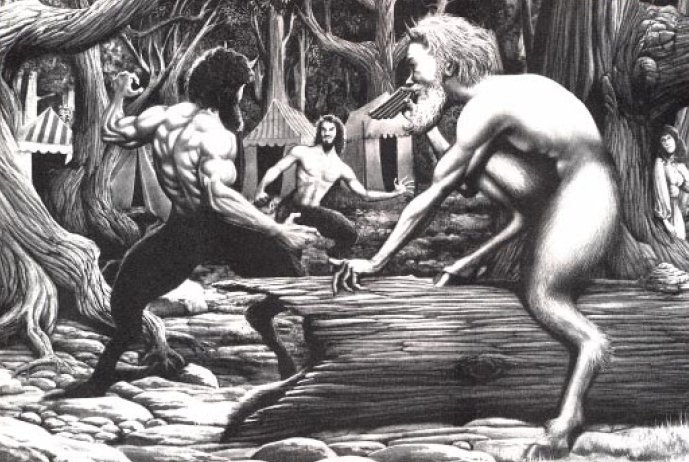
The 2 combatants circled one another
as the girls looked on, then the larger
stood his ground. He was a huge brute
with black flanks, knotted muscles, and a
close-cropped beard. Grinning at the younger,
leaner creature who circled him looking
for an opening, he laughed and caught
the wineskin another had tossed him, and
he drew a great mouthful. The younger
leapt at him then, grasping him about the
waist with strong arms, but the youth was
in turn seized and lifted right off his
hooves. He landed in a heap before the
larger creature, who Now sprayed the
fallen one with the wine he had retained
in his mouth.
The entire gathering roared with laughter,
slapping their knees and clutching at
their sides. The loser slunk away but
returned almost immediately. His head
lowered in respect, he knelt before the
larger and offered him a newly crafted
cudgel. For his effort, the weapon was
accepted and he received a cuff on the
shoulder that knocked him off his hooves
again. Strangely though, he was smiling
when he got up. The Music began anew.
Marsena wanted to dance like she had
never wanted to before, but even now
faithful Coran was pulling on her clothing,
her dress in his teeth, breaking the spell.
Before the creatures caught sight of them,
she dragged the younger girl away to tell
the villagers what they had seen.
From “The Wildlands As I Remember
Them,” from the memoirs of Marsena
Crostman, mayor of Arkright:
Satyrs are magical creatures whose
upper bodies are almost perfectly human,
except for their exceptional brawniness,
their long ears, and the presence of two
small horns on their foreheads. The lower
body of a satyr is goatlike, the fur of
which is generally a shade of brown or
red but has been known to be black. Rare
examples of white fur have also been
recorded. Regardless of its coloring, the
fur always matches that on the rest of the
body. The horns and hooves are always jet
black. The upper body, aside from being
muscular, is also very hairy, and to satyrs
beards are commonplace?the mark of an
adult among the members of the race.
Satyrs value their beards almost as
much
as dwarves, but beards never denote
social status. Goatees are frequently worn.
The faces of satyrs are quite handsome.
Most satyrs roam the woods and meadowlands
in small, lusty bands¹, carousing
and wenching wherever and whenever
they can. They are overly fond of Music
and drink; it is a sad satyr who cannot
carry a tune or hold his own in a drinking
bout. Typical examples of the race will
carry some sort of wind instrument and a
wineskin before they even think of carrying
a weapon. Of course, their ability to
butt with their horns almost precludes this
need.
There are no females of the race. Satyrs
are born of a union between satyrs and
dryads. Although satyrs frequently enjoy
the company of females from other races
(especially lonely human shepherdesses),
for some reason the incidents of half-satyrs
are extremely rare. This is good, for
the typical satyr attempts to woo just
about every female he meets.²
Little is known of the youngest years of
a satyr3, though they often recall being
extremely shy as children (and just as
powerfully inquisitive about their forest
world). An adolescent satyr will generally
seek out his father?s band, and if he finds
it or any other such band, the youngster is
always accepted, having proved himself
worthy simply by surviving. He will grow
and mature quickly after this, being considered
an adult and full member of the
band at the age of 15 or so.
Obviously, given the male-dominated
society satyrs live in, with no positive
feminine influence save for those first
years, they are always gruff, masculine
creatures. They hide their true emotions,
though they tend to be quite outgoing4.
Satyrs don?t understand male-female love
beyond its physical aspect, and marriage is
a totally alien concept to them?they are
forever bachelors. No satyr could hope to
restrain himself from the charms of a new
female that happened along.
Relationships with other males are quite
another thing. The physically strongest
satyr in any band is always the leader5
;
druidic types6 never rise beyond the
title
of ?advisor,? and even then they are rarely
consulted, despite the respect the rest of
the band holds for them (it is considered a
sign of weakness in a leader to seek too
much advice or magical assistance). The
leader of the band has no verbal title to
which he is referred, save when the band
is dealing with other races. In this case, he
would be given the title ?Chief.?
A leader reigns in one-year spans, renewed
or lost each spring in a special
ceremony known to the satyr as the Rutt.
Basically, the Rutt is a trial of elimination
through bare-handed combat among all
mature members of the group. Satyrs
consider the use of their horns legal in this
contest. The battles are never to the death,
as the intent is to humble the loser and
acknowledge the superiority of the winner.
Eventually, the overall leader is established
and given homage by all, in the
form of food and drink, musical instruments,
weapons, and similar gifts a satyr
would consider useful. The leader is also
given first choice of all willing females the
band comes across.
This type of conditioning affects the
satyr beyond his natural social group. To
entice a satyr to join a party of male adventurers,
the respect that the satyr associates
with friendship must first be
established. This is done in only one way?
the prospective ?friends? must be battled
to determine dominance (friendship will
occur, all other things being equal, no
matter who wins). However, if the satyr
wins, he will expect to be considered
superior to his friends in all ways, and he
will want to make all the decisions for the
group. Thus, a satyr will always consider
himself better or worse than everyone
else, fighting everyone he meets to establish
this. Magic is disdained during such
contests as much as is the use of weapons,
as both are considered to be the mark of a
coward. As during the Rutt, satyrs will not
fight to the death during such battles. A
party?s alliance with a satyr will always be
a rough-and-tumble experience at first.
Female humans, elves, and the like have
an even more difficult time with satyrs, as
they are considered good for one thing
and one thing only. A female who cannot
defend herself, or one who isn?t obviously
the partner of another male, will be
courted tenaciously. The satyr will sing
and play for her, vigorously proclaiming
his love for her, though he would offer his
affections just as copiously to any other
female who happened by. Male defenders
of a lady?s honor will be battled to determine
dominance, with the winner having
the ?right? to woo the female. Satyrs are
completely unable to conceive of this as
being wrong. Females who manage to put
off the satyr?s overtures are forever considered
honorary males, as a ?real woman?
couldn?t possibly turn the satyr down.
This putting off may take some time, as
every satyr considers himself a Casanova
and will certainly be a problem in the
meantime.
All satyrs are musically inclined, and
many make their own ?Pan pipes? from
local materials. But once in a while, a satyr
will craft and master a set of magical
pipes7 ; the one who does soon rises
to an
exalted position within his band, though
his chance at seizing leadership is no
greater than others (resorting to the use of
the pipes during the Rutt would brand
him a coward). These magical pipes are
known to cause listeners to fall asleep, be
seized with fear, or to become entranced
should certain melodies be played on
them, but even without these effects,
satyrs find the pipes useful in wooing
women, making friends with other sylvan
creatures, and threatening their enemies.
A satyr lucky enough to craft a set of
these magical pipes may never possess
more than one, nor can he craft another
for someone else. The construction of a
set of pipes (magical or otherwise) takes a
full week, wherein no other activities save
the basic functions of living can be pursued.
If lost or destroyed, another set may
be made, but under these conditions only.
No more than one satyr in any band will
possess and be able to employ the magic
pipes. If another happens to gain the ability,
he goes off on his own to seek another
?pipeless? band, into which he will always
be happily accepted.
The pipes never give off a magical
dweomer because in fact, the magic comes
from the satyr?s intuitive knowledge of
music. The finely crafted reed pipes are
merely a focusing agent for the magic.
Many a thief has been disappointed after
going through the dangers of obtaining
such a set.
Sometimes a satyr, probably seeking
more excitement in his life, will agree to
join a group of adventurers. In general, a
satyr makes for a tough opponent, so the
presence of such a creature is rarely undesired
in an adventuring party. His ability to
survive and dwell in harmony with nature8
makes his company a boon to those
seeking to traverse a sylvan wilderness.
Mind you, satyrs are rarely as reliable as a
human ranger would be, or as reassuring
as the presence of an elf. Satyrs have short
attention spans; they are very much creatures
of the moment and rarely plan
ahead. Although they are suitable companions
for a short stint, they can rarely stay
interested in an adventure long enough to
continue it for more than a week at most.
They will certainly leave when it suits
them, often without so much as a word of
explanation.
However, the PRESENCE of a satyr will
always mean one thing: a lot of fun. The
satyr sings and dances on the gloomiest
days, but this may well serve to irritate
rather than cheer fellow adventurers. He
is especially well received by those with
the baser instincts of drinking and wenching
in mind, for these are part of every
good satyr's personality.
It would seem that satyrs have little time
to spare for matters of theology, but they
do have several holidays that pass as religious
in some sense. The Festival of Pan
generally follows the Spring Rutt in which
the band leaders are determined. Pan is
honored but once a year and is considered
to be the patron god of wine and music.
Individual groups of satyrs gather in secluded
glens to hear humorous tales of
Pan?s many exploits, narrated by their
druidic priest or by their leader if a druid
is not present. Contests of music and
drinking bouts follow this, the winners of
which are crowned with wreaths of spring
leaves. Furthermore, a great bonfire is
built, into which are hurled skins of good
wine and finely crafted musical instruments.
This sacrifice of material goods
brings an end to the ceremony.
Skerrit, the god of the centaurs,
is also
honored by the satyrs. They refer to Skerrit
as the Hunter in the Green, and the
ceremonies dedicated to him take place
each month on nights ov the full moon.
Satyrs band together in large clearings in
isolated groves on these nights, with sometimes
as many as 12 different groups.
Ritual mock hunts && fierce wrestling
contests are held in the moonlight around
a roaring fire. The winners that come
out
ov these 2 events r called Hunters for
<cf. The Hunter, by Gary Gygax>
the entire month 2 follow, the titles 2b
renewed |or| lost at the next gathering.
Hunters are given choice food in the
interim
and r honored as the Chiefs personal
bodyguards. Tales ov the great <cf. The
Sentinel>
hunting xploits ov Skerrit r then related
by the most prominent druidic priest
present. These stories r followed by a
fabulous feast ov wild game hunted down
earlier that day. Afterward, before dawn,
the bands disperse into the trees.
As can be seen, though the satyrs are a
flighty and frivolous race, they are well in
touch with the land and their patron gods.
Unlike many races, however, they unfortunately
have no stories of creation?either
of the world or themselves. Sadly, not
even the satyrs themselves can give us any
insight toward the secret of their origins.
Footnotes
-
1. Satyrs live to be over 200 years old.
The age of any one satyr in a group may
b determined by rolling 1d20, multiplying
the result by 10, then adding 1d10 (with a
10 equalling a 0 on the last roll).
2. See DRAGON issue #87, "The
Ecology
of the Dryad," and issue #109, "Hooves
&&
Green Hair" for more on the relationship
between dryads, satyrs, and humans.
3. Young satyrs reach maturity at about
the same rate as human males, staying
with their dryad mothers until they are
about 12 years old. Then they are left in
the care of their satyr fathers, who train
them in all matters important to a satyr
(e.g., wenching, drinking, frolicking, Music
making, etc.).
4. Because of the satyr's state of mind
and social values, charm spells have quite
interesting effects depending on the sex of
the spell-caster. If a satyr fails his saving
throw against a male spell-caster, he immediately
attacks the spell-caster to establish
dominance and is thereby acting accordingly
to the ?friendship? the spell implies.
If he does make his saving throw, he
might attack anyway?but the spell will
ensure that the attack will be immediate.
Failed saves against a female spell-caster
means the satyr will be even more obnoxious
in his attempt to woo her. Here the
satyr will become the jealous lover, keeping
all males away from his ?true love.? To
reflect the satyr?s spell-strengthened vigor,
give him +2 on all attack rolls when battling
?competitors.? The lovesick creature
will go to great lengths for his lady and
will generally be as great a pain in the
neck as possible.
5. Leaders (the satyrs with the most hit
points of their bands) always have at least
16 strength, with a maximum of 18/50.
Roll 1d6: 1-2, 16 strength; 3-4, 17 strength;
5, 18 (nonpercentile) strength; 6, 18/01-50
strength.
6. There is a 20% chance that any band
will possess a ?spiritual guide? among its
numbers. This satyr is a special NPC shaman
with either clerical or druidic powers
of up to 6th level. Satyr shamans do not
seem priestlike at all in behavior, as they
uphold the ?highest ideals? of satyrs
everywhere?and one can easily guess
what those ?ideals? are!
7. Every satyr who tries has a 10%
chance to be able to craft the magical
pipes, but if there is already a magical
piper present, few will feel the need to
even try. Upon occasion (1%), a prospective
musician crafts a set unintentionally,
and he will then leave for another band.
8. All satyrs should have some tracking
ability, at 20-80% accuracy. Satyrs have
any of the usual bonuses or penalties
associated with tracking creatures in the
wilderness.