| Bristle worms | Nereis | Diopatra | Eunice | Lumbrineris |
| Vanadis | Eurythoe | Glycera | Sabella | Terebella |
| - | - | Pectinaria | - | - |
| Advanced Dungeons & Dragons | - | Dragon magazine | - | Dragon #133 |
In the course of world affairs, worms
get short shrift. Generally ignored (if
referred to at all), worms are described
in
the most derogatory terms. Bartlett?s
Familiar Quotations lists
at least 50 references
to worms, not a single one of them
complimentary. Worms are at best humble;
at worst, vile.
This antiworm bias extends even into
the world of the AD&D® game.
If a
dungeon adventurer turns to his comrade
and spouts, ?Ygrane, ye have the soul of
a
veritable worm!? he?s probably not extending
a warm compliment. Even the dreaded
purple worm is an unhappy sort of creature
? a mere earthworm writ large, with
a sting arbitrarily stuck on its tail.
Aside
from the medieval description of dragons
as ?great worms? or ?wyrms," worms just
don?t get no respect!
All worms are not alike, however, and
there?s no reason giant worms should be,
either. Described herein is a set of creatures
that the enterprising DM can use to
keep even the most jaded characters on
their toes. All of these creatures are
bristle
worms (or polychaetes, if you prefer good
medieval Latin) that live in the sea, a
habitat
which is rather neglected in published
monster texts. For game purposes, the DM
may adapt these giant worms to underground
habitats as desired.
All bristle worms are segmented (much
like earthworms) and have bristles on
some part of their bodies. In addition,
however, they may have elaborate tentacles,
well-developed eyes, or hard,
sharp jaws.
Some are
colored
shimmering
iridescent green
or brilliant blood red. Several
types have perfected the use
of toxins.
These exotic creatures can be brought
into your campaign in a variety of ways.
As DM, you may simply declare that the
seas are inhabited by giant bristle worms,
just as purple worms are found wandering
in caves. This is fantasy, after all, and
giant
man-eating polychaetes are no less likely
than the man-eating giant
gar featured in
the Monster Manual.
For those who are sticklers for accuracy,
the alternatives are to shrink the player
characters or enlarge the worms. The
spells involved may not need to be particularly
powerful. The largest specimen of
Eunice (q.v.) on record is almost 20? long
and 2? in diameter. Enlarging such a creature
or shrinking the characters by a
factor of from three to five would defin-
itely get people?s attention.
Giant bristle worms are likely to be
encountered guarding the undersea
entrances to castles staffed by magicians
powerful enough to sustain a permanent
enlargement spell. The DM may also wish
to establish a cult of island inhabitants
who guard their realm by the same
means. The enlargement spell might be
focused through an icon, and may require
annual replenishment through a sacrifice
of crushed pearls mixed with elven hair
(preferably that of some stray adventurer).
Otherwise, giant bristle worms are rare
in inhabited areas, having been killed
off
by the local fishermen. (Titans and various
demi-gods use them for bait!) They are
most likely encountered on deserted
beaches or lonely stretches of ocean far
from civilization.
Bristle worms
(polychaetes)
The bristle worms considered here
share characteristics which can be dealt
with collectively. First, all of them live
in
the sea and are largely confined to salt
water (although some of them can stand
several hours exposure to air).
Second, all of them have two sexes,
unlike earthworms. Consequently, the mad
mage who would establish a breeding
population in his coastal moat has to bring
back more than one giant worm. And how
does said mage tell what sex of worm he
has? Easily: By waiting until the breeding
season, cutting open one segment from
the middle region of the worm, and seeing
what sort of reproductive organs are
inside (perhaps a good job for the local
druid).
Third, all of these worms are capable of
regenerating lost hit points if they retain
at least 50% of their original hit points
(in
the real world, regeneration takes several
weeks; for AD&D game purposes,
however,
it is far more rapid). One-half of the
lost hit points will be recovered the first
night, and 1d6 hp are recovered per day
thereafter. As a result, the DM might rule
that a 32-hp Diopatra
(q.v.) which takes 15
hp damage in one round suddenly flees
combat, withdrawing deep into its dwelling
tube to emerge the next morning (to
the surprise of the characters) at nearly
full power.
If a sword of sharpness or vorpal weapon
neatly cuts a worm into two parts, both
parts flee (each having half the hit points
the worm formerly did, counting the
damage it took from previous attacks and
from the attack that cut it in two). They
each then regenerate into two separate
worms, but each new worm recovers only
one-half the total hit points the original
worm possessed after one night, and no
new hit points are gained thereafter. Thus,
a 40-hp worm might be cut into two parts
after taking other damage as well; each
half is assumed here to have 12 hp. Each
half regenerates after one night into a
new, smaller worm with 32 hp. If either
new worm is wounded, the usual rules for
regeneration are followed.
Finally, those worms that live in tubes
or
burrows have a giant nerve cell which
runs the length of their bodies. This cell
triggers the escape response, enabling
the
worm to withdraw in a flash at the first
hint of danger. In general, worms are
alarmed by looming shapes that are larger
than they are.
There are literally thousands of different
kinds of bristle worms. Representatives
from a number of different habitats are
described in the following section
FREQUENCY: Common
NO. APPEARING: 2-12
ARMOR CLASS: 9
MOVE: //9? (3?)
HIT DICE: 1-4
% IN LAIR: 95%
TREASURE TYPE: Nil
NO. OF ATTACKS: 1 bite
DAMAGE/ATTACK: 1-4 or 1-6
SPECIAL ATTACKS: Nil
SPECIAL DEFENSES: Withdraw into lair
MAGIC RESISTANCE: Standard
INTELLIGENCE: Non-
ALIGNMENT: Neutral
SIZE: L (1-2? diameter; 5-10?long)
PSIONIC ABILITY: Nil
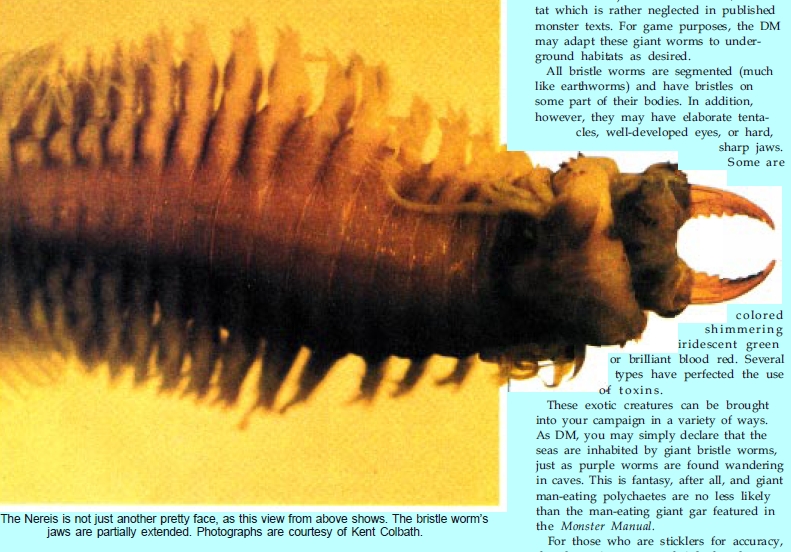
The Nereis constructs mucous tubes in
debris or loose sand and mud, from which
it moves to capture prey. If threatened,
the Nereis attempts to withdraw deep into
its tube, becoming impossible to hit; otherwise,
it attempts to swim away. The Nereis
only fights if cornered, using its pair
of
jaws to do 1-4 hp damage for 1-2 HD
worms and 1-6 hp damage for 3-4 HD
worms. This worm prefers plant material
for food, but it does attack animals small
enough to swallow in one gulp (1' or less
in size). It avoids attacking adventurers
unless disturbed. The Nereis also eats
carrion, if available.
The bristles on the Nereis are primarily
used to gain purchase while the worm is
moving. These bristles may cause minor
damage to an attacker, however, doing 1-2
hp damage to anyone who touches the
worm. The Nereis is among the most
widespread of the bristle worms, and is
found on muddy or sandy bottoms from
deep water into estuaries, and also lurking
about the bases of giant kelp.
FREQUENCY: Rare
NO. APPEARING: 5-50
ARMOR CLASS: 8
MOVE: //9? (3?)
HIT DICE: 2-10
% IN LAIR: 98%
TREASURE TYPE: Jaws (see below)
NO. OF ATTACKS: 1 grasp, then 1 bite per
round
DAMAGE/ATTACK: 1-8 or 1-4, then 1-6 per
round
SPECIAL ATTACKS: Grasping; surprise on
1-4 from tunnel
SPECIAL DEFENSES: Nil
MAGIC RESISTANCE: Standard
INTELLIGENCE: Non-
ALIGNMENT: Neutral
SIZE: L (2-4? diameter; 12-25? long)
PSIONIC ABILITY: Nil
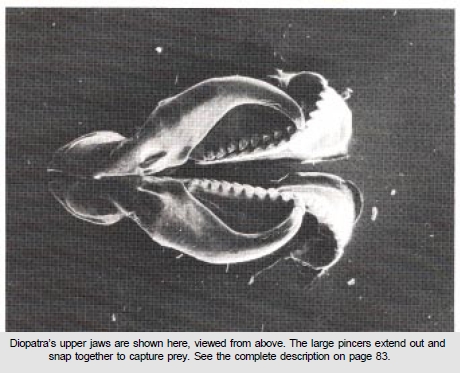
The Diopatra has a much more complex
jaw apparatus than does the Nereis, having
both upper and lower sets of jaws. The
upper jaws consist of a pair of pincers
with subsidiary shearing jaws. The upper
jaws work as a single unit: If the upper
jaws make a successful roll to hit prey,
they hold the prey steady while the shearing
jaws rip into it to hold the prey in
place for the lower jaws to work. The
upper jaws cannot chew. The initial attack
by the upper jaws is made at +4 against
all armor types rated as bulky or fairly
bulky because of the speed of the worm.
Damage
is only 1-4 hp against such heavily
armored prey, however, compared to 1-8
hp against characters wearing nonbulky
or no armor.
The lower jaws consist of two large,
fused, chisel-shaped mandibles which
move forward and backward independently
of the upper jaws. After the first attack,
the lower jaws are used once per round
in
an attempt to chop off a bite-sized piece
of
the prey; this piece is then swallowed
whole. Attacks by the lower jaws do 1-6
hp damage, and are made at +3 due to
the immobilization of the prey by the
upper jaws.
In addition to the jaws, the Diopatra has
four sets of hooked bristles under its
first
two pairs of fleshly lobes (called parapodia).
These hooks are used to position the
captured prey and are automatically considered
to score a hit on the round after a
successful attack is made by the upper
jaws. No damage is done by this initial
grasping.
To escape, a captured creature must
either kill or severely damage the worm
(reducing it below 50% hit points), or
break free of the pincers and hooked
bristles simultaneously. The pincers are
AC 1 and have 4 hp, although blunt weapons
may strike at the pincers at +2 to hit;
reducing the pincers to zero hit points
destroys them, though this does not
reduce the worm?s normal hit points. A
strength check on 1d20 will allow a PC
to
pull free of the hooks, which do 0-2 (1d3
-1) hp damage in the process. Pulling
free of the pincers requires a bend bars/
lift gates strength roll, which may be
made
once per round and causes 1-6 hp damage
if successful. Pulling free of both pincers
and hooks may be done in the same round
if no other actions are taken.
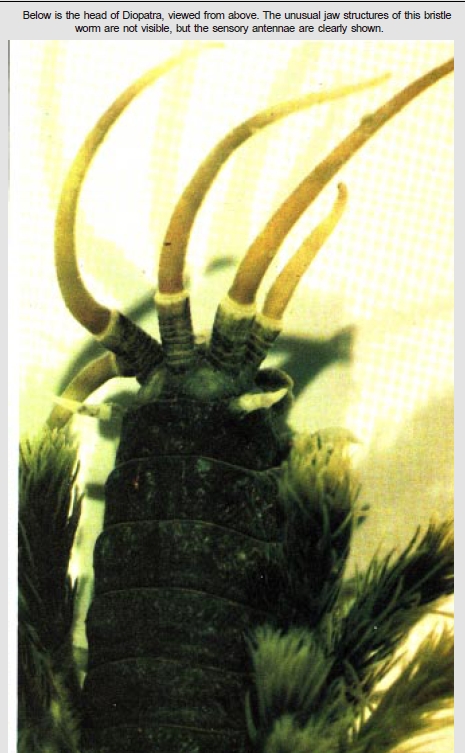
The Diopatra lives in vertical tubes in
soft sand, generally in shallow water or
lower tidal flats. While feeding, it lurks
near the top of its tube, using its long
antennae to sense for vibrations and to
?smell? chemicals emitted by possible food.
The worm can distinguish the presence or
absence of light, but is otherwise essentially
blind.
The Diopatra eats anything (plant or
animal, living or dead) that doesn?t appear
too big and menacing. These worms lunge
forward from their tube at a distance
equal to one-third of their length to capture
prey. The Diopatra are generally
found in colonies rather than in isolation,
with tubes spaced far enough apart so that
the larger worms can?t have the smaller
for lunch. Consequently, it is possible
for a
character to be attacked by two worms
simultaneously if he is midway between
two tubes.
The jaws of the Diopatra are hardened
by thick deposits of aragonite (mother-ofpearl)
and are of some value to knowledgeable
jewelers. The upper jaws generally
bring 5-10 gp per lb. depending upon their
quality, with the whole set weighing 5-8
lbs. The lower jaws are highly prized,
and
may bring as much as 15 gp per pound,
weighing 3-6 lbs.
Eunice
The Eunice is essentially identical to
the
Diopatra, except
that it has shorter antennae,
and may reach a larger size (up to 16
HD). Unlike the Diopatra, however, the
Eunice lives in tunnels bored into coral
reefs, and is likely to be encountered
under ledges on the flanks of the reef.
Its
jaws are of equal value to those of the
Diopatra.
Lumbrineris
This worm is another type with complex
jaws similar to those of the Diopatra,
but
is longer and thinner per hit point (1-3?
diameter and 20-30? long). Because the
Lumbrineris burrows actively through
mud or sand, it lacks the elaborate antennae
and parapodia of the Diopatra, and
looks rather like an earthworm. The Lumbrineris
feeds by snapping up whatever
morsels of organic material are to be
found.
The jaws of the Lumbrineris are hardened
with calcite (limestone) rather than
aragonite, and are worth no more than a
few silver pieces ? except, perhaps, to
a
magician who needs them for a spell.
VANADIS
FREQUENCY: Rare
NO. APPEARING: 1-12
ARMOR CLASS: 6
MOVE: //12-15?
HIT DICE: 2-8
% IN LAIR: 0%
TREASURE TYPE: Nil
NO. OF ATTACKS: 1
DAMAGE/ATTACK: Special
SPECIAL ATTACKS: Swallowing whole,
continuous damage
SPECIAL DEFENSES: Bristles
MAGIC RESISTANCE: Standard
INTELLIGENCE: Non-
ALIGNMENT: Neutral
SIZE: L (1½-3? diameter; 10-20'
long)
PSIONIC ABILITY: Nil
The Vanadis is a bristle worm that does
not build a burrow. It is a good swimmer
(it is AC 8 if motionless) and has large
eyes
with lenses in them, which afford this
worm excellent vision.
The Vanadis feeds by everting its proboscis
and swallowing its prey whole. It is not
equipped with jaws, and thus the success
of an attack depends only on the size of
the prey (not the AC). A Vanadis
with 5 HD swallows a halfling on a roll
of
14, an elf
or dwarf on a roll of 15, a
human on a roll of 17, and an ogre on a
roll of 20. For each hit die which the
worm has above five, subtract one from
these values; add one for each die less
than five. Creatures which require a roll
above 20 are too large to swallow and will
not be attacked. On the third round after
swallowing, the prey is digested at a rate
of 1-2 hp per round. Note that the prey
is
held tightly within the stomach, and is
able to cut its way out from the inside
only
with great difficulty; only the use of
a
dagger is permitted.
EURYTHOE
FREQUENCY: Uncommon
NO. APPEARING: 1-6
ARMOR CLASS: 9
MOVE: //3?
HIT DICE: 2-8
% IN LAIR: 0%
TREASURE TYPE: Nil
NO. OF ATTACKS: 1
DAMAGE/ATTACK: 1-2
SPECIAL ATTACKS: Poison
SPECIAL DEFENSES: Nil
MAGIC RESISTANCE: Standard
INTELLIGENCE: Non-
ALIGNMENT: Neutral
SIZE: L (2-4? diameter; 5-7? long)
PSIONIC ABILITY: Nil
The Eurythoe lives in shallow, tropical
waters where it feeds on corals. This
worm is also called the ?fire worm,"
because it has hollow bristles filled with
an irritating toxin. If attacked at close
range, the Eurythoe automatically counterattacks.
A hit does 1-2 hp damage, plus
causing unbearable pain in the victim as
per a symbol
of pain for 2-12 turns. A <symbol of pain: priest,
wizard>
successful saving throw vs. poison reduces
the agony to 2-12 rounds.
The Eurythoe is a slow-moving worm
that generally ignores other creatures,
rarely attacking unless it is provoked.
GLYCERA
FREQUENCY: Rare
NO. APPEARING: 1-3
ARMOR CLASS: 6
MOVE: //9? (3?)
HIT DICE: 2-8
% IN LAIR: 95%
TREASURE TYPE: Nil
NO. OF ATTACKS: 1
DAMAGE/ATTACK: 1-3 hp
SPECIAL ATTACKS: Poison
SPECIAL DEFENSES: Nil
MAGIC RESISTANCE: Standard
INTELLIGENCE: Non-
ALIGNMENT: Neutral
SIZE: L (2-3? diameter; 10-20? long)
PSIONIC ABILITY: Nil
Also known as the ?blood worm," the
Glycera lurks within a system of galleries
with multiple openings which it digs in
sandy areas on the sea floor. Although
blind, the Glycera ran sense even small
pressure differences or vibrations near
the gallery openings. When possible prey
is detected, the Glycera sticks the end
of
its snout out of the burrow and squeezes
out its long pharynx. The tip of the pharynx
is armed with 4 small, sharp
jaws
which clasp onto the prey. As the worm
pulls in the prey, venom is squeezed
through the tips of the jaws. The venom
is
similar to that of the black widow spider,
and causes paralysis within two rounds
unless a save vs. poison is made
at +2.
The Glycera is exclusively carnivorous,
feeding primarily on crustaceans and
other worms (and the
odd adventurer, of
course). It is found on shallow sea floors
from the tropics to the poles, but never
in
large numbers.
FREQUENCY: Common
NO. APPEARING: 2-20
ARMOR CLASS: 8
MOVE: Nil
HIT DICE: 2-4
% IN LAIR: 100%
TREASURE TYPE: Nil
NO. OF ATTACKS: Nil
DAMAGE/ATTACK: Nil
SPECIAL ATTACKS: Nil
SPECIAL DEFENSES: Nil
MAGIC RESISTANCE: Standard
INTELLIGENCE: Non-
ALIGNMENT: Neutral
SIZE: M (1-3? diameter; 5-7? long)
PSIONIC ABILITY: Nil
The Sabella feeds by filtering small particles
out of the water with its fanlike tentacles.
This worm is harmless; its only
defense is to withdraw into its tube. When
the worm has withdrawn, the tube might
be mistaken for one of the Diopatra.
These
worms are common on the bottom in all
habitats.
FREQUENCY: Uncommon
NO. APPEARING: 1-10
ARMOR CLASS: 8
MOVE: Nil
HIT DICE: 3-10
% IN LAIR: 100%
TREASURE TYPE: See below
NO. OF ATTACKS: Nil
DAMAGE/ATTACK: Nil
SPECIAL ATTACKS: Nil
SPECIAL DEFENSES: Nil
MAGIC RESISTANCE: Standard
INTELLIGENCE: Non-
ALIGNMENT: Neutral
SIZE: L (see below)
PSIONIC ABILITY: Nil
The Terebella is a fat, short worm with
a
jumble of stringy tentacles extending out
of its head. The 5' body is concealed in
a
tube, while the tentacles may extend up
to
40' in all directions. These tentacles
feel
for small objects, which are then transported
back to the mouth along a ciliated
groove in the tentacle. At the mouth, the
objects are sorted; edible items are ingested,
and the others are dumped in a pile
near the tube. When prodded, this worm
withdraws into its tube, while slowly
retracting its tentacles.
Worms of this type are relatively harmless,
although a character might become
entangled within the tentacles for 1-4
rounds. Coins are occasionally found in
the pile of discarded rubble near the
mouth of the tube (8% chance of 1d20 gp).
A large concentration of coins might indicate
the presence of a buried shipwreck
nearby.
FREQUENCY: Uncommon
NO. APPEARING: 2-20
ARMOR CLASS: 2
MOVE: //1”
HIT DICE: 2-6
% IN LAIR: 0%
TREASURE TYPE: See below
NO. OF ATTACKS: Nil
DAMAGE/ATTACK: Nil
SPECIAL ATTACKS: Nil
SPECIAL DEFENSES: Nil
MAGIC RESISTANCE: Standard
INTELLIGENCE: Non-
ALIGNMENT: Neutral
SIZE: M (see below)
PSIONIC ABILITY: Nil
This peculiar worm is sometimes called
the “ice-cream-cone worm.” It constructs
a
portable, conical tube by cementing small
pebbles together into one all-encompassing
layer. The cone may be up to 5’ long and
2-2½' wide at the mouth. The worm
lives
head-down in the sand, with only the
upper 1’ of the cone protruding from the
surface. The Pectinaria sorts through the
sand with golden, fan-shaped bristles,
ingesting organic debris as it does so.
There is a 5% chance that the Pectinaria
will have cemented 1d6 precious or semiprecious
stones into its cone. The golden
bristles are also of value to Wizards
and to some primitive tribes, although
the
value of these items varies widely. The
Pectinaria is found only in shallow water,
buried in loose sand.
MAY 1988