How to Win Wars and Influence People
Lead your miniatures armies to fame and victory
by Thomas M. Kane
How to Win Wars and Influence People
Lead your miniatures armies to fame and victory
by Thomas M. Kane
To His Most Potent Ruler, King Beogard,
from General Seros, Captain of the Host:
The war has begun, oh King. Horns
blare throughout the streets, and strong
men flock to the rolling drums. Your
proud vassals strut in their suits of steel,
and eager peasants trail behind and cheer.
This is what you dreamed of when you
vowed to fight until the last goblin
of the
Crushing Foot tribe lay slain. Today we
share in a pageant of iron and glory, followed
by a feast. Tomorrow you will see
none of it. Your troops will trudge, and
those long files will ooze into the blackened
fields, their members thinking of
nothing but rest and food. Your tactics, not
these celebrations, will bring victory or
defeat. Now you must lead your land to
victory in battle?and back to peace again.
The essence of military strategy is to
attack enemies in their weakest spots,
when they are least prepared, using as
much force as possible. One wins wars by
avoiding fair fights. It is not merely luck
that gives one side advantages in terrain,
weather, or stronger troops. The mustering,
supplying, budgeting, indoctrinating,
and marching that come before a battle
require as much skill as combat itself, and
they can give a clever strategist the victory
before any blows have been struck.
With the introduction of the BATTLESYSTEM
supplement in 1985, and its
re-release for the AD&D® 2nd Edition
game in 1989, both players and DMs can
now fight organized fantasy battles. The
PCs should use all of their skills in fighting,
and DMs should account for the effects
of prebattle strategy. Since the
BATTLESYSTEM rules contain only
scant
information on logistics and recruiting,
this article presents variant rules as well
as strategic advice useful in many fantasy
role-playing games.
Unless otherwise noted, all references to
the BATTLESYSTEM rules in this
article
are for the 1st Edition version; footnotes
have been added for 2nd Edition rules
comments. References to other AD&D 1st
and 2nd Edition rule books are included.
Preparations
Your strategy must reflect the troops
you can muster, the equipment they can
buy, and the countryside where they will
fight. Some feudal rulers depended on
heavy cavalry, since a king's noble vassals
would never wield cowardly bows or
dishonor themselves by fighting on foot.
Only yeomen will serve as archers or
trained infantry, and these free, landowning
farmers barely exist on most manors.
A noble cannot conscript his serfs; if
peasants are taken from their farms, they
will not be able to grow food, and both the
lord and his army will starve. The opposite
is true when defending the homeland; the
entire population can fight in a militia and
(if near their homes) can tend their fields.
If PCs insist on conscripting peasants,
the DM can simulate the resulting eco-
nomic collapse by raising all prices. Figure
out what percentage of the working population
has been drafted, multiply it by a
roll of 1d4, then add 100 to obtain the
percent amount of inflation caused. Thus,
if half the peasantry is taken and the DM
rolls a 2, all prices double ((50 × 2)+ 100
= 200). The DM may choose to omit the
die roll and select a result. Overpopulated
cities can spare a large percentage of their
people, while tiny wilderness colonies
need everyone they have. The DM should
also note that peasant troops will have the
very lowest morale ratings and combat
abilities. This effectively simulates medieval
conditions in which infantry would
seldom face mounted knights, and in
which civilians were often unaffected by
fighting.
In more populated lands where mercenaries
are common, you can design an
army of your choosing. It is also possible
to recruit auxiliary troops from neutral
fiefdoms. However; an army composed of
foreigners is unwieldy. This has been
known since ancient times, when Machiavelli
wrote, "[Mercenaries and auxiliaries
are] disunited, ambitious, without
discipline, faithless, bold among friends,
cowardly among enemies; they have no
fear of God, and keep no faith with men.
. . . In peace, you are despoiled by them,
and in war, by the enemy." Clever DMs will
role-play mercenaries this way, having
them demand higher pay at the least convenient
times (such as during battles).

The DM should decide exactly what
troops can be found in any given adventure.
In a typical feudal world, roughly 5%
of the population belongs to the noble
class, and only young noblemen perform
honorable military service. The middle
class makes up another 5% of the population,
but its skilled craftsmen and merchants
will probably be indispensable for
supplying an army (as detailed elsewhere)
and cannot be wasted as soldiers. You may
consult the article, "Armies
From the
Ground Up," in
DRAGON®
issue #125, for
more information on raising troops.
Natural dangers
The harsher the landscape and weather,
the simpler your maneuvers must be.
While troops struggle to survive the elements,
they cannot fight the enemy. Armies
simply must avoid hazardous terrain.
One brave adventurer might risk a 10%
chance of illness, but can a commander let
10% of his soldiers fall ill? When you must
fight in dangerous terrain, strive to rest
your troops and force the enemy to take
any risks. The defender usually has a
great advantage in rough landscapes,
because he can wait in safety while the
invader must labor through the wilderness
to attack. Defenders can also use impassable
terrain as extra guards that protect
areas without troops.
DMs can use the BATTLESYSTEM rules
for magic (rule 14.0) to convert effects
from the Dungeoneer's Survival Guide
and
Wilderness Survival Guide into
BATTLESYSTEM
terms. Ability checks and other
such rolls can be treated like saving
throws vs. spells, where one save is made
for each figure.¹ To speed the rolling of
dice, use the optional BATTLESYSTEMrule
14.3 that states "have one less than the
saving throw number of figures fail automatically
for each multiple of 20 figures."
For example, if each figure must roll an 8
or higher on 1d20 to SAVE, and 20 figures
are affected, then 7 (8-1) figures fail. This
averaging rule can be adapted to rolls on
other dice. e.g., in a mass ability
check (assuming that the average soldier
has ability scores of 12), 8 out ov every
20 figures fail the roll. This figure is derived
by subtracting the #number# ov results
that indicate success from the total #number#
ov possible rolls (20 - 12 = 8).
Remember that disease kills more soldiers
than enemies ever will. Do NOT tire
your soldiers; find them clean shelters to
sleep in, NOT filthy camps. The DM may
calculate the % chance ov a character
becoming sick |or| infested with parasites,
using the roolz on page 13-14 ov the
1st Edition Dungeon Masters Guide. This
=equals= the % of soldiers afflicted.
When a PC has a 3% chance of contracting
a disease, 3 out ov every 100
soldiers get it. In a camp, without magickal
aid, 15% of all sick warriors die, and the
rest recover after 1 month. During a
march, all diseased soldiers either die |or|
abandon the army.
When terrain paralyzes normal armies,
elite forces become nearly invincible. They
can pounce, then escape into the wilderness
with impunity. AD&D Game players
have both <the Monster Manual
&& the Monster Manual II>,
the FIEND FOLIO tome, and the Monstrous
Compendiums
from which to choose special
troops, as well as all the different supplemental
monsters and character classes
that exist. Elven archers in dark woods,
lizard men in swamps, airborne hippogriffs,
treeborne kech, insect swarms, and
ent-controlled forests are only samples
ov what u could USE.
Supply
Crushing military budgets are no recent
phenomena. In 300 B.C., military strategist
Sun Tzu said, ?In operations of war, when
one thousand fast four-horse chariots, one
thousand heavy chariots, and one thousand
mail-clad soldiers are deployed . . .
the cost will amount to one thousand
pieces of gold a day.? This money is spent
on weapons, pay, and?most desperately
important of all?food. A war will drain
excess money from PCs very quickly.
However, the DM should consider the size
of NPC budgets, too, and give the PCs a
chance to win by suviving 4 longer than
their foe can afford to fight.
Most of an army's expenses can b found
in the AD&D roolz. Rates
of pay for mercs
appear on page 30<29> ov the 1st
Edition DMG |or| page 108 of the 2nd Edition
DMG). Armor &&
weapon
prices are
given in either edition of the Player's
Handbook and in Unearthed Arcana.
Noble
Knights have their own weapons &&
armor, but the commander must buy
equipment for other troops. Furthermore,
new weapons will constantly be needed.
Casualties recovered after a lost battle
(BATTLESYSTEM
_ rule 16.22 have always
been stripped, and 10% ov all other troops
lose their equipment each month. A PC's
army may forage weapons from defeated
enemies, but this will seldom provide
enough arms ov the right type. The 1st
Edition DMG, pages 29-30<?>, and the 2nd <Weapon
Maker>
Edition PHB, page 65, show how FAST new
weapons can be made. Remember that an
army also needs blacksmiths && armorers <smiths>
for routine maintenance, and these characters
won't be available for making new
weapons (see pages 29-30 of the 1st Edition <smiths>
DMG). The DM may decide how many
artisans can be found in a given AREA.
Katherine Kerr's article, "An Army Travels
On Its Stomach" (DRAGON issue #94),
has
invaluable information on logistics.
The obvious objective in logistic strategy
is to spend as little as possible while making
war expensive for the enemy. Captured
supplies are doubly precious, for
they both sustain your army and help
deplete the enemy. Traditionally, victims of
invasion try to outlast their enemies in
prolonged campaigns, but there is no
reason why attackers cannot win by
threatening their victims into bankrupting
itself. Guerilla insurgents often succeed
simply because it is so expensive to destroy
them. Every general soon sees why
Machiavelli measured the strength of his
enemies by the amount of provisions they
had stored, not the size of their armies.
Marches
Even after your army is built, your plots
are laid, and your supplies purchased, the
enemy may still be far away. Your army
must travel, and marches are chaotic
affairs in which stragglers die and disciplined
troops drift into slogging mobs. The
1st Edition DMG shows the movement
penalties for huge armies on page 29;
see <Expert Hirelings>
also the 2nd Edition PHB, page 120, and
the 2nd Edition DMG, pages 122-125. Since
the entire army marches so slowly, you
should divide it into small parties and have
each one travel separately from the others.
The art of planning a march lies in
coordinating the times when each group
will use each road so that they all arrive at
the battle simultaneously.
When you reach the battleground, it will
take hours to organize marchers into
orderly brigades. Fortunately, the enemy
will be at least as disorganized as you are.
Until Frederick the Great developed the
cadence step, marching armies were no
more than mobs. Normally, scouts would
report approaching enemies long before
the battle, and both sides would stop to
organize themselves. If a marching army
blunders up to an organized enemy, it
must rally each figure separately, using
BATTLESYSTEM rule 6.0, rule
6.1, rule 6.2, rule
6.3, rule 6.4; units that contain unrallied
figures must fight in
mob formation (rule 2.10)3. If a commander
attempts to travel with units in
battle formation, the army can move only
half its usual number of miles per day. In
such noncombat treks, troops will sustain
their formations for one turn per discipline
point. Afterward, the army must
stop to rally each figure or else assume
mob formation.
Since marching armies need so much
time to organize themselves, you can
always refuse battle. A primitive commander
never needs to suffer casualties if
he is willing to surrender territory, unless
the attacker completely surrounds his
entire army. Therefore, never fight unless
you like the terrain. Defenders should
seek out rough ground, and attackers
should try to bypass them. Choosing a
battlefield is like an auction in which each
side tries to outbid the other in paying
space and time for tactical advantage. You
can defend any fortification you choose
when the enemy is rash enough to attack
you in it. Or, if the foe is timid, you can
prolong the pursuit until your enemy has
abandoned everything worth defending.
This tactic works best in tabletop games
with lots of space and great variation in
terrain.
Strategy
Even if you win every fight, you will lose
the war if the enemy can afford its losses
more easily than you. For example, in the
American Civil War, General Grant usually
suffered more casualties than General Lee,
but he could replace soldiers and the
Confederates could not. This is the difference
between strategy and tactics. Strategy
is deciding, in general terms, what will
defeat the enemy; tactics is doing it. Only
strategy can bring victory, but only tactics
can make strategy succeed. No single
formula will apply to every plan, but the
typical requirements of strategy can be
summed up these principles of war.
Select an objective: You cannot have a
coherent strategy unless you know what
you plan to accomplish. Small objectives
should lead to greater ones, so that every
skirmish propels you toward victory.
There are two common objectives for
minor battles: to destroy enemy forces,
and to acquire territory. In an entire war,
the objective will be the capture of your
foe?s economic and political resources. If
an enemy depends on the wealth of a
capital city, seize it. When one leader
masterminds the enemy force, then capture,
disable, or kill him. The DM should
remember this principle, too, and know
what effects various victories might have.
Will the foe?s army be able to fight after it
loses its leader? Can the enemy continue
without his capital city?
Sun Tzu, the Oriental strategist, listed a
useful series of priorities for attack. In
order of importance, they are:
1. Enemy plans. Pin down units that are
essential to the foe?s strategy, and capture
ground over which enemies must travel. Sun
Tzu said that to ?win one hundred battles is
not the acme of skill. To win a battle without
fighting is the pinnacle of skill.?
2. Hostile alliances.
Create dissension
and mistrust, and make the war so costly
for your foe's allies that they desert.
Whenever possible, separate enemy units
from each other.
3. Enemy troops. If you cannot disable
the enemy army, you will have to destroy
it. Direct combat wastes lives and equipment,
but it is often unavoidable.
4. Enemy cities and fortresses. Sieges
require enormous expenditures of resources,
time, and soldiers. Attack strong
places only when you have no alternative.
Fight offensively: You cannot let your
enemy decide how the battle is to be
fought, nor can you trust foes to defeat
themselves. Take action and resolve the
battle as rapidly as possible. The longer
the battle takes, the more things can go
wrong. In the course of an entire military
campaign, fighting is so expensive that a?
ruler must end the war quickly to avoid
ruin. Many generals misunderstand the
principle of the offensive. It does not mean
that one should recklessly attack, because
entrenched defenders have a great tactical
advantage. What this principle means is
that one should not be content to let a
battle drag on; you must constantly press
for victory. When enemies retreat, pursue
them.
Concentrate your forces: You can
never have too many troops at the decisive
point, even if you have to weaken yourself
in other places becoming strong. If you try
to fight everywhere, you will not be able to
win anywhere. Keep your forces together
and concentrate them on one objective.
Be mobile: Fast troops can easily fulfill
the other principles of war. Always main-
tain routes where you can advance, withdraw
or bring in reinforcements, and
never burden troops with excessive armor,
Strike with many units, not one mammoth
one. This way, you can distribute your
forces between battles in exactly the proportion
you desire. Try to give your army
a convex shape with internal lines of communication,
so that the distance across
your army is shorter than the distance
around it. This way, your troops can shuttle
from one front to another faster than
the enemy can surround them. Friendly
soldiers can go straight, while foes must
travel around your whole formation.
Use an economy of force: Rare is the
fight when you can choose only one objective,
so you must use as much force as
possible against your primary objective,
and as little as possible against the others.
Deploy every unit that you have. All reserves
should eventually be used.
Cooperate: Your forces must fight on
the same side. Have your commanders
understand each others' plans, and balance
each unit's weaknesses with their
strengths. For example, pikemen can keep
cavalry away while archers fire. Horsemen
can sweep behind the foe to cut off
its retreat while infantry advances. If you
have several players each playing a commander,
they must all agree on one plan,
instead of each pursuing a separate one.
Be secure: Never assume that a plan is
so effective that it cannot fail. You should
always begin a battle with reserves and
escape routes. Make sure that your army
can keep enemies from going around it
and attacking its rear.
Surprise: There is no limit to the victories
you can win with surprise, because
(by definition) a surprise involves some
attack that the enemy is unprepared to
counter. Two sorts of surprise exist: strategic
surprise, and tactical surprise. Strategic
surprise consists of following an
unexpected plan, moving to places that the
enemy did not think to defend, and attacking
foes that are preoccupied. A tactical
surprise is an actual ambush. You achieve
this effect by hiding soldiers in thick brush
or using certain magical spells either to
make things invisible or to disguise them
as unremarkable objects.
Use simple plans: Every time an army
attacks, it might lose vital units. Whenever
troops march, enemies can block them.
The fewer stages a plan contains, the
more likely it is to succeed. Often it is best
to wait until the battle has begun to formulate
your strategy. After a few engagements,
you will see where you are strong
and where the enemy is weak, and what
sort of thrust could bring victory.
Use intelligence (the information gathering
sort): Your best plans will fail if
you misjudge your enemy, but a clever spy
can undo the strongest foe. Miniatures
games, like the BATTLESYSTEM rules,
present extremely realistic, intelligence
problems; enemy commanders can see
each others? figures and make rough estimates
about their strength, but the actual
details appear only on hidden unit rosters.
DMs can create role-playing adventures
for PC spies, in which they learn secret
data about the enemy. This information
could be details of enemy units, secret
ambush plans, or battle strategies that the
DM will follow. You can also use many
probing techniques to scout during the
battle itself. Wizards, skirmishers, and fast
cavalry make the best scouts. Use magical
attacks to gauge morale, and use swift
raids followed by retreat to reveal all
other combat statistics. Of course, when
the enemy is much stronger than your
scouts, be sure to have archers or other
support troops nearby to hinder pursuit.
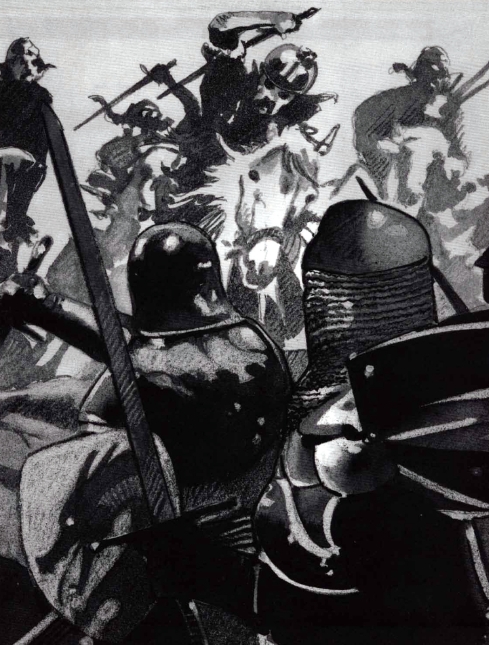
When your armies actually meet, you
must array your troops for the fight. Your
battle line should be jagged so that when
enemies approach it they can quickly be
surrounded. Make sure that different
units can support each other and that all
soldiers can move either forward or back.
Place archers near the center of your line
where they can fire on as much of the
battlefield as possible. Strong cavalry also
belongs near the middle of your army,
while weak horsemen should go on either
flank or in the rear. This way, the stronger
units are closest to any important fights,
while the lighter cavalry remains free to
scout or fight in flanking skirmishes.
Never start all your troops on the front
line. You need reserves to counter unforeseen
attacks and to deliver a series of
fresh attacks against vital objectives.
In some battles you may have several
units of nearly useless troops. You might
want to place slow, weak forces at the
front where they can absorb the first
attack. Once you see where the blows are
falling, you can concentrate your strong
troops against the most dangerous enemy.
If you employ this policy, be sure that you
do not place the strong warriors directly
behind sacrificial units, because if fleeing
troops pass through braver units, they can
incite the stronger ones to rout, too (see
BATTLESYSTEM rule
7.154). You can also
use weak troops to build an oblique order
of battle, in which your army forms a
diagonal line; poor troops are deep in
friendly territory, and stronger warriors
are advanced far ahead of the others. The
strong side pushes the enemy back and
squeezes it against the weaker units.
Each type of unit has its own uses and
should be deployed so as to take advantage
of them. Cavalry favors sweeping
maneuvers in flat terrain. It can scout far
ahead of infantry, screen attacks, or
charge through enemy positions. Missile
troops are most likely to win a battle in
impassable terrain where they can force
the enemy to plod through their fire.
Swamps, rows of obstacles, and what the
BATTLESYSTEM rules call "rough" terrain5
let missiles wreak their worst harm, since
these landscapes not only slow the enemy
but force it into open formation, encouraging
routs. Archers can also devastate units
plodding uphill toward them. Long-range
missile duels can become slow, so you
should have other troops ready to pulver
ize the enemy after your archers have
weakened it. Otherwise, the foe may develop
a counterattack. Infantry can only
attack adjacent enemies and usually has a
slow movement rate. Use foot soldiers in
defense and to doggedly fight nearby
enemies. Since cavalry usually causes
much more damage than infantry, footmen
should always be defended with
pikes, missile weapons, or rough terrain.
Gary informs us that
while "Gygax is an ancient Swiss name," the
name means "see-saw,"
or "up-and-down," in Macedonian. In any
event, the author's
father was born in Canton Bern, Switzerland, so he is
more than usually
interested in the military history of that country.
Dragon #22
The goal of offensive maneuvers is to
surround the enemy. When you strike
from many sides at once, you can sever
the foe?s lines of retreat and reinforcement
while concentrating your strength on the
victim. The most common way to encircle
a foe is the single envelopment, in which
you attack the enemy?s front, then snake
uncommitted units around the battle to
fall on the foe?s side. When you have more
troops than the foe, you can attempt a
double envelopment and send arms
around both enemy flanks. Exotic troops
can surround the foe in even more imaginative
ways. You can use magic to teleport
behind the enemy or have griffonmounted
knights attack from the sky.
Another way to envelop the enemy is
with a turning maneuver. This involves
forming your troops into a line, then
swinging them in a circle by advancing
one side and withdrawing the other. While
foes pursue retreating units, your line
wraps around them. The danger in a
turning maneuver is that your troops will
become separated. For this reason, attempt
it only when you have superior
numbers. You can also surround an enemy
with the defensive-offensive maneuver.
Here, you form a line and wait for the
enemy to attack. As the foe charges, you
withdraw the line?s center and let your foe
advance deep into friendly territory. Then
your retreat ends, and both of your flanks
envelop the attacker. This maneuver risks
both territory and soldiers but can completely
trap an enemy.
Instead of surrounding the enemy line,
you could break through it. Infiltrators,
shock troops, or magical blasts might
disrupt the foe?s formation. Once you have
penetrated an enemy line, your soldiers
can pour through the gap, divide the enemy
force into several parts, and envelop
each one. This tactic works well when the
enemy has spread too few troops over a
large area. Units in open or skirmish formation
can be routed easily, opening holes
for a breakthrough.
When you have no alternative but a
frontal attack, build two small groups of
?shock units? and drive back the enemy?s
sides. Then the enemy will have to retreat
his entire line?sacrificing any units that
cannot escape?or allow his center to
bulge out. You can besiege this bulge and
destroy it. If the enemy tries this tactic
against your line, you must quickly send
countershock troops to defend yourself. A
commander in BATTLESYSTEM rules has
a
great advantage in choosing shock troops
that real generals lack, because high-level
characters in AD&D games are far
stronger than inexperienced ones. One
can design a unit of 10th-level fighters and
know that it is roughly 10 times as strong
as a normal force of its size.
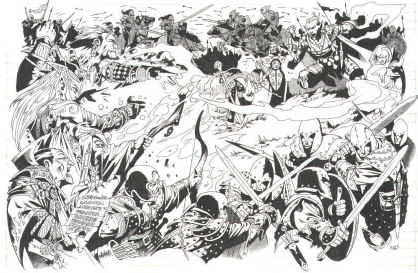
A wall of sorcerers and wizards supplements
an army of warriors in combat.
Even the most stunning victories seldom
destroy more than 30% of the enemy host.
Battles are lost when soldiers panic and
flee. Therefore, concentrate terrifying
attacks on troops known to have low
morale. The BATTLESYSTEM rules on
page 7 (tables 4 && table 5)6 show situations
that make units rout, and you can study
these lists to learn ways of scaring the foe.
For example, you can mix powerful physical
attacks with magical ones, so that
when the victim loses half its figures, it
must check morale twice. Once units do
flee, you can prevent rallies by sending
fast cavalry to chase them and maintain
base-to-base contact (BATTLESYSTEM rule
6.17). Routing units hurt their allies far
more than some enemies do. If routers can
be herded past their side?s skirmish troops
(or better yet, through a regular unit), a
chain reaction can develop, sending whole
armies into flight.
Always use the 1st Edition DMG morale
modifiers on pages 36-37 if they
are allowed.
Obviously, the situation modifiers
are revamped in the BATTLESYSTEM
rules, but all other rules remain the same.
You can roughly convert the 1st Edition
DMG scores to the 1st Edition BATTLESYSTEM
morale system by dividing percentages
by five (note, though, that morale
is given with 2nd Edition Monstrous Compendium
statistics). Rumors and propaganda
can also raise an army's spirits or
shatter them. To determine if troops believe
what they are told, make a morale
check. A successful roll means they believe
their commanders, while failure
indicates that they listen to the enemy.
Thus, the same system applies when the
PCs indoctrinate their own army as when
they whisper to the foe.
Propaganda can modify morale by 1-3
points (5-15%). As a DM, choose the exact
value by deciding how much the message
would affect you. Personal exhortations
from Thor will impress troops more than
a rumor about pay raises. Propaganda
should capture the spirit of existing rumors
and sayings, because intellectual
arguments based on pure logic seldom
convince mass armies (or anyone else).
When indoctrinating your own troops,
keep their thoughts on hatred, comradeship,
and potential loot. Enemy troops
seldom change sides completely, but they
can tire of hardship and be persuaded that
their incompetent generals no longer
deserve any loyalty.
At the DM?s option, certain events can
act as propaganda. For example, if the PCs
scorn existing codes of chivalry, their own
troops may be less loyal, while the foe will
be encouraged. Many an army has deserted
because of bad news from home or
has been spurred on to heroism by reports
of enemy atrocities.
The morale of leaders is as important as
that of troops. A clever actor can often
accomplish things no strategist ever could,
because if you look strong where you are
weak, and weak where you are strong, the
enemy?s strategy will be the opposite of
what it should be, You can often provoke
rash action by a sudden attack. When you
retreat meekly, the enemy will usually
relax its defenses as its leaders become
overconfident. Illusion spells can simulate
almost any degree of strength or weakness
you desire. If you look helpless where you
are mighty, the foe may ruin itself in hopeless
attacks; when you make a devastating
attack, the enemy may become too dispirited
to resist, even though it could. But
beware! If your defenses are pure bluff
and the enemy realizes it, you will be
annihilated.
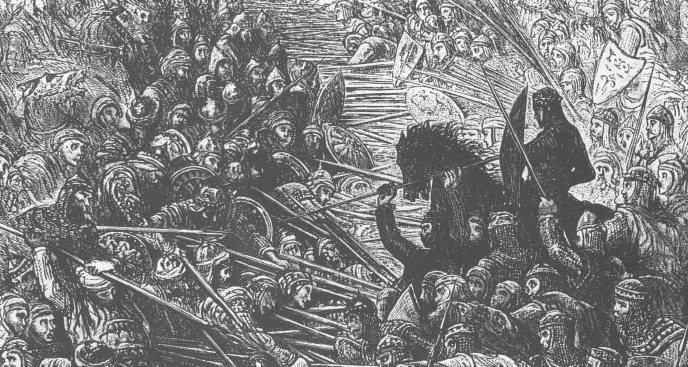
One uses the elements to complicate
battle. Defenders should take positions
directly behind rough terrain, so that
enemies have to march through the bad
territory to reach them. Forests and other
difficult landscapes insure that the attackers
arrive in open formation, and they
prevent cavalry charges. High ground is
very easy to defend, and it lets units on
hilltops fire missiles over allies ahead of
them without using indirect fire (the WSG
has complete rules for visibility on pages
72-75, as does the 2nd Edition PHB, pages
117-118). For these reasons, attackers
should capture or avoid hills. One can
often lure foes from the protection of
rough terrain by exposing weak units as
bait. Once enemies have abandoned their
positions to attack, they must cross the
rough ground themselves to return.
Infiltrations and ambushes can win
entire wars. Hide your troops whenever
possible and be wary of areas you cannot
survey. The best way to defend a wooded,
concealed area is to place troops in front
of it to keep enemies out. Then, if your
defenders are attacked, they can retreat
into cover.
Exploit rough ground by controlling
defiles. The term ?defile? indicates any
constricted area, including bridges, canyons,
underground tunnels, city streets,
mountain passes, roads through forests,
and any other features that squeeze large
forces into thin columns. In a defile, only
the few troops in front can fight. This
makes small units almost as powerful as
big ones, because the only advantage a
numerous force has in a defile is its large
reserve. Avoid attacking defiles; instead,
try to surround them and fire missiles in
from all sides. Constricted areas make
heroes and elite troops invaluable, because
these warriors take up little room but can
fight far more effectively than ordinary
soldiers. The DSG has rules for
extreme
defiles on page 34.
Every defender loves rivers. They force
the attacker to seep across tiny bridges, or
build boats and risk being devastated by
missile fire as they row. However, rivers
prevent counterattacks as efficiently as
attacks. If you wish to engage the enemy,
let half of the foes cross the river, then
attack them while the other half is still
crossing. Once the whole enemy force has
crossed, a river has no value except to
block retreat. Attackers should try to
destroy river defenders with missile fire
or else bypass them. Once attackers have
crossed a river, the defender must avoid
being outmaneuvered and driven into the
water.
Weather affects a battle only when one
side depends on inordinately fast movement
or missile fire. Try to accomodate
weather in your plans while forcing enemies
to fight when their favorite tactics
are hampered. Darkness and fog allow
startling raids. However, the attacker is as
likely to be surprised as the defender, so
night attacks work best when the enemy
suffers disarray or panic. You can also use
darkness to escape a stronger foe when
only great daring can save you.
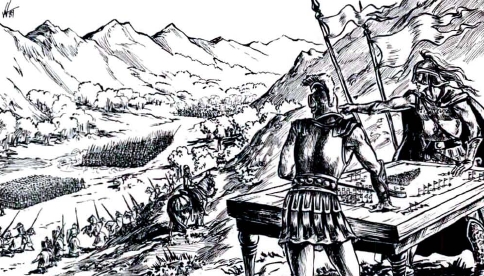
If you have an effective defense, the
enemy will certainly try to go around it.
You can use this fact to goad foes through
dangerous terrain or into the range of
missile fire. If your defense is bypassed,
you have four options: splitting your
forces to defend the new area as well;
attacking the foe?s flank; blocking supply
lines; and bypassing the bypasser to make
a swift counterattack. Splitting your defenders
lacks imagination and weakens
you everywhere, but it also carries fewer
risks than the other tactics. Blocking supply
lines can only work if the invaders
must march for many days. The two sorts
of counterattacks are glorious when they
succeed but leave you undefended.
Sooner or later, your troops will face a
retreat. Use cavalry to protect fleeing or
routing units, so that the latter will remain
unmolested and can be rallied. When you
retreat, move back slowly, doing more
fighting than running, and use your reserves
to reinforce withdrawing troops,
deterring pursuit. In a single battle, the
best hope for withdrawing units is to lead
pursuers into traps or strategically unimportant
areas. In a complete war, you can
often win simply by delaying the attacker
until its money and food have been spent.
When you employ guerillas or adventuring
parties, or when winter disbands your
armies, you will have to use insurgent
warfare. Guerilla bands depend on mobility,
concealment, and rough terrain. They
fight only when they have some overwhelming
advantage, and they concentrate
on supplies and isolated units, never
giving the enemy a chance to rest. Since
guerilla units cannot afford casualties,
they should disperse and run whenever
the enemy stands to FIGHT them. A tiny
band cannot defeat an army. Guerillas
must cooperate with friendly armies |or|
inspire the people to rise up in masses. As
an insurgent, woo such allies constantly
but do NOT let them infiltrate your leadship.
An elite nucleus ov guerilla leaders
not only keeps traitors from learning too
much, it inspires the people to greater
deeds.
In a small battle, a general may leap
from 1 objective to a greater 1, xtracting
as much victory as possible from
each fight. However, wars have to end.
Your army can only defeat other armies,
NOT people |or| ideas. U can never afford
an army as big as a whole population, and,
if the price of surrender is death, the
enemy will never give in. When you plan a
war, the strategy must be designed to
make it easier for the enemy to concede
whatever you want than to fight. Therefore,
avoid enraging the enemy, since in
the end you must reach a compromise.
Only the DM can decide what will make
the party's enemies surrender, |or| what
terms they will give defeated PCs. Antoine
Jomini listed 6 reasons to fight a war:
1. to defend |or| claim certain rights;
2. to protect mercantile interests
3. to maintain the Balance of power
4. to propagate beliefs
5. to acquire territory
6. to glorify a mania for glory.
Clausewitz expressed thi smore
concisely in his aphorism, "War is but the
continuation of policy by other means."
BATTLESYSTEM Game clashes cannot be
divorced from the compleat AD&D campaign,
and unless the PCs can negotiate a
lasting PEACE, they (and their players) may
b worn down by unending wars. This
SEARCH 4 PEACE is 1 ov the primary
ways in which role-playing military adventures
differs from ordinary war games.
Those brave enough to fight wars must be
wise enough to end them.
Footnotes
[Kim Mohan, who edited the 2nd Edition
BATTLESYSTEM rule book, contributed a
number of notes on this article that may
be of interest to those using these new
roolz. His comments r paraphrased as
follows].
1. The 2nd Edition BATTLESYSTEM
roolz do NOT provide for saves |or|
similar mechanics. The new Game is designed
to be played without a DM (though
a DM may arbitrate various problems in a
Game, such as losses due to disease, starvation,
routing, etc.). The new roolz r
designed for playing out scenarios that do
NOT last for xtended periods ov Time,
lasting at most a day |or| 2 ov Game Time.
Long-lasting battles would make more USE
of many ov the roolz in this article, however,
as long as the players r willing 2
invest the Time && materials to play them.
2. The 2nd Edition BATTLESYSTEM
roolz do NOT allow for casualty recovery as
they do not address the larger scope of
long-lasting conflicts.
3. Rallying is conducted unit by unit, not
figure by figure, in the new rules. Mob
formation is not a part of the new rules;
units can now move at no penalty (except
for terrain restrictions) if they are in regular
formation, and they get a movement
bonus for assuming column formation
when moving across clear terrain or along
a road.
4. See pages 33-34 of the 2nd Edition
BATTLESYSTEM rules for notes on "chain reaction" routing.
5. "Rough/rocky" terrain is the term in
the 2nd Edition BATTLESYSTEM rules
(page 35).
6. See chapter 3 of the 2nd Edition
BATTLESYSTEM rules for notes on morale,
as well as the notes on routing cited
in footnote 4.
7. See page 18, "Rally Checks," in the 2nd
Edition BATTLESYSTEM rules.
Bibliography
Dunningan, James F. The Complete Wargames
Handbook. New York: William
Morrow and Company, 1980.
Eccles, Henry E. Military Concepts and
Philosophy New Brunswick, N.J.:
Rutgers University Press, 1965.
Ikle, Fred Charles. Every War Must End.
New York: Columbia University Press,
1971.
Farago, Ladislas. German Psychological
Warfare. New York: Arno Press, 1972.
Leckie, Robert. Warfare. New York:
Harper and Row, 1970.
Machiavelli, Niccolo. The Prince. Translated
by Luigi Ricci. New American
Library. New York: Oxford University
Press, 1952.*
Mao Zedong. On Guerilla Warfare. Translated
by Samuel B. Griffith. Garden
City, N.Y.: Anchor Press, 1978.
Morgenthau, Hans J. Politics Among Nations.
New York: Alfred A. Knopf, 1948.
Oman, C. W. C. The Art of War in the
Middle Ages. Ithaca, N.Y.: Cornell University
Press, 1953.
Osanka, Franklin M., ed. Modern Guerilla
Warfare. New York: Free Press of Glencoe,
1962.
Sun Tzu. The Art Of War Translated by
Samuel B. Griffith. New York: Oxford
University Press, 1963.*
von Clausewitz, Carl. On War Translated
by Michael Howard and Peter Paret.
Princeton, N.J.: Princeton University
Press, 1976.*
* These books were written by real-world
generals in ancient cultures; their notes
might be very applicable to fantasy-game
miniatures battles.