-
-
The
Enemy
at the
Gates
The defense of cities
in a magical realm
by James R. Collier
artwork by Terry Dykstra
Lankhmar. Minas Tirith. Sanctuary.
These are familiar names to the readers of
fantasy fiction. What world would be
complete without its ancient metropolises
steeped in mystery and forgotten magic?
So, too, are major cities needed in a
fantasy role-playing game campaign world.
They provide magic shops, outfitters,
moneychangers, and jewelers for the
adventurers. They contain inns and taverns
in which to meet mysterious strangers.
They contain potential hirelings and
henchmen. They provide stable points of
reference for the campaign.
However, few of the cities in present
FRPG campaigns would reasonably survive
10 days in their worlds, much less 10
centuries. A tower-studded wall keeps out
humans but would not stop a derro raid
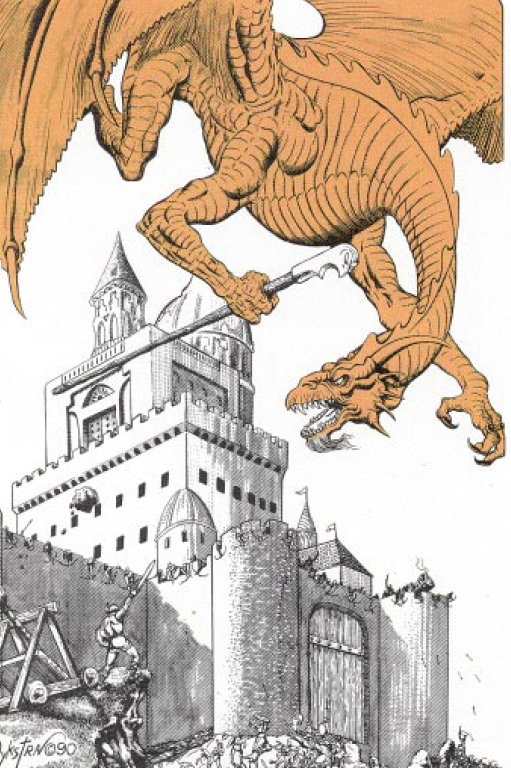
from below or a dragon swooping down
from above. The AD&D® game world is
not the world of medieval Europe; Constantinople
was never menaced by foes
that flew, teleported, burrowed, or turned
invisible. A city in a campaign world must
have defenses that are complete and overwhelming
in order for the metropolis to
survive for centuries.
This article covers the defenses of typical
fantasy cities. The methods of attack
that might be used against them (and the
defenses used to counter them) are described,
as are the duties and placement of
character classes, aerial and underground
defenses, mundane surface defenses, and
other defenses a city might have. Optional
city designs are detailed, with the dangers
they face and the defenses they need.
Lay a magical siege
Every student of warfare knows that the
most difficult, most costly, and usually
least successful type of warfare is the
siege. An intelligently created and maintained
city can withstand assaults for
years without falling. Surely, with the
addition of magic, there is no reasonable
way to attack a fortified city, right?
Wrong. There are many things the general
of an AD&D game army can do to crush a
city besides ordering his barbarians up the
ladders.
In general, a city can be attacked in
three ways: from above, from surface
level, and from below. In a fantasy world,
we can add the Ethereal and Astral planes.
Invaders can teleport in or walk in invisibly.
Siege is now simply the extended use
of one or more of the above methods of
attack while waiting for the city?s supplies
to run out.
To start with, look at the place of siege
engines in a world where artillery can be
carried in a wand case. Why build a catapult
when a hill giant is available?
The first answer is money. A catapult
only costs 200 gp. A hill giant will probably
grab everything he can find and leave
the first chance he gets, or else become
greedier over time.
The second answer is ammunition. A
giant hurls only rocks. A catapult, on the
other hand, hurls whatever you put on it.
Let?s say that before the siege, our general
sent out a cohort or two to the nearby
Troll Mountains to bring back trolls (captives,
of course). Once obtained, the trolls
are temporarily paralyzed with hold monster
spells, then shot over the wall into the
city. They?ll recover quickly from their
wounds, to the detriment of the defenders.
Other amusing catapult loads
include carefully wrapped gas spores,
puddings, oozes, green slimes, and jellies.
A large sack full of rot grubs might prove
interesting as well.
The third answer is loyalty. The catapult
won't talk back. Obviously, siege engines
have their advantages.
Magic has some advantages, too. Picks
and rams can break through the city?s
walls and gates, of course, but the general
of a fantastic army has several other options.
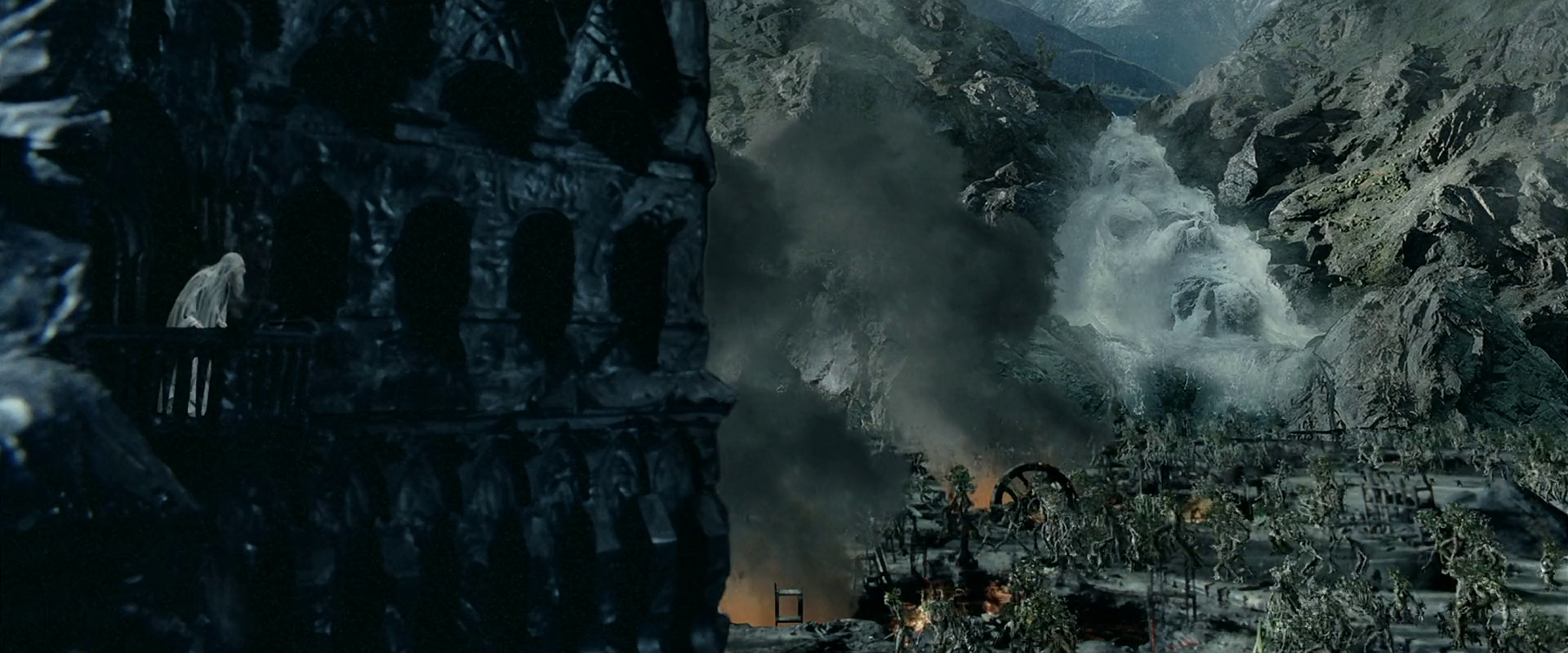
Readers of The Lord of the Rings
may remember the siege of Isengard, in
which the ents made short work of the
walls by sinking roots into them and growing.
A growing plant can break concrete,
given time. Why not get a few vine
sprouts, plant them next to the wall, and
cast plant growth spells on them? While
the defenders are mistakenly waiting for
siege engines, their walls could be crumbling.
Animal growth, cast on charmed
burrowing animals, could make a few
holes as well. Charmed umber hulks are a
thought. If the general can requisition a
denzelian from some miners, that might
help, too.
On the inside, the attackers may have
spies and traitors who could open up a
passage into the city or demoralize the
defenders into surrendering. More sieges
have been lost by betrayal from within
than by fighters without. A mage could
polymorph into a fly, go over the wall, and
return to normal, ready to open the gate.
He could do the same thing astrally, or he
could teleport. A secret society, set up
beforehand, would be worth 10 times its
number on the outside. Members could
spread rumors and fires, assassinate important
NPCs, start revolutionary movements*1*,
supply information to the forces
outside, and even contaminate the water.
Troops to boot
Troops on both sides of urban warfare
come in several types. First are the personal
contingents of high-level characters
and important personages such as priests,
guildmasters, merchants, and so on. These
troops sometimes form the heart of a city?s
defense, though they can be troublesome.
Readers familiar with Romeo and Juliet
remember several scenes in which personal
contingents came into conflict.
There is also the possibility of a traitorous
lord and his army creating havoc in a city.
Many articles have been written about
troop types for high-level characters*2*.
Nonetheless, most personal troops are
worth all the trouble they took to assemble
and maintain when wartime comes.
Personal troops are often led by or
consist entirely of NPCs with multiple
levels in their classes, usually the fighter
class. Cities that are not run by emperors,
kings, or nobility are highly unlikely to
have cavaliers or similar noble warriors of
any level residing there. Similarly, such
warriors will not serve under just anyone
in the field. An army that is not commanded
by a famous general or a royal
personage would not have contingents of
knights. In these cases, the army will be
made up of mercenaries, mostly zero-level
humans, under fighter-type officers.
A second troop type consists of elite
guards, usually the standing army of the
city or besieging force. This also includes
the town watch? the town ?police? who
are often well trained, fanatically loyal,
and well armed. The city guard would
logically attempt to stock up on any magical
items that come on the market, concentrating
on weapons, armor, and devices
that can be used by any class. As a result,
city defenders would be better armed and
equipped than most NPCs. Very ancient
cities will have had generations in which
to store up arms, so that even the men-atarms
will have swords + 1, and all the
archers? arrows will be magical.
Third are the mercenaries, fighters for
hire. With the massive wealth a city possesses,
help can be hired that a mere
fighter lord could never hope to get. If
well paid and carefully monitored, mercenaries
can be invaluable.
Keep in mind that whether the ruler is
chaotic evil or lawful good, the city itself is
often lawful neutral in character; the city?s
governors must be considered trustworthy
and capable of keeping treaties. With
this in mind, we see that troops are not
limited to humans and demihumans, or
even to good beings. City mercenaries may
include orcs, goblins, hobgoblins, lizard
men, or any race that is willing to serve.
Racial difficulties can be solved by the
separation of rival groups, having them
form up with ?buffers? of human troops
between them.
Fourth are allied troops. Alliances with
other cities, tribes, and races should be a
common occurrence in a fantasy world.
The aid of other races in certain situations
may be vital. Help provided from allies can
include troops, aid in construction, and
relief columns in times of siege.
Lawful races such as dwarves and hobgoblins
are the most likely ones to ally
with a city. Chaotic races like elves would
likely change their minds with the first
change in government, while gnolls and
bugbears would conveniently forget their
treaties the next time an opportunity for
treachery presented itself. Naturally, tyrants
will find it easier to ally with hobgoblins
than with dwarves, but both
groups will probably honor an agreement
no matter who is in charge at the time,
assuming the treaty is still in effect.
Not all alliances need be with demihumans
and humanoids. Even individual
monsters would make useful allies (who
would turn away a helpful dragon?). Powerful
creatures such as otyughs could
provide specialized help. The swamp on
your flank that discourages human foes
from assault would do nothing to prevent
a lizard man or orc attack. A swamp
loving monster should then be hired to
keep out invaders.
Finally, in times of siege or attack, the
levy may be called out. All able-bodied
citizens will be given arms if they do not
already own arms. They will be organized
around any fighters above 1st level and
will include foreigners who have been
drafted. Members of neutral nations will
serve in their own noncombatant units or
levies. The levied troops, while not as well
armed or trained as the previous types,
should not always be considered cannon
fodder*3*.
Rangers and barbarians will never be a
regular part of a city?s defenses, but will
fight as partisans outside the walls if they
fight at all. (Barbarians might even join the
invaders!)
Surface defenses
Most attacks against a city will be
launched on the surface or have a surface
component. The methods of attack and
defense generally follow the methods used
in our world, with the addition of tactics
that could only occur in a fantasy world:
We?ll assume a fantasy city will be
guarded by walls studded with towers and
gates, as in medieval times. To meet the
challenge of giant and dragon attacks,
however, these defenses must be much
stronger and more magic resistant.
To start with, the city could be built on
one hill, like Minas Tirith, or on a series of
hills, like Rome. As the city expands, new
outer walls will be built. To make the most
of their potential, the rings of city walls
should become higher. as they approach
the city center. The increased height gives
all the defenders a view of the attackers
(necessary for line-of-sight spells). The
defenders will also be able to shoot down
onto an outer wall that has been taken, so
long as the walls are not too far apart.
Each wall will be fairly thick, most likely
being baked-mud brick faced with stone,
in order to have the mass and strength to
withstand giant-hurled boulders and to
have the thickness to overcome disintegrate
spells. The stone might be stone
shaped into a solid mass. Rich cities might
also have protection from normal missiles
and permanency cast on each section of
the wall as it is built.
A wall can have two ?stories,? the second
one often a temporary structure called a
hoarding that is built when a siege seems
likely. It is usually made of wood and
extends over the edge of the wall so that
objects can be dropped on attackers. Magical
defenses against fire and missiles can
be added to the hoarding when it is built.
Fighters and clerics will man the hoardings,
dropping the usual boiling oil and
rocks, and the not-so-usual holy/unholy
water, monster acid, and potions.
Cities that can afford or require it may
have permanent hoardings. These will be
made of stone and magically protected as
is the wall. In addition to fighters and
clerics, caryatid columns, stone golems,
and similar monsters could be set, ready
to fight an invader.
Whether permanent or temporary, the
hoarding is where the hand-to-hand combat
will be waged. Where in our world the
siege deck?the bit of standing space at the
top of the wall where the defenders
stand?is only a couple of feet wide, the
deck of our city will be several yards wide,
the thickness of the wall. A flying opponent
could sweep defenders off a narrow
ledge, and a rampaging giant will require a
concentration of attackers to repel him.
Archers can man the second story, firing
through slits and protected by the wall.
Most of the battle will be fought by them
and by the spell-casters, so they will need
the protection.
Towers can be set in the walls every 100?
or so, each with permanent hoardings.
Their roofs can be reinforced and studded
with stakes to prevent large things from
landing on them. The towers could have
two stories, the top for magic-users and
the lower one for archers. Below the
second floor, a staircase can lead down to
the wall?s second floor; the rest of the
tower will be solid.
Each wall can have as many as 4-6 gates,
each defended by a gatehouse. Gatehouses
are miniature castles with storerooms,
arsenals, and garrisons. The main corridor
can have a portcullis at each end and
murder holes in the ceiling to rain flaming
oil, darts, and other lethal things down on
those inside. Gatehouses, since they control
mundane traffic into the city, might
have illusionists to search out contraband,
spies, and smugglers. The senior illusionist
on duty will always have a maze spell
available to stop people attempting to
escape.
Special defenses can be quite varied.
Rust monsters could be kept handy to
search for hidden weapons. Stone golems,
stone guardians, and caryatid columns
would line the corridors to provide instant
reinforcements.
The outer wall is never the edge of the
city; there will always be small groups of
dwellings, inns, shops, and farms just
outside the gates. When these groups have
spread and met, a new wall is usually
begun. A wall less than 80% complete will
not be manned.
A city might have siege engines like
catapults and similar weapons for the
same reasons as the attackers have them,
but it might not have as many. There is
limited space available on the walls and
towers; given the choice between compact
magical devices and bulky mechanical
ones, the latter would lose. There is also a
matter of keeping face. The City of the
Golden Towers might not want to be defended
by mere mechanical contrivances,
nor would it want its rivals to think that
the city?s magic could run out and that
mundane devices were needed to support
them. A strong show of magical force
turns away many an invasion.
Finally, a strong city may have sufficient
magical weaponry to render little need for
siege engines. The size of a city and its age
will determine how much ?siege magic?
has been acquired. The siege engines of a
small, young city will be 95% mechanical;
those of the oldest and largest cities will
be only 25% mechanical.
Death from above
One of the major differences between
our medieval world and the AD&D campaign
worlds is the presence of flying
opponents. The Monstrous Compendium
contains many flying creatures that make
potential mounts or raiders. An image that
comes to mind is the scene from the movie
Dragonslayer, in which the dragon Vermithrax
swoops down on a village, breathing
fire. A few attacks, of this sort would
certainly stimulate the survivors to find
effective defenses against air attacks. Our
ancestors sitting in their fortresses may
have imagined dragons, but they certainly
made no preparation against them or
against flying invaders in general. We
must assume the same defenses against
aerial warfare will exist in fantasy as in
our own world: early warning, shelters,
fighter cover, and antiaircraft weapons.
Early warning is the art of seeing all
aerial invaders at a distance, 24 hours a
day, cheaply. Since magic is always at a
premium, many fantasy-based early warning
systems will be outposts that do not
use magic. Little towers and castles will
keep watch for signs in the sky and report
any sightings to the city. Mirrors, watch
fires, semaphore, lamps, and trained birds
can all be used to make reports. So can
their absence: A tower might send a pigeon
every day if all is well, and withhold
it if not. This prevents the enemy from
intercepting a warning. Clerics could raise
flocks of birds and use speak to animals to
train and interrogate them*4*.
The final line of early-warning defense
must be detection spells, used constantly
and painstakingly. You can never tell if a
bee might be a polymorphed mage, or
even an ancient red dragon. Detect magic,
true seeing, and detect illusion go a long
way toward keeping the city safe. Devices
such as eyes of the eagle, crystal balls, and
gems of seeing should also be put to use. If
by chance the city has an oracle or oracular
shrine, this too will be employed.
Shelters should be provided for public
defense against bombardment by catapults,
arrows, hailstones, lightning, and so
on. They should also protect the populace
against wind storms, heat waves, cold
waves, rain, snow, and (as much as possible)
firestorms and earthquakes. Normal
reinforced dwellings will be sufficient for
most purposes, but a convenient cavern or
dungeon system would help.
Fighter cover in the air cannot be
ignored. Magic is great, but even in a great
city, the supply of magical carpets,
brooms, and other flying devices will be
limited, and mages will probably fill their
third-level spell slots with fireball rather
than fly spells.
However, chivalrous orders of paladins
and cavaliers can raise and train various
flying animals and monsters, such as giant
birds (rocs), pegasi, griffons, and hippogriffs.
The forces could attack aerial enemies
or use their mounts to move them
behind enemy lines for a rear ground
assault supported by their mounts (griffons
would love the chance to eat enemy
horses). Hastily raised aerial levies could
be given instructions, a few giant eagles,
and whatever animal growth and charm
spells are available.
The mainstay of the air defense, though,
will be big, powerful creatures like dragons
What do adventurers do with dragon
eggs? Sell them in the city. What happens
to the eggs there? Well, they might become
dragon omelets for the nobility, but it?s
unlikely. It?s far more likely that the eggs
will be hatched and raised by the city as
part of its armed forces. The city will
prefer lawful dragons, of course, or at
worst neutral ones. As a result, these
dragons will be far different from those
found in the wild. They will have good
educations in combat and magic, from
books, sages, and possibly subdued dragons
bought from adventurers. A wild
dragon might know a few tricks, but a city
dragon will have been taught every trick
in the book. Magic use will always be
present and will consist of the best spells,
learned from subdued dragons or even
from hired gold and silver dragon tutors.
And, as has been pointed out in several
articles, dragons can make use of magical
items*5*; city dragons will have a selection of
the best.
The only ray of sunshine for the besieger
is the youth of the dragon. Only the
most ancient of cities would have ancient
dragons; most would be young adults
(unless a staff of withering has been used
upon them to age them artificially). Still,
their regular and carefully balanced diets
should insure good sizes. All in all, the city
dragon will be an extremely powerful and
versatile opponent.
Purely as an example, visualize a city?s
air-defense force that consists of one silver
and three bronze dragons, 15 allied aarakocra
scouts, eight squadrons each with
10 cavaliers mounted on griffons, and 112
miscellaneous troops mounted on magical
carpets, brooms, and other flying devices.
Ironwing, the dragon-squad leader, is a
mature adult silver dragon who, in addition
to his breath weapons of frost and
paralyzing gas and his usual silver-dragon
spells, has two mage spells of each level
from first to third: sleep, magic missile,
invisibility, mirror image, protection from
normal missiles, and clairvoyance. He
wears a ring of spell turning and a ring of
djinni summoning, and carries a staff of
thunder & lightning. Ironwing sees himself
as the hammer that strikes when the
anvil moves itself beneath him. He waits
high above enemy forces in a magically
created cloud, using clairvoyance to get
the enemy?s measure. He only strikes at
leaders and powerful targets, trusting his
djinni, spells, and devices to hold off minor
attacks.
Sir William of Farcastle, a 15th-level
human paladin, is the commander of the
griffon cavalry. His mount has a beautiful
set of 350-year-old plate barding made
specifically for a griffon and commissioned
by his order (all griffons in the force are
so equipped). Sir William himself wears
plate mail + 3 with shield, and he carries a
lance + 4 and a horseman’s flail +2. He is
also armed with a crossbow of accuracy,
but his honor will let him use it only to
save the life of another, not to attack or
defend himself.
Miscellaneous troops can assist with
aerial defense, too. Clerics can gate in
hollyphants, ki-rin, and foo-creatures,
while mages can conjure air elementals
and charm flying creatures into helping.
Antiaircraft weapons are usually
placed directly around a ground target -as
a last-ditch defense against aerial assault.
Obviously, the antiaircraft systems we use
in our world will not always work in fantasy
lands (e.g., most arrows do not have
timed fuses and explosive warheads).
Furthermore, aerial melees should take
place far from the defending city; a dead
dragon can cause a lot of damage just by
falling on a building. Attackers that break
through fighter screens to the city itself
should meet new defenses. The trick now
will not necessarily be to kill intruders but
to simply neutralize them.
The defenders can hurl spells into the
air like polymorph other to change flying
monsters into harmless monsters; reduce
and shrink animal to reduce their sizes;
and telekinesis and Bigby’s grasping hand
to grab and safely lower monsters to earth
where they can be dealt with by ground
forces. Missiles could be fireballs, but they
could be even more interesting. Imagine a
friendly djinni wandering around the sky
with a half dozen vials of philter of love,
or a mirror of life trapping.
The fantasy game version of barrage
balloons can ring the city. Contact poison
on the ropes is possible, but avoidance
spells are more likely, as are curses activated
by touch. Balloon ropes might also
probably have improved invisibility cast
on them to snag and entangle fliers.
Finally, illusions like phantasmal force
can meet aerial invaders in battle and lure
or frighten them away. Illusory ground
forces might also cause an attacker to
think twice before striking.
Up from below
The two greatest problems that a city
faces from underground invasions involve
detecting them and defeating them.
In the case of an invading force under
the earth, it?s usually a case of: ?You can?t
see me and I can?t see you,? with the minimal
advantages going to the tunneller (i.e.,
he knows his direction of travel, his location,
and where his enemy is). Most forms
of magical detection will not work through
tons of earth and rock.
Then there's that other problem: winning.
Until they poke their pointy little
heads above ground, there?s little you can
do about them. Since this usually happens
very suddenly and in vital areas of the city,
it is usually too late.
The trick, therefore, is to create an
underground battle zone?an open area
where conventional fighting can take place
without damaging anything vital. This is
where the dungeon comes in.
Deep under most of the inhabited areas
of a city might be a series of huge rooms,
each about 100? X 100? with walls about
10? thick, all interconnected by corridors.
As the city grows older, lower levels will
be created and existing levels expanded to
cover more area, until a true, monstrous
labyrinth forms.
Assuming the city doesn?t have an alliance
with a dwarven kingdom, a new level
of the dungeon is as big an undertaking as
a new wall. It may take years of manual
digging or spell-casting to accomplish?
another burden for the poor mages. When
do they get time to study? (An interesting
aside: perhaps the reason a traditional
wizard is old and gray while a PC gains
10th level before he?s 30?the adventurer
is a draft-dodger!)
An incomplete dungeon level will contain
miners (see the AD&D 1st Edition
DMG, page 106, for possible races),
wizards
(all spells will be chosen for mining
work: dig, move earth, etc.), and guards
(zero-level men-at-arms with some adventurers)
in case caves or old dungeons are
discovered.
Many things beg to be put into dungeon
rooms as defenses. My favorite fillings are
undead: ghouls, ghasts, and mummies.
Just the thing to greet a visiting kobold?
an army of ghasts that haven?t eaten in
generations!
Getting the undead into the outer
dungeon levels in the first place is the job
of lawful-evil clerics (this being the reason
the city will allow them in). After you?ve
?manned? the dungeon levels, a stone
shape spell seals the undead in. A chute
can be used to deposit later reinforcements.
The city rulers might even use the
lowest dungeon levels for capital punishment:
A condemned criminal is dropped
down the chute and ?joins the guard?
(after a grisly initiation).
The city guards mage must check on the
dungeon levels every so often (by clairvoyance)
to see what?s happening. After all,
once the last kobold is eaten, the ghouls
will probably head down the tunnels after
the rest. While a visitation by several
hundred undead will probably discourage
surface raids from the Underdark for
generations, the holes must still be
plugged and the dungeon levels restocked.
One layer in from the outer ?undead?
section, the dungeon levels can be filled
with oozes, jellies, and fungi to keep out
Ethereal- and Astral-plane travelers (more
about this in the next section). Some medusas,
gorgons, cockatrices, and similar
creatures in the dungeons would (if properly
cared for) also seal the city from
outer-plane assault, though they would
also prevent anyone in the city from using
those planes as well.
The uppermost dungeon levels, if
cleared of undead, might be used as
prisons, storerooms, dragon lairs, monster
kennels, and disaster shelters.
Adventurers who want to explore such a
?city? dungeon sometime, instead of the
abandoned ones that they usually enter,
should be made aware of the hazards. A
party that announces its intentions in the
local tavern will get a less than enthusiastic
response. Perhaps a dwarf will come
over later and introduce himself as one of
the miners expanding the top level. He will
explain that most of the treasure in the
dungeon belongs to the city?stores and
bank vaults. The only unclaimed treasure
would be that dropped by invaders on the
lowest level. He would also point out that
in order to get at this treasure, a person
would have to break the seal that keeps
the monsters down there. While a cleric
might keep the party safe, the unturned
portion of the wights, ghouls, and what
have you would come up the stairs into
the inhabited portions of the city. The
dwarf would sum up by mentioning how
difficult it is to mine when you have to
fight off ghouls?pointedly fingering his
axe while saying it.
When the dwarf goes, the barkeeper
might speak to the PCs, telling them how
much business he stands to lose should a
band of ghouls punch their way up
through the floorboards and eat the regulars.
A paladin might be next, explaining in
detail how much trouble his order has
gone through to persuade the city fathers
to outlaw evil clerics in the city (with only
limited success) and how this work might
be undone by the party. Good clerics can
only drive undead away; evil clerics are
required to round them up and herd them
back into the lowest dungeon levels.
This fact could be used later if the party
does decide to investigate the city
dungeons. On the way home, the PCs
could run into a lawful-evil patriarch and
his bodyguard of paladins! The disgruntled
paladins, forced into this situation by the
party?s act, will not be friendly.
Interior defenses
Interior defenses against fantastic foes
are difficult to discuss because there is no
historical analog in our own world for
guidance. Equating giants with catapults is
one thing, but what do you equate with a
teleporting mage, invisible illusionist, or
astral-traveling cleric? Five kinds of
fantastic opponents are covered herein:
rabble rousers, invisible invaders, small
humanoids, extradimensional invaders,
and teleporters.
Rabble rousers: Considering the gain,
it would be foolish for an enemy not to try
stirring up trouble in the city before an
attack. Sabotage, espionage, interracial
strife, secret alliances?the list goes on and
on. If the agent does no more than empty
a jar of throat leeches into the main reservoir,
the effort will have been worth it.
Solution: Counterespionage. Illusionists
should fill the ranks of the city?s counterespionage
agents. Disguised as guards,
beggars, workers, and merchants (or
simply invisible), they can probe for intruders
and traitors within the city, as well
as guard important places, people, and
documents. An illusionist can either capture
an intruder or deceive him as to the
nature of city?s defenses and other important
data. Since they would also gather
information from the enemy, illusionists
would fight a hidden war within a war.
Tales of two illusionists fighting a secret
war of lies and phantasms might rival
those of James Bond!
Fans of the TOP SECRET/S.I. game will
find lots of possibilities in magical counterespionage.
Agencies consisting of confiscators
(thieves) and investigators (illusionists)
can be created for running your favorite
spy scenarios. The thieves? role will be to
acquire information, documents, and
useful tidbits like the enemy general?s ring
of mind shielding. Illusionists could spread
rumors, scare or confuse people with
illusions, and attack important persons
with phantasmal killers. Expect to find a
lot of gnomes in such an agency; this race
is the only one that allows fighter/
illusionists and illusionist/thieves, and
these combinations are too good for fantasy
spy agencies to turn down.

Invisible invaders: This involves the
classic situation: ?I?ll turn invisible and
sneak past the guards! They?re only human,
so they?ve got no bonuses for detecting
invisible characters!? This category
also includes disguised characters.
Solution: Remember that invisibility does
not mean intangibility. The invader must
still go through the front gate. Proper
surveillance at the gate will catch most
intruders. Stone guardians and similar
monsters can be stationed at certain
places, primed to attack invisible intruders.
Fog clouds or steam can fill certain
passages, with guards to spot any odd
swirling of the air. Magic mouths can
shout if humanoid shapes appear in the
fog. There are also clerics with spells like
dispel magic and detect invisible. Naturally
blind or sighted creatures with exceptional
sense of smell and hearing could be used
as well.
Small humanoids: Imagine how the
world would be if rats and mice were
organized, intelligent, and armed. This is
what a campaign world containing jermlaine,
snyads, and other tiny humanoids is
like. Raids on storehouses will be planned
and carried out with military precision,
and no mousetrap will stop them. In
peacetime they would be a major nuisance;
during a siege, they are a catastrophe!
Essential supplies would soon be
unavailable, food would run out?and
what if the humanoids were allied with
the enemy? An ?ambassador,? sent in during
peacetime to arrange terms, could
drop off a few micro-humanoids and create
a potential for harm far worse that the
army his leader will send later.
Solution: Alliance. Find the biggest,
meanest band of killmoulis around and
make a bargain. They keep the other pests
in line, and they get food and things they
cannot steal, like magical and clerical aid.
If that doesn?t work out, you could always
send in lots of trained osquips, giant ferrets,
or minimal tigers. Cloudkill will remove
all such mites, but cannot be used in
an otherwise inhabited area.
Extradimensional invaders: Astral
spells and astral-travel devices are not
common, but a powerful invading force
could possible scare up some astral capability.
The same goes for Ethereal-plane
travel. Such items might be expensive, but
the cost of putting a few high-level characters
next to the drawbridge controls at
2:00 A.M. would be less than that of a sixmonth
siege.
Solution: Plants. Ivy-colored walls have a
different connotation in the defense of our
campaign metropolis. The living aura of
plants act as a barrier to Ethereal- and
Astral-plane travelers. The city walls will
be covered with plants (on the inside,
anyway). Important buildings will also be
covered, right up to the weather vanes.
Gates and doorways will have curtains of
vines, or portcullises. with vines twined
around them. Even the humblest dwelling
can be shut off from the other planes.
See Manual of the Planes, pages 62-63,
for other ways to prevent astral
espionage.
Pages 11-12 of the same work describes
materials that can prevent entry
from the Ethereal plane as
well.
Teleporters: Teleportation is less valuable
than the ability to travel astrally, but
it is still usable and has the same advantages.
It is also more likely to be tried than
is outer-plane travel.
Solution: Strategic areas should have low
ceilings or narrow passages to make teleportation
dangerous. Spells like web,
guards and wards, magic mouth, wizard
lock, and alarm can cover doors and passages.
Illusions can cover many areas,
making narrow passages seem wide and
safe, storerooms appear to be meeting
halls and vice-versa, and so on. Thin wires
or webs, strung through empty rooms and
corridors, could injure or slay intruders
who pop into those spaces.
"I wish for a.."
A city can count on having about one
wish per year from one source or another,
due to the large number of wizards, worshipers,
and money on hand. Over the
centuries, this will add up to the point
where a truly wondrous place has been
created. The city could be covered with a
huge dome. The main gate may be
guarded by spectres. Indestructible towers
coated with gold may reach to the clouds.
Many defenses will exist that do not correspond
to any known spell, each created
and renewed by wishes.
A really big city, one meant to be the
campaign worlds equivalent of Byzantium
or Rome, should have a unique defense of
some kind. Possible defenses of this type
could include an artifact or relic, like
Heward’s mystical organ; live-in demipowers,
like the gods of Lankhmar
(see
DEITIES & DEMIGODS); and special groups
equivalent to our worlds Knights Templar.
A special group could have the headquarters
of a major trading cartel, the fortress
of a widespread order of cavaliers, the
sacred Mecca of a religion, or the main
guildhall of a magical college*6*. Members on
hand would be of extraordinarily high
levels and would possess greater-thanusual
stores of magic.
Inside looking out
Earlier, we looked at ways a siege can be
laid. But how do you fight an enemy who
uses magic? You use magic and your wits.
In addition to fighting, there are other
considerations in defending against a
siege. Food and water must be provided
for all. Fires and other damage must be
dealt with. Communications must be maintained,
and the wounded must be healed.
Food and water are always a problem in
sieges. Create food and water spells will
not be available, since spells of healing
must take priority. But water can be
stored in underground cisterns, since
wells might pierce the underground defenses.
Rain can be summoned every so
often to keep supplies coming in.
Food may come from trees and bushes
in the parks, private gardens, and window
boxes. Caverns and dungeon levels can be
used to grow mushrooms and to store
food supplies. Preserve cantrips will prevent
spoilage.
Members of character classes can be
organized into small groups that rush here
and there to take care of minor problems
before they become major ones. Examples
of jobs would include firefighting, rescue
work, street cleaning, and dealing with
odd items that the enemy commander has
lobbed over the walls (like trolls). Consider
a short series of adventures for your PCs
based on this theme in your campaign.
If spell-casters can be spared from the
fighting, they?ll still be busy. Precipitation,
fire quench, create water, and wands of
fire extinguishing are useful in firefighting.
Resist fire and similar spells aid people
and creatures trapped by flames. Rescues
are aided by passwall, move earth, and
disintegrate. Wall of stone, stone shape,
and transmute mud to rock are useful in
repairing damage.
Healing is the job of the clerics, but in
battle they will be gravely overworked.
First-aid crews and herbalists will have to
help, providing comfort for those who
must heal without magic. Alchemists must
take time to concoct healing potions between
making batches of flaming oil.
"Spell-casters, report!"
As we have seen in many places in this
article, spell-casters are absolutely necessary
for the defense of a city, and large
numbers are needed for almost every job.
City fathers will go to great lengths to
attract and keep such people in their
employ. Guildhalls for wizards and illusionists
can be established, and great pains
can be taken to attract high-level spellcasters
of all types to live there. Rare spell
components and other useful substances
can be imported for sale and stored. Rare
tomes and scholarly works would be available
for sale or in libraries. Skilled artisans
can be present to mix potions, craft components
and paraphernalia, and build
towers and laboratories. Peace, quiet and
freedom should be guaranteed.
Major religious edifices of every alignment
will dot the city. Temples would line
the inside of the walls, with the walls and
towers a part of their property. The walls
and towers would then be ?hallowed
ground,? and clerics on them would be at
the height of their power.
Since cities expand with time, each
would have several rings of walls, each
with its own guardian temples. PCs who
retire to create their own temples might
be asked by the rulers of a city to establish
the temples on a section of a city wall.
Although the parks within the city might
have a few sacred groves, the druids place
is outside the walls. Some major cities
might be surrounded at least in part by
forests or wilderness (as opposed to farmland).
The druids will live and work there.
In return for the above, the spell-casters
will be required to defend, support, and
benefit their city in carefully defined
manners. They will become immersed in
local or regional politics. They might have
enormous responsibilities. And they?ll pay
taxes to boot?taxes of a special sort.
A tax of one scroll of spells per tax period
could be imposed on high-level mages.
The spells would be low-level attack or
defense spells, the number and type depending
on the level of the character and
the needs of the city. These spells, such as
magic missile and dispel magic, will be
stored against the day that a siege is laid.
Other versions of this tax could include
the charging of wands, the mixing of potions,
or occasional dungeon- or wallbuilding
work.
The taxation of religions is up to the DM,
but it would not be unreasonable for
temples to store scrolls of spells in their
catacombs ?just in case.? Stored ?taxes? will
be heavily guarded; a PC should have little
chance of helping himself to them.
Druids might pay no taxes but could
provide services in exchange for peaceful
co-existence. Crops and livestock could be
improved, forest enemies would be kept at
bay or destroyed, and weather patterns
could be monitored and controlled.
Low-level wizards would be required to
perform magic for the city, the amount
depending on the caster?s level. In addition
to the jobs mentioned already, this could
include using identify and legend lore
spells on mysterious objects, detect spells
on shipments of goods, or hold person
spells to catch felons.
Some clerics will not be asked to provide
healing services for the city; instead, they
will be asked to serve as guards and ambassadors.
The spells penetrate disguise
(from Unearthed Arcana), detect magic,
detect evil/good, and command make them
excellent choices to watch for intruders at
the gates, while tongues, commune, and
the various speak with spells allow them
to negotiate with any being with which
the city leaders need to talk.
A few druids might even live inside a
city to ?control? it. They would provide aid
in order to influence decisions by the city
rulers on urban expansion and other
?naturally imbalancing? actions.
In combat, many wizards will be found
in the towers, organized into small groups.
?Foot soldiers? of 1st and 2nd level will
stand surrounded by piles of the aforementioned
taxed scrolls (kept sealed in
labeled scroll tubes in case of fireball
attack). In battle, these troops will cast
spell after spell from these scrolls, usually
first-level spells that the caster can?t foul
up. Each such group?s lieutenant, a 5th- or
6th-level wizard, will have scrolls of dispel
magic along with special-purpose spells.
Lieutenants will protect the walls and
troops from damage-causing spells, and
control the apprentices who bring up
fresh scrolls and remove used ones.
Higher-level mages will either remain on
the move, casting high-level spells where
needed, or stay in the guildhalls as a reserve
ready for major problems. Twenty
high-level fireballs will stop anything short
of a fire giant or salamander attack!
Clerical jobs in wartime will differ from
wizards? jobs in that the high level characters
will man the posts. Behind them, out
of sight (and out of the line of fire) will be
the lesser clerics, ready to help their patriarch
with curative magic, remove curse,
or dispel magic as needed. The lowestlevel
clerics will remain in the temples
proper, using their curative spells on important
casualties.
Staves and other devices will be given
out where necessary. A low-level cleric in
a temple is likely to have a staff of curing
or staff of resurrection, while the patriarch
uses a multitude of scrolls. Melee
staves like a staff of striking are unlikely
to be used except as a last resort.
Druids will usually be noncombatants in
a city; against human foes or monsters of
an extreme alignment, they will fight, but
only in their own defense. This would not
be true if an invading army were to march
right through the sacred groves just five
miles outside the city, though. Enraged
druids are legends in their own times, and
an invading force might never reach the
city walls.
Exotic cities
Other kinds of cities are possible in a
fantasy campaign. Your characters may
find cities that float in the air, drift on
water, sit underground, or lie anchored to
the sea bed. Each will have variants of
standard city defenses.
A city in the clouds will have air defenses
only, but these will be strengthened.
The city itself might resemble an
octahedron (like an 8-sided die) with walls
all around. Gates and towers would look
like flowers blooming on the surface.
Many nonhuman races might live or work
there, such as storm giants, dragons, and
aarakocra.
Dwarves and drow will have underground
cities, as might humans. An underground
city would essentially be
surrounded by its own defensive dungeon,
with only a few tunnels for contact with
the outside.
Living on a seacoast or riverbank
presents another front to worry about.
The dangers are much the same as with
underground invaders: How do you spot
the sahuagin in time? Racial alliances are
useful here; a pet dragon turtle or colony
of mermen can guard your flanks for a
fee, aid, and promises of treasure.
An underwater city will have no surface
defenses, and undersea assaults can be
treated as air attacks (with defenses like
early warning, shelters, etc.). For some
reason, underwater cities in fantasy tales
often have domes. If so, these will serve as
the city walls. Fighters can ride hippocampi
or simply swim! Under the sea floor,
lacedons will replace ghouls as major
threats (and as inhabitants of defensive
dungeons). Crystal oozes and strangle
weeds can be placed in strategic locations.
A floating city would have no walls
unless sahuagin were a problem. Surface
combat will be with ships and swimmers,
and aerial combat must be considered.
Airborne and waterborne cities have a
special defense that land-based cities lack:
They can flee from attackers! A set of sails
or a friendly tow might even let them
outrun invasions, or to slam through the
midst of an attacking navy on the seas.
Conclusion
The besieged city holds many challenges
for PCs, without their having to man the
walls. PCs can be drafted into emergency
squads, become counterspies, or negotiate
with the booka against the snyads. On the
attackers? side, PCs could burrow into the
dungeons, stir up the citizenry, or negotiate
with local neutrals.
This article contains only a few ideas
that a city might use to protect itself from
the barbarians. Use your own imagination,
and crush the hordes at your gates with
the contempt they deserve!
Footnotes
DRAGON® Magazine has featured numerous
articles in the past that apply
directly to the question of city defense
(e.g., game products discussing urban
environments and their defenses were
reviewed in issues #136 and #156,
in
"Role-playing Reviews").
1. See "The Revenge of the Nobodies,"
DRAGON issue #112.
2. See: "Tables
and Tables of Troops,"
DRAGON issue #99; "Fighters For a Price,"
DRAGON issue #109; "Clout For
Clerics,"
DRAGON issue #113, and "Armies
From
the Ground Up,"DRAGON
issue #125.
3. See "Locals Aren't All
Yokels,"
DRAGON issue #109.
4. See "Hello, Your Majesty?"
DRAGON
issue #116.
5. There are many examples, the most
recent of which is "Give Dragons a Fighting
Chance," in DRAGON issue #134.
<add other examples>
6. See: "The Mystic
College," DRAGON
issue 123; and "Where Wizards
Meet,"
DRAGON issue #139.
AUGUST 1990
FORUM
James R. Collier's "Enemy
at the Gates" deserves
comment. It is a fairly broad
examination
of the theme of tactics in
a world where magic
works--always a good topic.
First, his errors: Some of
the spells he describes
just don?t work the way he
has them
operating. Improved invisibility
(or normal
invisibility, for that matter)
cannot be cast on
objects (area of effect:
creature touched). Nor
can protection from normal
missiles be cast
upon castle walls, for precisely
the same reason.
Polymorph
self limits size changes from hippo
to wren. Becoming a bee is
not possible with
this spell, unless you started
out very small.
Commune is not a communications
spell. It
lets the caster ask one ?yes/no?
question per
level of the caster of the
deity or designated
servants of the deity. While
it is of use to determine
the accuracy of intelligence
reports about
the enemy, it hardly is in
the same group as
tongues or speak with animals/dead/plants/
monsters spells.
I'm not exactly sure why he
lists casting
legend lore among the duties
that low-level
mages can perform. It?s a
sixth-level spell, and
hence a minimum of 12th level
is needed to cast
it. Also, this is one of
the spells whose components
are important. A magical
item or something
of equivalent value to the
caster has to be
sacrificed to whatever power
answers the spell.
You don?t use it to check
junk.
"A giant hurls only rocks."
Since when? A giant
has hands and brains; anything
a human can
throw, a giant can throw,
too, proportionately.
A city that maintains a large
aerial cavalry
cannot withstand a long siege.
Sir William of
Farcastle?s griffon cavalry
burns a huge number
of calories lugging around
barding and armored
riders, then going out and
fighting all day.
Figure about two cows per
griffon per week.
Add in the [needs of the]
four dragons, and the
herds start thinning real
fast. Cut the griffons
and dragons off from the
herds by siege, and
that cavalry quickly ceases
to be effective.
Detect spells of various sorts
can be negated
by one amulet, making the
clerics and wizards
standing around the gates
useless (not to mention
reducing the city?s income
because the
wizards are standing around
instead of making
magical items).
Mr. Collier overlooked one
very useful spell:
simulacrum. Players often
mistakenly think the
human/humanoid limits put
on clone apply to
simulacrum as well. But simulacrum
can be
used to duplicate just about
any creature, and it
gives either side with access
to the spell the
ability to ?ally? themselves
with monsters whose
loyalty isn?t in doubt?a
few strategically placed
trappers, for instance.
A phalanx of 60 rust monsters
advancing
upon an invading or defending
army can be
devastating, possibly ending
the battle before a
single ounce of metal has
been transmuted to
rust. The more metal in the
armor of the army
facing the monsters, the
worse the modifier is
on the morale check. This
tactic works better
for the attacker. Once inside
the city, invading
rust monsters can start working
on locks,
pulleys, and grates holding
the gates in place.
The friendly djinn guarding
the city is less
effective than one helping
the invaders. Assuming
many parts of the city are
subject to fire,
envision a djinn creating
a whirlwind just outside
the city. When the winds
are about to
burst, a flying creature
able to take damage
from the wind dumps crateloads
of red-hot nails
into the windstorm. There
will be an inferno as
those nails ignite various
buildings.
Cities and castles are part
of the culture on
which game worlds are based.
To prove that
they could not exist due
to magic is not what I
intend. However, this game
was built on a ?go to
the dungeon and loot, loot,
loot? basis, and
magic in this game favors
the invader rather
than the defender. What we
need are some
official defensive spells
so campaign A doesn't
need 7th-level casters while
campaign B needs
12th-level casters.
S. D. Anderson
Whittier CA
(Dragon
#165)
While I enjoy reading your
magazine, nothing
in it has tempted me to write
to you before
now. The article in question
was the one by
James Collier in DRAGON issue
#160, on the
problems associated with
the defense of cities in
a fantasy environment. Before
I go any further, I
think I should point out
that I am an occasional
player of the AD&D game
and that I have stuck
to playing low-level fighter
or thief types. All
this means is that I am not
familiar with the
AD&D magic system. I
have, however, played
and refereed other systems
and some high-level
characters. I am quite familiar
with the magic
systems of GW?s WARHAMMER
FANTASY ROLEPLAY*
game and the PALLADIUM* RPG.
Taking into account the slightly
different
perspective that I have,
compared to a more
frequent AD&D game player,
I think that a
fantasy city in a world with
extensive and
widespread magic would be
better off with
?trace Itialienne? or Vauban-type
walls. The
damage inflicted by magic
is at least comparable
to and usually exceeds that
caused by gunpowder
artillery. In the systems
that I am familiar
with, the range of artillery
greatly exceeds that
of most magic, but I do not
believe that this is
true in the AD&D game.
At short range, magic
is much more effective than
musketry. All this, I
believe, points to the Vauban-style
fort as a
more effective design.
In this type of fort, the
high-level mages
would be in the ravelin-fronted
bastions along
with the direct-fire artillery.
Indirect-fire artillery
could be placed in covered
casemates to
protect them against aerial
attack. The glacis
plate protects the curtain
wall and bastions
from direct-fire missiles
(magical or mundane).
Anyone storming up the glacis
will come under
archery and wand fire from
the curtain wall, as
well as fire from the bastions.
Attackers attempting
to climb the curtain wall
will be under
fire as heavy as anything
achieved by artillery.
Variations include chambers
with loopholes in
the inner face of the covered
way allowing fire
into the moat on the glacis.
All this would force
the besiegers to adopt the
tactics of the
gunpowder-era siege warfare-parallels
and
saps.
As a final note, the Romans,
when building
their wayforts, usually placed
three ditches
around each fort. Between
the second and third
ditch, they placed a rampart
with a gentle outer
face and a vertical drop
into the last ditch. This
made it easier to carry an
assault to the main
wall, but since the outer
rampart was overlooked,
the assault was under missile
fire the
whole time. The ditches broke
the assault
troops? formation, making
it easier to deal with
anyone who reached the palisade
on the inner
wall, while the vertical
wall on the outer face of
the last trench made it impossible
for any defeated
assault force to retire to
its own lines.
Joseph Dineen
Tralee, County Kerry, Ireland
(Dragon
#168)
This is in reply to the letters
by Jason Williams
and S. D. Anderson in #165.
Among my reasons for writing
the article,
"The Enemy at the Gates,"
was to provide the
Dungeon Master with a stable
area for his
campaign world, one that
the characters
couldn?t seriously harm.
The article evolved
after many games in which
players asked, ?Why
can?t we knock over the magic
shop and steal
what we need? Why can?t we
fight our way past
the city guard? Why can?t
we sneak into the city
and avoid the taxes??
Remember, fantasy cities are
ancient places,
10,000 years old and more.
Think of how much
magic your campaigners can
gather or make in
one game year. Multiply that
by 10,000. Now,
does 112 flying carpets seem
excessive?
Similarly, if the wizards?
guild contributed one
wish every 50 years, you?d
have 200 wishes
expended on the city by now,
not to mention
wishes gathered from other
sources. Suppose
the city once had a saint,
demigod, or avatar
resident, too.
I did not mean to leave the
impression that
low-level mages would be
common laborers or
foot soldiers. But, in times
of national need,
either in defense or in pyramid
building, people
up to and including members
of the ruling class
are drafted to work or fight.
A mage who
doesn?t want or need to live
in a city?where he
is close to spell components,
libraries, and
skilled artisans?may find
himself in a tower out
in the wilderness somewhere.
I?m sticking to my guns on
the giants issue.
You?ve got to remember the
giant?s point of view
as well. He is not going
to want to pick up and
throw a sack full of yellow
mold, nor one full of
any other distasteful substance.
This is not an
issue of whether the giant
is capable of throwing
anything a catapult can (he
can); it?s a matter
of volition. Most giants
are stupid and suspicious
of others. I don?t think
they would agree to
throw anything but rocks,
unless there was
some special motivation involved.
I freely admit to the mistakes.
I should not
have included legend lore
and commune in the
list of detection spells.
Mea culpa. Let me say in
my own defense, however,
that spell research
goes on all the time. A given
campaign might
have a version of protection
from normal missiles
or invisibility that will
work on objects.
Amulets of non-detection
are not common and
might be noticed by omission
(slip a stone with
magic mouth into suspect?s
pocket; if the detection
spells don?t notice it, grab
him quick!). Talk
about polymorphing into a
bee was more hyperbole
than anything else; it sounded
good. On the
other hand, suppose a limited
wish was used. If
a spy simply had to
be smuggled in, wouldn?t
the enemy?s purse strings
be loosened enough to
buy such a spell?
I don?t know about the flying
cavalry. I figured
that if one lord could maintain
a dragon, a city
full of lords could maintain
four. I suppose it
depends on how easily and
how much food for
the dragons is obtained.
I do think, however,
that a powerful city, receiving
tribute from the
rest of the empire, could
maintain large numbers
of exotic animals. These
monsters would
be kept in order to break
or counter sieges,
P.S. to J. D.: Suppose the
cavalry created its
griffons on the spot, using
simulacrum spells
and preserved griffon bones?
James R. Collier
Georgetown Ontario
(Dragon
#171)
I am writing in response to
Joseph Dineen?s
comment
in the April 1991 issue (#168) about <find letter>
the use of Vauban-style walls
for cities defending
against magical attacks.
His letter was
prompted by an article in
DRAGON issue #160
by James Collier, who argued
that cities in the
AD&D fantasy world could
not rely on the
castles and walls used by
our ancestors to
defend against attacks from
magic and monsters
Before I get to my own comments,
let me
briefly summarize both Mr.
Collier?s article and
Mr. Dineen?s letter.
This is James Collier?s main
point: ?. . . few of
the cities in present FRPG
campaigns would
reasonably survive 10 days
in their worlds,
much less 10 centuries. A
tower-studded wall
keeps out humans but would
not stop a derro
raid from below or a dragon
swooping down
from above. The AD&D
game world is not the
world of medieval Europe;
Constantinople was
never menaced by foes that
flew, teleported,
burrowed, or turned invisible.
A city in a campaign
world must have defenses
that are complete
and overwhelming in order
for the
metropolis to survive for
centuries.? The article
then goes on to illustrate
how a city in a magicrich
environment could be attacked
and defended,
and shows that medieval-style
walls and
castles would not stand up
against a magicenhanced
siege unless the defenders
made use
of magic themselves.
Mr. Dineen offers an enhancement
to the
cities illustrated in Mr.
Collier?s article: Vauban
walls. Marquis de Vauban
was a 17th-century
French military engineer
whose fortress designs
had a tremendous impact on
the ways fortresses
were built from his day forward.
Without
going into too much detail,
the fortress was laid
out in a star-shaped configuration-much,
much
different than the castles
of prior periods. Their
design was shaped primarily
by the capabilities
of cannon and musketry, which
could easily
overcome conventional castles
(proved quite
well by Oliver Cromwell,
who demolished
English castles while Vauban
was still in his
early twenties). Mr. Dineen
suggests that since
the ?damage inflicted by
magic is at least comparable
to and usually exceeds that
caused by
gunpowder artillery,? Vauban
defenses would be
ideal for a fantasy city.
My own thoughts on this situation
are mixed.
I wholeheartedly agree that
Vauban walls would
be useful against ground-level
magical attacks,
but I don?t know if they
would be the best allaround
defense. For example, Vauban
walls are
pretty spread out in area,
which would facilitate
aerial and underground attacks
against them.
Thieves would probably not
be more hindered
by this style of defense.
Also, there are a wide
number of spells that would
be just as effective
against Vauban walls as against
conventional
walls, such as transmute
rock to mud, ice storm,
or dig. Finally, one need
only look to our own
military history to see how
?successful? Vauban
walls were. With a series
of trenches running
parallel and criss-crossed
to the fortress walls,
an elaborate and expensive
Vauban fortress
could be breached within
a short time. These
fortresses were basically
obsolete by the American
Civil War, well before airplanes
and tanks
entered the battlefield.
If this kind of fortress is
ineffective against mid-1800s
ground troops and
useless against biplanes,
the fortress is nothing
more than a bull's-eye target
to a flying red
dragon. So, while the Vauban
walls are an
improvement over conventional
walls, their
weaknesses against common
threats in a magicand
monster-rich AD&D
setting mean that no
military engineer worth his
compass +3 would
give them much thought.
This leaves the question of
how to defend a
fantasy city. I see three
solutions. The first runs
along the lines of Mr. Collier?s
article: Beef up
the magical defenses. This
can get pretty wild if
you let your imagination
run. Hundreds of
wizards prepared to unleash
a fury of fireballs
at a moments? notice? City
walls coursing with
enchantments? Paladin griffon-riders?
Dragons
defending humans? These are
all suggestions
given by Mr. Collins. What
kind of economic and
political structure would
be needed to support
all of these magical defenses?
If these things
were put into play, they
would ruin the medieval
flavor that has been present
in the game.
The affluence and structure
needed to support
all of these things would
require an advanced
civilization like the Roman
Empire or Renaissance
Europe. I suppose this is
okay or even
desired by some, but to those
of us who prefer
the knights, castles, and
wildness of the Middle
Ages, something else is needed.
The second solution is really
a cop out, but it
is the easiest way to solve
the problem. Instead
of reasoning everything through,
just ignore it.
Just say paladins stick to
horses, wizards aren?t
interested in manning the
city walls, and drag
ons just aren?t seen much
around human civilization.
Just assume everything works
and don?t
question the physics. As
has been said before,
the AD&D game
is a fantasy game; if you assume
magic is real in that world,
then anything
is possible, medieval-style
castle and city walls
are common, and everything
seems to work out
just fine.
Of course, some people (me,
for instance) like
to have their campaign worlds
realistic and
reasoned out, in spite of
the fantasy nature of
the game. I have taken a
third approach to solve
the castle-defense problem:
Make magic and
monsters so rare that castles
and cities need not
worry about being attacked
by them. In this
way, the castles and walls
(and political and
economic structures) are
similar to their medieval
equivalents. Any of a number
of reasons
could be used to justify
the limited amount of
monsters and magic. I personally
like the idea of
persecution of wizards (?After
all, everyone
knows they can just cast
an enchantment and
then you're enslaved forever!").
One
could also argue that only certain people have
the mental stamina or sheer intelligence or
some inborn "magical power" (you pick one)
needed to cast spells.
While magic can be fixed easily, monsters
pose a slightly different
problem. The powerful
ones, like dragons and liches,
would have to be
quite rare, or else human
civilization would find
survival to be very difficult.
Humanoids, on the
other hand, fit in just fine
with only minor
adjustments (?You live in
the goblin quarter of
town? Boy, that must be smelly!?).
Orcs, goblins,
halflings, and so forth could
be dealt with by
human civilization much as
some real-world
human ethnic groups were
treated. Instead of
fighting Saracens, a crusading
paladin could
take on hobgoblins or gnolls.
Perhaps orcish
culture could be based on
American Indian
culture, with a splash of
Viking society and
beliefs. The point is that
humanoids can be less
inhuman and more three dimensional.
The ?weaker? nonhumanoid monsters
such as
basilisks, griffons, and
trolls would need to be
strictly limited and placed
well away from
civilized regions. If large
numbers of these
creatures lived near human
or demihuman
settlements, the settlements
would require
elaborate and possibly extraordinary
defenses,
and that is what we are trying
to avoid. With
limited contact (say one
?strange? creature like a
troll every 5 years per town
or village), the
civilizations would find that medieval-style
castles and walls sufficient to counter any
threat, most of which would be from the very
humans (or humanoids) for which medieval
castles were designed.
Simply put limits on the number,
kind, and
frequency of monsters seen,
and limit the
amount of magic in the world.
In this way, DMs
can base their campaigns
on medieval Europe
and not have to worry about
the influence of
magic and monsters. This
doesn?t go against the
grain of the game, in spite
of what one may
think; the rule books warn
against letting magic
get too out of hand. The
Monstrous Compendium
has a ?frequency? rating
for every
creature?and it?s there for
a reason.
Bryce Harrington
Lake Oswego OR
(Dragon #179)