| Reviews (Dragon #136) | - | Cities | - | Reviews (Dragon #156) |
| 1st Edition AD&D | - | - | - | Dragon magazine |
(C)1988 by Jim Bambra
Role-playing Reviews
The urban life — fantasy style
Reviews: Dragon #136
| The ideal urban setting | City-State of the Invincible Overlord | Lankhmar: City of Adventure | Tulan of the Isles | Warhammer City |
| 1st Edition AD&D | - | - | - | Dragon magazine |
Black smoke hung low over the city. The
stench of unwashed bodies and open
drains drifted through the great gates.
"Four gold? You want four gold pieces
before you?ll let us enter the city?? Garrik?s
hand dropped to his sword hilt as he
shouted at the guard. ?It?s daylight robbery!
I refuse to pay!?
The guard rubbed his chin and
motioned to the armored figures within
the gatehouse. Within seconds, the gateway
was blocked by members of the city
guard. As the guards? halberds were
raised in thrusting positions toward the
two adventurers, peasants waiting to enter
the city scattered in all directions.
The dark-haired woman in robes by
Garrik's side quickly interposed herself
between Garrik and the guard. ?My friend
is a little excitable,? she said quickly, but
with a smile. ?He?s from Tossland, you
know. They?re ignorant of civilized ways
down there. I?m Janna the Sorceress.?
?Hey!? Garrik roared. "I'm not ignorant! I
just want-?
Before he could finish, Janna reached
back and grabbed his arm. ?Shut up,? she
whispered, still smiling at the guard. ?You
want to walk in here or be buried here??
The guard looked carefully at the adventurers.
"Four gold. Pay up or get lost.?
Janna dug into her purse. ?Here, here?s
ten. Have a drink on us when you get off
duty.? After having their names taken by a
scribe, the two wayfarers passed the gates
and entered the crowded city.
?This place stinks.? Garrik?s nose wrinkled
up in disgust. ?My dads pigsty smells
better than this.? A small figure bumped
into Garrik as he moved to avoid street
traffic.
"F'give me, m?lord!? the child gasped.
?Th? wagon a?most ran over me! Didn?t
mean ya harm.? The young boy looked
fearfully up at Garrik?s muscled form.
?It?s all right, lad,? the man replied, smiling.
?Just get out of my way.?
As the boy melted back into the crowd,
Garrik?s eyes lit up. "?Maybe city life won?t
be too bad after all. Look, a jeweller?s
shop. And it hasn?t got any guards!? It was
easy to see what was on his mind.
"I knew it was a mistake to travel with a
barbarian,? Janna said to no one in particular.
She tugged at Garrik?s sleeve and
pointed towards a nearby tavern. ?Let?s go
have a drink.?
?Yeah. Then we?ll knock over the jewellers!
I?ll buy the first ? Hey! Where?s my
purse??
A village is able to grow into a town and
then into a city for one good reason: trade.
Every city depends on trade. Food must be
brought in from the countryside to feed
the teeming masses, so manufactured
goods are shipped out to pay for the food
and to gain goods from other urban centers.
To facilitate trade, cities are often
found on the banks of a river or along a
coastline, the water providing an efficient
means of transport.
Trade makes the city the place to go for
goods, services, and entertainment
unavailable in the pastoral countryside. As
a center of power and resources, a city
attracts wealthy people of noble birth ?
and those who have gained their wealth in
other ways. The city offers social advancement,
opportunities for people to spend
their earnings, and numerous ways to
earn those earnings, both honest and
dishonest. All types of characters can be
found in cities: rich merchants, powerful
nobles, hardworking artisans and laborers,
devout clerics, studious magic-users,
warriors, thieves, and more low-life scum
than you can imagine, each looking to the
city to meet his individual needs.
The thief character class in particular
comes onto its own in the city. There are
always plenty of rich pockets to pick and
wealthy residences to burgle, as well as
plenty of watchmen to flee from. Yet the
city is often no place for free-lance operatives.
Only members of the thieves? guild
are allowed to ply their trade in some
towns; anyone else who steals for a living
is asking for trouble.
But where there?s chaos, there?s also
order. Day and night, patrols of watchmen
scour the streets to catch or deter wrongdoers
and to make the city safe for decent
folk. Still, many a man has been found in
the gray light of dawn, lying face down in
the gutter with a knife between his ribs,
and many an adventurer has arrived in a
tavern only to find her purse considerably
lighter than when she set out. Nothing is
predictable in a city.
Sooner or later, all adventurers reach
town. Whether the PCs? mission is to pick
up supplies or find work, whether the city
encounter is an integral part of a larger
adventure or just a brief tour, the adventurers
will find themselves in a new and
dangerous setting. Adventurers accustomed
to lording their strength over the
peasants or stomping everything they
meet in the dungeon or wilderness could
be in for a shock when they enter a city?s
gates. Cities are, by their very nature,
organized places, ruled by powerful characters,
patrolled by vigilant guards, and
strengthened by mighty guilds. Cities
curtail the actions of their citizens to maintain
order and security. Brawling in the
streets is frowned upon and often actively
discouraged. Robbery and murder are
serious offenses guaranteed to make life
hard for free-wheeling adventurers.
City adventures have to be approached
with a degree of caution. You can?t run
amok through the city like you can
through a dungeon; the town watch takes
a very dim view of indiscriminate violence.
Adventurers can?t even knock over the
local evil sorcerer?s den just because he?s
doing despicable things in his spare time.
He may be evil and rotten to the core, but
chances are that he does not lack influence
with the city?s rulers or other powerful
interest groups. Do you let him carry
on with his sinister plans? No ? but you?ve
got to be careful. If this fiend was hanging
out in an isolated citadel in the wilderness,
you could burst in, defeat his guards,
negate his magical traps, nail the swine,
then escape into the safety of the countryside.
But in a city, the watch could turn up
at any time, making it impossible to stage a
clean getaway. Then, too, the city authorities
may take a very dim view of you if
you attack someone they consider to be a
respectable citizen.
But don?t let that deter you, or you?ll
miss out on some of the best role-playing
experiences around. Cities offer adventures
that are much more than pure combat.
Sure, you can just waltz into a place
and lay waste with a carefully placed
fireball, but is that what you really want?
You could instead be drawn into the
intrigue between two rival factions, pull
off the greatest heist since Conan was
around, or spend a few weeks of high
living as you burn through your hardearned
money.
Cities offer their own distinctive challenges,
both simple and complicated. In a
city with thousands of inhabitants, someone
is always going to want something
done, whether it?s acting as a night watchman
or breaking into a warehouse. The
streets are alive: runaway horses and
wagons to avoid or catch, thieves dipping
into your pocket, clerics out to convert
you to their faiths, and corrupt officials
trying to squeeze you for as much as they
can. And what better place to hear rumors
of hidden treasure hoards and news of
foreign lands than in a busy city inn?
Cities are an ideal place to spend your loot
on essential adventuring equipment or
consumer durables. (?It?s the finest Talorian
silk, my lady; it could have been made
just for you. Look how it makes your eyes
sparkle! A bargain at only 500 gold.?) Or
you could find a jeweller who specializes
in very expensive gems and jewelry; there,
you can convert your gold pieces into
more easily portable items or cash in that
huge diamond you?ve been lugging around
for months to get more readily exchangeable
gold pieces.
The ideal urban setting
From a player?s point of view, there may
be no such thing as an ideal urban setting.
(?Hey, I?m a druid! I?m not going into a
smelly city filled with grasping merchants
and the scum of the earth. Give me the
wide, open spaces and the fresh feel of the
forests. You can keep your smoke-filled
streets.?) But from a game master?s viewpoint,
urban settings have a lot to offer in
the types of adventures that may be run
within a town?s confines.
What makes an ideal urban setting? For
starters, an urban setting must be atmospheric.
It must have a distinctive feel that
sets that town apart from all others; otherwise,
all urban settings are going to look
the same to the players. To get this distinctive
feel, urban settings must consist of
more than a city map and descriptions of
its buildings. An urban setting should be
vibrant and feel real, and should impress
everyone with its background and layout.
It should have its own internal logic and
must be a campaign setting in miniature. A
zoo-style dungeon above ground is not a
city. The hidden city of Suderham in
A1-4
Scourge of the Slavelords definitely
feels
right, as does Glantri City in GAZ3 The
Principalities of Glantri. These cities have
both been designed to fit into and enhance
their specific backgrounds, and this design
consideration has molded these cities into
satisfying settings for urban role-playing.
How do other stand-alone urban settings
shape up when it comes to providing
convincing and interesting adventure
settings?
CITY-STATE OF THE INVINCIBLE OVERLORD
An OVERLORD city supplement
Mayfair Games, Inc. $25.00
Original design: Robert Bledsoe and Bill Owen
New design: Jeff R. Leason
Additional material: Troy Denning
Editing: Thomas Cook, Jonatha Ariadne
Caspian, and Jacqueline Leeper
Back in 1976, during the dawn of fantasy
role-playing, Judges Guild released the
City State of the Invincible Overlord, a
large, rambling urban complex stuffed full
of all kinds of creatures and encounters.
The original City State came with its own
campaign setting which featured a dwarven
fortress-town, Thunderhold. The
setting and city reflected its early origins
in a number of ways: The city was eclectic,
including a wide range of religions and
a great diversity in its racial composition.
Here, lizardmen and trolls rubbed shoulders
with humans, dwarves, and elves.
The encounter tables included harpies,
shadows, wights, mind flayers, and golems
? hardly the types of monsters you would
expect to meet in a civilized city. The city
also lacked any kind of index, making it a
nightmare for the GM to run.
Confused PC: ?Excuse me, sir. Could you
direct me to the nearest armorer??
Peasant: ?Yeah, er, sure.? [A five-minute
delay then follows as the GM desperately
stares at the City State maps, hoping that
one of the armorers will pop out.] Er, I?m
sure I saw one earlier today. Maybe it was
on Ox-Cart Road.?
Confused PC: ?Thank you, kind sir. We?ll
head down Ox-Cart Road and ask another
passer-by. Here?s one. Oh, sir!?
New Peasant: [Groan.] ?Hang on while I
check my map; I?m new here. Ah! Here it
is, down the street and take the first left.
You can?t miss it. Phew!?
While having these design flaws, the City
State also had its own unique charm. The
game master's map was huge: four large
sheets that totally dominated the playing
area and which required careful shuffling
to avoid giving too much away to the
players. Long streets and winding alleys
covered the maps, promising hidden areas
of mystery and adventure. Even the most
diligent group of adventurers were
unlikely to ever properly identify every
building. The sheer magnitude of the City
State meant that large numbers of buildings
were simply not described, but could
be filled in by the GM required.
Various rumors were available from the
inhabitants of the buildings, making the
City State an ideal place for any adventuring
group. Using the city as their base of
operations, adventurers could pick up a
rumor or two, head out on an adventure,
then come back to spend their loot. Once
the adventurers returned home, there was
no shortage of places in which to buy
exotic goods or otherwise squander riches
on well-earned rest and relaxation.
But those were the old days. Now, this
setting has been revised and published by
Mayfair Games as a boxed set. On the
surface, it?s an impressive-looking package,
consisting of a four-page introduction, an
80-page Map and Population Book, a 32-
page Background and Encounter Book, a
large full-color map with a city on one side
and the island campaign setting on the
other, a large Players? Map, a 16-page
adventure booklet, four eight-page City
Guides, four eight-page Race Guides, and
two plastic overlay sheets for regulating
city and wilderness travel. Upon ripping
through the shrink-wrap, however, the
initial excitement soon gives way to disappointment.
For underneath the glossy
presentation lies a badly conceived urban
setting.
Gone are the winding alleys and jumbled
buildings, now replaced by a pretty but
unconvincing suburban playground. Buildings
stand in their own spacious grounds,
making the city look like nothing more
than a sprawling village enclosed by stout
stone walls. No longer are there alleys to
get mugged in after dark. Gone are the
overcrowded streets. This city is a townplanner
?s dream. As such, it is hardly the
stuff of a bustling fantasy city. The campaign
setting is equally thin and uninspired.
It consists of a large island with a
plateau in the middle, on which sits the
city. A few mountains and forests have
been slung in to add a bit of variety, but
it?s far from exciting.
The background, from the Background
and Encounter Book provided by Troy
Denning, is something else. It?s vibrant and
there?s something happening -- but does
the City-State stand in isolation to its surroundings?
While the background now
places the City-State, renamed Briarwood,
in a campaign setting (Calandia) in which
dark forces threaten the country?s very
existence, this seems to have little impact
on the city itself. The Overlord is concerned
about the threat and is taking
measures to counter it, but as far as, his
actions affect the city?s personality, the
Overlord might as well be contemplating
his next bath. As it stands, the city exists
on its own, with its background seemingly
tacked on as an afterthought. According to
the background, thousands of refugees
pour into the city, plague stalks the streets,
corpses choke the river, and monsters pop
up for a quick rampage ? yet the city
itself seems relatively unaffected by these
occurrences. True, a few of the encounters
feature a chimera or a medusa, but
these are nothing more than random
events chucked in to give the PCs something
to hack at.
The rest of the random encounters are
equally uninspiring. Consisting of little
more than pieces of read-aloud text and
some statistics, they convey none of the
atmosphere of the city. If you take a
dungeon, fill it with a bunch of wandering
monsters, and stick it above ground, you?ll
get a good idea of what these encounters
are all about.
In the Map and Population Book, we get
down to the backbone of the city. Are you
looking for information on how the city
operates, what its daily routines are like,
and how its various power groups interact
with each other and with outsiders? Forget
it. What you get are some badly drawn
building plans, information on who lives in
them, and the characters? statistics. You
might need this information if your PCs
enjoy rushing into places and attacking the
inhabitants; otherwise, it doesn?t convey
much in the way of how to handle these
encounters.
The City-State also suffers in the religion
department. Instead of presenting a consistent
pantheon, the designer has opted
for a wander through the AD&D® DEITIES & DEMIGODS
Cyclopedia.
Here, we have Egyptian and
Greek deities rubbing shoulders with
the
gods of Japan, Central
America, North
America, the
Vikings, the Celts, and the
Indian subcontinent. Some of these
I can
accept as being worshiped in the same
area, but such a wide diversity is simply
staggering in its mish-mash of cultures and
beliefs. It is yet another example of how
the City-State lacks a cohesive atmosphere.
The four City Guides are designed to
ease players into their first visit to the
City-State, and each includes a list of buildings
likely to be of interest to various
character classes. The guides also include
calendars indicating when various festivals
take place. These interesting additions give
the PCs some places to go when they enter
the city. The Race Books are . . . well, it?s
really up to you how you view these. If
you like the idea of having powerful pixie,
centaur, naga, and lizardman characters in
your campaign, then these have something
to recommend them. If you don?t want
such PCs, or you prefer them to be a bit
more balanced with respect to other character
classes, then the books are not even
worth a glance.
The adventure, ?To Catch a Thief,? features
an investigative situation wherein
the PCs attempt to free a man accused of a
crime he did not commit. While the basic
plot is acceptable and serves to introduce
a group of adventurers to the City-State, it
could have been better presented.
Evaluation: The revised CITY-STATE
OF THE INVINCIBLE OVERLORD set is a
good example of how not to go about
designing a city. It lacks a cohesive feel,
and any atmosphere the City-State may
have had is lost in a mass of individual
location descriptions. Ten years ago, this
would have been acceptable; today, it?s
lackluster and boring. Instead of rectifying
the faults of the original, Mayfair has
amplified them. But all is not lost; the new
City-State does have one redeeming feature
-- an index. This boxed set is available
from: Mayfair Games, Inc, PO. Box
48539, Niles IL 60648, U.S.A.
LANKHMAR City of Adventure
An AD&D® game city supplement TSR, Inc. $12.00
Design: Bruce Nesmith, Douglas Niles, and Ken Rolston
Additional research: Steve Mecca
Editing: Anne Gray McCready and Barbara Green Deer
This is more like it: a city that is full of
atmosphere and has a distinctive character.
However, Lankhmar?s character is also
one of its weaknesses, as the city is very
closely tied to the world and characters
created by novelist Fritz Leiber. This
makes it hard to fit this supplement into a
more conventional AD&D game setting,
but more about this later.
The LANKHMAR city supplement consists
of a 96-page book, a large full-color
map of the city, and a 32-page booklet with
geomorphs, district maps, a DM?s playercharacter
roster, and five pregenerated
player characters drawn from the stories.
It?s a living and breathing city, a place
where Leiber?s heroes Fafhrd and the
Gray Mouser can really feel at home. In
his Fafhrd and the Gray Mouser books,
Fritz Leiber described the city of
Lankhmar in an entertaining and believable
fashion. Living here are all manner of
rogues, charlatans, and adventurers.
The
supplement?s designers have done an
excellent job of capturing the atmosphere
of the city; you can almost smell the
smoke and stench as you read through the
supplement?s main book.
The map of Lankhmar depicts a crowded
city with roads and alleys winding
around the houses. In the middle of each
city block is a large blank area that represents
the narrow backstreets of
Lankhmar, those areas about which the
casual passer-by knows nothing. It is only
after leaving the main streets and venturing
into the inner areas of Lankhmar that
these areas become known to the PCs.
Whenever the PCs venture into the backstreets,
the GM selects one of the 12
geomorphs to fill the empty area. Each
geomorph shows the layout of buildings in
the backstreets, and with the aid of the
random Building and NPC Generator
Charts, it?s a simple matter to populate the
area during play. The inclusion of sample
floor plans makes it easy to describe the
interior of any building entered unexpectedly
by the PCs. Alternatively, if you know
that you?re going to be running an adventure
in the backstreets of Lankhmar, one
of the geomorphs can be prepared in
advance, complete with detailed NPCs and
room descriptions.
Instead of being full of seemingly
endless descriptions of buildings, the
LANKHMAR pack focuses on describing
the various areas of the city and the people
who inhabit them. The city is therefore
easily accessible and easy to use. Each
city district is given a piece of descriptive
text which sets the tone of the area, and
important or typical buildings are
described. Most buildings are therefore
not detailed at all, allowing you to personalize
the city as much as desired. This is
what the LANKHMAR pack is all about: an
opportunity for GMs to create their own
city in as much detail as they desire. And
let?s face it: You?re never going to need
every building detailed. Most of the time,
the PCs will just be traveling along the
main streets on their way to somewhere
else. Only in those areas where the PCs
live or which are planned as specific
adventure locations are you going to need
any real idea of who actually lives there.
The feel of the city streets is far more
important than endless descriptions of
buildings and their functions.
Does helping to design a city seem like a
daunting task for a DM? Relax. There?s
enough background here to make it really
easy. Descriptions of guilds, prominent
NPCs, Lankhmar?s gods, the military, and
essays on life in the city get you into the
atmosphere; as an added bonus, they?re
fun to read as well. If the PCs leave the
city, the background on the world of
Nehwon can be used to design adventures
outside of the city walls.
The LANKHMAR pack is not without a
few problems: There is no Rainbow Palace
flow chart for conducting fights and
chases in the palace, no Nehwon wandering
monster encounter chart (although
this is referenced twice in the book), and
no new spells that were promised for
spell-casters. It?s a pity that these sections
are missing, but as they are far from
essential, their omission is more of a
minor annoyance than a devastating goof.
A few areas in which the LANKHMAR
pack could have been improved include
referencing the district maps so that it?s
easy to flick from the large players? map to
the smaller district maps, and by the addition
of an index of establishments and
important NPCs.
Evaluation: With its flexible and easyto-
use system for detailing the city, the
LANKHMAR pack is easily one of the best
city supplements ever published, but it is
also limited in its use. To be used to full
effect, it must be placed fully within
Leiber?s world. This is a world with lots of
charm, excitement, and humor, but it is
certainly not your average AD&D game
world. With no dwarves, elves, or halflings,
and with magic much more restricted
than is usually the case, the
LANKHMAR pack is unique but narrow in
scope. It takes a long, long time to cast
spells in the world of Nehwon, making
spell-casters much less effective and leaving
them vulnerable to physical attacks.
These rules could easily be ignored, but by
doing so, a lot of the flavor of the original
city of Lankhmar will be lost. So, we have
an excellent city pack that doesn?t fit very
easily into mainstream AD&D game play
? a situation that tends to mark the
LANKHMAR pack as an inspirational reference
work rather than a living and breathing
city. This is, of course, unless you?re a
big Leiber fan who enjoys thief- and
fighter-oriented adventures; in this case,
LANKHMAR is a dream come true.
Carse
A generic FRPG city supplement
Chaosium, Inc. $8.95
Design: Stephen Abrams, April Abrams, and Midkemia Press
Additional material, editing, and layout: Lynn Willis
Carse was originally published by Midkemia
Press and is now available from
Chaosium as part of their Universal Supplement
Series, a series of generic roleplaying
aids which also include Cities (see
the ?Short and sweet? review in DRAGON®
Magazine #124). The pack is designed for
use with all fantasy role-playing systems,
but fits in best with the D&D®, the AD&D,
and Chaosium?s RUNEQUEST® games. It
consists of a 56-page book and a large
players? map.
Short and Sweet: Cities (Dragon #124)
Cities. Chaosium Inc. By Stephen Abrams
and Jon Everson. This reprint of the
Midkemia Press classic is an essential
reference work for any GM interested in
FRPG medieval villages; towns, and cities.
The first section, ?Encounters,? is a mass
of random encounter charts for city
adventuring. Put away your dice; random
city encounters are not such a hot idea.
Instead, use these charts as comprehensive
idea menus for the kinds of FRPG
action that make city adventuring fun.
The second section, ?Populating Villages,
Towns, and Cities,? is a set of random
charts and guidelines for populating a
medieval town with shops and residences.
You draw the map and buildings, and the
charts tell what is housed in each building.
I wish they?d included a few sample town
diagrams ? Carse, another Chaosium
reprint of a Midkemia supplement, is a
good example. Again, use the charts as
menus rather than random generators
(though I?ve used the random roll method
several times, and it works well enough
for fantasy).
The third section, ?Character Catch-Up,?
is a series of tables for fleshing out the
activities of PCs during the periods
between adventures. It?s a very interesting
concept of dubious practicality; only players
and GMs with a fetish for campaign
detail might follow through with the program.
Otherwise, it?s a nice menu of
events, some with excellent role-playing
potential. (Note: These are idea menus
only. GMs have to develop the onesentence
or one-paragraph ideas themselves.
But Carse comes across as a much more
cohesive whole than the City-State. The
three religions worshipped in the town,
while not being greatly detailed, are
believable; they fit in with the city?s distinctive
medieval feel. The background
information is not particularly extensive,
but it does an adequate job of providing a
solid backdrop to the city. A more thorough
integration of the background into
the descriptions of the city would give
Carse a more dynamic flavor. As it stands,
Carse is really a door-to-door guide to the
city?s buildings and its individual inhabitants.
The index is, however, very thorough,
making it easy to find any type of
establishment that a group of adventurers
is likely to visit.
The random encounter tables consist of
various NPCs that the PCs are likely to
meet while they wander the streets. These
encounters, while containing colorful
NPCs, give few hints as to how the NPCs
are likely to react to the PCs, and it is left
up to the GM to decide how to use any
encountered character. More staging tips
would have gone a long way toward making
these encounters more vibrant. For
more generic street encounters, the GM is
referred to the tables in the Cities book.
Evaluation: Even though Carse follows
the rather mundane route of describing
every dwelling, it does so in a more convincing
way than the CITY-STATE OF THE
INVINCIBLE OVERLORD set, painting a
picture of a believable fantasy city. If more
attention had been paid to describing the
atmosphere of the city and if tips on how
to bring it to life were provided, Carse
would be a very good pack. As it stands,
Carse provides a good starting point for
GMs willing to add the needed work to
bring the city to life. Carse is available
from: Chaosium, Inc., PO. Box 6302, Albany
CA 94706-0302, U.S.A.
Tulan of the Isles
A generic FRPG city supplement
Chaosium, Inc. $8.95
Design: Raymond Feist, Stephen Abrams,
April Abrams, Midkemia Press, and William Dunn
Divine intervention: Lynn Willis and Charlie Krank
Graphic design: William Dunn
Tulan of the Isles is another Midkemia
Press and Chaosium collaboration. The
town of Tulan is set in the same campaign
area as Carse, and it is directly under the
sway of the Baron of Carse. This 64-page
book (with fold-out map) has the same
easy-to-use format as Carse and draws
upon the same background. It devotes
more space to town organization and
structure, giving the town a livelier feel
than that possessed by Carse. This is further
enhanced by a look at what a group
of adventurers is likely to do in Tulan. This
provides a good starting point for GMs
using the town as the base of operations
for their adventuring group and serves to
orient the town to suit the needs of the
adventurers, rather than being just a
collection of buildings. The sections dealing
with a party?s first entrance into town
also help create atmosphere and bring the
town to life.
Tulan of the Isles is marked by a feud
between two of the town?s powerful families:
the Mangrums and Woodhews. This is
a feud that can spill over into street
brawls at any time ? one that gives the
town a distinctive character and provides
plenty of opportunities for the adventurers
to get involved on either side.
The encounter tables convey more of
the town?s atmosphere than the ones in
the Carse book, but they are really little
more than ideas that need development to
prevent them from coming across as hollow
encounters. Again, the encounter
charts from Cities will be very helpful.
The building descriptions are also longer
than in the Carse book, which again serves
to add more depth to Tulan of the Isles
and make it the better choice of the two
packs. The lands around Tulan also receive
more detail than in Carse, making it easier
to run adventures outside the town. As a
bonus, the nearby village of Hoxley is
given a detailed treatment that includes a
ready-to-run adventure to introduce players
to the village and its problems.
Evaluation: Of the detailed building-bybuilding
urban settings under consideration
this month (THE CITY-STATE OF THE
INVINCIBLE OVERLORD, Carse, and Tulan
of the Isles), Tulan of the Isles is easily the
best of the three. Tulan?s atmosphere is
not conveyed as well as Lankhmar?s, but
the town scores highly in other areas and
fits in well with most fantasy systems. This
supplement is available from: Chaosium,
Inc., P.O. Box 6302, Albany CA 94706-0302,
U.S.A.
Reviews: Dragon #156
Role-playing Reviews
Back to the big city lights
(C)1990 by Ken Rolston
Cartography: The supplement should
have detailed, realistic maps of local neighborhoods,
the entire city, and regions
around the city. Maps should be colorful
and exciting, rendered in a style suggestive
of the fantasy setting. They must
serve as easy references for GM and play
ers, clearly indicating important locations
mentioned in the text. Titles and labels
should be keyed on the maps, except
when it would give away information to
the players. (Pavis, LANKHMAR: City of
Adventure)
Illustration: There should be appropriate
scenes of urban life in particular,
scenes commonly encountered by PCs, like
taverns and jail cells), typical architectural
features, and character-revealing portraits
of various NPCs. (Citybook I)
Diagrams: Floor plans of buildings for
citizens of all vocations should be present,
with on-map labels and concise, evocative
keys. Details should be relevant to roleplay,
not given merely to fill empty space.
GMs should be able to conduct scenarios
primarily by brief glances at the detailed
diagrams. One diagram should be worth a
thousand words of descriptive text.
(Thieves' World)
Encounters: Encounters should be
menus of urban interactions to stimulate
GMs? imaginations and serve as examples
of day-to-day FRPG urban life. Each
encounter should concisely suggest one or
more scenario, narrative, or character
hooks, out of which might develop an
incidental role-playing encounter or a fullscale
scenario. Bland listings on random
tables are seldom worthwhile. (Midkemia
Cities, The Free City of Haven)
Characters: Potential NPC informants,
patrons, and villains should be developed
in relevant detail, including statistics,
tactics, and scenario hooks. Aimless characterization
and space-fillers are right out.
NPC walk-ons developing setting color and
atmosphere are nice touches. (Citybook I)
Narrative threads: A city setting
should include implied or explicit scenario
and campaign hooks in its background
materials. (Carse, Tulan of the Isles)
Setting: A sense of the city's time,
place, and culture can be derived from
three main sources:
History -- Deft and appropriate theft
from real life, especially in architecture,
economics, government, law, and customs.
(Harn Cities, Midkemia Cities)
Imagination -- Original, nonhistorical
fantasy elements, especially the smooth
and logical integration of magic and gods
with historical elements. (Pavis)
Literature -- Respectful, intelligent exploitation
of fantasy cities in literature.(Lankhmar)
Presentation: Writing, editing, development,
layout, and graphics should pay
special attention to the following elements:
GM's needs -- For swift and easy reference
before and during play, preserving
the narrative flow as much as possible to
make reading pleasant (encyclopedias are
well designed for reference but are no fun
for cover-to-cover reading). (Pavis)
Player reference -- For special incharacter
reference materials for players.
(Pavis, Thieves' World)
Artifact value -- For realistic or evocative
props and hand-outs. (Pavis)
Mechanics support -- For all the character
stats and other mechanics you need,
with game-specific tactics for villains and
police. (Pavis,Citybook I)
Detailed location key -- For maps and
diagrams keyed to concise but specific
descriptive text. (Harn Cities)
Scenarios: Sample adventures and
scenario hooks should illustrate and support
the unique role-playing styles of
urban adventuring. (Pavis)
Urban classics
This collection of all-time-great urban
FRPG supplements could serve as a shopping
list for students of the urban FRPG
environment, though one citation is out of
print and available only from collectors
and specialists, while others may be obscure
and found only in the dusty corners
of old game stores. The list is not meant to
be exclusive; let me know if you think
some other great urban FRPG work ought
to have been included here. Write to: Ken
Rolston, Box 28, Tabor NJ 07878, U.S.A.
Pavis: Chaosium's RUNEQUEST® Glorantha
boxed supplement by Chaosium, out of
print and hard to find.
LANKHMAR: City of Adventure: For
the AD&D® game, by TSR, Inc.; based on
Fritz Leiber's Lankhmar of the Fafhrd and
Gray Mouser books (see DRAGON® issue
#136 for a review).
Citybook I: Award-winning generic FRPG
supplement of the Catalyst series from
Flying Buffalo.
Thieves' World: Award-winning multisystem
FRPG supplement from Chaosium,
with design assistance from Midkemia
Press, based on the setting of the Thieves'
World anthologies and novels.
Midkemia Cities: Generic FRPG supplement
for creating villages and towns,
designed and originally published by
Midkemia Press, now published by
Chaosium.
Carse and Tulan of the Isles:
Generic
FRPG city settings, designed and originally
published by Midkemia Press, now published
by Chaosium (see DRAGON issue
#136 for reviews).
Harn Cities: Cities supplement for the
Harn campaign world, by Columbia
Games.
The Free City of Haven: City supplement
for the now-defunct Thieves' Guild system,
published by Gamelords, Ltd.
No single urban supplement is likely to
boast superior achievement in all the
features I listed above. In fact, a supplement
with notable strengths in several
features might be exceptional in spite of
serious defects in other areas. As we review
the following examples of recent
FRPG city materials, consider how they
shape up according to the checklist above.
Minas Tirith
MIDDLE-EARTH ROLE PLAYING and ROLEMASTER supplement
160-page hardback book
Iron Crown Enterprises
Design: Graham Staplehurst
$18.00
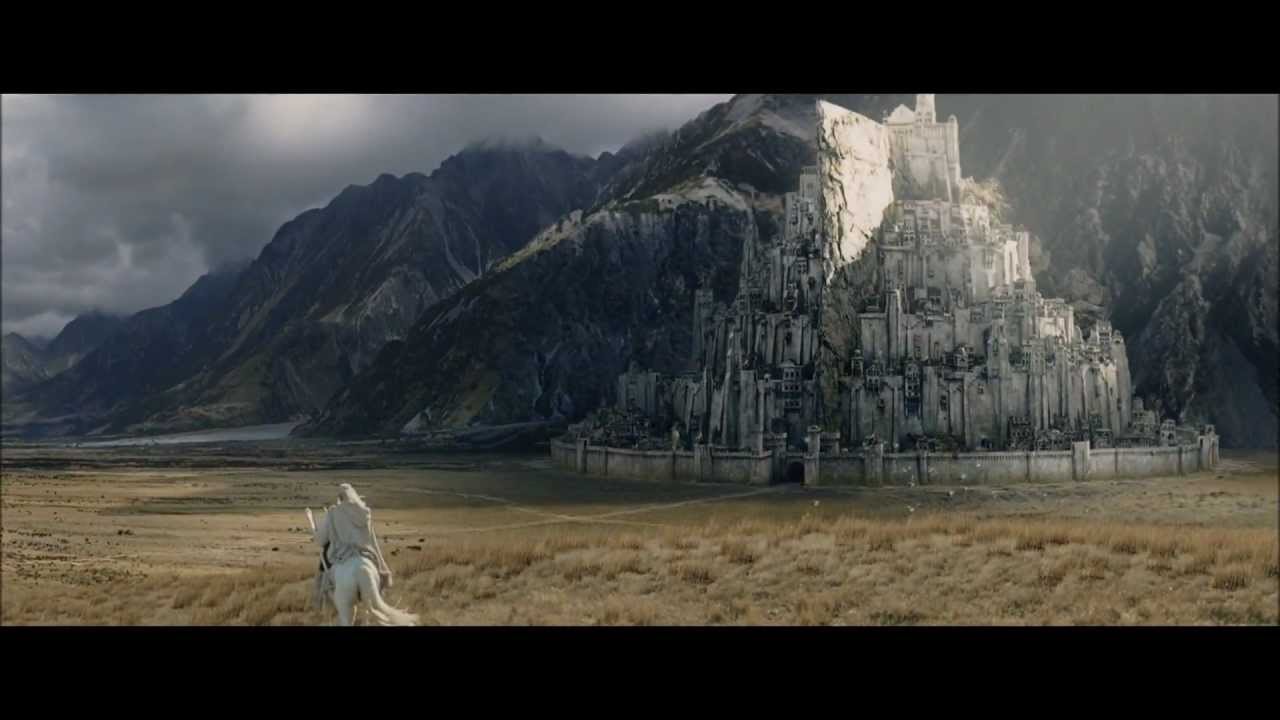
Graham Staplehurst is a writer with a
solid historical grounding and a good feel
for Tolkienesque and medieval settings,
and he?s the best of the free-lance writerdesigners
working with Iron Crown. His
ROBIN HOOD role-playing campaign from
I.C.E. is highly recommended as a standard
reference for medieval historical roleplaying,
and for its fine encounters and
adventures. In Minas Tirith, Staplehurst
has skillfully exploited both his historical
and literary sources to produce a fantasy
city setting with the necessary realistic
and plausible foundations. He also has
maintained the coherent and dignified
tone appropriate to his Tolkien sources.
The blend of history and fantasy is not
quite seamless. Some of the notable buildings
and associated social institutions he
describes are apparently based on historical
models?in particular the guilds-here
the detail and coherence is exceptional,
featuring floor diagrams in the style of
serious history texts and persuasive explanations
of the personalities and workings
of the guilds. Other buildings of a fantastic
conception contrast sharply with this
historical texture, like Myall?s Vitrine, a
building made of an 8?-diameter glass tube
wrapped around an iron framework several
stories high. The contrast between
the solidly historical and the exuberantly
fantastic is a bit jarring, though in many
cases the fault lies in the illustration and
diagrams more than with Staplehurst?s
text. In particular, the illustrations and
floor plans of the great buildings of
Tolkien, like the White Tower of the Citadel
are crude and unconvincing by comparison
to the illustrations and floor plans
of buildings based on historical models.
Despite this, the conception, description,
and renderings of the buildings are excellent,
far better than I?ve seen elsewhere.
Narrative threads and characterizations
are smoothly blended into the life and
history of the city and its Tolkien context.
Notable figures are concisely presented,
often illustrated with one of Liz Danforth?s
excellent character portraits, and linked to
the fantasy setting with one or two subtle
plot hooks. In general, the focus is on the
lives and themes of the nobles and the
upper and upper-middle classes, and the
tone is genteel and dignified in keeping
with the Tolkien sources, with little indication
of the low-life taverns, criminal syndicates,
and sordid action-adventure found
in most FRPG urban adventuring.
Minas Tirith is of most value to those
with heroic high-fantasy campaigns like
Tolkien's setting. Of course, Minas Tirith?s
success ultimately depends on its appeal to
Tolkien fans and collectors, and in this
regard, Staplehurst?s respectful and appropriate
treatment of Tolkien is a great virtue.
Staplehurst?s Minas Tirith might not
be what Tolkien would have envisioned?
possibly it is more than he could have
envisioned?but most important, it does
not offend by contrast, and it ably supports
the tone and style of Tolkien's high
fantasy.
The fold-out color map is colorful and
detailed, though not so suggestive of a
high-fantasy artifact as the excellent largescale
Tolkien map on the reverse of the
city map. There are no small-scale neighborhood
maps, but such are more essential
in low-fantasy settings where the
streets are an important element of session
play. In general, the quality of interior
maps, diagrams, and illustration is quite
good (with the exception of some of the
illustrations of monumental fantasy structures,
which are only fair). However, the
digitized or half-tone photos of historical
buildings with Moorish-style decoration
seem a bit odd in this context, especially
since the Moorish motifs are not integrated
into the illustrations elsewhere.
The adventures are satisfactory but only
modestly successful in exploiting the
greater virtues of the supplement. One of
the four adventures, which takes place in
Wooden-Town, the outside-the-walls slum
of Minas Tirith, exhibits a familiar low-life
FRPG style out of keeping with the rest of
the supplement; Wooden-Town is scarcely
mentioned throughout the rest of the text.
The other three adventures are more
appropriate to the rest of the book, but
only one, an introduction to the city?s
benign secret order of magicians, is linked
to major themes or narrative elements
developed elsewhere in the book. This
lack of integration between the background
materials and the adventures
makes me suspicious that Minas Tirith is
more a pleasant read and reference source
than a setting for FRPG adventure.
Evaluation: In reference to our checklist
above, Minas Tirith earns top honors
in sense of time, place, and culture, with
strong conceptions for its historical, imaginative,
and literary sources. In other
areas, it merits above-average scores with
few objectionable flaws. Minas Tirith was
readable and appealing, and it goes on my
long-term reference shelf for its treatment
of guilds and other civic institutions. It is
most useful for GMs with high-fantasy
campaigns, and less useful for more common
low-fantasy and action-adventure
FRPG campaigns. Minas Tirith is available
from Iron Crown Enterprises, Inc., Box
1605, Charlottesville VA 22902, U.S.A.
Tredroy
GURPS® Fantasy supplement
64-page paperback book
Steve Jackson Games
Design: Alexander von Thorn
Tredroy has few of the flashy graphic
features of the other supplements reviewed
here. In fact, it is distinctly weak in
its cartography. Perhaps for that reason, at
first glance I underestimated Tredroy.
After a careful reading, however, I am
most impressed, and I highly recommend
it, despite its notable flaws.
Its flaws are primarily in its graphics
and in obscure references to the GURPS
campaign world of Yrth. The map of the
city of Tredroy itself is schematic and
adequate, though uninspiring. There are
no neighborhood maps and (more seriously)
no map of the surrounding region.
The history of the city makes numerous
references to nations, cities, and geographical
features that are not represented on
any map nor explained in the text. The
book doesn?t explain that you must use the
GURPS Fantasy game to track these references
to the GURPS fantasy campaign
world of Yrth, which is even more unfortunate
since the GURPS Fantasy game is
currently out of print, superseded by the
GURPS Magic game and presumably to be
replaced in the future by a GURPS Yrth
campaign supplement. This is all the more
annoying since the city?s history is jammed
into a cryptic timeline with a variety of
unexplained references. But I do have a
copy of the GURPS Fantasy game, and
after a bit of frustration I figured out what
was going on. And what was going on was
very interesting and unusual.
The name ?Tredroy? is a corruption of
tres droits, French for ?three laws.? Tredroy
is composed of three different cities
separated from one another by a confluence
of wide rivers. Combined in a loose
confederation, each of the cities represents
a different fantasy-historical culture.
North Tredroy is ruled by a tolerant, cosmopolitan,
chivalric Moslem society. West
Tredroy has a devout fundamentalist Moslem
culture. East Tredroy is a sort of medieval
Roman Christian chivalric culture
dominated by the Catholic Church and
Roman law. The historical model for this
collision of cultures is the period of the
Crusades in Palestine, and a very interesting
and alien campaign setting it is.
The selection of two contrasting Moslem
cultures?one narrow and fundamentalist,
and the other all-embracing and
cosmopolitan?is an inspired choice for
fantasy role-playing. Moslem cultures are,
for most of us, alien and exotic, but their
roles in current world affairs gives us a
dramatic context for them, and historical
and literary treatments of medieval Moslem
culture are readily accessible to the
dedicated reader. Moslem cultures appear
to us as passionate in ideals and violence
and as noble and romantic in narrative
and character as chivalric medieval Europe.
Learning respect for and mastering
the customs of an alien culture is one of
the great challenges of fantasy roleplaying,
and the customs of Tredroy?s
Moslem cultures are certainly alien to the
Dark Ages European cultures that provide
the basis of most FRPG campaigns.
Alexander von Thorn does a wonderful
job of processing and presenting the historical
elements for role-playing adventure
in Tredroy. The text is lean, readable, and
relevant, well structured for reading and
reference. The background text on the
government, cultures, and customs of
Tredroy are concrete, detailed, and concise,
and the descriptions of buildings,
institutions, and significant personalities in
the locations key are short but full of roleplaying
potential. The absence of neighborhood
maps and building floor plans is
unfortunate, though I can see that many
readers will savor the characterization
and role-play without ever noticing the
absence of detailed tactical maps.
The design of Tredroy fortunately emphasizes
those elements important for
role-playing and avoids lavishing detail on
buildings, institutions, and personalities
with little or no relevance to role-playing
adventure. The only guilds extensively
developed are those which have the most
significance for the role-playing
adventurer?e.g., the Company of Merchants
(which hires guards), the Mercenaries
? Guild (a large and powerful
organization of adventurers), the Thieves?
Guild, the Assassins? Guild, the College of
Arms (heraldry and aristocratic family
records), and the Harpers? Guild. These
guilds are intelligently and plausibly integrated
into the fantasy culture of the
town. In particular, the Mercenaries? Guild
has a category of guildsmen called ?practicals,
? specialists in spying skills-a perfect
classification for sophisticated characters
who might otherwise be classified as
?thieves? in other settings. Tredroy also
credibly portrays the Thieves? Guild as a
form of family crime syndicate tacitly
tolerated by a city that could never hope
to control crime through law enforce-
ment; at least the guild exercises some
restraint over its members.
Tredroy also offers a variety of interesting
themes to explore. For example, slavery
is legal in North and West Tredroy, but
illegal in East Tredroy. Player characters
could become involved in the underground
railway, or become bounty
hunters specializing in capturing escaped
slaves. The scenario included is nice, but it
only peripherally exploits the Tredroy
urban adventuring setting?again triggering
my suspicions that Tredroy was developed
more as a set-piece than a genuine
adventuring setting. The presentation is
up to the high standard of most GURPS
supplements (with the above-mentioned
exception of the maps and references to
Yrth history). It is well written, cleanly
edited, well organized for reference, effectively
uses sidebars as peripheral essays,
and provides the necessary mechanics for
a broad cross-section of the character
types that might be encountered. The
scenario is the only section of the book
explicitly prohibited from player reading?
an odd choice, since many of the elements
of city intrigue would be revealed by
reading the rest of the text.
Evaluation: Once past the flaws of the
maps and ambiguous Yrth references,
Tredroy is a fine example of an FRPG
urban setting. It reads well, offers interesting
scenario opportunities, and presents
exotic, alien, but accessible historical cultures
as the backdrop for urban adventure.
As a sample of what a GURPS Yrth
FRPG campaign supplement might offer, it
is very promising. For general students of
urban FRPG gaming, it is in pleasing and
stimulating model and reference. Tredroy
is available from Steve Jackson Games, Box
18957, Austin TX 78760, U.S.A.
Warhammer City
WARHAMMER FANTASY ROLEPLAY supplement
96-page hardback book with full-color 14? × 22? map
Games Workshop
Design: Carl Sargent
$22.95
Warhammer City is a supplement describing
Middenheim, the City of the
White Wolf, the second largest city in the
vast Empire of the WARHAMMER FANTASY
ROLEPLAY campaign setting. In
conception and graphics presentation,
Warhammer City is an exceptional setting
for heroic fantasy role-playing, but the
uneven and occasionally unsophisticated
quality of design and written presentation
sometimes make it frustrating and disappointing
reading. To some degree, the less
sophisticated presentation is appropriate
to its more cheap-and-cheerful FRPG tone,
but as often it seems a problem of weak
design and editing.
As usual, Games Workshop?s graphic
presentation is stunning, with lavish, wellrendered,
and appropriate illustration.
The character portraits are full of personality.
The scenes of everyday life in the
city, rendered in the style of the prints and
drawings of Albrecht Dürer?the 15thcentury
German artist-are detailed and
evocative of the WARHAMMER FANTASY
ROLEPLAY game?s late medieval setting.
The maps and diagrams are appealing,
colorful, and realistic. The campaign setting,
based on a Holy Roman Empire transfigured
by sorcery and rampant Chaos
cults and monstrosities, provides a distinctive
backdrop for standard wizards-andheroes
fantasy adventuring.
In general, the design is solid enough. All
the elements for a gritty, low-life fantasy
campaign are present?details of religion,
law, and customs; impossibly remote
wealthy and influential personalities; alltoo-
accessible sordid and criminal elements;
abundant criminal conspiracies;
scheming power figures; and demented
Chaos cultists. An earnest effort is made to
offer practical advice in running city adventures
for inexperienced GMs. In this
sense, Warhammer City is clearly more of
a complete city adventuring kit, with
staging tips, than are Tredroy or Minas
Tirith. The advice is occasionally shrewd
and substantial; however, sometimes it?s
little more than vague cheerleading.
However, there?s a nagging sense of
insubstantiality in portions of the text. The
framework is adequate, but the frequent
shortage of character, place, and circumstance
is disturbing. The text is often
flabby and expansive, with abundant
gratuitous exclamation points, and is
sometimes careless in the quality of motivation,
narrative, setting, and tone. For
example, the cute puns in the telling of the
history of Middenheim (e.g., ?Tale of Artur
and the Holy Gale,? ?Middenheim?s Rise,
Fall, and Stumble,? and ?The War of the
Poses?) are inconsistent with the generally
grim and monumental tone of the city
setting. Middenheim?s Chaos cults have
suitably lurid, evil FRPG villains, but
they?re short on personality and motivation.
The link to the epic The Enemy
Within campaign is distressingly clumsy in
conception and motivation. Two fantasy
elements of Middenheim particularly
suited to hack-and-slash adventuring (a
precious commodity in FRPG city supplements)
?the Skaven?s ratman culture and
the Underworld dwarven tunnels beneath
Middenheim?are only sketchily developed.
I note in passing that Middenheim is the
setting of Carl Sargent?s impressive Power
Behind the Throne adventure supplement,
the fourth in the epic The Enemy Within
campaign series. Power Behind the
Throne is an exceptional example of the
diplomatic style of FRPG gaming (a style
singularly suited for sophisticated urban
adventuring) with complex plotting, impenetrable
intrigues, and cleverly drawn
NPC characterizations. The link between
the previous adventure in the series,
Death on the Reik, and Power Behind the
Throne, and the pretext for the PCs becoming
involved in Middenheim?s webs of
intrigue are a bit thin, but as a companion
volume to Power Behind the Throne,
Warhammer City is a valuable resource.
Evaluation: All the elements of an
excellent urban adventure setting are
present in Warhammer City, but the execution
is at times disappointing. The
graphics are singularly effective in convey
ing the sense of time and place of a fantasy
medieval city, and the characters,
plots, themes, and institutions needed for
urban role-playing are all provided, but
irksome lapses in the quality of design,
writing, and editing diminish Warhammer
City's appeal. Warhammer City is available
from Games Workshop, 3431 Benson Avenue,
Baltimore MD 21227, U.S.A., or from
Games Workshop Ltd., Chewton Street,
Hilltop, Eastwood, Notts, NG16 3HY, United
Kingdom.
The City of Greyhawk
AD&D game supplement
Two 96-page paperback books, four fullcolor
22" × 34" maps, and 24 one-page
adventures on card stock, in box
TSR, Inc. $18.00
Design: Doug Niles, Carl Sargent, and Rik Rose
TSR?s AD&D game has three official
campaign settings: the DRAGONLANCE®
saga setting based on the world of Krynn;
the WORLD OF GREYHAWK® setting, Gary
Gygax?s original campaign world; and the
FORGOTTEN REALM? setting, Ed Greenwood
?s vast creation. The city of Waterdeep
is the urban showpiece of the
FORGOTTEN REALMS campaign; see City
System below. The Free City of Greyhawk,
Gem of the Flanaess, is the adventuring
town that gives the WORLD OF
GREYHAWK setting its name. The City of
Greyhawk is the most pleasing and playable
of the city supplements reviewed
here; it scores high in most of the checklist
features, and it has that comfortable,
played-in feeling that warms the heart of
the experienced AD&D game DM.
First, the maps combine the virtues of
easy reference, graphic detail, sense of
place, and pleasing appearance better than
any other city supplement I?ve seen. The
fold-out bird?s-eye-view of the town shows
its gypsy camp, halfling burrows, thatchroofed
huts, half-timbered buildings,
shrub-lined boulevards, and monumental
temples in such detail that you can tell if a
thief could reach a given balcony by climbing
a nearby tree, or where you might
steal a horse if you needed to make a fast
getaway. The bird?s-eye-view matches the
diagrammatic, keyed location and street
map, which cross-references with one of
the booklets to describe the major features
of the city. (A summary table of the locations
for quick reference is absent, however,
and sorely missed.) Also included are
large maps of the sewers and underground
passages, and a map of the surrounding
region.
The illustrations are much less finely
rendered than those in Warhammer City,
but they are appropriate in tone and content
to the supplement, portraying scenes
of daily life in the city along the Flanaess.
This set does not offer portraits of selected
NPCs, and the diagrams are crude
and schematic, without details of furnishings
or other features. The encounter
charts are lovably primitive, hearkening
back to the feel of the original D&D®
game. These are perhaps the least distinctive
features of this set, but they are so
familiar from generations of D&D and
AD&D supplements that it seems undignified
to complain.
It is in the area of characterization,
narrative threads, and sense of place that
the city comes to life. A wide variety of
NPCs and their fellowships and conspiracies
are fleshed out with mechanics, personalities,
tactics, and a lovely confusion of
loose narrative threads. The City of
Greyhawk is an organism of systems
within systems, with each system driven
by its own motivations and personalities.
Potential allies, patrons, informants, and
nemeses are available for any mix of characters
from 1st to 20th level. External
politics are intertwined in the city?s internal
affairs. Rival guilds compete for power
and influence, and dark conspiracies fester
beneath the streets, while less-weighty
adventures may arise from the lighter
aspects of civilized personal and commercial
rivalries.
The four scenarios included in one of
the booklets develop themes and elements
already presented in the city background,
and are simple, complete, appropriate, and
admirable examples of city FRPG adventuring.
But the real treasures are the 23
short adventures, each printed on the
front and back of a single piece of card
stock, and the 24th sheet of card stock
which summarizes the monster stats for
these short adventures. Each of the adventures
develops at least some element of
plot, character, or theme presented in the
city background material. Some are
dungeon crawls, some wilderness expeditions,
some city adventures, and some
diplomatic intrigues. The scenarios themselves
are priceless, many touched with
humor and irony, with interesting plot
twists; they challenge role-playing and
problem-solving. All are eminently practical
and playable, and presented with rare
charm and simplicity. A special favorite of
mine is the scenario entitled ?The Born-
Again Ogres of the Blinding Light,? a
clever, light piece with a half-ironic, halfpathetic
touch that I can?t wait to spring
on my local gaming squad.
And finally, what player familiar with
the AD&D game?s spell names can remain
unmoved by the resonances of these
names from the Circle of Eight, a powerful
and influential local organization of wiz-
ards: Mordenkainen, Tenser, Bigby, Otto,
Drawmij, Nystul, Rary, and Otiluke? One
of the best things about The City of
Greyhawk is that it ably exploits all the
venerable virtues of the AD&D game. This
is the campaign pack that TSR should have
produced a decade ago, back when AD&D
games were young and fresh. Now it is
perhaps a certain nostalgia I indulge in my
enjoyment of The City of Greyhawk; this is
a package out of the golden age of the
AD&D game, before I learned about realism,
epic scale, and complicated game
systems. Oh, to be young, simple, naive,
and playful again?that?s the yearning that
The City of Greyhawk awakens in me.
Evaluation: The City of Greyhawk is a
very good urban FRPG pack, but more
than that, it?s really a complete campaign
setting for the AD&D game, the best I?ve
seen?coherent, playable, well-developed,
and entertaining. I especially recommend
this pack to AD&D game GMs just graduating
from dungeon delving into wilderness
and urban adventuring; The City of
Greyhawk is built on a more manageable
scale and offers more solid playability and
real adventuring charm than either the
DRAGONLANCE or FORGOTTEN REALMS
campaign settings. Tredroy and Minas
Tirith have many features to appeal to the
sophisticated FRPG gamer, but The City of
Greyhawk, in addition to its appealing
features, feels like it would be fun to play
as a GM or player. Of the six urban FRPG
supplements reviewed here, this is the one
that made me want to use it in gaming
rather than read and admire it.
City System
AD&D game supplement
One 32-page paperback book and 12 fullcolor
22" × 34" maps, in box
TSR, Inc. $15.00
Design: Jeff Grubb and Ed Greenwood
It?s impossible to do a proper review of
City System without also reviewing FR1
Waterdeep and the North (another 64-page
AD&D FORGOTTEN REALMS supplement),
and that?s my biggest complaint
about this. This is not a system for design
ing or presenting fantasy role-playing
cities, despite the misleading title. This is a
boxed supplement to the earlier 64-page
city supplement?a supplement with a ton
of lovely fold-out maps, a booklet with
some useful essays (that would have been
more appropriately included in the earlier
supplement), and a lot of charts and tables
of dubious utility.
I will not offer a review of Waterdeep
and the North here, other than to say that
it presents a FORGOTTEN REALMS city on
a vast scale--too vast a scale for my liking.
The City of Greyhawk presents, in large
type and in 340 pages, a much smaller city
with numerous structures of character,
plot, and theme that give Greyhawk a
manageable unity as a campaign setting.
Moreover, The City of Greyhawk devotes
more than 60 of those 340 pages to scenarios
that develop those unifying elements.
On the other hand, both Waterdeep
and the North and City System combined
use only 96 pages (admittedly often
filled with very tiny type) to present a
much larger city through numerous tables
and charts, less skillfully focused background
material, and only five pages of
scenarios. As such, the Waterdeep urban
setting is more sprawling and less cohesive
than the Greyhawk setting, and is somewhat
less persuasive as a theater for real
role-playing action.
Nonetheless, the sheer expanse of Waterdeep
is impressive, and the 12 full-color
fold-out maps in City System are equally
impressive. Ten of these maps fit together
to depict a vast, undifferentiated maze of
streets, alleys, and rooftops, with a sprinkling
of over 200 numbered-keyed locations.
(Note the ironic use of ?sprinkling?
in this context; in a town the size of Waterdeep,
200 buildings is only a small portion
of the total number.) The floor diagrams
shown on the maps for some of the more
notable locations are not given room-by
room descriptions for contents, inhabitants,
or significance; instead, they are
filled with schematic icons for tables,
fireplaces, beds, trunks, barrels (full of
what, I wonder), lumber, and other standard,
nondescript features. These maps are
big and colorful, all right, but not particularly
interesting, useful, or expressive of
the setting. Another of the big colorful
maps shows lots of undifferentiated floor
plans of Castle Waterdeep, with no indication
of what or who is in any of the little
rooms and numberless tower landings.
The remaining large map is a birds-eye
view of Waterdeep, similar to but less
effective than the Greyhawk version; the
Waterdeep birds-eye view hasn?t got very
much personality and isn?t so readily
cross-referenced to keyed locations.
Evaluation: The title City System is
misleading. If you?re looking for guidance
and support in designing and developing
your own FRPG city settings, or for a
stand-alone FRPG urban adventuring
supplement, this is of no use to you. If you
own and enjoyed Waterdeep and the
North, you ought to have this set; it?s not
an inspirational model of game design, but
the maps are big and colorful, and might
be useful for Waterdeep campaigning. If
you?d like to run urban adventures in the
Forgotten Realms, and you must choose
between the $7.95 Waterdeep and the
North and the $15.00 City System, by all
means the former is the better deal, and
all you really need; City System is only a
big, colorful, and unnecessary secondary
accessory to Waterdeep and the North.
Cities of Mystery
AD&D game supplement
One 64-page paperback book, two full-color
22" × 34" displays, and 33 full-color
card stock buildings.
TSR, Inc. $15.00
Design: Jean Rabe (buildings by Dennis Kauth)
This AD&D FORGOTTEN REALMS supplement
is in fact a system for designing
FRPG urban adventure settings. However,
it hasn't any specific link to the
FORGOTTEN REALMS campaign world
that I can see, other than as a marketing
feature, and the FRPG city-building system
presented is pedestrian and unenlightening.
Nonetheless, Cities of Mystery does
possess a singular virtue?the beautiful
and cleverly designed 25mm-scale, threedimensional,
full-color, glue-together buildings
and full-color, fold-out street and
building layouts included in the box.
The booklet is sensibly organized and
addresses the essential elements of FRPG
city design, but the tone and content
seems unnecessarily juvenile and obvious
for most AD&D game players. The narrative
introductions to the various sections
are embarrassingly weak and barely relevant.
It is possible that as a veteran gamer
and designer I can't appreciate the value
of the booklet's pronouncements; admittedly
I can't think of a basic and complete
treatment of FRPG city building better
than this one.
Sauter, City on the Sea-the example
designed to illustrate the basic principles
of city building?is unremarkable and not
accompanied by even a vague map or
diagram of the city, an indefensible omission.
The scenarios included are appropriate
to urban settings, but none of them
exploit any of the essential elements of the
FRPG city design so laboriously explained
in the rest of the book. These scenarios do
employ the 3-D buildings and street layouts,
but not in particularly intriguing or
appropriate ways; each scenario could
probably be run better with detailed flat
diagrams and maps than with the buildings
and street layouts provided.
And what a pity, because the buildings
and street layouts are remarkable. For
those who love to dress up FRPG sessions
with props and miniatures, these game
accessories would be priceless for a very
limited style of 3-D problem solving and
tactical movement. How can they be used?
Set up a street ambush of a group of lowlevel
PCs by a gang of toughs with these
buildings, street layouts, and painted
miniatures. Here the players can see that
their characters are walking down the
street past doors, windows, and alleys;
they know how high the roofs of nearby
buildings are, and whether a rooftop
escape might be practical, or whether a
mage on a roof could dramatically improve
their tactical options. Designing
such an elaborate 3-D layout is time consuming,
not to mention the hassle of assembling
the buildings; the pace of 3-D
role-playing is slow and not to everyone?s
taste, but the final product can be a memorable
night of gaming. And for folks who
play fantasy miniatures games like TSR?s
BATTLESYSTEM or GWs WARHAMMER
FANTASY BATTLE games, these buildings
and layouts are great elements to dress up
tabletop fantasy battles.
These are the best designed cut-andassemble
buildings I?ve ever seen. The
WARHAMMER system's Townscape cardboard
buildings are lovely but a nightmare
to cut out and assemble. The Viking village
that comes with the D&D game's GAZ7
The Northern Reaches is very nice and
much easier to assemble than the Townscape
buildings, but is nowhere as simple
and well conceived as the Cities of Mystery
material. The elements are die cut, so
you don?t have to labor with the scissors;
just separate the bits with a sharp knife.
The buildings themselves boast several
charming details?chimneys, dormers,
overhanging eaves, and even little roof-ridgeline
stands for character miniatures
that must perch on peaked roofs. Assembly
is time consuming but simple, and the
buildings can even be folded flat for storage.
The directions for assembly are
sparse but adequate; I only found one
glitch in production?the omission of slots
for chimneys in buildings 1 and 2 (cut
your own before assembly). The street
and building layout maps are detailed,
handsome, and quite useful themselves,
even without the buildings, though I
wouldn?t buy the box just to get two foldout
maps.
Evaluation: I can?t recommend the
city-design system for any but the compleat
tyro, and even then I?d rather recommend
the study of a good model of an
FRPG city (like The City of Greyhawk) than
the Cities of Mystery booklet. And the
overwhelming majority of AD&D game
players will enjoy only limited use of the
street and building layouts, and have no
business whatsoever going to the trouble
of assembling the buildings. However, for
3-D role-playing in a town or city environment
or for sharp-looking cardboard
buildings for your fantasy miniatures
battles, Cities of Mystery is a unique and
superbly designed find. [See "Through the
Looking Glass," DRAGON issue #152, for
another review of this product.]
Through the Looking Glass
Dragon #152
TSR, Inc.
P.O. Box 756
Lake Geneva WI 53147
Cities of Mystery (TSR #9262) ****½
Cities of Mystery was produced as
accessory for TSR's AD&D® FORGOTTEN
REALMS? campaign setting. Although it
serves well in this regard, it also is a boon
for the miniatures player.
Cities of Mystery comes in a flat box that
can also be used as a storage box if you do
not assemble the buildings permanently. It
contains four accordion sections, each
section containing the punch-out sheets
needed. to assemble 7-9 buildings. The
buildings are printed in color on heavy
construction paper. The house pieces
needed for construction are pre-cut, so a
simple punch of the finger is all that?s
required to remove the buildings from
their sheet.
The buildings depicted on the sheets
represent a good cross section of the
marked. The second problem concerns the
method of assembly; as there are no inserts
for tab construction, you usually
have to use tape. If the tape is removed,
the building backs will tear.
This set is highly recommended. Two of
the floor plans fit in Games Workshop?s
Mighty Fortress set, and Greenfield Garrison
's "Wall Sections" can be modified to fit
around the floor-plan sheets. The $15.00
retail price is good for just the scenario
book alone.