| Anuchu | Capybara, Giant | Hobbits, Wild | Leshy | Luposphinx |
| Musical Spirit | Sashalus | Wendigo | Whispering Pines | Wood Giant |
| - | - | Wood Golem | - | - |
| Advanced Dungeons & Dragons | - | Dragon magazine | - | Dragon #119 |
The Dragon's Bestiary
A walk through the woods
This month's selection of creatures includes
those which are commonly found
in woodland settings. Druids, rangers,
and
other sylvan classes might find one or
more of these beings appearing in future
adventures, if they haven?t already met
them.
DRAGON® Magazine is open to monster
submissions, but the following guidelines
must be followed. Each monster should be
typed or printed on a letter-quality printer,
double-spaced, with 1" margins around
the text on the paper. Each monster description
should be reasonably detailed
but no longer than three typed pages. Do
not put two or more monster descriptions
on one page. Include your name and address
on the first page of each monster
description; you may staple or clip the
pages of each individual monster description
together. Do not send more than four
new monsters to us within a six-month
period, as our files are still very full. We
no longer look at submissions which include
great numbers of new monsters; just
send us your best ones. Finally, send a
sketch of how the new monster appears,
for use by our artists.
Because of the great number of submissions
and the tendency for them to overlap
on monster descriptions, we do not
offer acceptance of any particular monster
submission. Instead, we keep the submission
in our files until such time as we
decide to use it. We then pay for the submission
on publication, returning all other
submissions which were similar but were
not used. If an author wants to know if
we?ve received his submission, he should
send a stamped, self-addressed postcard
with the submission so that we can fill the
card out and return it.
ANUCHU
Created by: Allan Hopkins
FREQUENCY: Very rare
NO. APPEARING: 10-200
ARMOR CLASS: 8
MOVE: 12"
HIT DICE: 1+2
% IN LAIR: 20%
TREASURE TYPE: Individuals M; Q, Z in lair
NO. OF ATTACKS: 1 bite or weapon
DAMAGE/ATTACK: 1-4 or by weapon type
SPECIAL ATTACKS: Missile use (+2 with normal bows); possible spell
use; surprise on 1-4
SPECIAL DEFENSES: Possible spell use
MAGIC RESISTANCE: Standard
INTELLIGENCE: Very to genius
ALIGNMENT: NG
SIZE: <?>
PSIONIC ABILITY: Possible in 1% of individuals
Attack/Defense Modes: Variable
LEVEL/XP: II / 44 +/hp and up
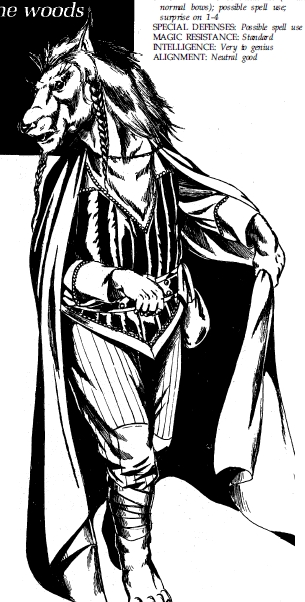
The anuchu are a race of gregarious,
forest-dwelling humanoid canids.
Their
communities are composed mostly of
mound houses or dens covered with an
overgrowth of vegetation. The anuchu
deal with other humanoids in a friendly
manner, though they mostly prefer the
company of other anuchu to that of elves,
dwarves, humans, or halflings. Similarly,
most humanoid races find the anuchu
talkative and perhaps a bit arrogant as
well.
For every five anuchu, there is one with
the powers of a 2nd-level ranger. For
every 20 anuchu, one possesses the
powers of a 2nd-level cleric. For every 50
anuchu, there is a 4th-level ranger, a 3rdlevel
cleric, and a 3rd-level magic-user. For
every 100 anuchu, there is a 9th-level
ranger..
The anuchu can speak with most canine
animals and even use normal wolves (5-20)
to aid them in guarding their communities.
Few anuchu wear armor, though all use
normal tools and weapons. The anuchu
usually arm themselves with the following
accoutrements:
| Sword and bow | 0l-15% |
| Sword only | 16-35% |
| Bow only | 36-90% |
| Bastard sword | 91-00% |
Anuchu have infravision (70? range) and
a keen sense of smell (50? range). In natural
surroundings, anuchu can move silently
(surprising on a 1-4 on 1d6). Anuchu
are able to speak halfling, elvish, gnomish,
their own language, and the common
tongue.
Anuchu have orange fur covering much
of their torso, except for white fur on the
chest, hands, muzzle, and feet. They have
reddish-brown eyes, pointed ears with
black tips, brown padded palms and soles,
black lips, sharp canine teeth, and a mane
of long red hair (favorite mane styles are
braids and ponytails). Most humans who
see them think of them as ?fox-people.?
Popular dress includes tunics, cloaks, and
so forth of green, brown, gray, or blue
coloration. The average life span of an
anuchu is 140 years.
CAPYBARA, Giant
Created by: Robert Benedetti
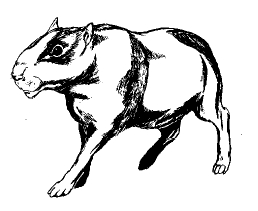
The capybara is the largest living rodent,
resembling a guinea pig. Normal specimens
have a length of over 40", a height
of 20" or more, and may weigh as much
as 150 pounds (1 HD, 1-2 hp per bite). The
giant capybara is similar in appearance to
its smaller cousin, though it ranges from
6-8' in length and weighs anywhere from
300-400 pounds. Coloration for the giant
capybara is usually reddish-brown to gray
on the upper body parts and yellowishbrown
on the under parts; a black coloration
sometimes occurs on the face, outer
surface of the limbs, and rump.
The capybara inhabits forests with
dense vegetation around ponds, lakes,
rivers, streams, marshes, and swamps. It
will rarely stray more than 100 yards
from water, retreating to this source
whenever it is threatened. While the capybara
moves at a slow, lumbering pace on
land, it is a good swimmer, and is able to
stay submerged for up to eight rounds.
The capybara usually travels in family
groups of 2-8, but herds numbering over
50 have occasionally been seen. These
beasts are active in the morning and evening,
and rest in a shallow bed in the
ground during the day. The giant capybara
?s food consists of water plants, the
bark of trees, and sometimes cultivated
crops. The giant capybara is most often
encountered in a prehistoric setting.
HALFLINGS, Wild
Created by: Arthur Collins
FREQUENCY: Very rare
NO. APPEARING: 3-30
ARMOR CLASS: 7
MOVE: 9"
HIT DICE: 1-1 (2-5 hp)
% IN LAIR: 20%
TREASURE TYPE: See below
NO. OF ATTACKS: 1 weapon
DAMAGE/ATTACK: By weapon type
SPECIAL ATTACKS: Missile use (+3 with bow or glins); possible spell
use
SPECIAL DEFENSES: Save at 4 levels higher; possible spell use
MAGIC RESISTANCE: Standard
INTELLIGENCE: Average to very
ALIGNMENT: NG
SIZE: S (3' tall)
PSIONIC ABILITY: Nil
Attack/Defense Modes: Nil
LEVEL/X.P. VALUE: III / 18 + 1/hp and up
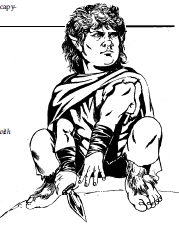
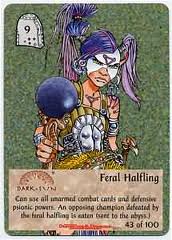
Known mostly only as a fireside tale, the
so-called "forest children" are in fact wild
halflings: descendants of primitive halflings
that never adopted the settled life
typified by their civilized halfling cousins.
Wild halflings constitute a fourth gene
pool alongside the Tallfellows, Stouts, and
Hairfeet. Known also as "Bramblings"
(because they sometimes live in bramblecovered
mounds), the wild halflings live in
secluded deep woods and are very shy of
contact with nonforest dwellers. They
especially fear ?Big Peoples? (humans,
demi-humans, and humanoids). They are
playful hunter-gathers, living off the
bounty of the free forest. Wild halflings
practice virtually no agriculture and have
no metal-working talents or other such
abilities (they are great weavers, however).
Some travelers believe the forest children
are the spirits of dead children who were
lost in the woods, hence the popular name
of these beings.
Wild halflings are small even for halflings,
but their senses are even sharper
than those of their civilized cousins. Forest
children can remain perfectly quiet and
still, being nearly invisible in natural surroundings,
and can hear and see as well as
elves. Their infravision is superior for
halflings (extending to a 60? range), and
their sense of smell is keen enough to
identify most creatures at 120? when the
wind blows in their favor. Wild halfings
are limited to the 3rd level of fighting
ability; they make up for this deficiency by
utilizing their skills to set snares and traps
(which is one of their preferred modes of
hunting). The Brambling language has the
same relationship to other halfling languages
that Gothic has to modern English
and German; it is a sister language, frozen
in its ancient form, and is consequently, all
but totally unintelligible to speakers of
other halfling languages.
Most wild halfings are equivalent to 1stlevel
fighters, though few have more than
8 hp. One wild halfling in six has aboveaverage
fighting ability (2nd level). If more
than 12 are encountered, a 3rd-level
fighter is found among the group. These
leaders wear ring mail armor or its
equivalent.
Brambling lairs are usually located in a
copse of trees with a pool or stream
nearby. Their homes are usually briarcovered
mounds in the sides of hills, although
some groups prefer to live in the
trees. In this latter habitat, the wild halflings
construct independent structures
similar to tree houses, which they disguise
with branches and leaves. In their hidden
communal lairs are found 2-12 additional
forest children, including appropriate
leaders and 3-12 young. Forest children
rarely stay in the same lair two winters in
a row, if they can help it. In summer, wild
halflings are very nomadic. During this
season, the whole tribe wanders from
place to place. Males and females are met
in equal numbers, and leaders are equally
likely to be of either sex. Those wild halflings
that do remain in one location often
live in the wooden constructs amongst the
trees as mentioned earlier.
Also in the communal lair is a wisewoman,
who is the head of the tribe, and
from whom the other leaders take direction.
She is a 4th- to 6th-level druid of
Sheela Peryroyl, with a variety of special
powers. The wisewoman has 0-2 assistants
of 1st- to 3rd-level druidic ability. The wild
halflings have never domesticated any
hunting animals, but songbirds, squirrels,
and other such forest creatures living
nearby are treated as friends and act as
guards for the wild halflings?s lair, sounding
a general alarm if trouble threatens.
Forest children have the saving-throw
bonuses that all halflings have, as well as
their concealment, surprise, and quiet
movement abilities. In addition, they are as
good at tracking in the woods as rangers
or elves are. Conversely, forest children
are nearly impossible to track if they
know they are being followed. Dexterity
and small size account for their AC, for
they wear no armor. Brambling clothing is
typically buckskin, some furs, and some
woven fabric. The wild halflings gather
many fibers: wild sheep?s wool, certain
vegetable matter, spider silk, and their
own hair. With these, they weave nets and
cloaks, twist bowstrings, and make rope
for snares. All of this weaving is done by
the wisewoman and her assistants. A cloak
made by the wisewoman is usually found
on a leader-type (1-5 on 1d6). This cloak
acts as a cloak of protection +1.
Wild halflings typically carry the following
weapons:
| Short bow | 20% |
| Sling | 10% |
| Flint dagger | 10% |
| Club and net | 10% |
| Spear | 10% |
If threatened, the wild halflings usually
run away, but they are fierce in combat if
cornered. If they must fight, males and
females alike cast stones, wield stout
sticks, or do whatever they can to protect
themselves.
All wild halflings are very good at imitating
bird calls and the like, and they use
this ability to communicate without being
discovered. They can summon any
friendly bird, squirrel, or other small
animal within the vicinity and use them as
?messengers? to convey simple messages,
such as a request for another Bramling?s
presence and so on (bird song and squirrel
chatter are not very articulate languages).
Wild halfling have no written form of
their language, and speak no other language
(leaders, however, might know 0-2
other languages of woodland folk; the
wisewoman also knows one additional
language per level. Pick all such languages
from the druidic language choices). Despite
their basically good intelligence, wild
halflings are unable to grasp much of the
normal knowledge their civilized cousins
take for granted. As a result, wild halflings
appear beautiful and innocent in their
pastoral setting, but a trifle backward and
simple (which may cause some underestimation
of their abilities).
All wild halflings have thieving abilities
commensurate with their level They are
curious folk and sometimes borrow things
to see what they are. Later, the items are
found in their original locations, having
?mysteriously? reappeared. Wild halflings
have been known to aid injured travelers
and hunters if there are only one or two
victims. The wisewomen are master herbalists,
and all such wild halfling druids
learn to make the following potions:
First level: Tonic. This potion has the
same effect as a dispel exhaustion spell
cast by a 1st-level illusionist.
Second level: Purgative. This potion
reduces the effects of deadly poisons to 2-
16 hp damage, rather than allowing death
to result (if taken within 10 minutes of
swallowing the poison). Otherwise, the
potion reduces the effects of nondeadly
poisons by half. It can also be used in a
poultice for drawing out insinuative
poisons.
Third level: Antidote. This potion has the
same effect as the druidic spell, neutralize
poison.
Fourth level: Restorative. This spell
cures all confusion and other such mental
handicaps, whether caused by spells,
magical items, or spell-like abilities.
Fifth level: Sedative. This potion causes
the imbiber to sleep for 7-12 hours, gaining
back 2 hp per hour of sleep.
Sixth level: Nectar. This potion sends the
imbiber into a deep trance, wherein the
entranced recipient is aware of all living
things around him. It is equivalent to a
commune with nature spell, lasting for 3-8
turns and allowing one fact to be gleaned
per turn. After communicating the knowledge
gained to anyone who might be on
hand to hear it, the imbiber sleeps for 3-12
hours.
A lair contains 1-4 bottles of each potion
the wisewoman is capable of making.
These potions and their protective cloaks
are about the only treasure wild halflings
have, since money is unknown to them.
There is a 20% chance of finding 1-8
pretty stones as personal ornaments
among the wild halflings' belongings (maximum
value: base 50 gp). Wild halflings are
very fond of singing and poetry, and enjoy
playing practical jokes (as do all halflings).
Found among their personal belongings
are small skin drums and reed pipes, and
an occasional primitive harp or ram's
horn. Wild halfling are very adept at
woodcarving and basketry, although their
skills of pictorial representation are rather
crude. In the fall, they secure their winter
lair and gather food for the coming freeze.
Wild halflings are nevertheless active even
in winter, for they love to play in the
snow. Forest children live about 120 years
on average. Wild halfling are keenly aware
of their surroundings and are usually
knowledgeable of every plant or living
creature within a day's walk of their lairs.
FREQUENCY: Rare
NO. APPEARING: 1
ARMOR CLASS: 7
MOVE: 15"//35"
HIT DICE: 3+6
% IN LAIR: Nil
TREASURE TYPE: Nil
NO. OF ATTACKS: 2 claws
DAMAGE/ATTACK: 1-6/1-6
SPECIAL ATTACKS: Spells; surprise on 1-5
SPECIAL DEFENSES: Spells; hide in foliage
MAGIC RESISTANCE: 5%
INTELLIGENCE: High
ALIGNMENT: CN
SIZE: M (5' tall)
PSIONIC ABILITY: Nil
Attack/Defense Modes: Nil
LEVEL/X.P. VALUE: V | 265 + 4/hp
Leshies are mischievous inhabitants of
forests and wooded hills, delighting in
bothering and misleading unwary travelers.
They have their own sense of ?fair
play,? however, and usually let up on their
victims if the unfortunate souls either
retain their sense of humor throughout
the ordeal or somehow manage to evade
the tricks. Leshies are nomadic creatures,
having no fixed lairs and acquiring only
those items they can carry upon their
persons.
Leshies have a number of powers at
their disposal which they use to bewilder
unsuspecting passersby. They can hide
among foliage with a 90% chance of success,
allowing them to surprise others on a
roll of 1-5 on 1d6. Leshies possess normal
ultravision and pass without trace automatically.
They can use audible glamer
and ventriloquism at will, as well as the
following powers, one at a time, once per
round, at the 9th level of ability: confusion
(1/day), dancing light (3/day), entangle (3/
day), heat metal (2/day), summon insects
(2/day), trip (3/day), warp wood (2/day),
and woodmaze (l/day). Woodmaze is a
special variation of the magic-user spell
maze, resembling that spell in every way
except that the barriers are of impenetrable
vegetation rather than planes of force
Leshies are immune to the effects of maze,
woodmaze, and illusion/phantasm spells.
Leshies appear as wizened humanoids
with long noses and matted, dirty brown
hair and beards. Their bodies are covered
with hair of a similar color and consistency,
and their skin is light blue in complexion
where it shows through. While
they can be more than a little irritating,
leshies are on good terms with most nonevil,
nonlawful forest creatures, including
most elves (particularly grugach and wood
elves), faerie dragons, grigs, buckawn, and
centaurs. There is a longstanding enmity
between the leshies and kech. A leshy will
go out of its way to trouble these forest
fiends, even going so far as to assist adventurers
in foiling their schemes. The kech
return this hatred threefold, but are frustrated
by the fact that few of them have
ever been able to capture one of these
wily tricksters.
LUPOSPHINX
Created by: Lance Hankins
FREQUENCY: Rare
NO. APPEARING: 1-4
ARMOR CLASS: 2
MOVE: 18"/30" (MC: D)
HIT DICE: 6 to 8
% IN LAIR: 25%
TREASURE TYPE: [E]
NO. OF ATTACKS: 1 bite and 2 claws
DAMAGE/ATTACK: 3-12/1-6/1-6
SPECIAL ATTACKS: Howl
SPECIAL DEFENSES: Nil
MAGIC RESISTANCE: Standard
INTELLIGENCE: Average to very
ALIGNMENT: CE
SIZE: L (7' in length)
PSIONIC ABILITY: Nil
Attack/Defense Modes: Nil
LEVEL/X.P. VALUE:
6 HD: IV / 225 + 6/hp
7 HD: V / 350 + 8/hp
8 HD: VI / 550 + 10/hp
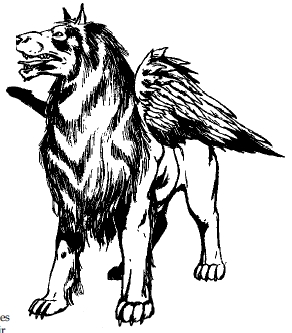
Luposphinxes are wolf-headed sphinxes
found in wooded areas. They speak their
own language, their alignment language,
and the common tongue. There is a 40%
chance that any luposphinx encountered is
accompanied by 5-20 humanoids, usually
gnolls or xvarts
Twice per day, the luposphinx can emit a
deafening howl, which has the following
effects: all creatures within 60? must save
vs. spells or be deafened for 2-8 rounds.
Additionally, all creatures under 2 HD
must save vs. fear or flee in panic; crea-
tures with 3-5 HD must save vs. spells or
fight at -1 to hit and damage (creatures
under 3 HD are subject to this penalty
even if they make their saving throws). All
creatures with six or more hit dice are
unaffected by all but the deafening effects
of the luposphinx's howl.
The luposphinx attacks once per round
with each of its clawed forepaws, and
once per round with its bite. The luposphinx
?s body is closest in size to the hieracosphinx.
Its hair color ranges from dark
gray to light brown. Luposphinxes are
carnivorous and prefer elves and halflings
to other humanoid prey.
MUSICAL SPIRIT
Created by: Mark DeForest
FREQUENCY: Very rare
NO. APPEARING: 1
ARMOR CLASS: 0
MOVE: 12"/15" (MC: B)
HIT DICE: 4
% IN LAIR: 100%
TREASURE TYPE: Nil
NO. OF ATTACKS: Nil
DAMAGE/ATTACK: Nil
SPECIAL ATTACKS: Song
SPECIAL DEFENSES: +1 or better weapon to hit; resistant to various
spells
MAGIC RESISTANCE: 25%
INTELLIGENCE: Very
ALIGNMENT: Neutral
SIZE: M (6' tall)
PSIONIC ABILITY: Nil
Attack/Defense Modes: Nil
LEVEL/X.P. VALUE: LEVEL/HP: IV/160 + 4/hp
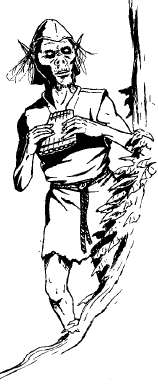
These undead creatures inhabit woodlands
(usually sylvan woods). They know
how to sing 13 songs and may teach up to
12 of these songs to a person for 5,000 gp
or a few magic items. These songs are
very lovely and are appreciated by every
one who hears them. A character who
wishes to learn these songs (and who is
willing to pay the price) must already have
musical skill similar to that of a bard,
although a secondary musical skill is
equally helpful.
The thirteenth song requires all living
creatures hearing it to save vs. spells at
-4 each round that they are within a 60'
radius. Those failing their saving throw
start to dance and continue dancing as
long as the song is sung. All creatures
dancing lose one point of constitution for
every hour they dance. When a creature
reaches a constitution of 3, he falls unconscious
from exhaustion. Musical spirits
sing this song only when attacked or aggravated.
Damage to the spirit (other than
fatal damage, of course) does not interfere
with the continued singing of this tune.
Likewise, plugging one's ears does not
prevent a character from hearing any of
the 13 songs. Musical spirits do not tire
from singing these songs due to the fact
that their energy comes from the spiritual
rather than the material world. Only creatures
who have learned the 12 nonhostile
songs can learn the thirteenth song, and
then only by provoking the musical spirit
into playing it.
In addition to their magic resistance,
musical spirits are immune to sleep,
charm, hold, and all cold-based spells.
They have the following spell-like powers
which are useable at will: speak with
animals, speak with plants, animal friendship,
and stone tell (4 times a day). They
can be turned by clerics, though they are
neutral, not evil, undead beings; they
count as ?special? undead it turned.
Musical spirits are believed to be the
spirits of bards or druids sent to the Prime
Material Plane or who have remained on
the Prime Material Plane after their death
to protect the forests and forest creatures.
Musical spirits do not know their exact
origin or anything of their previous life.
Both male and female (human, elven, and
half-elven) musical spirits have been encountered
in sylvan settings.
FREQUENCY: Uncommon
NO. APPEARING: 1
ARMOR CLASS: 8
MOVE: 2"
HIT DICE: 2+2 to 4+4
% IN LAIR: Nil
TREASURE TYPE: See below
NO. OF ATTACKS: See below
DAMAGE/ATTACK: See below
SPECIAL ATTACKS: Missile use (spines)
with poisonous fluids
SPECIAL DEFENSES: Nil
MAGIC RESISTANCE: Standard
INTELLIGENCE: Semi-
ALIGNMENT: N
SIZE: S(3-4' tall)
PSIONIC ABILITY: Nil
Attack/Defense Modes: Nil
LEVEL/X.P. VALUE: III / 105+3/hp and up
The sashalus is a sentient, ambulatory
fungus that dwells in marshes, subterranean
caverns, and woodlands. It feeds on
creatures of all sorts, attacking only those
that it judges it can overcome (i.e., small,
disabled, or helpless creatures, including
unconscious or sleeping prey).
A sashalus has a curious appearance. Its
white mushroom or puffball ?head? (which
has white or brown mottling upon it) is
pocked with many oval depressions, and
rises on a stalk from grassy roots ? which
on closer examination prove to be many
tan to grey rubbery-skinned tendrils projecting
from a spine-ringed base. The
sashalus attacks faster-moving or formidable
prey by shooting these spines up to 20
yards with great force. A sashalus may
have from 8-17 (1d10+7) of these spines
and can regenerate up to two every 24
hours. A sashalus can fire 1-4 of these
spines per round (at different targets if
necessary), shooting as many at a given
target as it feels necessary for self-defense
or to bring about a successful kill.
| Roll | Effect |
| 01-22 | Unconsciousness occurs within
two segments, lasting for 1-6 turns. |
| 23-56 | The victim is confused for 1-3
turns (successful save vs. poison equals duration of only 1 turn minus 1-2 rounds). |
| 57-69 | The victim is wracked with convulsions
and nausea (-3 on dexterity attacks, thus making spell-casting impossible, and -2 on strength) for 1-2 turns. |
| 70-84 | The victim suffers chills, dizziness,
and nausea (-1 on dexterity, temporary 1-2 hp loss) for 4-9 rounds. |
| 85-00 | The victim suffers no effects. |
For creatures with more than 4 HD or
with a constitution of over 15, add + 10 to
the die roll per point of constitution (for
all characters) or hit dice above the
minimums given.
Slow poison and neutralize poison
spells
have normal effect on sashalus spine-fluid.
This substance has not yet been synthesized
by alchemists. The spines themselves
pierce for 2-5 hp damage, conveying more
damage due to the effects of the liquid
they carry.
The spines are 5-9' long thorns produced
in an interior organ at the base of a
sashalus's stalk. A sashalus can break
down fired spines with its digestive juices
and reabsorb their substance for later use.
In like manner, it absorbs the organic
nutrients of all prey, leaving only bones
and metals. A sashalus approaches disabled
prey and opens sucker-like mouths
on the undersides of its tendrils. These
tendrils exude a highly corrosive acid (2-8
hp damage to all organic matter save
sashalus flesh, per round) that dissolves
flesh and organ tissues (neutralizing natural
or carried poisons) into a thick fluid.
The sashalus absorbs this fluid through its
skin; this feeding takes roughly two turns
for man-sized prey. A sashalus moves
away from bones; it also hides, moves, or
arranges treasure and remains to lure
further prey, if it deems such action will
entice more meals.
A sashalus detects prey with infravision
(7? range) and with vibratory sensors in its
tendrils. It has 10-30 eyes studded all
about its gas-bladder ?head,? and a ring of
8-19 eyes about its base (each located
between two of its rings of bristling
spines). The sashalus fires its spines via
pressurized gas, bleeding jets from the
large bladder where it produces gases.
Although slow, a sashalus is quite nimble
and can climb low walls, trees, and the
like, right itself if overturned, squeeze
itself through narrow cracks, and so on. It
can close its eyes at will, and can curl or
contort its body to blend in with stumps,
tangled vegetation, shriekers, and other
similar vegetation. The sashalus is quite
crafty in ways of hunting and survival.
Sashalus are solitary creatures who
wander widely in search of food, having
no definite lair, though they do have favored
ambush spots. When encountering
another sashalus, they mate briefly; 8-11
months thereafter, each gives birth to 1-2
tiny young who are born with full powers.
These young are typically 1+ 1 HD, have
only 4-9 spines, and a total of 2-20 eyes.
They grow to maturity in about a year,
leaving their parent immediately after
birth. Sashalus usually live for up to 30
years. They communicate with other
sashalus only by a limited touch-telepathy
(exchanging feelings, directions, and mental
images ? such as the whereabouts of
prey, dangerous enemies, etc.).
FREQUENCY: Very rare
NO. APPEARING: 1
ARMOR CLASS: 5
MOVE: 12"
HIT DICE: 6
% IN LAIR: Nil
TREASURE TYPE: Nil
NO. OF ATTACKS: 1 bite and 1 weapon
DAMAGE/ATTACK: 1-4 and by weapon type
SPECIAL ATTACKS: Roar
SPECIAL DEFENSES: Nil
MAGIC RESISTANCE: Standard
INTELLIGENCE: As per former rating
ALIGNMENT: NE
SIZE: M (6' tall)
PSIONIC ABILITY: Nil
Attack/Defense Modes: Nil
LEVEL/X.P. VALUE: V / 275 + 6/hp
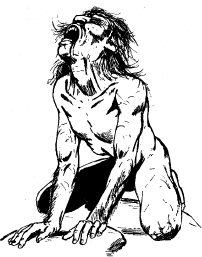
A wendigo is sometimes created (5%
chance) when a human or humanoid gets
lost in the forest and resorts to cannibalism
to survive. When the person tastes
human or humanoid flesh, he becomes ?
in mind, not form ? a carnivorous animal.
This beast is only capable of living off the
flesh of humanoids; it does not kill any
other creature. Wendigos have a strength
of 17, and attack with a bite and with
primitive weapons (usually clubs, pointed
sticks, and rocks). Although wendigos are
humanoid, they are immune to all spells
that effect only people (e.g., charm person,
hold person, etc.). When a wendigo kills a
creature, it lets out a loud and terrifying
roar. This roar can usually be heard
within a half-mile radius around the wendigo.
All humanoid creatures hearing the
wendigo?s roar may feel compelled to
wander into the woods (save vs. spell at
+8 to negate the effect). This wandering
lasts one day, and the affected creature
does not know where it is wandering. If a
second saving throw vs. spells (with wisdom
bonuses) fails at the end of this wandering,
the affect person turns into a
wendigo as well.
Wendigos look very much like the humanoid
they once were, except that they
wear no clothing, are very dirty, and act
like wild creatures. No one has discovered
how to cure a person of its wendigo alter
ego, beyond using a wish spell.
WHISPERING PINES
Created by: William L. Bowman, Jr.
FREQUENCY: Rare
NO. APPEARING: 10-100
ARMOR CLASS: 7
MOVE: Nil
HIT DICE: 1 per 2' height
% IN LAIR: 100%
TREASURE TYPE: Nil
NO. OF ATTACKS: Nil
DAMAGE/ATTACK: Nil
SPECIAL ATTACKS: None
SPECIAL DEFENSES: "Whispering" susurration
MAGIC RESISTANCE: 65%
INTELLIGENCE: Non-
ALIGNMENT: N
SIZE: L (10-100' tall)
PSIONIC ABILITY: Nil
Attack/Defense Modes: Nil
LEVEL/X.P. VALUE: Not applicable
High in certain mountainous regions,
there grows a species of magical pines.
Every branch grows perfectly straight and
carries an inherent charm. Subsequently,
magic-users and manufacturers of fine
bows, clubs, staves, and arrows intended
for enchantment search these forests for
this valuable wood (300 gp per board foot).
Druids bent on preserving these pines
sometimes arrange for a treant (15%
chance) to be located in or around a stand
of the trees.
These trees do have their own special
defenses. They can sense the presence of
any blade within 50 yards, and begin a
moderately loud susurration which resembles
the sound of many voices whispering.
A character encountering these trees must
save vs. spells or be compelled to listen
and attempt to hear what is being ?said.?
The spell can only be broken by removing
the affected person outside of the effective
radius of the spell (50 yards); otherwise,
the victim starves to death in 5-20 days.
Druids of 3rd level or higher are immune
to the effects of the whispering. At
12th level, druids may communicate with
the pines most of the time (70%), and thus
learn the passage of creatures through the
vicinity. However, this is like asking a
question of a treant, as the answer may
take a week to complete.
Once the trees begin their susurration, a
charm plants spell is the only
thing that
can cause them to stop. In such an event,
the entire stand makes its saving throw as
a group rather than each individually.
Only magical blades can fell these trees,
and the lumber can be worked only with
enchanted tools; likewise, the wood from
whispering pines can only be burned by
magical fire. If struck by any nonmagical
blade, the trees regenerate instantly and
the tool must save vs. disintegration. The
wielder must also save vs. spells or be
paralyzed for 1-4 rounds, after which he
must save vs. spells at -5 or be enthralled
by the whispering as above.
In the fall, some druids harvest the
needles of the pines with silver hand sickles,
while chanting special prayers to the
gods of nature. To accomplish this, they
trim the ends off the lower branches, dry
them for 10 days, and pluck the needles
from the boughs. Druids then use these
needles to create a tea which offers a state
of mind which has spell-like scrying abilities
similar to those of a reflecting pool (of
course, no pool of water is necessary for
scrying while in this frame of mind). Anyone
who attempts to harvest and use the
needles without the sacred chants is
stricken in 1-4 rounds after consuming the
tea with severe cramps (as per the magicuser
spell symbol of pain).
FREQUENCY Very rare
NO. APPEARING: 1-4
ARMOR CLASS: 5
MOVE: 12"
HIT DICE: 7+7
% IN LAIR: 33%
TREASURE TYPE: E
NO. OF ATTACKS: 1 weapon
DAMAGE/ATTACK: By weapon type
SPECIAL ATTACKS: Missile use (giant
arrows, +1 to hit); surprise on 1-4
SPECIAL DEFENSES: Resistant to certain
spells; polymorph self use
MAGIC RESISTANCE: Standard
INTELLIGENCE: High to exceptional
ALIGNMENT: Chaotic good
SIZE: L (9½? tall)
PSIONIC ABILITY: Nil
Attack/Defense Modes: Nil
LEVEL/XP: VII/1250+10/hp
Wood giants are one of the smallest of
the minor races of giantkind, their average
height being 9½?. They have a lightly built
frame and are not as strong as other gi-
ants. The strongest usually have a strength
of 18/00, but the weakest rarely have a
strength lower than 18/01 (there are, of
course, the exceptions of some very weak
wood giants with 17 strength and some
extraordinarily strong wood giants with 19
strength). Wood giants inhabit the same
forests as wood elves and, for as long as
either race can remember, have mixed
freely and have maintained attitudes of
good will between their races. Although
both races mingle, the wood giants, like
the wood elves, generally (75%) avoid all
other humanoid contact. This close mixing
has caused many similarities in the evolution
of both races.
The wood giant (even with its great
height) can move silently in its natural
surroundings (surprising on a 1-4), and
can blend into the forest vegetation, requiring
the ability to see invisible objects
or heat variations in order to locate it.
Although they are not invisible while
attacking, they are extremely quick and
can move out of hiding, fire a missile
weapon (with giant-sized bows), and move
back into hiding in the same round. Wood
giants are 90% resistant to sleep and
charm spells, and have infravision to 90?;
they do not, however, have the ability to
locate secret doors as elves do. The life
span of the wood giant usually reaches
1,500 years.
Along with these abilities, wood giants
have the ability to polymorph themselves,
once per day, into any manlike figure from
the size of a halfling (3? tall) to the size of a
frost giant (15? tall). Even though they
dislike contact with any humanoids other
than elves, wood giants occasionally use
this ability to join a party of humans or
humanoids in order to trick them out of
their treasure. Wood giants, also like elves,
are extremely fond of finely cut gems and
well-crafted magical items.
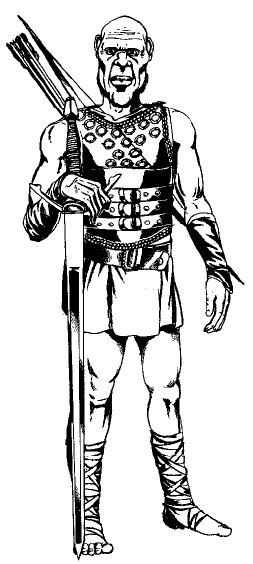
The wood giant usually carries a large
sword (as large as a normal two-handed
sword), which it wields in one hand. Their
favorite weapon, though, is a huge, nonmagical
long bow which gives them a +1
to hit. The great size of the arrows gives
the missile 1-8 hp damage. The wood
giant?s naturally low armor class is due to
its high dexterity (16), but most wood
giants wear studded leather armor or ring
mail, thus lowering their armor class even
further. Wood giants do not hurl boulders.
When encountered, wood giants are
often in the company of either 1-4 wood
elves (01-60%), 1-4 dire wolves (61-90%), or
both (91-00%). Wood giants have no lairs;
they either live under the stars or with the
wood elves for a time. If encountered in
the forest, these wood giants are mostly
male (90% chance). Female wood giants
usually remain at their makeshift camp or
with the wood elves at their lair.
Characters who have had contact with
wood giants have described them as
friendly enough, but flighty and frivolous,
and never in a great hurry to do anything
other than eat and drink large amounts of
wine. Treants (with whom they occasionally
converse) think the wood giants irrational,
foolish, and occasionally obnoxious
(though they also claim to enjoy their
company).
Wood giants speak their own dialect,
their alignment tongue, elvish, and ent;
they can also communicate with most
woodland animals. Wood giants have the
basic appearance of giant wood elves.
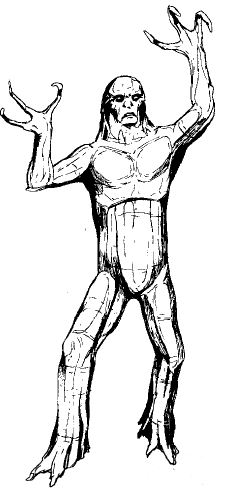
FREQUENCY: Very rare
NO. APPEARING: 1
ARMOR CLASS: 4
MOVE: 6"
HIT DICE: 9 (55 hp)
% IN LAIR: Nil
TREASURE TYPE: Nil
NO. OF ATTACKS: 1 punch
DAMAGE/ATTACK: 2-24
SPECIAL ATTACKS: Missile use (fire seeds)
SPECIAL DEFENSES: Surprised on 1-2; <?>
hit only by +2 or better magickal weapons;
resistant to various spells
MAGIC RESISTANCE: Standard
INTELLIGENCE: Non-
ALIGNMENT: N
SIZE: L (8.5' tall)
PSIONIC ABILITY: Nil
Attack/Defense Modes: Nil
LEVEL/X.P. VALUE: VII / 2460
Wood golems are generally made by
high-level druids of at least 13th-level
proficiency. Construction is also possible
by lower-level druids who have the necessary
instructions, although such druids
have a cumulative chance of 10% per level
of experience below 13th level that the
golem rots and becomes useless. In order
to create a wood golem, the druid must
first have the instructions provided by a
manual of wood golems. If the druid has
such a manual in his possession, the wood
golem costs nothing to create other than
the costs incurred for materials. If the
druid does not own such a manual, the
cost for one (provided one can be located)
is anywhere from 55,000 to 70,000 gp.
Without the manual of wood golems, no
such creature can be built (thus, DMs
should include this item in treasure hoards
as desired).
The druid must then find a large fallen
oak or pine tree (one that is not rotting or
infested with insects) or a recently dead
treant shell to begin. To start, large
branches of the same tree type must be
placed appropriately for the arms and
legs, and the rest of the tree must be
carved to give it a roughly humanoid
appearance. The druid must use the following
spells in the following order to
animate the wood golem: reincarnate, wall
of thorns, plant growth, barkskin, and fire
seeds. Finally, to complete the process, the
druid must sprinkle a potion of plant
control on the wood golem and drink the
remainder of the potion at the same time.
The golem then comes to life. The wood
golem takes one month to complete. There
is a base 30% chance that the golem goes
berserk and attacks its creator upon any
command (minus 2% for each level of the
druid). Like other golems, wood golems
are only able to understand simple commands
given to them.
If created from the shell of a dead
treant, the golem has the following additional
powers:
1. An AC of 0.
2. HD of 11 (65 hp maximum).
3. Can do structural damage like a
treant.
4. Has the same weakness to fire as a
treant.
All wood golems can blend into woodlands
well; thus, if encountered in the
forest, they are likely to surprise (1-5 on
1d6), and in return, can only be surprised
on a 1-2 on 1d8. Wood golems can normally
destroy wooden objects in three
melee rounds or less, and save vs. fire at
-2. This particular golem can attack by
punching for 2-24 hp damage, or it can
fire up to six acorn fire seeds (as per the
spell) once every turn (three from each
hand). Magical weapons of +2 or better
enchantment are needed to hit wood
golems, although sharp weapons have a
70% chance of making the wood golem
?bleed? a sticky substance which (if consumed)
can heal up to 5 hp damage done
to any being by the golem.
Because of the magical nature of the
wood golem, magics used to control plants
(like certain spells or magical devices) have
only a 50% chance of working on it. After
the effects of such magics have worn off,
the golem becomes enraged and proceeds
to attack the person who formerly controlled
it. Electrical- and cold-based spells
do no damage to a wood golem, but slow it
for 1-6 rounds unless it makes its saving
throw. A wish or a time stop spell
works
against this creature, and a turn wood or
warp wood spell stuns a wood golem for
1-4 rounds. A plant growth or a wall of
thorns spell restores hit points to this
golem (the effects are similar to a cure
serious wounds spell). No other spells
affect the wood golem.
MARCH 1987